I was browsing through my old stack of Frederick M. Noad guitar books, acquired when taking classical lessons back in the early 80s. In “Solo Guitar Playing II,” published in 19771, Noad’s comments are witty and engaging, critical and evaluative. He emphasizes an incremental and developmental approach to learning the instrument, the idea being to “master one level before moving to another” (13), but I’ve never met anyone who learned the instrument that way. I’m not even sure what a “level” is when it comes to actually playing, but levels may be more evident and necessary in instruction books than in sitting down on your own and discovering the instrument in your own hands. In any case, crawling is not a prerequisite to walking, and all beginning walkers are amateurs:
“I have written this book primarily for the amateur, since of the enormous number of people who fall under the spell of the guitar only a handful become professionals, and those not always the best players” (13).
In his introduction to “Lesson Nine, Style and Ornament: The Baroque Period,” including music from the years 1610 through 1750, since the 1950s in popular resurgence, Noad brought his students up to date on audience expectations, employing an ornamental writing style suitable to a discussion of the Baroque:
“Although much genuine understanding has emerged from this revival, so has much specious academicism. The first wave of enthusiasts tended to be pedantic and unyielding in their opinions, giving rise to heated controversy and a surfeit of pettifoggery” (129).
We may notice today that kind of expert or rule-bound performance insistence in other musical forms, including folk music concerts where the audience must pretend they are in a church where everyone can hear the pin drop. And as Noad wrote in 1977:
“The result of this was that fine musical performances were often dismissed by the new cognoscenti on some technical ground, more often than not based on the execution of ornaments.”
As if Django himself had ever reached a level where no further experiment was permissible if the music was still to be called Gypsy Jazz, where naming something supercedes the essence of the sound.
But Noad goes on to say the rule-bearing aficionados had relented a bit:
“Today a calmer approach reigns with the passing of what Louis Crowder2 has called ‘the panic period of Baroque interpretation,’ and we find with relief that Bach need not, or should not, be played with the regularity of a sewing machine” (129).
Martin Messier has created music for the sewing machine, and Les Sewing Sisters have created music featuring sewing machines as musical instruments:
I’ve never learned to sew, but I took typing lessons in high school, though I don’t recall typing much outside of class. The typing lessons were definitely developmental, jjjj ffff, etc., with bells going off all around the room, and keystrokes clicking and carriages returning at varying tempi. The classroom was an orchestra pit. What style each student brought to their instrument was a function of muscle strength and restraint, clarity of touch, rhythm and self-expression, each sitting with appropriate posture and attempting a graceful carriage as instructed, as if playing a guitar.
The composer Leroy Anderson wrote a piece featuring a typewriter as a musical instrument in 1950. First performed in 1953, it’s often directed with humor, as if it’s not to be taken too seriously, but apart from the typewriter, the music in Anderson’s short piece sounds traditional, unlike, say, what a piece featuring a typewriter might sound like if written by John Cage. Two examples of the Anderson piece, titled “The Typewriter,” follow, the first directed seriously, the second with jocularity.
Solo Guitar Playing, Book 2, An introduction to technique and repertoire for the intermediate guitarist, Frederick M. Noad, Schirmer Books, A Division of Macmillan Publishing Co., Inc. 1977. ↩︎
Noad footnotes the Crowder: “See Crowder’s introduction to Denes Agay’s piano anthology, The Baroque Period (New York: Yorktown Music Press, 1971).” ↩︎
What is sound? Tinnitus, from the Latin for ring or tinkle, we hear in our ears, but its source is not external sound. My own tinnitus is louder in my left ear, and if I try to pay attention to it, there are at least two sounds audible, as if an electronic musical duo is playing in my head. The ringing is enveloped under an umbrella of an engine or fan, or the electric rush of a motor, an incessant susurrus, which is balanced between the ears. The quieter my environment, the louder the tinnitus. Tinnitus is noise that is not sound, and it is a common ailment for those with hearing loss.
My hearing loss, in both ears, worse in the left, probably originating from operating the motor pool compressor truck with jackhammers and other pneumatic tools and from firing weapons without adequate ear protection during my Army days and probably made worse playing music too loud over the years, is now augmented through hearing aids. The current pair are state of the art and include Bluetooth capability, which means I can stream an electronic sound source (radio, TV, computer, phone) directly into the hearing aids. But the sound is not quite natural. I hear it in my head, not in the ears, and not precisely where the tinnitus sounds, but when streaming, the tinnitus seems to turn off. It’s a bit like wearing headphones. It can be somewhat disconcerting.
Often, when I think of sound sans sense, I think of John Cage. Cage was a musician and writer. Piano was his instrument, but he became involved in electronic sound and electronic music – experimental music. Cage’s music might sound like tinnitus to some listeners. But any instrument can grate or creak or be made to scream or moan or laugh or guffaw. Some of the early film cartoons used modern music innovations and techniques. “Modern” music is often characterized as atonal or dissonant, and as technology developed as electronically enhanced. An evocation of emotional turmoil. Turbulence and tohubohu is often the sound it conveys, or that I hear, which of course are two different things. In any case, what I’m still calling modern here is actually now quiet old.
What are the differences between noise and music? What is the relationship between sound and hearing? We might spend a few big bucks on music sound reproducing equipment (stereo, speakers, etc.) for home or car. The louder, it seems, the better. But when heard live at a concert, the sound may seem radically altered. And the listener in a front row seat hears a different concert than the listener in the back row, upper level, even if they’re in the same hall at the same time for the same music. In music and in conversation clarity is probably the most important attribute to one hard on hearing. It’s not that I can’t hear, but often that I don’t hear clearly. Increasing volume doesn’t necessarily add clarity. It just adds noise. Cage might say, what difference does it make? Listen to what you hear and disregard the rest. And music is not words.
“Music as discourse (jazz) doesn’t work,” Cage said. “If you’re going to have a discussion, have it and use words. (Dialogue is another matter.)”
John Cage, A Year From Monday, Wesleyan, 1969, page 12, from Cage’s ongoing “Diary: How to Improve the World (You will only Make Matters Worse)” 1965, which was taken from the magazine Joglars (Vol. 1, No. 3, 1966), where it was presented as: “a mosaic of ideas, statements, words, and stories. It is also a diary.”
What did Cage mean by distinguishing dialogue from discourse? Dialogue is conversation, conversational. Discourse is debate, to run away from. Dialogue is theater. Discourse is lecture. Discussion is an investigation. We are using words; no help, no matter how loud.
Some sounds are empty. What does that sound like? Jazz guitarists speak of getting a hollow sound or tone. One of the John Cage books is titled “Empty Words” (Wesleyan, 1981). “Most of the material in this volume has previously appeared elsewhere,” the listener is told. Where? Sound is ubiquitous, everywhere:
“Wherever we are, what we hear is mostly noise. When we ignore it, it disturbs us. When we listen to it, we find it fascinating. The sound of a truck at fifty miles per hour. Static between the stations. Rain. We want to capture and control these sounds, to use them not as sound effects but as musical instruments.”
“The Future of Music: Credo,” from Silence, John Cage, p. 3, Wesleyan 1961, 1973.
Capture this, from the opening section to Thomas Pynchon’s novel Gravity’s Rainbow (Viking, 1973):
“A screaming comes across the sky…He won’t hear the thing come in. It travels faster than the speed of sound. The first news you get of it is the blast. Then, if you’re still around, you hear the sound of it coming in.”
page 3, then 7
The reader is in London where the German V2 rockets, travelling faster than the speed of sound, hit the ground and explode before anyone hears them coming. Before Pynchon’s novel begins, then, an explosion has occurred. Or not, maybe one lands a dud.
In Coleridge’s poem “The Eolian Harp” (1795), the instrument sits on an open window ledge, where an incoming breeze stirs over the strings, making music. How improvised is that! One would need super sensitive ears to pick up such wispy sounds.
…the world so hush’d! The stilly murmur of the distant Sea Tells us of silence.
…Where the breeze warbles, and the mute still air Is Music slumbering on her instrument.
The wind as guitar pick.
I’ve been playing Gypsy-Jazz guitar lately, by which is usually understood playing in the style created or formalized by Django Reinhardt and his peers and followers. The style is characterized by the use of a different kind of guitar from the classical guitar popularized by guitarists like Andrea Segovia and Julian Bream. They played on a 12 fret neck fitted with catgut and then nylon strings in the treble and silk then nylon wound with metal in the bass. Other differences might include a shorter but wider neck, a smaller box, different woods and internal bracing techniques. Different from what? Basically from the all metal, louder string guitars developed later – what has come to be known as the western or folk guitar, and is used in blues, bluegrass, folk, country. But the Gypsy-Jazz guitar is a different instrument still.
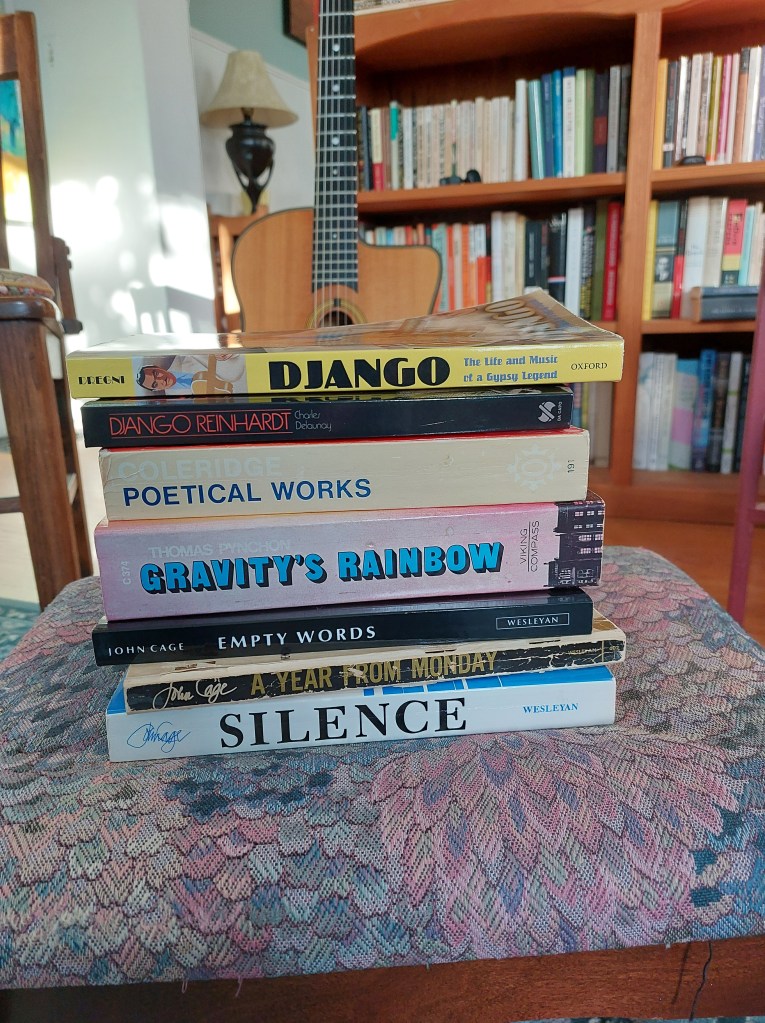
The Gypsy-Jazz (also “jazz manouche”) guitar is louder, played with a guitar pick rather than the fingers with fingernails, has a longer neck, so a longer scale length, and all metal strings. Most importantly, it’s not a solo instrument. It’s designed to be played in a small combo, usually consisting of at minimum two guitars, and often with stand up acoustic bass, violin, clarinet, accordion, and vocalist. Django played in noisy dance clubs before the advent of amplifiers and electric guitars. He needed an acoustic guitar that would project over the racket and clatter and sound in sync with the other instruments. Readers interested in learning more about Django and his music might read Django Reinhardt, by Charles Delaunay, 1961, Da Capo Press, and Django: The Life and Music of a Gypsy Legend, by Michael Dregni, Oxford, 2004. Briefly, it’s told that Django, born in poverty and coming of age without any kind of formal education, learned to play violin, banjo, banjo-guitar, and guitar. By the time he was 18, he was playing in bands in Paris and making money. Then he burnt his left hand badly in a fire in the caravan. Recovering, he taught himself to play the guitar anew, using mainly just two fingers from his left hand to fret the notes and chords, developing an entirely new technique. Thus began a new style of playing guitar that has influenced just about every guitarist of all genres since and still begs to be mastered even by those with all their fingers playable.
When asked if he admired Django Reinhardt, Julian Bream said:
“Oh sure. And I played plectrum guitar up to the age of 21, I played frequently in a dance band in the Army. And, yes, I loved playing jazz guitar, but not as a profession, just for fun. You can’t mix the two. I can remember playing steel-string guitar for dances, and it just ruined the sensitivity of your left hand. And I was playing rhythm guitar with big six-string chords all night long. It was a knucklebender!”
“50 Years on the Planks: Julian Bream Talks About His Life and Work,” Classical Guitar October 1996. Retrieved 4 Mar 24.
I’ve been working to play Gypsy-Jazz style without a plectrum (guitar pick), so fingerstyle, with fingers and fingernails, which some say is not only unorthodox but impossible – to play in the Gypsy-Jazz style of Django. I use a thick gauge string on a Saga Gitane DG-250M model, which I purchased used not long before the pandemic broke out and then had to quit the group workshops I’d been attending. The thicker strings compensate for the lack of pick. I’ve just always played with my fingers, hardly ever flatpicking. And I’m not playing dance halls these days, more like a lute in an open window.
Gitane DG-250MConcert ReadyAmerican GothicDjango’s ChordsGuitar LandBooks referenced in this post.
A house down around the block is getting a new roof, hammers echoing like giant flickers. Since the big virus outbreak the neighborhood seems quieter, fewer cars speeding up the bumpless street, the park above closed to the outdoor concerts, though a few bicycle races and random music groups have come and gone. We frequently hear music though, through the trees, over the roofs, through the backyard fences, but can’t always be sure of where the sound is coming from. No fireworks this year. Not a single yard sale. But some noise seems louder, the trash trucks on their weekly binge, the mailman at the mailbox, the yapping yellow dog behind and a yard over, skateboards, our tinnitus.
A loss of sound seems paradoxically to quicken our sense of hearing. That is dynamics, change in pressure and temperature, frequency and consistency. Some sounds we don’t hear until they go silent. Sound can baffle, bounce around dancingly. If you’re uncertain where a sound, particularly a voice, is coming from, the disorienting distraction bewilders. Just because you don’t hear a sound doesn’t mean you can’t feel it, its pressure in your ears, resounding around your head. Likewise, you might hear voices, but the words lack clarity, and you can’t make out what’s being said.
Some sounds are tight, other loose fitting. A flash flood of sound leaves a wake of mud. The beginning of rain drips into the ears, like its relative petrichor, that newly wet earthy scent in the nose, a slow awakening to something that’s been asleep for a long time and is now looking for a new bed to spend the night, one of your ears unfolding asymmetrically.
No point in pointing to made one’s way each momentous breath passes coming in spaces between arriving & leaving you learn to breathe with the tummy.
To breathe is to fall loose into mattresses of surf full of air bubbles drifting to shore with a slow tide as light as moon goes in the sky and on the sea.
Sitting on the wooden bench under the lilac, while Chloe plays in the age-old schoolyard, Papa awaits the second coming, not knowing what to expect, unable to recall the first coming.
I will write you flowers every morning to read with your bitter coffee a bright yellow squirt of sun oily blue green froth on top.
You sleep with a cat whose soft purr gives you pleasure all the joy of color impressions for the day.
You are soft like warm butter barely melting down a scone topped with a couple of gummy candy raspberries.
The butter wets the real fruit jelly rounds to light pigment an open place for lips to play and tongue – wait you didn’t think this was really about flowers, did you?
Here are two flowers the one calls a honey bee the other falls asleep petals open softly fictile.
There is so much silence hear the rustle of ants hustling across the counter for sugar and sweet stuffs, see the apple blossoms opening feel the bees approach touch the molten lava freeze it you can but no matter.
Once we admired multiple uses of one another of the now tossed cast off laugh tassels flipping flopping bouncing from rear view mirrors windows all rolled down.
Now we adhere to this new silence deafens touch asks for something that is nothing blends with the wall wearing night caps and socks to bed.
Outside cold winds blow bare branches whip the rain’s violence pours mercifully out a kindness allows for sleep and sleep.
The rain falls and falls all night long soaks through the ground walls fills the basement rises up the stairs floods the living room wicks up the wallpaper and pours out the windows.
To sand a page of flat board, one abrades first metallico then brushes dolce, as the piece turns to canvas. That is a music lesson learned in the woodshop. On the guitar, metallico is played near the bridge, where the strings are tight and unbending and sound like the steel wheels of a train or fingernails on edge across a chalkboard – both sounds rarely heard these days as trains recede farther into the industrial inner city or disappear through the countryside, and chalkboards fill landfills. In the middle of nowhere one learns to listen. Dolce on guitar is sounded where the strings loosen, up the neck from the soundhole. Sweet is dolce, but the hard, long ē of sweet sounds more metallico, so soft is dolce, not sour, but balmy. Metallico, that steel rail sound, harsh and disagreeable, straightens the spine and tingles the neck hairs. For some listeners, dolce raises goosebumps; for others, metallico does the trick. Dolce is the sound of the short, soft vowel, metallico the sound of the long, hard vowel. Thus the meaning of a musical note changes with its vowel length. A bent line over the vowel illustrates the soft sound (ă, ĕ, ĭ, ŏ, and ŭ), a straight line the hard (ā, ē, ī, ō, ū). Often, the meaning of a poem rests within its sounds, not seen in its definitions. One must listen to a poem like one listens to a piece of music. The reading question is often not what a poem means but how it feels when read or heard, what its sounds suggest. Some poems sand wood; others cut stone.
The poet is born in squalor, his first love. Some of the poet’s favorite words include seedy, shabby, seamy. These are words made with a hissing sound. In phonics, that sound is called a sibilant, and is produced by forcing the tongue toward the teeth, with the lips near closed, forcing air out like a snake whistling. But opposite words are equally valued by the poet: classy, stylish, exclusive. Even if the reader uses words without really caring about words as such much. The poet is not primarily concerned with getting a point across, and is held harmless if some point hurts its object in the bargain, even if so much the better. If an annoying sound appears to sharpen the point, there’s value added. The poet is in love with words.
But it’s easy to confuse poetry with sarcasm, satire, or irony. And the true cynicism of poetry often gives way to stoicism. This may occur when the poet realizes there is no point to anything, including his own poetry. Innuendos may still be highly valued (particularly where points may be scored), for all words have their beginning in figures of speech, which is to say, metaphor. That is precisely what an eye for an eye and a tooth for a tooth is meant to solve. Words disallow mistake when artificial trade-offs are refused. But language is no place for despots, try as they might to exert control, to establish absolute authority. Who controls the movement of words over space and time?
Words are all substitutes. No one can claim dominion. One is as good as another. Language is democratic. And that is why the poet is married to shame, his own mother, at once virgin and harlot (that is to say, vagabond, a beggar for words). In a truly democratic society, where everyone is equal and all words hold common sway, and competition without compromise is useless, it may begin to appear the only way to have a-leg-up-on is to attempt to subject another to shame. But shame has never worked as a measure of control. And that is why poetry can be so hard to get, and why hard times come so often to poets.
The poet stands accused of nothing and nonsense. His love of words and sound and color is scorned and mocked. He is the scapegoat for confusion.
“It is told in sounds,” Joyce says, “in polygluttural, in each auxiliary neutral idiom…and anythongue athall” (Finnegans Wake, 117).
“– Is it so exaltated, eximious, extraoldanddairy and excelssiorising?
– Amengst menlike trees walking or trees like angels weeping nobirdy aviar soar anywing to eagle it!” (Finnegans Wake, 505).
Here Joyce takes a common, neutral cliché, defrocked by virtue of its clichéd repetition (nobody ever saw anything to equal it), and gives it wings so it can take off again, renewed, refreshed. “Poetry is the foundation of writing,” Beckett says. “When language consisted of gesture, the spoken and the written were identical” (Exagmination, 11).
Just so, Thoreau, a monk amongst trees, delights in the poetry found in sounds and tries to locate the sounds in human language, and we see him building the foundation for his own writing. An example of this is found in the “Sounds” chapter of Walden.
Thoreau has heard a hooting owl, to him a “melancholy sound,” and tries to imitate the owl’s sound: “I find myself beginning with the letters gl when I try to imitate it.” And in the passage, he repeats the gl letters so that the reader, if reading for sounds, must hear his meaning: “gurgling melodiousness…,” “gelatinous mildewy stage….” “It reminded me of ghouls…howlings” (118), this last, the gl inverted. And we thus find Thoreau a polyglot at work, in at least two languages, the language of nature and the language of the human, and the combination of the two might be what Joyce meant, repeating Thoreau’s gl, by “polygluttural,” the mouth flooded with the sounds of nature.


 The Coming of the Toads