Susan came down to say it’s raining and did I want to bring in the cushions. I hadn’t heard the rain, though I’ve got the doors and windows wide open, but I knew it wouldn’t last long, a trace only had been predicted, but I also knew she’d be disappointed in me if I didn’t hop up and go grab the cushions, and in the moment she waited to see if I was going to go out or continue thinking at my laptop for how I wanted to say something about Benjamin Wood’s novel “Seascraper,” I pictured her dashing out and snatching the cushions herself from the rain in her nightgown and slippers.
I stood at the edge of the porch, cushions safely secured from getting wet, watching and listening to the rain, falling harder now than I had expected. Yesterday morning I was in the yard watering when I felt the drops hitting my hat and hands, but it lasted not even one minute, a trace, and I continued with the yard work, and the sun melted another day. But today as I stood at the opening of the porch and began to smell the dry ground oils stirred by the new rain I suddenly felt almost like an epiphany the end of summer.
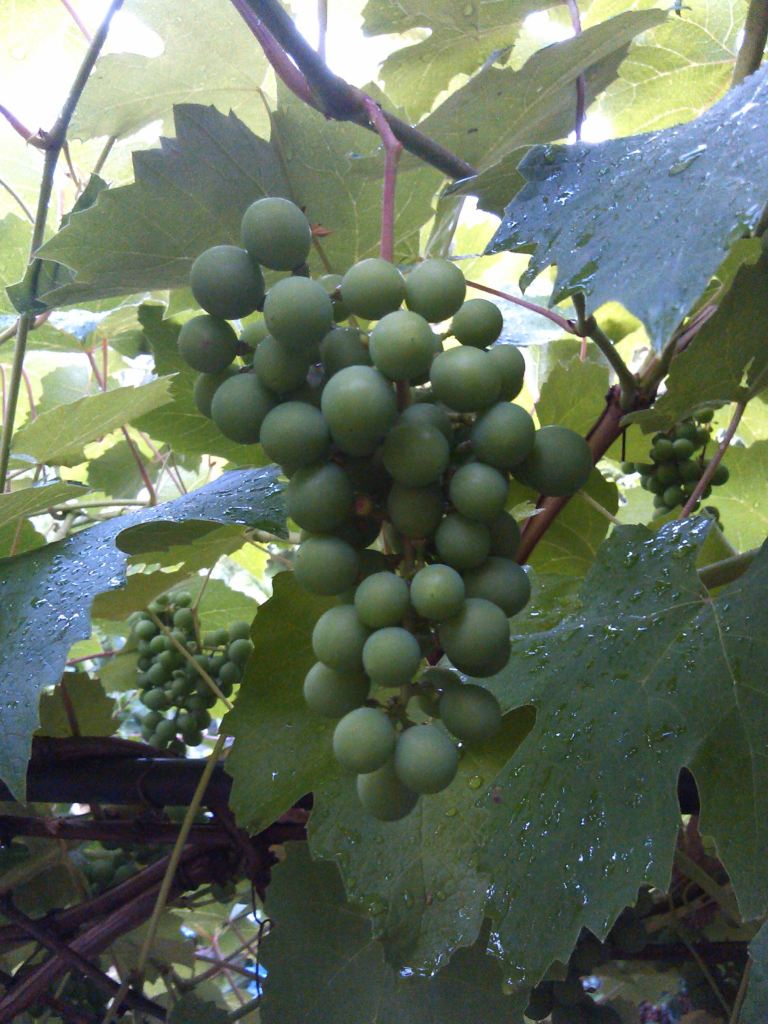
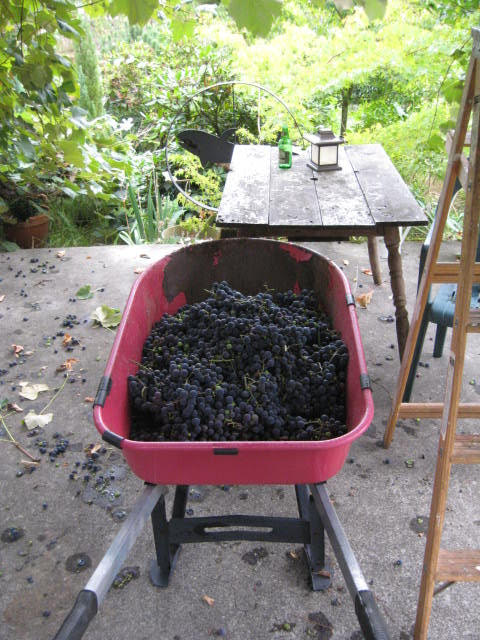
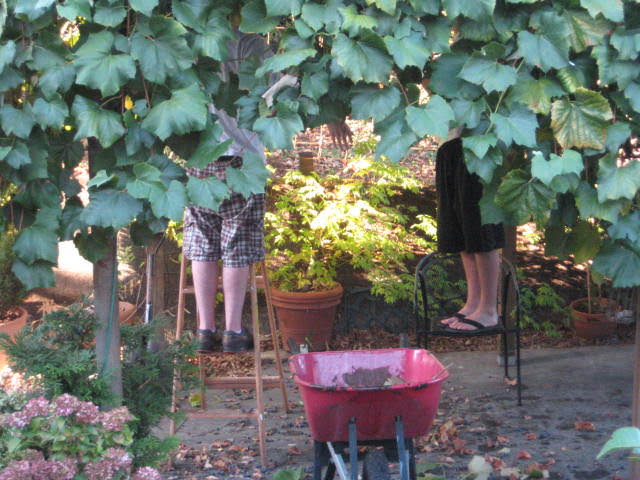
Yesterday I harvested the grapes from the pergola I built 35 years ago, the oil of the cedar boards dry and the wood crackling and splitting and fraying like an old T-shirt. I’ve been thinking for a few years of taking it down. By August the grapes are heavy. Scuttling the pergola will be a hard task. Meantime, the dwarf apple tree has overgrown the grape trunk and the Blaze Climbing Rose has reached the stratosphere, entangling its barbed links through the grape vines and the apple branches, a beastly hairdo that winds its way through the aged cedar board barrettes.
As I had predicted the rain stopped after a minute or two, my epiphany manifesting the end of summer yet another illusion of insight, a pseudo-epiphany, as too often happens. The rain was but a trace. And while I’ve got my copy of “Seascraper” sitting here by my side waiting for me to say something about it, I’ve lost the gumption. I’m going back out to take another look at the pergola; might even have a go at the Blaze.
Rain. Inside still reading “Traveling Sprinkler” while outside rain falls, sprinkles, showers. Yesterday briefly it rained hard, but mostly (and the forecast is now calling for ten more days of this) a light, light to moderate rain, periods of partial clouds amid dashes of partial sun. But it’s beautiful, the multi-blue-grey cruisers and destroyers, heavy-hefty frigates idling by, littoral patrol boats, submarines up in the sky. Loose Cs strolling by. Anyway, I reached page 160 in Nicholson Baker’s “Traveling Sprinkler,” beginning the day at page 92, so close to 70 pages for the rainy day. When I left you yesterday, I might have sounded a bit worked up about his getting the Best Buy guitar. And later, I even looked it up, and sure enough, there it was, for $40, at Best Buy, a Gibson acoustic, but out of stock.
Back at the first paragraph of Chapter Four, Paul Chowder, the first person narrator of “Traveling Sprinkler,” opens with:
“I’m out in the garden, Maud, and the very fine clouds have, without my noticing, moved across the moon and collected around it like the soft gray dust in the dryer. I want to scoop the gray clouds away and see the moon naked like a white hole in the sky again, but it isn’t going to happen” (29).
Why does he call it dust, the dryer lint? Because dust sounds better than lint coming just before dryer, and the st gives off the flavor of the stuff.
I took numerous breaks from “Traveling Sprinker” yesterday, one to play The New York Times “Spelling Bee” game with Susan. We’ve been playing it together nearly every day. We sit next to one another on the love seat and prop my tablet against a pillow between us and use our stylus pens to enter words, making mistakes as we go, talking about the words. Coco, for example, which we’ve seen before, not acceptable (“not in word list”), not to be confused with cacao or cocoa, both acceptable. Sometimes the rules seem a bit illogical. Yesterday, the middle letter was O, and the other six letters were G, L, A, I, C, and Z, the other letters arranged in a circle around the O, and I saw emerging like a photograph being developed, zoological, and so we started with the day’s only pangram.
But we ended up getting stuck a few words away from a Queen Bee finish, found a couple more, but then couldn’t find our last word, a 6 letter GO word. We took a break to stretch and cut an apple into slices and came back to the couch lightheartedly determined to reach Queen Bee for the day, only one word away. In 179 Spelling Bee game-puzzles, we’ve reached Queen Bee only 19 times. I decided to ask AI (Artificial Intelligence) for some help, explaining to Susan the difference between cheating and getting some help. I asked Gemini, and this is the answer I got:
“Let’s see… using only the letters G, O, L, Z, A, I, and C, and starting with GO, a six-letter word we can make is GOLGI.”
Do you see the problem with that answer? So much for getting some help.
I was reminded of a recent post over at Ashen’s blog, “Course of Mirrors.” The post is titled …Thoughts on AI and ChatGPT …, and in it, Ashen creatively questions the implications of Artificial Intelligence. She quotes a 70s poem by Wislawa Szymborska – here are a couple of lines: “The Tree of Understanding, dazzling straight and simple,/ sprouts by the spring called Now I Get It.” And I am reminded of the Richard Brautigan poem, “All Watched Over by Machines of Loving Grace.” Machines, who, like all parents, it would seem to be developing, make mistakes.
I woke up this morning thinking of rain and W. Somerset Maugham’s short story titled “Rain.” The story is about restraint and strain and torrential tropical rain. But what I was thinking about was what we mean when we say, “It’s raining.” What’s the it? I wasn’t fully awake yet when I thought later I’d ask Gemini to explain. I just now asked, and here is Gemini’s answer:
“Ah, that’s a fun little linguistic puzzle! The “it” in the sentence “It is raining” is what we call a dummy pronoun or an expletive pronoun.
Think of it this way: the “it” doesn’t actually refer to any specific thing. It’s a grammatical placeholder that we use because English sentence structure generally requires a subject. In this case, there isn’t a real subject doing the raining. Rain is a weather phenomenon, not an action performed by a particular entity.
So, the “it” is just there to make the sentence grammatically correct. We use similar dummy pronouns in other impersonal constructions, like:
“It is cold outside.”
“It seems like a good idea.”
“It‘s important to be on time.”
In these sentences, the “it” doesn’t point to anything concrete; it simply fills the subject slot.
Isn’t language fascinating? We have these little grammatical tools that help our sentences flow even when there isn’t a literal subject performing an action.”
Not a bad answer. I wasn’t expecting that bit of editorializing at the end. And now I’m thinking back to the short story “Rain”:
“If he remonstrated or sought to put his meaning into an intelligible phrase, Walker would fly into a passion and cry: ‘What the hell do I care about grammar? That’s what I want to say and that’s how I want to say it.’”
But back to yesterday. While I was chatting it up on my phone with Gemini, Susan said, “Look at the [tablet] screen.” And there it was, the page that appears when you’ve reached Queen Bee! Susan had come up with the missing word: Googol.
Looking about for something cool to read, for today is scheduled to be the hottest day, and I recalled Hermann Hesse’s “Siddhartha,” its beginning lines:
“In the shade of the house, in the sunshine of the riverbank near the boats, in the shade of the Sal-wood forest, in the shade of the fig tree is where Siddhartha grew up, the handsome son of the Brahman, the young falcon, together with his friend Govinda, son of a Brahman. The sun tanned his light shoulders by the banks of the river when bathing, performing the sacred ablutions, the sacred offerings. In the mango grove, shade poured into his black eyes, when playing as a boy, when his mother sang, when the sacred offerings were made, when his father, the scholar, taught him, when the wise men talked.”
Sounds cool, but Siddhartha, as we now know, had a long row to hoe before attaining coolness.
Siddhartha might have been a member of what Gertrude Stein named “a lost generation”:
“One generation passeth away, and another generation cometh; but the earth abideth forever… The sun also ariseth, and the sun goeth down, and hasteth to the place where he arose… The wind goeth toward the south, and turneth about unto the north; it whirleth about continually, and the wind returneth again according to his circuits…. All the rivers run into the sea; yet the sea is not full; unto the place from whence the rivers come, thither they return again.”
The wise men in my youth would have near a cool drinking beer to go with the flow.
Honeydew beach and rollicking surf in the morning chores in the afternoon sit out with the family in the evening when the sun goes down in the shade of the olive tree, the Chinese Elm and the three carob trees.
Meanwhile, waiting for rain, Walt Whitman:
And who art thou? said I to the soft-falling shower, Which, strange to tell, gave me an answer, as here translated: I am the Poem of Earth, said the voice of the rain, Eternal I rise impalpable out of the land and the bottomless sea, Upward to heaven, whence, vaguely form’d, altogether changed, and yet the same, I descend to lave the drouths, atomies, dust-layers of the globe, And all that in them without me were seeds only, latent, unborn; And forever, by day and night, I give back life to my own origin, and make pure and beautify it; (For song, issuing from its birth-place, after fulfilment, wandering, Reck’d or unreck’d. duly with love returns.)
Of course, “the voice of the rain” in places today is not so quiet and “soft-falling,” but seems on the attack; something absurd has been disturbed.
Likewise, the blue sky and this week’s yellow period we for months awaited comes down today like a cast iron lid where we sit like a cake rising in an oven.
No point in pointing to made one’s way each momentous breath passes coming in spaces between arriving & leaving you learn to breathe with the tummy.
To breathe is to fall loose into mattresses of surf full of air bubbles drifting to shore with a slow tide as light as moon goes in the sky and on the sea.
Sitting on the wooden bench under the lilac, while Chloe plays in the age-old schoolyard, Papa awaits the second coming, not knowing what to expect, unable to recall the first coming.
I will write you flowers every morning to read with your bitter coffee a bright yellow squirt of sun oily blue green froth on top.
You sleep with a cat whose soft purr gives you pleasure all the joy of color impressions for the day.
You are soft like warm butter barely melting down a scone topped with a couple of gummy candy raspberries.
The butter wets the real fruit jelly rounds to light pigment an open place for lips to play and tongue – wait you didn’t think this was really about flowers, did you?
Here are two flowers the one calls a honey bee the other falls asleep petals open softly fictile.
There is so much silence hear the rustle of ants hustling across the counter for sugar and sweet stuffs, see the apple blossoms opening feel the bees approach touch the molten lava freeze it you can but no matter.
Once we admired multiple uses of one another of the now tossed cast off laugh tassels flipping flopping bouncing from rear view mirrors windows all rolled down.
Now we adhere to this new silence deafens touch asks for something that is nothing blends with the wall wearing night caps and socks to bed.
Outside cold winds blow bare branches whip the rain’s violence pours mercifully out a kindness allows for sleep and sleep.
The rain falls and falls all night long soaks through the ground walls fills the basement rises up the stairs floods the living room wicks up the wallpaper and pours out the windows.
As said of politics, all rain is local, parochial. It may seem frivolous to a parish under water that in a neighboring bureau filled with sun denizens are dressed in shorts and sleeveless shirts drinking dizzy fizzy wine coolers in the town square park sitting in beach chairs on the warm dry grass listening to a gypsy jazz band play La Mer, while next door, where rain falls, Leonard Cohen indoors on a turntable sings, “All the rain falls down amen, on the works of last year’s man.” Yet in rain country umbrellas are not as ubiquitous as one might expect, nor are they absent in the sunny clime. The rain falls through hair, straightening the curl, seeps through flannel and wool, fills the shoes and soaks the socks, wrinkles the skin. The rain bounces off the asphalt street, runs down the gutters carrying along leaves summer and fall debris: a dirty tennis ball, a burnt out sparkler, a used up crumpled face mask. The rain overflows the curb down at the corner and a car spins by splashing a muddy wave across the sidewalk. A city bus sploshes around the corner, windows fogged, the driver and riders masked and anonymous. There are no cats to be seen out and about, a few dogs hunkered up on their porches. A woman with no umbrella scurrying shoulders hunched head down misses her bus and takes shelter under the awning in the doorway of a closed cafe, pulls out her phone and votes for sun, but the polls are closed for the winter.
 The Coming of the Toads