Tag: Portland

  • Lugubrious Fog

    Lugubrious etymologically descends from the dinosaurs in “Allegro Non Troppo” (1976) when the great reptilian gargantuans gentle and armored alike move south ahead of the ice and melt into tar. In Bach fugue file they march.

    I was sitting in bed four nights ago typing this, under a pile of covers, plus fully clothed, wearing two pairs of pants, three shirts, a sweater, a vest, a wool watch cap, and a pair of wool socks. It was 12 degrees Fahrenheit outside, windchill below zero. The house had lost power eight hours ago, years ago, the vicious east winds having blown down enough trees around town to put mist local folks in a freezer. But I gave up the typing in the cold. It was now 30 degrees inside the house. I pulled my hands inside the covers like a turtle for the long cold night and we decamped the wood igloo the next morning moving happily south to a warm house full of warm children.

    Frost’s promises to keep keep us sustained, moving, to keep warm. Yes, “The woods are lovely, dark and deep,” but what melancholy invites us in? Our horse still questions why we might stop here. The museums are also lovely, though well lit, still dark and deep, security guards meandering the lost empty halls, the paintings wired, the statues as still and as cold as ice sculptures, and they don’t allow horses in. Anyway, we prefer trees wandering in the wind full of birds and squirrels and lost kites and balls and flying saucers and climbing kids.

    Earlier that afternoon, I was in the backyard, preparing a place for Zoe, when I heard a rushing sound, a falling dinosaur come to roost, and heard the voice of the tall Sauroposeidon, a wind and wood splintering crash and crush, and looked north to my neighbor’s backyard to see the 100 foot 100-year-old east Pine limbs still shaking off the ice and snow where it had come to rest breaking through the ridge beam, the tree’s upper girth shattering off and coming to rest in the front yard.

    The frightfully freezing cold day moves slowly lugubriously on and we learn that pine tree but one of hundreds of trees falling all about town in the east wind in soaked soils across power lines, cars, streets, houses, parks and lots.

    Back home now, five days on, power restored, but morning after ice storm moving across last night, but still now, windless, half inch of ice coating tree limbs, cars, street, wires, the downed dinosaur leaning across the roof next door. Fog. The dickens of a cold fog. But should we lose power again the air is at least warmed up some, to just below freezing outside.

    A lugubrious fog has settled in, sifting down through the firs, down the street, over the houses and yards dotting the rotting old volcano.
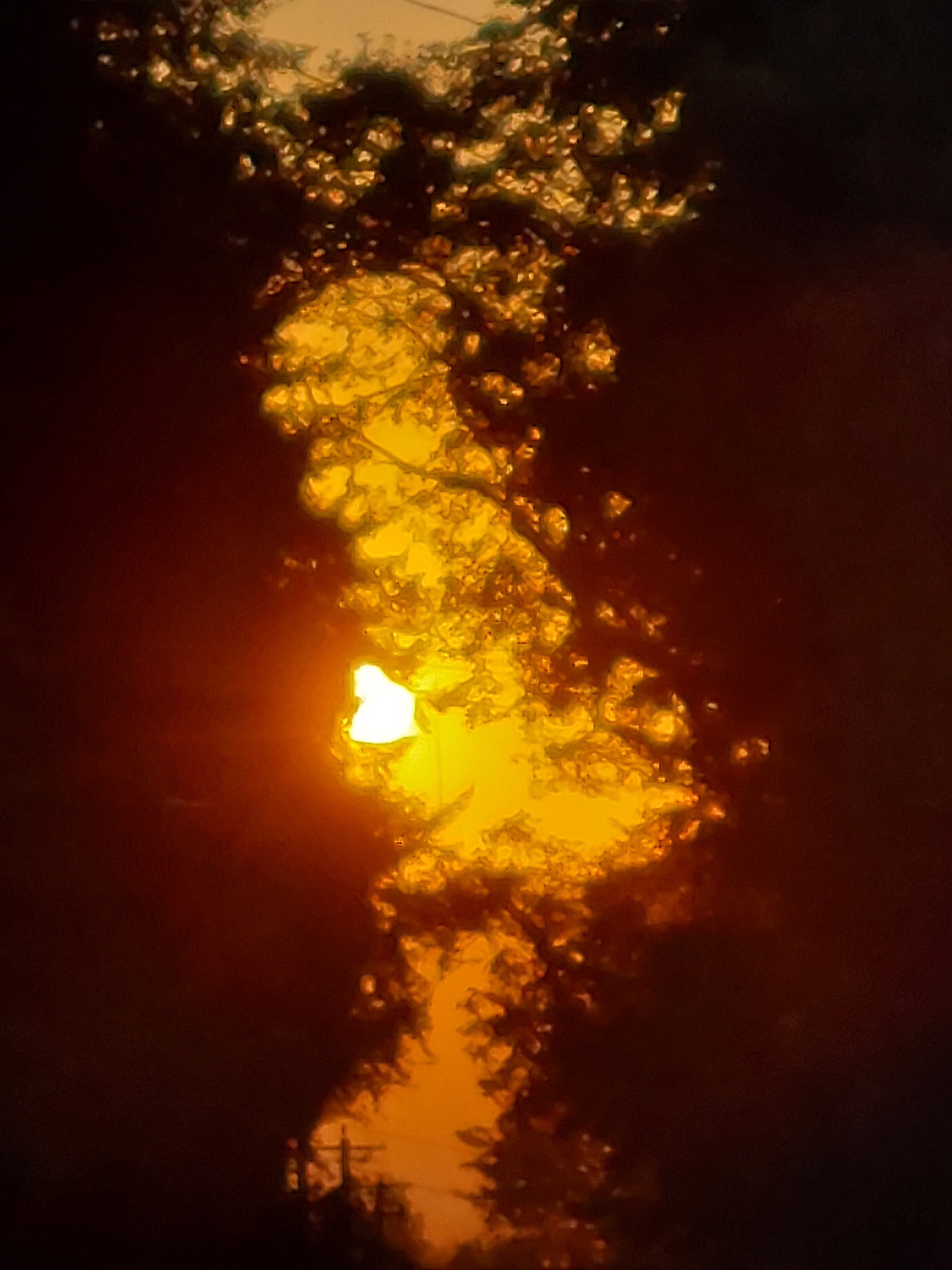
  • Autumn Us

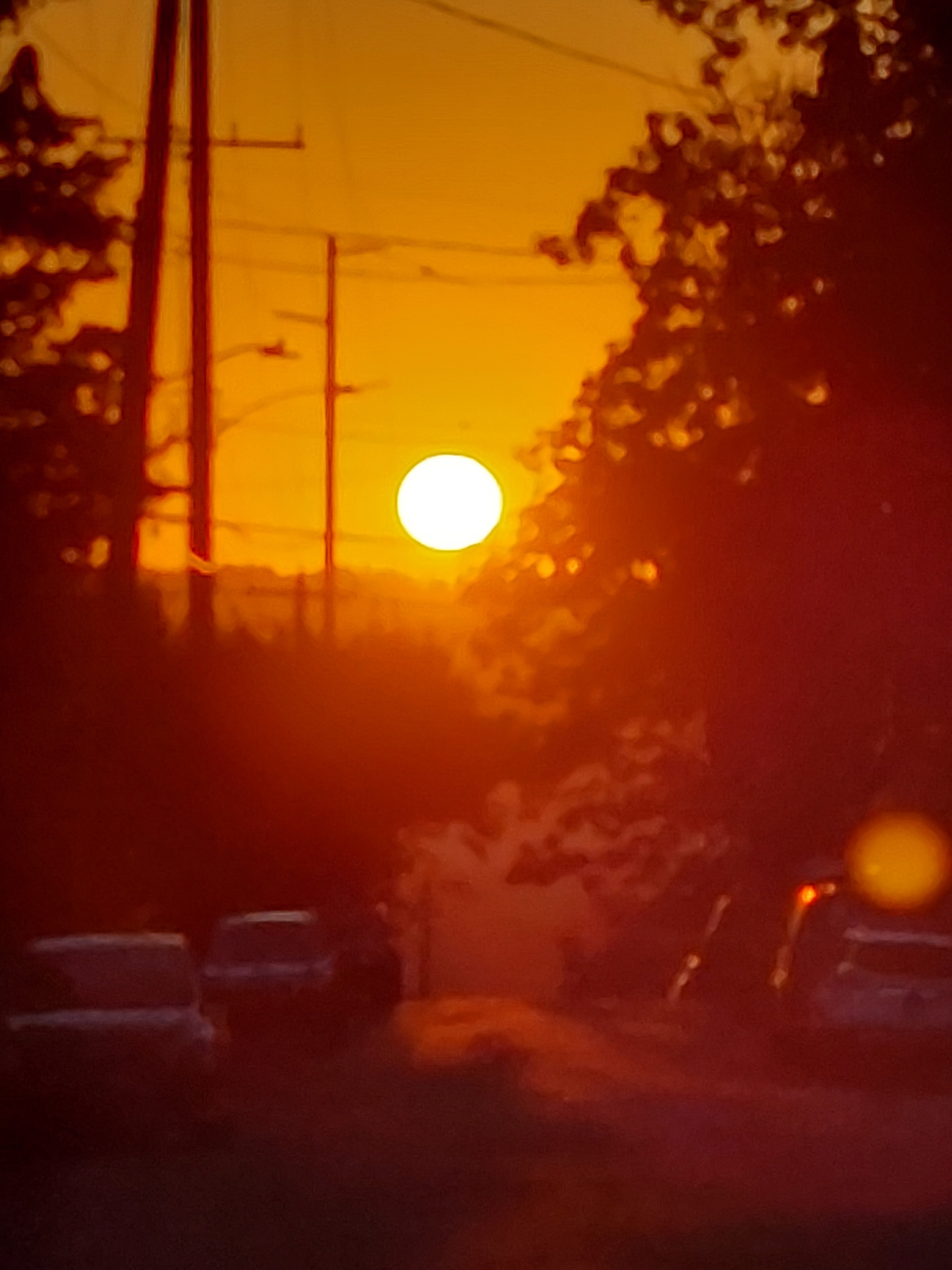
    In the evening the sun is placed
    over 60th and Belmont walking
    down the middle of the street
    into the powdery scene I snap
    a few pics with my phone cam:

    Autumn Equinox 2022 from SE Belmont and 68th

    Earlier in yard I cut feather grass
    as dry as a lint trap and the spent summer
    daisies cringed crinkled into dust as
    I yanked on the stiff stems like the barber
    at my gone to seed hair a mess she said.

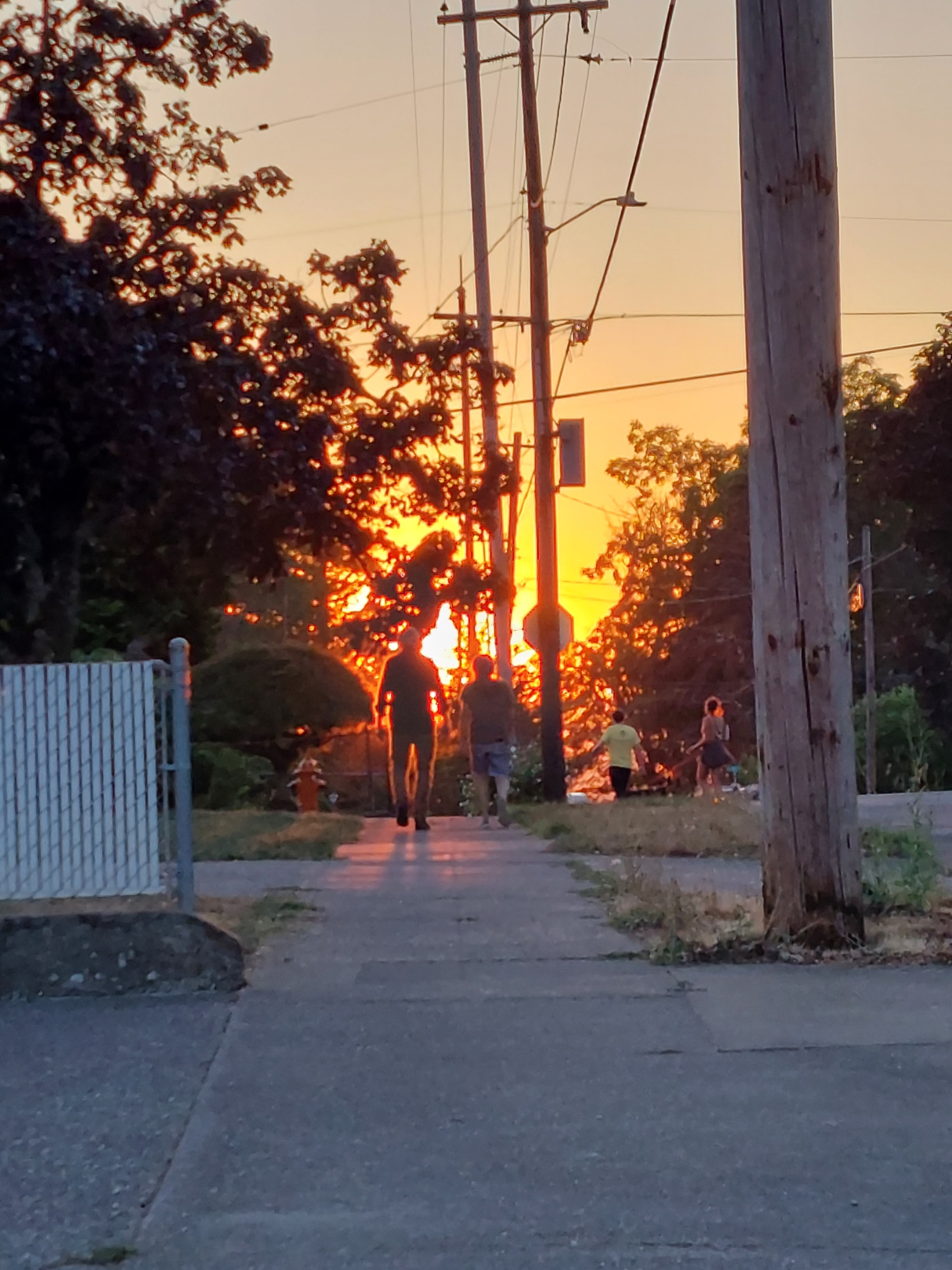
    Looking west over downtown to West Hills from SE 68th and Stark

    End summer evenings still too hot
    to walk but coming of Fall equinox
    portable air conditioner quiet fan
    spins cooler nights tiny blue eyes
    charge to pay to keep cool to sleep.

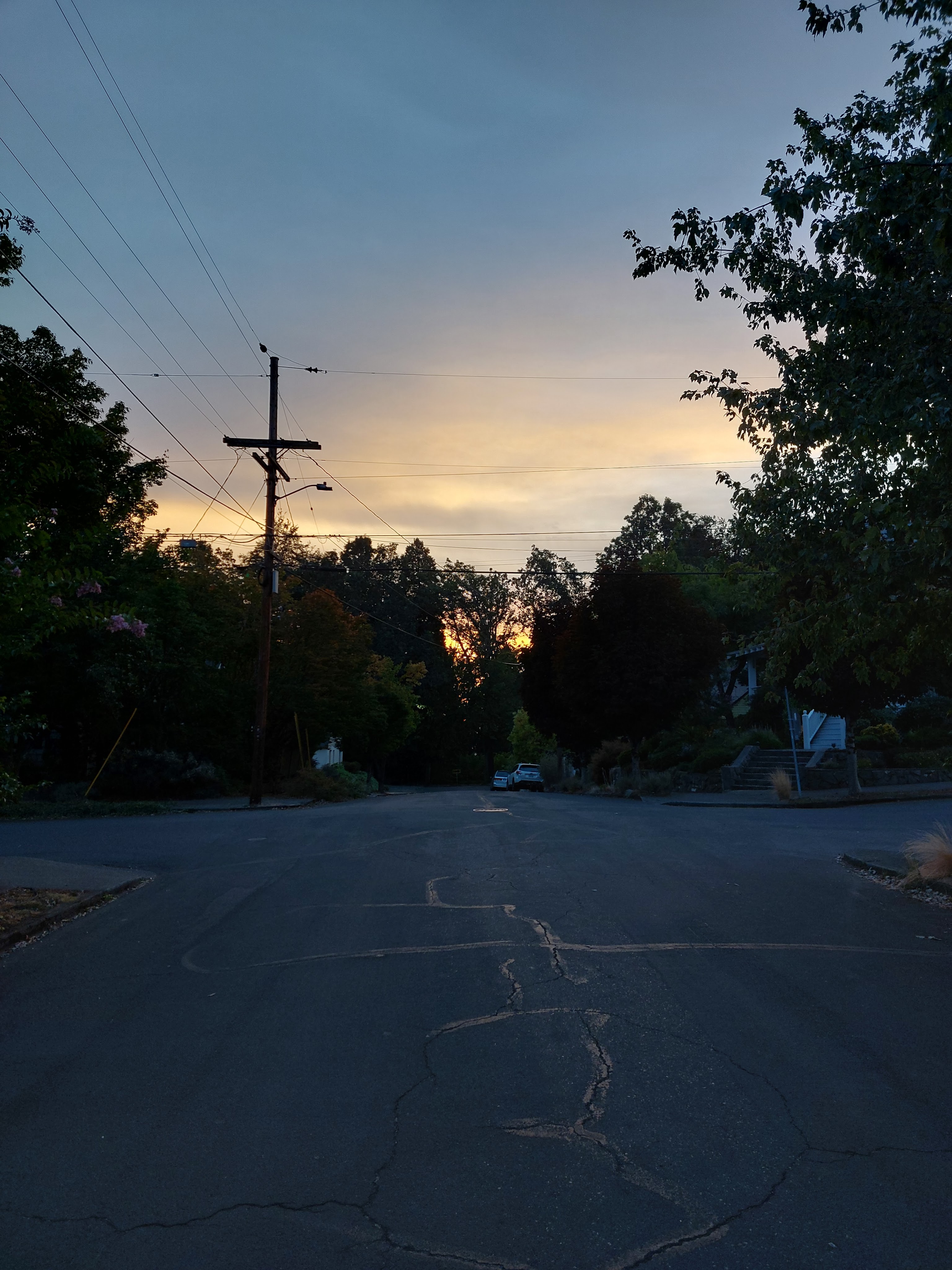
    A day later, a bit cooler, orange to blue, Morrison and 68th

    So it goes Vonnegut said so it goes
    around and around on old vinyl the needle
    finishes its drive toward the center the turntable
    still spinning the needle clicking back
    and forth wanting to stop but caught in the groove.

    Caught in the groove walking around and around

    No one understands Universe least of all physicists
    who must talk a taught tongue while the rest of us
    find rhymes and rhythms as we dance around and around
    until the moon goes down as Chuck Berry said around and
    around until the sun goes down and the moon comes up.

  • Fictional Photography

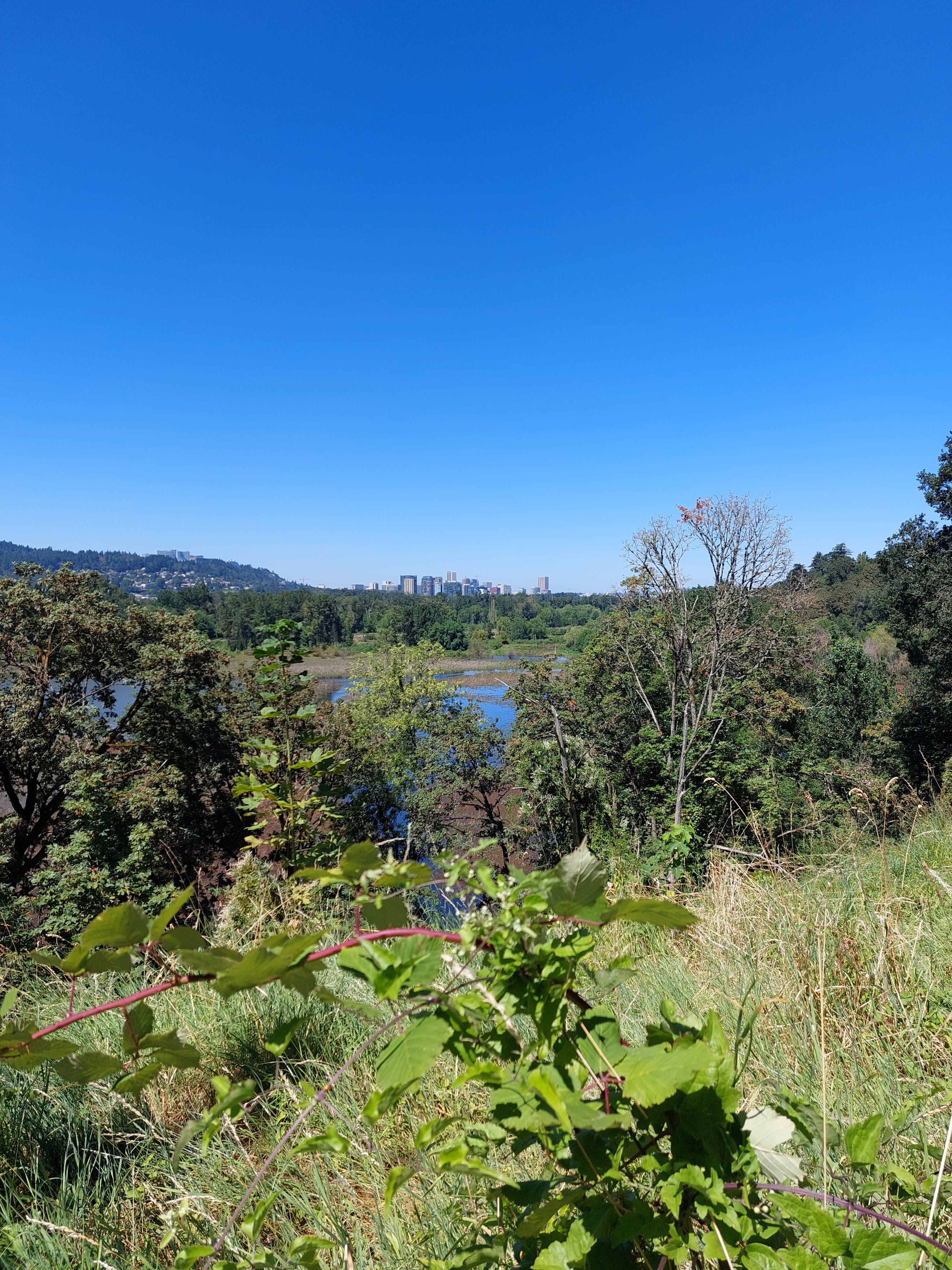
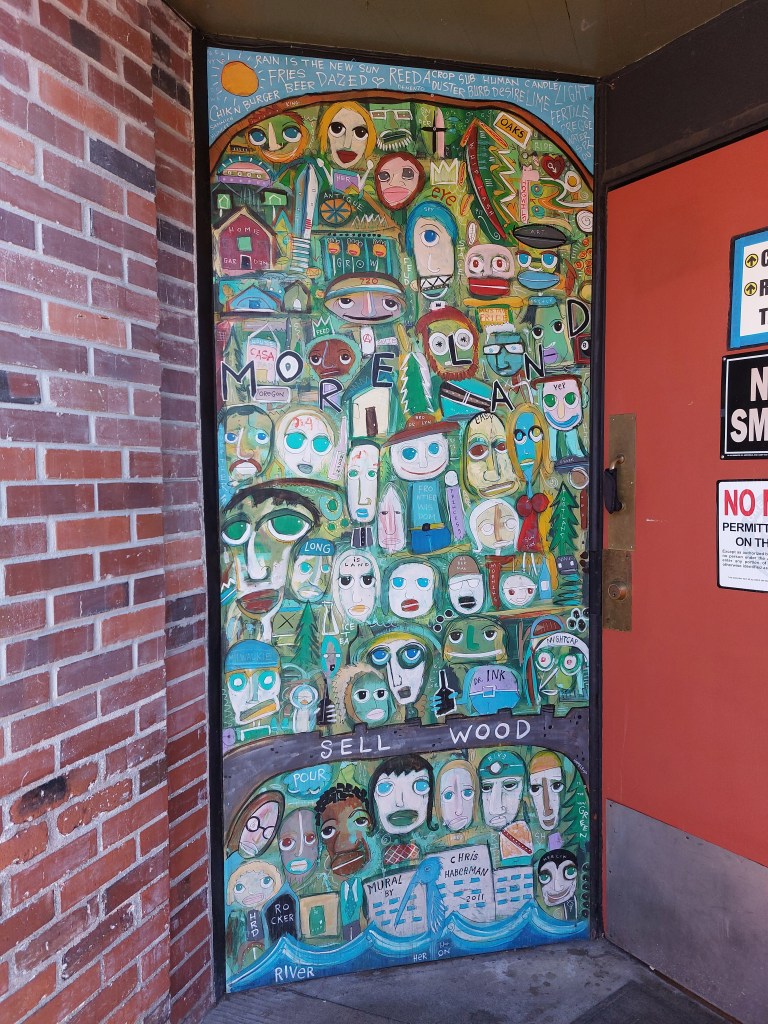
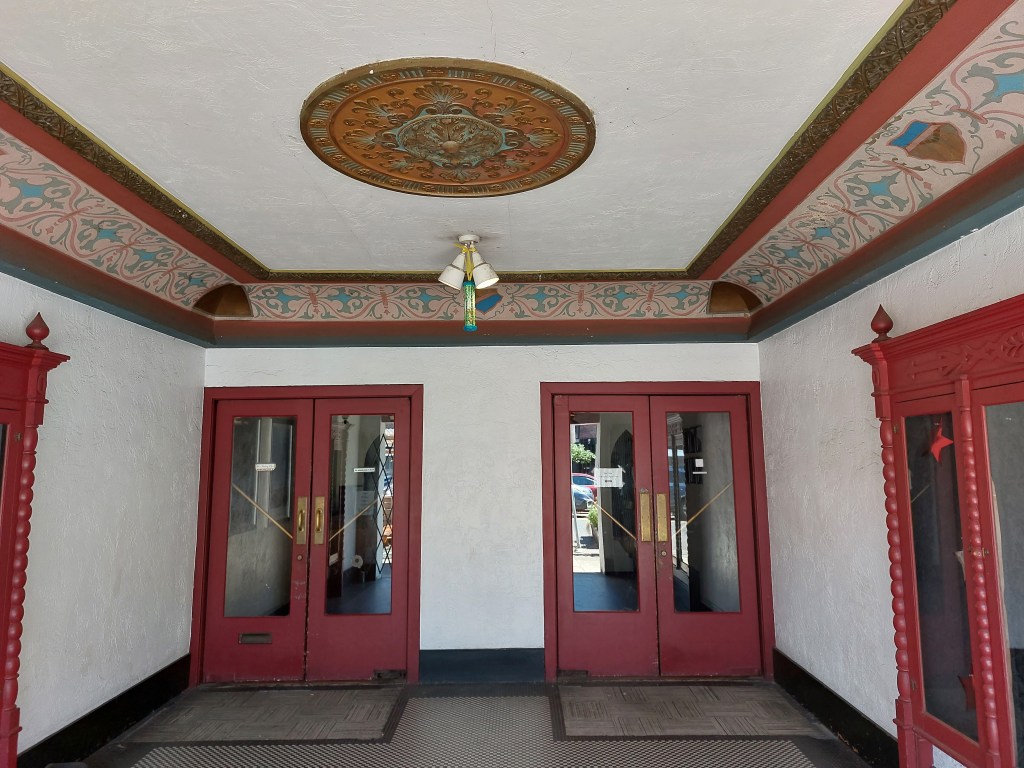
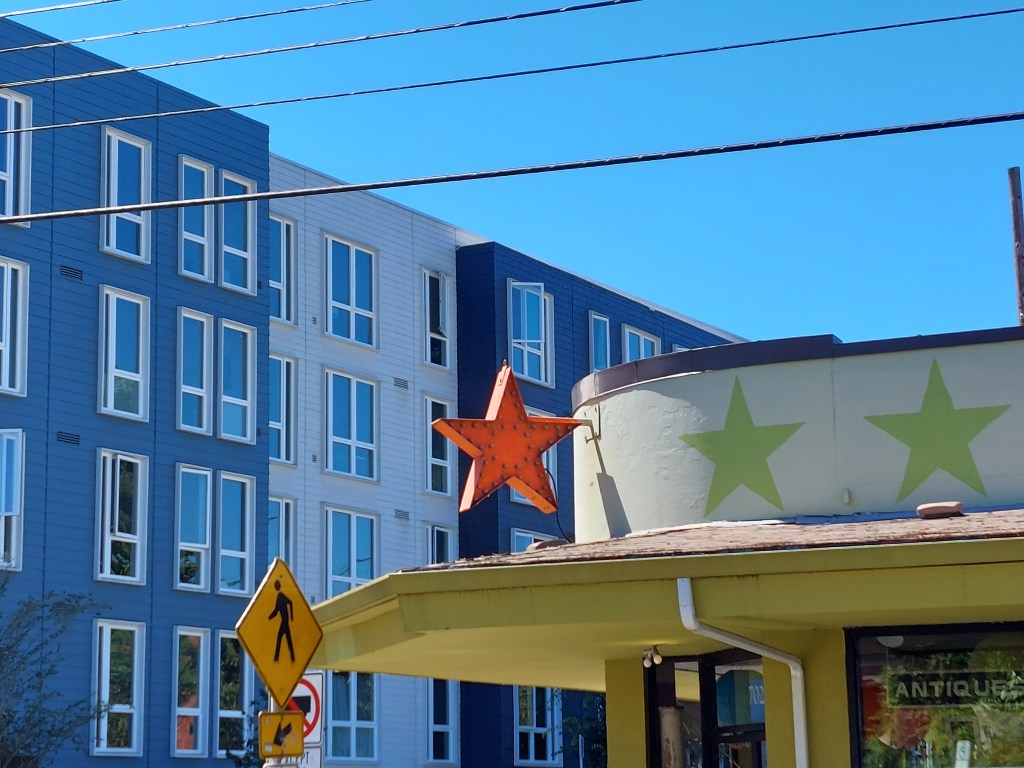
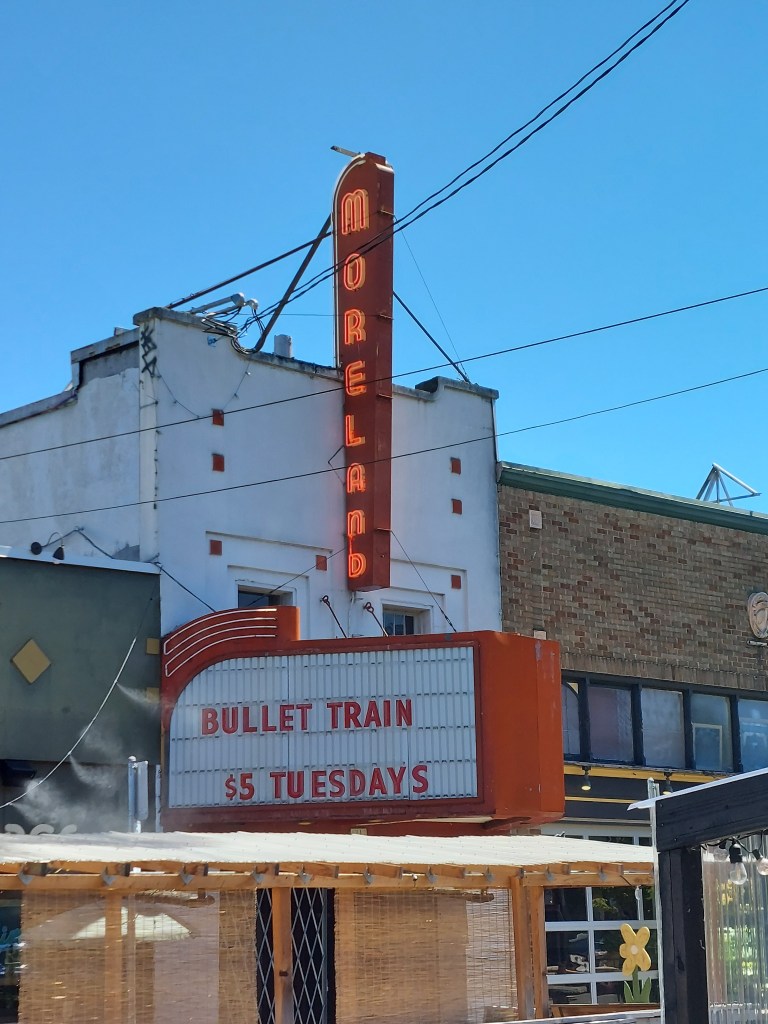
    Yesterday, we cruised on foot an antique, theatre, and tavern storied section of Sellwood then drove to the north facing cliffs where we looked across Oaks Bottom, where still lives lively the Oaks Amusement Park, “where the fun never ends since 1905,” the Oaks Park Roller Skating Rink, East Island, Hardtack Island, Ross Island, and across the Willamette River and above the trees to the tops of the taller downtown Portland buildings, looking smaller than nature in the distance.

    Downtown Portland from Sellwood Cliff

    The walking tour of Sellwood came after a trip to the Ledding Library of Milwaukie where Clo returned a book and Z checked out a new one and where I purchased from the library discards store a copy of Gordon Bowker’s 2011 “James Joyce: A New Biography.” Ahead of his Preface, Bowker quotes from Bernard Malamud’s 1979 “Dubin’s Lives”:

    “The past exudes legend: one can’t make pure clay of time’s mud. There is no life that can be recaptured wholly; as it was. Which is to say that all biography is ultimately fiction.”

    p. 5

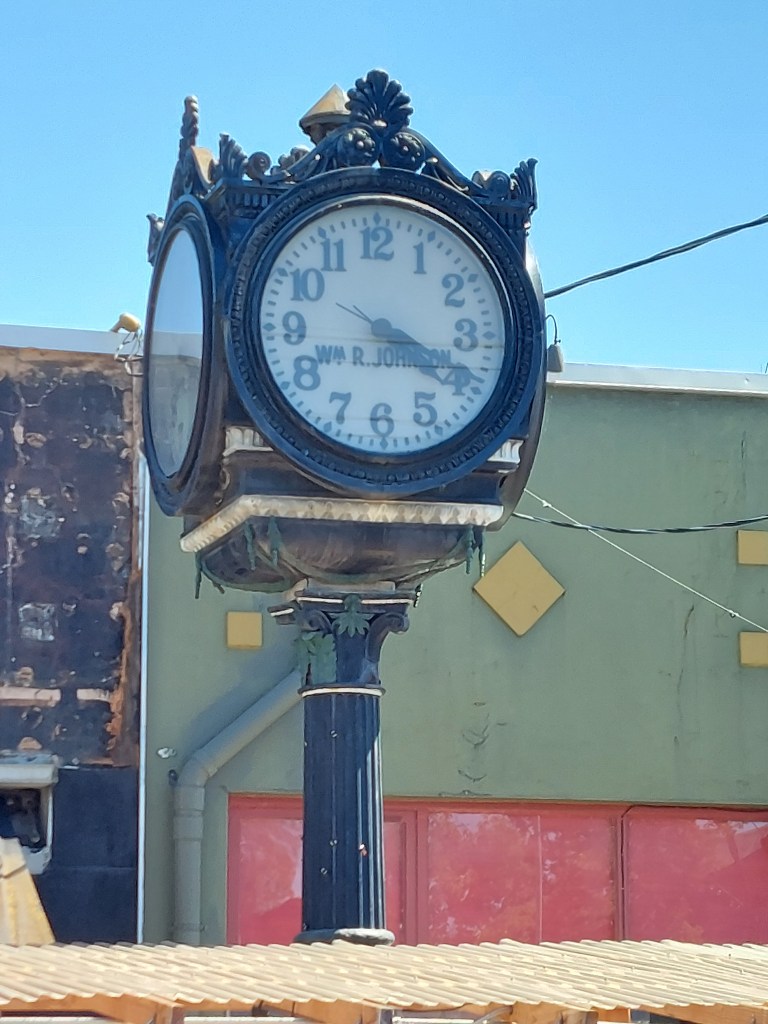
    In a similar sense, all photography might be considered fiction. Certainly that view of Portland above is only distantly related to a view of what’s going on in the streets below and between those tall buildings. One problem is how quickly things change, grow, recede. But photographs stick, or they used to. Maybe memory itself is a fiction – without which nostalgia couldn’t thrive like it does. Sellwood is currently an interesting blend of the old and new, of change. Imagine a time when it was necessary to build and display a gargantuan grandfather clock on the street. Did no one carry a watch? Today it’s one of the local antiques, and like a true grandfather tells a fiction all day long about what time it is.

  • Intermission: A Smoky Sea

    On the floor of a sea of smoke
    crawling to an empty conch
    I pass a woman out walking
    her dog neither with a mask
    and she smoking a cigarette.

    And some bony lady jogging
    thru the smoke and fog up
    and down the local side
    walks a serious jogger in
    deed sans nuisance mask.

    Toodeloo, I whistle in my
    mask, in my car, windows
    rolled, destooled, the bars
    all closed, on my way to
    the store for milk and beer.

    Now a Worst World Air Award
    for this smoke covered coast
    an Atlantis sunk in smoke
    a coal drenched London
    an orange Tambora scarf.


  • Notes AWP Close: The 8th Day

    Wandering post AWP19 Portland town yesterday with entrepreneurial intrepid impresario Berfrois editor at large Russell Bennetts and his Midwestern sidekick Simon Calder, I had occasion to consider Hemingway’s “The Sun Also Rises” in a contemporary context, where all the characters have cell phones, except one, who has lost theirs. But I can’t decide which Hemingway character would be cellphoneless: Jake? Lady Brett Ashley? Certainly not Count Mippipopolous, whose Twitter feed at AWP19 would be going nonstop. Maybe we would have Jake’s friend Georgette find the lost cell phone, but she would keep it hidden for a time, posting miscreant tweets and pics with her bad teeth.

    The idea behind Thornton Wilder’s “The Eighth Day” is that God, having created the world in 7 days, proceeds to take the 8th day off, during which what we now consider time takes place, such that we are all, since the beginning of time, living in the 8th day of creation.

    After their holiday in Pamplona at the festival of the bulls and all the bullfighting, “The Sun Also Rises” characters go their separate ways, Robert Cohn disabused of his romanticism, Jake cemented in his existential crisis, Brett off with the once untouchable but now touched and wrecked bullfighter Romero. It’s going to be a long 8th day.

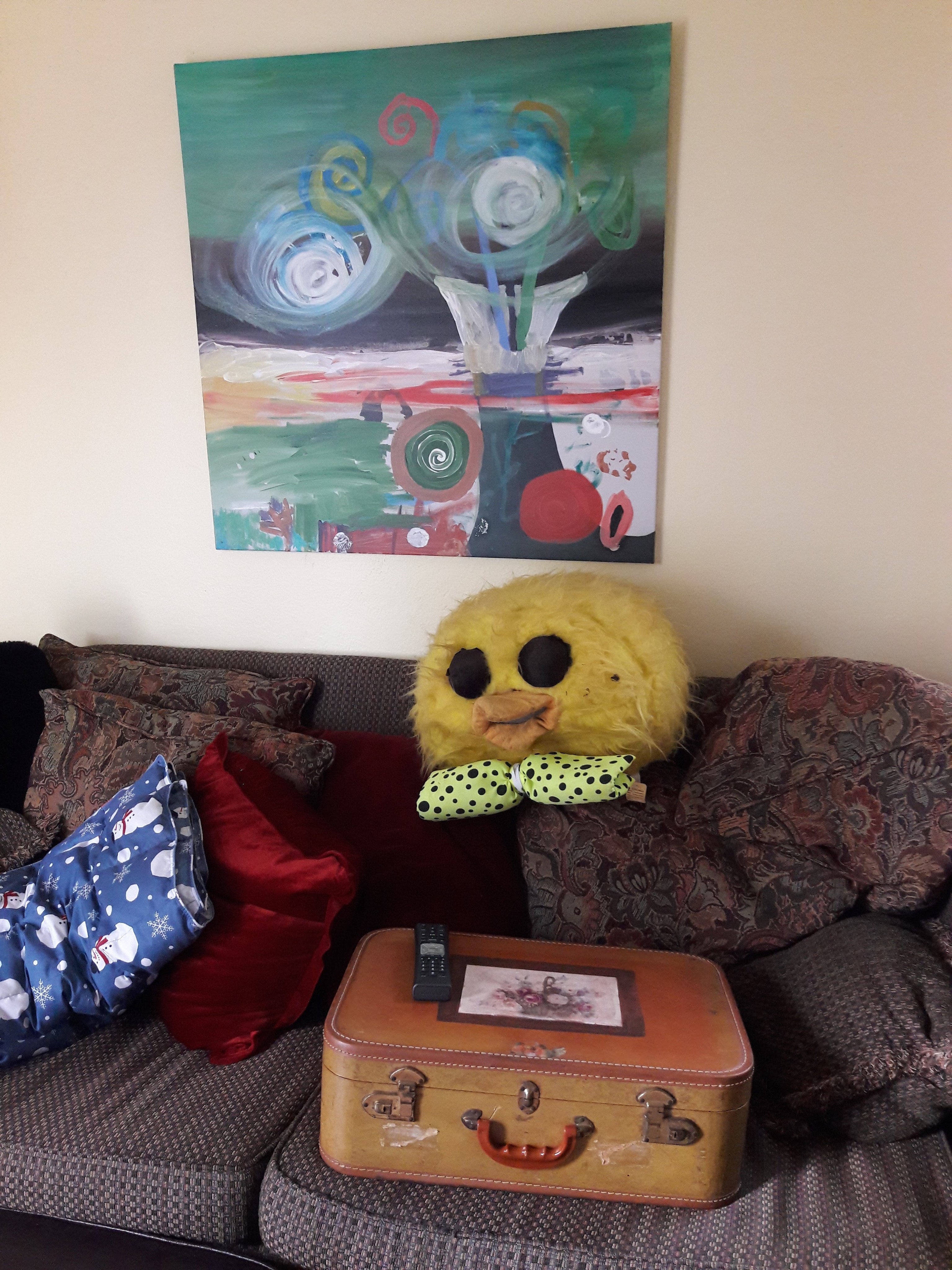
    Now living in the 8th day of AWP19, at least one Berfrois character has decided to remain on in Portland town. Here they are, comfortably taking over the TV remote:

    20190401_091516

    This is the eighth and last in a series with notes on AWP19 and the concurrent publication of the Berfrois and QM’sT books.

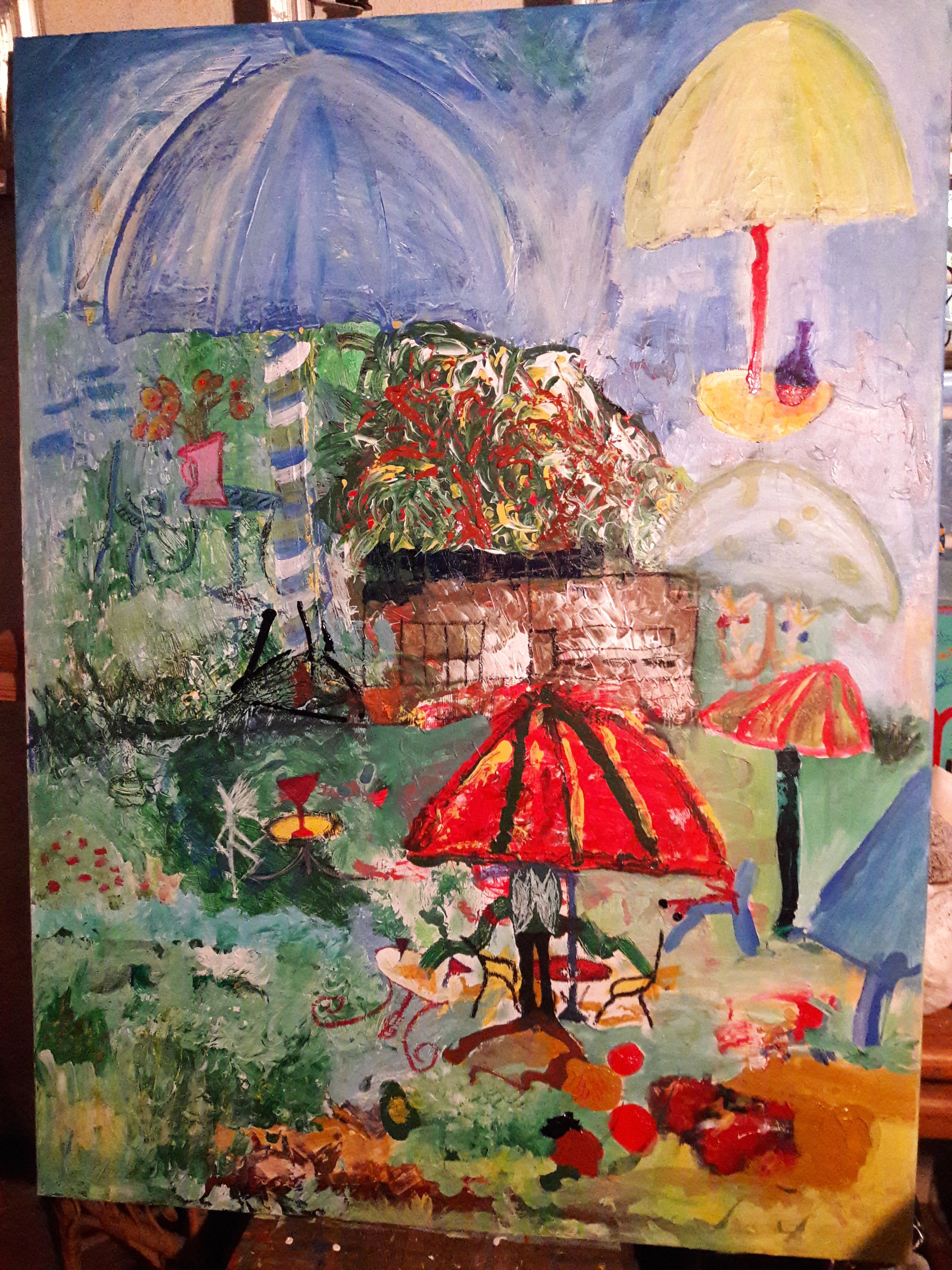
  • Sitting Out: Painting in Progress

    Sitting Out: Painting in Progress

    Portlanders love to sit out. At sidewalk cafes, outside pubs, in their yards or drives. On porches, decks, balconies. In parks. On special occasions, neighbors will close their street to cars so they can sit out in the middle of the block at improvised tables in whatever chairs seem to turn up. The atmosphere of a street closed to cars turns surreal in these times. Maybe because it rains six months out of the year, Portlanders don’t take the perfect evening for a sit out for granted, but they’ll even sit out in the rain, huddled beneath coats and blankets around a fire pit or under overhead standing outdoor electric heaters.

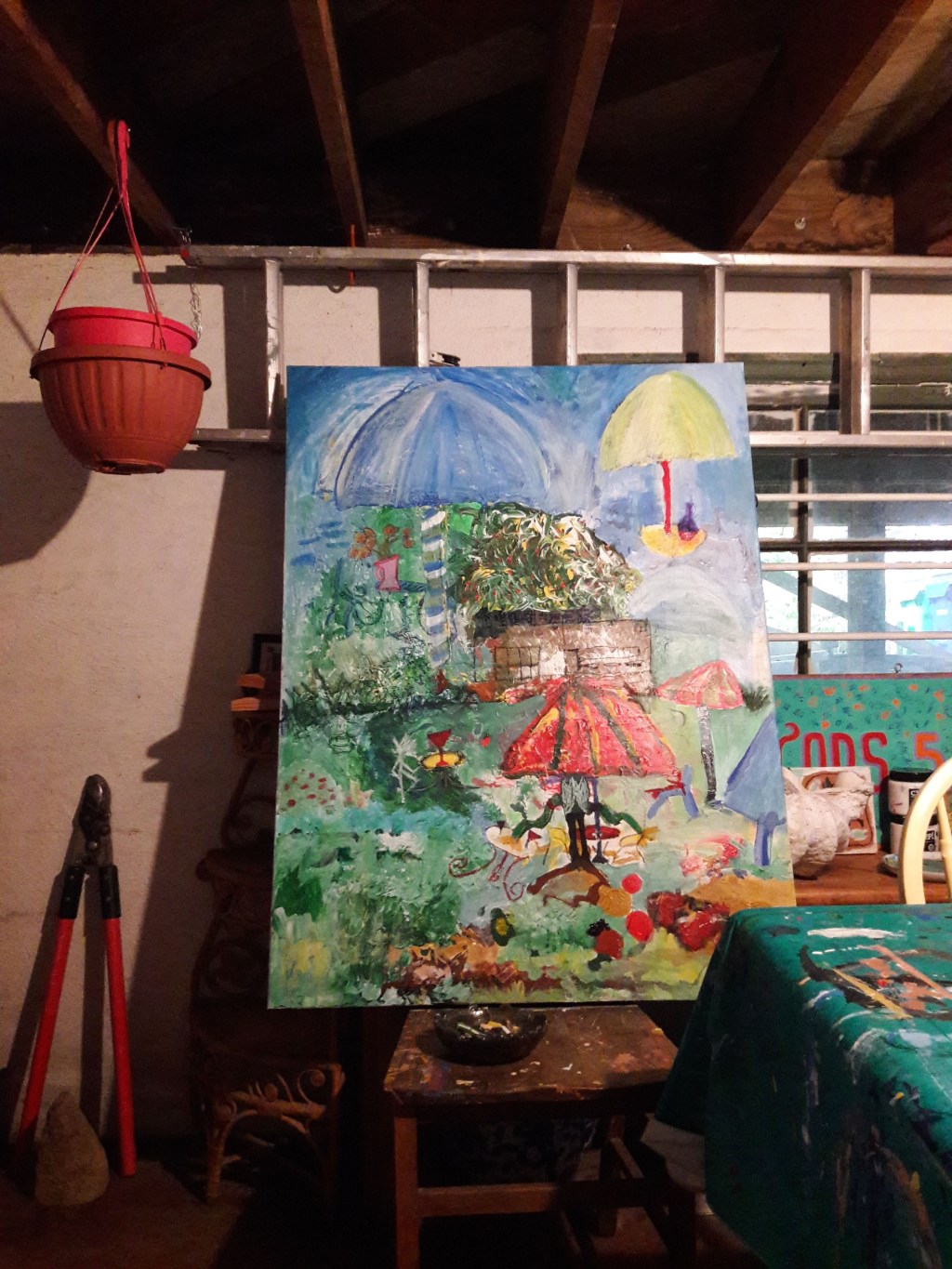
    The current painting in progress is tentatively titled, “Sitting Out.” It’s 3 feet by 5 feet, stretched canvas. I’ve used acrylics, oils, and oil pastels, applied with brush, palette knife, or directly out of the tube. The grandgirls have been involved in this painting as well. Chloe is responsible for the bottom left, raspberries at the top of a green hill, ZZ for the sky and bottom right umbrella and blue chair seated with a red figure. Layer upon layer. Things get covered up. Sometimes it’s a mistake to cover something over, but you keep working. A canvas of this size is not inexpensive, but we got this one used at a garage sale for $5. We painted over the old painting, but ZZ wanted to keep some existing red roses in the bottom right hand corner, so we tried to preserve those.

    20180930_1727471


    Our studio, such as it is, is located in the basement:

    The grandgirls are back in school now, and I’m working on the sit out painting in the basement alone. Last night I added the black umbrella outline with the broken stretchers pointing upward in the middle left. Had the girls been there, they would have booed this change. I need to figure out a way to cover it up without ruining the horizon line below it, which tops Chloe’s field.

    Below are two pics of Portlanders sitting out on the sidewalk and in the street corral of a corner restaurant:

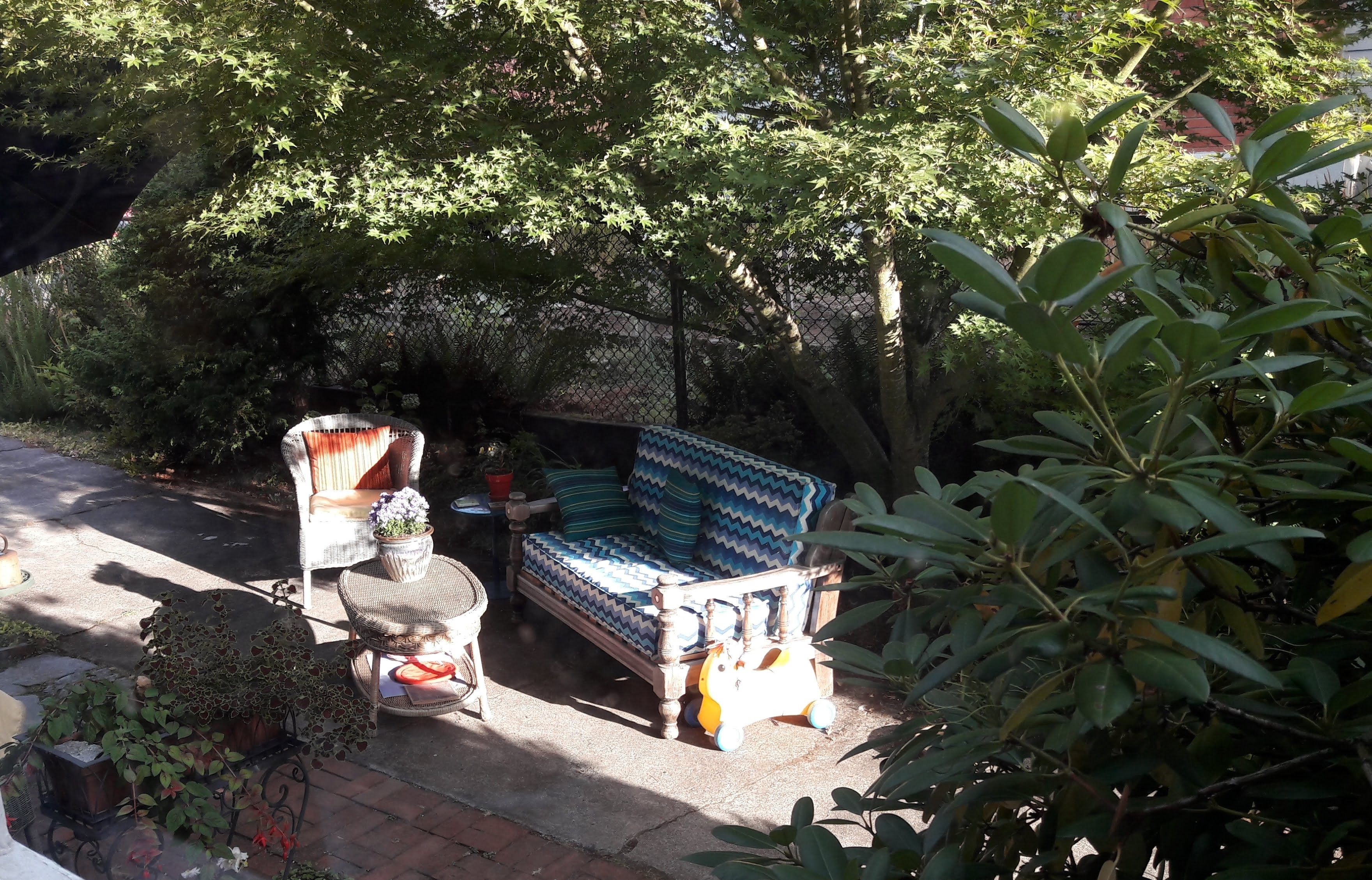
    And we’ll close with this pic of a sit out zone in an unused portion of a driveway, Ollie waiting patiently to be taken for a ride:

    20180829_1455401

  • Optotype

    Line 15 currently detours across the Hawthorne Bridge due to a temporary weight restriction on the Morrison Bridge, which is under repair. I hopped off the bus at the west end of the Hawthorne Bridge, passed the Salmon Street Springs Fountain, and walked south along the Willamette to the eye clinic, just over a mile upriver. I saw some strange markings on the sidewalk, as if math really is fun. A gaggle of signs befouled the views, whispering orders, dangers, and cautions. I noticed there were no warning signs near the mooring bollards, and wondered how many people walking along ogling the view have tripped over them. Rarely do I have to yield to slower traffic.

    Just south of the Hawthorne Bridge, I noticed an interesting, kind of improvised, lean-to-dock moored just off the west bank between the bridge and the park beach, downriver from the yacht harbor. The boat and dock set-up reminded me of Anais Nin’s “Houseboat,” and of Penelope Fitzgerald’s “Offshore.” And the usual gaggle of geese casually befouled the park beach area. I don’t mind the geese, though the city has been taking precautions to minimize the goose poop problem. But I was wearing the new Fila walking shoes Susan recently scored for me, and I wasn’t sure the goose path was how I wanted to break them in. Portland is called the City of Roses. You would think the roses wouldn’t mind the geese.

    Modern accommodations for travel, appurtenances for getting around – what a mess! Just north of the Ross Island Bridge, workers were just about finished dismantling the Project Pabst Festival. It was a little early to be thinking of a cold PBR Tall Boy. I walked along “River Place,” above the small harbor, and passed by the “River Walk Cafe,” enjoying the cliches, and at the corner of Meade and Moody thought, how about “Mead Place,” or the “Moody Walk Cafe”?

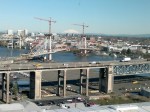
    A rowing crew rounded the pilings of the Marquam Bridge (a concrete brouhaha that spans and expands the definition of bridge), the submarine moored behind them on the east bank, below OMSI and the Portland Opera. The Pabst Horse trotted off on a trailer. The Portland Aerial Tram (constructed at a cost of $57 million), juxtaposed with the old Ross Island Bridge, reminded me of the 20th Century: “Turn! Turn! Turn! (To Everything There Is a Season)”.

  • November Day Along the River

    How are you? You are how
    this is too easy
    a still gift of photographs
    almost like a real letter.

    You like flowers, flowers like you, like
    Peonies, purple green red yellow mopped hair
    Marigolds, red orange bites
    Red geraniums in a real clay pot
    and those little white hanging threading flowers,
    I don’t know their name, whispery white.

    I am 1,000 characters
    all so small you can’t see them
    like tiny little squiggly bugs.
    You are 1 bodacious character
    like a lobster on the ocean floor under
    blue waves under an orange sky,
    or a swell cat, an orange tabby
    with blue eyes,
    who never scratches but purrs
    and curls in your lap for a nice nap
    on a hot sunny summer day,
    a sleepy breeze cooling powdery sky.
    Evening comes and a glass of white or red wine
    and dinner and the sun goes down
    and the moon comes up
    up and up and up and up
    so the path is lit.

    But now is not summer
    now is the beginning
    of a long winter
    without you.

  • This is Portland for Christmas

    I asked Eric if for Christmas he might like a couple of books. It was a busy week, with the Christmas baby on her way, and so Susan and I found ourselves in Powell’s on Hawthorne two days before Christmas looking around for things we thought Eric might find interesting, not an easy chore, since we have trouble usually identifying things that even we might find interesting. It’s not easy finding the right book at the right time for someone. Choosing a book is like picking a campsite. But Susan’s a genius at this sort of thing, and found Nick Hornby’s 31 Songs, perfect, and Nickel and Dimed: Undercover in Low-wage USA, by Barbara Ehrenreich (the perspicacious reader will pick up on the perfect pairing these two books make).

    Then, waiting in a long Powell’s last minute Christmas line with a hundred other Portlanders on Hawthorne, I spotted what appeared to be a little, homemade paperback, This is Portland: 13 Essays About the City You’ve Heard You Should Like, by Alexander Barrett. Three of the essays are only one sentence long (illustrated, to give them a bit more heft), and I liked that he still called them essays, and that you could read an entire essay standing in line at Powell’s on Hawthorne and that by the time you got to the counter, you could finish the book, and if you didn’t like it, you could just put it back. But I did like it, and I thought Eric would dig it, and the essay that cinched the deal (two pages long, still standing in line), was “Hawthorne V. Belmont,” about the supposed value clash between the two alt-commercial Portland East-side strips.

    The author of This is Portland had only moved to Portland eight months before the writing of his book, but the book’s undated, which we find a bit weird, but Portlanders are supposed to value weird, so there you go, but a bit of Toads sleuthing and we came up with an on-line version of the book ($5 at Powell’s, but we’re more than ok with that, see below), and not only that, but we discovered (ok, this was actually pretty easy, the sleuthing part, since Alex the brief essayist included his website address at the end of his book) an amazing website devoted to himself, the Portland essayist, apparently hosted by his parents.

    About being ok spending $5 for something available on-line for free: obviously, emailing somebody a link doesn’t make for much of a gift, but beyond that, we continue to support hard copy whenever we can, and Alex’s little hard copy book has already been shared and read by at least six others, folks dropping in on Christmas day to visit and share-alike. It’s a wonderful Portland.

    Related: “Portlandia“; “Portlandia Portraits