Tag: Paris

  • Middle-Aged Once

    Patrick Modiano’s novella “In the Cafe of Lost Youth” opens with an epigraph attributed to the French philosopher Guy Debord:

    “At the halfway point of the journey making up real life, we were surrounded by a gloomy melancholy, one expressed by so very many derisive and sorrowful words in the cafe of the lost youth.”

    I was unable to track down the source of the quote. It’s possible it comes from a memoir or some throwaway magazine article. But it reminded me of the opening to Dante’s “Inferno”:

    “Midway in our life’s journey, I went astray
    from the straight road and woke to find myself
    alone in a dark wood.” John Ciardi translation, 1954.

    Dante is comparing having lost his purpose or direction in life in middle age, 35 or so, to getting lost in a wilderness where one has wandered off a steadfast, well-worn path. He’s unable to locate himself on some reputable and credible map, either from an external or internal viewpoint. Why doesn’t he back up, retrace his steps? Instead, he forges on in the dark on a crooked path. At that point, a step forward could just as well be a step backward.

    Dante both forges purposefully ahead and rambles on, caught in the web of the woods, presses on like some point man cut off from his platoon, tracking deliberately with some goal of trying to map a new way out. Though he lacks an immediate target, he’s not aimless.

    “I placed the typewriter on the small pitch-pine table in my room. I already had the opening sentence in my mind: ‘Neutral zones have at least one advantage: They are only a starting point and we always leave them sooner or later.’ I was aware that once I sat down in front of the typewriter, everything would be much less straightforward.” (89-90, “In the Cafe of Lost Youth,” Patrick Modiano, 2007 Editions Gallimard, 2016 NYRB, 118 pages).

    Modiano was the recipient of the 2014 Nobel Prize in Literature. The only other book of his I’ve read is “Young Once” (1981 Editions Gallimard, 2016 NYRB, 156 pages):

    “Does life ever start over at thirty-five? A serious question, which made her smile. She would have to ask Louis. She had the feeling that the answer was no. You reach a zone of total calm and the paddle boat glides all by itself across a lake like the one stretching out before her. And the children grow up. They leave you.” (5).

    Both novels are sepia-tinged with the kind of suggestive noir one begins to associate with normal life, which is to say there is no normal, but everyone you meet is obsessed, or ought to be, with their past and future but are actually caught up in the web of their now, hopelessly trying to live in the moment but forced to move on, like Dante, or Beckett, in spite of having lost track of where they are in the moment. Even trying to move back is another futile move forward. Yet at some point, maybe that middle age point, one is given pause, a kind of grace – to reflect, to look back, to sense forward, lost in that very stillness:

    “They did not know that this was their last walk through Paris. They did not yet exist as individuals at all; they were blended together with the facades and the sidewalks. In macadam roads, the stones, patched together like an old cloth, have dates written on them to indicate when the successive layers of tar have been poured, but perhaps also recording births, encounters, deaths. Later, when they remembered this period in their life, they would see these intersections and building entryways again. They had registered every last ray of light coming off of them, every reflection. They themselves had been nothing but bubbles, iridescent with the city’s colors: gray and black.” (154)

  • Notes on “The Paris Library”

    One of my sisters recently visiting, one the guitarist and both patient artists on paper and cloth, not in any particular hurry, so riding the Coast Starlight for a bit of adventure and fun you don’t get on an airplane these days, and knowing my affinity for books, upon leaving for the southbound trip, left me a gift of “The Paris Library.”1

    As genre, it’s a historical novel, and thematically covers some of the same ground found in “Suite Francaise,” the novel by Irene Nemirovsky,2 the setting of both books the World War II German occupation of France and its effect on the French population. In the preface to the French edition, a quote from Irene in a letter to a friend: “How could you think I could possibly forget my old friends because of a little book [she’s talking here about her first novel, “David Golder”] which people have been talking about for a few weeks and which will be forgotten just as quickly, just as everything is forgotten in Paris?” (421-422).

    That everything is forgotten is why we write and read, and why sometimes there are those who would destroy or ban books, or close libraries. At the same time, given the ongoing repetition of predicaments that lead up to those books, one wonders if one really wants to repeat a given experience vicariously yet again, or why.

    Irene’s daughter Denise discovers while copying her mother’s notes over 60 years after World War II, “These were not simply notes or a private diary, as she had thought, but a violent masterpiece, a fresco of extraordinary lucidity, a vivid snapshot of France and the French – spineless, defeated and occupied: here was the exodus from Paris; villages invaded by exhausted, hungry women and children battling to find a place to sleep, if only a chair in a country inn; cars piled high with furniture, mattresses and pots and pans, running out of petrol and left abandoned in the roads; the rich trying to save their precious jewels; a German soldier falling in love with a French woman under the watchful eye of her mother-in-law; the simple dignity of a modest couple searching amidst the chaos of the convoys fleeing Paris for a trace of their wounded son” (Preface to the French edition, 430).

    But “The Paris Library” remains in wartime Paris, where not everyone is “spineless” or even “defeated,” but half the story includes, almost absurdly, in split-time alternating chapters, a setting some 40 years later in the US state of Montana. Letters play an important role, another way of remembering, should they be stashed away for some future generation to discover – or for the letter-writer to re-discover an old self. And in “The Paris Library” the human frailties uncovered or challenged by universal circumstances of the results of one’s actions prove the human possibilities of self-empowerment and resilience and rehabilitation. Challenging too, the constant reminder that one constant of the human condition seems to be the constant seemingly contradictory struggle for peace.

    1. “The Paris Library,” by Janet Skeslien Charles, first published in Great Britain by Two Roads (John Murray Press, Hachette UK), 2021. ↩︎
    2. I have the First Vintage International Edition, May 2007, translation (2006) by Sandra Smith, originally published in France as Suite Francaise by Editions Denoel, Paris, in 2004, and subsequently in Great Britain by Chatto & Windus and in the US by Knopf, 2006. ↩︎
  • An Avocado Grows in Paris

    Another book influencing its predecessors is Elaine Dundy’s The Dud Avocado, originally published in 1958 and reissued in 2007 by NYRB, which includes an afterword written by Dundy in 2006. The Dud Avocado follows the period young Sally Gorce chooses an expat existence in Paris over college, expenses not exactly all paid for by a concerned uncle, so Sally’s survival, such as it is, depends also on chance, her wit, new acquaintances, and part time gigs, including as an actress in a small theatre. The precursors include the Hemingway of The Sun Also Rises, Scott Fitzgerald and Lost Generation company, and other coming of age in Paris tall or short tales.

    The characteristics of Dundy’s book include wit, sarcasm and satire, humor. As an example, consider this section which follows the thoughts of a wealthier (than Sally) English woman:

    “We sat at the cafe until lunch time. A couple, two English people, sat down at the table next to ours just in time to see the Bullfighter and all his pals get into a shiny lavender Cadillac and drive off in a blaze of flashing chrome. The woman, a large Junoesque creature with a sensationally unhappy expression on her face, had slapped on an enormous pair of sunglasses as he came out and had been studying him intently. Suddenly she turned to her companion. ‘Well, there’s another dream gone down the drain – he must be every bit as high as my waist,’ she announced sullenly. ‘He really looks such a boring little man, doesn’t he, so utterly clueless in these revolting American clothes, I can’t think why we’re going to do this picture. Basil wants us all to go down to San Sebastian to watch him on Sunday but I don’t think I’ll bother.’”

    p. 178-179 NRYB 2007 edition

    The above excerpt could have been a short story written by Hemingway had Ernest stayed in Paris and become a French theorist in the 1950’s instead of continuing to take himself seriously and move his feast to, I don’t know, Idaho. Anyway, Sally continues listening to the remarkably disenchanted woman as she complains about the noise on her morning plane ride into Paris:

    “‘I suppose it simply doesn’t occur to some people that one might be trying to recover from the night before.’ She took a large gulp of her drink. ‘I’d quite like to see the bullfight though, wouldn’t you? I do adore cruelty. Everybody back home’s too dreary, going on and on about the horses. Papa’s forbidden me across the threshold if I go to one. Can you believe it? That’s an added incentive.’”

    179

    During her stay, Sally loses, or has stolen, or both, her passport, and the plot thickens as a result, and one might recall Casablanca and the difficulty of obtaining transit papers, which, today, might include letters from one’s doctor certifying Covid free status before boarding, and again, one presumes, after landing?

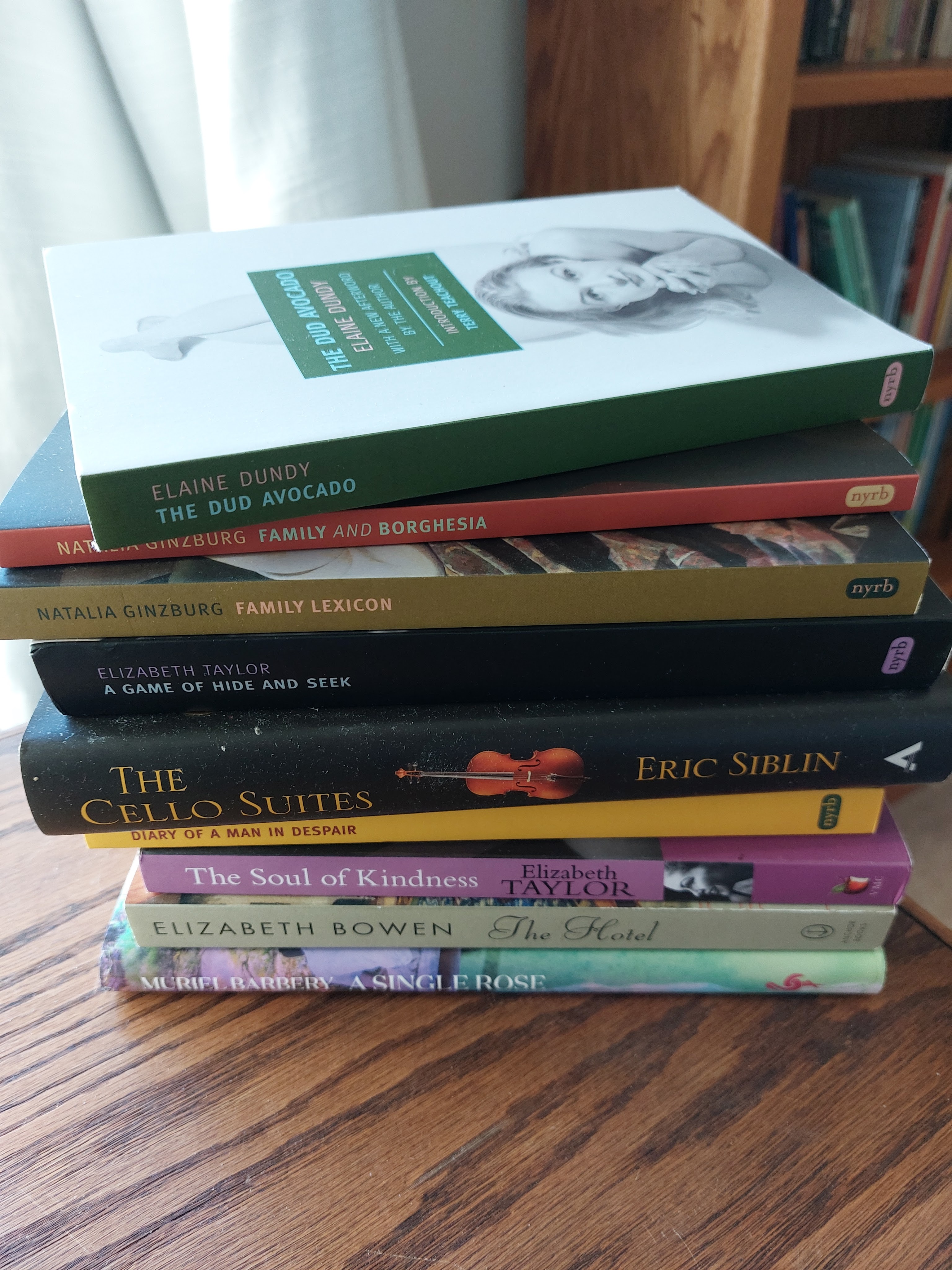
    Ah, the vicarious joys of reading, where one need not wear a mask or worry about the breath of one’s travel mates or show documents prior to entry. Speaking of the joys of reading, enclosed please find a pic from my recent Fall reading stack. I continue to be drawn to women writers of the mid 20th Century, most recently having discovered Elizabeth Bowen and Elizabeth Taylor. Natalia Ginzburg’s writing in style and substance remains untouchable, essays and fiction and her mix of the two. The Muriel Barbery I came across in a briefly mentioned review in The New Yorker and having enjoyed The Elegance of the Hedgehog bought it and liked it enough to send a copy to one of my sisters, the one who had recommended Hedgehog to me. What goes around comes around. Friedrich Reck’s Diary of a Man in Despair, in the stack, remains unread. I bought it some time ago, before the general despair now enveloping us all. The Cello Suites I’ve already mentioned – a gift from one of my other sisters. I was going to write up a post briefly mentioning each of the books finished this Fall. Maybe I just did. Anyway, if you find yourself on the way to Paris one of these days, you might consider taking along a copy of Elaine Dundy’s The Dud Avocado. And keep an eye on your passport.

    Fall Reading 2021

  • Fragments Strung Together to Make a Whole

    Cold, clear morning. Just below freezing. Frost riffs across roofs and grass the sun has not yet touched. The hoary, grey-silver stubble of winter blades, stiff. The skinny, rigid jogger skips by again, down the road, round and round she goes. A squirrel. No birds. Quiet. Clarity. Wind nil. Across the street on the sidewalk guy wearing black beard pulling red wagon up the hill in the wagon a child sitting holding the rails.

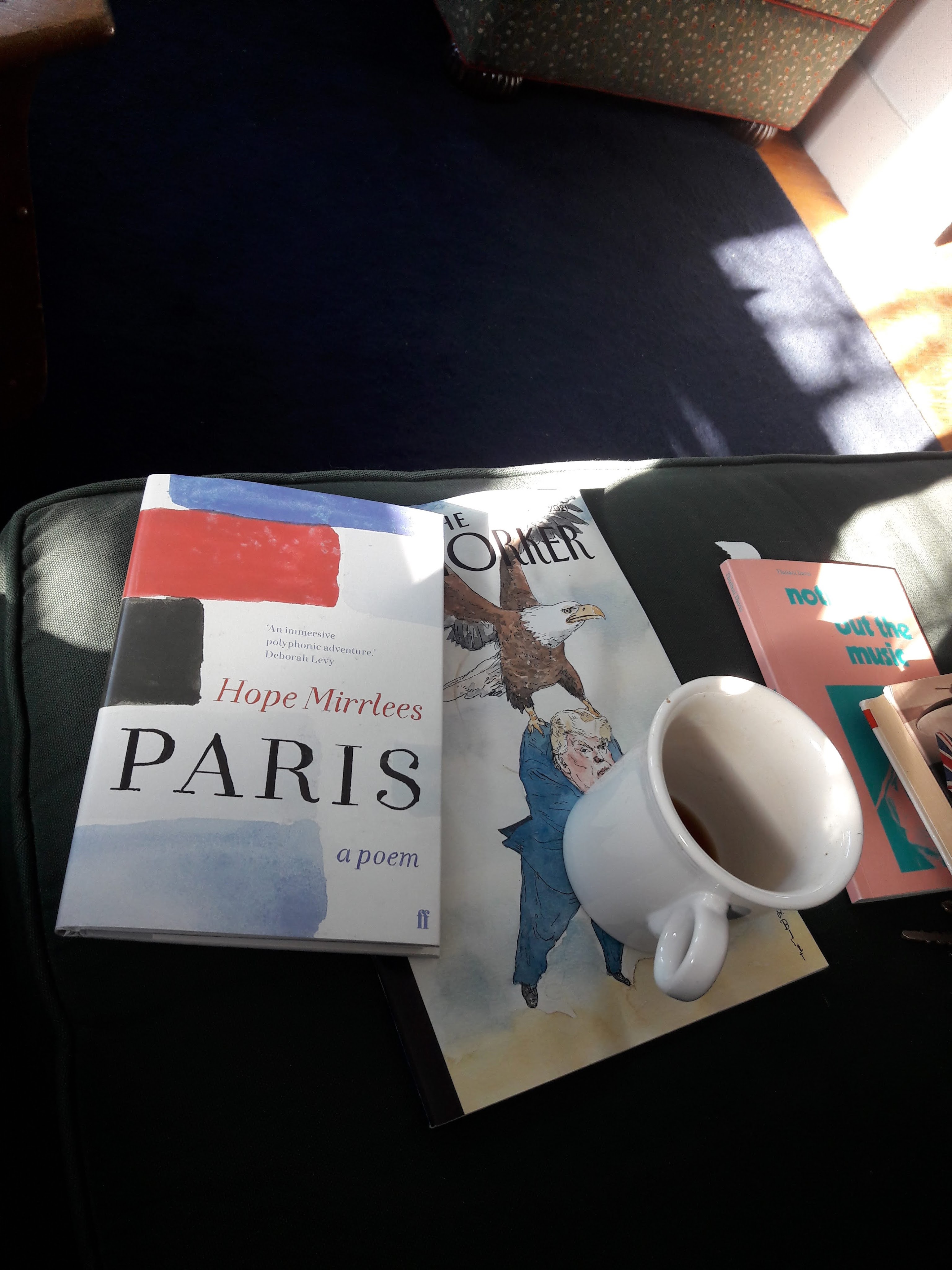
    Back inside, a couple of books: “nothing but the music: Documentaries from nightclubs, dance halls & a tailor’s shop in Dakar, 1974-1992” (Thulani Davis, Blank Forms Editions, Brooklyn, 2020, but just out, pre-ordered & in snail mail about a week ago, January 2021, 63 pages); and “Paris: a poem” (Hope Mirrlees, first published in 1920 by the Hogarth Press, 175 copies, handsewn, this edition in 2020, also recently received, Bloomsbury House, London, 59 pages).

    In an Afterword (long after, 100 years after), of “Paris: a poem,” Sandeep Parmar shares the setting: “Spring 1919 was quiet and cold….The weather put a dampener on the First of May demonstrations,” and she quotes from a letter, “Riots were expected but all fell flat and it was like an English Sunday – traffic stopped shops shut and nothing doing” (56-57). Sounds a bit like the morning here described above I just came from back inside to read and write. That’s not as easy as it might sound, at least not the reading part, not reading “Paris: a poem.” The poem itself runs from page 3 to page 23. The remainder of the book is Foreword (Deborah Levy), the aforementioned Afterword, and Commentary (by Julia Briggs, 2007, reworked to fit this edition), this last running from pages 25 thru 51, including Works Cited and an Addendum by Parmar. There’s also a page of notes apparently part of the first edition. For the aficionado of the obscure, this little book is a goldmine. And here I am, panning for gold:

    The sun is rising,
    Soon les Halles will open,
    The sky is saffron behind the two towers of Notre-Dame (22).

    The close of Parmar’s Afterword wants quoting in this little review just wanting to share what resources might be extracted:

    “But it also startlingly brings to life a city lost to the past: the voice of an old nun chanting masses, American servicemen at jazz clubs, hawkers on the street, the sounds of newly opened metro trains and the glare of advertisements for exotic colonial products, the famous and nameless dead, as well as the living who have endured tragedy and survived, who must now inhabit this great metropolis side by side with those they mourn.”

    (59)

    Which might bring us back to today, what we began our little review with, still a cold, clear morning, now with cup of coffee, a couch, and “Paris: a poem” to carry us through to a sun low in the south noon and another early evening of thanks for the “nothing doing” of the moment. For we are doing as little as possible, still stuck in our own tragedy and attempts to survive, masked and not famous, inhabitants of this Earth, these cities, constantly renewing, so frequently we often miss what’s passing as it passes. And perhaps that’s the purpose of poetry – to still the passing for recording and reflection and renewal.

    Tomorrow, or the day after, I’ll talk about the other little book recently acquired: “nothing but the music.”

  • Henry Miller’s “Tropic of Cancer”

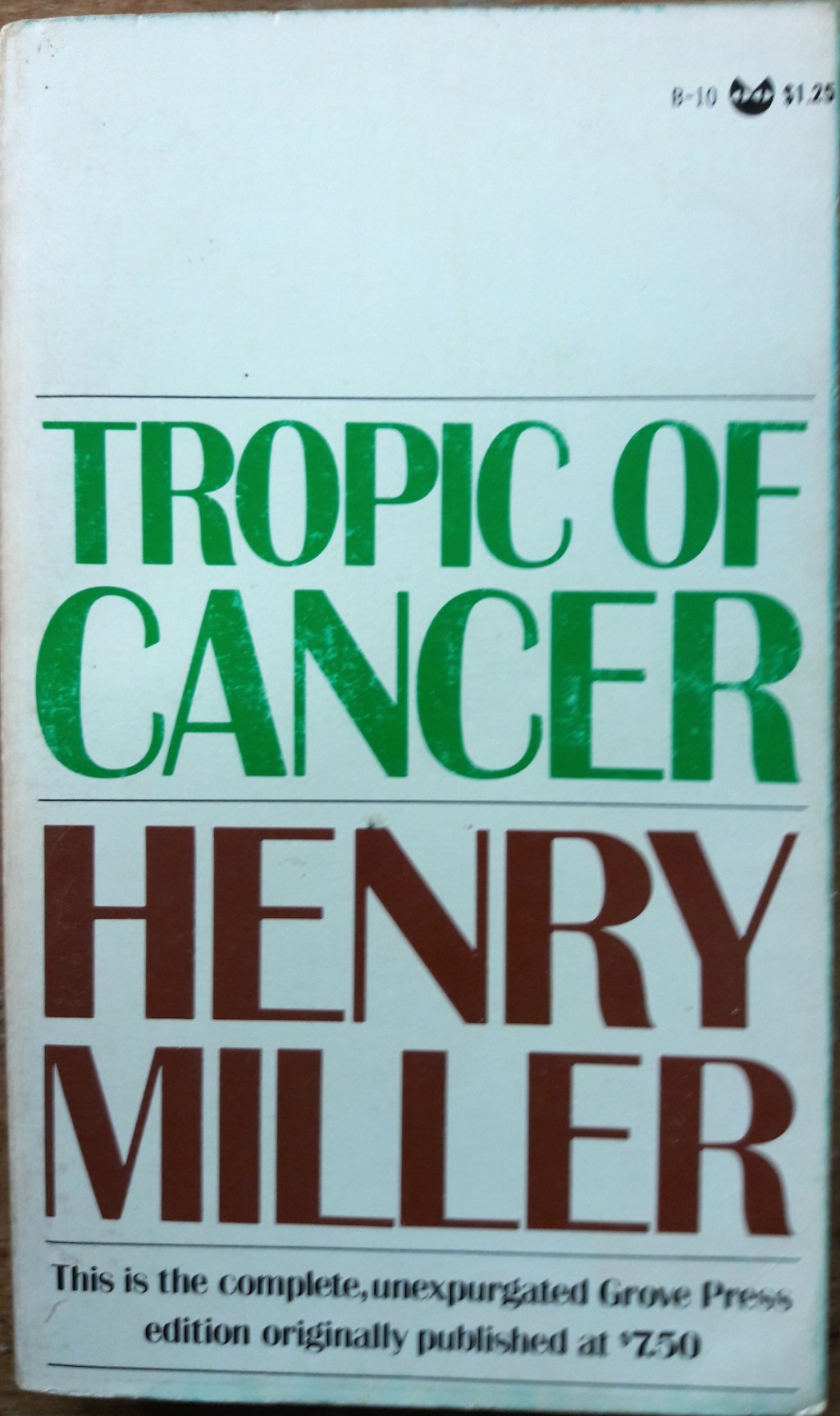
    Henry Miller’s “Tropic of Cancer”

    Henry Miller’s “Tropic of Cancer” contains everything Hemingway left out of “The Sun Also Rises,” which had left Ernest with the tincture of  a refined sentiment. That is one difference between the Jazz Age and the Great Depression. Turned out, we didn’t always have Paris; most of us never had it. From page 1 of Miller: “I have no money, no resources, no hopes. I am the happiest man alive.”

    I don’t remember when I first read “Tropic of Cancer,” probably ’68 or ’69. From my notes written on the back of the last page and inside the back book cover:

    art sing 1
    Liby 36
    whore – Germaine 40-43
    Popini 58
    artist 60
    America 86
    change 87-90
    room dream 114-116
    woman want 117 (45, 26)
    pimp & whore 143-144
    Matisse 146-149
    Russia America 154
    working with boss 158
    mona 160-166 (smile)
    Paris 162-188
    book 163
    moon 167
    paragraph (style) 167, 202, 216
    converse 171
    army 200
    Whitman 216
    gold standard 219
    writer 224
    what’s in the hole 225
    earth 225, 226
    idols 228
    task of artist 228
    inhuman 230
    art 229-280
    human 231-259 (view on goodreads)

    “Tropic of Cancer” was first published in France, 1934, Obelisk Press.
    My edition is First Black Cat Edition 1961 Fifteenth Printing B-10, $1.25.
    Introduction c 1959 by Karl Shapiro first appeared in “Two Cities” Paris, France.
    Preface by Anais Nin, 1934.
    No ISBN appears in the book, but the number “394-17760-6” appears on the bottom right of back cover.

    Yes, trying to do something with Goodreads for the new year. I’ll be putting up short reviews like the one above from some of my old reads.

  • Migrations

    Migrations“Not far from seedy Sandy Boulevard,” a local newspaper article read, some time ago, attempting to describe a seeming paradox of a nice neighborhood limited by the desolation of the average urban street, where Easter bonnet parades have given way to noir glassed evenings, streets that help distinguish the right from the wrong side of the tracks, spring from winter, beauty from irony.

    The planet Earth seems a benevolent seedy place, and how from this abundance of fruit and flowers moved easily about by breeze and bees come the ideas of poor taste, of good form, of appropriate policy and procedure, of social mores?

    History is an argument whose occasion has lapsed, the audience mesmerized, hypnotized, and a quick exit of pathos, the persuasion a torn curtain. For Joyce’s Stephen, in “Ulysses,” history was “a nightmare from which I am trying to awake.”

    Part of that nightmare might include migrations: caused by drought or famine; escape from prejudice and persecution; exile from war; fallout from economic, climate, or technological calamity; eviction notice from landlord; or perceived opportunity, where the grass simply looked greener on the other side of the street. There is an ongoing, small but worldwide, migration of corporate workers essentially homeless from forced relocation every few years, happily scattered about though, rare seeds, often heirlooms.

    The nightmare is humanity’s pollinator, its vector, its wind and breeze, river and sea, bee and fly.

    Gentrification causes migrations. Local news recently broke of a 127 year old building to be torn down on Belmont, where the century old trolley rail lines occasionally reappear, rising through the wear and tear in the asphalt street. By local standards, a 127 year old building is old, but not so old, maybe, by Parisian standards. Some might see the old Belmont building as having gone to seed, seedy, associated with sleazy; others might see history, a story that cannot be razed or covered. Whether it’s torn down or fixed up, the building’s current occupants will have to find new digs.

    But what is seediness? Why is the seedy scorned? Who creates the seedy? And how does seediness move? Who moves toward the seedy rather than away from it? How is life different for those gone to seed from the well bloomed and harvested? Behind the façades, however rich or seedy they might appear, is life in the back of the five star hotel the same as life behind the one star motel? Is five star bitterness five times more bitter than one star bitterness?

    One year, in Los Angeles on a boondoggle, we met up with some of the old gang for a couple of days adventuring in the façade capital of the world, Disneyland. We got rooms at a local hotel. The lobby looked friendly, the lounge ready for a beer, the courtyard intimate, the rooms dark but plush. Not five star, but not one star, somewhere in between, we imagined. We settled in for a nap with plans to reconvene later in the lobby and head out for some gumbo at the Blue Bayou.

    And then we saw the rats scurrying up and down and all around the courtyard palm trees, arms length from the balcony, plump, healthy looking rats, but did we want to share the night with them? We rustled up the energy to confront the front desk clerk concierge, and checked out free and clear for a clean well lighted place without rats. It did not take long to relocate and we were happily ensconced in a new place apparently fortified against rats. I did not disturb the group’s peace of mind, but I wondered where management might have kept the rats in this new place. In an urban landscape, one is never more that fifty feet or so from a rat. Something is always going to seed, never mind the season.

    The classy squirm away from the seedy, the swank from the stink. But they often meet in the noir. The cancer of cynicism does not distinguish the posh from the pinched. Textbook history often sounds like it was written from an airplane circling over a city cleansed of its seeds, and we see nothing of the city’s underground, where we might come face to face with its rats.

    “To become imbued with shades of grey, to blend into the drab obscurity of blind spots, to join the clammy crowd that emerges, or seeps, at certain times of day from the metros, railway stations, cinemas or churches, to feel a silent and distant brotherhood with the lonely wanderer, the dreamer in his shy solitude, the crank, the beggar, even the drunk – all this entails a long and difficult apprenticeship, a knowledge of people and places that only years of patient observation can confer.”

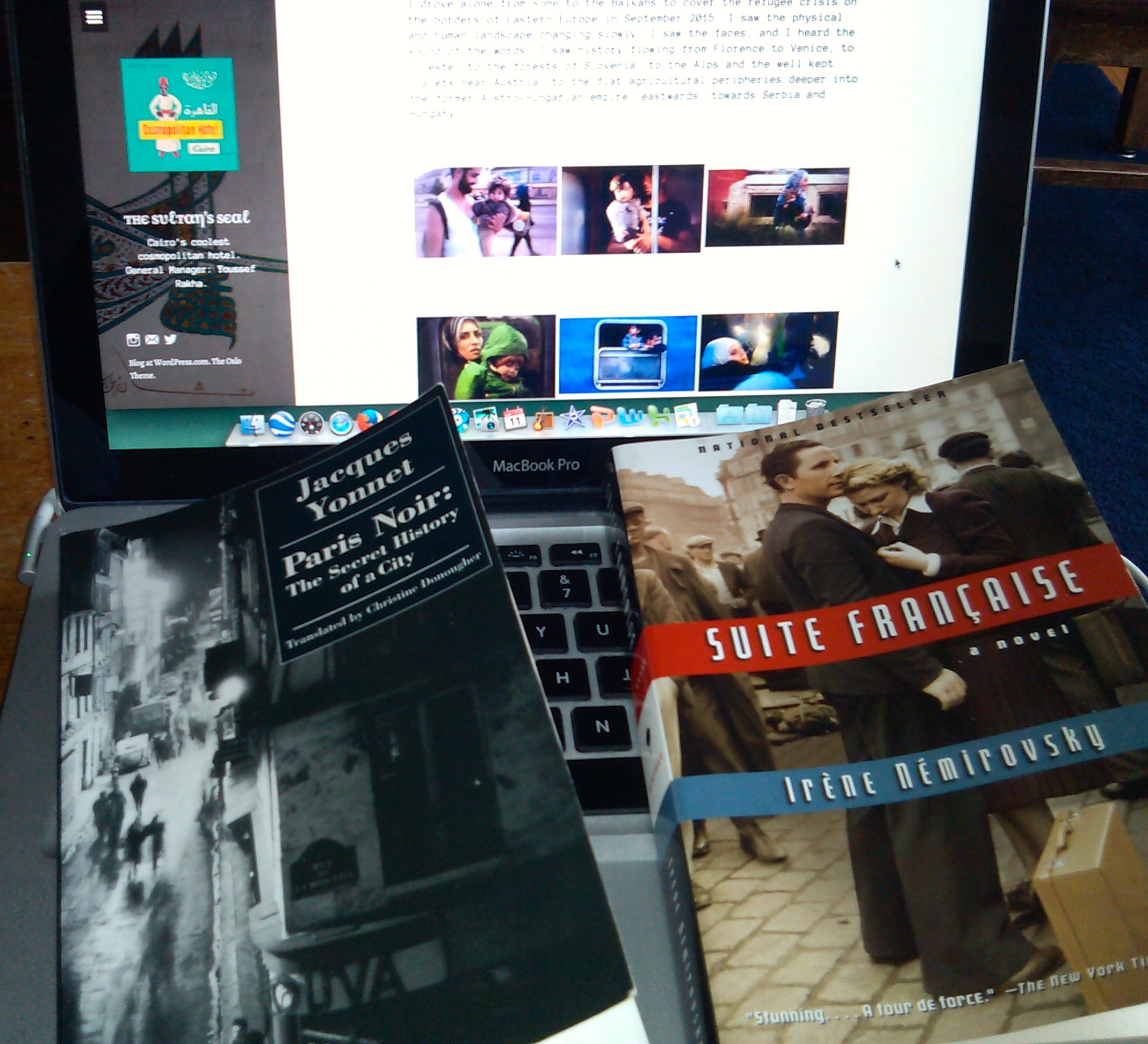
    We are in Nazi occupied Paris, in Jacques Yonnet’s “Paris Noir: The Secret History of a City.”[i] Most able Parisians have escaped and are on the run, many at the last minute, by train or car, bicycle or walking, long crowded lines moving generally south to southwest, ahead of the advancing Nazi army about to reach Paris. This migration is of course history: dates, names, and numbers dutifully recorded, but for a bird’s eye view of the ordinary trauma, conversations, blunders, hopes, and fears of the average Parisian fleeing the city, many packing as if for a vacation to the Midi, turn to “Suite Francaise,” a recently uncovered account in the form of a novel by Irene Nemirovsky, who died in Auschwitz.[ii]

    Yonnet’s book takes place in Paris during the occupation and after. The narrator works for the Resistance, running several missions and establishing connections and communications, always an eye on the patrolling Nazis, living in squalid conditions, associating with all kinds of gone to seed characters with names like “Keep on Dancin’.” The narration reads like a journal or diary.

    For the characters in Nemirovsky’s book, the trip out of Paris is a nightmare. Food is quickly scarce, as is petrol, cars are abandoned, train schedules uncertain, everywhere long lines of refugees on the move, unable to carry much, villages and towns empty of provisions, families sleeping out, feeling lucky it’s June and the nights warm, but then again it’s too hot. There’s nothing to drink, nothing to eat. A few enemy planes buzz overhead, explosions heard in the distance, and a few bombs drop near, the strategy uncertain, apparently to take out train stations, rail lines, fuel depots, but there are civilian casualties and injuries. And throughout the telling of it, Nemirovsky focuses close in, describing ordinary people caught unprepared in extraordinary circumstances.

    Samuel Beckett and his life long partner Suzanne would have been on the road out of Paris, walking, sleeping out, hiding by day, moving at night. Later, it would be said the roadside scenes in “Waiting for Godot” might have been first suggested to Beckett on his way out of Paris. And James Joyce and his family would have been on their way out of Paris, for Switzerland, Joyce concerned that the war would distract people from reading his latest book, “Finnegans Wake.”

    Some of Nemirovsky’s characters describe their predicament as horrible, nothing like it ever seen before, but they are reminded by others they are not the first, nor likely to be the last.

    New ethical environments quickly evolve, wrongs are met with a patient retribution, if not justice, both in Yonnet’s occupied Paris among the down and out, the deadbeat and seedy, the sick and infested, the fallen, and in Nemirovsky’s trail of humanity moving away from Paris, away from the city, away from an old life toward something new and unknown.

    Back in mid-January, the Egyptian writer Youssef Rakha posted to this blog, “The Sultan’s Seal,” a photo essay by the Reuters cameraman Antonio Denti (@antclick on Instagram). Titled “Upstream,” Denti’s essay begins:

    “I drove alone from Rome to the Balkans to cover the refugee crisis on the borders of Eastern Europe in September 2015. I saw the physical and human landscape changing slowly. I saw the faces, and I heard the sound of the words. I saw history flowing from Florence to Venice, to Trieste, to the forests of Slovenia, to the Alps and the well kept chalets near Austria, to the flat agricultural peripheries deeper into the former Austro-Hungarian empire, eastwards, towards Serbia and Hungary…”

    Denti’s photo essay focuses on the parents and children of the recent migration and refugee crisis. He calls his project a photo diary. It is “terrifying and beautiful.”

    [i] Jacques Yonnet, Paris Noir: The Secret History of a City, translated and with an introduction and notes by Christine Donougher. First published in France in 1954, first Dedalus edition in 2006, reprinted in 2009. 280 pages, paperback.

    [ii] Irene Nemirovsky, Suite Francaise, a novel, translated by Sandra Smith. Originally published in France in 2004, first Vintage International Edition, May 2007, 431 pages, paperback.