One story, unfinished, a fragment. The writing cools from a weak plot and flat characterization. The story fills the page we are on, but we may not be on the same page as others reading the same story (based on the assumption there can only be one story), and no one can page backward or forward. That other pages even exist is therefore without proof. Our story has grown since the first word, and continues to expand. The distance from the beginning to the end is therefore immeasurable. We will never have the whole story, but that’s another story.
Tag: Mechanics
-
Working Class Pub
Where no one knows your real name where indeed you have no name but any number of names but no number but you wear your identification it shows is shown in the red dust around your eyes and there’s a glimmer suggests you’re still alive and at the corners of your lips the moisture of bird feathers and your hands are calloused black and blue and your clothes are stained with oil and grease and chalk and shavings of wood, metal, and paint. This pub plays no music, which you wouldn’t be able to hear clearly anyway. No darts. No pool table. No television sets. No chess board, no backgammon, not even caroms. No playing cards. There’s coffee twenty-four hours a day for those just getting going, first cup free, the swing shift, the night shifts, at the factory, in the warehouse. The oil fields behind the houses. The docks on the bay. Molly brings you your pint, with a little cup of salted peanuts in the shell on the house. Will Molly please text home for you, a bit late, might stay for a second pint tonight, being’s it’s Saturday night, and you’re walking, or was when you got here.
-
“The Morning” & “Just Write Anything!”
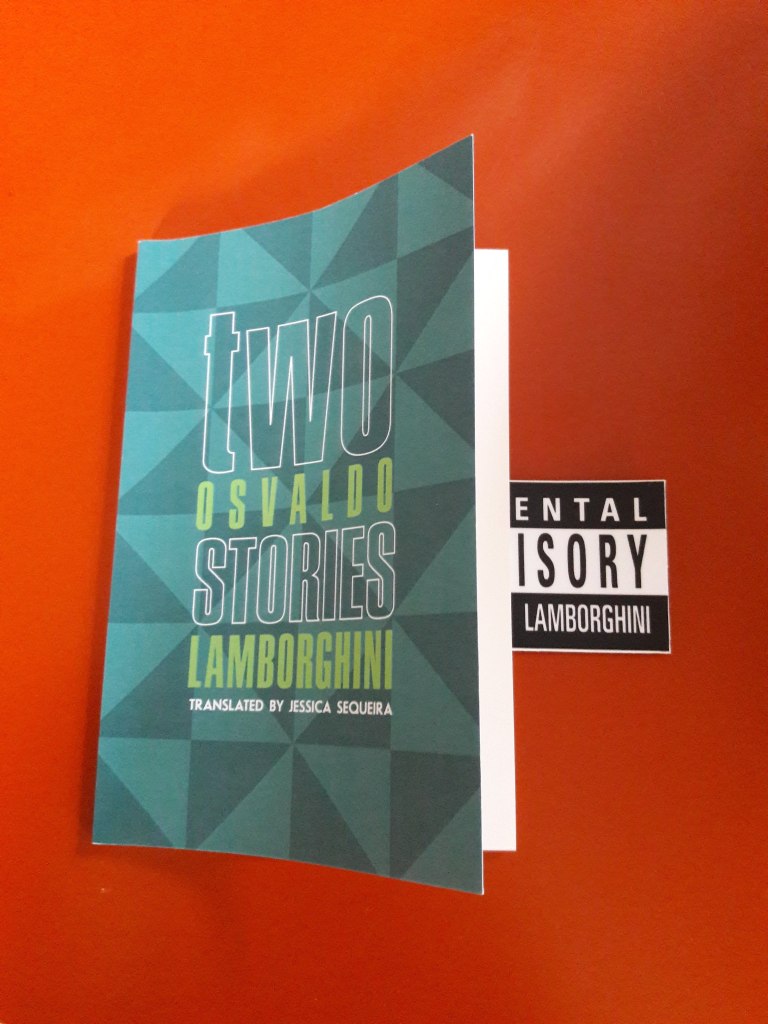
Two Stories by Osvaldo Lamborghini, translated by Jessica Sequeria, just out from Sublunary Editions (Seattle), measures a mere 80 pages (4 and ½” by 7” by ¼”) and contains the pieces “The Morning” and “Just Write Anything!” and also an introduction (by Cesar Aira, translated by Adrian Nathan West), an acknowledgements page, a 4 page translator’s note, and 62 endnotes (in a font size so small this reader’s used eyes required over-the-counter reading glasses of +3.50 strength), almost as long as either story – indeed, a third story – as well as a Parental Advisory warning label (suitable for bookmark use), modified to read:
P A R E N T A L
A D V I S O R Y
OSVALDO LAMBORGHINIOne is tempted to form a review as response in a supposed style of the stories:
In the beginning was the word. And the ice dam(n) broke, the word escaped, and all hell broke loose, as in a Blow-up. A devil’s drool (“Las Babas del Diablo,” Cortazar). It was all done on a typewriter. That tin bell kept us awake. Its tintinnabulations. And he had to send his only son, or daughter, as the case may arise, to supply some endnotes, but he didn’t explain to what end. And the notes musical, in a sense, pleasant. One confessed to eating the plums. Bless me Father, for I have eaten the plums. They were purple. And the season Lent. We had given up meaning for the season, without reason. And the church filled with words, every pew stuffed end to end. And every word related. In each word all the genetic material of the language, of all the languages, of the uttered universe. Prokaryotic flagellum. To allow word movement. The words stood, knelt, sat, stood, and filed out, one by one, pew after pew, line after line. Some disappeared. Through the blank pages of the cosmos, along the gaucho trails along the green rivers in the gorged valleys below the ghastly ghostly mountains, seeping through the pampas and the full drainage basins, out to sea. The sea, the sea! Wordomics. This is my body, a comics: “To ourselves … new paganism … omphalos” (Joyce, Ulysses).
Of the two stories, “The Morning” and “Just Write Anything!,” the latter is perhaps the more accessible, comprehendible if not understandable, than the former, but the first, “The Morning,” one might find more enjoyable. The two stories might have been written for two different audiences (although Aira’s introduction suggests Lamborghini didn’t write to any particular audience), but neither seems within the purview of the common reader. But what is within the purview of the common reader? Slogans? Well, slogans are comprehendible, but rarely understood. They become like magic words, spells. In the US today, MAGA might serve as an example; an argument of proposal in no need of backing, it is not an argument at all, but an order, a command. Authoritarian. Enter, sex, and why we need a parental advisory. Sex, like politics, manipulative, special interest, you scratch my back I’ll scratch yours. For the working class, sex is one thing, for the middle class, something else. The middle class wants relief from guilt, a guilt the working class does not feel. The middle class wants to enjoy, to experience pleasure, guilty it has benefits others don’t, but not enough that it can’t also enjoy envy of those who have more. Thus the middle class craves perfumes and brands, must have fantasy and escape, ritual that includes punishments and rewards. The working class has not time nor appetite for values which can’t readily be seen, measured, felt. As for Peronism and whether or not readers need a background in Argentine history to appreciate Lamborghini, Peronism might not be substantially different from any other ism around the world seeking to exploit one class by numbing another class for the enrichment of a third class, except that Peron started out wanting to make all of the people happy all of the time. But of course there are always those who don’t want to be happy, or don’t care to be made happy. Politics is sex without love.
In other words, for the working class, the word innuendo means exactly what it sounds like, while for the middle class, it can only suggest what cannot in what is sometimes called polite society (on the endangered species list) be directly talked about, and must be submersed in ambiguity, doubt, and mistrust. Enter Peron, that is to say, to wit, an imputation that what is valued most in each class can somehow be conjoined, but the ballroom can’t hold everyone.
Click here, on the belly button, where you were tied to your mother, treading water in the salt marsh. You were still nullifidian then. All gills and fins. Your mother’s voice coming muffled through the cloudy water. And then your cry, and then your sucking, and then your sleep, and then the tin bell, and the rhythm rolling. The next time you awake, you are swaddled in the bottom of a dory, your father at the oars, your mother tending a fishing line, all against a muddy current in coastal waters.
Lamborghini’s writing is probably not egalitarian, not as evidenced by these two stories or the three poems appearing in Firmament No. 1 (Sublunary Editions, Winter 2021), not that it needs to be, yet it contains all the characteristics readers generally value. Humor surrounded by horror. The sweets and sours and bitters and salts of life. It is a writing of associative addition, one image conjuring up or giving way to another, the narrative like a bus ride, the bus stopping at the end of every sentence to let someone off and to take on another rider. Though these riders are not necessarily characters – they may be ideas, or props. Repetition is therefore valued, and memory encouraged. So that at the end of “The Morning,” if asked what it is about, we can say it is about a character savaged. But the common reader wants her back scratched, not whipped.
The form (forms) of these two short stories appears very different in each, the one on the open sea, the other back and forth where the rivers spread in the tidal marsh. Jessica Sequeira’s “endnotes” are indispensable, and actually a pleasure. For one thing, it’s comforting as a reader to know you’re in the same boat as other readers, translators, critics. That is to say, the difficulty is not yours alone, not yours at all. You are now able to read. And while the endnotes clarify, elucidate, inform, they also project, surmise, guess.
Sublunary Editions is an independent press out of Seattle. You can find a copy of Two Stories by Osvaldo Lamborghini here.
-
Whether Weather, or Not
One thing might be certain as we embark onboard ship 2021, there should be weather. Notice the qualification, for there are times when the weather seems to disappear. These are the days we sit out, barefoot, open, a grassy hill overlooking the houses and farther in the city, where the cars are the size of ants and behave accordingly, one on the tail of another. Whether or not we enjoy the weather seems to be a matter of taste. An old friend called on Thanksgiving to say hello. The weather here Thanksgiving week was cold but calm and mostly dry, highs in the low 40’s, lows in the high 20’s. In the afternoon, we put a couple of cafe umbrellas over the deck. The plan was to set out dips and chips and cut fresh vegetables, drink a beer or two, and grill some goose (aka chicken), and eat on the deck, three in our party, masked and distanced, at separate tables. Jacketed and hatted with blankets to drape over one’s legs. A small outdoor heater provided a psychologically friendly red hot burner, but its heat dissipated quickly and wasn’t of much practical use. Still, there it was, in the center of things, and we took turns moving up to it to warm our hands and seats over the fire, as it were. Meantime, down on the southern coast, winds over 100 miles per hour blasted away at Cape Blanco. I briefly described out situation, our predicament, over the phone to above said old friend, and asked for a description of his plans for Thanksgiving. He said it was too cold in their location to eat outside. What’s the temperature, I asked. 65, he replied. Degrees, or age? I wondered. Now, here, we are in the throes of a wet January winter, the temperature mild, highs in the 40’s, the rain coming as it does off the Pacific, moving inland over the valleys, pushing colder air to the east of us. But the point of this little post isn’t to sound like a weather report. Still, the weather is with us, and we ignore it at our peril. Better to go out into it, walk unsteadily the tipsy decks of ship 2021, the better to say, if we survive the storms, we lived them, and did not cower, though we did mask up, even if we might sound like our favorite Shakespearean Dad:
“Blow, winds, and crack your cheeks! rage! blow!
You cataracts and hurricanoes, spout
Till you have drench’d our steeples, drown’d the cocks!
You sulphurous and thought-executing fires,
Vaunt-couriers to oak-cleaving thunderbolts,
Singe my white head! And thou, all-shaking thunder,
Smite flat the thick rotundity o’ the world!
Crack nature’s moulds, an germens spill at once,
That make ingrateful man!” -
Chess Puzzle
The chess pieces, old, dry, and frizzled, can only sleep, but as alive as cold-blooded bees in winter they dream of moves, puzzles, contretemps, and suck honey from the hive of time. They cluster quietly, clot in knots, in symbiotic formations, each exchange of pieces in turn reconstituting a meal in which each guest eats at the table of the other. Condemned to the board, the bored King snores while the Queen stirs the hive to action, cleans house, chasing the pawns this way and that, has knights jumping over the furniture, splits and clefts the sliding Bishops, insanely, apparently, willing to surrender their position to move closer to their dreary King asleep like a fossilized cat on the love seat in the living room.
-
Comma and Anti-comma
Is the comma in danger of extinction? Here at the The Coming of the Toads commas have fallen out of favor as we have begun to eschew the common comma, not all commas, and the comma in writing (where else is it used?) still remains an effective tool for the common reader, but sometimes the right word in the right place creates its own pause and nothing more is needed by way of punctuation, for the common reader or the anti-reader. Of course commas are used for more than to create pause. The comma used to separate items in a series, red white and blue, for example, often punctuated as red, white, and blue, keeps the colors from running together. The comma evolved from the colon and suggested something cut out but today the comma is used to add on, to amplify, to continue, to ramble on, sometimes unmercifully, the end nowhere near, the sentence a structure of lean-tos, each clause flipping about like a butterfly which may look to the common reader indecisive. Then there is the comma butterfly, also called angelwing, and what writer would want to eliminate angel wings from their writing, not us. Whoops, that’s anglewing, not angel wing, a mistake no comma can rescue. Still, the happy discovery that commas may suggest angel wings gives us a lift.
-
The Apostrophe of Waiting
You took away the source, but it was some graffiti, as I recall, but now in the grog of morning’s woke fog, I forget what it said, but one of the words was missing an apostrophe, crowds, I think, should have been crowd’s. The crowd is awaiting its apostrophe. So something is missing, the elemental that connects. That’s the meaning of apostrophe – an elision, but more, to turn, to turn away (from), even as things merge, as in a crowd. The apostrophe, like a stray bird, lands in the nest of merged things, its meld. The crowd is awaiting its possession, what it wants, its melt and weld. Also, the apostrophe that is an address to a missing person, one who has been turned away, or is turning away from another, as the crowd disperses. Waiting’s apostrophe. Waiting for the bird that has flown to return. As the crowd scatters, like birds, each one turning away from their neighbor, coming apart, each now a new apostrophe looking for a new gathering, a new mustering, a levy of birds, where they can drop into place to satisfy the whole. And today’s crowd of words is punctuated by the police, steel pot helmeted commas out to enforce the gravity of grammar, but they seem unable to put a stop to the run-on sentences.
-
Part of the Game
Fans of baseball and elections found suspense and drama in the long playoff series closing the 2020 seasons, some with delight, others with disappointment, of course, but to say despair is too much; after all, it’s just a game – one in which many fans show not much interest until the end of the season when the pennants are up for grabs, the news and ads full of hype and hyperbole, the waving of bunting pandemic. Baseball fans were heartened to see a fair play series between the Dodgers and the Rays, particularly after the Astros allegedly stole championships with their sign stealing campaign now exposed, confirmed, and penalized in scandal for the 2017 through 2019 seasons. The record books for the 2020 baseball and election seasons will be forever checked with asterisks for the influence of Coronavirus disease 2019 on the play and outcomes. Assumptions got tested, predictions again found presumptuous, and predilections and presuppositions exposed. And the utmost importance of audience was heralded, as fans insisted on being a part of the game.
-
Under Surveillance
To hobo is to work gig to gig while wandering. I was not a bum or a tramp, not to disparage those good folks. I was not a beatnik or a hippie. I ran out of Sylvie’s pills but the chip on my shoulder did not grow back. I did not run around or stand on street corners with a veteran sign hanging around my neck. I was not a superhero, nor an antihero. To look at me, talk to me, you would never guess I was a god. I was not a surfer or a hodad, a punk or a hood. In terms of socio economic demographic analysis, Venice was a good fit for me, where, it was sometimes said, figuratively, by those not in know, ignorant of street life, the Los Angeles sewer meets the sea (literally, the sewer meets the sea in El Segundo, at the Hyperion Water Reclamation Plant). I was not part of some well intentioned social worker’s caseload. I was not out on parole, had no record, though I stood ready to assist with whatever community service might come my way. I was not on the run. Neither was I looking to put down any roots. I had a few old connections still, friends, if you didn’t ask for too much: Sylvie, Wormy, Ray, Walter. As I may have mentioned earlier in these episodes, I remained aware of my privileged position, and would not claim that I was in any way independent of society, though I would argue I was free of many of the systemic webs most are caught up in, often unawares, even if caught for a lifetime. I had few needs and even fewer wants. I had effectively disappeared. I was no longer a person. My only daily target action plan was to avoid impeding another’s notion of progress, physical or mental, to avoid falling into a bucket of crabs. So I was briefly startled, continuing my way north along the Venice Boardwalk, seeing the yellow hummer reappear at the end of a side street, two obviously holding thugs hopping out to greet me. The inside of the hummer, its back windows blacked out, was modified and equipped with high tech surveillance tools: computers, high powered scopes, cameras, radios, closed circuit electronics, biometric kits, affective computing tools, face recognition and thermogram devices and screens, wireless tracking devices, microchip implant kits, covert listening and GPS tools. The yellow hummer was a spider in a webbed Internet of person things (IoPT). We’re private not government the thugs were quick to assure me. Sylvie asked us to set up a Zoom chat with you. She’s concerned you’ve not been answering her text messages.
“Under Surveillance” is episode 56 of Inventories, a Novel in Progress in Serial Format at The Coming of the Toads.
-
Cut and Run
By the time we finished packing and loading up the car with goods for the girls and Tilde it was too late to start out for the long drive to Frisco, so it was decided we would stay the night at Tilde’s parents on the canal in Venice and get an early start up Highway 1 come morning. Tilde insisted I install car restraint seats for the girls, the full rig for Harriet, who was under 8, and a booster seat for Nancy – thus we’d be legal and safe. But it took some time for me to modify the seat belts for proper fit, and I had to make a trip in her father’s pickup to a local auto parts store. Meantime, the girls were helpful in packing and loading up their own gear: dolls and teddy bear; blankets and pillows; notebooks, crayons, and pencils and pens; magnifying glasses; a violin and a Martin Backpacker guitar; books; sunhats; backpacks with clothes, water bottles, cell phones and chargers (this last forcing another errand to the auto parts store for an adaptor that would allow for charging devices using the dashboard cigarette lighter); dog food and dish and water bowl. With Tilde’s father’s help I attached a surfboard rack to the roof of the car and tied off the girls’ two bicycles. Tilde packed into the trunk a 5 man camping tent, a camp stove and lantern, and a bigger cooler stuffed with food, ice, and drinks. Tilde’s father, the girls called him Papa Papa, wasn’t a bad guy, and we got to talking about life in Venice living on the canals, but as an alleged close friend of Wormy, I got the cold shoulder from her mother, and was consigned to the front porch on the canal for sleeping quarters for the night. Tilde slept with the girls in their room, her mom stowed away in the master upstairs for the night, and Papa Papa and I sat out on the porch watching the water and drinking beers and when the beer was all gone turned to a bottle of Scotch Whiskey. We talked into the wee hours, and I awoke late in the morning, the house closed up and quiet, a note taped conspicuously to the porch door: Dear Glaucus, I am perfectly capable of driving myself and the girls to San Francisco, but thanks for your help. Good luck, Tilde. Out back, I saw that Wormy’s ’56 Chevy Two-ten packed to the gills was gone. Tilde had left my cowboy roll on the porch for me, and I hooked up and headed off in the direction of the Venice beach and boardwalk, first letting loose with a vociferous hobo piss in the empty alley, footloose.
“Cut and Run” is episode 54 of Inventories, a Novel in Progress in Serial Format at The Coming of the Toads.
 The Coming of the Toads