Tag: Mechanics

  • Size Matters

    Nothing moves unless moved
    yet every mote of dust
    scintilla of whispered light
    black crow in pine snow
    still falling all falling.

    For verily I say unto you, Till heaven and earth pass away, one jot or one tittle shall in no wise pass away from the law, till all things be accomplished.

    Matthew 5:18 KJV

    All things all thoughts
    big and small
    full and empty
    macro and micro
    one and all
    universal and local
    sacred and profane
    church and tavern
    zero and infinity
    one and none
    colossal and small
    corporeal and paltry
    carnal and spiritual
    tittle-tattle and –

    and so on and so on

    For that which won’t be
    seen or measured
    is big
    but anything you can take
    a ruler to
    is small.

    If all you can
    do is compare
    one thing
    to another
    you are missing
    both
    size and matter
    what is
    and what is not.

    The biggest is yet
    to be seen
    the smallest
    to be measured:

    For by him were all things created, that are in heaven, and that are in earth, visible and invisible, whether they be thrones, or dominions, or principalities, or powers: all things were created by him, and for him.

    Colossians 1:16 KJV
  • Zest

    Writing poems, you want to focus
    on what to leave out; for example,
    leave out phrases like for example,
    one of the academics on a jaunt.

    The leaves fall; for example,
    consider the maple.

    The maple tree green
    red-orange
    suddenly bare.

    Another academic wishing
    he was a real poet
    and not just another drunk
    in a bar after his night class.

    Leave out articles, too (the, a, an).
    And add detail with specificity.

    The maple tree lime green in
    spring turns to fall and rust.

    Use a dictionary to make sure
    you’ve got the best verb
    for the occasion:
    turns might become (now or later)
    lathe, which suggests circular motion:

    Lime green leaves
    limbs on lathe
    leaves shaved
    disposition zest.

    Also important to think
    about when to leave
    the poem
    alone
    go home.

    But new ideas will arrive.
    The place gets crowded,
    maybe noisy:

    The poet bartender
    adds a piece of zest
    to drinks she prepares,
    which twists what
    is said, lips pucker
    distastefully sour –
    better just have one more
    and then get on home.

    At the Spinning Lathe Bar
    on each stool sits
    a ball of yarn
    she looms back and forth
    warp and weft
    she sheds, picks, and beats
    takes up and lets off
    replenishing drinks
    replacing fresh pints.

    Midnight and she wants
    to go pee and go home
    leaves cover the way
    streetlights smolder
    black branches wet
    she approaches the stairs
    of the Metro and falls
    amidst the rusted leaves
    still wearing her bar
    stained apron.

    She undresses in front
    of the backlit window
    her breasts are orange
    tipped her yellow hair
    in the streetlamp light
    flooding her bedroom.

    She climbs into bed
    thinking Spring is
    a seemingly happy
    drunk Fall often sobers.

  • Punctuate Yourself

    Punctuate, yourself.
    A few points on punctuation.
    Punctuate yourself!
    Can we pull over, please?
    I have to go punctuate.
    But there’s nowhere to stop!
    I’m going to runon.

    Imagine you’ve just finished a possibly remarkable poem (into which you’ve poured the decanted, pure liquid of your heart and soul, not to mention other vital organs), if a poem can be said to ever be finished (be it ever so humble), in any kind of existential sense (which we know it can not – can never end), and the first, perhaps the only, criticism that is offered remarks on the lack of commas or periods – a comment on the punctuation used, or not used, in your poem, ignoring the fact that an apparent absence of punctuation is, still, a kind of punctuation. But in fact, your poem is called (critics love name calling) a run-on sentence. Or, in any case, that’s the only comment you get, that there’s a run-on indeed there is so you have no or little defense.

    But punctuation is pertinent to poetry, and poets should take due care to punctuate their poems. What is punctuation? We often, maybe, think of punctuation as a tool used to separate. To insert. To come between. A wedge in thought and time, or speech. We insert a punctuation mark. We dot. We apostrophize. The punctuationist seeks to achieve stasis – no more morphological change, by which we mean the study of shape. Punctuation, then, suggests change. To mispunctuate is to risk sudden change in selection and variation – in other words, to introduce ambiguity (mutation).

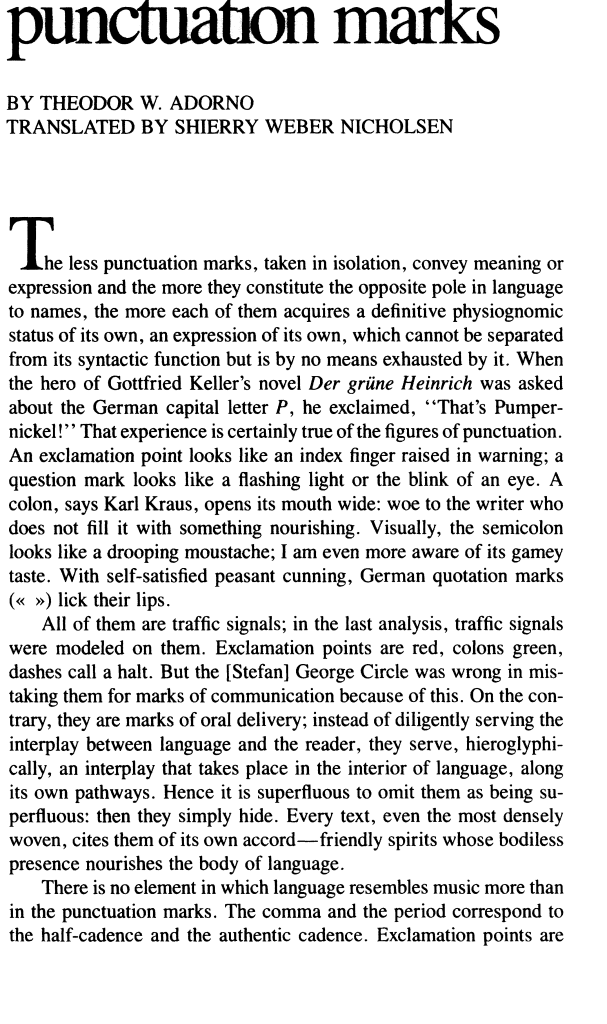
    Adorno wrote a short essay on punctuation, on punctuation marks, to be specific – as if punctuation consists of a kind of graffiti sprayed across one’s text.

    Note how Adorno moves from anthropomorphic comparison to explaining writing as driving a car. And then apparently turns on the car radio, and there too, in the canned music, finds punctuation. He thus shows the difficulty of even talking about punctuation as it might exist in its own right.

    We find punctuation endlessly interesting, and appreciate the attempts of our readers to find clarity and avoid ambiguity in our writing. Unfortunately, achieving clarity and avoiding ambiguity are often not the primary aims of poetry. What is clear is often opaque. What is meant is often not what is meant at all. This is not to suggest that poetry is a game of hide and seek (though that does often seem to be the point of the universe). Poetry may indeed be viewed as a kind of punctuation – where we insert in our day or night a comma or period of rest and pause, of relaxation, where, or within which, we may reflect and attempt to come to terms with our predicament.

    Indeed, we might even say that poetry is punctuation. And punctuation is poetry, even if mispunctuated.

  • Art from The Arc

    I paint for the same reasons I write: it’s a physical activity that is peaceful, happy, and all about light. Though for some time now I’ve not been painting much. When I do paint, the images come from some underground reservoir, the same place many poems come from, a vision from the inside, if I can say so without sounding too psycho, as opposed to en plein air, painting what one sees on the outside. I read recently that Monet painted dozens of scenes of the River Seine – the same scene over and over, but each scene in different light. I’ve never seen a Monet painting in person, only pics of them, often the light different in each photo, and I’ve often wondered what Monet would think of that, the light in his paintings changing with each reproduction. The light in a parlour or museum likewise might change the scene as it was seen and painted. That effect is not unlike sound effects, where the splendid, carefully practiced arpeggio heard on the radio is accompanied by static, a dog barking in some distant yard, or a trash truck picking up the street cans and noisily dumping them into the void.

    I did see some Rothko paintings in person, some time ago, at a show at the Portland Art Museum, and I was surprised by how thinly he applied the paint to the canvas. You could easily see the warp and weft of the canvas. Of course you’re supposed to view from a distance – the same distance for everyone? One’s eyesight too changes the light. Way back in my school days, I once tried to argue that Monet’s impressionist style was the result of cataracts, but I was struck down by an art student who argued that the work of the impressionists was the result of an art theory they had invented and implemented as a complicated statement on reality and vision. I still think it might have been cataracts.

    I started painting with my two granddaughters when they were little and liked to play with paints, unconcerned with talent or any kind of “I can’t draw” self-criticism. We all three painted for the same reasons mentioned above: peaceful, happy, and light. And fun! At first I bought new canvases from an art supply store, of modest size, 20″ by 20″ or so, but I then started to find large canvases at garage sales, priced cheaply enough, far less than I was paying for the new ones at the art store, and I bought them for us to paint over. The garage sale finds were not Monet’s or Rothko’s, so no harm was brought to the art world by our painting over them.

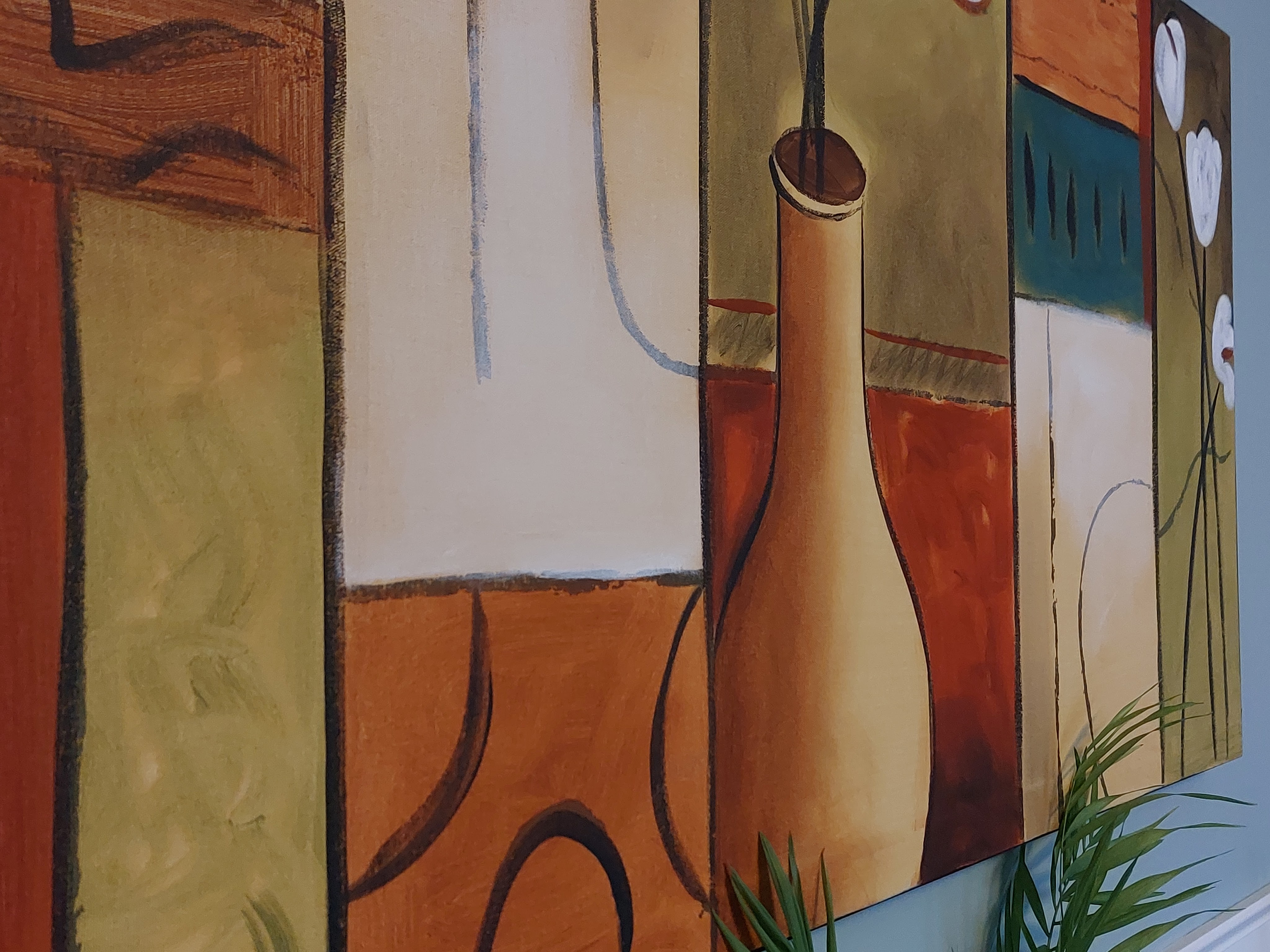
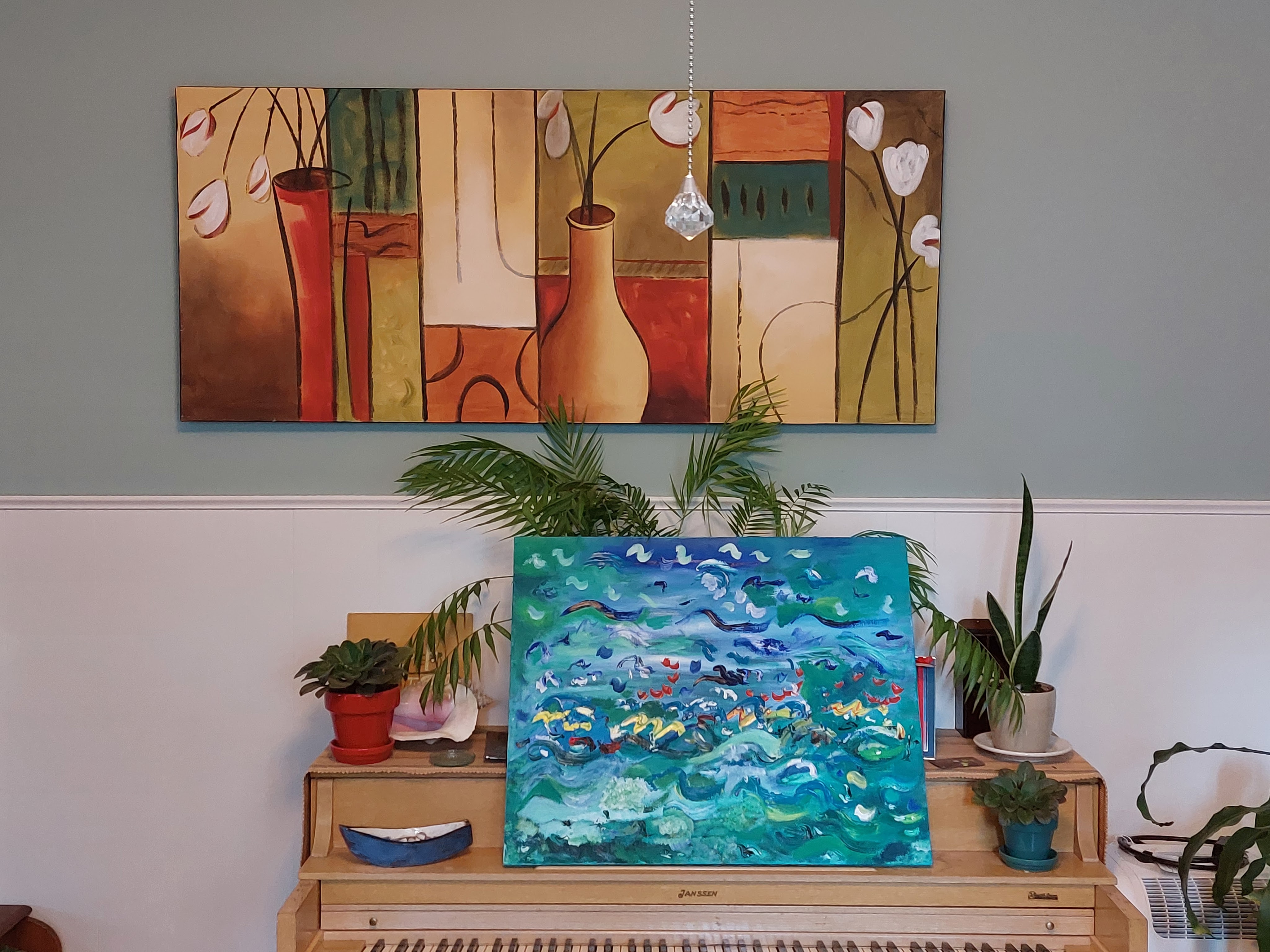
    Recently, over at The Arc, a non-profit thrift store not far from us, out on the sidewalk, against the wall, behind some smaller items, I spied a large canvas, 26″ x 60″ x 1 & 1/2″. They wanted $10 for it. A great find. The visions of what I might paint over it started drifting in like a slow moving moon, the light in a park changing by the minute. But when I got the painting home, a canvas print of some sort, the kind used to decorate hotel rooms or small business lobbies, I began to have second thoughts about painting over it. Something about it said no, put me up as is.

    So I did, and here it is, for your critical review. Please leave a comment! Is it art? Is it good? Why, why not? …B, care to comment? Ashen? Dan? Bill? Barbara? Lisa? Susan? All you artists and art aficionados out there?

    The pic in the bottom right corner shows one of my basement paintings, sitting on the piano, which I took down to hang the Arc find.

  • Variations on a Theme

    One word at a time.
    Onewordatatime.
    At a time one word.
    At a word one time.

    Word data time.
    One word one time.
    Timeword dow.
    Wordtime.

    At a one time word
    at a me wime tord
    da da
    ta ta

    twon word town time
    drown mod me at
    meet word time mate
    mata mada

    one word at a time
    at a time one word
    a word one time at
    a time word one

    excuse me sir
    you dropped a word
    dripping yes
    time drow

    don’t look
    for nonsense
    where there is
    none

    look to the heavens
    look to the skies
    look where
    you’re going

    look at the mud pies
    stuck in the gutters
    rise rise rise down
    falling swimming with

    outword crescendo
    there is no progression
    now is the time
    to decompress

  • Inwait

    Inwait watching listening
    to what he wants to hear
    then to critique that lesson
    passably betraying purpose
    occasion audience intent
    the critic in wait teases out
    the objections passive
    aggressively indirectly
    disconnects the circuit
    breaks the circle of care

    the critic lies in wait
    for pretentious chichi
    affectation of what is
    stretched thin to impress
    takes a back seat alone
    in the cynical corner
    and enjoys the play

    meanwhile the husband who hopes
    the woman who kneels knows prayer
    the child who tries to please and fails
    drama takes place in an empty house

    words linked absurdly together
    like barbed wire avoid likes
    but attract comments like flies
    to sweet sticky paper

    happens all the time
    you who always
    those who never
    it argues thus
    near dusk
    all at once
    it comes out
    without revision
    without a second
    thought

    that’s ok it’s not easy
    hitting a baseball
    being social
    attending holy mass
    body and blood
    sitting alone
    writing a poem
    being a critic

    keeping the secret
    watchdog beware
    keeps it chained
    to his heart barking
    champing at the bit
    coughing up crud
    it’s not easy
    being a critic
    lying in wait
    taking the bait

    still the sun also
    rises and climbs
    and falls but too hot
    too cold too close
    too far away
    too bright too long
    too short a day
    for the critic
    on the hunt
    for something to say

  • Comma Splices

    If I wanted to use one,
    I’d use two, one for me
    and one for you, 4 to a
    bar, 5 to a fence.

    Comma connotes pause,
    like a cat’s paw does,
    when lifted midair.

    Pick up your comma poops,
    put in scoop bags,
    and place in the trash can.

    The Once and Future Comma Queen
    will return to Gramarye.

    Pause, and enjoy, an ice
    cold comma, tonight.

    Harmonic Bohemian Comma Scale:
    lunula moon, clipped ring finger
    nail, crow talon, gypsy jazz plastic
    guitar pick, muddy udder rudder,
    silent scythe, silver clacker spoon.

    There is no substitute
    for a comma, either
    you use one or you don’t.

    Comma rules form
    a book of spells,
    a Grimoire.

  • Subbing in Substack

    I spent a few hours this week delving into Substack, the online self-publishing venue giving independent writers the opportunity to build a syndicated portfolio intended for a dedicated audience of subscribers who read for free or pay, often on sliding scales, the writer usually offering more content to paid subscribers. It’s a little like busking, where the musician sets up on a busy street corner and pulls out the axe and puts out the tip hat.

    One great plus of Substack is that there are no ads, few distractions. The presentations I’ve seen are clear and clean. I was already a free subscriber to Caleb Crain’s “Leaflet,” a combo newsletter of his bird watching photography and his lit-culture-watching writing, and of Julian Gallo’s “Cazar Moscas” – wonderful title that, which means to catch flies, or to fish with a fly, apt metaphor for Substack. When Substack began, in 2017, not too long ago but maybe a long time in online years, the idea was to establish a newsletter, so that with every Substack post an email notification went automatically to subscribers. And that’s how I still read Caleb and Julian’s new pieces. And this week I discovered and subscribed to Patti Smith’s Substack. I had become aware of podcast capability at Substack, and when I found Patti there, I saw that she was also putting up short videos, which I immediately found attractive for their simplicity, honesty, clarity. They didn’t seem to be performances, but downhome one way conversations, personal, if you will, in of course an impersonal, voyeuristic way. For example, I saw her in her everyday place in Rockaway, and it looked exactly like a lived in beach house might look if it indeed was lived in.

    Anyway, I had been interested in moving my “Live at 5” guitar gig from IGTV to some other venue, not really all that interested in seeing my seventy something selfie on the silver screen anymore, and growing tired of Instas addictive format, and I thought about podcasting, that is audio only, some guitar, song, story, poem, conversation. Then I became aware of Substack’s video capability and before I knew it, I was going live on Substack with a “Live at 5” show. Or so I thought. The whole enterprise ended in disaster. As near as I can tell, Substack does not enable live streaming. You have to upload either audio or video, and the videos are limited to, it appears, under 10 minutes. I had by Substack “Live at 5” showtime 16 free subscribers. I’m not sure what they ended up seeing or hearing, if anything. And then, late last evening, I discovered the “Live at 5” video I had made for Substack in the photo gallery of my Samsung device. It was just over 5 minutes long. I watched a bit of it, stopped it, and deleted it.

    Interested viewers may check out another version recounting my subbing at Substack experience here. I’m reminded of Dylan’s famous words, “and I’ll know my song well before I start singing,” an admonition I’ve never paid much attention to, and also reminded of the Nobel Prize time Patti forgot the lyrics, which was no big deal, but of course everyone had to make a big deal of it, as if pros never get nervous or forget the words.

    Where do I go from here? IDK. Real time with real people might be nice.

  • Changing Fonts

    Sometimes, mornings, sitting at the laptop, waiting for the groundwater to rise, words to develop, appear, as in a photographer’s darkroom bath, I play around backstage in the blog with fonts and settings and such as are available via the WordPress setup. The urge comes similar to that of wanting to move the furniture around in one’s pad, or rearrange the Picasso or Matisse paintings dotting the walls. Or move the plants around. I would tell you all how this is done (i.e. changing fonts), but I don’t want to be responsible for anyone crashing their blog and watching nine years of exceptional poetry or original street pics washed down the drain. And I’m not an expert, just an experimenter.

    Anyway, you perspicacious readers with good eyes for this sort of thing might have noticed a number of changing fonts experiments this morning here at the The Coming of the Toads. And, effective with this post, I’ve switched the entire blog to new fonts: Playfair Display for the Heading Font and Fira Sans for the Base Font.

    Other fonts I played around with this morning include EB Garamond, which I thought elegant but too light and tight, and Space Mono / Roboto, which I found fun and modern in a way one might be nostalgic for comics from the 1950’s. I thought Bodoni Moda interesting. But in the end, for now, anyway, I settled on changing sitewide to the Playfair Display and Fira Sans fonts. These are available via Global Styles in WordPress – at least in this, the “Seedlet” theme, they are available.

    While my primary concern when it comes to choosing fonts is to find something simply easy on the eyes, I want the type to attract the reader without calling too much attention to itself. At the same time, I find the historical background of font development interesting. For example, looking up Fira typeface in Wiki, I found this:

    “With the name Fira, Mozilla wanted to communicate the concepts of fire, light and joy but in a language agnostic way (sic) to signal the project’s global nature.”

    https://en.wikipedia.org/wiki/Fira_(typeface)

    Joy! And not only that, but I found that Fira Sans is used by the governments of both New Zealand and Iceland – their “font of choice,” according to the Wiki page I consulted. Ok, ok – if it’s good enough for them…

    Again, I’m not an expert, of much of anything, let alone fonts, but if one is to spend as much time as I do writing, typing, blogging, “publishing” (as it were), drawing, cartooning, doodling, it seems inevitable one’s interests will or might or should include typeface and type design. There you have it.

    Display font derives from sign making, text typically larger than the text found in the body of what’s printed. It seems most display fonts were originally hand drawn. Of Playfair Display, I found that it’s a font created by one Claus Eggers Sørensen. Who knew?

    One consideration choosing fonts and in fact doing anything on the blog these days, is the fact that readers are using all kinds of devices – desktops, laptops, tablets, phones – to access and read blog posts. So you want something that will lend itself to a variety of formats and devices. What you see is not always what you get.

    The Coming of the Toads blog, which dates posts at least monthly from 2007, and which began as a kind of addendum to adjunct activity, has gone through a number of changes in “theme” (template) design over the years. (Has anyone noticed?) Currently, the blog uses a “minimalist” design open to the WordPress block formatting. This seems for now a good fit for the drift to ever more poetry posting I’ve been lately most interested in doing.
  • Comma Toes

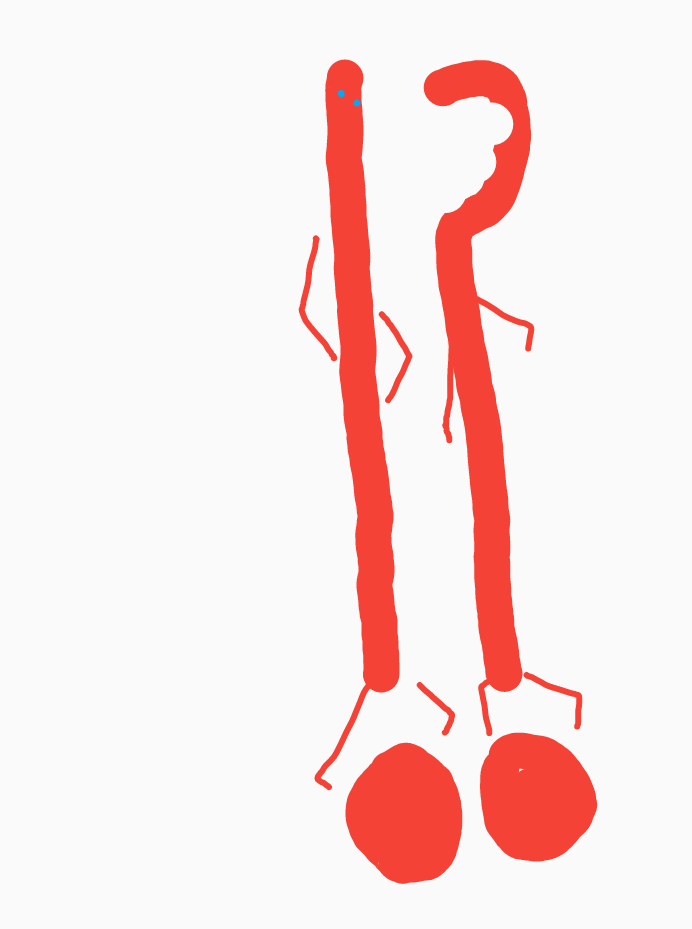
    Where to step a comma , 
    to tiptoe haltingly ,
    without readers tripping over it ,
    losing their way.

    A comma pirate drops his
    offshore ,
    as if it had a special purpose ,
    a bouncing buoy ringing a bell ,
    a porpoise out all alone.

    The comma critic , well-versed
    in elementary particularity ,
    vacuums up all the fallen commas ,
    the mote dust off a linoleum floor.

    The exclamation point shouts ,
    a telephone pole poised atop
    a bowling ball !

    While the ear shaped question
    mark asks the obvious ,
    ad nauseam ,
    comatose.
    “Why all the questions!” “Why are you always shouting?”
  • Intelligent Life

    Intelligence might mean an ability to exercise choice, even if the options seem limited or nil. A couple of weeks ago, meeting for a beer with fish and chips at a local English styled pub where soccer from the real England was playing on hanging television sets to an audience of rapt fans sipping beers, an old friend asked me if I thought there exists intelligent life elsewhere in the universe. At once I had to consider the definitions of intelligence and life and universe. I also had to consider that at first he said simply life, then qualified the question by adding intelligent, as if other kinds of life were assumed to exist but even if so had already failed some test of life.

    In the midst of this morning’s freshly updated global warming news, walking with a cup of coffee in ye olde Americana backyard, I stopped to consider again why the Dogwood tree now refuses to flower. About 25 years old, flowering reliably every spring until seeming to lose interest in recent years, full of healthy green leaves, not a touch of pink blossom does it this year yield. I would blame last year’s torching hot summer, when the temperature one day in July hit an unprecedented 116 degrees F, easily the hottest ever locally, or this April’s absurdly late snow storm, which piled a few feet of heavy wet snow on branches already leafing out, bending them all the way to the ground under the weight of the late snow, but elsewhere around the neighborhood all the other Dogwoods are blooming to beat the band, a bumper year.

    Maybe this Dogwood has simply chosen not to bloom this year. The reason may be nothing more than a desire to exercise its ability to choose. But where would this desire, seemingly baneful to its existence, come from? Or maybe the energy required to produce blossoms is being used to correct some deficit in the soil or water or location – but again, similar conditions around the area are at the same time thrilling all the other Dogwoods into fully blessed vibrant pink blossoms.

    What have I done to offend this Dogwood such that it refuses to bloom? At worst, I’ve ignored it, but the other plants in my yard seem to appreciate being mostly left alone to their own devices.

    Nature, left to its own devices, continually overseeds. It has always done so, blasting and piping surely enough that somewhere somehow something takes hold roots and spreads. But never alone, always sewn from a diverse bag of seeds, some seemingly smarter than others, whatever that means. And it means nothing. The same intelligence that informs me informs the Dogwood. Thus as I sit here in my attic room from where I can watch through the window the Dogwood willfully refusing to bloom, I choose to write.