Tag: Line 15

  • Abaft the Blues Fest

    Red-orange earworms admonish taptoo! fashion,
    now clear the drum is an old, beat suitcase
    rigged with foot pedal, and, too, there they are,
    tin bells on his curled toes, as literal as pencil lead,
    as calloused as an oak pew hymnal.

    Lavender fresh, she sang at Hop’s Hootenanny,
    sipped mint juleps from a food cart pulled
    by a calico cat in zither shade by a stream
    under an old willow, but the bell pull string broke
    under the weight of his monolog cartogram.

    On top of it, academic aristocracy whizzed
    by dressed in pressed berets and scholarly drafts –
    what difference they followed the leader or not?
    Collectors yodeled passwords, unlocking a juke joint,
    and raspberry chords popped up oily fishes.

    No need now to call placid plumber, three blue
    hydrangeas wilting in bath humid heat,
    down by the river, down by the wash,
    down by the singing and the top posh posts
    written with plush plumes of lacks and noods.

    Safe sound spillway falls, noise overflows,
    ears carp and loud lips cop bad press,
    but dolce glissando this urgently close still
    makes some sense, and at the first aid tent
    they polish their moonstone eyes.

    Paste fast food milk turns cast iron sour,
    and butter curdles her chlorine-yellow hair
    as they stuff bitter newspapers with trust,
    dogpaddling thru pull duck old cobwebs,
    but empty, golden juke boxes near finish him.

    On Line 15 on the way back home, the night
    quietly spinning, the river sparkling crinkly
    as the bus crosses the Hawthorne Bridge,
    a lone accordion pulls and lulls images only
    understood asleep or listening to music.

  • The Art of the Bus Stop

    It was to be his last day, he dreamed, a phantasmagorical dream
    recurred, after a cup of coffee, in wakeful brain, a near belief in seizure.

    How would he spend his last day? He should limit his options,
    if chance proved him a fool tomorrow, build a hedge of porcupines.

    But if today’s feeling did not pass, his options were not so limited.
    He could fly anywhere, stay in a Six Star hotel in bikinied Marseilles,

    fly to romance Rome and get in line for a final Papal blessing,
    parachute into the Mojave desert, jump off Saddleback Mountain,

    surf the Banzai Pipeline – like in the old days, take the board out.
    Who would dare cut off an old man on a wild wave on his last day?

    He got his surfboard out of the deep basement, his lovely wife still sound asleep.
    He walked down to the bus stop. He waited with his surfboard on the poetic bench,

    beneath the ancient acacia tree. The bustling bus came but the discreet driver said no
    to his putting the untethered surfboard in the bike rack on the front of the bus.

    He went back to waiting at the busy bus stop, and this is how he passed
    his penultimate yesterday, talking to bussers about the art of surfing.

    Related Posts: Winter is icummen in, Lhude sing Line 15
    Reading Roland Barthes’s Writing Degree Zero on Line 15

  • East Side Mt Tabor Photo Essay Walk

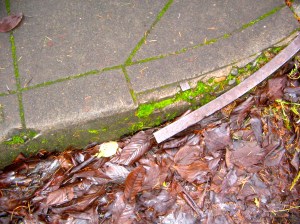
    The sidewalks in what used to be called Tabor Heights, on the north slopes of Mt Tabor, were poured in the early 1900’s. The dates are marked on the curbs, but many of the dates are being lost to code enforcement requiring homeowners to fix broken concrete in their sidewalks. Curbs rounding corners were banded with steel to protect them from wheels of horse drawn carts. The steel bars are now peeling off.
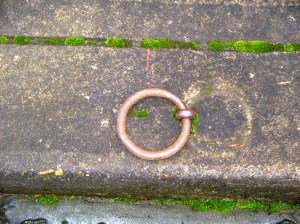
    Steel rings were placed into the curbs for horse ties. Some folks have taken to tying play animals to them these days.
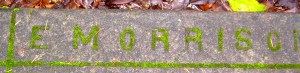
    The names of the streets were cut into the curbs.
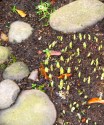
    John Lennon once said a poet’s job is to walk around and notice things that no one else has time for. It’s late December, but bulbs are already starting to come up, and noticing them, I was reminded of John.
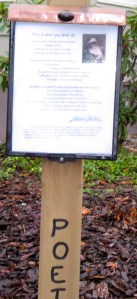
     

    There are a few poetry posts in the neighborhood. Today, this one contained Walt Whitman. I stopped to read it. Here’s what it says:

    “This is what you shall do; Love the earth and sun and the animals, despise riches, give alms to every one that asks, stand up for the stupid and crazy, devote your income and labor to others, hate tyrants, argue not concerning God, have patience and indulgence toward the people, take off your hat to nothing known or unknown or to any man or number of men, go freely with powerful uneducated persons and with the young and with the mothers of families, read these leaves in the open air every season of every year of your life, re-examine all you have been told at school or church or in any book, dismiss whatever insults your own soul, and your very flesh shall be a great poem and have the richest fluency not only in its words but in the silent lines of its lips and face and between the lashes of your eyes and in every motion and joint of your body.”

    The excerpt is from Whitman’s preface to Leaves of Grass.
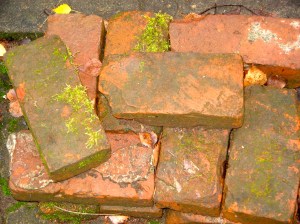
    Someone left a small pile of used bricks near the sidewalk. Maybe they are going to make a little stepping block. Used brick is very useful.
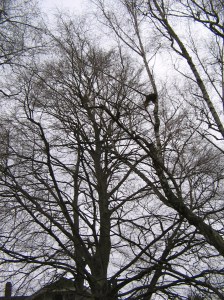
    The deciduous trees in the neighborhood are asleep. One of the biggest yard trees around is located on Yamhill, across from the small pile of bricks.
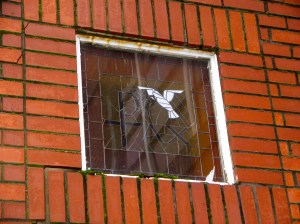
    In addition to a lot of bikes, beer, and beards (as illustrated in Alex Barrett’s This is Portland), there are a lot of churches in Portland. This stained glass window is at Ascension, on the corner of SE Yamhill and 76th.
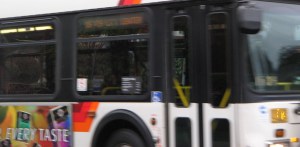
    Tri-Met Line 15 passes through the neighborhood. This one’s rounding the Ascension corner, continuing its westward route to Belmont and downtown.
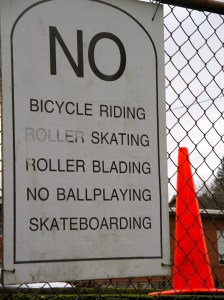
    The NO sign is on the fence of the playground-parking lot at Ascension. It was the occasion of a sestina (see previous post). Today there were a couple of bright orange-red cones by the fence. So much depends upon the bright orange-red cone; not sure what depends on the sign of NO. John Lennon might have written a song about the sign of NO, instead of a sestina.
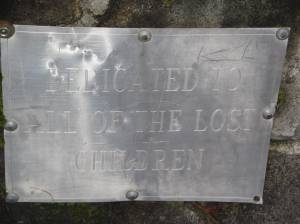
    Just below the sign of NO, on the wall, is a little plaque that reads, “Dedicated to All of the Lost Children.” It’s easy to miss. It’s just below the sign of NO.
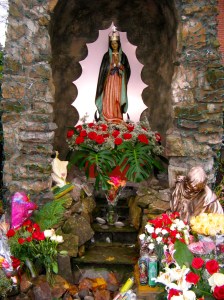
    Inside the Ascension grounds, there’s a lovely shrine.
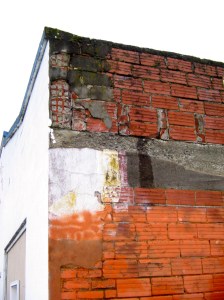
    This building on SE Stark shows a number of projects involving bricks.
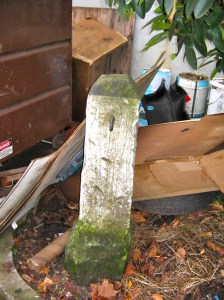
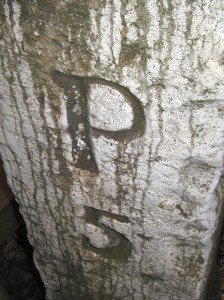
    This is a Portland landmark, on SE Stark. Stark was originally called Baseline Road, and from the baseline meridian, measurements and directions were made. The two photos show one of the old baseline markers, located just west of Flying Pie Pizza, on the south side of Stark.
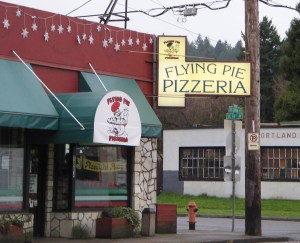
    This is another Portland landmark, the original Flying Pie. Above the sign, you can see the tops of the firs atop the northeast corner of Mt Tabor. I’ve dropped a few hundred feet since beginning the photo essay walk.
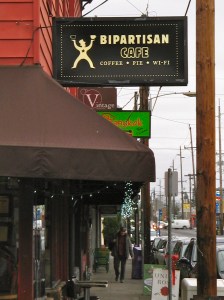


    This is my destination, Bipartisan Cafe, SE Stark and 79th. Note the Vintage cocktail lounge sign just below the Cafe sign, where I’ve played guitar a few times. Vintage used to be the Why Not Wine bar. I played some guitar there when it was the wine bar also, a few times with George, and a few times solo.
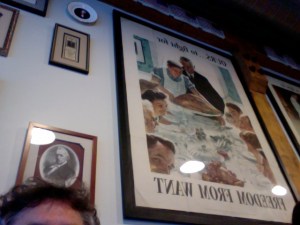


    Here I am inside Bipartisan, putting together the photo walk essay, drinking a cup of coffee. The cafe is crowded today. I’m sitting on a couch with my back to the wall. They’re playing some good songs in the cafe. People all around me are talking, reading, working on laptops, as I am, drinking coffee. There’s a guy showing his daughter how to play Scrabble. There’s another guy reading and listening to his iPod, white wires going into his ears. Outside, the rain is beginning to fall again. There goes another Line 15. Above and behind me is a large poster of a Rockwell. At the top it says: “OURS…to fight for.” And at the bottom it reads, “FREEDOM FROM WANT.” The drawing is of a family turkey dinner.

  • Two Poems for Christmas and the Feast of the Epiphany

    Epiphany

    In the straw burrow farm mice.
    Get a little closer and you’ll see
    Nits in baby Jesus’s hair, lice,
    And a house snake in the olive tree.

    There’s beer on the breath of the three
    Sage men sitting under the olive tree,
    Playing games of cribbage,
    Ushering in a new age.

    The pieces are swaddled in wool.
    Mary’s breast-feeding the baby Jesus.
    Joseph takes out his tools
    To build a bed before the night freezes.

    Mary wipes Joseph’s brow,
    The wise men questioning how,
    Talking to Joseph about what he did,
    And what in the end might be in the crib.

    From an East Side Bus

    The lurching bus crowds forward,
    dogs away from the curb broken under
    the plum tree overarching the shelter.

    The bus thrashes on, wobbling
    in a fit of leaf blowing, phlegmatic coughing.
    The young, motley couple

    (we see them every day lately),
    their rusted stroller full
    of plastic blankets,

    empty bottles, and crushed cans,
    sleeps on the bench in the bus shelter
    covered with plums and damp purple leaves.

    “Epiphany” appeared in Rocinante, Spring 2009, Vol. 8

  • Winter is icummen in, Lhude sing Line 15

    “Winter is icummen in, / Lhude sing Goddamn,” sang the irascible Ezra Pound, and while, as far as I know, he never had to ride local Tri-Met’s Line 15, he seems to have had some experience with public transportation, for he continues, in his poem “Ancient Music”: “Skiddeth bus and sloppeth us, / An ague hath my ham. / Freezeth river, turneth liver, / Damn you, sing: Goddamm.”

    The bus in winter when full is still a hungry beast galumphing to the curb at every stop to pick up riders in galoshes. The riders squeeze aboard like polyps into the beast’s belly, back-packed and wool-hatted, jacketed wet and sinewy, noses running out of the cold and into the heat, leaky faucets leaking pus, umbrellas furling and unfurling, colorful flags popping the beast’s flatulence as it pulls up to the curb and politely lowers its door.

    I climb aboard and peristaltic pressure pushes me all the way to the back of the bus where I stick to the back wall, a fresh polyp, and through the wall I hear the engine moaning in its uneasy sleep. The bus dreams it could be an 18 wheeler, no passengers, a single driver in a penthouse cab, rolling smoothly but solidly through serene mountain passes. I could sleep too, in the warmth of the beast’s belly, but I have to make a transfer, so I ring the bell and work my way up to the back door.

    I get off the bus at Southeast 12th and Morrison. Winter seems worse here, and I unfurl my umbrella and wait at the intersection to cross, the wind and cold rain lapping at my legs. Off the bus though I’m feeling better about winter. I get on my next bus for the short ride up 12th to Benson High School. I hop off amid students breaking for lunch, a few with cell phones on hold as they hail the bus to wait, others crisscrossing the lawn at random like snowflakes. I cross NE Irving, once again longing for the old Sweet Tibbie Dunbar’s, where the juicy prime rib with roasted potatoes, soup, and a Christmas ale surely cured whatever ailed as winter might have been coming in.

    “Use your head, can’t you, use your head, you’re on earth, there’s no cure for that!” Beckett’s Hamm says in “Endgame.” Ah, yes, but there is a cure, ancient music, but go not as Pound “’gainst the winter’s balm,” but let the cold wind up your legs, around your waist, and wrap your soul in cold, for it’s then you’ll feel liveliest.

  • Reading Roland Barthes’s Writing Degree Zero on Line 15

    What would Roland Barthes have said about the snippets of poetry published among the ad displays, public service announcements, and caution notes headlining the interior of local bus Line 15?

    The poetry placards please riders through a program called, somewhat fancifully, Poetry in Motion, though the poems move relative only to someone off the bus. For the rider/reader, the poems move at the same speed as everything else on the bus, with the exception of the rider just boarding, stumbling down the aisle in the opposite direction of the bus lurching forward. It’s a good idea to wait until seated before trying to read the poetry. In any case, why not call the poems, simply, “Bus Poems”?   

    But what’s remarkable is the number of riders and therefore potential readers of the poetry, “reaching an estimated 15 million daily [countrywide],” according to the Tri-Met site. Poetry never had it so good.

    Readers may be reminded of Johnny Tillotson’s 1961 hit song “Poetry in Motion.” The refrain of Tillotson’s song seems particularly apt to the riders on Line 15: “…For all the world to see.

    a-woe woe woe woe woe woe.” Find out more about Poetry in Motion at the Poetry Society, or at the Tri-Met site: Selections for 2007, or check out the British original Poems on the Underground, including Autumn/Winter 2008 selections, which celebrate the 1918 Armistice.

    A random search adds to the randomness of the entire enterprise with this from Charles Bukowski, the bard of beer, on poetry and motion– locomotively, as Bukowski is seen displaying his full critical license (not for the poetically squeamish). We’ve not seen any Bukowski poems on the bus – though there are times on the bus when we feel we are in his company.

    Which brings us back to Barthes, who found deconstructing poetry difficult, since the pieces already cover the floor in various stages of disassembly: “…what is attempted [in modern poetry] is to eliminate the intention to establish relationships and to produce instead an explosion of words…since…modern poetry…destroys the spontaneously functional nature of language, and leaves standing only its lexical basis” (p. 46). This sounds like a bus ride. “The Hunger of the Word, common to the whole of modern poetry, makes poetic speech terrible and inhuman. It initiates a discourse full of gaps and full of lights, filled with absences and over-nourishing signs, without foresight or stability of intention, and thereby so opposed to the social function of language…” (p. 48). “…modern poetry destroyed relationships in language and reduced discourse to words as static things” (p. 49). Maybe that’s why they decided to put some on the buses.

    The audience on the Line 15 bus shifts slightly at every stop, and every bus ride is already a poem in motion, riders hopping on, hopping off, each a word, or a line, some a full verse, the bus curtsying occasionally, its caution bell bleeping, as it leans down to pick up a rider unable to hop, poems and riders waiting patiently motionless, the big scurrilous bus a measure of notes transpiring.

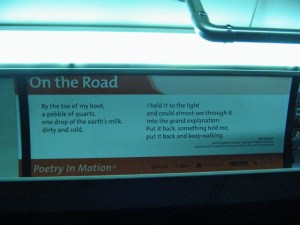
    "On the Road," a Bus Poem by Ted Kooser on Line 15
    “On the Road,” a Bus Poem by Ted Kooser on Line 15