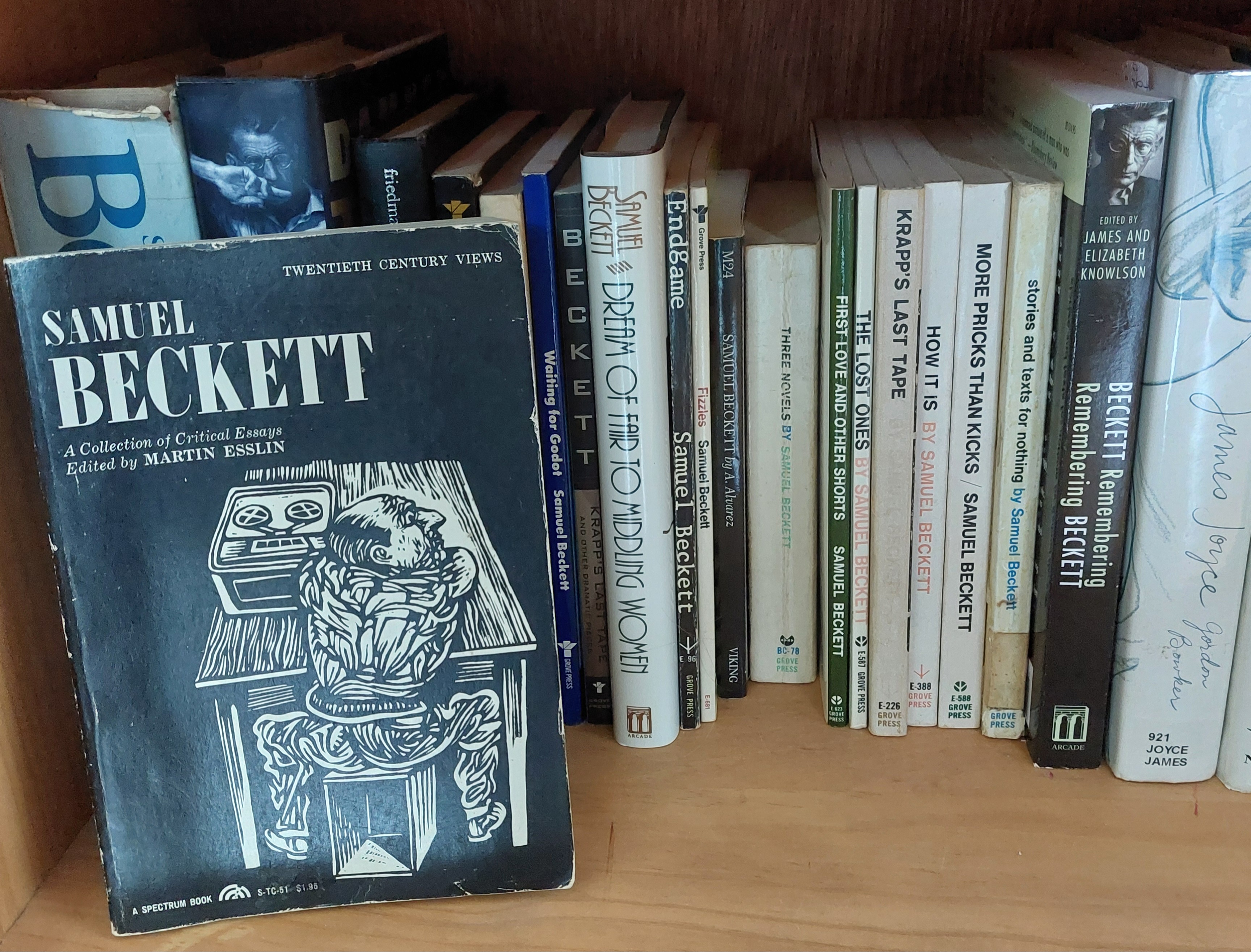
I was browsing through an old paperback of essays on Samuel Beckett (not to mention the why), and landed on this, about the weight of words, found in A. J. Leventhal’s essay titled “The Beckett Hero,” here discussing Beckett’s names:
“If the names are not adventitious (and Beckett weighs all his words) it means that we are asked to think of this play, not as an isolated piece of inaction in a corner of France, or if you like Ireland, but as a cosmic state, a world condition in which all humanity is involved” (49).
What does it mean to weigh a word? Do words have weight? They certainly do in a metaphorical sense. A person whose words are said to carry weight is listened to; whether their opinions are respected or not is a different question, as we hear tell of windy speakers, windbags, by which is meant a person whose talk is full of hot air. Pompous.
Air has weight, expressed in pressure. Does wind have weight? In Shakespeare’s play “King Lear,” we find the weight and pressure of wind and words mixing in the storm:
“Blow, winds, and crack your cheeks! rage! blow!
You cataracts and hurricanoes, spout
Till you have drench’d our steeples, drown’d the cocks!
You sulphurous and thought-executing fires,
Vaunt-couriers to oak-cleaving thunderbolts,
Singe my white head! And thou, all-shaking thunder,
Smite flat the thick rotundity o’ the world!
Crack nature’s moulds, all germens spill at once,
That make ingrateful man!” (King Lear, Act 3, Scene 2)
Another example of a windy word passage appears to be Beckett’s poem titled “Whoroscope,” judging from John Fletcher’s reading in the same collection of critical essays, this one titled “The Private Pain and the Whey of Words”:
“The fact is that this ‘poem’ is little more than prose monologue chopped into lines of unequal length. No rhythmical pattern can be discerned and the vocabulary is of studied colloquialism. Lame puns like ‘prostisciutto’ (i.e. ‘ham’ / ‘harlot’) and ‘Jesuitasters’ attempt to imitate Joyce. In spite of its wit, the whole poem gives a frivolous impression; genuine poetic richness is lacking, for paradox, esotericism, and verbal pyrotechnics take its place” (25).
Fletcher has already told us, setting the stage, that Beckett’s poem “won the prize (ten pounds), was printed in 300 copies, and led to Beckett’s being invited to contribute to an anthology of poems which Henry Crowder set to music, also published by Nancy Cunard at the Hours Press in 1930.” Beckett had knocked the poem out in one sitting, Fletcher discloses, to enter the contest, which asked for a poem “on the subject of Time.” Continues Fletcher in his critique of the poem: “The poem is not very interesting and certainly seems to have little to do with time.” One wonders now how much one of those original 300 copies might fetch at auction. 100 copies were signed.
Where have we heard whey before?
“Little Miss Muffet
Sat on a tuffet,
Eating her curds and whey;
There came a big spider,
Who sat down beside her
And frightened Miss Muffet away.”
Clear enough, except what’s a “tuffet”?
Fletcher makes much of Beckett’s feud with nothing. He tells us Beckett stopped writing poetry in 1949, and quotes from Beckett’s “Three Dialogues” of the same year:
“The ‘Three Dialogues’ grant the artist the honor only ‘to fail as no other dare fail,’ failure being ‘his world and the shrink from it desertion, art, and craft, good housekeeping, living.’ We shall see, indeed, that in his poetry as in his other writings Beckett has never shirked the fact ‘that there is nothing to express, nothing with which to express, nothing from which to express, no power to express, no desire to express, together with the obligation to express.’”
“Nothing will come of nothing,” King Lear says, reflecting Shakespeare’s own struggle with nothing. “Speak again.”
~~~
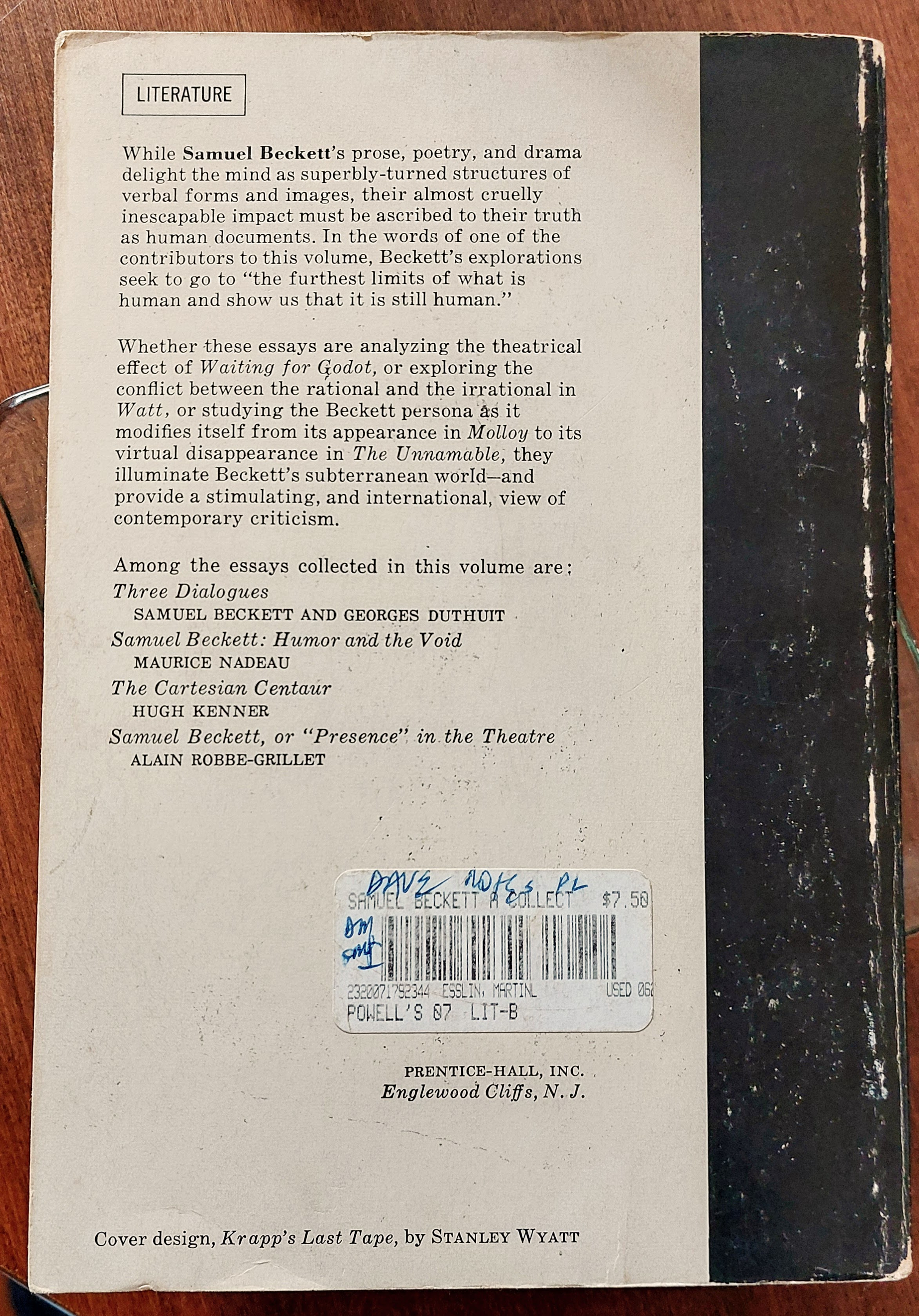
“Samuel Becket: A Collection of Critical Essays,” Edited by Martin Esslin, Prentice-Hall, A Spectrum Book, 1965. Includes “The Beckett Hero” by A. J. Leventhal, a lecture at Trinity College June 1963, and “The Private Pain and the Whey of Words” by John Fletcher, a lecture given at Durham U England November 1964.
 The Coming of the Toads