Tag: Joyce

  • On Forms

    At the end of Mark Twain’s “The Adventures of Huckleberry Finn,” Jim finally tells Huck the dead man in the house they encountered earlier floating down the river was Huck’s father, and Huck, now aware and free of family, and now bored with his friend Tom Sawyer’s boyish ways, decides it’s time to cut out:

    “…and so there ain’t nothing more to write about, and I am rotten glad of it, because if I’d a knowed what a trouble it was to make a book I wouldn’t a tackled it, and ain’t a-going to no more. But I reckon I got to light out for the Territory ahead of the rest, because Aunt Sally she’s going to adopt me and sivilize me, and I can’t stand it. I been there before.”

    I’m with Huck, though it’s too late for me to pretend I can uncivilize myself, or maybe I was never civilized enough to begin with; in any case, I can at least decide I’ll write no more books. Eight is enough, and they are a big trouble, and troubling, and hard to take down. Civilization is a form of living that includes books, but one can live happily without being a reader or a writer.

    I’ve never put much stock in ancestry. My mother said her maiden name, though spelled differently, came from Anne Boleyn, the beheaded queen. That would make for an interesting answer on a medical form to the question, how did your ancestor die? Today’s medical forms often ask for information related to questions of genetics, presumably to help with diagnosis, but what’s wrong is still often just a guess, but lots of afflictions do carry useful genetic information. At the same time, some consideration might be given to mutations and the idea that at the cellular level some form of intelligence or at least some form of communication between or among cells, in plants and animals, informs protective changes.

    In the military, forms, identified by letters and numbers, such as the popular “DD Form 214” (DD for Department of Defense), carry orders, instructions, information. An Army is a form of military organization, and etymologically, the word army suggests to form, fit together, join, as one makes and makes use of tools.

    In high school, we learned to fill out forms. A popular question on those forms was “Father’s Occupation.” This might have been a precursor to the genetic questions on today’s medical forms. It might also help explain my being predisposed against interest in ancestry – though I would respond differently to such forms and questions today than I did when in high school. High school is a form of education, but in time the content wears thin, grows obsolete, while the form calcifies one’s entire being.

    Of history, Joyce in “Ulysses” has Stephen tell his principal, Mr. Deasy, it’s “a nightmare from which I am trying to awake.” Many of us might say the same of high school – a nightmare from which we are still trying to awake. Stephen, in conversation with Deasy:

    —History, Stephen said, is a nightmare from which I am trying to awake.

    From the playfield the boys raised a shout. A whirring whistle: goal. What if that nightmare gave you a back kick?

    —The ways of the Creator are not our ways, Mr Deasy said. All human history moves towards one great goal, the manifestation of God.

    Stephen jerked his thumb towards the window, saying:

    —That is God.

    Hooray! Ay! Whrrwhee!

    —What? Mr Deasy asked.

    —A shout in the street, Stephen answered, shrugging his shoulders.

    We’re still in episode two, “Nestor,” when Stephen makes the joke about a pier being “a disappointed bridge.” His students don’t seem to understand. Stephen is thinking of forms:

    It must be a movement then, an actuality of the possible as possible. Aristotle’s phrase formed itself within the gabbled verses and floated out into the studious silence of the library of Saint Genevieve where he had read, sheltered from the sin of Paris, night by night. By his elbow a delicate Siamese conned a handbook of strategy. Fed and feeding brains about me: under glowlamps, impaled, with faintly beating feelers: and in my mind’s darkness a sloth of the underworld, reluctant, shy of brightness, shifting her dragon scaly folds. Thought is the thought of thought. Tranquil brightness. The soul is in a manner all that is: the soul is the form of forms. Tranquility sudden, vast, candescent: form of forms.

    Cuneiform, Uniform, Reformatory.

    We might find something a bit morbid in recalling the ancient forms. No, I’m not too interested in ancestry, but somewhat (so. me. so. what). But to call out some ghost you don’t really know, yet a relation, still: from referre ‘bring back’ – see relate: couple with.

    —Pooh! Buck Mulligan said. We have grown out of Wilde and paradoxes. It’s quite simple. He proves by algebra that Hamlet’s grandson is Shakespeare’s grandfather and that he himself is the ghost of his own father.

    Joyce’s Buck Mulligan is in some form more interesting and certainly more fun than his Stephen Dedalus, even as Stephen is stand-in for Joyce himself. Stephen might be too given over to thinking about forms, while Buck more given to thinking about the form of suds atop his pint. Then again, Stephen is not Joyce, but an interesting form of.

    I was still in high school when my father was buried in an under-road big pipe project cave-in. The forms used to shore the walls of the deep ditch gave way, and he was pinned under a dump of dirt and against the cement pipe. He was rescued with seven broken ribs and some skin abrasions, a form of occupational hazard.
  • Hearty

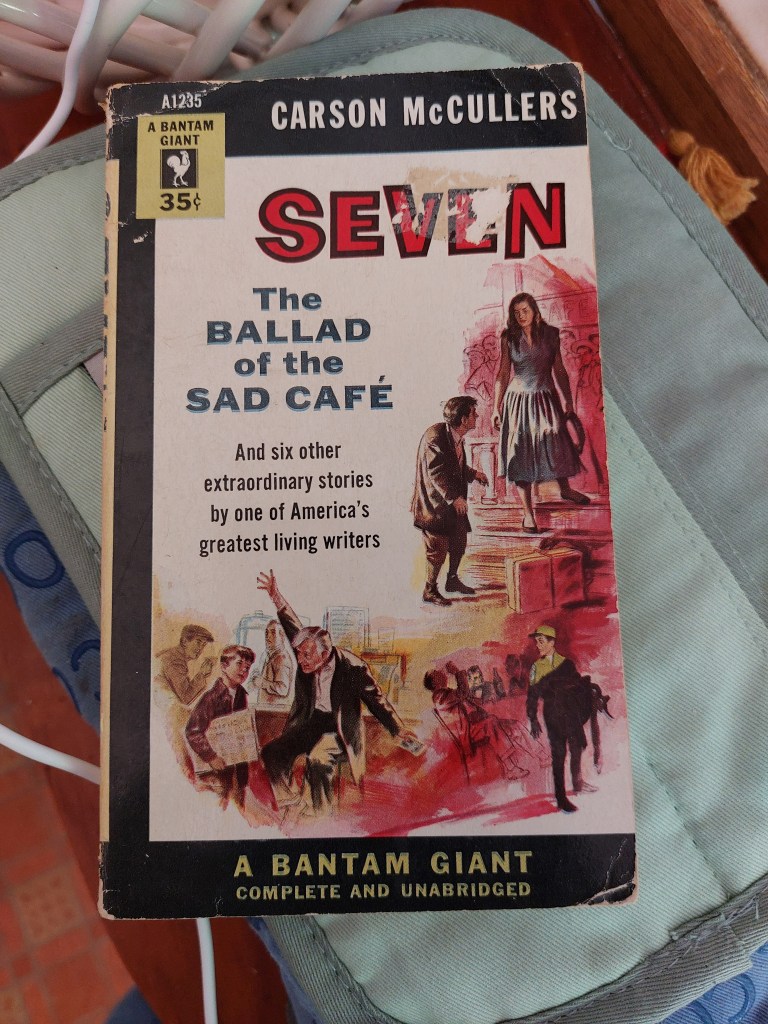
    If you’re looking for Carson McCullers, you won’t find her at the Heart Clinic, where in the waiting room the chairs are a pleasant pastel-green plastic, the color of hope, and comfortable, though the wait is not long, and the streaming station is set to 60’s and 70’s rock ‘n’ roll.

    Carson’s “The Heart is a Lonely Hunter” was published in 1940, when she was just twenty-three. We read it in high school in the mid 1960’s. The title comes from a poem by the Scottish poet William Sharp, published under his pseudonym, Fiona MacLeod. The word green appears in the 24 line poem 10 times. Here is the last stanza:

    O never a green leaf whispers, where the green-gold branches swing:
    O never a song I hear now, where one was wont to sing
    Here in the heart of Summer, sweet is life to me still,
    But my heart is a lonely hunter that hunts on a lonely hill.

    Only a poet would say of the heart it is “a lonely hunter.” But notice MacLeod/Sharp didn’t say “the heart”; he said “my heart.” Carson took his personal reflection and turned it into a universal appeal. Is the heart a lonely hunter? The answer will depend on whom you ask. But meantime we might also play around with Carson’s title:

    The Heart is a Garrulous Scavenger
    The Heart is a Forlorn Blogger
    The Heart is a Red Red Rose
    The Heart is a Hollow Muscle

    The word heart appears in Joyce’s “Ulysses” at least 200 times. Here is Stephen reflecting on one of his students in the “Nestor” episode:

    Ugly and futile: lean neck and tangled hair and a stain of ink, a snail’s bed. Yet someone had loved him, borne him in her arms and in her heart.

    But Joyce’s use of the word includes the real thing, too, as we find when we first meet Bloom:

    Mr Leopold Bloom ate with relish the inner organs of beasts and fowls. He liked thick giblet soup, nutty gizzards, a stuffed roast heart, liverslices fried with crustcrumbs, fried hencods’ roes. Most of all he liked grilled mutton kidneys which gave to his palate a fine tang of faintly scented urine.

    And this, meant to convey patience and forbearance in its context – Bloom thinking:

    Wear the heart out of a stone, that.”

    Of course many of the hearts are at the funeral for Paddy Dignam, but the young girls heart-worded “Nausicaa” episode begins with Gerty on the rocks close to sunset:

    The summer evening had begun to fold the world in its mysterious embrace. Far away in the west the sun was setting and the last glow of all too fleeting day lingered lovingly on sea and strand, on the proud promontory of dear old Howth guarding as ever the waters of the bay, on the weedgrown rocks along Sandymount shore and, last but not least, on the quiet church whence there streamed forth at times upon the stillness the voice of prayer to her who is in her pure radiance a beacon ever to the stormtossed heart of man, Mary, star of the sea.

    There is the sweetheart and the Sacred Heart. And times they might be the same. Or the heart is a flower. This from Molly Bloom:

    I love flowers Id love to have the whole place swimming in roses God of heaven theres nothing like nature the wild mountains then the sea and the waves rushing then the beautiful country with the fields of oats and wheat and all kinds of things and all the fine cattle going about that would do your heart good to see rivers and lakes and flowers all sorts of shapes and smells and colours springing up even out of the ditches primroses and violets nature it is

    And yes Molly Bloom has the last heart at the last of Joyce’s book “Ulysses” says:

    yes and his heart was going like mad and yes I said yes I will Yes

  • On the Moon

    Moondance 1A group of moonstruck locals climbed to the top of the park Sunday night to view the rising of the super moon. In Italo Calvino’s short story “The Distance to the Moon “ (1965), the characters climb to the moon from Earth using ladders:

    “Climb up on the moon? Of course we did. All you had to do was row out to it in a boat and, when you were underneath, prop a ladder against her and scramble up.”

    It’s the same moon Leonard Cohen had in mind when he sang,

    “Ah, they’ll never, they’ll never ever reach the moon, at least not the one that we’re after.”

    But which moon are we after?

    In Buckminster Fuller’s book “Nine Chains to the Moon” (1963), he explains the title:

    “A statistical cartoon would show that if, in imagination, all of the people of the world were to stand upon one another’s shoulders, they would make nine complete chains between the earth and the moon. If it is not so far to the moon, then it is not so far to the limits, – whatever, whenever or wherever they may be.”

    Fuller may have climbed up to the moon to write some of his books.

    When the Brooklyn Dodgers first arrived in Los Angles, they played in the Coliseum, which was not built for baseball, and the fence in left field was so close that a screen was put up so homers would not be too easy. But a Dodger player named Wally Moon cleared the fence so often his homers came to be called “Moon shots.” The Space Race was on.

    For most, the dark side of the moon will remain forever dark. Apollo 8 circled the moon late in 1968, the year of the Tet Offensive, so there were other things on minds besides the moon. Eric Sevareid, for one, was unimpressed with the promise of pics from the dark side of the moon. From his short article, “The Dark Side of the Moon” (if following link, scroll about ¼ down):

    “There is, after all, another side— a dark side — to the human spirit, too. Men have hardly begun to explore these regions; and it is going to be a very great pity if we advance upon the bright side of the moon with the dark side of ourselves, if the cargo in the first rockets to reach there consists of fear and chauvinism and suspicion. Surely we ought to have our credentials in order, our hands very clean and perhaps a prayer for forgiveness on our lips as we prepare to open the ancient vault of the shining moon.”

    Of course, as it turned out, the dark side was no different than the bright side. Go figure. Speaks more to the mystery of metaphor than to the mystery of the moon.

    Joyce had, in “Ulysses,” given his version of the perigee. From the penultimate episode of Joyce’s “Ulysses,” written in catechism form:

    “With what meditations did Bloom accompany his demonstration to his companion of various constellations?

    Meditations of evolution increasingly vaster: of the moon invisible in incipient lunation, approaching perigee: of the infinite lattiginous scintillating uncondensed milky way, discernible by daylight by an observer placed at the lower end of a cylindrical vertical shaft 5000 ft deep sunk from the surface towards the centre of the earth: of Sirius (alpha in Canis Maior) 10 lightyears (57,000,000,000,000 miles) distant and in volume 900 times the dimension of our planet: of Arcturus: of the precession of equinoxes: of Orion with belt and sextuple sun theta and nebula in which 100 of our solar systems could be contained: of moribund and of nascent new stars such as Nova in 1901: of our system plunging towards the constellation of Hercules: of the parallax or parallactic drift of socalled fixed stars, in reality evermoving wanderers from immeasurably remote eons to infinitely remote futures in comparison with which the years, threescore and ten, of allotted human life formed a parenthesis of infinitesimal brevity.”

    No, the answer is not as brief as those in the Baltimore, and we still seem to be nine chains from the moon. In any case, must it always sound so cold? Not at all. Joyce follows up with a question and answer that deconstructs the man in the moon.

    Moondance 2Sevareid had acknowledged the emergence of a new moon:

    “The moon was always measured in terms of hope and reassurance and the heart pangs of youth on such a night as this; it is now measured in terms of mileage and foot-pounds of rocket thrust.”

    Joyce also allows for a double moon, one of science, one of metaphor, in Bloom’s catechism answers:

     “What special affinities appeared to him to exist between the moon and woman?

    Her antiquity in preceding and surviving successive tellurian generations: her nocturnal predominance: her satellitic dependence: her luminary reflection: her constancy under all her phases, rising and setting by her appointed times, waxing and waning: the forced invariability of her aspect: her indeterminate response to inaffirmative interrogation: her potency over effluent and refluent waters: her power to enamour, to mortify, to invest with beauty, to render insane, to incite to and aid delinquency: the tranquil inscrutability of her visage: the terribility of her isolated dominant implacable resplendent propinquity: her omens of tempest and of calm: the stimulation of her light, her motion and her presence: the admonition of her craters, her arid seas, her silence: her splendour, when visible: her attraction, when invisible.”

    081020141748Pic to left: back from the mountain, down from the moon, in the backyard, a somewhat diminished super moon over the apple tree. I picked up a guitar. There are many more songs with moon in their title than sun. The reflection is not as blinding as the reality.