Tag: Guitar
-
78 RPM Saturday Night
Three new short pieces up over at SoundCloud with The Variable Trio. “Little Richard” and “Easy on the Blues” were attempts to recreate the shellac 78 sound, using aged vocals recorded open microphone into a portable recorder on tape cassettes then playing them back through a boombox into GarageBand, using the laptop open microphone and the “telephone vocal” setting with increased reverb. “Coffee House Scramble” was recorded using six tracks of GarageBand settings (Wide Wide Wah, Spring Theory, Alien Waves, Echolalia, Old School Punk, and Swampland), using the Fender Telecaster played unplugged acoustically into the laptop open microphone, and adding tracks of Yamaha Bass, hand claps and thigh slaps and slides, and acoustic piano.
-
Back Story Folk Guitar
This Yamaha Red Label FG-180 guitar was probably built in 1969. The woman in the guitar store next to the Loyola Theatre in Westchester said Jimmy Webb had been in the week before and picked up this very Yamaha and played a few chords. She couldn’t believe I’d never heard of Jimmy Webb. It was March, 1970, and I’d just returned from active duty in Forts Bliss and Huachuca. Having talked to some other guitarists, I already knew the FG-180 was the guitar I wanted for the money I had, factory made in Japan, so inexpensive, but playable, reliable, and sound worthy. The guitar, case included, cost $100, a Martin dreadnought knockoff, no extra charge for the Jimmy Webb back story.
A back story is a forward. The forward is not a trailer, nor is it an abstract. The back story never spoils. It’s an appetizer. The back story, moving forward, provides the predicament that explains the current situation. Without a back story, new episodes drift aimlessly and meaninglessly, random dead links. The back story deflates absurdity and fills the reader with hope. The back story is a proposal, a hypothesis, an argument.
My first guitar was a hand-me-down from a neighbor friend, but its neck was broken by an early girlfriend jumping off the top bunk. I then purchased for $25 from an ad in the South Bay Daily Breeze newspaper, a nylon string, plywood top Orlando.
What is the relationship between physicists’ string theories and guitar? The on-line forums for both are full of confusing, contradictory claims, but full of back stories. A guitar often comes with a back story. Several guitar cases were recently spotted for sale in thrift shops, but the guitars were long gone. We might have some idea the age of the universe, but is it old or young, and what does it matter? The Ventura guitar case the guitar shop offered to throw in today shows the wear and tear of travel in a deuce and a half, to Fort Liggett and Camp Roberts and Camp Pendleton, and later trips to gold rush country and various ocean beaches, and not a few years sleeping in a dank basement while the guitar enjoyed an open stand in the living room.
This FG-180 has a spruce, two-piece solid top, mahogany sides, and a two-piece mahogany back. The neck is a thick bar of nato of one piece with the head. The fretboard is one quarter inch thick rosewood. The Yamaha link (above) says the backs were three-piece, but the top and back of this one are both two-piece, book matched. The bridge is rosewood. The FG stands for folk guitar. This one has a thin crack in the back of the head, at the top of the neck.
The top under the bridge has lifted some, and the head crack is a bit worrisome; light or extra-light strings will reduce tension. The FG-180 is now set up with D’Addario XL Chromes, flat wound, jazz light gauge, electric guitar strings. The electric strings when played acoustically don’t produce as loud or deep or full a sound as acoustic strings, but they pop, ping, and twang, “like a steel rail humming” (Pete Seeger, “Hobo’s Lullaby”), and if you do want to plug the guitar into an amplifier, use an old fashion, Dean Markley sound hole fitted pickup.
In Astra Taylor’s film “Examined Life,” Slavoj Zizek explains how we are seduced by ideology. If the universe has a back story, our present predicament can be explained, even if the explanation makes no sense. The Big Bang is a big back story. When an effect tickles or bites or bombards or floods us, we search for a cause. We reconsider our back stories.
We somehow must work and rework, correct or clarify, our back stories into our instantaneous presentations and performances amid the distractions, commercials, hypes, phobias, click bait, news tsunamis – the whole bafflegab of what’s up now.
Zizi Papacharissi, in “A Networked Self,” appears to understand the ability to “back-story” (to verbalize a noun, to go with the flow, “To prepare a face to meet the faces that you meet” as Eliot said in “The Love Song of J. Alfred Prufrock”) as an adaptation skill, the ability to adapt to changes in social environments, from a supposed fixed state, where the self was assumed to be a character bound in a book with a lineal story, to a fluid self that is constantly seeking its own level, walking on the deck of a small boat, changing with every social interaction, mimicry as a survival technique (elasticity of demand in a social market):
“Narratives about the self have always been performative. That’s what renders aspects of our identity a discourse. What changes is that performativity is augmented through online means of self presentation. And it is this enhanced theatricality, afforded by certain online platforms (SNSs, and various forms of blogs and microblogs), that individuals find most appealing.
Sociability is practiced to the network, via the network. Performances of the self enable sociability, and these socially oriented performances must carry meaning for multiple publics and audiences without sacrificing one’s true sense of self. These polysemic performances not only contain many layers of meaning, but are remixed and remixable – sampling digital traces of identity to piece together performances that are further remixed and re-interpreted by multiple audiences and publics.”
That could be used as a back story that may now explain the emergence of the folk revival of the 1950s and 60s. The revival, originally acted out in small coffee shops, living rooms, and campus settings, was at first minimally commercial. Few expected to earn a life-long living from singing folk song covers, but that wasn’t the goal, and the identity of the performer was inseparable from the identity of the audience. The audience participated in the performance. But that participation wasn’t a surge of fans aspiring to go on stage. There often wasn’t a stage, and each time a song was sung it was renewed in an altered form. Many of these performances were not recorded. They were passed on as living songs. Folk music is chameleon and transferable.
One of my older sisters sang in a high school folk group, “The Travelling Trio.” Their travels did not take them out of the Los Angeles Basin. They sang in living rooms and the local high school gym. Imagine a young Judy Garland singing Elizabeth Cotton’s “Freight Train.” But unlike my sister, whose voice flowed like melted chocolate over fresh strawberries, your voice sounds like a galvanized plumbing pipe rattling in the wall with trapped air bubbles. Such a voice might confuse Tom Waits with Hedy West. Still, your Kentucky grandfather played the spoons and the harmonica, to add more filler to your back story, and you were an easy target for the music bug early on.
But a singing gig was not to become part of your back story. You played finger style. You liked the guitarist John Fahey, saw him play at Long Beach State and again at the Ash Grove. Not only did he not sing, on stage he never said a word. You were playing what you pretended was folk blues and fell into jazz. You took up what you called jazz guitar, though not everyone necessarily heard it that way.
Classical guitar lessons are useful for a few years. Your fingers already know how to play, but your brain doesn’t always know what they are doing. Over time, you’ll use up several teachers who will walk you through a couple of Aaron Shearer books, and a few of the Frederick Noad books, and teach you the Segovia scale method (which you might later hear Joe Pass dis, along with the number system). Your first teacher will probably introduce you to Leo Brouwer and his “Etudes Simples.” The Cuban composer’s short pieces are of course not all that simple, but at least you don’t have to sing. You’ll learn to read, slowly, like a stuttering primary school student, and learn enough to work through a Dionisio Aguado book, “Studi Per Chitarra,” on your own. You’ll learn by heart the old cliché: “The guitar is the easiest of instruments to play poorly, the most difficult to play well.” You’ll return to jazz and folk and find your breath and take solace in another cliché: “Close enough for jazz.”
Close enough substitutes feeling for the pursuit of perfection which as Cornel West explains in “Examined Life” is the romantic road to disappointment. So it was in the spirit of close enough that I answered an invitation from Sunshine Dixon to read a poem at an artists’ reception in the campus library, but I suggested that instead of reading a poem I might bring my old FG-180 guitar and sing a folk song. I worked up a folk version of “Gospel Plow,” using Dylan’s version on his first album as inspiration. If a recording pops up on-line somewhere I’ll add a link to the back story or upload a piece of it to SoundCloud. Maybe sister Peggy Ann will tune in.
And if you’d like to read more about the artists’ reception, Sunshine and I collaborated on a short article now on-line here, already part of a back story.
-
Baseball Pitch Sequence Tracking and Guitar Chord and Scale Illustrations
Watching the baseball playoffs, garage and basement guitar aficionados may notice the similarity between baseball pitch tracking and guitar chord and scale illustrations. A kind of visual metaphor conflates the two methods of viewing a sequence stilled for analysis.
The following tables illustrate a five pitch sequence that parallels a B minor 7th flat 5 chord. The first two pitches were high, and were called balls. The second two, rising fast balls, were swung on and missed. The third pitch looked good. The fourth pitch drifted inside as well as high. The count is two balls and two strikes:
1 2 3 4 The fifth pitch is high and outside, and the batter lunges for the ball and misses for strike three on the open 6th string:
5 1 2 3 4 The sequence of pitches played on the guitar might sound something like this, strike three sounding a muted bass note:
-
B Flat Minor Seventh Flat Five
a sharp as brittle as glass
spikes strikes oiled wood
tie the ground below
a rose bubbled bottleeasy flats as surf foams
loosen smiles and sea
splashes rock dome
circled cutwateras soft as flurry breeze
whistles and leaves
as hushed as memory
conjurors breatheas down inside the chord
fingers fasten figure
for suggestions
in fretted spacesas sluice and mosey walk
the line above the ocean
in single lens reflex
in frame free accord -
James Joyce’s Guitar Chord in the 1915 Ottocaro Weiss Photo
What guitar chord is James Joyce playing in this photo?
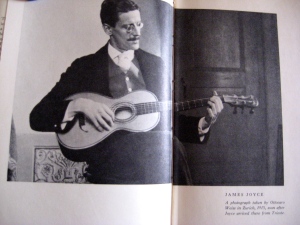
The original photo, taken by Ottocaro Weiss, in 1915, is housed in Cornell’s James Joyce collection, in an exhibit in a glass closet titled “Poetry and Music.” I first saw the photo of Joyce playing the guitar years ago in the Ellmann biography, and I cut it out and pinned it over my desk somewhere, but I’ve since lost that copy.
“Fingers to stray on Joyce’s guitar again after its restoration,” an article by Terence Killeen in the March 22, 2012 Irish Times, discusses the restoration of Joyce’s guitar and contains a fascinating video clip of the luthier at work on the guitar. Gary Southwell, the luthier, guesses, based on the finger wear on the fretboard, that Joyce probably was not a “fantastic” guitarist because the wear suggests mostly first position, standard chord forms: “He wasn’t all over the fingerboard.”
Can we tell from the photograph what guitar chord Joyce is fingering? Assuming his index finger holds the root note, then he’s playing a 1-b5 on the bass strings. If the root is an F, then he’s playing an F-B. But his ring finger appears to be positioned directly over the second fret, so it’s hard to tell if he’s fingering a D or a Db. But anyway a closer look suggests that his index finger is not on the 6th low E string, but on the 5th string, playing a Bb note, the middle finger then (still a flat 5) playing an E note, and the ring finger playing a Db note. But I can’t tell what frets he’s fingering, and at first glance, I assumed he was fingering an Em7 chord (guitar spelling: E, B, E, G, D, E = 1, 5, 1, b3, b7, 1).
In any case, Killeen, in the video, seems to say that Joyce is not actually playing the guitar in the photo. I’m not sure why he thinks not. Joyce looks relaxed in the photo, leaning a bit back and away, probably the better to see his left hand fingering, given his poor eyesight. The thumb of his right hand is hidden behind his palm, but it could certainly be plucking the 6th, 5th, or 4th string. Maybe he was not playing the guitar during the photo because he had to hold still for the photographer. But he’s clearly fingering a chord. Or is he? Again, his index and ring fingers appear to be hovering directly over the frets, not slightly behind them.
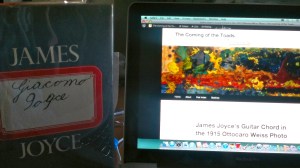 I recently acquired a hardback copy of “Giacomo Joyce” (Viking Press, reset and reissued May, 1968), introduction and notes by Richard Ellmann, and was surprised and delighted to find the Weiss photo of Joyce and his guitar used as a frontispiece, spread across two pages.
Perhaps the chord Joyce is fingering in the Weiss photo is from Finnegans Wake, a pun-chord, a humorous play on notes.
Follow up 8 Sep 13: Check out guitarist Gerald Garcia’s Joyce guitar analysis (read through post and scroll through comments section).
-
Hootenanny Revisited: Photo Essay of Old Songbooks
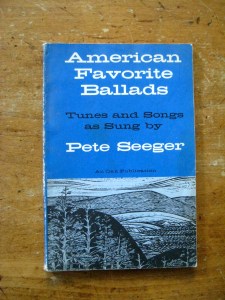 “As Woody Guthrie advised those who heard and sang his Songs to Grow On, ‘Now I don’t want to see you use these songs to divide nor split your family all apart. I mean, don’t just buy this book and take it home and keep it to yourself. Get your whole family into the fun. Get papa. Get mama. Get brother. Get sister. Get aunty… The friends. The neighbors. Everybody.’” Mose Asch quoting Woody is found in Asch’s “Foreword” to Pete Seeger’s “American Favorite Ballads: Tunes and Songs as Sung by Pete Seeger.” Moses said, “It was not until after World War II that young people in all walks of life and all parts of the United States made use of this folk music tradition and adapted it to their way of expressing their feelings and of tying up the past to their future…Now it is up to the children and grandchildren to take it from here.” But that was 1961, and those children now have children and grandchildren of their own.
Oak Publications put out all kinds of folk music books in the 1960’s. Ramblin’ Boy and other songs by Tom Paxton was one of the best. My copy,
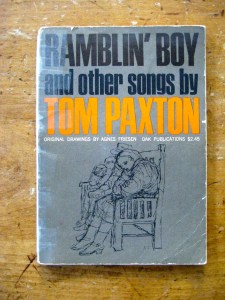 well worn with taped binding, is a second printing of the book first published in 1965.
Says Tom in his “Introduction,” “I have a habit – the habit of sitting in Joe’s on West Fourth Street or the kitchen of the Gaslight…trying to carry on the work that Woody began.” 2012 is Woody Guthrie’s centenary.
Paxton, in his intro., wonders if the songs he’s written are folk songs. He says, “…it takes years to know for sure.”
A guy by the name of Jerry Silverman put together several instruction books. The Folksinger’s Guitar Guide
 came out in 1962, and was followed by The Art of the Folk-Blues Guitar in 1964. These books contain chord diagrams; traditional music notation and tablature; lyrics; photographs of players and scenes; and comments on the songs and how they might be played.
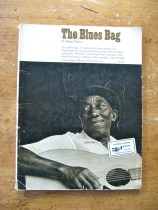 Happy Traum was another instruction book anthologist and player. His The Blues Bag came out in 1968, and remains an outstanding introduction to blues guitar song playing: includes lyrics, tab and classical notation, study notes, photographs, and additional resources information.
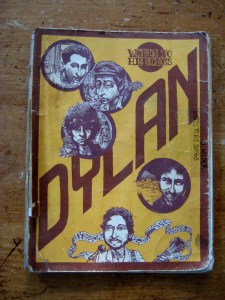 By far the most curious song book in my collection is Dylan: Words to His Songs. There is no publisher named, no price. It appears to be a bootleg project. Here is what the introduction page says, completely: in the upper left hand corner, “november 1971”; then, centered: “this book has no pretentions [sic] but to offer you the words to dylan’s songs including the ones released on his albums, singles and broadside recordings and a gathering of songs released on the white records: daddy rolling stone, great white wonder and little white wonder. you will find an alphabetical index in the back of the book”; and in the bottom left hand corner: “illustrated by holy cat.” The book is organized by chapters corresponding to Dylan’s albums, beginning with “march 1962 bob dylan,” and ending with “nov. 1970 new morning,” but that is followed by pages marked “broadside,” “singles,” and “other recordings.” The book is 79 pages in length, and 8 & 1/2 by 11 in size. The text is set in basic, pica-like, manual typewriter font. For years, my copy travelled with my old ES neighbor and friend Jon, but it’s been back home for awhile now. It’s falling apart, the pages falling out, songs spilling out, the way I think Woody would have enjoyed.
For anyone planning a hootenanny or a hoedown, a few songs from any of these books might play and sing happily well. Be sure you invite the children and the grandchildren.
Related Post: Schopenhauer’s Blues; or, On Jazz & Folk Music, from Hoedown to Hootenanny: A Happening Post


 The Coming of the Toads