Tag: Discuss

  • Reassessments

    Reassessments

    According to Google Ngram, use of the word reassessment peaks around 1990, a climb beginning in the 20s, rarely used prior to 1900. We suspect what’s driving that curve are real estate markets. But to reassess is still relevant to publications, which is to say, books will go out of print, magazines fold, newspapers disappear – and folks will leave Twitter or abandon once again their high school acquaintances or second cousins found on Facebook. Clicking on a blog one has not visited for some time may turn up: This account does not exist: try another search.

    So too, does one reassess one’s involvement in both writing and reading: annually, quarterly, monthly, daily, or with each post or page. What am I doing here? Who is reading this? Will anyone like? Do I like? Who, what, when, why, where, and how – how to write, and why? How to read, and why?

    When we read a book, we turn the page, back and forth, if you read like me, up and down. So called social media sites generally all work upward: we page up, but as we page up, what’s down continues falling and disappears through some virtual cutting room floor. Usually, only the most recent posts, comments, tweets, pics – whatever – get any attention. Form is in the driver’s seat. And the form of social media sites requires constant replenishment (Google Ngram shows constant and regular use of the word replenish from 1800 past 2000). But the social media publications get replenished even though the stock is still full, even if nothing has been depleted.

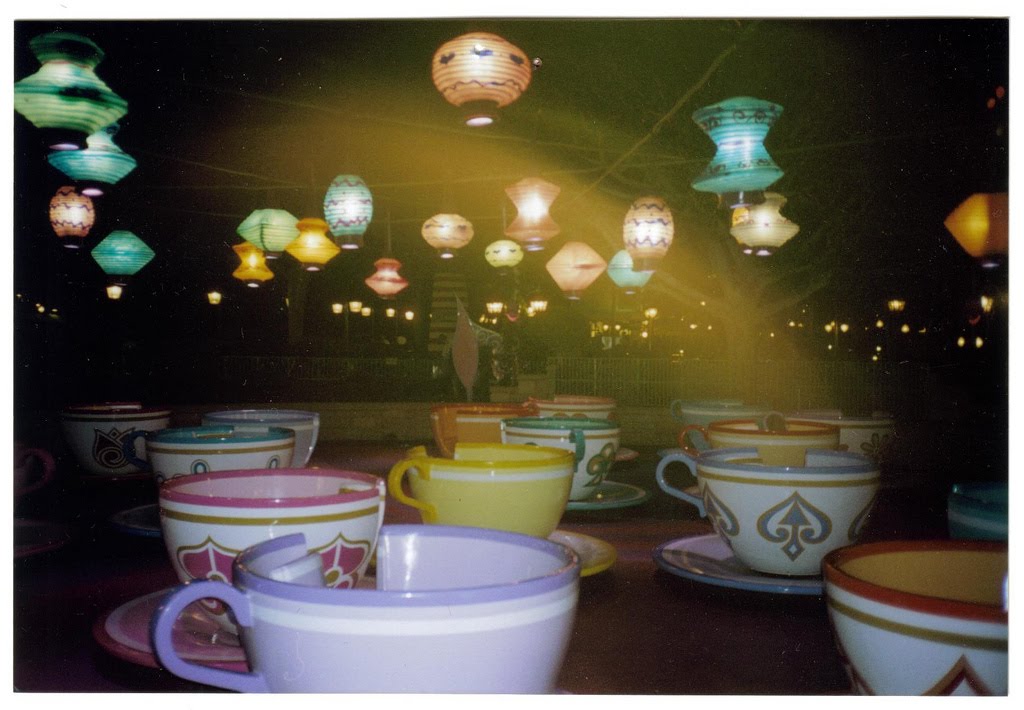
    The social media cup is neither half empty nor half full; it’s always full, as this post no doubt attests. Full of what, might make material for a different post.

    Photo: The Teacups ride at Disneyland, exiting the park at closing time, Joe Linker, around mid-90s.
  • Birdbrain, Bird-witted, and more on Thought

    Birdbrain, Bird-witted, and more on Thought

    Reflecting yesterday afternoon on my morning post, “On the Coast Starlight,” in which I suggested thought, if we are to try to compare it to anything, seems more bird-like than the train of thought first found in Thomas Hobbes’s 1651 “Leviathan,” I thought, to force thought onto a track where ideas are coupled one after another in forward motion toward some predetermined destination results from printing press technology, as McLuhan has shown. Thinking like a train does produce advantages, but the linear notion of thought may put us in a cage. Then it came to me that a reader might have commented that I seem birdbrained.

    Since I’ve had comments and likes off for recent posts, no such reader was able to suggest it, so I’ve come forward to suggest it myself. (Readers intent on comment, like, or dislike, btw, will find an email address at the bottom of the Toad’s About page.)

    But why we have come to disvalue flightiness to the extent we have, I’m not sure. Birdbrain, according to Google Ngram, is a word product of the second half of the 20th Century, while bird-witted has a more storied past, with interesting spikes of usage in both the 1720s and the 1820s.

    I readily agree that my brain seems to be more bird-like than train-like. But upon discussion with Susan, she informs me that only the hummingbird is able to fly backward. Trains, of course, can travel forward or backward, but not at the same time. Yes, but trains can’t leave the track (except to switch to another track), and two trains running in opposite directions on the same track – well, in a quantum train world, perhaps a train may indeed run forward and backward at the same time. In any case, the intelligence of birds is not in question. The question is whether to think like a bird offers the human any advantage over thinking like a train. But we are only speaking to the metaphors, of course, because of course trains don’t actually think at all, and people don’t and can’t and will never think like birds any more than they’ll be able to fly like a bird.

    It’s probable that in the era of trains, people did think more like trains than bird-like, while before artificial locomotion was mass produced, people thought more like other animals think. Now, people no doubt think more like automobiles. And we might update Hobbes to suggest an automobile of imagination.

    The poet Marianne Moore, in her poem “Bird-witted,” leaves no doubt that to think like a bird is to think like a human:

    parent darting down, nerved by what chills 
      the blood, and by hope rewarded -  
    of toil - since nothing fills 
      squeaking unfed 
    mouths, wages deadly combat, 
    and half kills 
        with bayonet beak and 
        cruel wings, the 
    intellectual cautious- 
    ly creeping cat.
    The last stanza of “Bird-witted,” from The Complete Poems of Marianne Moore, Penguin, 1982, p. 105-106.
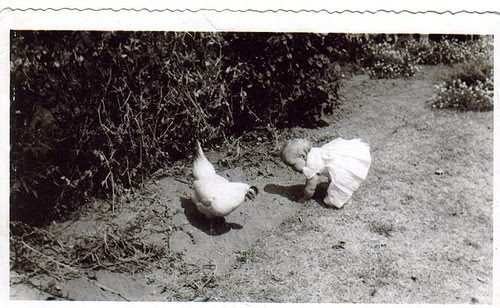
    Photo: Susan and Chicken, Culver City, circa 1952.
  • What is Essential?

    What is Essential?

    In John Cage’s “Lecture on Nothing,” we find the following comment: “It is not irritating to be where one is. It is only irritating to think one would like to be somewhere else.” Likewise, we may find that when we are alone, we find ourselves wanting company, but when we are in company, we may find ourselves wanting to be alone.

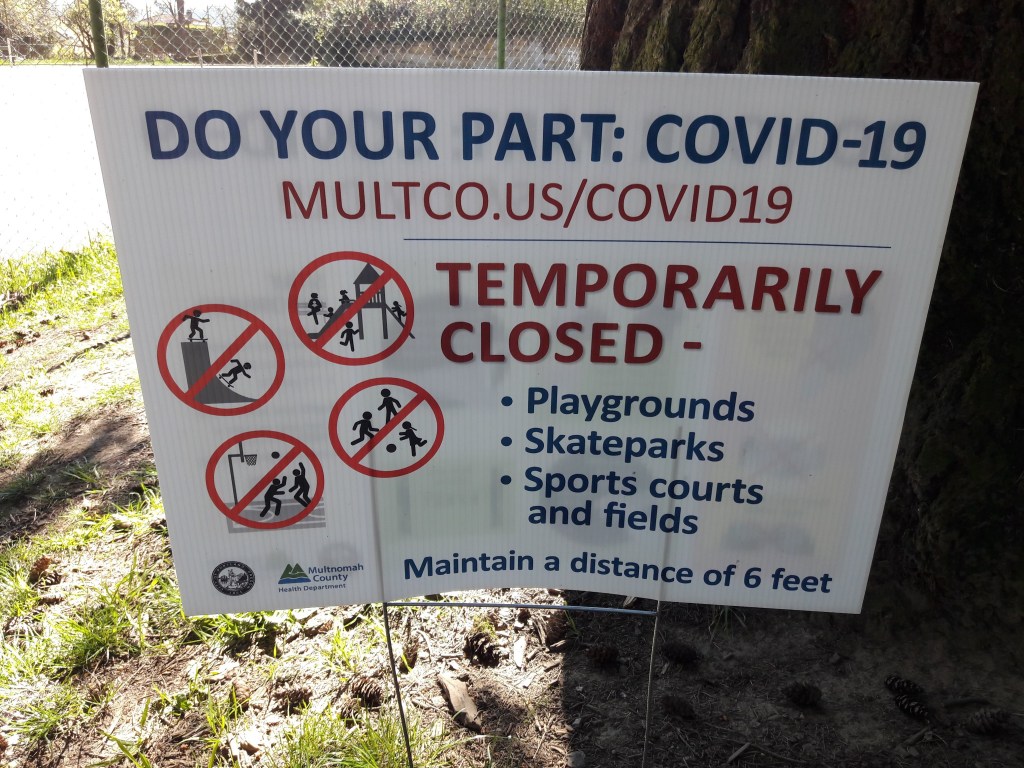
    As we find ourselves now, confined to quarters, advised to advance toward others (nor permit them to advance toward us) no closer that 6 feet, and even then advised it might be a good idea to wear a face mask and gloves and carry a sanitizer, we are reminded of Maslow’s Hierarchy of Needs. Once a lower but more essential need is met, we may climb a rung higher on the pyramid until we reach the nirvana of self-actualization.

    We must now assume that top rung to have a base of 6 feet, so that there is only room for one person, that one being, of course, one’s self. And to be fully self-actualized means being able to stay home perfectly content with staying home.

    But then we find Maslow adding on yet another rung to the top of his hierarchy of needs (even if, in practice, this would mean expanding the original base and subsequently the base of all the other rungs leading up to the top). The new top of the pyramid, reached after self-actualization is achieved, might be described as staying home without staying home, otherwise known as self-transcendence.

    All that work on meeting one’s needs only to discover at the top of the climb one leaves one’s self behind. It might be that only by staying home can we come to grips with the differences between our needs and our wants such that we may find our essentials.

  • In a Frenzy

    In a Frenzy

    Why are the TV newscasters shouting, frantic, frenetic, in a frenzy, like callers at auctions, preachers at land’s end, the newsboy on the corner hawking papers: Extra, Extra, Read All About It! It now being this constant state of emergency, impossible to keep up with, put on loops. Truth be told, it’s torture. Truth be bold, it’s boring.

    The news so quickly grows old, must keep it from petering out. So stories and comments on loops, ostinato. Even when the story seems about to change, the background keeps looping, looping around the talking head, the face masked in makeup, the expert, the one we might trust, still wearing a suit and tie, a dress, symbols of serious purpose, uniform press. On location, back to you, Jack, in the studio. Thank you, Jill.

    “Oh, when there’s too much of nothing
    No one has control” (Bob Dylan).

    Usually, ahead of disaster, a catastrophe, people go on the run, head for the hills, or run down to the water, pick up and go, evacuate. Or shelter in place until it’s passed – the hurricane, tornado, earthquake, battle, swarms of locusts.

    But this one’s different. We are told to stay in, and if we do go out, to keep our distance. There is no safety in numbers. On the contrary. We must go it alone. When has there been a more existential crisis? We must decide for ourselves what to do, what’s news.

  • The Epic Virus and Examined Life

    The Epic Virus and Examined Life

    Nothing like an Epic Virus to remind one how connections work. Members of this current batch of humans share just about everything of themselves, like it or not, even their money, some more some less than others.

    Life swarms with sounds we can’t hear, and teems down pouring itself empty with flying bugs and crawling things, birds and fishes, and the smallest creatures invisible to the naked eye that can make bread rise and turn grapes to wine and hops to beer, life that enters and exits the great smoking and stoking train of the body, riding one car to the next, to and fro, round trips, never holding an official ticket. Life is idiomatic.

    In Astra Taylor’s film Examined Life, Kwame Anthony Appiah reflects on how the ways in which humans are connected have changed over time. Gone are the days, Appiah explains, when the only people you ever saw in your entire lifetime were the members of your own family or small tribe:

    “As a species that was designed for living in bands of a hundred-odd people for much of its evolutionary history, we have to figure out how we’re going to live in a planet with 6, 7, 8 billion people. Billions not divided into lots of little bands of a hundred, but constantly interacting – and interacting in units of hundreds of millions. The United States, for example, has a population of 300 million right now. So as an American, you exist in this kind of virtual relationship with 300 million people. If you’re lucky enough to be Chinese, your virtual relationships are soon with 1.5 billion people or something like that” (p. 88, Examined Life: Excursions with Contemporary Thinkers, Edited by Astra Taylor, The New Press, 2009; Interviews from the film Examined Life, 2008).

  • “end tatters” 1st Review, and a Cover Revision

    “end tatters” 1st Review, and a Cover Revision

    The first review of “end tatters” is in, received via cell phone text:

    “Finished End Tatters; especially liked About Confusion, Bells, and To Surf, which I hope to do this morning. Milk made me very sad. Waiting for your next novel. Alma and Penina my favorites.”

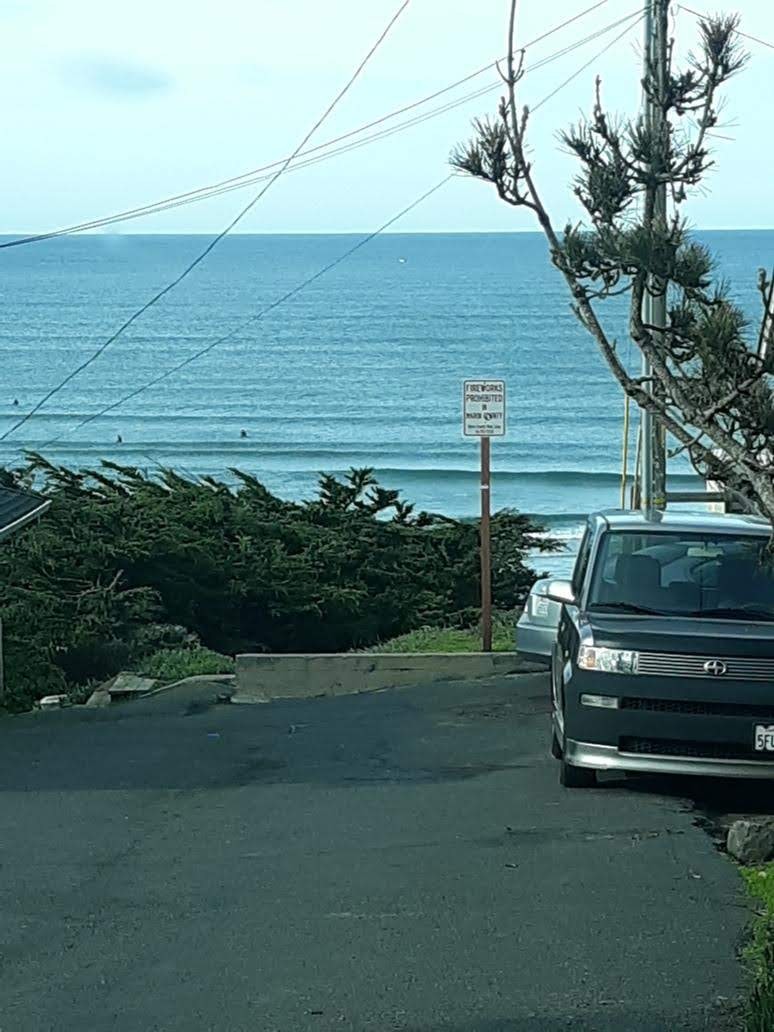
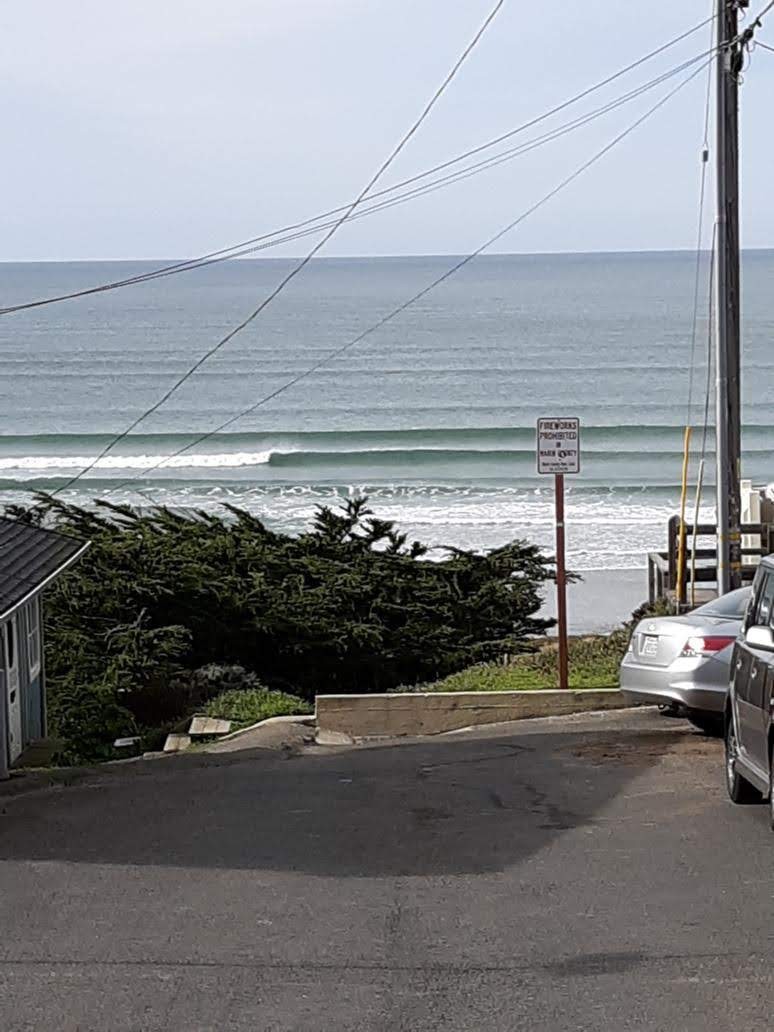
    To drive down, stop, and check out surf spots at the end of a beach town road is part of surfing. A second text from our first reviewer came in that evening, with a couple of pics and a note that he had made it into some waves:

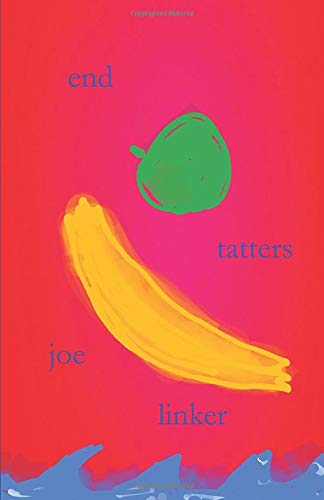
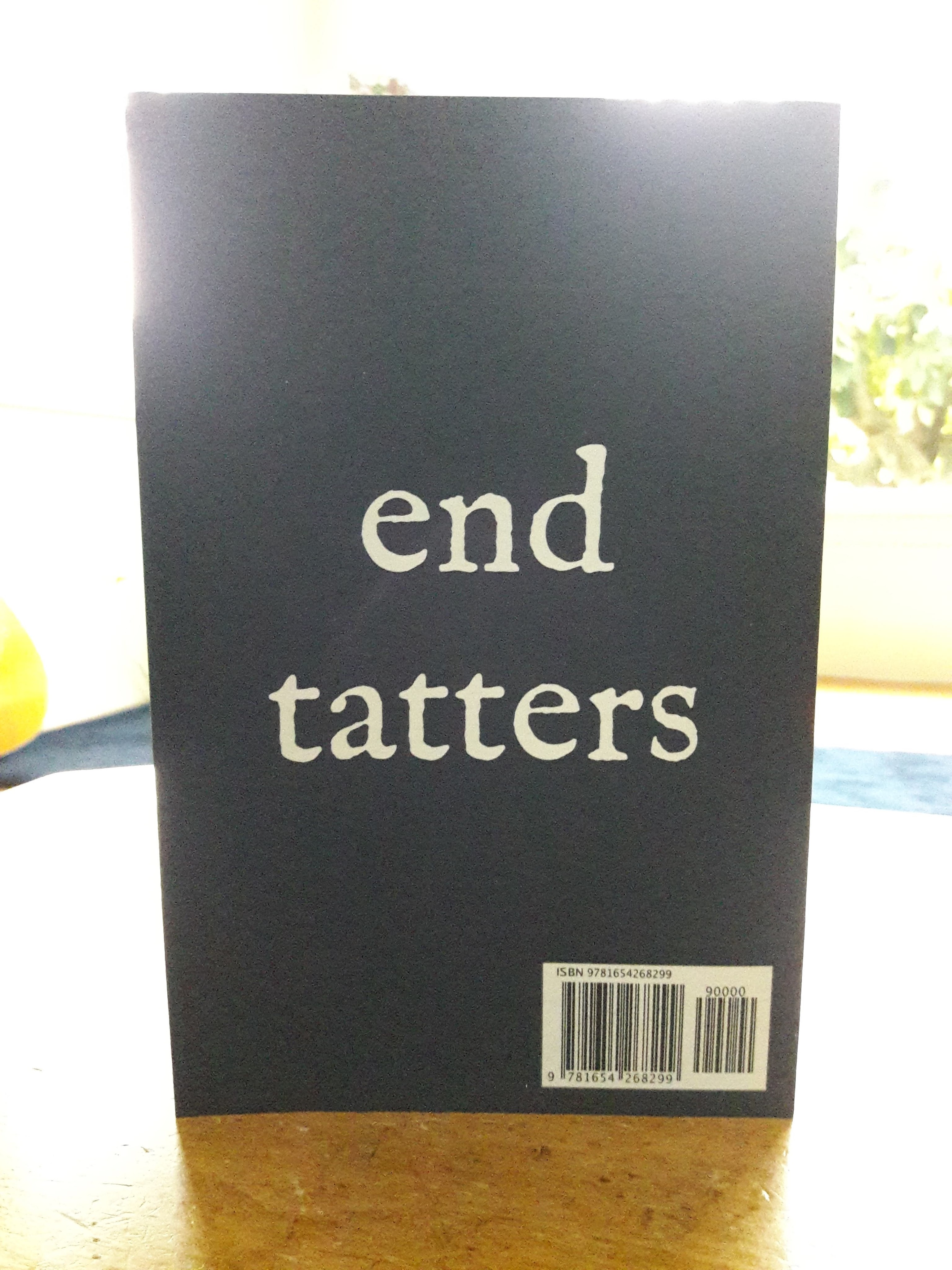
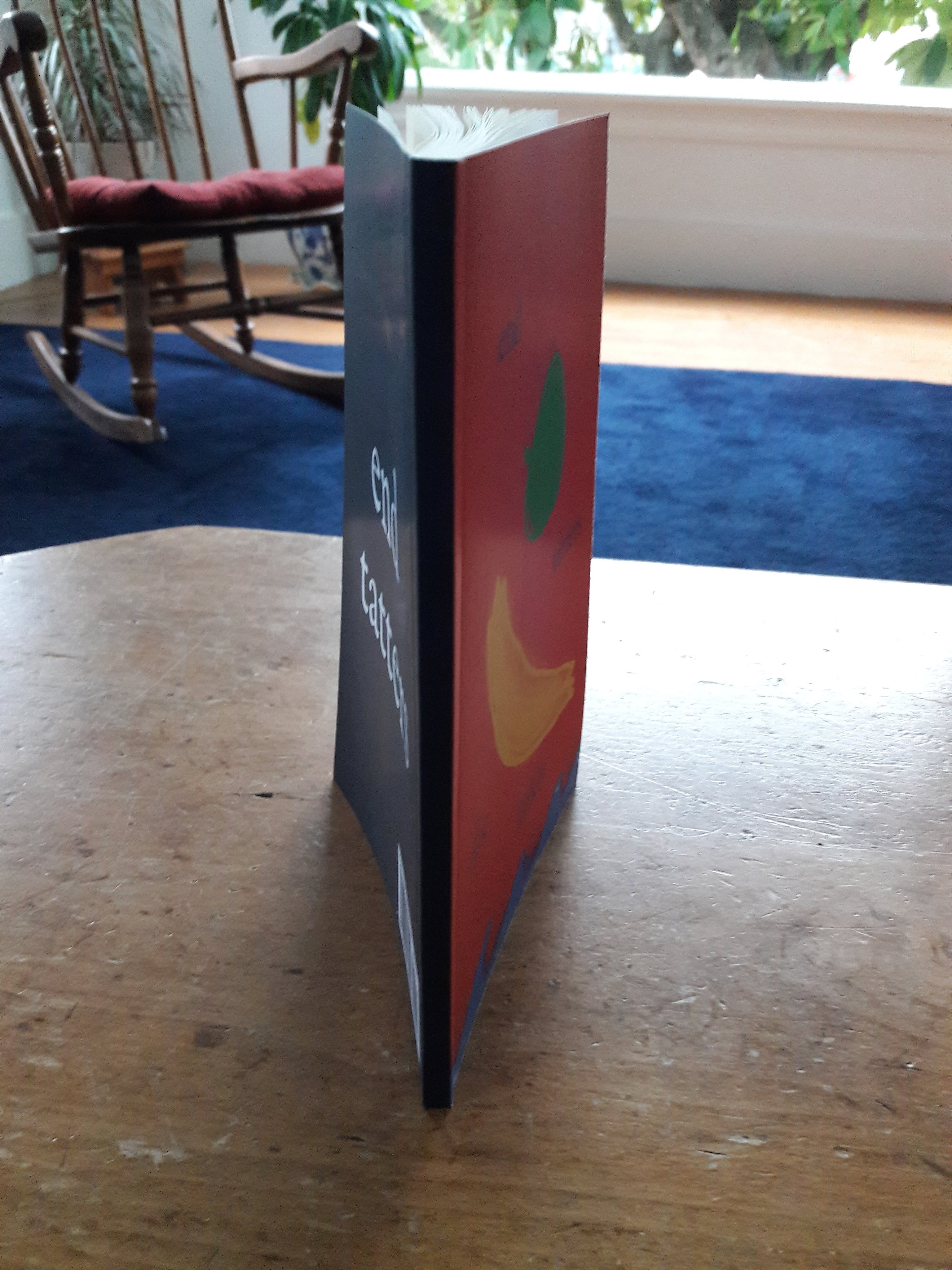
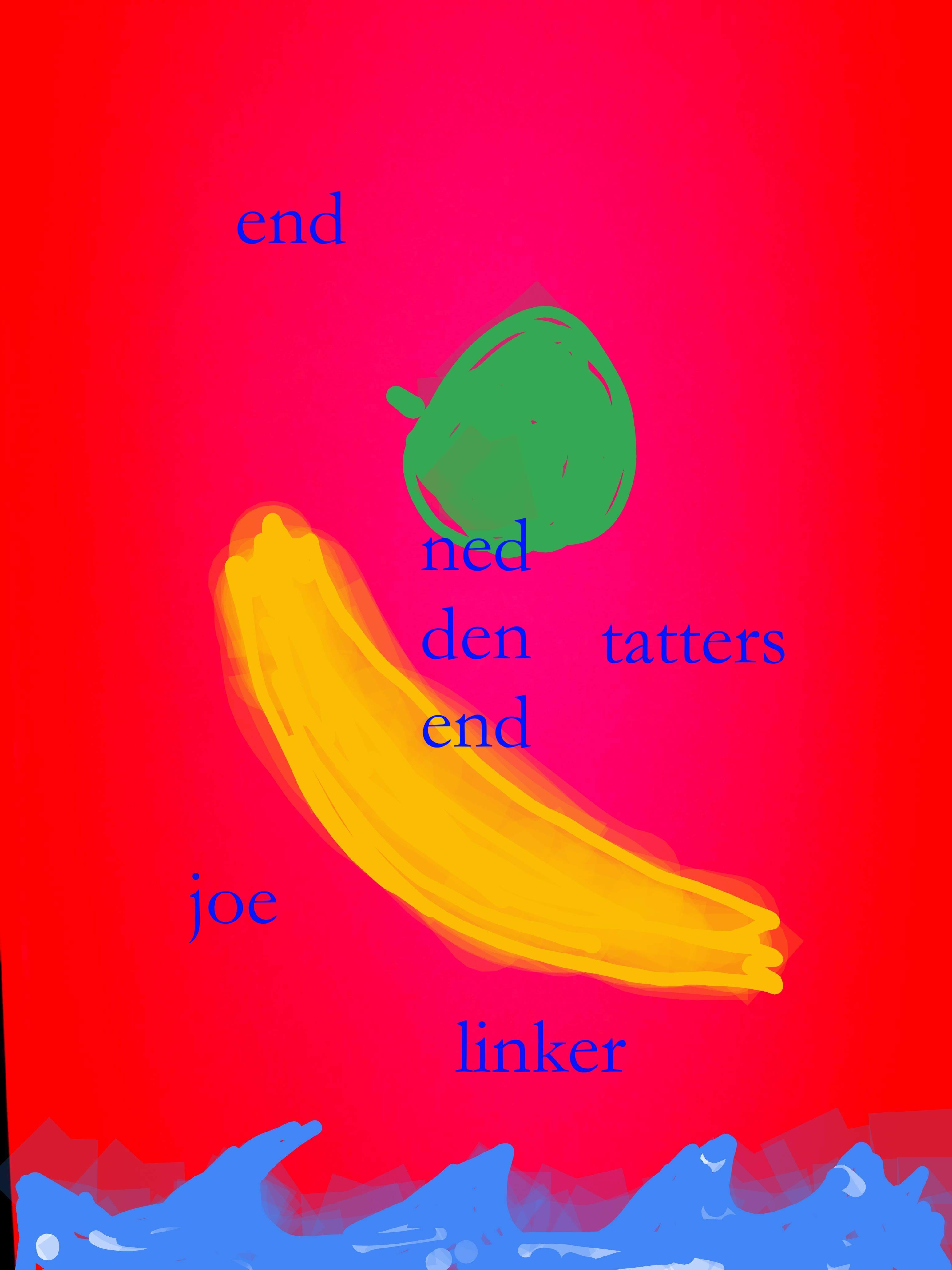
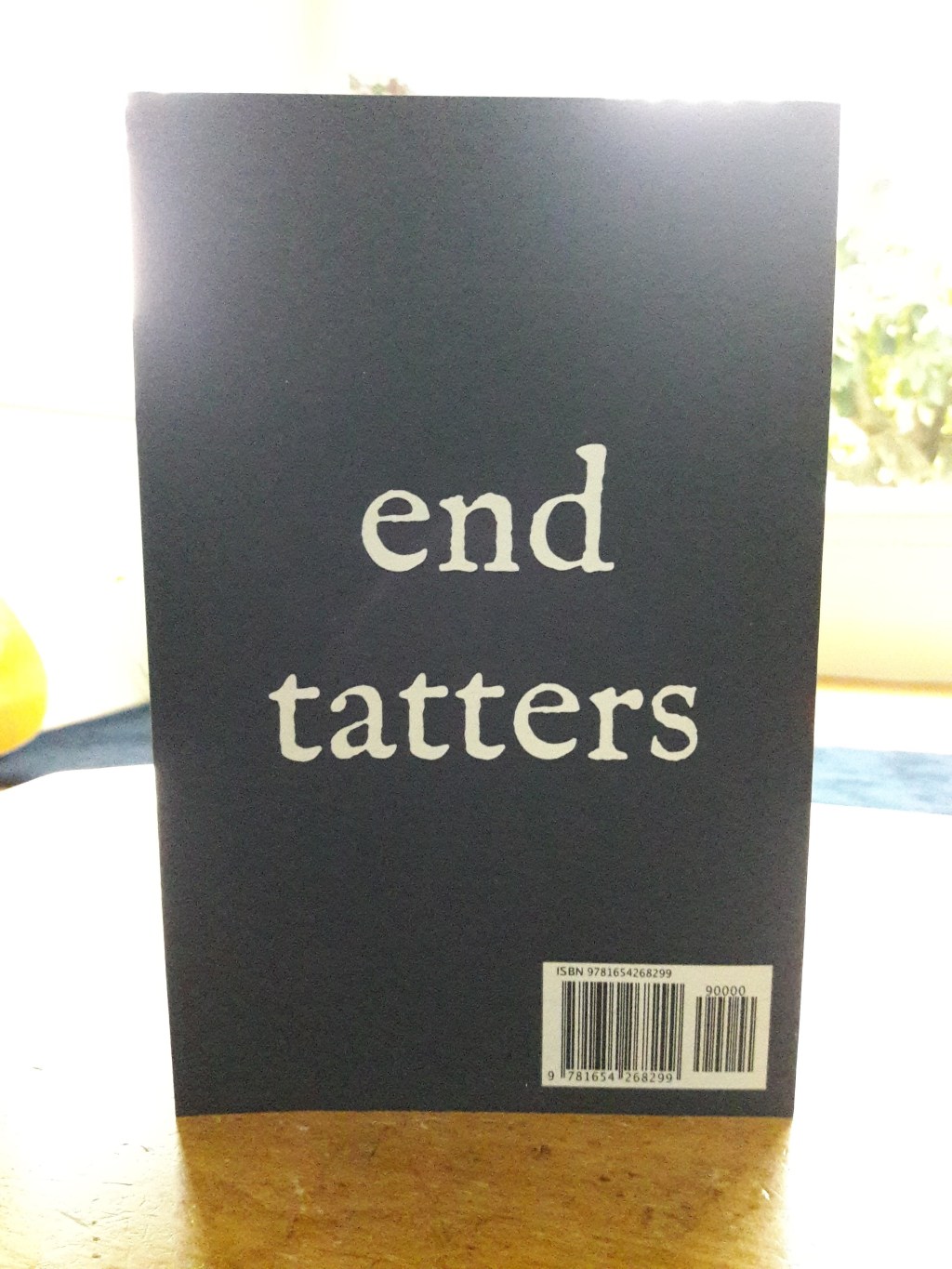
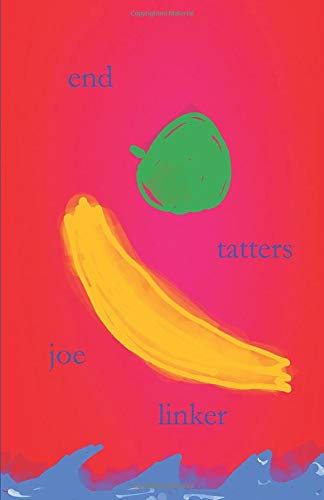
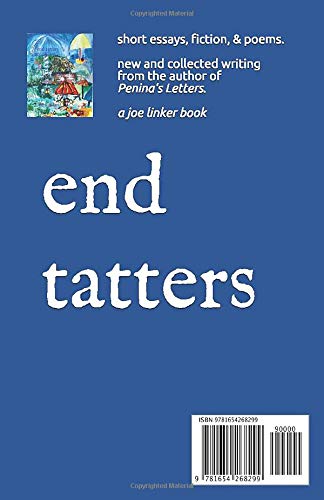
    Meantime, still not entirely satisfied with the “end tatters” cover (having already made several changes pre-publication), I made a post-publication cover revision. Copies sold with the blue back cover are now considered to have some increased value for collectors. New cover photos below:

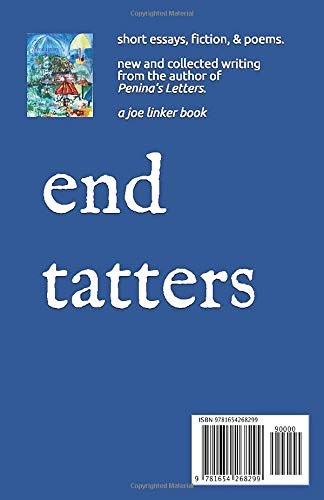
    Original back cover shown below:

    Go here to order your copy. Write a review and send it to thecomingofthetoads @ gmail dot com, and I’ll post it to the blog.

  • About “end tatters”

    About “end tatters”

    “end tatters” is now available in paperback. I don’t intend an e-book version. As indicated on the copyright page, “Some of the End Tatters pieces previously appeared, some in different form, in these publications: Berfrois; Berfrois: the Book; Queen Mob’s Teahouse; Sultan’s Seal: The Hotel Cosmopolitan; One Imperative; and The Coming of the Toads.” The book does offer some new pieces also, though, so it collects previously published and new pieces. My primary purpose in publishing the book in paperback form is that I wanted to save, on paper, a number of pieces a bit scattered on-line, while I had some new pieces I wasn’t sure what I wanted to do with. Besides that, I enjoy making books, reading books, collecting books.

    Distributing and selling indie books is a different matter. Even giving them away does not at all ensure they’ll be read. Nevertheless, I’ll be giving away a few copies of “end tatters” to innocent bystanders. So be on the lookout.

    With “end tatters,” I’ve attempted a kind of imprint, the somewhat clumsy, perhaps, “a Joe Linker book.” Below, we see the “CONTENTS” page:

    CONTENTS

    Bells…11
    Milk…17
    Trees…23
    This and That…25
    Taking the Call…27
    Nativity Scene…33
    In One’s Dotage…45
    Divine Comedy…47
    To Surf…49
    About Confusion…57
    Epiphanic Cat…67
    The Tyger…69
    Wealcan…71
    Horny Theology…88
    Withdrawal…91
    Cliff Notes…93
    Vintage…95
    In Transit…97
    Cricket…99
    Remaindered…101
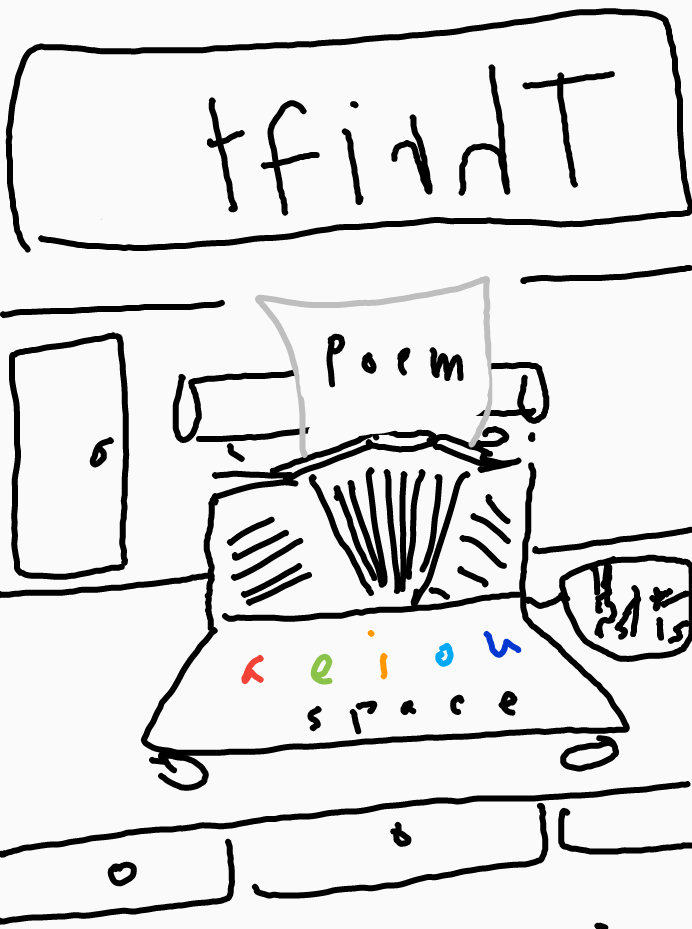
    Typewriter…103

    And a bit more info. for this post, with some pics:

    Product details

    • Paperback: 105 pages
    • Publisher: Independently published (January 8, 2020)
    • Language: English
    • ISBN-10: 1654268291
    • ISBN-13: 978-1654268299
    • Product Dimensions: 5.5 x 0.3 x 8.5 inches
    • Shipping Weight: 6.7 ounces
    • Average Customer Review: Be the first to review this item
  • In Print: “End Tatters”

    In Print: “End Tatters”

    “Do you want this book published,’ he asked, ‘or just printed?” Said Angus Cameron (editor at Little, Brown) to J. D. Salinger upon learning Salinger wanted no advertising of his forthcoming “The Catcher in the Rye.” Particularly, and peculiarly, from the publisher’s viewpoint, J. D. wanted no author’s photo on the cover (Ian Hamilton, In Search of J. D. Salinger, 1988, Random House, p. 115).

    How to launch a book? Advance review copies. Interviews. Author’s book tour. Live readings. Ads in trade journals. Book store displays. Billboards on Sunset Boulevard and in Times Square.

    Like Salinger, though they’ve actually few if any other options, the indie writer/publisher eschews the traditional publicity stunts ahead of book store distribution for a blog post or two.

    This is the second in a planned series of posts designed with the usual blog accompanied by tweet fanfare to launch, from the author of “Penina’s Letters,” a new book, titled “end tatters,” coming this week. Below, we see the front and back covers, and the back gives a brief description of what’s inside:

  • News

    Walking north up 69th on the way to Montavilla for an afternoon coffee, in the street at first, around my neighbor’s sidewalk repair project, barricades up while the newly poured cement dries. Then a short hello to the next neighbor out trying, with some difficulty, apparently, to start his gas lawnmower, yard work project of mid-December in progress. Next I came upon a five gallon bucket half full of water placed in the walkway to secure what appeared to be a tiny cement patch job. At the corner of 69th and Stark, I noticed the city fire hydrant replacement work is now complete, tools and materials cleared, the new hydrant standing like a shiny orange Christmas ornament, moved around the corner. Against the curb, a large steel plate remains to be picked up. I had just set out, the day cold but partially clear, with no wind to speak of, and already I had enough news to fill a paragraph.

    What is news? Most of what passes for news these days is tabloid sensationalism, entertainment, ratings and sponsor influenced selections from a worldwide reservoir of orality and photographs depicting and commenting on current events, the more current, the better, the higher the octane the more promise the trending and the more seen the ads. Today’s news is a kind of pornography, never enough to truly satisfy, and therefore an addictive substance. Originally, pornography was simply writing about prostitutes, while news was simply new things previously unknown to an audience. Today’s news is a new pornography, stories about the risks of public exposure of joyless addictions, risky setups for personal attention and gain.

    An important accoutrement used in today’s news is the public opinion poll. But how can the public have any kind of informed opinion if its only source of information is the news? Yet the news is saturated with what the latest polls show. Even the public broadcasting stations seem addicted to polls, in spite of how poorly polls used at the time had predicted the 2016 election results. And the current polls, acknowledged generally to have meaningful margins of error, don’t seem to be moving anywhere, plus or minus. Impotent, still, polls are the new foreplay of stories to come.

    Down in Montavilla and now discover the food carts on Stark in front of the old Beets parking lot have vanished. Now that’s news. Story at eleven.

  • Advertisement

    All advertisement is argument.

    We start arguments when we say something and we know someone will disagree. Happens all the time. We are never safe from disagreement. If you say, “The sun rises in the east,” you might think you’d be safe from argument. But an astrophysicist listening in might say the sun does not actually rise. The earth spins in orbit around the sun, and so on and so forth. A rebuttal around what you said about where the sun rises might productively explain the importance of point of view and perspective, presuppositions and assumptions, audience and expectations, proof and fallacy. Or it might be met with an eclipse of the eyes.

    Most of the above, in one form or another, you can find in books on rhetoric, and most of those have as their ultimate source of reference, Aristotle. When “The Coming of the Toads” started out, on December 27, 2007, the first post was about argument. Since then, the Toads has posted 866 arguments. Not that frequency or redundancy leads to persuasiveness. Some readers will no doubt argue that’s 866 arguments too many.

    Artists enjoy argument. A poet might say, for example, “Wouldn’t it be nice if the sun rose in the west for a change?” Buckminster Fuller suggested we replace the words “sunrise” and “sunset” with sunsight and sunclipse. Fuller, a scientist and inventor, was arguing that language both informs and betrays how we see and understand things. Both physicists and philosophers might ask, “Why does the sun rise?” Their answers will be arguments. Advertisers can’t afford arguments, so they cleverly disguise saying anything someone might disagree with. An advertiser might suggest sunopen and sunclosed.

    Silence, too, is often met with disagreement. “You should speak up,” someone says. “Say something.” Or your silence alone might be understood as disagreement, particularly if your arms are folded tightly across your chest. Advertisers never fold their arms or cross their legs.

    Aristotle saw that arguments happen everywhere and all the time. But listening closely, he also saw that some people were better at argument than others. Some people always seemed to be right, no matter what they said. And Aristotle thought that if he studied how those people argued, he might be able to explain the tools of argument.

    The proper use of those tools is the subject of another argument.

  • Modern Man in Search of a Sofa

    It is 1985, and a corporate colleague tells me his grandfather and father had built the house he would come to grow up in just before World War II, having ordered it out of a Sears Catalog. The house was delivered as a kit, with plans, in parts, via rail to a nearby town, where it was then trucked to the lot where they put it together. Yes, “some assembly required.”

    We were reading “In Search of Excellence” in the mid 80s, at all levels of the organization. But what many workers were actually in search of was a job with benefits that paid at least enough to buy a house for the fam and stuff to put in it, including sofa in the living room, pram in the entry, and car in the garage. For my part, I had recently come to realize the community college adjunct job I’d been working full time since the close of the 70s wasn’t going to produce such excellent results.

    In the first half of the 20th Century, the Sears Catalog served a bit like today’s Amazon. But I searched Amazon this morning to see if I could buy a house online and have it delivered, and all I found were backyard sheds. Sears discontinued its catalog division in the early 1990s. It’s hard to stay close to the customer when the customer is constantly on the move. In any case, most corporations (and stores and shops) only affect concern for the customer; what they’re really after is a share of the customer’s wallet, or, in Amazon’s case, the whole wallet. But what happens when customers no longer pack wallets?

    Or no longer want stuff, or at least, not so much stuff. Or still want some stuff, but different stuff. In other words, does Amazon sell souls? Or, as Jung put in his “Modern Man in Search of a Soul”: “No psychic value can disappear without being replaced by another of equivalent intensity” (209).

    There are, it is argued, certain efficiencies that promote the use of Amazon over the emotional expense of leaving one’s safe harbor for the voyage out to the mall or downtown or the shops of Hawthorne. Why should consumers feel shame about where or how or for what they shop? In any case, it appears most feel no shame. But is that because they are driven by unconscious desires, wants that may be manipulated by elevator music, trance inducing ads, or atavistic urges to covet one’s neighbor’s goods?

    I don’t know, but it often seems shoppers are led to the market like the Eloi in “The Time Machine” are pulled to the Morlocks. In return for the seemingly safe setting the Morlocks have created, the Eloi serve themselves up as food to sustain the Morlockian system.