Tag: Discuss

  • Three for the Road

    Quiet finally filled Wormy’s place as an early morning fog rose over the dunes from the ocean beach. His plan to slough off Tilde awoke a sleeping shrew. They fought and argued and cried and wrestled and scratched, clawed and scolded each other all night long, Tilde’s wails crescendoing up and down scales like fiddles in flight. Why he couldn’t wait till morning to tell her I don’t know. Something about he wanted to give her time to pack and say goodbye. Late morning I got up and went inside and made coffee. On my way to the bathroom I passed their bedroom and saw them sleeping head to toe. The ’56 Chevy two-ten was gassed up and ready to go. I packed my bedroll kit and stashed it in the trunk with a small cooler of ice, a couple of beers, a chunk of cheese, and a loaf of bread. I waited outside with Brigid, sipping coffee, feeling the breeze begin to shift offshore to onshore. We were not getting the early start I had asked for. Wormy came out with his coffee. We heard the shower come on through the open bathroom window. Tilde came out, her hair still wet, her backpack fully rigged, and walked straight to the car without a word. She stowed her stuff in the trunk and climbed into the back and whistled for Brigid who jumped into the back seat, the two of them hugging and snuggling in a way that did not suggest goodbye. I gave Wormy a questioning look. Oh, yeah, he said, turns out Brigid is Tilde’s dog, not mine, and she wants to keep her. We were now three for the road as I pulled onto Grand Avenue and drove down to Vista del Mar where I turned north to San Francisco.

    “Three for the Road” is episode 52 of Inventories, a Novel in Progress in Serial Format at The Coming of the Toads.
  • An Old Rig and a Passenger

    Wormy had a girlfriend, was in a relationship, he wanted to get rid of, to get out of. He had a plan. He wanted to do some time travelling on the scooter. I tried to tell him that was a bad idea. All times are the same, same rotten humans unhappy with their lot. The only road to true happiness was to live like a gypsy in a caravan putting down only shallow roots if any, keeping with your family. Nonsense, he said. The girlfriend was called Tilde, a nickname ascribed to her from the way her eyebrows grew: ~ ~ . The plan was I would give Tilde a ride up the coast with me to San Francisco, where she had a sister Wormy was in touch with who would take her in and help her find a job waitressing. Tilde had been tending bar at the Orange Orchid Tiki Bar and sleeping with Wormy and had grown accustomed and comfortable with the arrangement, but Wormy was beginning to feel cramped and closed out and wanted to kick out before wiping out, as he put it, and did something really stupid like get married. He would tell Tilde it was all over between them, but that I would give her a ride up the coast to her sister’s place. Tilda’s sister was some sort of professor at one of the Frisco colleges. Her beau was a veteran right fielder for the Kyoto Kinks who owned a fancy Japanese restaurant in Frisco. Long ways to go two on a Vespa, I said. Impossible. You’re not taking the scooter, Wormy said. You’ll take the Chevy. The Chevy was his restored 1956 two-ten with a rebuilt 265 cubic inch engine, 3 speed synchromesh manual transmission. Cream white with turquoise roof and lower side panels. Not as classic as the Bel-Air, but a nice ride for a coast cruise. Go ahead, Wormy said, who had backed the car out of the garage and was beckoning me to take the wheel and we’d go for a test drive around town. It was a different kind of time travel, the ’56 Chevy, and maybe I’d had enough of the scooter for a time, and I agreed to Wormy’s plan.

    “An Old Rig and a Passenger” is episode 51 of Inventories, a Novel in Progress in Serial Format at The Coming of the Toads.
  • Used to It

    Revving up the time travelling scooter I pulled away from Tin Can Beach and 1954 and the veterans I’d met and spent a few days and nights with hanging out and drinking beers listening to stories they’d brought back with them from Korea. I drove into the traffic on the Pacific Coast Highway heading north in present time. I thought I might continue north on Hwy 1, camping out nights, and see what more I might experience along the way, moving back and forth in time as suited my mood. I had thought about spending some more time with the veterans, maybe even putting up a shelter of my own on the beach. The cold water in the morning a short walk away provided the kind of wake up call one yearns for without knowing what exactly it is until you’ve hit the water a few mornings running. There are two ways of jumping into the ocean. One, you wade in, gradually getting used to the cold temperature until you’re out far enough to dive under a wall of white water. The other way is how I learned and preferred. You start at the top of the berm above the water line and dash down toward the water high jumping the waves until you’re deep enough to dive under one, come up, and keep swimming out, fireflies buzzing on your skin, biting, until they all wash off under the waves and you’re suddenly used to it. But Tin Can Beach was rife with disadvantages. My second night, sleeping in my bedroll in the sand outside the vet’s hut, we were wakened by a woman’s scream out on the beach followed by the sound of someone running clumsily through a pile of tin cans. We got up and walked about a little ways up and down the beach, but it was dark and quiet and still, and what we’d heard was apparently not that unusual. We went back to sleep, and in the early morning were again wakened, this time by an early surf fisherman who had stumbled across the body. It took the cops almost an hour to finally show up. One of them questioned us, but they knew the woman, and they already had a warrant out for her partner in crime. The interview cop wanted to know our addresses for his notes in case the authorities might need to get ahold of us later, and as we all tried to explain this was it, Tin Can Beach was our address, he shook his head and said, I don’t get it. I don’t get how you guys get used to it, living like this. We got to talking with him. Turned out he too was a Korean War veteran. Funny how we all seem to turn down different roads he said, but no one laughed. It wasn’t that kind of funny. But you get used to it – a war, sleeping out, incarceration in a system job, ticketing people, retreating far from some madding or smug crowd, time travelling. And I didn’t want to get used to it, used to anything.

    “Used to It” is episode 48 of Inventories, a Novel in Progress in Serial Format at The Coming of the Toads.
  • Love with the Proper Structure

    Zeroing in on the yawing wound of her loss, Minerva had said she had loved Hotel Julian. There are lots of other buildings in Los Angeles, I offered, to assuage her pain – penalty, I thought to myself, for not taking better care of what she claimed to love. But it wasn’t the building she loved, the structure, all those parts lovingly dismantled and carried out by the scroungers, scavengers, salvagers. To love a plate of hot salty fries cooled with catsup, the same love as for a Coney Island hot dog and a cold beer at the ballpark on a summer afternoon as the crowd settles in to a quiet fourth inning, is not the same love one might feel for a fearless fox terrier, or an alley cat rescued from a winter rain, or a baby of necessity given up by its teen mother, or the love for an abusive father or mother whose needs can never be satisfied by the child. Jesus said to love the Father with all your heart, soul, and mind; he didn’t say you had to be happy about it. Likewise, he said to love others as you love yourself; but he didn’t say what to do if you don’t love yourself, if you suffer from anhedonia, if your self esteem has been lowered to the level of a creeping worm. But a worm will turn, as the saying goes, and pressed to love, will. Love is desire that never dies. We often want something that may not be good for us, and the satisfactions those loves might provide quickly peter out, but true love (to coin a phrase) is a want for something that is always good for us, even if that good does not produce the same kinds of satisfactions or gratifications we’ve come to enjoy and want again and again, and which we eventually might come to realize are actually insatiable, and we can only want more. To love is to want less, not more, to be fulfilled, not emptied. To structure is to build, compose, make up.

    “Love with the Proper Structure” is episode 43 of Inventories, a Novel in Progress in Serial Format at The Coming of the Toads.
  • An Air of Bad Ease

    An Air of Bad Ease

    An air of bad ease descended upon the rooftop gathering as employees of Hotel Julian listened to Minerva explain her predicament, and, by process of detrimental reliance, their own. Commercial buildings, particularly those housing paying guests, were subject to strict codes designed to protect the public against construction dangers inherent in aging and disrepair of physical systems that might result in unforeseen and unexpected loss to property or life. The purpose of updated codes was to minimize the uncertainty of loss. While Minerva tried to focus on the cost of updating, including the interruption to business, which would probably put the employees out of work long enough they would have to find work elsewhere, Julian argued the building should qualify for state and national historical interest and preservation. Either way, Minerva countered, the costs would be a show stopper. But there might be preservation funds or grants available for which they could apply. But the project would require neighborhood support, and that was certainly uncertain. Besides, current guests could ill afford future rates required to sustain a renovated project. Would there come a new clientele? In this neighborhood? Did Julian want to participate in a gentrification project? Dour looks and quiet space filled the conversation, which was, for the most part, between Minerva and her son. Hotel Julian was, after all, a family owned business. And there was the problem of the tunnel, built under the public road without permit or any kind of engineering approval. The tunnel coming to light had afforded the inspectors no end of curiosity and enjoyment. At that, faces with frowns glowered in my direction. Prior renovations to the building, particularly the one of the late 1940s, adulterated its original character to a degree it would be difficult to argue its historical nature or value. And now an elevator would need to be installed. The fire escape ladders could no longer be used to access the rooftop for public tavern use. There wasn’t anything about the rooftop bar that met any kind of code, license, or fee requirement. Seamen had been berthing in the hotel since the late 1800s; surely that provided some proof of historical interest. There was no business plan. They had, in a sense, been stealing from the business, letting the building deteriorate from improper maintenance. They had let it go, much as a person aging might be prone to let their own body go, ignoring exercise, diet, health care. Not that they didn’t care for their body, or their mind, but that the maintenance and upkeep became too much to bear. The old building contained a history of stories few today cared about. Neighborhoods change, and they had simply gone with the flow, in part, though, responsible for the direction that flow had taken. They were not slumlords, but a low rent district had evolved over time in their surrounds. They had adapted. Minerva asked for suggestions and questions. What about turning the building into a maritime museum? Find a new owner, one willing to invest in the old. The air on the rooftop, rarely used during the day, the sun rising, warming, then heating the tar roof, became too hot without umbrellas, and Minerva adjourned the meeting without ceremony or decision. I stayed on the roof, still nursing my morning coffee, walking the perimeter, watching the yachts come and go down in the harbor, and saw a few sailors dressed in white pulling detail on a distant Navy Destroyer deck. I was thinking about what might come next, while the others climbed down to go to work. I felt at ease, even as I felt somewhat bad about that easy feeling that comes from an ability to both care and not to care when presented with a prospect designed for either.

    “An Air of Bad Ease” is episode 41 of Inventories, a Novel in Progress in Serial Format at The Coming of the Toads.
  • The Yachts

    The Yachts

    Before not long at all, Cajetan got caught in the capture spiral of the fancy riggings of yacht harbor life, seduced by marine varnish and well groomed boats, afternoon Long Island iced teas sipped on a securely docked deck, and untouchable ship’s daughters yearning, not to mention, to hear him tell it, a few ship’s mothers in the bounty. That some best man would certainly unceremoniously cut him adrift should his sycophant stowaway piracies be discovered only seemed to quicken his thirst to drink straight from the yacht hoses – the blower, the bilge, the drain line. He quickly promoted from cleaning boats to supervising the cleaning of boats, and with barely a month’s experience casting about the harbor for starlight opportunities, he started up his own hull cleaning diving company, a one man show, a startup enterprise he was keen to offer me a partnership in as he planned the floating of an initial public offering. All he needed was a bit more capital. I rushed to assure him he had no idea how moody a harbor could be, how skillfully the owners could cast him from dockside to a dirty ocean while they continued to hop yacht to yacht rarely if ever testing their prows against the same seas he grew up in. I told him his two weeks before the mast seemed to have netted him little more than more want, and he’d end up walking some endless plank of broken dreams if he did not soon “heel to his own keel.”

    “The Yachts” is episode 39 of Inventories
    a Novel in Progress in Serial Format at The Coming of the Toads.
    (Click link for continuous, one page view of all episodes.)

    Note: With episode 30, the title of the novel was changed
    from the original working title of “Ball Lightning” to Inventories.

  • Tunnel Ahead

    Tunnel Ahead

    Pluto. Underground. Lineage. Plans.

    Pluto lived in the Seattle underground, the old stores abandoned below the raised street level project completed after the substantial fire of 1889. One night, after a poetry reading in Pioneer Square, Sylvie and I slipped down to visit Pluto. He was busy mapping out the Seattle Shanghai Tunnels, where the gods could get lost on vacation. Cities built upon cities give rise to strange rumors, seeping stories trying to explain what can’t be seen: the buried, the covered, the closed, the past. And the stories, like the people they depict, pile up, one sitting upon another, and their lineages when described set the characters and their plots upside down. Put no stock in the dead weight of your coat of arms. Neither be impressed nor depressed by what occupied your forebears. Your great great great grandfather may have been a prince or a pirate, a saint or an executioner, a sage or a fool; what does any of it have to do with you? A distant aunt may have been Catherine the Great or Catherine of Alexandria; so what? What system of serfdom is necessary to break the wheels that broke the backs of the ancestors eaten by cultural vultures and laughing hyenas and that continue to roll over so many? Where we come from is a matter of chance, unless there exists some Grand Plan, but there is no such plan, unless Hands Off is a plan. If where we come from is a matter of chance, so too is where we are headed. That does not mean we should forgo working to make good choices, but that we can’t fully control or even see or hear all the variables of influence, and that what looks like reward may be useless decoration. A purse is something that must be carried.

    “Tunnel Ahead”
    is episode 26 of
    Ball Lightning
    a Novel in Progress
    in Serial Format at The Coming of the Toads.
    (Click link for continuous, one page view of all episodes.)

  • Waiting for Sot

    Waiting for Sot

    Scruples. Chance. Fishing. Hiding.

    Most of the gods are on the make. Being at least part human, as I am, may cause one to harbor some scruples. These Sylvie relies on to keep me on the straight and narrow. It’s no wonder humans have created shame in an attempt to keep the activities of the gods under some control and keep them from seducing and infesting people with their talons and talents for abuse of power. The god Sot was both cob and pen. I was waiting for Sot’s message which should tell me when to expect Wally the Whale who would carry me in its belly out to sea. It should come as no surprise given the ambiguities of our origins that gods often have more than one name. I am sometimes called Chucker’s Chance, also Prior Probability. Possibility is not the same as probability. Nothing is impossible, but not necessarily probable. Initial singularity, an oxymoron, illustrates. The problem is we like to see something happen more than once so we can begin a line of best fit. One occurrence only creates a point, but not a line. Points are multidirectional in potential, while lines are by definition linear, lineal, and must contain at least two points, one of which can always be used as a referent. All of that the actuaries to the gods taught me – but that’s not to say I was a good student. For the next seven nights I made my way down to the pier to fish, waiting, testing my new cover, hiding out during the day in an attic above a garage in North Redondo. I had let my hair quickly fall to my shoulders as part of my new disguise. The beach cities are not particularly safe havens for hiding. Because the cities are relatively small and wealthy from enormous taxes from expensive properties and prolific and diverse businesses, their police are well funded. And the locals are not friendly to outsiders, though on the pier exceptions are made for the fishers who are supposed to add color and character which satisfies the tourist expectation and taste for the exotic. Still, there are rules written and unwritten that could mean either one’s safety or danger, depending on unknown, random forces at work. One had also to watch out for the Lifeguards.

    “Waiting for Sot”
    is episode 17 of
    Ball Lightning
    a Novel in Progress
    in Serial Format at The Coming of the Toads.
    (Click link for continuous, one page view of all episodes.)

  • A Supreme Boredom

    A Supreme Boredom

    Immortality. Stardust. Death. 

    Unique to the gods is the problem of supreme boredom. The gods have nothing to look forward to. Long after the last human has returned to stardust, the gods will live on, every day the same, infinite sameness. Mortals, humans, see that distant coach called death coming, in the distance, always somewhat distant, even if it’s knocking at the door. There’s always the chance of another breath, the breath of another chance. Death travels at night, during the day, in every season, every hour. It trots along – death by death by death. But at least mortality is not boring. To live a life without end is not a life. I don’t know how to describe immortality to mortals: a permanent scar; a tattoo that can’t be removed; a wart that keeps returning. A want that won’t go away no matter how many times satisfied. A roller coaster that never rolls to a full stop. To live knowing that you will sooner or later bid farewell – that’s exciting. If you knew you were never going to die, why would you ever bother even to get out of bed? Things could be put off until tomorrow forever. Death is a wake up call.

    “A Supreme Boredom”
    is episode 15 of
    Ball Lightning
    a Novel in Progress
    in Serial Format at The Coming of the Toads.
    (Click link for continuous, one page view of all episodes.)

  • Walter and the Panhandler

    Walter and the Panhandler

    The gods and one's nature. Metamorphosis. Unhuman. Inhuman. Panhandling. Gold. Plutocracy.

    Most gods have little choice but to follow their nature. It’s not so much that they are bound to, but that they want to. It’s what fulfills them, brings them happiness, even if its taste is bitter. It’s true though, that with a lot of hard work, one may achieve a kind of metamorphosis of one’s nature, changing, over time, but then that very change has always been a part of one’s nature, waiting in the wings, as it were. Metamorphosis is different from mutation or mistake or accident. The snail wants to be a snail, slipping and sliding slowly along its trail to and fro its eats. The seal is at home in her wavy salt water coves, climbing the rocks to dry in the sun after a meal of fish. So too the human can not be unhuman. Inhumanity is a different matter. One follows a slippery slope toward inhuman behavior, landing in the pond of selfishness, fed by streams of stinginess and hoarding. If you are happy, you will hand over some change to the panhandler on the corner, and not think twice about it. His cardboard sign may be filled with lies (veteran, three hungry kids and no place to call home, need money for ticket back home); so what, of these lies? Doesn’t all advertising fib? Appeals to the emotive, the passions. So when Walter and I reached the corner where sat the fellow with his sign (can’t work – groin injury), and Walter scoffed what was he, an NFL quarterback? I gave the fellow a greenback. Why Walter should care, Ray having just recovered the missing transaction of $300 million, is a story not of metamorphosis but of one’s nature. Walter is a miser. And, one of the wealthiest men in the world, he is, by nature, a panhandler who advertises by pandering to the base desires of a soft audience he detests. The language of the gods is not made of words. The best prayer, as Thomas Merton has told us, is wordless. As a flight of birds. As a sea breeze. As a flight of bills falling into a hat sitting on a sidewalk between two wretched legs. Words are seeds in bloom, flowers and weeds, wanted and unwanted. The bee is on your lips, her long tongue slipping through for the nectar of your words. It will take many bees to change these words to honey. The panhandler is working, similar to Walter, sifting his investment pan for gold nuggets, panning for gold. As an enterprise, it’s one of the most efficient. Surely, I told Walter, even you must appreciate at least that much. Money in one’s pockets, like gold, does nothing. It’s a dead weight. It must be circulated. This wretched state of affairs is part of human nature. Zeus blinded Plutus so that the god of money could freely pour the goods of his cornucopia without regard for worthiness. Thus we arrive at our current plutocracy, which affords sans philosophy, sans religion, sans love, sans hope, sans charity.

    “Walter and the Panhandler”
    is episode 13 of
    Ball Lightning
    a Novel in Progress
    in Serial Format at The Coming of the Toads.
    (Click link for continuous, one page view of all episodes.)

  • Baseball, the Canned Crowd, and the F Word

    Baseball, the Canned Crowd, and the F Word

    At first, I couldn’t find the Dodgers on TV last night, the second game in a series with the Giants in Los Angeles beginning the 2020 shortened season; apparently wasn’t available on the MLB channel in Portland. The Mariners were on the local Root Sports channel, and I was glad to hear the same folks doing the play-by-play as if nothing has changed. Then I was surprised to find the Dodger game on some obscure cable channel. I watched an infield grounder, the batter thrown out at first, a routine play, and then I heard it: Canned Cheering, a canned crowd.

    To be canned is to be thrown out, maybe deriving from the US English garbage can. The 2020 season, delayed about four months by the pandemic shutdown, is being played in stadiums full of empty seats, no tickets sold, unless you count the selfie cutouts available from the Dodgers. That must be where the noise is coming from.

    If you’ve ever played a game of street or backyard whiffle ball, or a game of over-the-line in the local park, you might know you don’t need an audience to enjoy baseball. Rules vary depending on the venue – over the house is a home run, but a foul ball over the fence, falling into the street, is an automatic out.

    “I’m the Dodgers. Who are you?”
    “I’ll be the Giants, Juan Marichal on the mound.”

    The game is on, all a foot, the fantasy as real as real ever gets.

    Because Major League Baseball as viewed from the stands or television is not exactly real. The real game is played behind a facade of hero, dream, and cleanliness. Maybe the canned crowd was brought in because of plays like the one in which Dodger Joc Pederson, on his way to being thrown out at first in the fanless season opener, doubles the F Word while running down the line, his voice fairly clearly picked up by the TV mics in the quiet stadium and broadcast into living rooms around the US – where, what, no one ever uses the F Word?

    Respect is born out of shame, shame a form of control. Language is contumacious; it swells and breaks and rolls like the restless ocean. Words are turbulent, irrepressible. At the same time, cussing is often the evidence of a lazy tongue. That is why I decided to omit the F Word from “Penina’s Letters,” with the exception of the discussion in the chapter titled “Henry and the Punctuations”:

    “The experience of war can not be told in words,” I said, “but when F-words fill the cheeks with froth, a fascist has infiltrated the mind.”
    “Who the fuck talks like that?” Bucket scrunched his eyebrows over scowling lips.
    “My friend, Henry,” I said. “It’s a game we play.”
    “Clever,” Gabbia said. “But getting back to the common soldier, surely words like fuck and shit are as common as cigarettes and coffee. Part of his mess kit, I shouldn’t wonder.”
    “That’s right,” I said. “And, like the mess, rationed.”
    “But surely the unfixed tongue is one of the few freedoms the foot soldier feels, and in the fire of the fight, is a weapon he can unleash to gratify his fear.”
    “To be frank, no,” I said. “But, the foot soldier does make efficient and effective use of his F-word vocabulary.”
    “Do tell,” Gabbia said (148-149).

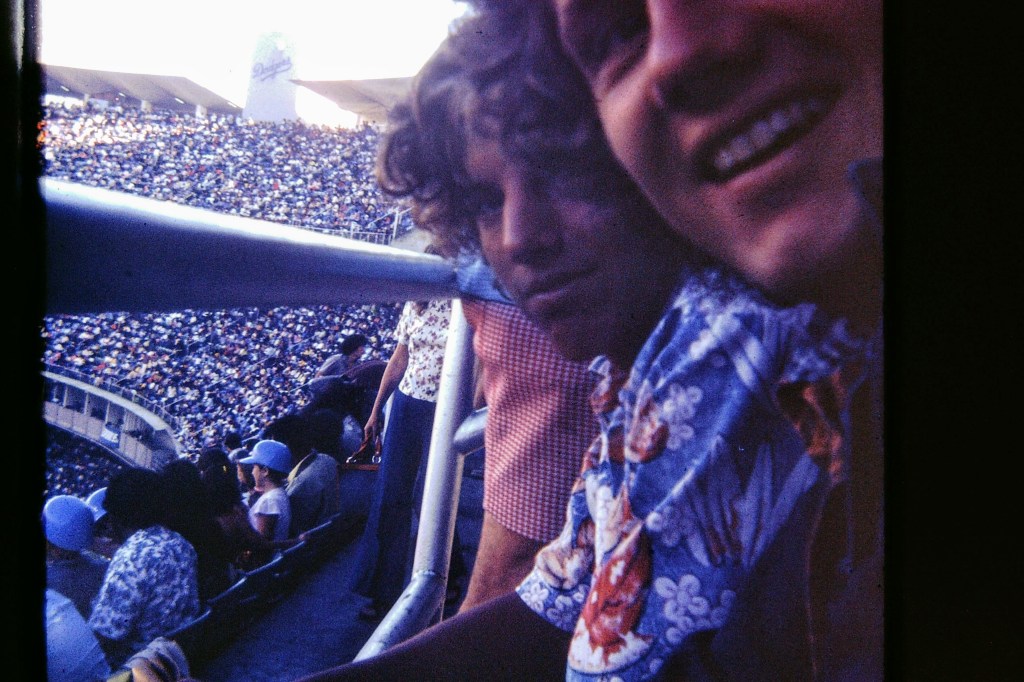
    Photo: With my brother John at a Dodger game, September, 1975. Photo by Susan.