I’ve been reading the new Mel Brooks book, All About Me! My Remarkable Life in Show Business (Ballantine Books, 2021), aloud evenings for family entertainment. It takes a little getting used to, but it beats Jeopardy, which I’ve given up along with ice cream as a near nightly habit moving into the new year. I got the Mel Brooks book for Susan as a Christmas gift. She likes Mel Brooks. She’s very knowledgeable about films and actors and singers and such. Remembers lyrics of far away songs and where she was and how old she was when she saw a movie and who she saw it with. Her grandfather on her mother’s side was in the film industry in Hollywood, a career scene painter, back in the days when movies were made mostly on backlots and required giant backdrops of scenery painted, so the action filmed in the foreground would look like it was done on location. His specialty was clouds, skies, oceans, also buildings and street scenes, fronts, false facades, and interior walls and columns and windows. One year, they flew him to Italy to paint some backdrops for Ben Hur. He worked for the studios. He was an artist, a painter, in the union. He used bristle brush and airbrush. I probably wouldn’t get in line to watch Ben Hur now, but it was a very successful and influential film. I don’t know if Susan’s grandfather ever met Mel Brooks, but Mel might have been influenced by the Ben Hur film when making his History of the World films. Anyway, Mel uses the phrase “It took a little getting used to” frequently in All About Me! For example, when he first eats the Army chow called “shit on a shingle” he says, “it took a little getting used to.”
We’re in Chapter Three, titled World War II, and 18 year old Mel’s just finished a 1945 seasick crossing of the North Atlantic in February and is now in the French countryside of Normandy training to join an Engineer Battalion. In an aside, a flash-forward, he returns to the French farm while in Europe during the filming of The Elephant Man (1980), which was produced by Brooksfilms. And when Mel gets to the farm, he’s greeted by the little French farm kid he befriended with candy in 1945, the kid now the size of a bear. “Mon Dieu! Mel?” the now grown kid says, recognizing the now middle aged ex-soldier.
It takes a little getting used to, but I enjoy reading aloud, even if Susan is the only person in the audience. A book like All About Me! lends itself to an oral reading, straight ahead first person narrative memoir with plenty of room for interruption to discuss what’s going on, complete with jokes and laughs and dialog, anecdote and history, and old photos to share with the audience.
Yeah, it takes a little getting used to, oral reading for entertainment, for the reader and listener, but it’s fun and engaging and certainly beats bad television, but probably not the football championships. Add another lockdown activity to the list of things to do during the Great Covid Scare.
How do we recall a past occurring prior to our visit to the planet? The physicists are busy trying to recall the origin of the universe, and beyond. Meantime, I’ve been busy visiting the Baroque era of the 17th and 18th Centuries. We discover timelines to be arbitrarily drawn. Borges explains in his Kafka and his Precursors, arguing how Kafka influenced Shakespeare, for example. And J. S. Bach, even when played on so called period instruments in a cold church in Saxony, continues to be influenced by Thelonious Monk. It’s best to keep the algorithms confused, guessing.
For some time, Penelope Fitzgerald’s novel The Blue Flower sat buried in the to-be-read stack, even as all her other novels were read, some more than once: The Bookshop, At Freddie’s, Offshore. The problem seemed to rest in the tag historical novel. But couldn’t Offshore also be considered a so-called historical novel? In any case, it was Eric Siblin’s The Cello Suites: J. S. Bach, Pablo Casals, and the Search for a Baroque Masterpiece, thoroughly enjoyed, that brought about a reconsideration of The Blue Flower, bringing it to the top of the stack, opened, and listened to.
Here is an example of how Penelope influences the Baroque era of Saxony:
“‘I am not sure about that,’ said Fritz. ‘Luck has its rules, if you can understand them, and then it is scarcely luck.’ ‘Yes, but every evening at dinner, to sit there while these important people amused themselves by giving you too much to drink, to have your glass filled up again and again with fine wines, I don’t know what…What did they talk about?’ ‘Nature-philosophy, galvanism, animal magnetism and freemasonry,’ said Fritz. ‘I don’t believe it. You drink wine to forget things like that. And then at night, when the pretty women come creaking on tiptoe up the stairs to find the young innocent, and tap at your door, T R I U M P H !’ ‘There are no women,’ Fritz told him, ‘I think perhaps my uncle did not invite any.’ ‘No women!’ cried Erasmus. ‘Who then did the washing?’”
The Blue Flower, 1995, Penelope Fitzgerald, page 30 in the Second Mariner Books edition 2014.
It’s that bit of who does the washing, to cite but one example, which begins her 20th Century novel and remains a motif throughout where Penelope influences the Baroque era that is her setting.
I’ve been living baroquely lately, coming into the new year, the confused seasons out of control – fall to winter for now though here seemingly obvious. It’s cold and wet and dark out, the darkest days of the year, the longest nights, the hardest streets. The homeless are between a rock and a hard place. They are the meek inheriting the earth, for what that’s worth. A week ago, when it started to snow, we were exactly six months from the freak heat wave of late June when one day we reached an absurd 116 degrees. Where I came of age, the southwest side of Los Angeles County, near the beach at the north end of South Santa Monica Bay, South Bay, for short, the mostly small, originally factory lodging, houses, and our little corner house, were plotted between the oil refinery and sand dunes and ocean and the Hyperion Water Reclamation Plant and the sprawling airport and the growing aerospace industrial parks, while there were on the east side of our small town still strawberry fields, a few horses in stalls, and a railroad track from the east running behind our backyards through a curving dusty chasm, what the kids called Devil’s Path (or Devil’s Pass), a short cut along the tracks into town, that ended at a small depot near Main Street and Grand Avenue. But in spite of all the brouhaha surrounding us, the ocean nearby was the weather.
There were only two seasons in my childhood: summer, which was the school vacation season, and the school year, the months on either side of vacation. The weather had little to do with our sense of seasonality. The sky was close to blue, the water almost blue and hues of such, the yards and parks and baseball diamonds multi shades of green, the streets mostly clean. Of course there hung about our heads the gunbarrel-blue cake of atrocious smog, though not so much nearer the water, unless the Santa Ana winds were blowing, maybe for a week or so once or twice a year was all in those days. And June might have been the foggy season, but the breezes off the ocean usually pushed and cleaned as they blew east across the big basin, through the canyons up into the hills and up the long boulevards that ran east and west, and blew too through our house because there was always a window open (or broken) somewhere or a door might open or close any time of the day or night as we came and went to and fro through the blues and greens and sandy yellow days and well lit nights of Los Angeles and environs.
Why did humans leave Africa? If that’s what happened, and it’s becoming increasingly clear that our history, what little we can be sure of, might be a bit more compound-complex. In any case, I can’t answer that; I don’t even know why I left Los Angeles.
We live, it’s been suggested, but I don’t remember where I first saw or heard this, at the bottom of a sea of atmosphere (I googled the phrase just now and came up with about 30,000 results, so instead of quote marks, I’ve italicized it). But nothing like water, the rain, to wash out one’s punctuation marks.
Punctuated equilibrium suggests a paragraph whose flow of ideas is steady and stable, one thought logically following another in a gradual evolutionary movement that can be traced forward and backward and annotated. Sudden changes are more difficult to explain.
In Steve Martin’s movie “L. A. Story,” the main character is a television weatherman. But there is no weather in his Los Angeles, by which is meant change in weather. That is a paragraph without a main idea.
Locally, on the television news, consisting mostly of stable formatting, the studio news teams, that is, the players on camera, consist of an anchor, the sportscaster, and the weatherperson – the great American Triumphant (one pictures Benjamin Franklin flying his kite in a lightning storm, the on location camera crew shaking in their boots). The weatherpersons rarely seem to be given enough time to elaborate, as evidenced by their speed of speech. They sound like hawkers at an auction. The numbers and maps, highs and lows, radar of fronts, systems, and directions all whiz by, “put in motion,” and “hour by hour,” as they say, so quickly that as if to include the weather at all in the newscast seems to have been an afterthought. And the channels devoted to weather 24 by 7 are no different, everyone in a hurry to get out of the weather, whatever it is.
The newshour (or half hour, as our attention spans continue to wane) is not an essay, even though the principal parts may seem like paragraphs in some unified whole. The news relies on something new happening, but not even sudden changes in the fossil record can satisfy our quest to know, let alone understand, what’s going down.
Are we in the midst of a sudden change in the fossil record? Story at 11.
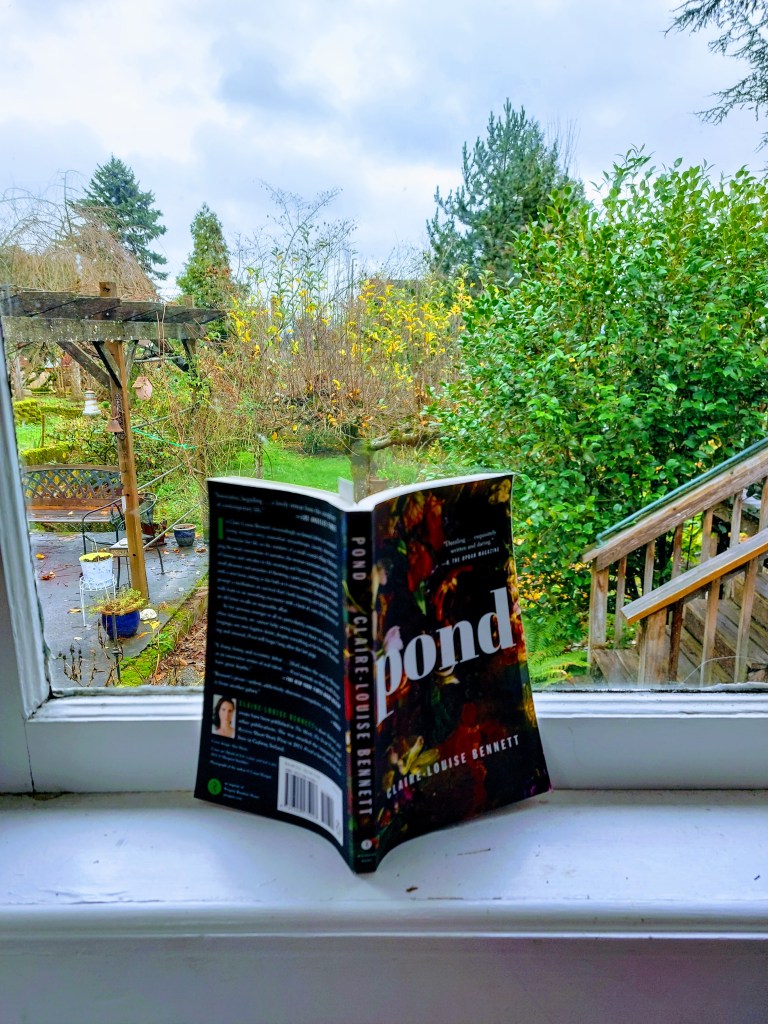
(Pond, by Claire-Louise Bennett, Riverside Books, 2016, originally published in Ireland by Stinging Fly Press, 2015, 195 pages)
There are thirty snippets of “Praise for Pond,” cutlets from big and small zines and papers (and authors selected or solicited for blurbs) on and offline, from reviews, presumably, four full pages of front matter, mostly adjectives and adverbs describing the author’s (Claire-Louise Bennett, Riverside Books, 2016, originally published in Ireland by Stinging Fly Press, 2015, 195 pages) “prose… mind…debut…sensibility”:
ardent, obsessive-compulsive, a little feral…kookily romantic;
innovative, beguiling…meditative…fresh;
witty;
dreamlike…startling;
attentive…baroque and beautiful;
stunning;
cool, curious…intense;
elegant and intoxicating;
fascinating…immersive…readable;
exhilarating…comfortable…confident;
deceptively simple…unsettled…formidably gifted;
strange;
muddiness…deliberate and crisp;
sharp…discursive;
weird;
impressive;
compelling;
quirky…opinionated;
inventive;
believable…dazzling;
captivating…wonderful;
quiet and luxurious;
ablaze;
absorbing, compassionate;
distinct;
provocative;
wry.
But I will add that what Bennett requires of her reader is patience, the kind of indulgence one might assume will not make for a popular reading, yet here it is, an “eccentric debut…of real talent.”
The common reader might already suspect we are in for deep waters in “pond” when we see the page that comes after the list of twenty titles in the table of contents, quotes from Nietzsche (The Birth of Tragedy), Natalia Ginzburg (“A Place to Live”), and Gaston Bachelard (The Poetics of Space). I can’t explain why the titles of the Nietzsche and Bachelard books are placed in italics (in the Riverside paperback copy under review – i.e. the one I read, the first American edition, and have posted a pic of above, sitting in the kitchen nook window looking out on the wet yard as I type) while the title of the Ginzburg book is placed within quote marks. But, as it happens, the book I finished just prior to opening “pond,” coincidentally, (and I don’t really know if it should be typed as “pond,” “Pond,” or “POND”; or pond, Pond, or POND) was a Natalia Ginzburg book: “Family and Borghesia” (nyrb reissue, 2021), a very different kind of book from “Pond,” though similar in its wanton flow of words and focus on detail (how’s that for blurbing?). Moreover, as I looked up “patience,” wondering if it was the right word, appropriate and all that, for where I wanted to put it, adding my own descriptive, albeit with a noun, to the thirty clips, knowing full well it will never nor would have made the cut, I came across this sample sentence to illustrate the use of “indulgence”:
“Claire collects shoes—it is her indulgence” (Google dictionary, Oxford languages).
I don’t collect shoes, nor, I suspect, does Claire-Louise Bennett, who apparently lives or lived during the making of POND on the Atlantic Coast of Ireland in a small stone hut of some kind, again, apparently, as I put together a few clues from the book as well as from rummaging around. I live on the Pacific Coast of the US, not within a stone’s throw of the water, anymore, but close enough to enjoy the waterlogged winters of the Pacific Northwest, about ninety miles away from the big pond as the roads go, about seventy miles for the birds, assuming they take a direct route over or through the passes of the Coast Range. The coordinates for Galway are 53.2707° N, 9.0568° W; while for Cannon Beach, Oregon are 45.8918° N, 123.9615° W. It’s currently (as I type) 44 degrees in Galway and wet at 8pm, a bit of wind maybe a bit of sun tomorrow to close a rainy week and start a new one; while at the Oregon coast it’s wet and 47 degrees finishing the morning with a high wind warning in place for this evening to close a wet week and start a new one. That’s not to say living on the Pacific coast of the US is anything like living on the Atlantic coast of Ireland. Except that, we both get our weather for the most part from our close proximity to what some call wild oceans.
In any case, I very much enjoyed reading “pond,” and thought I might put up a post from another West Coast of rivers and streams dampness and moss and ponds and puddles galore:
“aplenty in abundance in profusion in great quantity in large numbers by the dozen to spare everywhere all over (the place) a gogo by the truckload by the shedload” (Google dictionary)
I think galore is the descriptive word I’ll end this review (if, indeed, it can be called that, and, if not, I don’t know what) of “Pond” with.
“Did you post something to your blog today?” “I’m thinking of going horizontal.” “Really, and how was your day?” “Not bad. I escaped Twitter in the knick of time.” “What does “in the knick of time” mean, exactly?” “Sorry; comments off.”
One gives notice. Another grins and abides. The one no longer interested in content, the other insisting on diary entries reaffirming his firm grip on reality. One is motionless, the other still moves about. One accepts but withdraws, the other complains, and even though there’s little to complain about, finds a way to complain about that too. One prays in an empty space, the other watches the news in a room full of knickknacks and memorabilia no one remembers. One drifts, the other plans outings.
One falls silent, another gets up and talks. One is more interested in conversations without words. One deactivates, the other continues to like and comment and, in short, feels engaged.
One stops the vertical fall and the horizontal push, and edges fall away. Another scrolls up and down and takes cuts.
The one never did make sense, the other insists on making sense.
I was reading through the Wiki entry for Frank Zappa, can’t remember why, and came across this quote from his autobiography, “The Real Frank Zappa Book”:
Since I didn’t have any kind of formal training, it didn’t make any difference to me if I was listening to Lightnin’ Slim, or a vocal group called the Jewels …, or Webern, or Varèse, or Stravinsky. To me it was all good music.
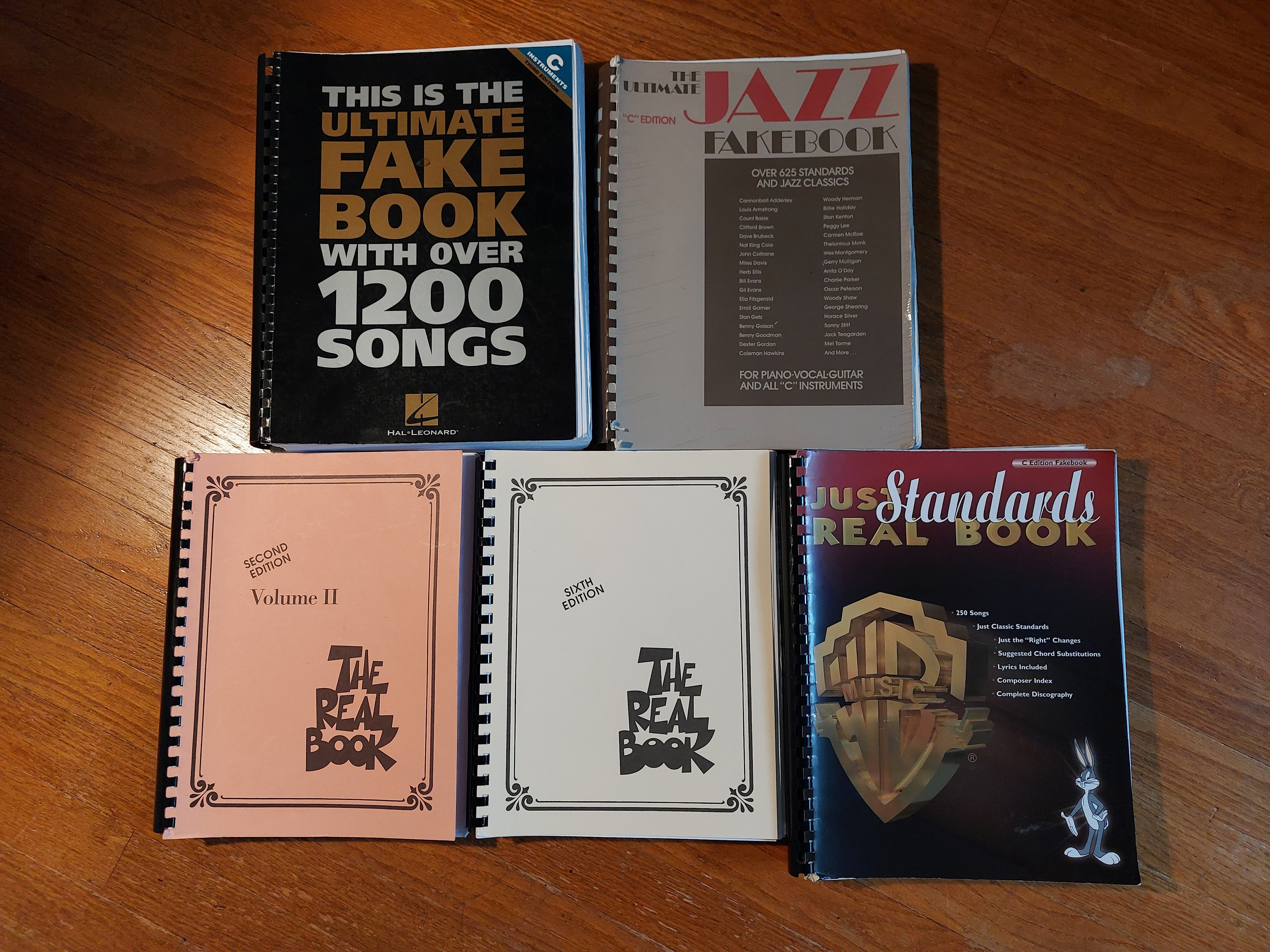
The title of the Zappa book might contain a reference to the musical fake and real books, collections of a kind of shorthand lead sheets used by players as sketch or blueprints to cover pieces. These music books usually fit any song on one page, and show melody notes and chord symbols. The original fake/real books differed from songbooks in that they did not include lyrics and were mostly used by jazz players who only needed guidelines, not strict written scores that might have gone on for pages and still only approximated what one had heard or wanted to hear.
The many versions of fake and real books published over the years complicates a description; suffice to say they provide a recipe for the song, but the musician still needs to do the mixing and cooking. They don’t work like player pianos. That reading above of the title is layered below the obvious one, that so much had been said and written about Frank that he decided to sort the wheat from the chaff and clarify what the real Frank Zappa was all about. I’ve not read it, but I’ve put a copy on hold.
Meantime, what about the part of that quote that says, “all good music.” What is good? What is music?
If to identify is to accuse, I probably shouldn’t mention Keith Kopka’s travelling punk band past in easy to get front row outlier venues where the stage is so close to the audience sweat exchanges and curls the tickets, nor mention his emergence as a poet with enough good material to fill a book, “Count Four.” Good title for a book of poems, readers waiting for the rim shot, the close cadence that bridges music and language, a command, like Basic Training drill marching, the poet soldier the sensitive one who saves the Motel 8 (or 6 or 4 or 12 bar blues) weekend pass receipt on the back of which is scribbled a waitress’s name and phone number which might appear in some future poem about a past mistake. She gotta way, don’t she, babe. And we’ll never know if she’s still a waitress (speaking of identity, and so what if she is?) or if she found success (if not happiness in apple pie crust) by turning her con artist skills into legitimate work as an adjunct and now only waitresses part time to make ends meet:
She’s a waitress, no older than nineteen, mouth caked in lipstick, pie flour streaked on her thigh. Watching her, I can tell by how she keeps her apron on during sex, that she’ll wait tables forever.
III. Lafayette, Indiana, Star City (50)
Kopka’s poetry seems to successfully bridge what should satisfy simultaneously the respectable academic reader with diplomatic credentials and the still street smart fighting guys and gals intellectually inclined but unwilling to sell their future for a degree, happy to wait for an encore they know deep down where the blood runs true will never come:
but on the entire crowd who continues to believe it, when you sing about the coal vein of hillbilly music being the only thing that keep you hangin’ on, the expensive idea that you still break our hearts, and have your heart broken.
Dwight Yoakam’s Hat (89)
Just so the key to the effectiveness and efficiencies of Kopka’s poems, which will be popular scratched on the walls of an egalitarian latrine or published in the pure pages of a Poetry magazine, where normal wears formal:
Asia is a sexual astronaut, surrounded by a radiated halo, a solar system of pleasure choices, links to videos, and a chat room.
Asia Carrera’s XXX Butt-kicking Homepage, 1998 (12)
Yet there are domestic, familial, moral imperatives, purposeful and meaningful roots to Kopka’s poetry. One doesn’t become a Punk (or poet) by chance, but by choice. The decision is existential and requires a rebirth. All life begins as a kid and spins like a top:
By then I’d circled all the way around to my father’s house again. Same house I grew up in. So I ring the doorbell, and when my father answers I start to name what I’ve lifted.
Interrogation (1)
His dad sets him up in a suit in a poem that contains the ritual of a sacrament, the Sacrament of Confirmation. On the way home they rehearse a lie for his mom about how they got the suit, as if she won’t guess the truth. They won’t mention “Vinny the Tailor,” the kid’s sponsor, who never sewed a stitch in his life:
Vinny, menace of the Jersey Turnpike, man who never stitched a thing more complicated than an alibi,
Vinny the Tailor (20)
The world turns, as in a soap opera, life grows hairy, there are chores to get done, some things change and others don’t:
like an un-staked scarecrow. My aunt dries dishes while my mother washes. My uncle rolls his eyes when I toss Danielle a dish rag, and take my mother’s place
Homecoming (33)
The roots of now old trees rise up, raise the sidewalk, crack the cement. You can’t go home again, but neither will you feel at home in Harvard Yard. You find yourself starting to talk about punctuation, a concern for commas:
This comma, handed down from generations of working class parents
Georgic on the Boston Comma (37)
“Count Four,” and place a comma. As good a rule as any. And with rules come sophistications, affairs of the road, where poems become counts of indictments, stories are told slant, as Emily suggested, where “Success in Circuit lies.” But there are more guns in these poems than guitars, and a violence that cries out for meaning. The words are crisp and intelligible, not muddy as if through a Marshall 100 watt amp built to take squelching and squealing abuse. The poems waiver in stereo back and forth between anecdotal narratives laced with abuse and epiphanic moments and where some never awaken from the noise of self-abuse. These poems were written over time, the book collecting from a myriad of sources, a few independent or alternative, and are brought together under the imprimatur of a vintage label. The book’s title appears in the poem “All We Do Is Begin,” as in “Begin the Beguine,” where poetry translates noise into music, mosh pit convulsions into slow dance. It’s poetry where the Punk finds their way out of the mosh pit and into the solo business of writing poems to make sense of it all:
Through the wall you heard a song end, and in its ring the singer counted to four. You were just starting to understand how he’d count four thirty times a night for twenty years. It is easy to hate what we’re given, especially when it’s all we know.
All We Do Is Begin (85).
The guns are not symbols, as any guitars might have been; they’re literal and costly and deadly and like tattoos hard to erase. And the poems come loaded with history lessons, poems like “You, Strung,” that meld the personal with the general, reality with fantasy. These are poems Holden might have written, if he had written poems. And an epigram might make for the stunning occasion of the argument, as in “Square Dance Conspiracy,” above which Henry Ford gives us his opinion on the source of jazz, which he gets wrong, though his description seems to work. In any case, “Square Dance” a great exercise in poetic apostrophe, where “Wild nights – Wild nights!” are calmed if not tamed.
I don’t get the feeling Kopka’s poems are hastily written. There’s an underlying patience, notes of growth and maturation, and his poems show both temperamental talent and writerly skills at work. The ideas begin in observation, might be confessional, but could be fictional, and ethical choices are made, dug out, and then backfilled. Description moves us forward, closer to the action:
We’re eating poutine in a courtyard canopied by hackberry trees…. Under the table, the brunette unfolds a napkin on my lap, her palm holding me through the cloth makes a slow, migratory circuit.
The Birds of Montreal (86)
There are three sections to “Count Four,” and a single poem introduction (“Interrogation”), for a total of 32 poems. The book is well organized and presented. No very short, tweet-like poems. The poems are formally written using poetic devices both hidden and obvious. Not that these need to be recognized for enjoyment of the book. The poems are accessible, and in that sense traditional and conservative, at least in form, rather than radical and blurred. There’s humor as well as remorse. The narrators are dynamic characters, changing from their beginnings as a result of their experiences. It seems there is no end to some of these experiences for each new generation that cometh. The poem “Hollywood Ave,” for example, takes a new pic of an old icon. Originally named Prospect Avenue, but changed to Hollywood Boulevard; too bad, Prospect far more telling. Or maybe the poem is about any one of the other 90,000 Hollywood Avenues spread throughout the country. And “Coke Folks” could easily be a nowadays sitcom.
Final Note: I very much enjoyed and like the poems in this book. I don’t want to be in most of them, but I imagine Keith Kopka doesn’t either these days. He’s no doubt moved on, this book seems to function as a kind of memoir, and I look forward to reading his future writing. For readers who would like to know more about Kopka now, here’s a link to an essay he wrote last year, titled PUNK ROCK, POETRY & THE MYTH OF MASCULINITY (OCTOBER 14, 2020 VOL. 1 BROOKLYN). But get a copy of “Count Four”; it’s the real thing.
On Sunday, January 9th, 1966, three days after the Feast of Epiphany, a story appeared in the New York Times, in the Religion section of the newspaper, in Section H, on page 146, under the title: “‘God is Dead’ Debate Widens.” The Times did not, as the Elton John song “Levon” suggests, declare the death of God:
“He was born a pauper To a pawn on a Christmas day When the New York Times Said ‘God is dead’ and the war’s begun”
Elton John and Bernie Taupin, 1971, from the album “Madman Across the Water.” The B side of the “Levon” single was titled “Goodbye.”
What the Times did say, in the story’s opening paragraph, was:
“The clearest thing about the small but much-publicized ‘God is Dead’ movement in Protestant theology is its catchy, provocative title. After that, all is subtlety, the specialized technical language of the academy, professional abstruseness and lay bafflement.”
The same might be said of Global Warming, which this week the Times did declare is no longer maybe coming: it’s here. Again, the Times reporting. The story derives from the recent United Nations report published via its Intergovernmental Panel on Climate Change. The gist of the report is this:
“It is unequivocal that human influence has warmed the atmosphere, ocean and land. Widespread and rapid changes in the atmosphere, ocean, cryosphere and biosphere have occurred….Many changes due to past and future greenhouse gas emissions are irreversible for centuries to millennia, especially changes in the ocean, ice sheets and global sea level.”
It was the German philosopher Nietzsche (1844-1900) who most famously suggested “God is Dead.” From his “Thus Spoke Zarathustra”:
“When Zarathustra was alone, however, he said to his heart: “Could it be possible! This old saint in the forest hath not yet heard of it, that GOD IS DEAD!”…Woe unto all loving ones who have not an elevation which is above their pity!…Thus spake the devil unto me, once on a time: “Even God hath his hell: it is his love for man.”…And lately, did I hear him say these words: “God is dead: of his pity for man hath God died.”—…So be ye warned against pity: FROM THENCE there yet cometh unto men a heavy cloud! Verily, I understand weather-signs!“
Nietzsche, like the Times, was merely reporting, and the following, from his “The Joyful Wisdom,” he attributed to a “madman”:
“The insane man jumped into their midst and transfixed them with his glances. “Where is God gone?” he called out. “I mean to tell you! We have killed him,—you and I! We are all his murderers! But how have we done it? How were we able to drink up the 168sea? Who gave us the sponge to wipe away the whole horizon? What did we do when we loosened this earth from its sun? Whither does it now move? Whither do we move? Away from all suns? Do we not dash on unceasingly? Backwards, sideways, forwards, in all directions? Is there still an above and below? Do we not stray, as through infinite nothingness? Does not empty space breathe upon us? Has it not become colder? Does not night come on continually, darker and darker? Shall we not have to light lanterns in the morning? Do we not hear the noise of the grave-diggers who are burying God? Do we not smell the divine putrefaction?—for even Gods putrefy! God is dead! God remains dead! And we have killed him! How shall we console ourselves, the most murderous of all murderers? The holiest and the mightiest that the world has hitherto possessed, has bled to death under our knife,—who will wipe the blood from us? With what water could we cleanse ourselves?”
Yet Nietzsche remained hopeful in “The Joyful Wisdom”:
“We philosophers and ‘free spirits’ feel ourselves irradiated as by a new dawn by the report that the “old God is dead”; our hearts overflow with gratitude, astonishment, presentiment and expectation. At last the horizon seems open once more, granting even that it is not bright; our ships can at last put out to sea in face of every danger; every hazard is again permitted to the discerner; the sea, our sea, again lies open before us; perhaps never before did such an ‘open sea’ exist.”
The UN report also ends with a hopeful note, that future climate change could be limited, that if we cut CO2 emissions, we will see:
“discernible differences in trends of global surface temperature would begin to emerge from natural variability within around 20 years, and over longer time periods for many other climatic impact-drivers (high confidence).
You’re not a real King unless you’re in a Shakespeare play.
/kiNG/ rhymes with bring the King his spring slippers.
A soft King is hard to find.
Louis XIV (the Sun King) reigned for 72 years and 110 days, and behaved like one might want of a King (but born too late for Shakespeare). Louis might have been called the Woke King, for that’s a long time to go without sleeping. Or the Ballet King, for he loved to dance, and insisted his court keep its knees up.

 The Coming of the Toads