Tag: Discuss

  • Field Notes 28 Aug 23

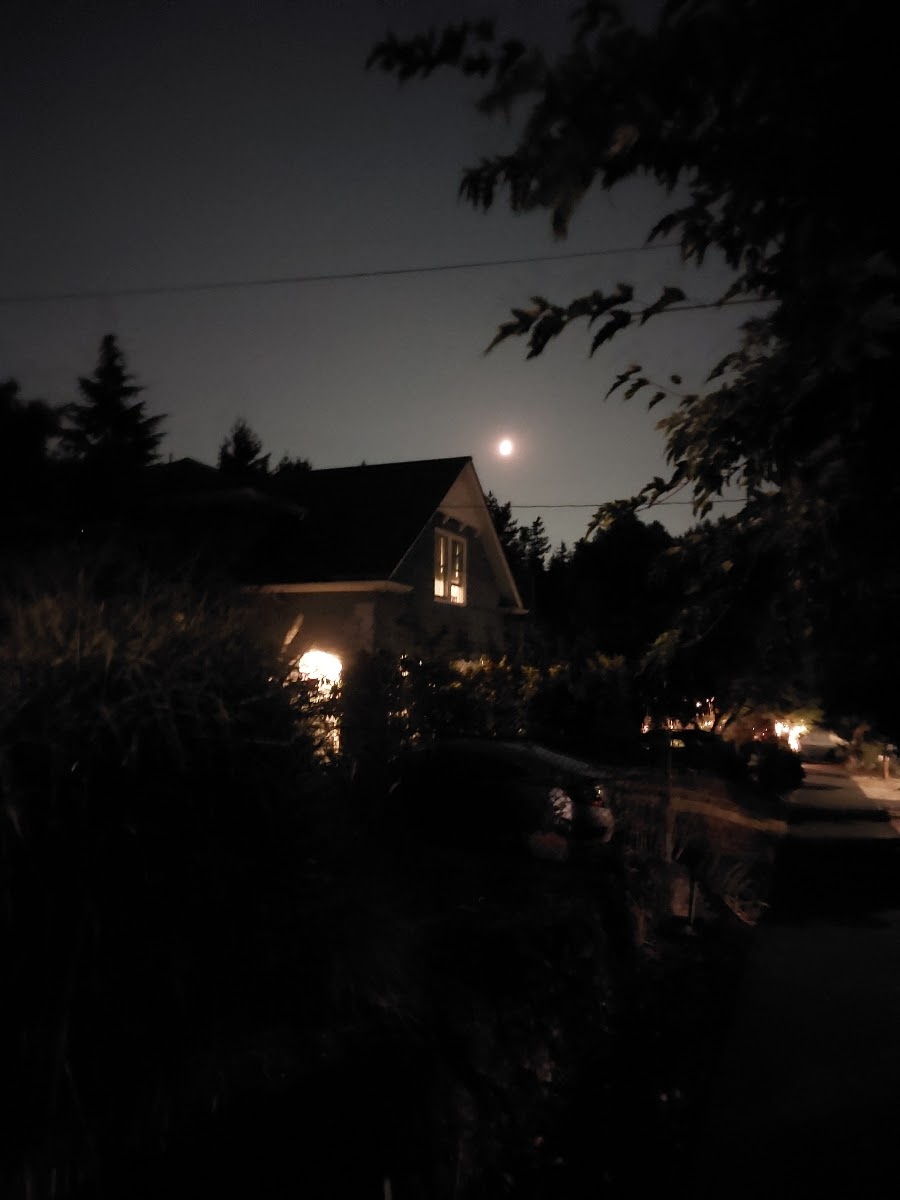
    Walked a mile last night with Eric, curlycue around the neighborhood streets late in the evening, the blue moon rising over the houses and over the firs up on the dark volcano, first cool evening in awhile, feeling the ocean air arrive like an old steamship foreshadowed by tugboats pushing and pulling against a tide. Earlier had sat out in the drive with the guitar, disturbing the universe, though no one seemed to mind, a few passersby walking dogs giving me a nod, the International Play Music on the Porch Day passing locally like any other day.

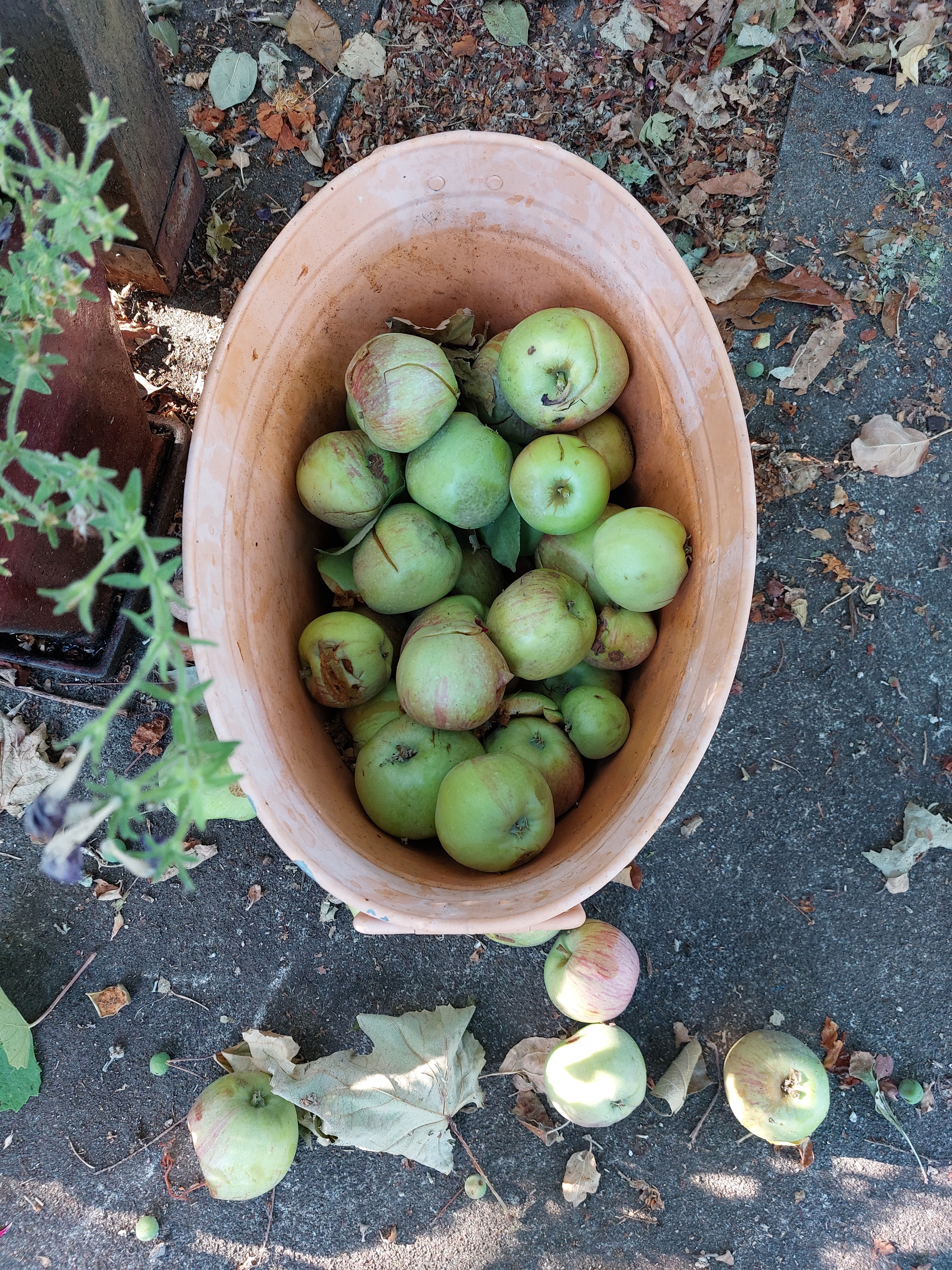
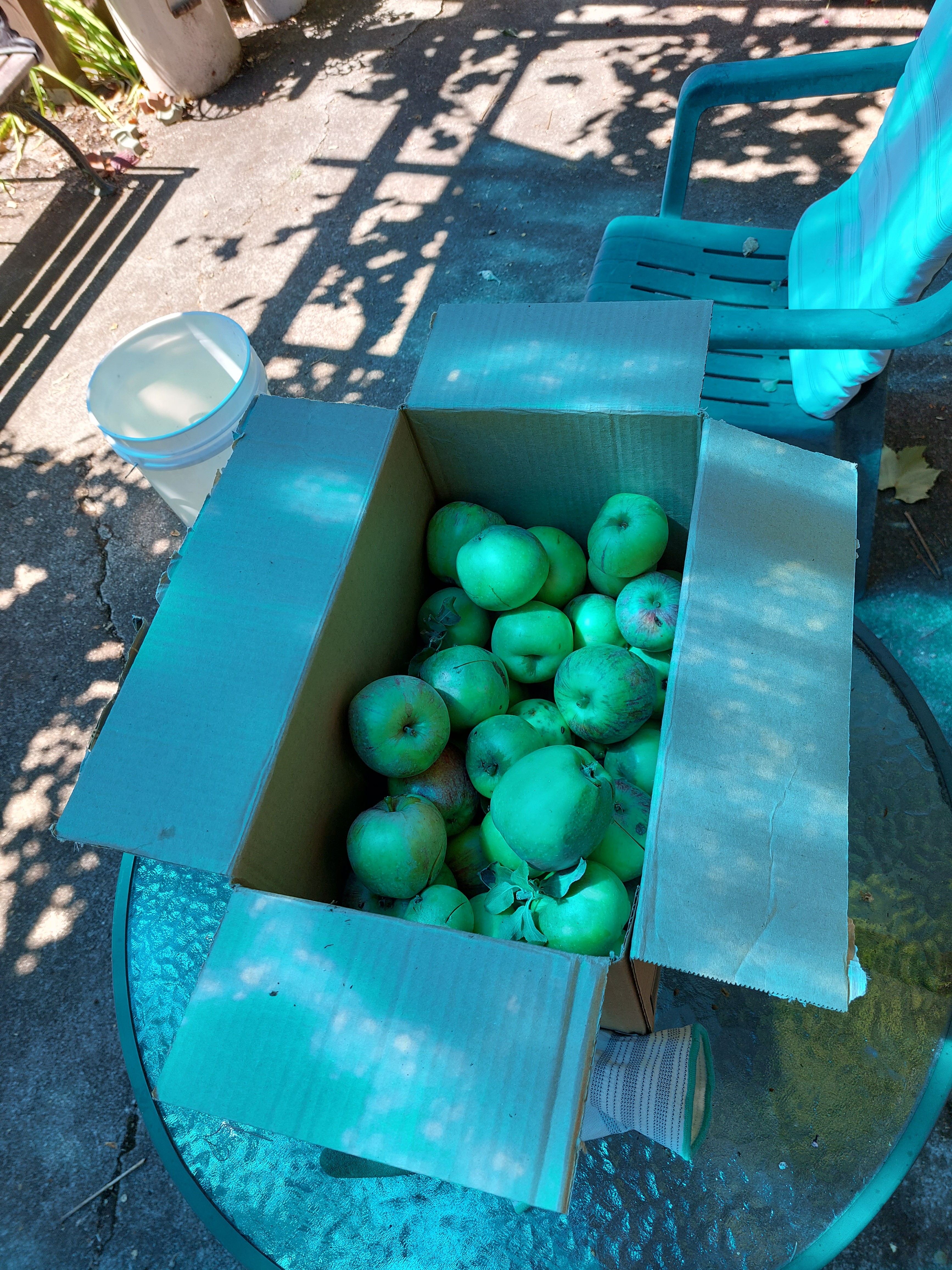
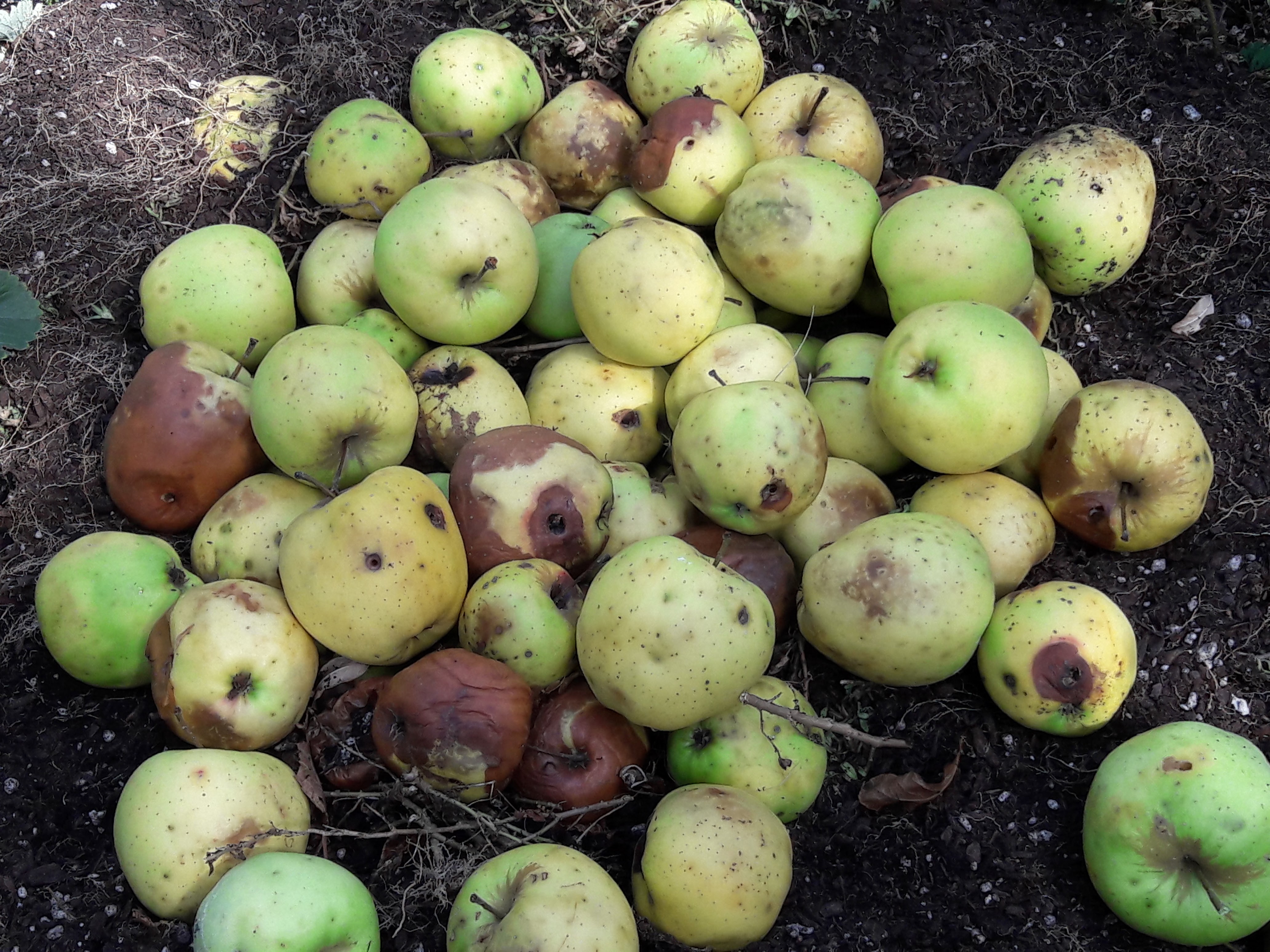
    The neighbor’s Brobdingnagian apple tree, high up above the border wall, half of which hangs out and over our grape pergola, too high to pick, seems to have come close to finishing its self-harvest drop, around a dozen or more bushels falling on our side of the wall this year, a bumper crop, peck after peck after peck we’ve picked up and bagged.

    Meanwhile, peaches are in season. Fresh peaches, juicy and tender, slightly fuzzy, plump, pink and red and yellow and orange. Nectarines are also peaches, but without the fuzz, smooth, and the pit of the peach is akin to an almond. This is what comes from looking things up, a new pastime. Of the numerous poets who have tried to get their hands around a peach, perhaps none have squeezed as close yet stayed afar as Andrew Marvel, in his poem titled simply “The Garden” (circa 1650), where he seems to prefer the actual peach to any metaphor that might point elsewhere for one’s fuzzy orbs:

    “What wond’rous life in this I lead!
    Ripe apples drop about my head;
    The luscious clusters of the vine
    Upon my mouth do crush their wine;
    The nectarine and curious peach
    Into my hands themselves do reach;
    Stumbling on melons as I pass,
    Ensnar’d with flow’rs, I fall on grass.”

    Andrew Marvel

    Why “curious”?

    “I grow old … I grow old …
    I shall wear the bottoms of my trousers rolled.

    Shall I part my hair behind? Do I dare to eat a peach?
    I shall wear white flannel trousers, and walk upon the beach.
    I have heard the mermaids singing, each to each.

    I do not think that they will sing to me.”

    from “The Love Song of J. Alfred Prufrock,” T. S. Eliot, 1911

    One of these days, I’ll compose my own poem to the peach, maybe “Portrait of a Peach,” which is to say, one you cannot eat, dare or not. Lately, Susan’s been offering ripe peaches on a plate to nibble through the slow afternoon, so soft, so cool, so sweet, so refreshing. Love peaches, love to see two, side by side, each to each, within easy reach.

    Speaking of growing old and wearing trousers rolled, yesterday, lightly working outside, I came close to falling twice. The first time, I caught my pant cuff on a hook under the outdoor couch. I nearly fell into a cluster of flower pots. The second time, the foot whose turn it was to move forward on the porch somehow stuck in place, and the pot I was carrying was tossed so I could stop my fall with the arm that was holding it. The pot fell and broke in two, splattering the walk with potting soil. And somehow I found myself sitting on the porch step. Not quite a fall, then, a sit?

  • Get Real

    To make art, to make things
    out of other things, to engage
    in artifice, a confidence game:
    “Get real,” your critics say.
    The earth is a rug
    constantly being pulled
    out from under you.

    The artificial is real: the bread
    and wine camouflage the need
    to sacrifice the poor lost lamb,
    not to mention the virgin,
    created by man made
    design critics to avoid
    her real predicament:

    “Poor and rich belonged to the same world and placed themselves on a common, even sliding scale, but beggars could not. The ptochos was someone who had lost many or all of his family and social ties. He was a wanderer, therefore a foreigner for others, unable to tax for any length of time the resources of a group to which he could contribute very little or nothing at all…a ptochos was a shocking reality for the Greco-Roman world” (272). 1

    “The beatitude of Jesus declared blessed, then, not the poor but the destitute, not poverty but beggary…Jesus spoke of a Kingdom not of the Peasant or Artisan classes but of the Unclean, Degraded, and Expendable classes” (273). 2

    1. Gildas Hamas quoted in John Dominic Crossan’s “The Historical Jesus: The Life of a Mediterranean Jewish Peasant” (272). 2. Crossan gloss of Gerhard Lenski (273).

    Who then or now could write
    a poem who is not at least poor
    real poor or in spirit or metaphor?
    Yet the beggars make their signs
    and hold up their poems
    along the roadsides,
    the least of publications,
    the yeast of city life.

    “What is needed, then, is not insight into the Kingdom as future but a recognition of the Kingdom as present. For Jesus, a Kingdom of beggars and weeds is a Kingdom of here and now” (Crossan, 283).

    What is real
    will not be
    found staring
    at the universe
    through artificial eyes
    to catch a glimpse
    of dawn’s first light,
    nor descending
    to the bottom
    of the sea
    in rich pods
    to study ancient
    shipwrecks,
    nor in any travel
    nor in any poem.

    But surely we must
    avoid the real
    at all cost
    and become more
    artificial.

  • Shapers: Part Two of Ashen Venema’s Mythical Odyssey

    I’ve been reading Ashen Venema’s Course of Mirrors blog for over 10 years now, and in that time, she’s shown remarkable reselience and steadfastness, sharing essays, poetry, photography; recollections, insight, learning; humor, pathos, teaching – all the while working on a major work, which might become a trilogy (along the lines of Dune, Rings, Star Wars, Potter). The first part, a novel titled “Course of Mirrors: an Odyssey,” I reviewed in June 2017. Its sequel, titled “Shapers,” is now out. I purchased an ebook version via Amazon. A paperback version is also now available via Amazon US and other channels. Both books were published by Troubador.

    If you’re looking for a quick read, “Shapers” is not it. Its 360 pages are dense with encyclopedic-like entries that explain the far-out world readers must navigate. At the same time (though time is presented as protean), this new world won’t seem entirely foreign. For example, Chapter Two begins with a description of a fictional place and time that sounds uncomfortably familiar – uncomfortable if we go to fantasy to escape our real-time predicament:

    Rhonda, the larger of the Western Isles, used to be an empire competing with rival powers in seizing territory around the world. Indigenous people were uprooted and traded as slaves, until colonies were gradually granted independence. Over time, migrations ensued. People left ancestral homes to seek education and work in the lands of their conquerors, including Rhonda. Traditions mingled, sparking rapid industrial and technological growth along with a moral, intellectual and spiritual freedom that promised each individual unlimited potential.

    This sudden material expansion exhausted earth’s resources and caused rivers of waste flowing into oceans. Machines replaced hands, feet, eyes and even brains. Citizens with nothing meaningful to do were prone to emotional outbursts, filled prisons, or were over-medicated for stress. The ideal of freedom was like an inflated balloon. It burst into anarchy.

    Rhonda concluded that freedom was dangerous. By AD 2540, a correction project had long been in operation, employing the aid of a shunned people known for their unconventional approach to science, psychology and psychic phenomena – the Shapers. As long as they left politics alone, they were granted autonomy of research and funding. Their underground dwellings and laboratories circled around air-funnels lined with mirrors, through which sunlight was reflected down. Rhonda’s rationality project seemed a success. Emotionally unstable citizens were sent to the Shaper Portal for correction. They returned relaxed. The methods through which such miracles were achieved remained unquestioned, as long as they worked.

    Page 37

    Myth is a fictional story used to explain something real – an event, person, thing – even if the telling incorporates unreal (fantastical, imaginary, other-worldly) tools. The theme of “Shapers” explores the human existential crisis of individual freedom that entropically devolves into chaos or extinction, versus imprisonment in some structure of rule or servitude that leaves one arguably safe from existential dread but at the cost of one’s freedom. Where myth survives as something real, believed in, its explanation is simultaneous with the culture that creates it or evolves from it, its aims, its reality. One can’t see beyond one’s own mythical circumstance. Myth helps explain the errors of one’s way, should one go astray. Some contemporary myth, like the life stopping descriptors used in modern psychology, may seem to have the aim of self-actualization, but like most New Age approaches, simply attempt to justify one’s lifestyle – to oneself; the other doesn’t matter. Myth communicates using symbol, metaphor, and a great deal of hyperbole. We can read “Shapers” as myth, and explore symbols and structure, or we can go to it for entertainment and pleasure.

    Another characteristic, apart from myth, of the science fiction genre, is its tendency to waver between camp and seriousness, such that much if not all sci-fi is to so-called serious literature what the B movie is to film. In any writing, the verisimilitude of dialog quickly becomes problematic. If the setting is completely made up, how should the characters talk? How will people talk in the year 2540 – like they do today? Do people talk in paragraphs or in quips?

    “I like feeling secure and comfortable, it makes for peace,” Shakur said.

    “Pockets of peace, I like them too,” Oruba said. “I relax into habits, beliefs, attitudes, but all too easily fall asleep to the wavelength of universal guidance.”

    Shakur frowned. “I thought a calm mind maintains that wavelength.”

    “Not when creative intensity is lost, then the spiral of life falls flat and we’re stuck in a sluggish labyrinth of time, not in harmony with the ever-changing cosmos.”

    “Aren’t we one with the cosmos anyway?” Shakur asked.

    “Yes and no. There’s the yearning for the womblike feeling of oneness and safety, and there’s the resonance with forces that animate us. These forces make for eccentricity and difference, but when constrained for the sake of order and control, leaders become bloated with power. The more rigid the system, the more it imprisons people.”

    “I get it,” Shakur said, grinning. “Leo thought he was a god and now he’s a rat.”

    Oruba roared so suddenly, he dropped his plate of canapés. “He’s luckier than you imagine, he found love – he’s gone on a journey. He escaped the system.”

    Mesa was not amused. “I can see how Rhonda’s system is corrupt,” she said, “and change is necessary. But Armorica is not corrupt, its people are peace-loving.” She paused. “Maybe too much, I admit… we slowed change, and with it, time.”

    Forming a square with his fingers and thumbs through which he looked at his friends, Oruba said, “We observe through frames. We line up these fragments to create a composition.” He popped a quail’s egg into his mouth and chewed it slowly to relish its taste. “We continually shuffle and weave these fragments into new compositions of light. But for truly new visions to emerge we must suffer collisions. They tend to shift surfaces and expose the roots of our memory and experience. There you find the sap of life, from which spins the golden thread of intention and vision.”

    “I’ll shut up for now,” Shakur said, “but I will ask you the question again.” He made a sweeping gesture at the garden. “We had a collision here, and I’m digging towards Tilly’s vision of a rose garden.” Filling up glasses, he added, “A toast to celebrate our friendship! I’ve no right words for this, other than I’m going to miss you terribly!”

    Page 352

    How does one travel in time? But we all do it, are doing it now. The week or day passes quickly or slowly, we think, the longest day the longest suffering. But to shift from one time to another is the provenance of sci-fi. Why time travel? To warn, to fix, to meddle? Can we look forward to a future of gourmet meals as we discuss modes of reality? The scientists seem in charge, in more ways than one. And what of the trinity? If God is three for the price of one, do we also, made in his image and likeness, share our individual reality with two others who also claim to be us? We lived once, why not again? Is once any less mysterious than twice?

    Ashen Venema is both a scientist and an artist. In “Shapers,” we find her bringing the two perspectives together to view our contemporary predicament. She asks the question, What will happen given our current trajectory? The narrative of “Shapers” includes third-person omniscient and first-person diary. The technique adds diversity and interest to the writing. There are other aids provided to help the reader navigate and keep place, including glossary and cast of characters and other front matter, and 29 numbered chapters, each broken into several titled parts.

    Of course, any book today may quickly pass unnoticed. Which ones should we read? Without ad campaigns, movie deals, marketing ploys – alas – the challenges become surreal. But a book review might help. If you’ve read this far into this one, your next move should be to get Ashen’s “Shapers” and join the fun. It might be noted that English is not Ashen’s native language. This is a strength for someone traveling to distant worlds and conversing with diverse cultures. And she is a scientist only if psychology is a science. Psychology experiments with and explores inner worlds; the other scientists explore and tinker with outer worlds; the artist brings the two together in a single view. All of which, in a recipe of fiction, makes for good reading.
  • On Going

    Going somewhere this 4th of July weekend? Traveling? Here’s an article to take with you, read along the way: “The Case Against Travel,” in which the contemporary philosopher Agnes Callard strikes out to strike out travel. She begins citing surprising testimonies on travel hate from Chesterton, Emerson, Socrates, Kant, Samuel Johnson; but the best is this, from Fernando Pessoa:

    “I abhor new ways of life and unfamiliar places. . . . The idea of travelling nauseates me. . . . Ah, let those who don’t exist travel! . . . Travel is for those who cannot feel. . . . Only extreme poverty of the imagination justifies having to move around to feel.”

    The Weekend Essay: “The Case Against Travel”
    “It turns us into the worst version of ourselves while convincing us that we’re at our best.”
    By Agnes Callard
    June 24, 2023 The New Yorker

    Of course, we must ask what is meant by “travel.” Callard is not talking about having to leave town for another to attend a wedding or funeral, attend a family reunion, or interview for a job. She’s talking mainly about tourism, travel for the sake of travel. Going somewhere. And thinking that getting there somehow improves our nature. It doesn’t, Callard argues, convincingly for this homebody, anyway.

    Why folks still want to go somewhere puzzles me. The recent pandemic, still simmering on the back-burners of an overheated health care system, combined with the now certain and overwhelming and ongoing effects of global warming and climate changes, the social and economic unrest like swarms of yellow jackets infesting our cities, ongoing world wide war and immigration and refugee catastrophes – you would think folks would be content hiding out at home. Could it be people are unhappy at home? Unable to relax? Can’t get no satisfaction?

    What to do? But of all the game changing events just listed, the pandemic possibly is most responsible for changing habits across the board of socio-demographic freedom of movement choice. And, surprise and silver lining, we find improvement in the move away from normal: working from home, on-line shopping, neighborhood garage band, do-it-yourself cultural improvement. Eschewing the downtown or suburban mall crowds and visiting the local thrift store to satisfy one’s shopping urges. Church in the park.

    And we might wonder what Artificial Intelligence and Virtual Reality technologies have in store for us down the road. Case in point? The Google Arts & Culture app, where you can take a virtual tour of the Lincoln Memorial, play games in nature, explore the art in Barcelona; play with words with music, fonts, and video; take a hike along The Camino de Santiago; explore Iconic Indian Monuments; discover and discuss The Lomellini Family; do crosswords, artwork, writing.

    Of course, on the other hand, as Jean-Jacques Rousseau said:

    “I can only meditate when I am walking, when I stop I cease to think; my mind only works with my legs.”

    Rousseau quote taken from the Callard article; I don’t know the original source.

    Hard to imagine Rousseau on a 14 hour flight somewhere, legs bent as if in shackles, thinking, I could walk at home, where a study of physics might show me I’ve not even begun to discover the miracles of existence close at hand. What are those miracles? I don’t know, but I’m happy to stay put this summer and smell them out.

  • Wheels within Wheels

    Wheels within Wheels

    Thomas Merton, in his preface to his collection of essays titled “Mystics and Zen Masters” (1961-1967, The Abbey of Gethsemani, 1967 FS&G), suggests a closeness in claims of those across cultures attempting contemplative lives:

    The great contemplative traditions of East and West, while differing sometimes quite radically in their formulation of their aims and in their understanding of their methods, agree in thinking that by spiritual disciplines a man can radically change his life and attain a deeper meaning, a more perfect integration, a more complete fulfillment, a more total liberty of spirit than are possible in the routines of a purely active existence centered on money-making. There is more to human life than just ‘getting somewhere” in war, politics, business – or “The Church” (viii).

    Entering the Church, apparently, does not guarantee a contemplative future. And when Merton asks, “What, exactly, is Zen?” (12), he already knows there can be no satisfactory answer. Writing in the 1960s, Merton was in tune with his Catholic audience under the influence of John XXIII’s Second Vatican Council, which called for an aggiornamento, a modernization, bringing the church up to date.

    Merton even suggests Zen, having lost, like Christianity, its Medieval “living power” (254), is in need of an updating. Today, we might ask, What, exactly, is Christianity?

    In Christianity the revelation of a salvific will and grace is simple and clear. The insight implicit in faith, while being deepened and expanded by the mysticism of the Fathers and of a St. John of the Cross, remains obscure and difficult of access. It is, in fact, ignored by most Christians (254).

  • The Kids Are Alright

    “When I wrote this song I was nothing but a kid, trying to work out right and wrong through all the things I did. I was kind of practising with my life. I was kind of taking chances in a marriage with my wife. I took some stuff and I drank some booze. There was almost nothing that I didn’t try to use. And somehow I’m alright.”

    The Who, Live at the Royal Albert Hall, 2000

    Rock and roll has no doubt saved many a kid from an unjust boredom or dysfunctional unrest, just as it has probably toppled many more into an excess of abuse and waste or early use of hearing aids. But that’s an argument of causality, which is to say we need to determine what causes can be clearly traced in an unbroken chain of events from proximate cause to results and effects and distinguish those causes from correlations – connections that are more associate than causal – associated with the cause but not primary producer, if at all, of an effect. If we don’t clearly isolate the cause, we run the risk of treating a cause that doesn’t affect the negative effects we’re trying to cure. But The Kids Are Alright is also a moral argument: how should youth be spent?

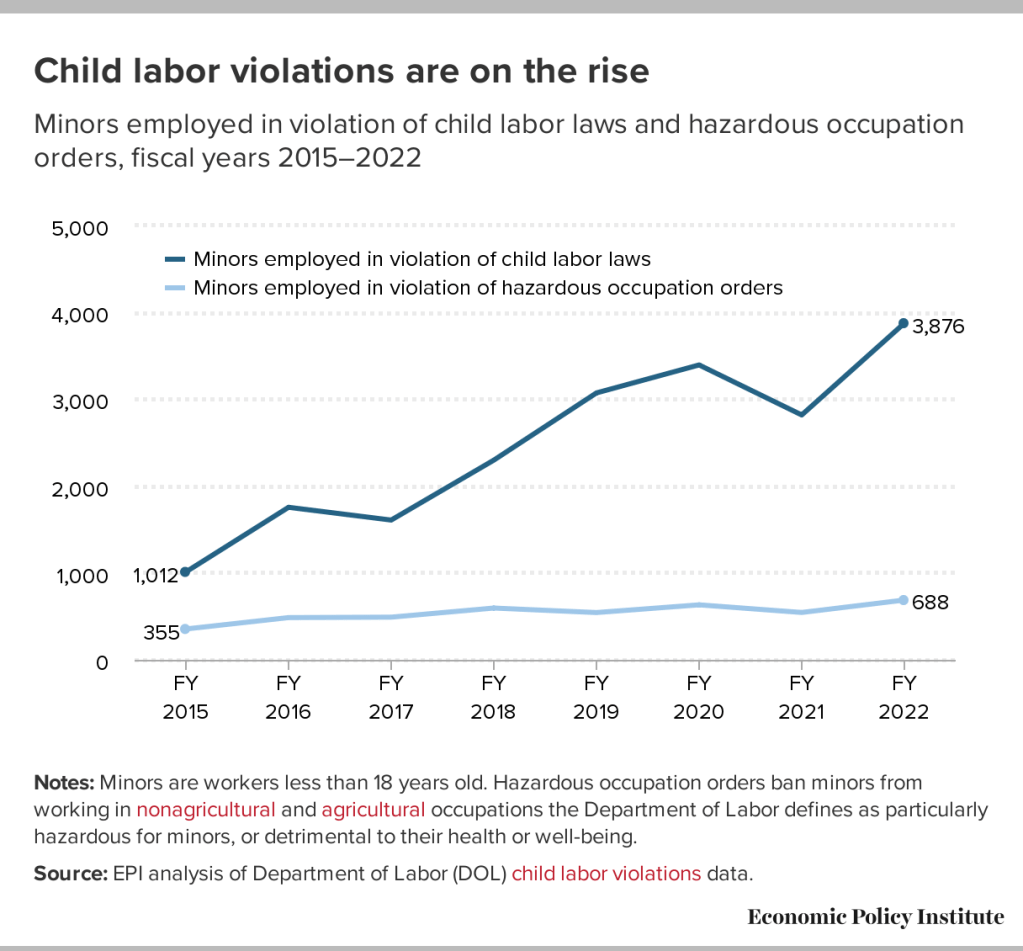
    Consider, for example, the current rise in legislative efforts to weaken or repeal child labor laws. What’s provoking these new but seemingly archaic and draconian measures? Child labor laws have been implemented over the years to protect children from low wage and excessive work-hour exploitation; workplace injury; and stunted emotional, intellectual, and physical growth. Who would want to repeal such protections for children, and why?

    First, we note that violations of the laws have been increasing in recent years. If you’re a business found in violation of a law, one solution might be to try to get the law changed:

    According to Pew, the root cause driving attempts to repeal child labor laws is workforce shortage. Business and industry can’t find enough workers. Workers that have historically filled the jobs in question (restaurant and hospitality; unskilled manual labor; assembly line work; industrial laundering, sanitation services) are staying in school longer. But that doesn’t account for the historically large number of missing workers. Where have all the workers gone?

    According to the US Chamber of Commerce, there are several reasons for the current workforce shrinkage: increase in family savings fueled by the pandemic; early retirements; lack of access to childcare; and new business starts. And, we might add, the so-called gig economy – which has allowed greater freedoms, flexibility, and opportunity for entrepreneurs. In short, there are currently more jobs than workers, and the reasons are several and varied.

    And some see the solution as allowing younger children to work more jobs. But take a look at the industries most affected by the workforce shortages (again, according to the US Chamber of Commerce). Food Service and Hospitality jobs have been hard hit. These are jobs that can’t be worked from home. But not all must-report-for-work jobs have seen high quit ratios.

    Not all jobs are created equal, even if the pay might be equal. Who are the industry and business leaders and their pandering legislators trying to repeal child protections? According to Pew (citing EPI), supporters of repealing child labor laws include: “national and state branches of the National Federation of Independent Business, the Chamber of Commerce and the National Restaurant Association, as well as lodging and tourism associations, homebuilders and Americans for Prosperity, a conservative political advocacy group.”

    These are not necessarily guys and gals all wearing MAGA hats. If we oppose repealing child labor laws, and we find ourselves wanting to criticize the businesses mentioned above, we might ask ourselves how often we support these businesses by buying or using their products or services. As an example that illustrates the problem, consider this, from the same Pew study cited above:

    “Arkansas and Tennessee enacted changes last month. A new Arkansas law removes a requirement that children under 16 provide proof of parental consent to work, while the Tennessee law scraps the prohibition on 16- and 17-year-olds working in restaurants that derive more than a quarter of their revenue from alcohol.

    “We’re desperately needing some extra workers between the ages of 16 and 17 to work at some of these restaurants,” Tennessee Republican state Rep. Dale Carr said during a February hearing on the legislation, which he sponsored. Carr represents Sevierville, a tourist destination in east Tennessee.

    “With Workers Scarce, Some States Seek to Loosen Child Labor Laws,” Pew, 17 April 2023.

    Pour your own drinks. Tour your own backyard. Camp out instead of holding up in a hotel. Meantime, where there are labor shortages, businesses should consider how they can attract and retain workers. They need to offer adequate and equitable pay, benefits, job security, safety and protection, and flexibilities they have not previously considered. Business owners and managers need to treat their employees as persons, as humans, with dignity and respect, regardless of their age, yet according to their age. And users of their products and services should recognize their complicity in the economic interconnectedness and responsibilities throughout our consumer society. Then, just maybe, we’ll all be alright.

  • In My Easter Bonnet

    A friend of mine writes he’s broken a rib. The circumstances (he doesn’t recall how it happened) remind me of Genesis:

    The Lord God caused a deep sleep to fall upon the man, and he slept; then he took one of his ribs and closed up its place with flesh. And the rib that the Lord God had taken from the man he made into a woman and brought her to the man. Then the man said, “This at last is bone of my bones and flesh of my flesh; this one shall be called Woman, for out of Man this one was taken.” Therefore a man leaves his father and mother and clings to his wife, and they become one flesh. And the man and his wife were both naked, and were not ashamed.

    New Oxford Annotated Bible, Full Revised Fourth Edition, Oxford University Press, 2010.

    A lot gets done in that first week of the Bible, at the end of which even God apparently needed a rest (and, in like miraculous manner, my friend with the broken rib somehow still got the tree pruned and the ladder put away). Readers might well question the facts of the matter. But in the introduction to Genesis in the Oxford, we get this:

    In the modern era, Genesis has been an important battleground as communities have worked to live out ancient faiths in a modern world. For example, much discussion of Genesis, at least among Christians in the West, has focused on whether the stories of Genesis are historically true. Astronomers, biologists, and other scientists have offered accounts of the origins of the cosmos and humanity different from those in Gen 1-2. Some believers, however, insist on the importance of affirming the historical accuracy of every part of Genesis, and have come to see such belief as a defining characteristic of what it means to be truly faithful. This definition is relatively new: the historicity of Genesis was not a significant concern prior to the rise of modern science and the historical method; in fact, in premodern times, the stories of Genesis were often read metaphorically or allegorically. Moreover, many would argue that an ancient document such as Genesis is not ideally treated as scientific treatise or a modern-style historical source. Instead, its rich store of narratives offer nonscientific, narrative, and poetic perspectives on values and the meaning of the cosmos that pertain to other dimensions of human life.

    page 10.

    Yet one may still argue, as Mary Midgley does in “What is Philosophy For?” for a single dimension, a holistic approach that accepts one without discounting the other:

    For instance, adding or removing the idea of God is not just changing an empirical detail, like adding or removing Australia from the map of the world. It is much more like changing the idea of that world as a whole. … In actual life, each of us has a world with a great background which our culture makes ready for us, including a whole population of human and non-human creatures, forces, atmospheres, opportunities, customs, tendencies, ideals, dangers and challenges. As Irish Murdoch has sharply pointed out, this ‘culture’ is not just a matter of a few recent films and fashions; it contains everything that we believe in, including our fashionable views about science itself:

    It is totally misleading … to speak of two cultures, one literary-humane and the other scientific, as if they were of equal status. There is only one culture, of which science, so interesting and so dangerous, is now an important part. But the most essential and fundamental aspect of culture is the study of literature, since this is an education in how to picture and understand situations. We are moral agents before we are scientists, and the place of science in human life must be discussed in words (Murdoch, The Sovereignty of Good, 34).

    Midgley, What is Philosophy For? Bloomsbury, 2018, 54-55.

    While it might make modern sense (scientific or otherwise) to read Genesis as allegory, what are we to make of the Resurrection? If read as metaphor, of what? As allegory, with what hidden meaning, and why hide it to begin with? Does being born again free us from that “great background which our culture makes ready for us”?

    One of the most interesting books I’ve read during the pandemic is Shusaku Endo’s “A Life of Jesus” (Paulist Press, 1973). At its close, having written about the life of Jesus as actual biography, Endo returns to metaphor and allegory:

    Where Mark and Matthew have written that the whole earth shook when Jesus died, and that the high curtain split in two, the evangelists are not recording events which actually happened, but are rather expressing the lamentation of the disciples and their consternation at the death of Jesus….Did Jesus therefore accomplish nothing? Was Jesus simply helpless after all? Was God silent? Was the sky merely dull? In the end, was the death of Jesus really no more than the death of any other powerless ineffectual man?

    154

    And then Endo, when it comes to the Resurrection, puts the allegory to test:

    Did these events actually take place? Are they historical facts, things that really happened? Or is this a fiction produced by the early Christian Church, perhaps an episode written to inculcate through symbols the undying memory of the Christ?

    157

    Endo questions how the disciples could have behaved so cowardly during the crucifixion but later turn about and emerge as courageous martyrs for the fledgling church. Was there some incredible but undeniable event that explains their conversion? Yet, Endo asks:

    But the concept itself of resurrection – did the idea even exist in the age of Jesus and his disciples? And if it did exist, what did the concept actually involve?

    161

    But don’t go out and buy and read Endo’s book thinking he has the ultimate answer. Once one has proof, one no longer needs faith. And Endo, in his reflective conclusion, says:

    For all I know, there may well be an analogy here between their [the disciples] inability to understand Jesus during his lifetime and our own inability to understand the whole mystery of human life. For Jesus represents all humanity. Furthermore, just as we, while we live in this world, cannot understand the ways of God, so Jesus himself was inscrutable for the disciples. His whole life embraced the simplicity of living only for love, and because he lived for love alone, in the eyes of his disciples he seemed to be ineffectual. His death was required before the disciples could raise the veil and see into what lay behind the weakness.

    178

    As for broken ribs, my father once broke seven at once, buried in a cave-in, where he was crushed against a huge underground concrete pipe, a project he’d been working on, the deep ditch he was down in inadequately shored. I sent my friend with the recent broken rib a copy of the newspaper account, as proof. How my father escaped further serious injury is one of the mysteries of his life. From Midgley again:

    During the past century, philosophers have provided enquirers with one more alternative: mysterianism. This is the view that there are some questions which our minds are simply not fitted to resolve, and that free will is one them. In order to resolve this metaphysical puzzle Noam Chomsky adopted the name ‘mystery’ for these cases, apparently from a pop group called Question Mark and the Mysterians. He suggested that these unmanageable questions are not really problems at all but mysteries, situations in which scientists should stop saying (as they always do at present), ‘We do not have the answer to this yet,’ and should simply say instead, ‘This one is beyond us.’ He adds that this limitation is not surprising since the cognitive capacities of all organisms are limited, which indeed is true.

    Will this do? It is surely a relief to hear the learned admitting that there are some kinds of things that they do not and cannot know. But we need to ask next, which ones are they? And why?

    33
  • On Beauty

    What is Beauty, that Beast in all caps?
    The beauty of beauty is beauty
    (“Rose is a rose is a rose is a rose”)
    wants no thought, bears no meaning.

    We may begin by stating what beauty
    is not: beauty can not be purchased,
    beauty is not style nor fashion,
    beauty is not transitory nor fixed,
    serves no function, is non-cultural.

    Beauty is cosmopolitan, universal.
    Beauty is humble, avoids museums.
    Beauty is not needy, invites no convo.
    Beauty is meaningless, for sense,
    that human construct, usurps beauty
    of its principal pleasure.

    Meaning (definition, interpretation,
    reveal, tell-tale) translates forms,
    the essence of beauty, into human
    terms, where it loses its native essence.

    We can not paint the soul, nor post
    a pic of it.

    Beauty is not the opposite
    of ugly, tho ugly walks hand in hand
    with beauty, speaks with beauty,
    but beauty has no answer,
    no comment.

    And yet, Eco says:
    “…an orgy of tolerance, the total syncretism and the absolute and unstoppable polytheism of Beauty.”
    Which is to say, “Beauty! Get out of Dodge!”

    Beauty is not a value, but a virtue.

    We can of course get more involved:

    But we grow weary of wearing
    that same old tattered dress,
    and find little tenderness
    in your tries and stays.

    We close our talk on beauty
    with a beautiful poem
    by e. e. cummings:

    [O sweet spontaneous]

    BY E. E. CUMMINGS

    O sweet spontaneous
    earth how often have
    the
    doting

                 fingers of
    prurient philosophers pinched
    and
    poked

    thee
    ,has the naughty thumb
    of science prodded
    thy

            beauty      how
    often have religions taken
    thee upon their scraggy knees
    squeezing and

    buffeting thee that thou mightest conceive
    gods
             (but
    true

    to the incomparable
    couch of death thy
    rhythmic
    lover

                 thou answerest

    them only with

                                  spring)

    E. E. Cummings, “O sweet spontaneous” from Tulips & Chimneys. Copyright © 1923 by E. E. Cummings. Reprinted by permission of Public Domain. Copied from Poetry Foundation.

    PS: We have been waiting
    overtime
    for your answer
    this year.

  • Doubt and Drift

    Faith is belief in what cannot be proven. If something can be proven, faith in it is no longer necessary. But most of us can’t prove anything. We spend most of our lives swimming around in a sea of faith – faith in people, places, things; faith in history, institutions, religions; faith in ideas, nature, love. We live by faith in these things, not just that they exist, but faith in that they work as designed, faith in how they should work, and faith in how they do work.

    We no longer have faith in the news. “Popular distrust of the news media has been traced to the coverage of the stormy 1968 Democratic National Convention,” Louis Menand discusses in “Making the News: The press, the state, and the state of the press” (The New Yorker, February 6, 2023, 59-65). Underlying any loss of faith comes the realization that too much may have been invested in the building blocks of truth, facts, and how we think we do things the way we do because we’ve always done them that way. These blocks turn out to be soft and fuzzy and protean. What is true changes with the times, predicaments, what we want.

    “As Michael Schudson pointed out in ‘Discovering the News’ (1978), the notion that good journalism is ‘objective’ – that is, nonpartisan and unopinionated – emerged only around the start of the twentieth century. Schudson thought that it arose as a response to growing skepticism about the whole idea of stable and reliable truths. The standard of objectivity, as he put it, ‘was not the final expression of a belief in facts but in the assertion of a method designed for a world in which even facts could not be trusted. … Journalists came to believe in objectivity, to the extent that they did, because they wanted to, needed to, were forced by ordinary human aspiration to seek escape from their own deep convictions of doubt and drift.’ In other words, objectivity was a problematic concept from the start” (p. 60).

    We might find complementary or corollary application to other areas. Menand uses the 1968 convention to illustrate how the news is not reported but made, and that once the recipe for how it’s made is made manifest, and there follows general doubt and drift from the sources – from the who, what, when, where, how, and why of the story – the remaining mess makes for great leftover meals for anyone wanting to take advantage of that doubt and drift to further their own agenda, investment returns, popularity, hold of the reins. We might find corollary application of the argument in the doubt and drift in our times from religion, health care, higher education, police protection – all areas once strong with the faithful but we now look out and find empty pews. Damage control, by which is meant control of the news over the story, becomes paramount in restoring the faith.

    But we reach a point where faith can’t be restored. The Jesus Movement becomes the Free Press of religion. Indie becomes the barbaric invasion of not traditional music, film, publication, art, but of the open-gate making, distribution, and profit (or not) of free expression. We can no longer die for our country, only for one another. We take medical advice with a grain of salt. The man wearing the badge, the clerical collar, the stethoscope, the suit and tie – might as well be wearing a newspaper. The homeless person is one of us. The Emperor wears no clothes. The Wizard is a humbug – and like he said, he might be a good guy, but he’s a bad wizard. We are out here on our own.

  • Wonder of the On-Line Literary World

    This month, Berfrois, the small literary magazine, has closed its virtual doors. For the last 14 years, Berfrois, under intrepid editor Russell Bennetts, an economist out of England, has published daily writing, forming over time an eclectic list of contributors and an audience of intercultural competence. The end of active writing appearing in Berfrois comes 100 years after the closing of the modernist journals period, which ran, according to the Modernist Journals Project, from the 1890’s to the 1920’s, ending in 1922:

    We end at 1922 for two reasons: first, that year has until recently been the public domain cutoff in the United States; second, most scholars consider modernism to be fully fledged in 1922 with the publication of Virginia Woolf’s Jacob’s Room, James Joyce’s Ulysses, and T. S. Eliot’s The Waste Land. We believe the materials in the MJP will show how essential magazines were to the rise and maturation of modernism.

    Modernist Journals Project, About page, retrieved 15 Dec 2022.

    They were mostly referred to, and still are, as small literary magazines, little magazines. Most did not last long. Blast ran just two issues, 1914 and 1915. They were of course hard copy, printed magazines, small publication runs, small format. The most famous now might be The Egoist (1914-1919) and Little Review (1914-1922), which ran installments of Joyce’s “Ulysses.” Harriet Monroe’s original Poetry ran from 1912 to 1922 (still alive today as a kind of First Wonder of the Corporate Literary World).

    Is today’s on-line literary world, in 2022, now “fully fledged”? It might be, given the disastrous turn of events surrounding the social media platforms that create, sustain, and destroy – in situ. What can it possibly mean to be on Twitter, for example, with a million followers? Even 100 followers would be impossible to keep up with, even if managing your Twitter feed was all you did. Yet most tweets are never read by anyone. At most, they have the life span of a mosquito, and can be just as viral and vile. We shall be glad to see our current winter of discontent freeze them all in their tracks. For the tracks of tweets carry no real cargo.

    Most poems are never read either, but that’s a different story. And I digress. Some of my own writing appeared in Berfrois. Mostly prose, discursive writing. Berfrois published the academic, the non-academic, and the anti-academic. Its editorial voice appeared often to be one of casual interest. In a sense, Berfrois was a general interest magazine, and sought to publish the best it could find of both the best and the worst – for what is often considered today’s worst of writing ends up being tomorrow’s best.

    One of the most attractive features of Berfrois was the lack of advertising. It sought to be reader funded before its time. It might have found a good home at today’s Substack, where we find everybody that’s anybody cashing in their lotto tickets. “Thousands of paid subscribers.” Sounds lucrative, but a poor warrant to join a new fray.

    A bit of money but a lot of time it takes to run these endeavors. And we run out of both, lose steam, wonder what all the fuss is about, what it might be like to go for a walk down Broadway unnoticed or dismissed, or to wander to and fro with no desire whatsoever to be followed. In the meantime, a heartfelt thanks to Russell Bennetts for his contributions via Berfrois to the life of modern journals.

  • On the Value of Art

    We should think of art as an activity and not a product. The value of art to a culture comes from its work in illustrating and communicating symbolically the meaning and importance of a culture’s way of life. Art should be considered both literally and symbolically, as it works simultaneously by substantive representation and by implication and suggestion. What is suggested and therefore inferred is not comprehended literally but unconsciously, both in the individual and in the collective consciousness of the culture. Art provides thoughtful but also inconsiderate access to the unconscious and subconscious mind. It does this through pretending or pretention. All art is pretentious. Art begins with the childlike acting of let’s pretend.

    The monetary value of a work of art, hundreds of millions now paid for a painting, does not speak to the value of art as it works in a culture. Anyone can engage in art, and everyone does. If we think of art as an activity (and not a product), we see the audience engaged in the work, not just watching or listening, but as part of its ongoing creation, and we see the work as a work in progress: vibrant, aging, deteriorating, fading. That is beauty.

    To say that all art is pretentious works as follows. One year, I went to a local barber to get my hair cut. As Ring Lardner explained in his short story “Haircut” (1925), the participation in the activity of art makes the audience part of the work’s creation. (Sometimes, a visit to a barber can be as bad as having to go to a dentist.) In the barbershop at the time of my haircut, there happened to be three of us: the barber, myself, and an apparent friend of the barber. On the wall opposite the barber’s chair I sat in, hung a small, representational painting of a snow capped mountain. The barber proceeded to explain the painting’s merits. He said, “Put a photograph of that mountain next to that painting and I defy you to tell me which is which.” Of course, neither the painting nor the photograph was the mountain, but a pretension of the mountain. What the barber as art critic appeared to value in art was literalism. But in spite of his efforts, no mountain filled his barbershop.

    Also implicit in my barber’s criticism is a theory of value and values. What we value, as individuals and as a culture, is simply what we want, what we desire, both consciously and unconsciously. But what we want is not always good for us. And by good here we mean healthy, life affirming, balanced, unpolluted, not harmful to ourselves, others, or to our environment. Cars, for example, in that context, are not good for us, yet most of us want one and can hardly imagine getting around without one. We might even say that all means of transportation are bad for us, even walking. Transportation is fraught with risk. We should sit at home and do nothing. But when the asteroid hits, it will hardly matter where we are or what we are doing. And what we value is transportation, and we work, ostensibly, to make the modes safer.

    When we engage in activities that are not good for us we experience the irrational or nonrational. What the barber valued in art was more than simply representationalism, but rationality. He apparently felt that art that expressed or provided access to an irrational or nonrational experience was bad art. By the way, throughout the entire haircut, the barber enjoyed a cigarette that in between puffs sat in a green ceramic ashtray and emitted a wavering column of smoke that from my vantage point produced in the mountain a volcano effect.

    We value looking inside of things. We want to see inside a mind. Thus we undergo psychoanalysis or some sort of therapy. We want to see inside our body. Thus we undergo a colonoscopy or get an MRI or an X-ray. We want to see inside our psyche – thus we read and write poetry. But notice the metaphor may not work there. The psyche is not inside, but outside. It’s all around us. And is it good to see inside of things? Are not these things closed up for good reasons? What happens when we intrude? Is that the purpose or effect of art – to look inside of things, to see what has been covered, hidden, kept secret?

    There is no hierarchy of values. When we speak of family values, we point to what a unit of culture wants, and, again, that want is not necessarily synonymous with good. We value high school sports, football. Football is, at least arguably, not good for us – it’s not a healthful, balanced sport. It’s not a good investment. But football is a family value, of much importance economically and emotionally, of current US American experience. But we might think of football as an art form. As an art form, uncovering the irrational, we might find in football some of the hidden expressions and meanings of our culture.

    When we speak of the value of art, we want to avoid a hierarchy of values. All values are equal. Maslow’s hierarchy of needs, often illustrated in pyramid illustration, as useful as it might be, underscores the culture’s competitive nature, which art undermines. For art is not competitive. And where there are art competitions – they have nothing to do with art.

    A long married couple, having worked hard lifelong, now retired, would like to spend some leisure time in appreciation of a bit of what they think of as high culture. They buy tickets, from an ad received in the junk mail, to the local opera, where they experience the same family arguments they’ve live with these past 50 years, and hear the same folk songs they grew up with. They don’t understand a word of it, but they know someone is pissed off and another is beside themselves with grief and regret. Still another gloats, and another is mean and prods. And the couple, dressed to the nines for the experience, enjoy a glass of champagne in the lobby at intermission. They look around at the other opera goers and don’t recognize anyone. They each visit their respective lounges where they see someone in a full size mirror, a person they hardly recognize. And suddenly the value of art dawns on them, in the latrine at the opera.