Tag: Discuss

  • Notes on the Difficulty of Reading a New Poem

    Poem WalkingWhat happens when we encounter a new poem? New poems can seem impenetrable. But maybe the idea is not to penetrate. If the poem is new, the reading experience is also new, unfamiliar, foreign to our eyes and ears, to our sensibilities. What happens when we read a poem?

    In the darkroom, the developer slides the photographic paper into the chemical bath. Slowly, an image emerges. Reading a new poem is a similar process in as much as the full picture does not immediately reveal itself. But that’s as far as that analogy might go. A poem is not a photograph.

    The poem as montage, as mosaic, the narrative line pieced together stitch by stitch. Begin anywhere.

    Poems are made with words, usually, and words have two basic kinds of meaning, denotative and connotative. With regard to connotative meaning, words suggest, have associative meanings, colloquial twists, and personal meanings. We have our favorite words, and words we find distasteful. “Are you going to eat those adverbs?” “No. I got sick on an adverb once, in grammar school.” Cultural, contextual meanings. We can’t control language.

    When encountering a new poem, we ask the traditional questions: who is speaking, with what voice, and what is the intended audience, remembering not to confuse the speaker with the author, the audience for ourselves. What’s the speaker doing, talking about? What the diction, what the tone, what the setting, what the irony?

    Here’s the poem under question: “Foxxcan Suicide (Stylish Boys in the Riot),” by Russell Bennetts (the editor of Berfrois). We look for help. Suicide we know. Painless, as the song says, though we doubt that, and that song is not about suicide. A soldier’s choices are limited. Are a reader’s choices similarly limited? Does “Foxxcan” suggest Foxconn, the so-called Foxconn suicides?

    I recognize Starnbergersee, from T. S. Eliot’s The Waste Land, but is a single word enough to create an association? Why not? Eliot’s poem is fragmentary. “Foxxcan Suicide” is fragmentary, or so it seems. What if picking up on an Eliot reference is wrong? We could ask the author. No. What can the author know of the reader’s experience? Words are out of control once they hit the paper. The poem is a reading experience. And something more than Starnbergersee reminds me of Eliot: the many references, obscure to this reader, though I know who Axl Rose is, sort of, but I can’t say I know him, though he’s from my home town, big town. And the Roses had a label: UZI Suicide. So? Threads, though, links. And I know who Legacy Russell is, though not well enough to get the three asterisks at the end of that line, asterisks that point to no footnote.

    Still, I like the new poem. I like the fragmented narrative. I like it for its changes in diction and speech, its orality, its lyrical last stanza, or paragraph, the socio-economic comment it ends on. I like the almost hidden poetic characteristics, the rhyme, for example, of “Legacy,” “easy,” and “please me.” Gradually, more of the picture seems to emerge: the teen spirit (Nirvana). Maybe it’s language that has become suicidal. The poem casts this reader as a kind of outsider, beyond the pale. Maybe I just don’t get it. “Well, how does it feel?”

    Some time ago, in a workshop with David Biespiel, we used a kind of shorthand response technique as a way of quickly getting at new reading experiences. David called the technique, “What I See.” You had to tell it, what you saw, in 25 words or less, or so. Kenneth Koch taught a similar kind of technique, an attempt to get at the poem’s “idea.” What’s the idea, Koch asks, of Blake’s poem “The Tyger”? The speaker is asking questions of the wild animal, but of course the Tyger does not respond. The questions the speaker asks seem to have something to do with who made the Tyger, the maker’s character. Blake uses images of a blacksmith to try to picture the Tyger’s maker. For Blake, the blacksmith would still have been a powerful and practical individual, a maker of things useful, but his work was being subsumed at the same time by larger manufacturing forces that would come to be known as the Industrial Revolution. And that revolution would give way to more: “Stylish Boys in the Riot.”

    What happens when we read a poem? From the Paris Review Interviews, this one with August Kleinzahler:

    INTERVIEWER: Recently Poetry posed a question about the social utility of poetry. Does that interest you?
    KLEINZAHLER: No. I agree with Auden that “poetry makes nothing happen.” Nothing else needs to be said about it.

  • Poetryphobia: Muriel Rukeyser’s “The Life Of Poetry”

    The Life of PoetryMuriel Rukeyser’s “The Life Of Poetry” covers the poetic experience, its many uses and resistances, during the 1940’s. Her view of poetry comes from the experience of war, by her participation in freedom efforts prior to the war, and by disappointment the war did not bring peace, and also by science, which suggests a new age for poetry, and by the growing use of popular arts (radio, movies, songs, dance). Muriel argued that US culture feared poetry, where poetry is emotion. Emotion is feared because it calls up and recognizes harm, and asks for reparation for harms done. But who wants to do that? So poetry isn’t a popular art form. It’s not an art form at all. Once poetry becomes an art form, it freezes on the surface: No myth but movement, no still lives, no basket of fruit and the hovering fly that never dies. And the poem is not a “place” (154, 174), the mind not a hunk of meat. Both are energy. The emotion of poetry creates empathy and argues for change. She was writing about silicosis as early as 1938, advocating for victims, explaining the disease. Empathy is recognition, which is also emotion, of the audience, which she prefers to call the witness. What is witnessed? Relationships: between images, sounds, symbols, people, things. And relationships are constantly on the move. Nothing is fixed, not in time, not in space, not in mind.

    We probably do dislike poetry, at the least ignore poems, or even scorn poetry, treat poets like vaudeville clowns, but it would seem a bit overwrought today to say we fear poetry. But when Muriel says we fear poetry, she means we are separated from emotion, and the thought of reconnecting to our emotion scares us. Human nature probably does not improve over time, in spite of technological progress, and we may be further removed from emotion today than we were in 1949. The culture Muriel’s talking about does not value emotion, the emotional. The sections of “The Life of Poetry” devoted to the popular arts and the uses of poetry in the sentimental suggest lost opportunities. The popular arts fail to go deep enough. Sentiment is unlike emotion. Emotion is a weakness because, once it is unleashed, it is uncontrollable. Control is a value. One attempts self-control, and when that doesn’t work, control over others. Allowing the working class, the miners and laborers and factory workers and garment sewers and waitresses, weekend release over a couple of beers and a country western song playing on a jukebox, evoking tears, or the equivalent sentiment found in church prayer, is acceptable. But no emotion. Control yourself. Get sentimental if you must. It’s ok to vent. You can wear it on your sleeve, your troubles, but don’t freak out. And self-pity also is sentimental.

    “There is difficulty in breathing.
    Yes.
    And a painful cough?
    Yes.
    Does silicosis cause death?
    Yes, sir.” (Rukeyser, Collected Poems, “The Disease,” 86:87)

    Emotion is the weary heart wearing and tearing on the poet’s sleeve. This doesn’t play well in boardrooms, where emotion is kept submerged through charitable donations and the branding of giving, or in churches where the sacrifice is symbolic, or in marriages of competition. Emotion is not anger. Anger is the sediment of sentiment, frustrated or undefined or ill-defined desire. Poetic emotion sublimates repressed desire. Poetic emotion is the sublimation of antithetical cultural values. For example, the auto has ruined the country, the countryside, the culture suffering in detrimental reliance. Without definition, this ruin devolves into road rage, the driver’s psyche full of potholes. Sentiment is nostalgia for a 1957 Chevrolet, road trips, surf safaris. The car is a catastrophe, the planet hit by an asteroid, impossible now to see the earth beneath the asphalt. But the smell of the new car still intoxicates, Whitman’s rooms full of perfumes. What to do about it? Robert Creeley, “I Know a Man”:

    drive, he sd, for  
    christ’s sake, look  
    out where yr going.”

    The novel as middle class entertainment contains emotion; that is, the novel packages emotion, places limits on emotion, surrounds emotion with form. As for the dime store novel, mysteries, detective stories, noir: the term “hard boiled” is born of sentiment. The so-called seedy section of the city boils with sentiment. The sentimental love to visit, but they don’t want to live there. It’s good to have someone to look down on, to criticize, to arrest. Likewise, poetry as craft is sentimental where it deliberately obscures to imitate emotion. The merely personal or found fabrications or wordplay that does not touch the human condition is entertainment. Not that entertainment isn’t useful; it is, but it’s not poetry. Poetry is the marriage of play and work, where play pays dividends and work pays nothing but a release of emotion, which spells trouble. Muriel describes a workshop exercise (179) that might be called “where’s the poem”? The poem exists in the imagination of the witness, and that’s not craft. A poem is not words.

    There is a war between play and work, between worker and exploiter, between the divided selves. Poetry acknowledges the war and becomes a tool to make people whole again. Emotion is the stain of war that poetry seeks to clean. There’s another reason emotion is devalued, suggests Muriel. Emotion connects to nature, to trees, to roots, to the land and to animals. That’s seen as cutting into profits, though it need not. To reach down into the emotion that connects the human to the planet requires a reevaluation of the relationship. Today’s eMotion is backlit. That’s not the emotion Muriel is talking about. Muriel’s emotion sews together symmetrically a sensorium distorted by technology as in a funny mirror. Muriel’s emotion deals with alienations and depravations, goods and evils.

    Important poets for Muriel included Whitman and Melville. Whitman is the poet who discovered good, and good is his breathy line, the form of the discovered self, the freed self. To Melville passed the work of dealing with evil. Muriel foreshadows the current crisis in the Humanities by juxtaposing poetry with science, comparing methods, making good use of science. Imagine your kid comes home and tells you he’s decided to study to be a cave wall painter, and he’s going to work in caves, painting on walls by the light of a torch. Fear of poetry is about resistance to emotion, but more, about the resistance to the imagination, about inability to even recognize the imagination.

    “The Life of Poetry” is not an academic book (a good thing), but it’s not an easy book. For one thing, the references to popular culture are antiquated, and some of the references are obscure. For another, there’s evidence on every page the writing is the work of a poet. But by the last two chapters (the penultimate “Out of Childhood,” and the last, beginning “The Meaning of Peace”), the prose becomes familiar, the writing a little less fearful.

  • The Bad Hop Boat Poem

    You watch
    Baseball
    and recall
    the hit
    that took a bad hop,
    bebopping
    between your legs
    like a line
    impossible
    to scan,
    bouncing
    over your glove
    touching
    the dirt.
    No one is listening.
    Even the umpire
    shook his head.
    “Shake it off,”
    Coach called
    from the critical
    dugout.
    “Bad hop,”
    the gracious
    pitcher said.
    But no, even now
    you can not
    accept the excuse,
    because you
    fear the ball
    & the poem,
    as you explain:
    “I was thinking t i l l e r
    of a boat f  u
    on the high o d
    C’s.” l  d
    A e
    Infield poem b  r  u  n
    error full o w
    confuses v o
    a boat with t h e b a l l
    o
     “E6,” says C C C C C w C critic.
    C C C C C C
    C C C C C C
    C C C C C C
    C C C C C C
  • Vowel Trial Balloon

    “Baby I wove you
    Ain be mine wover too.”

    “Nary time owns you
    Ain me I go undo.”

    “Say me try toned prude
    Nay ye buy so two.”

    “Wage fee I know you
    Say ye sigh oh adieu.”

  • Dear Reader: “Charming Gardeners,” by David Biespiel

    There used to be a public telephone booth down on the corner from our place, the kind the caller entered through a panel glass door and dropped coins into the phone, outside the cleaners, across from the realtor’s office, the street corner just a dot of commercial activity in an otherwise residential neighborhood. The telephone booth got hit with graffiti occasionally, or a pumpkin around Halloween, and the glass was often in need of repair. The door broke and was discarded, the telephone book disappeared from its chain, and finally the box was taken away. The booth attracted activity, some locals opined of the nefarious sort. The booth might have represented to some a stranger. At night, a small lamp lit the booth. Outside the booth, a couple of newspaper stands added to the tiny urban pastoral. One day, out walking, I passed by the booth, and the phone rang.

    On the corner across from the phone booth stood a blue mailbox. The mailbox got more business than the telephone booth, but not enough, apparently, for it too was taken away. The newspaper boxes that stood next to the phone booth have also been removed. The cleaners closed, and for a time the corner reminded me of an abandoned gas stop on a two-lane road bypassed by a highway. Bit of an exaggeration, that, but not much, for like the telephone booths, many of the mailboxes in the Southeast Portland neighborhoods are disappearing, and the small bookstores, like the newspaper stands, are being rooted out, also. Last year, one of my favorite small bookstores, Murder by the Book, at the west end of the Hawthorne district, met its demise.

    Really? Are we to read yet another letter on the disappearance of newspapers, books, newsstands and bookstores, and poetry?

    Not at all. Some things don’t change, among them, Emily Dickinson’s one way missive: “Her Message is committed / To Hands I cannot see.” And what better way to illustrate the stubbornness of the staying power of poetry than a book of poems in which each poem is a letter to someone? We save letters, but first we have to write them, send and receive them.

    Poetry, as John Cage said of music, occurs whether we intend it or not, but we won’t have the unintended poetry of letters if we stop writing letters. The democratically accessible form of the letter is still with us, even if mailboxes are becoming scarce. Is an email not the same as a letter? An email is a phone call compared to a letter. Letters don’t have the immediacy of an email. Letters are not immediately delivered, and we don’t expect an immediate reply. We might wait weeks or months for a reply, or years. But we probably wouldn’t resend the letter, noting “2nd request” in the subject line, as we do with emails. Letters can be a bit of a hassle to write, requiring a kind of toolkit: paper, pen, table, envelope, address, stamp, mailbox. Letters, perhaps, require more of an occasion than emails, occasion to write, more of a purpose. If you really want to get someone’s attention, you don’t send them an email; you write them a letter. Letters are more difficult to forward than emails. And the letter might be returned, as emails are sometimes returned, too, as undeliverable. Or a letter might wind up in the dead letter post office, and you might never know if your letter sent was ever received or read.

    Melville’s Bartleby worked in a dead letter office before going to work as a scrivener for the lawyer who narrates the tale. Where have all the scriveners gone? The poet Charles Olson’s father was a mailman. In “The Post Office: A Memoir of My Father” (1948), Olson describes how, through office politics, misunderstandings, and general stubbornness all around, his father had his mail route taken away from him. Olson explains the importance to letter carriers of personalized routes, but also explains how the letter carrier is important to the community of people on the route. Olson explains how the mail carrier becomes a confidant reader and the most knowledgable person in the neighborhood of personal affairs:

    “Mail, over any length of time, will tell secrets a neighbor could not guess. Nor do I mean the reading of postcards or the ‘lamping’ of letters. Nor what a man hears over a coffee. Or that a man’s mail does not always come to his house, or a woman’s either. It lies more in the manner in which people look for, ask for, receive their mail. And talk about it” (43).

    Olson insists this is “not to be mistaken for nostalgia,” for the post office was akin to the military, and letter carrying is hard work, hard on the body. Yet the loss of Olson’s father’s route was both the loss of valued labor and the loss of an identity. Not for nothing does a man wear a uniform.

    Another Charles and poet, Charles Bukowski, explains further, in his novel “Post Office” (1971), about his days as a letter carrier in Los Angeles, in bitter, sardonic, and laughing prose, what carrying the mail is all about:

    “There were 40 or 50 different routes, maybe more, each case was different, you were never able to learn any of them, you had to get your mail up and ready before 8 a.m. for the truck dispatches, and Jonstone [supervisor] would take no excuses. The subs routed their magazines on corners, went without lunch, and died in the streets” (10).

    But the point here is that bit from Olson about “how mail is received.” That’s the poetry. And try giving someone a poem, not publishing a poem, but just give someone a poem, as a letter, and see how he or she receives it. You’ll learn more about that person than you might learn sitting over coffee or beers talking about children or baseball.

    I’ve often felt about poetry what the poet Marianne Moore said in her distinctive poem titled, simply, “Poetry”:

    “I, too, dislike it: there are things that are important beyond all
    this fiddle.”

    But fiddle is a perfect word to describe the activity of poetry, where the gig is a jig of restlessness, and I like to fiddle, more and more these days, if fingerpicking the Telecaster qualifies as fiddling. And I like to watch a fiddler at work, pushing and pulling the bow. In any case, we might get very little actual fiddling at a poetry reading. By the time the poet takes the mic, the fiddling part is over. He puts the bow aside and starts to talk. But the poem as letter suggests an importance Moore’s definition seems to discount. Don’t go near the water if you don’t want to get wet.
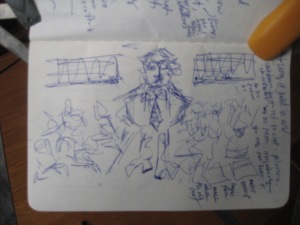
    DB ReadsThe rectangular space of the swimming pool, the opening of the swimming hole, the lake or ocean cove below the cliff as a page. The poem as a dive, form, and a form of competition, an argument. The poet, a high diver, slips into the water, no splash, no wake, surfaces, swims to the ladder, climbs out, takes his seat. The poet David Biespiel has been a diver. I don’t know if that matters much to the enjoyment or understanding or getting at his poems, overall. But I thought about it as I walked down to Powell’s Books in the Hawthorne district a week ago to listen to David read for the launch of his new book of poems, “Charming Gardeners,” the poems conceived and formatted as letters. I listened, observed what I could of the audience, doodled some, was distracted by the books on stacks surrounding the podium and audience – some funny titles out of context, ironic when juxtaposed to the reading, the room holding the Young Adult category of books:

    “Hideous Love,” “Wild Boy,” “How to Love,”  “Pretenders,” “Frozen,” “Sick,” “The Hunger Games,” “Catching Fire,” “Chasing Shadows,” “Captain Cat,” “A Taste of the Moon.”

    I need to get back over there and browse through some of them.

    The last time I was at Powell’s on Hawthorne for a reading was to hear Patricia Marx, of the New Yorker, upon the launch of her new novel, “Him Her Him Again the End of Him,” (2008). There were about 12 people in the audience on a bitter winter evening. I was there with Eric in support of some high school assignment-deal. Patty tried playing a recording of some kind, but the technology failed for some reason. But I enjoyed her, nevertheless. A live reading is like live music, better than radio, but only in some ways. Because listening to the radio at home, you can get work done around the house. But in a reading you have to sit still and be polite (Biespiel’s was not a Beat reading accompanied by a jazz combo) and not fidget, sort of like being in church, the folding chairs as uncomfortable as pews. This isn’t always the case, depending on venue. The Robert B. Laughlin lecture Eric and I attended (out on another high school assignment junket) back in 2005 sported a rowdy crowd of all ages and disciplines, as the rousing Q&A following the lecture showed.

    DB Notes 2Poems as letters, or letters as poems, I’m not sure which comes first, but the idea raises the hand for a question. What is the intended audience? And is the reader a voyeur, as David, perhaps jokingly, suggested? And recall Emily’s note: the writer can’t see the hands of the letter holder, not unless the writer is also the letter carrier. The epistle is an old form. David said something about the letter as poem narrowing the audience, the focus now on an individual, not a song to nobody in particular. William Carlos Williams: “To Daphne and Virginia” [his daughters-in-law], the beginning of the second verse:

    “Be patient that I address you in a poem,
    there is no other
    fit medium” (“Selected Poems,” 1968, 134)

    DB Notes 1David read five poems at Powell’s on Hawthorne the evening of the book launch reading: “To Wendy from Yellow Hickory”; “To Buckley from Berkeley”; To Wiman from Walla Walla”; “To Lenney from the Greenbrier Hotel,” and “To C. D. from D. C.” These are lengthy, traveling poems that talk and click along like a train (though most of the travel is by plane), engines full of breath. I was reminded of Whitman, the way he adds on, continually, one thought giving rise to the next, unafraid of repetition, commenting on the landscape, ideas, people, as he goes, adding comments, evaluative, reflective, and several of the poems mention Whitman. In “To Buckley from Berkeley,” for example, which begins, “Dear Bill” (as if we are on familiar terms – you see the extent to which the trope can travel), the letter goes on for 18 lines before we get a period, and what follows is this: “That, Bill, and also this:” followed by another 41 lines before the next period. (If unfamiliar with Buckley, enjoy an introduction by viewing video of segments of his TV show, “Firing Line.” Here, via YouTube, he talks with poet Allen Ginsberg, and Ginsberg, another Whitman influenced poet, reads a poem, which he seems to have mostly, impressively, memorized; he wrote it, he says, while on LSD, but watch Buckley’s, famous for his facial expressions, reactions. A better introduction to Buckley is his book “Buckley: The Right Word,” a book I enjoyed.) But some find Whitman an old coot, and Ginsberg, too, and, as entertaining as he was, Buckley was an old coot, too. Even as a young man, Buckley was already an old coot, conservative, tight blazer and tie. Maybe it’s hard to be a cootless poet. But a drift toward cootness was something Ginsberg and Buckley shared.

    Anyway, I am very much enjoying “Charming Gardeners.” It’s an encyclopedic book, chock-full of references of every kind, both personal and general. It’s a book that strikes out to find America, an act that may or may not require preparatory reading. There’s a “Postscript” of explanatory notes. The note to the letter-poem “To Hugo from Sodo,” for example, explains that SoDo, in Seattle speak, refers to the area south of downtown Seattle, an area I’m familiar with. It’s an industrial district. From the I-5, drivers can see SoDo sprawled out along the waterfront, the new stadium now an iconic part of the scene. The Seattle Mariners used the acronym in a marketing campaign, “Sodo Mojo.” More poets should attach notes to their work. Marianne Moore often provided her readers with notes. Then again, while sometimes the notes help, sometimes we feel the bottom fall away even deeper. “Charming Gardeners” is so full of references that it will take a long time to read – if one is to track all the references down. But that’s the idea. It’s a watershed, full of names (“…the law firm / Of Ginsberg, Kerouac, Burroughs, Cassidy, and Corso,” for example – funny, that) and locations all around the country, and events, historical and local. Other topics: baseball, the Civil War, God, cities, politics, illness, love.

    That day I was out walking and walked by the telephone booth down on the corner, and the phone rang. Are you not interested in whether or not I answered it? And if I did, who was on the other end? There’s no chance to answer it now; the telephone booth has disappeared. This is why we should continue to write letters. Whether we turn them into poems or not is a different matter. But most people like reading letters; most people like to get mail. But someone has to start the chain. For a poet, a letter ensures, maybe, at least one reader.

    Related Post: Walt Whitman and a Letter of Ourself – How a letter I wrote to one of my sisters came back to me, some 40 years later.

  • Off Leash

    Psychedelic Dog
    “Call me Ishmael. No, wait. Call me Ichabod. I don’t know. Call me Ivanhoe. Just kidding. Call me a cab. Call me anytime. Just give a whistle. Call me Isabel, Isabel Archer. No way! Just kidding. Lovely portrait, though. Wouldn’t you agree? Call me up in springtime. Call me Ichiro. Call me Iago. Yuch! Call me Ian Fleming. Call me Inspector Immortal. Hay-hay! He-he! Hi-hi! Ho-ho! Hoo-hoo! Call me a star! Just don’t call me serious.”
    Cats on a Dog Day
    “Seriously? Are you going to stand for this?”
    “Call me chagrined.”
  • The Old Factory Blues

    The Old Factory Blues

    – What are you doing?
    – You stink!
    – Before we decide if something stinks, what must we analyze?
    – But you stink!
    – Stink is an argument of definition.
    – Pshew! Just like you to ignore cause and effect.

    – I’m reminded of the story of the old factory blues.
    – What’s a factory?
    – A factory is a place where they make things.
    – Was I made in a factory?
    – You were made in a dumpster under blue neon in an alley across from a factory.
    – What did they make in the factory?

    – Every evening sharply at five a great whistle blew, scaring all the alley cats but me. As you know, I’m not one to flinch at noise. And after the whistle, the factory hands came out and petted me and fed me scraps from their lunch pails.
    – Really? Good stuff?
    – Oh, my, yes: bits of smelly tuna fish, little curds of cottage cheese, spam cans still with some fatty gel stuck to the bottom.
    – Sounds delish, so why the blues?

    – One day, the whistle stopped blowing, and the factory was surrounded by a fence of barbed wire. The factory hands disappeared, and a giant blue spotlight was erected to light the alley throughout the night, all but drowning out the small blue neon above the dumpster.
    – What did they make in the factory?
    – Golden gooses.
    – Why do I smell a moral to a story coming on?
    – If there is a moral to the story, it is that life stinks, but which leads to a secondary, paradoxical moral.
    – I’m breathless. A double moral story.
    – And the second moral is that it is the very stink of life that recalls the sweet smell of love, of who we are and where we come from.
    – Ah, that story stinks!

  • Psychosomatic foghorn earborn earworms!

    Reading Lists“I see you and Joe finished that book on mistakes. Was it good?”
    “Joe posted some notes to his blog.”
    “Did anyone read that post? I noticed he got no likes or comments.”
    “To be a blogger is to go unread as no author dare go unread.”
    “What?”
    “Never mind.”
    “So what are you reading now?”
    “I’m thinking of picking up The Sorrows of Young Werther.”
    “Sounds like an unnecessary error. I just read for fun.”
    “What is fun?”
    “Psychosomatic foghorn earborn earworms!”
    “Please don’t say that again.”
    “So did you help Joe with that post?”
    “I put forth a few views.”
    “Phew! Thinko agin!”
    “Agenbite of widget.”
    “Let’s go outside and have some fun!”
    “I recall a moment, long ago, that may have been fun.”
    “That’s the spirit! Let’s go!”

    Related Posts: Common Earworm Remedies and the Mutant Earworm
    A Cat’s Memoir
    Notes On Reading Caleb Crain’s “Necessary Errors”

  • The Root of the Matter

    A
    poem
    in the shape
    of a tree. A poem
    about a tree in the shape
    of a tree. Some will argue it’s neither
    a poem nor a tree, not a real tree, anyway.
    Critics will argue the tree is not a poem, because
    it has neither rhyme nor stanzas, though the lines do
    present shape. Some will say, as a critic once commented
    following an investors’ viewing of a B movie still in the editing cut
    phase: “Does anyone else feel a better use of this particular roll of celluloid
    would be to cut it up for guitar picks?” Some will say the tree should be cut down,
    or yanked out by enormous
    dentistry-like heavy equipment,
    the kind used to clear cut forests.
    Thus we arrive at the bare tap root
    of
    the
    ma
    t
    t
    er.

  • 99 Bottles Over the Wall

    On the tabletop of the sea sat a few empty bottles
    surrounded by the detritus of discussion.
    No burning butts, though,
    the bar under water, the talk polite,
    as if no riptide of innuendo threatened to drown out the quip.

    Paddling out is hard enough; now
    how does the stranded entrepreneur get back to the strand,
    having drifted so far out?
    The question is rhetorical and impossible, an impassable bottle.

    This great bottle business denial,
    all in the business of passing bottles,
    unable to pass on this impassability business.

    Across the bar there is no mission statement:
    free to wander and listen to the swimming voices, sailing and selling, tacking back and forth, bantering and bartering.
    Eventually, all sink, subsumed or consumed,
    bottled in the great Ocean of Business,
    no need for pain or pleasure, fear or courage, emotions or metaphor, opinion or belief,
    swallowed within the immense immortal impassable snorkel bottle.

  • Kirill Medvedev: “It’s No Good”

    Kirill Medvedev’s poems are easy to get into. He explains situations, tells stories about people. You don’t mind listening and want to hear more. He’s contemplative and calm and reasonable, even when he’s making a wakeup call, dissing and dressing down, asking why things can’t be rearranged. The vocabulary isn’t hard. The figurative language is sparse. “I don’t like metaphors,” he says (74). The poems are slim, fat free, figureless. In some lines, he’s almost like a stand-up comic, in his delivery, his next move always a surprise. But the poems challenge in other ways. If you’re not laughing, you might be his subject, and the venue seems either oppressive or empty tonight. Medvedev’s concerns are the Man (government, politics, power), Work and Money (economics, business, family), and Free Time (culture – what we do when we get off work – trust, honesty, values). He puts those concerns into his poems, essays, and special pieces he calls “actions.”

    It’s No Good: poems / essays / actions” includes selections of Kirill Medvedev’s writing from 2000 through 2012. Published in December 2012 by Ugly Duckling Presse, you can get a copy as a giveaway incentive with a new print subscription to n+1. While Medvedev, like Faulkner’s Isaac, has renounced his copyright, the English translations from the Russian original are copyrighted by Keith Gessen, who provides an introduction, and several other translators. “It’s No Good” is an argument. What’s no good? The title is from Medvedev’s first book of poems. Gessen explains the Russian title, “Vsyo plokho,” can be translated into “Everything’s Bad.” Medvedev is talking about the predicament of a nascent generation, and poetry becomes the window through which everything can be thrown.

    Poetry, for Medvedev, is “an authentic way of seeing, the degree of its expressiveness the only criterion by which you can determine its quality” (125). This would seem to be a good, and it is: “I am, of course, exaggerating,” he says. “I’m forcing reality to fit under my favorite rubric of ‘it’s no good.’ It’s not entirely true; some things are good; there are oases” (124). The problem, why everything might be bad, is that our contemporary predicament includes more than poetry. But to know what poetry is and what you are trying to make with it is not a bad predicament. It’s a good start to know

    “…your own worth)
    …to determine
    THE CAPACITY
    to see and accept yourself
    as you are” (74-75).

    And then what? “We need to do away with this false notion of ‘poetry as private activity’” (136).

    Charles Bukowski is precursor to Medvedev’s poetic attitude. Medvedev translated Bukowski from English to Russian, but he knows he’s not Bukowski, nor does he want to be. Bukowski is rude and raw, cusses in his poems, drinks to excess, and is apolitical and not socially engaged. He’s an outsider, sits alone at the end of the bar, but when he talks, he’s clear. What Medvedev has in common with Bukowski is an absence of compromise, honesty (which means speaking clearly of your predicament, your situation, in a contemporary voice), and a disdain for the various fine clothes and perfumes that poems are sometimes made to wear:

    “everything is
    nothing, everything is
    nothing, just the way it
    started, I kiss statues
    and the flies circle singing
    rot, rot, rot” (Bukowski, from “Song of the Flies“).

    Bukowski, a son of Los Angeles, grew up in good weather, but the Great Depression hit from without and from within. He grew up in a “house of horrors” (see “Ham on Rye“).

    “From my mother’s sleep I fell into the State” (see Randall Jarrell, “The Death of the Ball Turret Gunner“). Yes, from mom’s syrupy womb, we all slip and fall into our father’s house, a country governed by an attitude, and if your father happens to be temperamental, poetry may be one of the few options available to escape his pincer plier grasp. “I’m a child of the Russian intelligentsia, I’m a person of culture” (122) Medvedev says (his italics), another difference between him and Bukowski, I thought, until I got to his definition of culture. Culture, for Medvedev, is connecting to the predicament of the weary. He speaks a kind of “Weary Blues,” as Langston Hughes wrote. The Soviet Union has collapsed, but there are problems with the renaissance. In the Dylan song “It’s All Good” (“Together Through Life” 2009), the phrase is used sarcastically. The phrase is a political speech, an aphoristic tip of the hat to the power of positive thinking folks, an advertisement for soap or cigarettes, Faulkner’s lament that the US has found no other place for the artist than to use his celebrity to sell something. The phrase it’s all good suggests art must remain a positive thing, to clean up everything bad. Art must not contribute to the bad. Medvedev’s title “It’s No Good” is an opposing viewpoint to the hollow socio-political phrase “It’s All Good”; or is it:

    “so everything’s all right.
    although, maybe the fact that
    everything’s all right is the problem?
    no, that’s not a problem.

    or maybe it’s that when everything’s all right,
    that just doesn’t sit well with me?
    no, it sits well.

    (then what the hell?)” (note: ellipsis in penultimate line is part of the poem, 213).

    What’s a good poem in Medvedev’s view? You don’t hear Medvedev talking about craft. A good poem must be new (if what you’re into is craft, your poem is old at conception), and a good new poem must contemplate a new audience, one that didn’t exist prior to the poem. The poem draws a crowd (184). This may sound like a fad or pop art call-out, but it’s a great challenge to “light out for the territory ahead of all the rest,” as Huck said, to avoid the old ways of getting civilized. This is the reason Medvedev turned away from the traditional forms of writing, publishing, and hobnobbing in the literary world. Most of “It’s No Good” was published originally on his website following his renunciation of his copyright. He explains why he started a blog. And “It’s No Good” ends with selected poems originally published by Medvedev on his Facebook page. Imagine John Ashbery or Billy Collins starting to self-publish their poems on a Facebook page. Imagine the look on their literary agents’ faces. These guys have agents, but it should be noted that very few poets have agents, because there’s no money in poetry: a poet could craft a manned spaceship to Mars in a poem, solve the riddle of dark matter in a metaphor, steal the Pope’s hat in a trope – there would still be no money in his poetry. So why shouldn’t Ashbery and Collins earn a bit of dough with their poems? It’s all good.

    It’s not that Medvedev did not have status as a poet. He studied at the Moscow “Lit. Institute,” was published as a poet, journalist, and critic, is a translator, gave readings, but apparently, with regard to those things, “it’s no good.” Contemporary poets like Medvedev take risks, and there’s a certain kind of toughness required. Poetry is no good; it’s all good. Throughout “It’s No Good,” Medvedev talks about past Russian writers, imprisonments during the Soviet era, all sorts of harassment, the risks of failure and loss, and particularly the political engagement that often results in exile, censorship, or worse (Pablo Neruda, the Chilean poet, comes to mind; and in the US, the McCarthy years of blacklisting and the numbing that came from the naming of names), and Medvedev speaks clearly, eloquently, and with great empathy for oppressed individuals and peoples. And throughout all of this he emphasizes a perhaps obvious but powerful point: you don’t have to be a politician to participate in politics. This is why the anthologized poem is effete and a waste of Medvedev’s time and energy (198). One of Medvedev’s poems, titled “How’s This for a Poem?,” is made from the text of a press interview with a crane operator given after he was fired from his job for trying to help organize workers. Medvedev gets out the caps in the last stanza:

    “BUT IT’S ALRIGHT life goes on
    and as for me, given all the free time
    Surgutneftegaz has accidentally presented me with,
    I INTEND TO USE IT EVERY SINGLE DAY
    TO FIGHT FOR PEOPLE’S RIGHTS – THEIR HUMAN
    RIGHTS” (note: caps are part of the poem, 220).

    “It’s No Good” doesn’t so much end as stop. Because it’s now today, and we are free once again to move about. Or are we? In the last section of the last poem a young widowed mother soothes her child to sleep in a working class nativity scene. She wants her child to grow strong to continue the fight. The fight for what? We’ve been through two decades of “It’s No Good,” witnessed, of course vicariously, the exploitations and losses, the external chaos that seems to galvanize the internal despair, wars and fights, and the competing interests of groups and individuals. That’s all a reader can do, witness vicariously, but a writer like Medvedev is both a reader and a person of action, a true poet, which for him means to influence change. But what if the child wants to “light out for the territory”? Can that right be subsumed too? But there is no territory that is not somehow enabled by connections, Medvedev would say. How should we act, behave, in a fatherless state – this is now Medvedev’s concern. Father Bear has finally wandered off for good, isn’t coming home anymore. We are free to move about, must move about.

    And once up and moving about, then what? “No work of art is a thing in itself, as bourgeois thought claims,” Medvedev says. He carefully considers the values of pure art, straightforward utterance, the new sincerity (or the new emotionalism, which sounds like the breakout of memoir here in the US), and dismisses them all as avoidances, enablements, co-optations. Nor is art “a divine reflection, as religious thought claims, but evidence of all of society’s defects, including the relations of the dominant and dominated. The task of innovative art is to insist on the uniqueness of the individual while revealing the genuine relations between people, the true connections in society, and, as a result, to forge a new reality” (199-203, 237).

    Joyce comes to mind, who at the end of “A Portrait of the Artist as a Young Man” has decided to leave his country and home and family:

    “—Look here, Cranly, he said. You have asked me what I would do and what I would not do. I will tell you what I will do and what I will not do. I will not serve that in which I no longer believe, whether it call itself my home, my fatherland, or my church: and I will try to express myself in some mode of life or art as freely as I can and as wholly as I can, using for my defence the only arms I allow myself to use—silence, exile, and cunning….

    Mother is putting my new secondhand clothes in order. She prays now, she says, that I may learn in my own life and away from home and friends what the heart is and what it feels. Amen. So be it. Welcome, O life, I go to encounter for the millionth time the reality of experience and to forge in the smithy of my soul the uncreated conscience of my race.”

    Joyce was on the run from two masters, the Church and imperial Britain (“Ulysses“), but while Joyce would have, in Medvedev’s view, influenced literature, he would not have influenced politics. He would not have made a difference in his reader’s lives. And what difference he did make might now seem a disaster given how buried and anthologized he’s become in the academy, how many lives have been lost to peer review, a country with a stingy father and stiff immigration laws. Again from the final poem in “It’s No Good”:

    “…for the moment
    the progressive labor activists have a higher political consciousness
    than the intellectuals,
    than the professors,
    it’s just too bad there are so few of them” (271-272).

    “It’s No Good” is full of history, past and present, stories and anecdotes, commentary, reports of daily events. It’s significantly more than a book of poems, more than mere literature. It’s a book to be read and re-read, a book that encourages reflection on one’s place and activity in the web. Gessen’s introduction and the many footnotes throughout are helpful, and there are many paths pointed out for further reading.

    Kirill Medvedev, “It’s No Good.” (2012). Edited and introduced by Keith Gessen. Translated from the Russian by Keith Gessen with Mark Krotov, Cory Merrill, and Bela Shayevich. n+1 / Ugly Duckling Presse, Eastern European Poets Series #30. ISBN 978-1-933254-94-4.

    30 Jul 2013: Interview with Kirill Medvedev at Boston Review
    30 Sep 2013: “Kirill Medvedev’s Personable Provocations” at The New Yorker Blog