If you want to read a book, unless you plan on reading it all in one sitting, impossible if you’ve picked a big old obsolete kicker, you’ll need a bookmark to avoid dogeared pages, and a place to store your book while you go about your other business: rucksack, briefcase, purse, table, shelf – an empty pocket, maybe. Books are not nomadic. Reading is a sedentary exercise. As for the argument for obsoleting print books in favor of ebooks, they require a hot reading device with batteries or electricity hookup nearby. A paper book might be simpler, and nothing worse than on the bus ride home and coming to the denouement of your thriller a pop-up appears telling you to plug in your device, you’ve only got 5% battery left, and your screen suddenly turns to an overcast sky, and you don’t know who done it.
Read enough books and you might even think about writing one yourself. But how do you turn that thought into a book? And what kind of book? In Louis Menand’s most recent piece for The New Yorker (August 26, 2024), he says, “Not only is there no settled definition of what counts as a bookstore; there is no settled definition of what counts as a book” (68). But that’s not to say books are not counted. They are, ad infinitum. Suffice to say, however you define or count it, your chances of your book selling off the shelves are worse than finding life on Mars. You’d have a better chance going viral with a reel of your recent garage sale. In any case, again no matter how you define and count them, you’ll always be confronted with the existential theorem that says the number of books sold will never be the same as the number of books read: it will always be more or less – most probably more sold than read. But if you persist in writing your book, try a romance. According to Menand, “The big winner in the pandemic was the romance novel. Eighteen million print copies were sold in 2020; in 2023, more than thirty-nine million copies were sold. Romance is among Amazon’s most popular genres” (72).
But Menand’s piece isn’t so much about books as about bookstores. A “Critic at Large” feature, it’s titled on-line at The New Yorker site, “Are Bookstores Just a Waste of Space? In the online era, brick-and-mortar book retailers have been forced to redefine themselves, but the print issue title is “Remainders: Why do bookstores still exist?” A remainder, in the book industry, is an unsold book, a writer’s doom word. Much to our disappointment, but not really diminishing his article, Menand doesn’t mention Penelope Fitzgerald’s “The Bookshop” (1978, movie version 2017). There you’ll find not the augmented hopes of the would be writer but the diminished hopes of the would be independent bookshop owner. We must read carefully for the antagonist though – there are several, for the odds of a bookstore succeeding may not be much better than the odds of a book being read.
Maybe bookstores still exist, and persist, like public libraries, because they appeal to the painting of a desired cultural landscape that includes a peaceful Main Street lined with shade trees and with ample sidewalk space for browsing the boutique window displays, though without much advertising fanfare but word of mouth. But an industrial setting also works as the cultural landscape: railroad tracks down a block of warehouses, light manufacturing shops of brick walls and metal roofs, building supply stores, a bakery, and a brewery, a National Guard armory – and a poetry reading tonight at the Vacant Lot Bookstore. The most successful bookstore, like the cafe or tavern, will likely be local and, to use Menand’s word, curated, by which he means specialized in a particular genre, the bookseller a trusted critic, the books on hand discussed neither as commodity nor snob fodder but cultural artifact of one’s own time and place.
At the same time, maybe books have nothing to do with bookstores, and the trends are simply part of the overall decrease in interest in offline retail shopping. Bookshops can be of course special places in that they merge the urge to purchase something, anything, with the cultural value, real or perceived, of reading. And many bookstores offer more than a retail outlet. They sponsor readings, art shows, writing classes, lectures, book launches and meet the author opportunities. Some have even added coffee and doughnuts. But as a place to simply go in and buy a book in the window, like going into a phone booth to make a call – well, first you have to find a phone booth. It’s possible that the current decline in retail interest reflects the general current decline in post World War II commercializations, commodifications, standardizations, much of which has moved virtually online, where it’s realized the physical necessity of the thing was never a reality. Why will a person buy something they don’t need?
“Guy needs a friend,” Harriet tells Dobson in Chapter Six of “The Danger Tree,” the first novel in “The Levant Trilogy,” where we find the same characters we met in “The Balkan Trilogy,” while introduced to new ones, too, as Harriet and Guy, a young English couple newlywed at the beginning of World War II, on the run from the invading Nazis, first from Bucharest then Athens, now find themselves in Cairo, in fear of having to run again as Rommel is rumored to be only hours away.
“Needs a friend! But no one has more friends.”
“There are friends and friends. There are those who want something from you and those who will do something for you. Guy has plenty of the first. He’s rather short of the second.”
“Do you mean that?”
“Yes. He collects depressives, neurotics and dotty people who think he’s the answer to their own inadequacy.”
“And is he?”
“No, there is no answer.”
p. 140, NYRB, 2014, first published 1982 as “The Levant Triology” by Penguin.
Later – alone, out of money, apart from Guy and adrift from Cairo into Syria, unable to find work, suspect and strange, following her rash escape, both deliberate and random, Harriet finds friends, and reflects,
“…she, an admirer of wit, intelligence and looks in a man, was beginning to realize that kindness, if you had the luck to find it, was an even more desirable quality” (497).
But is kindness alone enough?
“Lister was kind but, thinking of his fat, pink face, his ridiculous moustache, his wet eyes and baby nose, she told herself that kindness was not enough” (525).
Like Lister, many of Manning’s characters seem to walk on as if just out of a Shakespeare play. The critic Harold Bloom saddled Shakespeare with inventing the human. Shakespeare certainly made ample studies, having created well over a thousand characters in his plays. Manning too produces a host of characters, and while she doesn’t forge the human, she does fashion personality: quirks and tics, foibles and fears, motivations and enthusiasms – ways of being, but not always of one’s own choosing: why are we the way we are, and can we change? How do we make friends? How do we keep them? But none of Manning’s characters stand alone; they are each part of some social imbroglio: a picaresque duo; peasant families forced from their homes into refugee status; government administrators lost in corridors of bureaucracy; bosses and the bossed about; soldiers in lines marching off and stumbling back; colleagues and acquaintances and friends going to work, meeting in cafes for drinks or dinner, attending concerts or lectures, sightseeing, going on walks, always talking. Manning’s friends come together to join up and to disassemble, to get news, to ask questions, to criticize and admire, scold and berate, laugh and cry amid betrayals and sacrifices.
In the first book of the trilogies, “The Great Fortune,” Guy produces and directs a Shakespeare play. The whole enlarged endeavor is a sort of aside, meant to give the locals a respite from their anxiety over the war threatening near, but also to give the novel a subplot to view the interconnections of characters – their relationships, how they get along or not with one another, thrown together by chance and circumstance. The play is “Troilus and Cressida,” its amateur performance played once in Bucharest in 1940 a great success. But while just about everyone Guy knows has some part in the production, Harriett has no role to play but that of an observer.
In “Hamlet,” Shakespeare gives the bumbling Polonius the job of dispensing advice, now responsible for a litany of trite sayings repeated usually without knowing the questionable credibility of the speaker. A favorite of mine:
Those friends thou hast, and their adoption tried, Grapple them to thy soul with hoops of steel;
To grapple is to hook, as a grape plant does with its tendrils. But who wants to be grappled to someone else’s soul?
The second half of Polonius’s advice on friendship is usually dropped from the reference:
But do not dull thy palm with entertainment Of each new hatched unfledged comrade.
To be fledged is to be feathered for flight. How does one prepare for the flight of one’s friends?
Harriet and Guy’s friends jockey for position but more for survival. The loss of friendship becomes so common one seeks to avoid making new friends. This is the case with Simon Boulderstone, a British soldier in Egypt to fight in the desert war. Simon shares in alternating chapters with Harriet protagonist duties. He quickly loses the two Army friends he made on his way to Egypt. But he falls in with the tried and true buddy system, then loses a couple of good buddies. Simon learns one fights and dies not for one’s country but for one’s friends. He also learns friends that glitter often bleed lead.
Entangled in the theme of friendship is the theme of personality, how and why some are attracted to others while others are not, and may even be repelled. How and why relationships that start off so sweet often turn so sour and bitter. How and why some people have certain needs and wants that others readily cast off as useless burdens. How and why we use others in the guise of friendship then rid ourselves of them when the use grows obsolete. At the same time, we find friends who, as the saying goes, stick through the thick and thin, don’t abandon ship at the first sign of taking on water. In the end, we find Harriet and Guy the best of friends, which may mean putting up with one another’s spontaneous and fickle lack of friendship or having to entertain the friendship of others who if alone would not come close.
Thinking back to my earlier days of blogging, when it now sometimes seems writers then often wrote with different purpose, as in sharing a conversation with themselves to which others might be invited to listen in and, if need be, comment. Have we stopped talking to ourselves? Some days these days I’m nearly the only person I talk to, so if I do talk to someone else, some random Q & A with a passerby or on a visit to the grocery, I’m likely to mull over what was said with playback on repeat. Too often I find myself looking for meaning in a bucket of refuse, wanting to rebuff the debris, worried I might have not given someone or something my full attention, mired in muddled memory. Of course my interlocutor is long gone and remembers none of it and would be surprised to know I have it on mental-virtual video. Talking to ourselves is where conversations begin. Where can they end? I suppose many prepare a speech or lecture or opinion or anecdote, or spurn the prep and just go for it, though most rarely press it, but one might in conversation attempt to lecture or tell a story of something that once happened and for some reason the links still work, but not all of them, or the links take you places unexpected, but what’s the purpose of a lecture, a one way conversation, or an anecdote impossible to research? Do casual conversations have purpose, or are they simply a template for one’s personality, a way of spraying one’s mental territory? After a decade and more, a blog full of broken links, difficult to refresh. And we lose purpose, or misplace it, or deleted it by accident.
Olivia Manning’s writing is full of conversations. Characters come and go and return and you feel like you know not so much what they are going to say but how they are going to say it, and after a time there’s no difference. If the conversation contains nothing new, how something is said takes on more importance than what is said. But since it’s fiction, or selective memoir, everything that’s said must have some meaning, some purpose in the whole. Some reason for being said:
“The evening was one of the few that they had spent in their living-room with its comfortless, functional furniture. The electric light was dim. Shut inside by the black-out curtains, Harriet mended clothes while Guy sat over his books, contemplating a lecture on the thesis: ‘A work of art must contain in itself the reason why it is so, and not otherwise.’”
“Who said that?” Harriet asked.
“Coleridge.”
“Does life contain in itself the reason why it is so, and not otherwise?”
“If it doesn’t, nothing does.”
“Fortunes of War: The Balkan Trilogy.” NYRB 2010. Page 872.
But is life a work of art?
Critics have called Manning’s work somehow less than art. A blurb by Howard Moss on the back cover of my NYRB copy says,
“One of those combinations of soap opera and literature that are so rare you’d think it would meet the conditions of two kinds of audiences: those after what the trade calls ‘a good read,’ and those who want something more.”
You’d think that’s what a good conversation ought to purpose for. Why isn’t soap opera considered literature? It is, but one without an end – like a blog. Critics don’t like something that doesn’t come to an end. Someone that goes on and on and on is not considered a good conversationalist. But having enjoyed “The Balkan Trilogy” so much, I’m now on to the second of Manning’s trilogies, “The Levant Trilogy.” I’m only about 50 pages in, but already I think I can say it’s another good read mix of soap and lit. Though I’m not bothered by soap alone. Hemingway is full of soap. Soap and sap. Though the soap is rarely used for its purpose. The blurb was taken from a review of Manning’s Balkan and Levant trilogies Moss wrote for The New York Review, April 25, 1985, titled “Spoils of War.” Moss liked the books, almost in spite of his taste, it seems:
“The way this past world comes to the surface is un-Proustian and non-metaphorical; the thrust of the whole rarely has time to stop for digressions. Manning, who avoids elevations of style as if an ascent were a bog, also evades sentimentality, and although she can handle atmosphere, her main interests are those two staples of realistic fiction, character and action.”
But we do find digressions in the Manning books, mostly in the form of colorful sensory and physical descriptions of the weather and its effects on the streets, parks and gardens, the mountains and valleys and the trains traversing under the sky above and above the people below. But while these descriptions are placed here and there frequently it’s true they are short and appear almost as doilies or tchotchkes arranged to create atmosphere. But in the end, for Howard Moss, the trilogies lack poetry. But a poetry of war might create illusions, and what would be its purpose? Moss has already said of Manning:
“An enemy of illusions, she does not quite see how crucial they are both in love and in war.”
Was it on purpose Manning avoided metaphor and poetry? We can take purpose too seriously, forgetting that mostly what’s said is said in jest, to fill the spaces of silence, or to scratch common itches. We usually proceed without purpose. In Alice, on purpose, we find:
“They were obliged to have him with them,” the Mock Turtle said: “no wise fish would go anywhere without a porpoise.”
“Wouldn’t it really?” said Alice in a tone of great surprise.
“Of course not,” said the Mock Turtle: “why, if a fish came to me, and told me he was going a journey, I should say ‘With what porpoise?’”
“Don’t you mean ‘purpose’?” said Alice.
“I mean what I say,” the Mock Turtle replied in an offended tone. And the Gryphon added “Come, let’s hear some of your adventures.”
“I could tell you my adventures—beginning from this morning,” said Alice a little timidly: “but it’s no use going back to yesterday, because I was a different person then.”
“Explain all that,” said the Mock Turtle.
“No, no! The adventures first,” said the Gryphon in an impatient tone: “explanations take such a dreadful time.”
Indeed they do. Such might be to blog, or to write an epic trilogy or two, but while some explanations seem to require a long form, others can be riffed off in a tweet or two.
We say “on purpose” to explain some experience wasn’t “by accident.” But purpose is confounded by all those imperatives upon us that determine how we feel and experience but are not within our control, like the medulla oblongata stuff. We might try to proceed with purpose to do something purposeful with our day, or at least with our writing, or our blog, but to what purpose other than to show what happened and how our feelings may have changed over time and what ideas if any might accrue from those changes. But if all we can show is pettiness, narrow-minded cheap anecdotes, or soap operatic epic-intended purpose or explanations that go nowhere, why bother wading through the bog of a blog or a trilogy of books, all of which can never ascend but only descend, down as the page rises and disappears, one post after another, more often than not style and sense on repeat, poetry or not? Speak Memory, Nabokov said, while others might say, “Shut up!” Memory is like an upstairs neighbor pounding on the floor.
Memory is the editor-in-chief of experience:
“The Dormouse had closed its eyes by this time, and was going off into a doze; but, on being pinched by the Hatter, it woke up again with a little shriek, and went on: “—that begins with an M, such as mouse-traps, and the moon, and memory, and muchness—you know you say things are ‘much of a muchness’—did you ever see such a thing as a drawing of a muchness?”
Memory is an example of a muchness at work (or play).
“That’s the effect of living backwards,” the Queen said kindly: “it always makes one a little giddy at first—”
“Living backwards!” Alice repeated in great astonishment. “I never heard of such a thing!”
“—but there’s one great advantage in it, that one’s memory works both ways.”
“I’m sure mine only works one way,” Alice remarked. “I can’t remember things before they happen.”
“It’s a poor sort of memory that only works backwards,” the Queen remarked.
If memory only works backwards, what do we call the facility by which we look ahead? Can we imagine a future different from anything that’s contained in our memory? Imagination is muchness at work (and play). But character and action need a place to unfold, and Manning describes dwellings and rooms, bars and cafes, parks and walkways and trails. You can have a conversation anywhere. And her writing while sparse of metaphor is not devoid of poetry:
“The lawn was set with citrus trees that stood about in solitary poses like dancers waiting to open a ballet (695).
The landscape is part of the weather:
“As they rounded the house and came in sight of the sea, the clouds were split by streaks of pink. The sun was setting in a refulgence hidden from human eye. For an instant, the garden was touched with an autumnal glow, then the clouds closed and there was nothing but wintry twilight (695).
For all indents and excursuses, we have run out of purposes, if we ever had any, having relied on the feeling that we might as we sometimes do find our purpose in the act of going forth, but there’s never a guarantee.
We got a new pair of eyeglasses. Things look different now. Epiphanic frames. There’s seldom a guarantee others will see things the same way we do. Was he safe or out sliding into second base? Nine replays from nine different angles in slow motion and still the umpires are not certain. And we don’t see things the way we used to. The way we were. The light ever changing, en plein air an open challenge. Take away the mirrors!
We were using non-prescription readers. Look over the top rim to see distance. The readers are inexpensive, and we had several pairs, easy to grab here or there, easily lost, broken, discarded, get a new pair, be found using someone else’s pair. The new eyeglasses are prescription, bifocal, a bit spendy, not to be lost, scratched, misplaced, stepped on.
We used the readers for close up work: Chromebook, phone life, ingredients, books and magazines and sheet music, pics, shaving, mail call, is that a bug? Habit forming, may have used them when we didn’t really have to. Convenient.
The new spectacles will take some getting used to. Evolution. Natural selection. We once tried to argue the impressionists painted what they saw – their vision blurred, eyesight not so good; someone said they painted from a well worked out theory. We still think theory comes later, what keeps the academics employed, the art appreciationists. Artists paint what they see. They don’t all see the same thing in the same way, and even if they do, are not trying to paint a photograph, but what they see feels like, the experience of the changing light. If you look closely at a Monet, you might see a slide show in progress. Might need a special pair of glasses.
So we are now dependent on glasses. They won’t change the way we dream:
“And I dreamed I was flying and high above my eyes could clearly see the Statue of Liberty sailing away to sea”
Paul Simon, “American Tune,” 1973
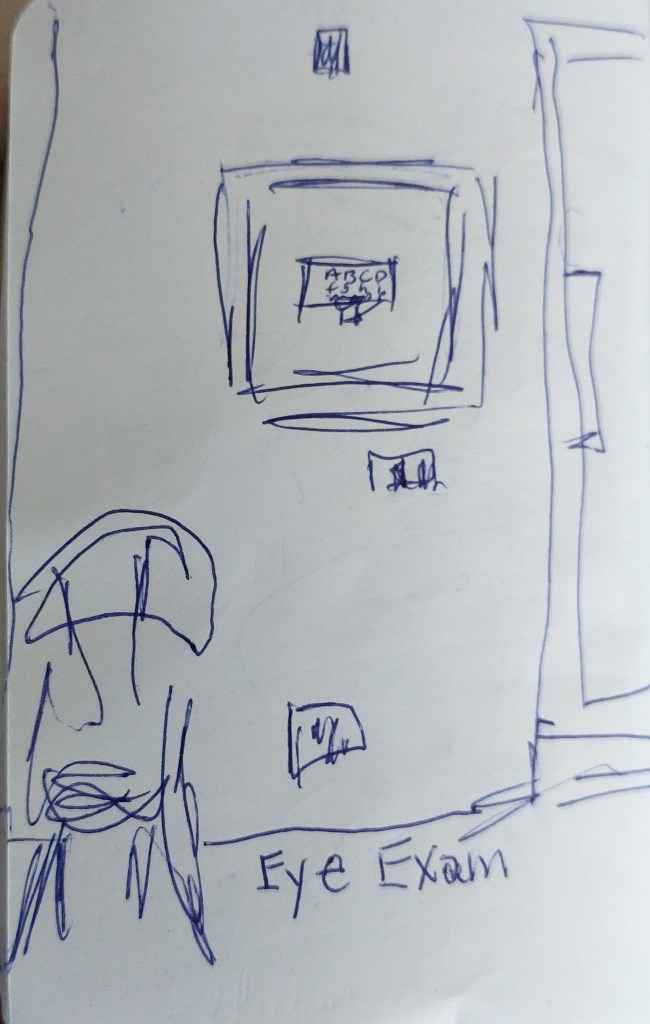
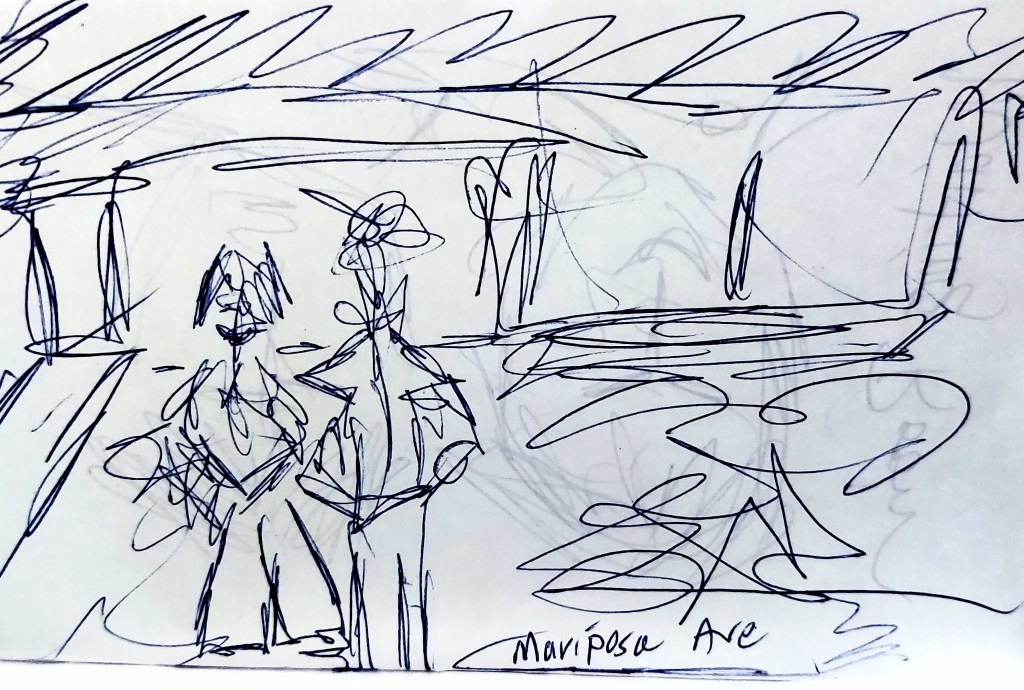
Waiting RoomEye ExamDilatedOn the Road AgainMariposa Ave
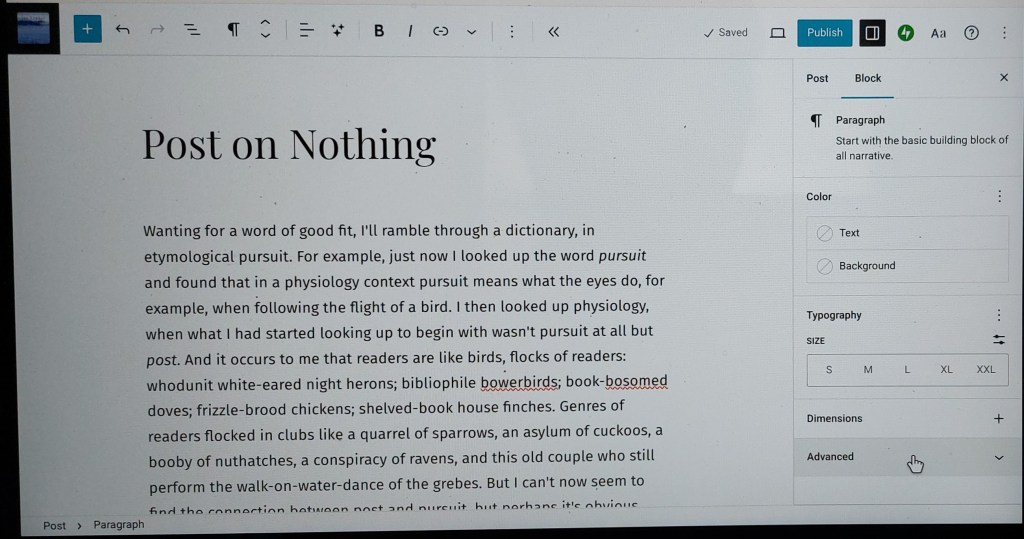
Wanting for a word of good fit, I’ll ramble through a dictionary, in etymological pursuit. For example, just now I looked up the word pursuit and found that in a physiology context pursuit means what the eyes do, for example, when following the flight of a bird. I then looked up physiology, when what I had started looking up to begin with wasn’t pursuit at all but post. And it occurs to me that readers are like birds, flocks of readers: whodunit white-eared night herons; bibliophile bowerbirds; book-bosomed doves; frizzle-brood chickens; shelved-book house finches. Genres of readers flocked in clubs like a quarrel of sparrows, an asylum of cuckoos, a booby of nuthatches, a conspiracy of ravens, and this old couple who still perform the walk-on-water-dance of the grebes. But I can’t now seem to find the connection between post and pursuit, but perhaps it’s obvious. Even familiar words have family history and we don’t know half the story as we rush to tell.
To post on a blog is to post in effect on nothing, the original posts one might post to being a mile marker, a signboard, road sign, doorpost, or a telephone pole, for example, on which one stuck a note giving notice, information or invitation or direction, or entertainment or argument, to passers-by, readers at random, on display in a public place. Such posts usually have (though not always obvious) some purpose, unlike graffiti, say, which usually is gratuitous. So far so good, a blog post is just that, what folks used to affix to a physical post, but there is no such real post to a blog post, unless one considers this open space where we seem to be (the internet, the web, the cloud, the blogosphere, the device – whatever it’s called) a post, but not a post like a milled fir 4 x 4, a tree shorn of its branches, returned into the ground, where to post something we might need a fashioned sign and a hammer and a nail.
                      "I have nothing to say

    and I am saying it                     and that is

poetry                 as I need it      ."
And post it. But this, this post, to return to it, is not poetry; this is a blog post, a post on a blog. About nothing. But what is nothing, if not something? Cage also prepared something called “Lecture on Something,” but the above quote is from Cage’s “Lecture on Nothing,” from page 109 in Silence (1961). But then again I hesitate to call this (thing that I write on, post to) a blog. A blog is a form as a poem or a song or an advertisement is a form. What is a form? We grow so weary of nothing (unless we are one of the cognoscenti of relaxation). Nothing to do. Nothing to say. Nothing to eat. Nothing to drink. Nothing in the kitty.
So we create and tend to forms. To blog is to write, but not quite, since some blog posts are devoted exclusively to the posting of pics, often posted without referent rhyme or reason. Content without form. How is that even possible? Anyway, aren’t there enough pics posted already? Yes, and words too. Is a pic a word? If you look up pic, you’ll probably see it’s classified as informal. It does not wear a cummerbund or a gown. But of course a picture is worth a thousand words. And where does that come from, that saying? We can look it up, and do. From advertising, apparently. The ads on the sides of trolley cars, which, passing as they do, a Clanging of Birdsong, provide for a moving post on which to post in pic form enough to imprint on the random viewer in passing a brand, a product, and a suggested desire or want, to follow up on later. Soap, cigarettes, auto parts, perfumes, hats, guitar picks. Are pictures worth more than words? Something called Picture Superiority Effect, from Wiki:
The advantage of pictures over words is only evident when visual similarity is a reliable cue; because it takes longer to understand pictures than words (Snodgrass & McCullough, 1986[15]). Pictures are only superior to words for list learning because differentiation is easier for pictures (Dominowski & Gadlin, 1968[16]). In reverse picture superiority it was observed that learning was much slower when the responses were pictures (Postman, 1978[17]). Words produced a faster response than pictures and pictures did not have an advantages [sic] of having easier access to semantic memory or superior effect over words for dual-coding theory (Amrhein, McDaniel & Waddill 2002[18]). Similarly, studies where response time deadlines have been implemented, the reverse superiority effect was reported. This is related to the dual-process model of familiarity and recollection. When deadlines for the response were short, the process of familiarity was present, along with an increased tendency to recall words over pictures. When response deadlines were longer, the process of recollection was being utilized, and a strong picture superiority effect was present.[19] In addition, equivalent response time was reported for pictures and words for intelligence comparison (Paivio & Marschark, 1980[20]). Contrary to the assumption that pictures have faster access to the same semantic code than words do; all semantic information is stored in a single system. The only difference is that pictures and words access different features of the semantic code (te Linde, 1982[21]).
With regard, then, to pics and words, as used in posts on blogs, one (pics) probably is not inherently, or intrinsically, worth more than the other (words). But what’s being measured in terms of worth is the value of advertising. Where pictures meet advertising in a meld (as in to announce, where the announcement and messenger are the same) is Instagram. Originally a place to post pics for folks with a hankering for photography, Instagram has become a wake of buzzards, a commotion of coots, a swatting of flycatchers. It’s an elevator of advertisements, the etymology of advertisement including a statement calling attention to itself and at the same time a warning. An advertisement is a solicitation, to be solicited, the more notoriously so, the better. Advertisement is a form.
That music is   simple to make   comes from   one's willingness to ac-
cept       the limitations    of structure          Structure is
simple      be-cause         it can be thought out, figured out,
measured       . (111)
In Cage’s “Lecture on Something” entire pages are left blank. “Let no one imagine that in owning a recording he has the music,” Cage said (128). Nor, if we own a book, do we necessarily have the poetry. Cage often left sections of music blank, too, the better to hear, presumably, the truck passing through the street below the window within a piece. If Cage had had a blog, he might have expressed issues of frustration regarding the “limitations of structure.” And it’s amazing to see what he accomplished with a typewriter. Here on WordPress, poetry, modern poems, often difficult to arrange on a blog page or post, are given, in the so-called “block” format used to make the WordPress page, somewhat easily to the functional white needs of poetry. WordPress predicates the paragraph as the primary foundation (block) of writing. Maybe for prose, but not so much for poetry, and probably not at all for the writing of music or tablature. That said, I’m not an expert at WordPress styles and options. I want to write, not do computer programming, so maybe I’m missing formatting possibilities, but the WordPress Preformatted and Verse blocks seem to work flexibly enough to attempt some creative forms. But the block is self-contained – I don’t see the possibility of a block within a block, where, for example, the typography of one word might change in size relative to the typography of another word in the same line or block, or of letters to letters in the same word.
     writing      verse (unblocked words)     on  WordPress
                  is as             simple as       writing
music
           if one        accepts          the
                      limitations (rules)
                                         of structure
the structure of limits (that which can't be measured)
nothing has no limits
What limitations was I talking about again? And anyway, doesn’t verse have all the limits it needs, without bringing WordPress into the discussion? Even a piece of doggerel has its limits, its boundaries. But notice Cage said “make” music, not write music, not compose music. One can make music if one has access to any kind of sound making device. To make silence is probably the most difficult challenge. If we take a pic of this post, we’ll find a picture is not worth a thousand words, since we can’t fit a thousand words into the pic, a post of 1,453 words, 8 minutes read time.
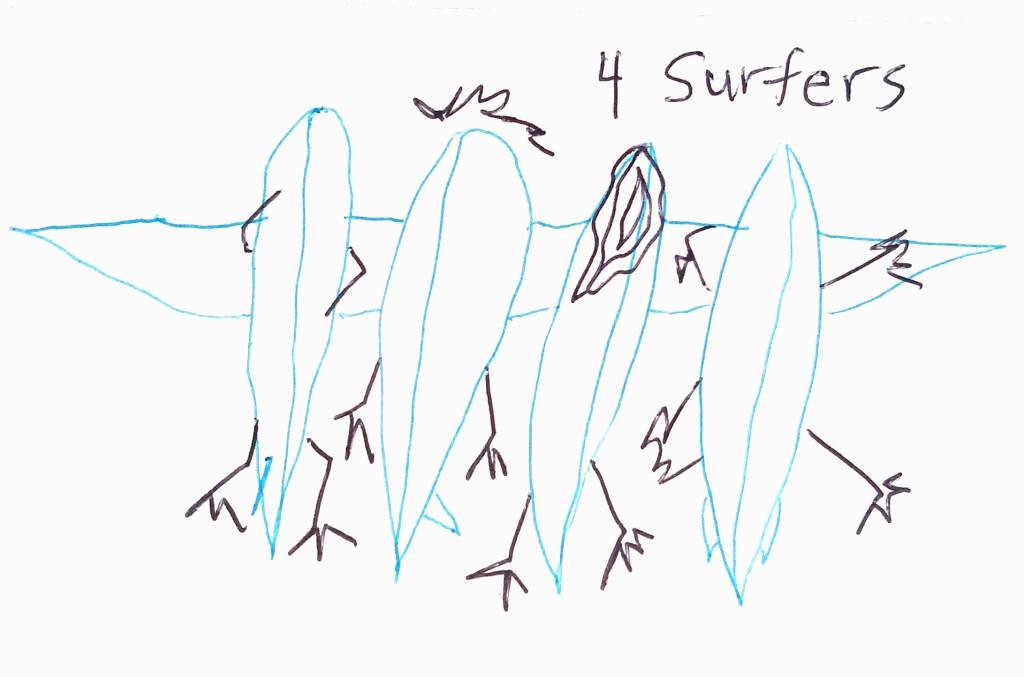
Those who travel back and forth through time, to and fro, up and down, in and out, with the tides, over and under the swells, stopping now and then to visit. They were here, now they’re gone, return to sender. Sisters, first, then brothers, then ten of us, thoughts like tinnitus that echo like a whiffle ball others can’t hear, sounds won’t leave us alone, to night us, all ten nights of us, Knights of Tinnitus, while these guitars gently sleep, and surfboards drift. A banjo plays brightly, its tabor head a full blue moon, up on the beach. So it goes.
But how does it go?
Ah, but ask the winged burds!
We look before and after, And pine for what is not: Our sincerest laughter With some pain is fraught; Our sweetest songs are those that tell of saddest thought.
But what did they bring along, if not knotty pine – oak or peonies?
They brought along their come-a-longs, and along the river they walked, while in the wet reeds the wee birds nested and rested. There were peonies and pizza aplenty.
And along the river, did they sing songs?
Of chords they sang songs, serious songs, silly songs, songs of love and despair. Cover songs and under cover songs. Songs with no words.
What songs did they sing?
So it goes, so it goes. They sang so it goes.
But where did it go?
I don’t know. “While we look not at the things which are seen, but at the things which are not seen: for the things which are seen are temporal; but the things which are not seen are eternal.”
And what did they take back?
Don’t look back, but they took back a weighty tome, a mighty book, a reference book, a history book, a look into our times, past times, out of time, a book of songs.
And did they play it as surfers or hodads?
They played it both dolce or metalico, as the moon prevailed.
Why did they leave so soon?
“Blue moon of Kentucky, keep on shinin’. Shine on the one that’s gone and said, ‘Goodbye.’” So it goes.
Why do some derive pleasure from some other’s misfortune, a strange joy often described as schadenfreude? The English version is epicaricacy. Now there’s a good word, suggesting epic caricature. A form of sadism, maybe. It’s not one of the seven deadly sins, though it could be related to wrath or envy. Or moral desert.
Is it a weakness not to feel happy at a bad person’s misfortune? Is it impossible for a bad person to experience misfortune? Is misfortune a precursor to happiness? Can we even recognize true misfortune? What appears to be divine retribution may turn out to be a blessing in disguise. Likewise, do we know luck when we find it? Trina wins a lottery in Frank Norris’s novel “McTeague.” She ends up sleeping on the coins, literally, a bed of coins.
The blessing in disguise is of course impossible to know. We can’t know what does not happen, only imagine it. But we’re good at imagining things. And our predispositions and assumptions often make no sense. We don’t believe in God, but we think people get what they deserve. We stick to the belief that good deeds are rewarded while bad acts get punished even as the headlines are proof of an alternative reality. Pride, greed, and envy are well-dressed floats in our celebration parades.
We scan the headlines for signs of redress: the writer whose best seller is found to be plagiarized; the preacher who kept a mistress; the scholar who misspells, mispronounces, misses tenure; the sports hero hooked on drugs; the politician prosecuted. But the schadenfreude feelings these misfortunes stir up are no substitute for kindness and humility. What we seem really to be looking for is vengeance. But our code of disbelief has already struck down any possibility of such a judge.
We are given then to randoms. We don’t know why things happen the way they do. And no event seems final. The so-called extinction of the dinosaurs is belied by the hummingbird and crocodile. I’ve been thinking of the dinosaurs recently, the ones we once thought now fill the gas tanks of our cars, but that’s a myth. Life doesn’t pass so much as alter – allegro non troppo: fast, but not so fast we can’t see or feel it go; and for the most part happy, though not permeating or permanently so. In any case, and as Slavoj Zizek points out in his segment of the Astra Taylor film “Examined Life,” the catastrophe of one species may be the good fortune of another.
Is happy misfortune a universal truth, like the constant speed of light or theories of relativity? In the absence of proof of life elsewhere in the universe, is life on Earth a happy misfortune? Or is life elsewhere already over, ended, and not so happily? And would we feel a sense of schadenfreude to find out?
One day, a child sitting in his grammar school classroom, I swallowed a ferrule, the metal eraser-holder cap at the top end of the pencil. I had been chewing the end of my pencil, thinking, I like to think now, was why, or maybe I was just hungry, but, in any case, I had like a beaver at work on a log, bit through, and suddenly the ferrule shot like a pill right through my mouth and down my throat. I hardly felt a thing. It didn’t lodge or get stuck, just down it went, where things go when you swallow them.
As if chewing the pencil through and swallowing the ferrule wasn’t foolish enough, when I got home, I told my mom. That night, in the hospital bed, after visiting hours, the nurse came in to turn out the light and told me in the morning to use the bedpan so they could check to see if the ferrule had gone all the way through. The ferrule was never found, but I was discharged after the one night’s stay anyway.
Yesterday, I Googled “Why did I chew on the end of my pencil?” and found this, from a site called “Pen Heaven,” an article titled “Pen Behaviour; Chewer, Clicker, Twiddler…?”: “Those who are in the habit of chewing and/or nibbling on their writing implements are generally nervous souls. Other than not wanting to borrow their pen, this person needs to be handled with care as they are often anxious, thin-skinned and take offence easily.” Nailed it? Not sure, but it was the most interesting answer in between all the more obvious dental hygiene warning posts.
It’s a neat trick, of course, naming things based on casual observation of ticks and such. You can do it with just about anything, works like astrology. When something is given a name, a certain amount of control is exchanged, and explanations exceed their boundaries. But the trick after time is often exposed. Several recent articles serve to demonstrate.
In “Why We’re Turning Psychiatric Labels into Identities,” Manvir Singh takes a close look at the Diagnostic and Statistical Manual of Mental Disorders (The New Yorker, May 6, 2024). The DSM is the desktop guide of the American Psychological Association, used to reference diagnoses. Behavior is given a name, and the named one assumes an identity. One problem with the process, as Singh makes clear, comes when the names are changed or deleted and those assumed identities are abandoned: “Revamping the DSM requires destroying kinds of people.”
In “Who’s Afraid of Judith Butler?” (The New Yorker, April 29, 2024), Parul Sehgal profiles the Berkeley based philosopher. Butler, Sehgal says, “recently adopted they/them pronouns but doesn’t ‘police it.’” Sehgal refers to Butler as an academic celebrity – is that a non-sequitur or oxymoron, I wonder. Certainly Butler had not set out to achieve celebrity: “Butler told me that they had little notion of what was happening at first. ‘Someone from the Village Voice asked, What are you thinking about the new directions in queer theory? I said, What’s queer theory? They thought I was being Socratic.’”
In grammar school, we were required to have two pencils, one red, the other black, and one pen, blue ink. At the top of each loose folder page we wrote “JMJ,” invoking the Holy Family to bless our work, no matter how messy or failing it might become. The pencil was used for math; in fact, to use ink for math (or arithmetic, as it was then named), cost points. So I must have been involved in some arithmetic function at the time I swallowed the ferrule. I doubt the word ferrule was at the time part of my speaking or even reading vocabulary. Imagine swallowing an iron bracelet.
Pope Francis may seem by some bound by something like iron bracelets, but he always seems able to break free from them. In “The Pope Goes Prime-Time” (The New Yorker, May 21, 2024), Paul Elie comments on the Pope’s recent appearance on the news show “60 Minutes.” I missed the show, but found Elie’s comment piece noteworthy. The Pope had to respond to questions as if he were running for political office. Elie comments: “In substance, it was something like a highlight reel of topical remarks similar to those the Pope has previously made in interviews, homilies, and blessings. The wars in Ukraine and Gaza; women, children, and migrants; sexual abuse and climate change; the nature of the Church; the need for hope; and the attitude that Francis calls ‘the globalization of indifference’—were all mentioned, if briefly. When Francis was asked about antisemitism, for example, he replied, ‘All ideology is bad, and antisemitism is an ideology, and it is bad. Any ‘anti’ is always bad. You can criticize one government or another, the government of Israel, the Palestinian government. You can criticize all you want, but not ‘anti’ a people. Neither anti-Palestinian nor antisemitic.’”
Also of special interest, the Pope’s definition of conservative: “A conservative,” the Pope said, “is one who clings to something and does not want to see beyond that. It is a suicidal attitude. Because one thing is to take tradition into account, to consider situations from the past, but quite another is to be closed up inside a dogmatic box.” The Pope seems to be trying to speak without a dogmatic ferrule bound around his neck.
Dogma may be the practice of naming things. We used pencil for arithmetic because it was assumed in math we make errors, which need erasing (seemingly contrary to that was the requirement to show one’s work). I’m not sure why it was not equally assumed we’d make errors in writing sentences. The red pencil was used for both math and writing, where the lines of a diagrammed sentence would be drawn in red. We named the words diagrammed: noun, verb, adjective, adverb, pronoun, preposition, conjunction, interjection. Grammar became dogma.
Once you start thinking about ferrules, you might begin to see them everywhere, as, indeed, they are ubiquitous. Without them, things unravel, fall apart, come undone.
In Percival Everett’s “James,” we read Mark Twain’s “Adventures of Huckleberry Finn” overdubbed with newly invented first person narration by Twain’s character Jim, who becomes the protagonist, changing his name to James – “Just James,” he introduces himself at the end, when asked what his last name is. Or maybe, in Everett’s telling, James is his last name, and his first name is Just.
Huck becomes a secondary main character, a deuteragonist. “James” is not the first book to take a foil character from another book and reverse foils. Mark Twain did it himself when Huck, who first appears in “The Adventures of Tom Sawyer,” becomes the narrator of his own story. The full title of Huck’s work is “Adventures of Huckleberry Finn (Tom Sawyer’s Comrade).”
The antagonist remains the same as in the Mark Twain book James comes from: slavery in the US mid 19th Century – or more specifically, slave traders or sellers, owners, and others benefiting or attempting to leverage for some advantage from the arrangement. In one of many ironic ideas in “James,” James and his friend Norman come up with a plan: sell James, James escapes, sell James again, repeat again and again as they move north – the idea first suggested to James by the Duke of Duke and Dauphin infame, here presented as far more evil than in Twain. They are brought nearby, and the slapstick is not funny. The early chapters of Everett’s book more closely follow Twain’s narrative than the later chapters, where we find new adventures of James and his reflections on what’s happening to him, why, and what can he possibly do about it as the book spirals into fantastical end chase scenes.
But Everett might have left James without a surname to underscore the existential adventure James embarks upon when he decides to leave his wife and child when he hears of his owner’s intent to sell him downriver; if sold he fears he’ll be separated from his family never to see his wife or child again. But to be without a surname is to be free from predispositions, assumptions, or any kind of argument about who you are or might be, where you come from or where you might be going. Language is a primary theme of “James,” as is writing and reading, and to give names to people, places, things, is to establish their reality, particularly if named via writing:
“My name is James. I wish I could tell my story with a sense of history as much as industry. I was sold when I was born and then sold again. My mother’s mother was from someplace on the continent of Africa, I had been told or perhaps simply assumed. I cannot claim to any knowledge of that world or those people, whether my people were kings or beggars. I admire those who, at five years of age, like Venture Smith, can remember the clans of their ancestors, their names and the movements of their families through the wrinkles, trenches and chasms of the slave trade. I can tell you that I am a man who is cognizant of his world, a man who has a family, who loves a family, who has been torn from his family, a man who can read and write, a man who will not let his story be self-related, but self-written.
With my pencil, I wrote myself into being. I wrote myself to here.”
Percival Everett, “James,” Doubleday, 2024, p. 93 (italics in original).
What does James mean by “self-related,” and what does it mean to be “self-written“? And how do the two terms differ? He doesn’t mention self-published, or any kind of publishing, and how he might have to rewrite, edit, embellish his story to get it published. But he seems to feel it is published as soon as he writes it down. Self-written. “Adventures of Huckleberry Finn” begins differently. We’re six paragraphs in before we learn Huck’s name, which we get indirectly, from the Widow Douglas. Huck begins by telling us we don’t know about him unless we’ve read “Tom Sawyer,” which contains some lies, Huck says, which doesn’t matter, everyone lies, he says. James presumably will not lie, not to his reader.
To be a writer is to make choices, to string together those choices. The above quote, from page 93 of “James,” is a rewrite of an earlier draft:
Then I wrote my first words. I wanted to be certain that they were mine and not some I had read from a book in the judge’s library. I wrote:
“I am called Jim. I have yet to choose a name. In the religious preachings of my white captors I am a victim of the Curse of Ham. The white so-called masters cannot embrace their cruelty and greed, but must look to that lying Dominican friar for religious justification. But I will not let this condition define me. I will not let myself, my mind, drown in fear and outrage. I will be outraged as a matter of course. But my interest is in how these marks that I am scratching on this page can mean anything at all. If they have meaning, then life can have meaning, then I can have meaning.”
p. 55.
Huck is not much given to such reflections in his book. That’s not why he writes. Maybe he’s too young yet. Why does he write? He simply jumps in and rambles on, telling of things as they happen, his eye for detail and ear for dialog both as acute as an owl’s. He doesn’t recognize or reveal his indebtedness to his creator, but he does mention him:
“That book [Tom Sawyer] was made by Mark Twain, and he told the truth, mainly.”
Huck has no need to lie to his reader. He’s enough to relate without lying.
James’s use of the term self-related could be a reference to the autobiography of Venture Smith, mentioned above in the quote from “James” page 93. Smith’s self-account begins as follows:
“The following account of the life of VENTURE, is a relation of simple facts, in which nothing is in substance to what he relates himself. Many other interesting and curious passages of his life might have been inserted, but on account of the bulk to which they must necessarily have swelled this narrative, they were omitted. If any should suspect the truth of what is here related, they are referred to people now living who are acquainted with most of the facts mentioned in this narrative.
The reader is here presented with an account, not of a renowned politician or warrior, but of an untutored African slave, brought into this Christian country at eight years of age, wholly destitute of all education but what he received in common with other domesticated animals, enjoying no advantages that could lead him to suppose himself superior to the beasts, his fellow servants. And if he shall enjoy no other advantage from perusing this narrative, he may experience those sensations of shame and indignation, that will prove him to be not wholly destitute of every noble and generous feeling.
The subject of the following pages, had he received only a common education, might have been a man of high respectability and usefulness; and had his education been suited to his genius, he might have been an ornament and an honor to human nature. It may perhaps, not be unpleasing to see the efforts of a great mind wholly uncultivated, enfeebled and depressed by slavery, and struggling under every disadvantage. The reader may here see a Franklin and a Washington, in a state of nature, or rather, in a state of slavery. Destitute as he is of all education, he still exhibits striking traces of native ingenuity and good sense.
This narrative exhibits a pattern of honesty, prudence, and industry, to people of his own colour; and perhaps some white people would not find themselves degraded by imitating such an example.
The following account is published in compliance with the earnest desire of the subject of it, and likewise a number of respectable persons who are acquainted with him.”
The Project Gutenberg eBook, A Narrative of the Life and Adventures of Venture, a Native of Africa, But Resident above Sixty Years in the United States of America, Related by Himself, by Venture Smith.
That is not like the book Percival Everett is helping James to write. In any case, self-related might also refer to concepts or ideas of the self discussed by Kierkegaard. Percival Everett gives his reader homework assignments. James in dream reveries has discussions with Voltaire and Locke. Does the common reader simply gloss over these references? Google them? Do they provide argument for James’s own conclusions and rebuttals regarding economics, ethics, slavery? Are they meant to explain the behavior of Judge Thatcher, who presumably has read these same writers (James gets the books from the judge’s library)?
“Kierkegaard does not think of the human self predominantly as a kind of metaphysical substance, but rather more like an achievement, a goal to strive for. To be sure, humans are substances of a sort; they exist in the world, as do physical objects. However, what is distinctive about human selves is that the self must become what it is to become, human selves playing an active role in the process by which they come to define themselves.”
Language is the great theme of Percival Everett’s book. It’s about writing, what to write about and how. It’s about how people talk, often adopting or adapting a style they might think is suitable to their audience – or what they think their audience might want to hear. Language is marketing. Even when talking to ourselves, we might often feel like we’re selling something, or being sold something. The rhetorical flourishes in “James” both stir the emotions and logically persuade; and who can argue with James’s first hand ethos reliable and credible experience? James is a statement, a claim, to which there can be no rebuttal. His backing is impervious. Percival seems to want to write (as James does) something of both human affairs (history) and economic activity (industry). When James kidnaps Judge Thatcher, the judge asks James three times over the course of several pages, “Why are you talking like that?” – referencing James speaking out of the expected slave-speak language and instead using the judge’s own language. The judge can’t get over it, can’t understand, is utterly confused by James’s ability to speak out of (what the judge believes to be) character. James’s rhetorical skills mean, for one thing, the judge’s view of James has been and remains wrong. The foundation of his excuse for slavery is undermined, and he caves in on himself, though he keeps acting like a judge. In terms of the dual language scenario Everett has created, the judge might just as well be suddenly talking to an alien. He is talking to an alien.
While language is the great theme of “James,” the pencil is the great symbol. James at one point thinks he’ll adopt the last name of FABER, it being stamped on the stub he’s using:
“I studied the small stick that had cost so much. I had no way of knowing whether Young George’s beating had stopped short of his death. I knew I owed it to him to write something important. The pencil lead was soft and made a dark mark. I resolved to use it with a light touch to have it last as long as possible. Stamped on it was the name FABER. Perhaps that would be my last name. James Faber. That didn’t sound too bad.”
p. 102.
Did Percival Everett consider putting the name THOREAU on the pencil, after Henry David Thoreau’s father’s pencil making company, where Henry worked a good part of his life? The pencil appears again and again during James’s journey, almost always at a cost incommensurate with its size and weight and feel. If symbol, what does the pencil stand for? If you’re going to write, as James wants to, you need an implement, and paper, which James also acquires though not quite at the same cost as the pencil. The pencil is a tool. We would probably discard without thinking twice a pencil already whittled down to the stub size of the one James holds on to almost to the end. The feel of the pencil in his pocket gives him comfort, he says. Later, he notes the pencil has “survived.” Others have not.
But note how quickly James seems to move from the sacrifice of Young George for the pencil to thinking some more about choosing his name. James has the ego of a writer. Huck had a story to tell, but he had no aspirations of becoming a writer. Ironically, Huck has no use for books, in Twain or in Everett. Can books make you good? Is reading sublime? Is James a good man or a good character or both or neither, or does that matter? He wants out of his birth predicament. What he wants is not arcane: he wants to live in peace and independence and freedom with his family. Notably not included in Everett’s version is the scene in “Adventures of Huckleberry Finn” where Jim scolds his daughter for leaving a door open, asks her to close it, and when she ignores him, he hits her, only to discover she can’t hear. She didn’t hear him telling her to close the door. Twain’s Jim feels the remorse of pathos, and we feel it too as he recalls the event to Huck. Would a similar scene, if included in “James,” come before or after the “Papa, Papa, Papa,” that comes at the end of Everett’s chase? Writers make choices because they have choices. That’s the reason James wants to become a writer. Slavery can’t prevent James from writing.
“James” is full of sarcasm, wit, irony, satire – but it’s not humor as Twain wrote humor. For example, at the end of “James,” Graham, the evil owner of a slave breeding plantation, upon being rousted out of his house to find his cornfield ablaze and his slaves in revolt and escaping, his overseer dead on the ground, James’s gun in his face, says, “What in tarnation?” Really? Tarnation? Isn’t that a clown’s word, an alteration, euphemism, for damnation? Is tarnation what Graham would have said? But it was a word used circa 1850’s, as indicated by Google’s Ngram analysis:
Use over time for: tarnation
And, note, tarnation is making a resurgence.
Or does Percival have Graham say tarnation to mock him before James shoots and kills him? Is its use in “James” intended as humor? Graham has no idea, as Judge Thatcher did not, not clue one, of what’s happening. Tarnation, indeed.
I stepped in front of him. “Who the hell are you?” I pointed my pistol at him. “I am the angel of death, come to offer sweet justice in the night,” I said. “I am a sign. I am your future. I am James.” I pulled back the hammer on my pistol. “What in tarnation?” He cocked his weapon.
p. 302.
Maybe it’s farce? A pun? It’s a mixture. Depends on how you hear it, not necessarily on how it’s said – not necessarily the same as how it’s said. But James (the word, Biblical) means supplanter. While James professes no interest in the God of his oppressors, he clearly knows the Bible.
The gravity of social media at times it seems profoundly influences our every move. By gravity I mean that mutual attraction force that pulls us under and down, down rabbit holes, sink holes, the vortex created by following. By social media I mean to refer here to the sites that are for the most part vertically inclined, up and down, the newest appearing at the top, the oldest nudged down to an endless bottom where they are forgotten relics or remaindered in the fossil record. These social media sites are not formatted as mosaics, like newspapers, but like scrolls – though scrolls, even the most ancient, were often formatted horizontally as well as vertically. And the newspaper could be taken apart and shared: “Who has the funnies?” By profoundly I mean the unlimited hours an addiction to social media at any site soaks up the dark energy of our otherwise beachcombing days.
There are the followers and the following, not always the same, and often as not unknown to one another. How many and how often seen or read? And there’s the rub. I’ve been working on a formula. What number of followers or following beyond which to say one is actually following in any meaningful sense of seeing and responding to even if only to think about without comment or response – beyond which any significant number of posts, tweets, pics, etc., is no longer possible?
In other words, for example, the Instagramer I might follow who posts daily several pics multiplied by 100 other Instagramers I also follow equals hours of staring at Instagram until I can no longer honestly say I’m following all the number of individuals my account accounts for. Something like that. I could say, attending a live football game in the huge arena where sit 80,000 fans, that I’m following them all. Likewise, the social media follower who says they are following me back but who also follows say 5,000 others can’t possibly be paying much attention to me. Thus Instagram, recognizing we’ve a problem here, initiates a feature like close friends. Close friends, good neighbors, faithful followers, on the same team, family (though of course this latter often may come fraught with unfollowing in biblical proportions).
What has all this to do with “The Best of the Toads”? Just this: Here too the posts have been falling, a long way down, since my first post in December of 2007, and at least monthly since. There are now 1,463 posts. Where did they all go? And which ones might a reader most enjoy, find interesting, not to mention well written? The latest post is not necessarily the best.
So, I’ve made a Best of the Toads page, that visitors to the blog might be able at a glance to view the most successful posts since the beginning of the blog in 2007, successful as defined by number of views, but also including some posts that are my favorites no matter the number of views. You can view the new page here, or click on it in the blog menu. Happy falling!
Pretend you’re sitting atop the water tower of a town. A bird. You look around and with a questioning caw fly off and glide about. What do you see? To the north, an airport; to the south, a factory; to the east, manufacturing, and a few fields as yet undeveloped (in one grow strawberries, in another horseback riding stables, in another a few dirt bike trails); to the west, sand dunes covered with ice plant flow down to the ocean.
That’s a good start. Now you’re sitting with paper and pencil, it doesn’t matter where, and begin to sketch. In paragraph one, above, you defined the edges of your place, edge as a kind of border or margin. We see the airport north, the dunes and ocean west, the factory south, and the industrial area east. These mark the outer edges of the paper.
Now sketch within those edges streets and buildings, houses and apartments, schools and parks, churches, a downtown area with shops and a few offices. The place is hilly. A winding railroad track enters from the east and ends near the downtown business section, at a small rail station housing a post office. A road passes the railroad station and leads out of town and over the dunes, curving down to the beach. A north-south four lane highway passes on the east side of town, separating the residential area from light manufacturing buildings and offices.
So far, we could be just about anywhere. If you want, you can pencil in a particular school or park, a baseball diamond, a police station, a bowling alley or pool hall, a tavern or two on the outskirts, at the edges. Notice the more detail we add, the more we limit ourselves to a particular place and time.
Time
You are a night bird. It’s 3 or 4 in the morning as you fly over looking down on your place. A few people might still be awake, and a few others are just waking up. But most of the population is still asleep, and the place is night dark, a few lights on here and there, one or two traffic lights, a few street lights on the main streets. But the factory to the south is well-lit (twenty-four hours a day), and spews smoke from stacks, while the airport to the north is lit but quiet for now, but the first planes are gearing up for early morning take off. The beach is dark, but you see the foam from the waves brushing toward shore.
Is your place in the past, present, or future? Or a mix of times. If in the past, what year? You don’t need to be specific. You might think of the time of place as before or after a war, during the 1950s, or some time before or after the coming of the Internet. Above, we said some of the fields on the east side of town are still undeveloped. That might suggest mid-century. For now, let’s go with the 1950s. We see two little league baseball fields, one on the east side, one on the west side, so again with more detail we limit our options. That’s ok. It creates focus.
If we think 50s, we might spot a milk man delivering bottles to residential homes in the early morning hours. There are station wagons in the driveways, bicycles left out in the yards, clothes left on outdoor clotheslines. There are empty lots and a number of small wood frame structures that house factory workers. The factory whistle blasts twice a day, morning and evening, another indicator of time. A custodian opens a school. It’s morning. A priest leaves his rectory for the church sacristy to say early morning mass to a bevy of nuns. A castaway sleeping under a lifeguard tower on the beach awakes, rolls up his bag, and continues his trek south. A boy folds the morning papers in the driveway of one of the little houses on the west side of town. He pauses to glance at a headline, but doesn’t read the story. He wraps each folded paper in a rubber band and sticks the folded paper into a satchel hanging from the handlebars of his bicycle. The bicycle is painted royal blue, a one speed with coaster brakes.
Also as part of time we should consider which of the four seasons we want to start with. And here we might as well begin to think about how these kinds of details influence our purpose. Spring suggests new, birth, optimism; while winter suggests the opposite. If we begin our novel in spring, will we end it in winter, or continue it into the following spring? Again, all we need for now is a sketch. We might move through several springs, but we’ve got to end somewhere, even if our ending is going to suggest a sequel. Because a novel should have a beginning, a middle, and an end. It’s a bundle. For now, let’s keep it simple – one cycle of the four seasons, beginning and ending with spring. If it’s spring, we can now sketch in flowers, cherry trees in bloom, a nursery in the center of town busy with pots and bags of compost.
Speaker
Spring brings out the population, from which you’ll pick a talker, the speaker, the voice who tells the story. You might pick more than one, but for now, again, let’s keep things simple and pick only one. To decide on a talker, it will be helpful to first look in and see who’s there, in your place. We’ve already started to sketch in characters. At 3 am, we noticed a high school kid climbing out a first floor apartment window on the edge of town, near the airport, and we watch him walk to a house in the center of town, open the unlocked door, and go inside without turning on a light. He could be our talker. Or we could sketch out who he might have left in the apartment he climbed out of. Maybe she should be our talker. Again, we don’t need to pen it in yet. We can continue to sketch in pencil. We also see the night shift leaving the factory and the day shift come on. Lunch pails. Thermoses.
Notice though, that once we pick a single speaker, we’re limited to talking about only what that speaker can see and hear. Of course, any one individual can see and hear just about everything by talking to others, listening to the radio, inferring from clues, but we might also consider a speaker who appears to see and know everything – we’ll let the bird introduced up above be our speaker. But that speaker won’t be from the place, even though they’ll seem to know everything about the place. That kind of speaker might seem easier to develop at first, but readers will want to know why, out of everything the speakers see and know, they pick only a few people or things or events or activity to talk about.
Activity
If we see activity, we might begin to realize the development of a plot. We already saw the kid climbing out a ground floor apartment building in the early morning hours, before dawn. What was he doing? Did anyone else see him? The factory is changing shifts. We can follow one worker home or another to his workplace. The priest and nuns are at mass. What are they thinking about? A milk man makes his rounds, moving in quick spurts like a second baseman.
To those activities we might add: a cook and waitress open a cafe in the downtown block – let’s go ahead and give that street a name: Main Street. A man in a uniform of some sort opens a dutch door to the little train station building, though there is no train. Let’s put the train station on Railroad Road. Two school busses leave the city yard, located near the train station. One heads east, the other west. Also in the city yard appear three mechanics, a street sweeper operator, a squad of seven city maintenance workers, and a hungover supervisor wearing a crumpled suit and dirty tie and an out of shape fedora hat. The hat could be a detail we might follow later.
What else do we see going on? A line of cars enters the airport parking lot. A plane takes off over the dunes and out over the water begins a wide turn to the north. About 20 minutes later, another plane takes off, low over the beach, disappears in the western sky. This goes on all day long. The place is noisy. Noise becomes a character. On the side of the beach road, a surfer climbs out of a station wagon, pulls his surfboard from the rack on the car roof, and walks down to the water near a rock jetty. Two neighbors meet on a sidewalk and stop to talk.
Dialog
People talk, to one another, and, if no one else is around, to themselves. What do they say? Depends on who they’re talking to. To a neighbor, they might talk about family and friends, goings on about town, fashion and fads, magazine and newspaper articles, who’s getting married and who’s separating, sickness and health, songs, jobs, who just moved out and who’s moving in, the weather, the upcoming spring rummage sale at a local church, Easter hats and dresses, the new 1955 Chevrolet Bel Air the supervisor down at the city yard just drove by, his hat crushed, it was noticed.
People talking is a kind of action. They can talk anywhere, anytime. To write effective dialog, you have to listen to a lot of different people, and you’ll notice no two talk exactly alike or say exactly the same thing the same way twice. Unless they’re trying to sell you something. Enter the door to door salesman who parks his car at the end of a block, pulls his sample case out the trunk of his car, smokes a cigarette at the curb, and walks up to door number one and knocks, hat in hand.
Finished Sketch
You’ve been sitting up on the water tower for some time now. Post the sketch on the wall over your writing space. Focus in on one of the structures or persons. Clock in time, date, location relative to place, and start writing.
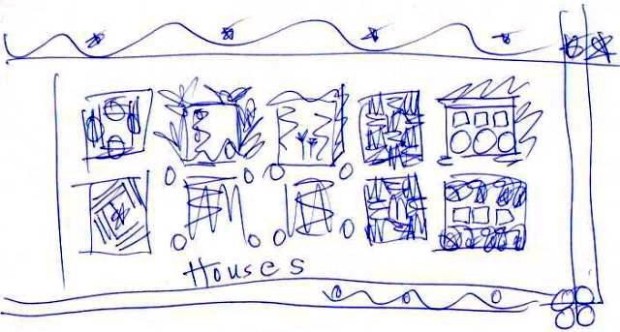
Houses
Think you know this place described above? Leave a comment!


 The Coming of the Toads