

A Notebook – Since 2007
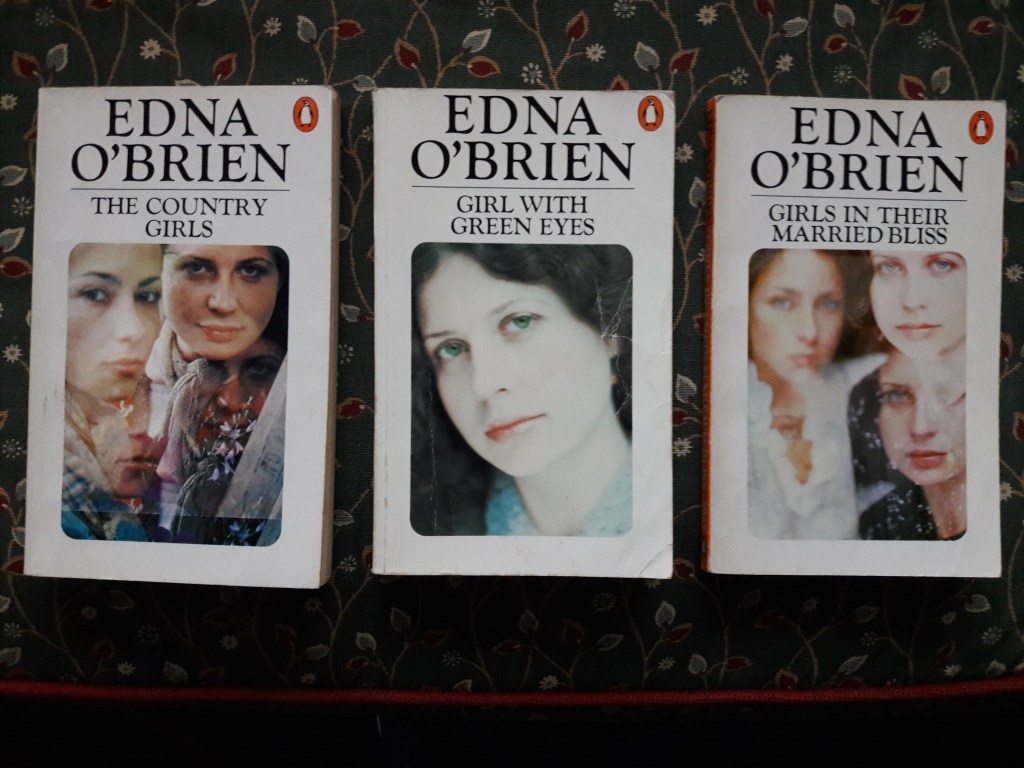
Edna O’Brien’s “The Country Girls” is the first in the trilogy telling the life and times of Kate and Baba, two girlfriends from country situations who get to the city trying to move away from the tangled mores of Irish family, church, education, and politics of the mid twentieth century. The second in the trilogy is “Girl with Green Eyes,” first published as “The Lonely Girl.” The third, received by critics at the time with the least enthusiasm, is “Girls in Their Married Bliss.”
Kate and Baba must work jobs, find a place to live, take care of themselves, all on their own. So what, we might ask. Those might be good problems to have. Indeed they are, and even better if the girls survive – the attempts to shame, the gentlemen who come into their lives, the petty but deep economic exploitations, trusts and distrusts of one another and their trysts.
“I work in a delicatessen shop in Bayswater and go to London University at night to study English. Baba works in Soho, but not in a strip-tease club, as she had hoped. She’s learning to be a receptionist in a big hotel. We share a small bed-sitting room, and my aunt sends a parcel of butter every other week” (212, “Girl with Green Eyes”).
At the time of their publications, in the early 1960’s, O’Brien’s books were banned, her family shamed. “The Country Girls” is dedicated to her mother, though it’s doubtful her mother ever read it. It wasn’t enough for the Irish censor board to simply ban the books – people burnt them in public shamings, and priests denounced them from the pulpit. It’s doubtful any of them read any of it, except maybe the pages someone said were rife with you know what, and God bless and keep you if you don’t know.
But O’Brien persisted, her work redeemed itself and a generation of girls. “My whole body was impatient now. I couldn’t sit still. My body was wild from waiting” (186, “The Country Girls”).
But redemption might not be sufficient for those who want to write their own lives, who want to be reborn every day: “Not long ago Kate Brady and I were having a few gloomy gin fizzes up London, bemoaning the fact that nothing would ever improve, that we’d die the way we were – enough to eat, married, dissatisfied” (7, “Girls in Their Married Bliss”).
My Penguin paperback copies are all three editions from 1981 (they were originally published in 1960, 1962, and 1964). Many editions have been printed, some with maybe better cover designs.
…from my Goodreads “short reviews of old personal library books.”
Rake the Sentiment: 3 Poems at Cosmopolitan Hotel Cairo. < Click to visit and read.
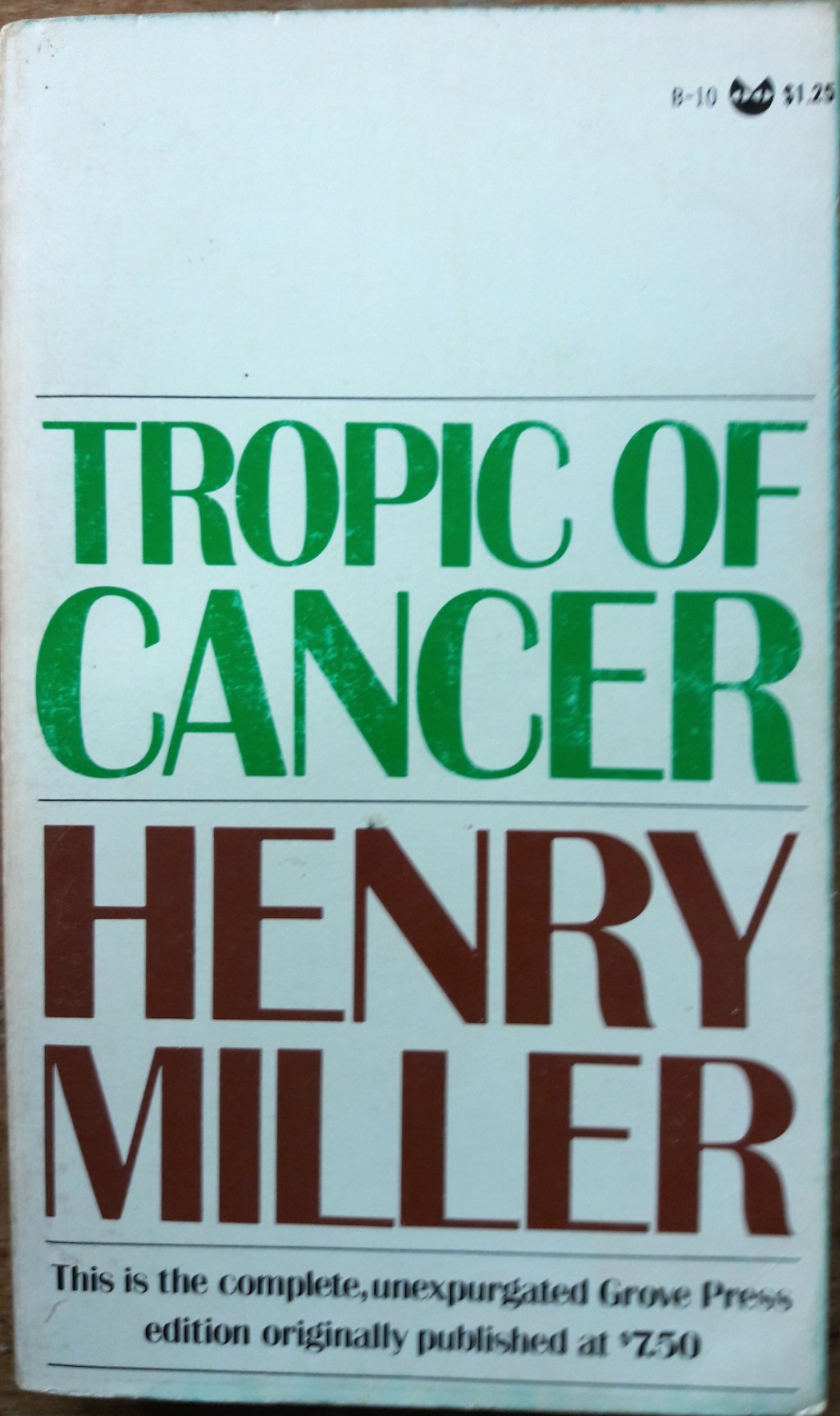
Henry Miller’s “Tropic of Cancer” contains everything Hemingway left out of “The Sun Also Rises,” which had left Ernest with the tincture of a refined sentiment. That is one difference between the Jazz Age and the Great Depression. Turned out, we didn’t always have Paris; most of us never had it. From page 1 of Miller: “I have no money, no resources, no hopes. I am the happiest man alive.”
I don’t remember when I first read “Tropic of Cancer,” probably ’68 or ’69. From my notes written on the back of the last page and inside the back book cover:
art sing 1
Liby 36
whore – Germaine 40-43
Popini 58
artist 60
America 86
change 87-90
room dream 114-116
woman want 117 (45, 26)
pimp & whore 143-144
Matisse 146-149
Russia America 154
working with boss 158
mona 160-166 (smile)
Paris 162-188
book 163
moon 167
paragraph (style) 167, 202, 216
converse 171
army 200
Whitman 216
gold standard 219
writer 224
what’s in the hole 225
earth 225, 226
idols 228
task of artist 228
inhuman 230
art 229-280
human 231-259 (view on goodreads)
“Tropic of Cancer” was first published in France, 1934, Obelisk Press.
My edition is First Black Cat Edition 1961 Fifteenth Printing B-10, $1.25.
Introduction c 1959 by Karl Shapiro first appeared in “Two Cities” Paris, France.
Preface by Anais Nin, 1934.
No ISBN appears in the book, but the number “394-17760-6” appears on the bottom right of back cover.
Yes, trying to do something with Goodreads for the new year. I’ll be putting up short reviews like the one above from some of my old reads.
Our Potus who hides us
from sea to lake crisis
hollow is your name.
Thy Kingdom rots
from east evidence storms
to trans west fires.
Feed us our daily diversions.
Forgive us our not tots
as we forgive those
who abandon us.
And lead us not into fees and tolls,
but deliver us our lowly titles
and our vulnerable genders,
our human based prayers.
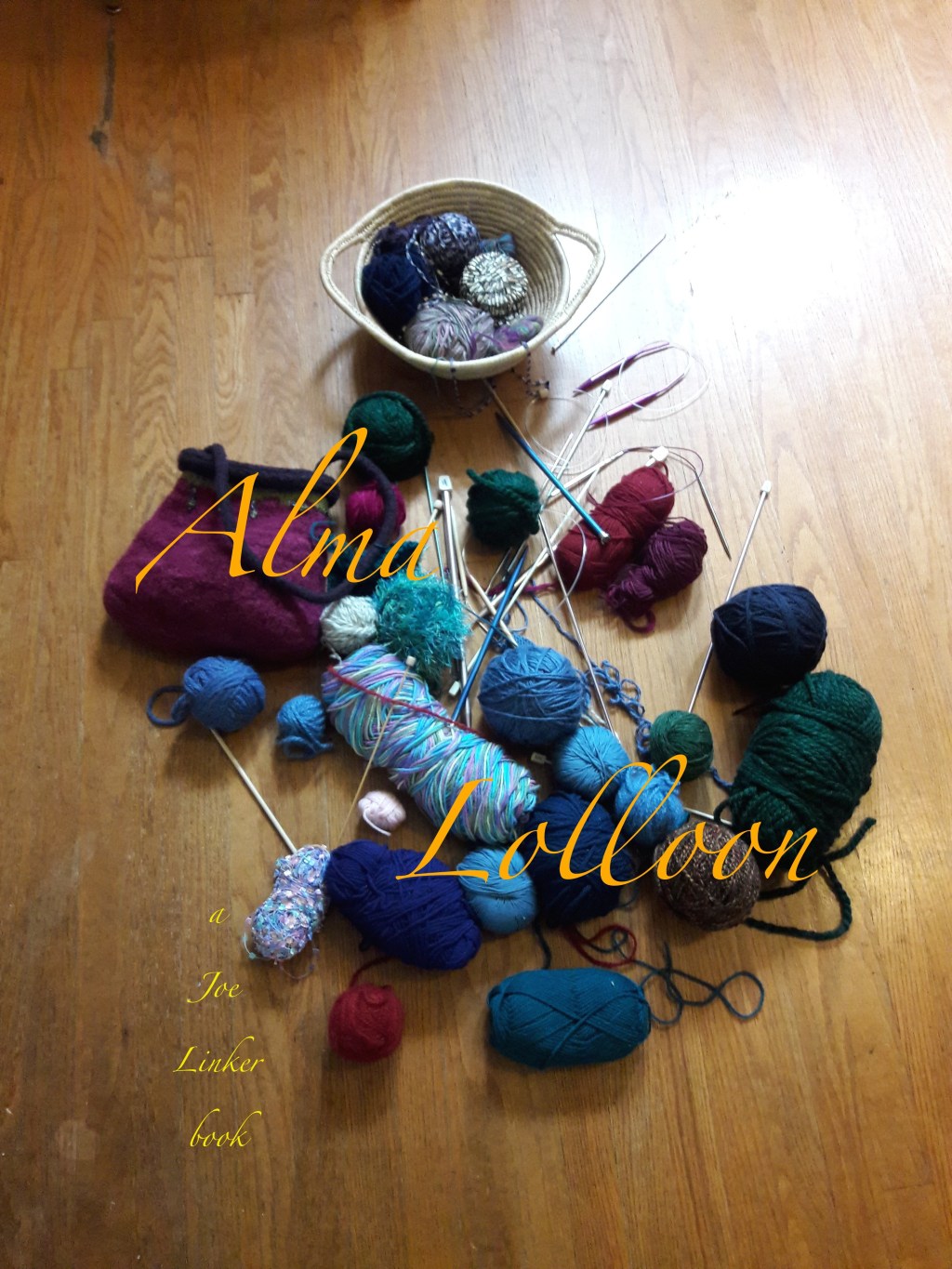
Another review of “Alma Lolloon” released into the cybersphere, this one by Ashen Venema, author of “Course of Mirrors” and blogger friend. I paste below, and below that, please see the “TinyLetter” opportunity.
~~~
My this week’s Tiny Letter copied below. Would you like to sign up?
Three reviews of “Alma Lolloon” are now loose in the cybersphere:
Bill Currey bound his review in a tweet, to wit:
Bill Currey @williamcurrey
And here I thought I was going to get a Joycean map with footnotes and all to Linker’s Portland! I stumble blindly onwardly towards, if not to summation, at least to termination.
Joe Linker @JoeLinker
Replying to @williamcurrey @PhilippaRees1 and 2 others
Thanks for the review, Bill. Sounds like something Beckett might have said.
And Dan Hennessy posted a review of “Alma Lolloon” to his “Tangential Meanderings” blog (AKA: itkindofgotawayfromyou). Click here to read Dan’s review.
And if you’ve not read Philippa Rees’s review of “Alma Lolloon,” it’s at Queen Mob’s Tea House. Click here.
Bookmark Giveaway!
We’ll be spending the holidays with the grand girls, and for an art project we’ll be making bookmarks for a Joe Linker book.
The bookmarks use standard, toxic free materials, of paper and fabric, thematically linked to the books with original artwork.
If you’d like to receive a complementary bookmark, please send a reply to this tiny letter telling us what book you’d like the bookmark for (Penina’s Letters; Coconut Oil; Scamble and Cramble: Two Hep Cats and Other Tall Tales; Saltwort; or Alma Lolloon), and also include a snail mail address for us to mail you the bookmark. All bookmarks will be sent out by Dec 31st. If you prefer, we can send you an e-bookmark. Reply the same as above but with an email address. What’s an e-bookmark? Not sure, we’ve not made one yet.
You can view the covers of the five books here.
Philippa Rees has a review of “Alma Lolloon” up at Queen Mob’s Tea House. Please stop by for a cup and a read.
I was interviewed by Vlad Savich for Queen Mob’s Tea House. Trip on over and check it out?
is it? is it? is it?
what time is it?
the cricket asks
the night notes call
a view of space with
ornamental lights
near like the cat
hiss skin rips
claws a violet sky
saturates maroon
the cauliflower
cumulus moon
this squall passes
as does this darkness
the outdoor words
drift over the river
as the last cricket replies
is it? is it? is it?
time to get
out of bed yet?
As The Coming of the Toads nears its 10th anniversary (our first post was Dec 27, 2007), we reflect on why and wonder what now.
The new book, “Alma Lolloon,” is out (“look inside” here). “Out” may seem hyperbolic – it’s now available. Others trying to write and publish will get the difference.
Most writers, excepting the besttellers, have to self-promote; yes, even when published traditionally by a standard house in the traditional manner.
It is, then, in the interest of shaking the bushes and the amateur spirit of writing, I invite readers of The Toads to subscribe to my TinyLetter notes.
Meantime, the amateur spirit in writing lives on at The Toads:
We do not have the New Yorker DVD library (though we do have in the basement a stack of paper copies we regularly prune for mold), but we do have E. B. White’s “Writings from the New Yorker, 1927-1976,” edited by Rebecca M. Dale (HarperPerennial paperback edition published 1991).
The “Talk of the Town” pieces these days only occasionally reach White’s wit or brevity. He often captures a moment of his own time while gazing into some distance, foretelling. A case in point, his May 11, 1929 piece, where he writes: “’Writing is not an occupation,’ writes Sherwood Anderson. ‘When it becomes an occupation a certain amateur spirit is gone out of it. Who wants to lose that?’ Nobody does, replies this semi-pro, sitting here straining at his typewriter.”
Yet today, as the reading crisis spreads its tangential wings to include newspapers pruning peripheral departments, some semi-pro and pro writers are forced back into an amateur spirit.
Where will they go? Continued White: “Nobody does, yet few writers have the courage to buy a country newspaper, or even to quit a city writing job for anything at all. What Mr. Anderson says is pretty true. Some of the best writings of writers, it seems to us, were done before they actually thought of themselves as engaged in producing literature.”
Or before, in other words, they thought of themselves as real writers at all. One blogs in the hopes the amateur spirit will prevail, painfully aware that blogging also makes it easier, as White later said, “for persons who are not artists and writers to continue the happy pretence” (May 21, 1938).
But it’s not only to gain even amateur status that we might entertain the doubtful purposes of writing – for self or for others; it’s because even though we know full well we’ll never play right field for the Dodgers, we still enjoy shagging balls in the back-yard; we will still ride a skateboard down the hill, though of course we are no Tony Hawk, as our spouse reminds us, shouting she’s not taking us to emergency when we fall; and though we could never follow “Da Bull” into the big waves, when we’re back in El Porto, we’ll always paddle out for a small one.
Whatever happens to the pros, this amateur writing spirit hopefully encouraged and evidenced in the best blogging, whether pretence or preface, may enable those who agree that writing is learned while writing, and in no other way, to find a subject, knowing that subjects often reveal themselves only once we’ve made the commitment marked by a few hundred words.
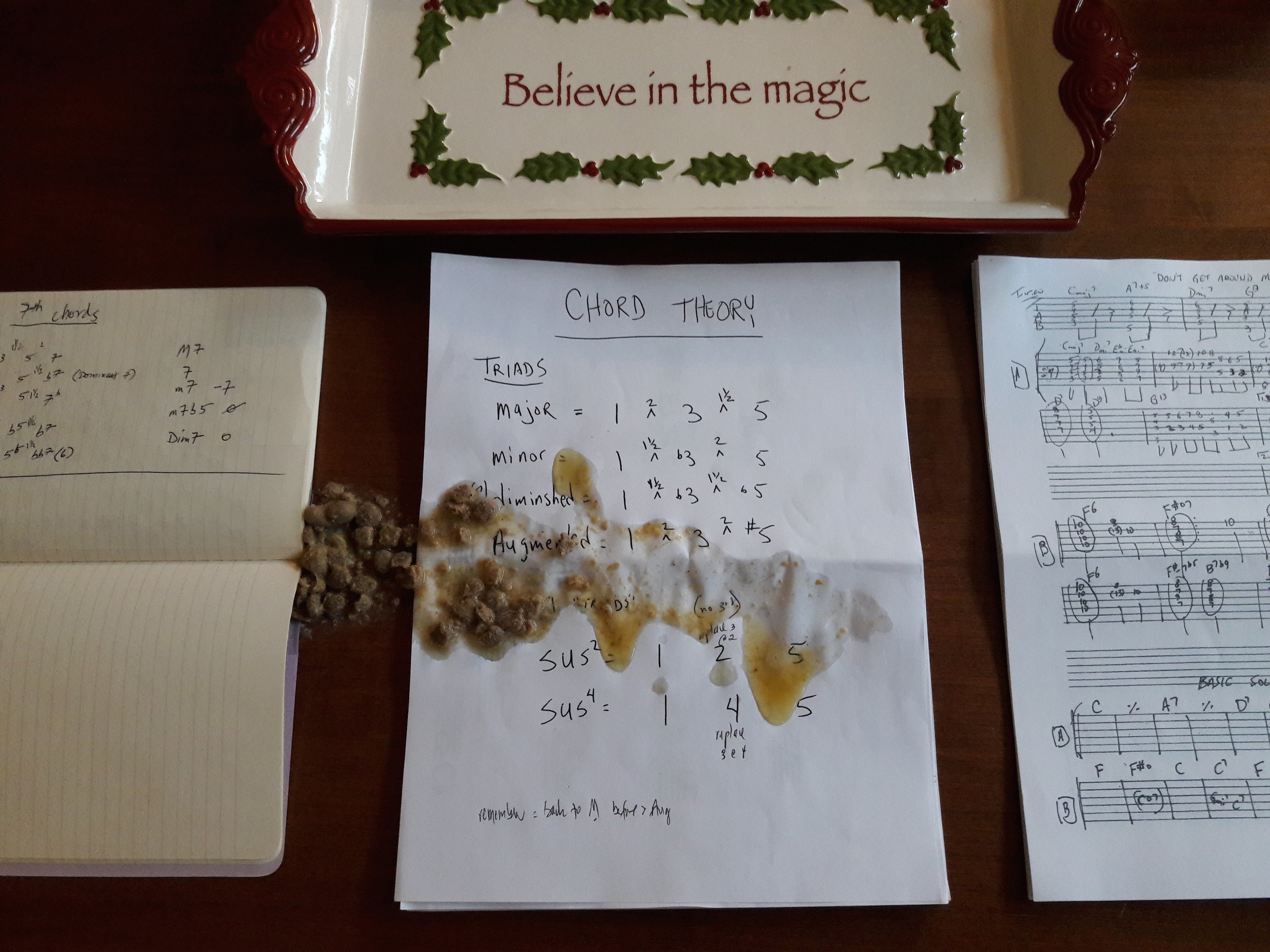 I’ve noticed when I pick up the guitar and the cat Zoe is hanging out, she’ll scurry off to a quieter corner. Cats have excellent ears.
Yesterday, home from the afternoon music theory class I’ve been taking, I organized my notes and handouts, reviewing each page. I left the pages in neat piles on the dining room table.
This morning, I go to resume my music musing, and what do I find but the cat music critic’s overnight review – Zoe had barfed over my notes.
Cats are excellent communicators. I’m glad she doesn’t tweet.
 The Coming of the Toads