Tag: Buckminster Fuller

  • AI at the Crossroads

    In Buckminster Fuller’s imaginatively scientific “Operating Manual for Spaceship Earth” (1969), he looks forward to automation and computation, and I’ve no doubt he would have welcomed the automation we now have at our disposal called Artificial Intelligence, or AI.

    Man is going to be displaced altogether as a specialist by the computer. Man himself is being forced to reestablish, employ, and enjoy his innate “comprehensivity.” Coping with the totality of Spaceship Earth and universe is ahead for all of us. Evolution is apparently intent that man fulfill a much greater destiny than that of being a simple muscle and reflex machine – a slave automaton – automation displaces the automatons.

    How to describe the common reader’s understanding of AI? We use AI, often unwittingly. Like it or not, it’s increasingly shaping our online experience. If we use it directly, via the Gemini or ChatGPT apps, we might notice the fine print: “ChatGPT can make mistakes. Check important info.” And, “Gemini can make mistakes, so double check it.” When I asked Gemini about the possibility of making mistakes just now, it responded, in part, with this:

    “The fact that I can make mistakes is a core part of how I function.”

    I’m not quite sure what that means, but it gives me pause. And I’m not at all sure how well I understand AI, what it is, how it works, where it’s headed. What to do? Ask AI?

    AI is already significantly affecting, often asymmetrically, with both positive and negative results, every part of our daily lives: in schools, where it’s being encouraged or banned; in finance, where it’s considered a smart bet or a bubble; and in healthcare. In June of 2025, Bill Gates, speaking at the African Union, talked about including AI in solutions to health care problems:

    Gates spoke about the transformative potential of artificial intelligence, noting its relevance for the continent’s future. He praised Africa’s young innovators, saying he was “seeing young people in Africa embracing this, and thinking about how it applies to the problems that they want to solve.” Drawing a parallel to the continent’s mobile banking revolution, he added, “Africa largely skipped traditional banking and now you have a chance, as you build your next generation healthcare systems, to think about how AI is built into that.”

    If the banking comparison seems simple, consider how the distribution of health care works, the availability of diagnosis and providers, particularly in rural areas.

    How to balance that potential good with the possibilities of bad outcomes? But assuming AI takes off on its own, as in some sci-fi doomsday predicting scenarios, how is that any different from what human agency has already spread? Fuller addressed this question:

    Of course, our failures are a consequence of many factors, but possibly one of the most important is the fact that society operates on the theory that specialization is the key to success, not realizing that specialization precludes comprehensive thinking. This means that the potentially-integratable-techno-economic advantages accruing to society from the myriad specializations are not comprehended integratively and therefore are not realized, or they are realized only in negative ways, in new weaponry or the industrial support only of war faring.

    Am I hopeful, as Gates seems to be, or do I see AI’s future as business as usual, as the usual hands spoil it? Perceived winners and losers already seem to be taking sides. Fuller anticipated such, and here he talks about what we might call “guaranteed income”:

    “It is easy to demonstrate to those who will take the time and the trouble to unbias their thoughts that automation swiftly can multiply the physical energy part of wealth much more rapidly and profusely than can man’s muscle and brain-reflexed-manually-controlled production. On the other hand humans alone can foresee, integrate, and anticipate the new tasks to be done by the progressively automated wealth-producing machinery. To take advantage of the fabulous magnitudes of real wealth waiting to be employed intelligently by humans and unblock automation’s postponement by organized labor we must give each human who is or becomes unemployed a life fellowship in research and development or in just simple thinking. Man must be able to dare to think truthfully and to act accordingly without fear of losing his franchise to live. The use of mind fellowships will permit humans comprehensively to expand and accelerate scientific exploration and experimental prototype development. For every 100,000 employed in research and development, or just plain thinking, one probably will make a breakthrough that will more than pay for the other 99,999 fellowships. Thus, production will no longer be impeded by humans trying to do what machines can do better. Contrariwise, omni-automated and inanimately powered production will unleash humanity’s unique capability – its metaphysical capability. Historically speaking, these steps will be taken within the next decade. There is no doubt about it. But not without much social crisis and consequent educational experience and discovery concerning the nature of our unlimited wealth.”

    “AI at the Crossroads” means, depending on which road we turn down, AI can either unfold Fuller’s wealth or create more disparities — and the outcome depends on choices being made in our moment. But first we have to figure out what it is, if we still have time. Let’s hope there’s not a pact with that strange figure Robert Johnson met up with at his crossroads.
  • Manual for Intuition

    Buckminster Fuller was the most optimistic of scientists. He believed synergy solves the problem of entropy. Synergy, simply put, is working together to achieve more. Synergy is sometimes defined as a whole unpredictable from the sum of its parts (1+1 = 3). And Fuller thought there is enough to go around:

    “Once man comprehended that any tree would serve as a lever his intellectual advantages accelerated. Man freed of special-case superstition by intellect has had his survival potentials multiplied millions fold. By virtue of the leverage principles in gears, pulleys, transistors, and so forth, it is literally possible to do more with less in a multitude of physio-chemical ways. Possibly it was this intellectual augmentation of humanity’s survival and success through the metaphysical perception of generalized principles which may be objectively employed that Christ was trying to teach in the obscurely told story of the loaves and the fishes.1

    Dostoevsky said the same thing in his “Notes from Underground” (1864):

    “I admit that two times two makes four is an excellent thing, but if we are to give everything its due, two times two makes five is sometimes a very charming thing too.”

    Though Orwell in “1984” (1949) suggested we be careful with arithmetic and keep an eye on who’s controlling the data. William Blake also reasoned reason could be a tyranny (“The Book of Urizen,” 1794).

    For my own alone little part of the network, I’ve been wondering about the popularity of Doors, Wordless Wednesdays, and other prompts, and have opted to contribute a little poem on the subject of synergy and entropy:

    Loves and Fishes

    Planets like cauliflower
    heads can’t go it alone;
    entropy a flat bald universe,
    produces no combs.

    Love like the neutrino
    difficult to detect,
    plentiful and invisible,
    with no electrical net.

    1. “Operating Manual for Spaceship Earth,” R. Buckminster Fuller. First published 1969, new edition 2008/2011, edited by Jaime Snyder. Lars Muller Publishers. ↩︎
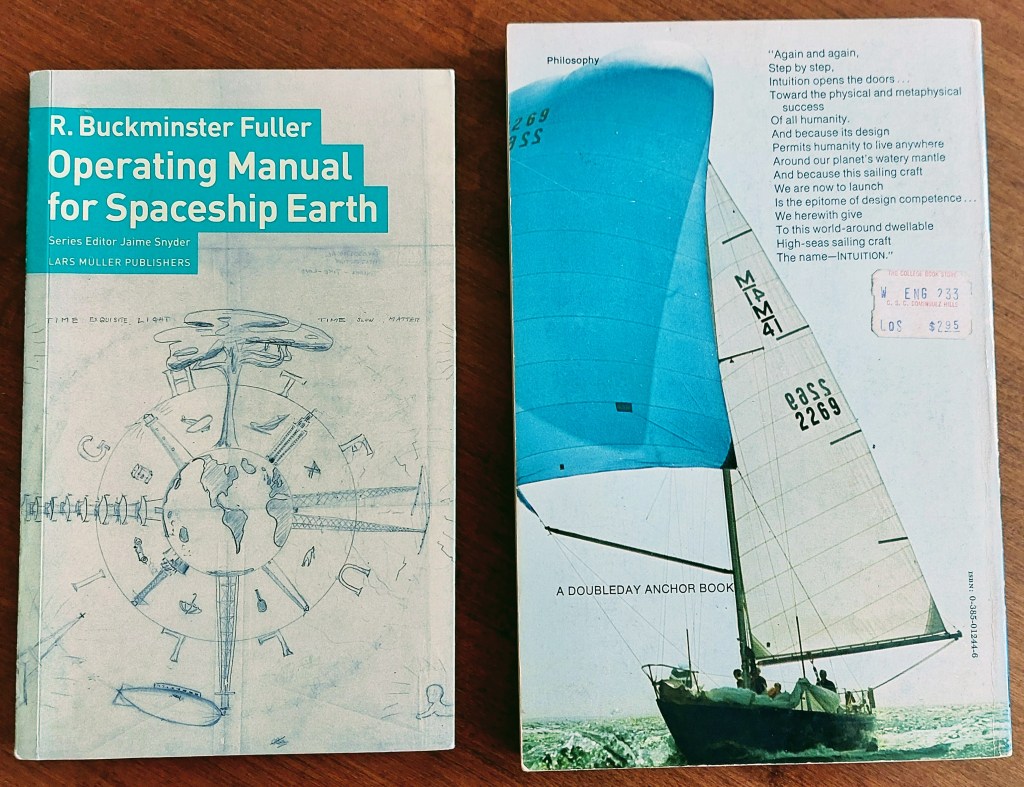
    Operating Manual for Spaceship Earth (1969) and Intuition (1972) – books by Buckminster Fuller
  • Old Haunts

    Old Haunts, all with current links, focused on core subjects: art, technology, music, science, and literature, but first, a brief explanation:

    Moving continuously toward more minimalist formats (which if not stopped could result in disappearance altogether), blogs may risk losing some appeal, particularly to readers who enjoy liking, commenting, and linking or sharing – in short, conversing – as well as indulging in pingbacks and reblogging, and who enjoy perusing sidebars, widgets, clicks and plays, slide shows, and sharing up and down the crowded street of social media sites and apps. An example of such minimalist drift, here at the The Coming of the Toads, might be the removal, some time ago now, of listings and links of followed blogs and favorite sites, what I called in the sidebar heading over the list of links: “Back Roads to Far Places,” the title from Ferlinghetti’s book.

    I use the WordPress Reader to subscribe to sites, and currently I’m subscribed to 146 – but not many of which post frequently or are still active at all, which sparks the idea behind this post, which might have been subtitled: and Other Broken Links. While I don’t currently post a widget of followed blogs or sites, I do manage my subscribed sites in the WordPress Reader, and I also maintain the “Links” feature in the WordPress Dashboard for my own use. There are currently 33 links. But links don’t always stay current or active, while others click to surprise, a site grown or morphed into other projects or disappeared (Page Not Found), and still others remain useful resources or pleasant places to visit, like old friends. Or the link simply breaks and you get sent who knows where and who knows what’s happened. Sites often change over time, and it can be hard and takes time keeping up with the changes.

    Anyway, I thought I’d share an update of just a few of the sites that do continue to work well and that I try to follow and that offer pleasant visits and are creative and resourceful:

    Marginalia and Gracia and Louise I first discovered in “High Up in the Trees,” a blog by the Australian artist Gracia Haby. It’s now called “Marginalia.” I like everything about it – font work, photography, text content, collage and other art work, the work Gracia and Louise do with animals. And there’s another site they maintain, called Gracia and Louise, full of things to see and wonder at. The sites probably work best on desktop, but the creativity in doing more with the drop-down necessities of on-line viewing is unparalleled (of that, here is a specific example, called Reel).

    McLuhan Galaxy always produces a profoundly puzzling experience in that there seems no end to his ideas and the ramifications of effects of media on society and culture – and yet here we go, linking and following, but where? The Blogroll will keep you occupied for hours of intellectual fun.

    I don’t have John Cage ears, but I’ve always enjoyed his writing, and much of his music I do enjoy. Kuhn’s Blog is not often updated, but the site resources remain available and loads of fun, with several interactive features (try Indeterminacy, for example). The John Cage Personal Library is itself a phenomenal work.

    The Buckminster Fuller Institute shares hope for the world from a worldwide perspective. The site may provide a new awareness for what’s going on worldwide to improve conditions, predicaments, problems – near and far. If your not familiar with Bucky, here’s a good place to start: Big Ideas.

    Words Without Borders features world wide writing in a variety of formats. Browse by country, theme, or genre.

    Old Haunts, all with current links, focused on core subjects: art, technology, music, science, and literature.

  • On the Wings of the Dove

    Caleb Crain has posted an interesting Leaflet devoted to questions of consciousness and an afterlife. If there is an afterlife, why (Caleb tells us Henry James in particular wondered) has no human soul ever come back to haunt or cheer its former digs? James might have been conflating consciousness with brain. (Calling consciousness “mind,” Buckminster Fuller radically distinguished between the two.) Caleb wonders about the infinite possibilities inherent in a consciousness that thinks about itself.

    Reading Caleb’s post, and thinking about his aloof Henry, I began to wonder for myself. If consciousness is infinite (as James and Caleb both seem to suggest possible), it must be round, with no beginning and no end, and not linear, so we might also wonder not only about a possible afterlife, but about a prior life, and why has no one ever visited there, or have any memory of it. If we fear or wonder about death and an afterlife, we might recall that we’ve experienced it before, for where were we before we were born, if not dead, which we seem to have survived, for here we are.

    An electrician I once had over to the house to work on some wiring told me, apparently working under some severe predispositions and assumptions that I was the Christian of his definitions, that he didn’t believe in anything he couldn’t see or measure. Thus he brought his rudimentary science into my darkened basement.

    William Blake held “the following Contraries to be True:

    – Man has no Body distinct from his Soul, for that call’d Body is a portion of Soul discern’d by the five Senses, the chief inlets of Soul in this age.
    – Energy is the only life and is from the Body, and Reason is the bound or outward circumference of Energy.
    – Energy is Eternal Delight.”

    William Blake, The Marriage of Heaven and Hell, 1793

    The five senses then, work not so much to let reality (consciousness thereof) in, but to keep it out, for to take it all in at once would drown us, suffocate us, consume us, like Rilke’s angel (a kind of interpretive translation of the opening of Rilke’s First Elegy follows):

    “Who, if I yelled out in my street, would hear me among the Angels’ Orders? And even if an angel hugged me quickly to her heart, I’d be consumed like a candle in her powerful embrasure. For beauty is the terrible beginning, that we hardly and barely (since so recently from the womb) endure, but here we still are, and while we wow in wonder the angel cools us, scores us, and her disdain destroys us even as she sustains us. Every angel is terrifying. And so I hold myself and hear my own and sole note of dark sob. God! Who can we reach out to with our need? Not angels, not one another, and the Disney animals see at once we are not at home in Oz, where all must be an interpreted world. That leaves us some tree on a hill, our eyes return to morning after morning, leaves us our child’s street and our parents and friends of old habits that drank and smoked there, loitered, and never left home. Only the angel can wear those magic slippers, hear those perfect notes. Oh! And the night, the night, well here it comes! When the wind full of space blows on our face, the night exists, is here, we want the night, but as soft as she is, she wounds, lists hard chores to be done the morrow, and we only the single of heart. It is not easy to be a lover. Lovers use each other to explore their only fates. You still won’t see? Throw the emptiness in your heart into the space of breath. Maybe the birds will feel the sudden burst of air with a passioned flight.”

    from the first Duino Elegies, modified for this post
  • Once More to the Moon

    The stars will blow out they say
    tho none have seen one up close
    or this far away for that matter.

    And for now the center still holds
    the “deep heart’s core” burns on
    of course tempered with age.

    The tool worn and bent its handle
    once forged so hot to the touch
    now almost cold the closer you come.

    The further astray and adrift
    solo in space in your egg shaped
    spiral lost in your milky way.

    Why nine chains to the moon?
    Because things arranged in threes
    allow a mysterious symmetry.

  • Advertisement

    All advertisement is argument.

    We start arguments when we say something and we know someone will disagree. Happens all the time. We are never safe from disagreement. If you say, “The sun rises in the east,” you might think you’d be safe from argument. But an astrophysicist listening in might say the sun does not actually rise. The earth spins in orbit around the sun, and so on and so forth. A rebuttal around what you said about where the sun rises might productively explain the importance of point of view and perspective, presuppositions and assumptions, audience and expectations, proof and fallacy. Or it might be met with an eclipse of the eyes.

    Most of the above, in one form or another, you can find in books on rhetoric, and most of those have as their ultimate source of reference, Aristotle. When “The Coming of the Toads” started out, on December 27, 2007, the first post was about argument. Since then, the Toads has posted 866 arguments. Not that frequency or redundancy leads to persuasiveness. Some readers will no doubt argue that’s 866 arguments too many.

    Artists enjoy argument. A poet might say, for example, “Wouldn’t it be nice if the sun rose in the west for a change?” Buckminster Fuller suggested we replace the words “sunrise” and “sunset” with sunsight and sunclipse. Fuller, a scientist and inventor, was arguing that language both informs and betrays how we see and understand things. Both physicists and philosophers might ask, “Why does the sun rise?” Their answers will be arguments. Advertisers can’t afford arguments, so they cleverly disguise saying anything someone might disagree with. An advertiser might suggest sunopen and sunclosed.

    Silence, too, is often met with disagreement. “You should speak up,” someone says. “Say something.” Or your silence alone might be understood as disagreement, particularly if your arms are folded tightly across your chest. Advertisers never fold their arms or cross their legs.

    Aristotle saw that arguments happen everywhere and all the time. But listening closely, he also saw that some people were better at argument than others. Some people always seemed to be right, no matter what they said. And Aristotle thought that if he studied how those people argued, he might be able to explain the tools of argument.

    The proper use of those tools is the subject of another argument.

  • Shops

    To Hawthorne, hopping nuts with holiday shoppers, the shops overheated, crowded with festive folks wearing wet weather gear, so it felt fresh again and good to leave a shop and back out onto the sidewalk. On the corner at the Hawthorne boutique Goodwill, the usual Cannery Row characters occupying the sidewalk, sharing beer bottles noted, something craft, where the money for that, wondered, and another sign, next a panhandling hat: “Too honest to steal. Too ugly to prostitute.” Got the to too correct. Literary bunch. Probably all with English major degrees.

    Distribution the problem, Buckminster Fuller said, Earth enough resources, but inefficiently distributed. And saw a news report last week where down in Los Angeles a new project encouraging grocery shops from throwing away food deemed unsaleable, systems now being created to collect and redistribute the food in a number of ways – to the homeless and hungry, to compost feed for animals, to entrepreneurial startups creating energy from the food scraps.

    At the same time, reports afield of Amazon mistreating employees, robots running over their own, for example, while on TV we’ve been seeing obviously propagandistic ads showing these same employees as happy as Tiny Tim when miserly Scrooge shows up with the surprise goose.

    But deep waters, this anti-Amazon sentiment. Was retail clerk ever a great job? And suppose Nordstrom or Macy’s does goes under – would that be some sort of cultural catastrophe? Suppose Amazon actually capable of solving distribution inefficiencies Earthwide: Water, Food, Shelter, Medicine, Grain, Tools. Suppose Bezos awakes from uneasy dreams some Christmas morning and converts his current medieval style dungeon warehouses into chic campuses like the ones employees currently enjoy in Silicon Valley? We should focus on problems of distribution and job satisfaction and livable wage, not on some romantic notion of brick and mortar life in shops.

  • On the Moon

    Moondance 1A group of moonstruck locals climbed to the top of the park Sunday night to view the rising of the super moon. In Italo Calvino’s short story “The Distance to the Moon “ (1965), the characters climb to the moon from Earth using ladders:

    “Climb up on the moon? Of course we did. All you had to do was row out to it in a boat and, when you were underneath, prop a ladder against her and scramble up.”

    It’s the same moon Leonard Cohen had in mind when he sang,

    “Ah, they’ll never, they’ll never ever reach the moon, at least not the one that we’re after.”

    But which moon are we after?

    In Buckminster Fuller’s book “Nine Chains to the Moon” (1963), he explains the title:

    “A statistical cartoon would show that if, in imagination, all of the people of the world were to stand upon one another’s shoulders, they would make nine complete chains between the earth and the moon. If it is not so far to the moon, then it is not so far to the limits, – whatever, whenever or wherever they may be.”

    Fuller may have climbed up to the moon to write some of his books.

    When the Brooklyn Dodgers first arrived in Los Angles, they played in the Coliseum, which was not built for baseball, and the fence in left field was so close that a screen was put up so homers would not be too easy. But a Dodger player named Wally Moon cleared the fence so often his homers came to be called “Moon shots.” The Space Race was on.

    For most, the dark side of the moon will remain forever dark. Apollo 8 circled the moon late in 1968, the year of the Tet Offensive, so there were other things on minds besides the moon. Eric Sevareid, for one, was unimpressed with the promise of pics from the dark side of the moon. From his short article, “The Dark Side of the Moon” (if following link, scroll about ¼ down):

    “There is, after all, another side— a dark side — to the human spirit, too. Men have hardly begun to explore these regions; and it is going to be a very great pity if we advance upon the bright side of the moon with the dark side of ourselves, if the cargo in the first rockets to reach there consists of fear and chauvinism and suspicion. Surely we ought to have our credentials in order, our hands very clean and perhaps a prayer for forgiveness on our lips as we prepare to open the ancient vault of the shining moon.”

    Of course, as it turned out, the dark side was no different than the bright side. Go figure. Speaks more to the mystery of metaphor than to the mystery of the moon.

    Joyce had, in “Ulysses,” given his version of the perigee. From the penultimate episode of Joyce’s “Ulysses,” written in catechism form:

    “With what meditations did Bloom accompany his demonstration to his companion of various constellations?

    Meditations of evolution increasingly vaster: of the moon invisible in incipient lunation, approaching perigee: of the infinite lattiginous scintillating uncondensed milky way, discernible by daylight by an observer placed at the lower end of a cylindrical vertical shaft 5000 ft deep sunk from the surface towards the centre of the earth: of Sirius (alpha in Canis Maior) 10 lightyears (57,000,000,000,000 miles) distant and in volume 900 times the dimension of our planet: of Arcturus: of the precession of equinoxes: of Orion with belt and sextuple sun theta and nebula in which 100 of our solar systems could be contained: of moribund and of nascent new stars such as Nova in 1901: of our system plunging towards the constellation of Hercules: of the parallax or parallactic drift of socalled fixed stars, in reality evermoving wanderers from immeasurably remote eons to infinitely remote futures in comparison with which the years, threescore and ten, of allotted human life formed a parenthesis of infinitesimal brevity.”

    No, the answer is not as brief as those in the Baltimore, and we still seem to be nine chains from the moon. In any case, must it always sound so cold? Not at all. Joyce follows up with a question and answer that deconstructs the man in the moon.

    Moondance 2Sevareid had acknowledged the emergence of a new moon:

    “The moon was always measured in terms of hope and reassurance and the heart pangs of youth on such a night as this; it is now measured in terms of mileage and foot-pounds of rocket thrust.”

    Joyce also allows for a double moon, one of science, one of metaphor, in Bloom’s catechism answers:

     “What special affinities appeared to him to exist between the moon and woman?

    Her antiquity in preceding and surviving successive tellurian generations: her nocturnal predominance: her satellitic dependence: her luminary reflection: her constancy under all her phases, rising and setting by her appointed times, waxing and waning: the forced invariability of her aspect: her indeterminate response to inaffirmative interrogation: her potency over effluent and refluent waters: her power to enamour, to mortify, to invest with beauty, to render insane, to incite to and aid delinquency: the tranquil inscrutability of her visage: the terribility of her isolated dominant implacable resplendent propinquity: her omens of tempest and of calm: the stimulation of her light, her motion and her presence: the admonition of her craters, her arid seas, her silence: her splendour, when visible: her attraction, when invisible.”

    081020141748Pic to left: back from the mountain, down from the moon, in the backyard, a somewhat diminished super moon over the apple tree. I picked up a guitar. There are many more songs with moon in their title than sun. The reflection is not as blinding as the reality.

  • Back to School: An Interruption to Learning?

    Buckminster Fuller’s Operating Manual for Spaceship Earth is available on-line at the Buckminster Fuller Institute. I think of it as Fall nears and students return to school, though they’ve no doubt been learning all summer, and school may be an interruption to that learning. Fuller explains, “Of course, we are beginning to learn a little in the behavioral sciences regarding how little we know about children and the educational processes. We had assumed the child to be an empty brain receptacle into which we could inject our methodically-gained wisdom until that child, too, became educated. In the light of modern behavioral science experiments that was not a good working assumption” (Chap. 1, para. 9).

    The Operating Manual was first published in 1969, and I first read it at Cal State Dominguez Hills in the early 1970s as part of the 20th Century Thought and Expression Minor, an interdisciplinary, non-specialist course of studies: “Inasmuch as the new life always manifests comprehensive propensities I would like to know why it is that we have disregarded all children’s significantly spontaneous and comprehensive curiosity and in our formal education have deliberately instituted processes leading only to narrow specialization” (Chap. 1, para. 10).

    Fuller was an inventor and an architect, and a philosopher and a teacher whose work touched regularly on the forms and reforms of education: “In our schools today we still start off the education of our children by giving them planes and lines that go on, incomprehensibly ‘forever’ toward a meaningless infinity” (Chap. 2, para. 1).

    Throughout Spaceship, Fuller illustrates the debilitating effects of specialization and reflects on the success of generalized thinking, the ability to look at one thing and see something else, to invent. The specialist is unable to invent because his learning narrows to a dead-end point in an institutionalized tunnel: “Once man comprehended that any tree would serve as a lever his intellectual advantages accelerated. Man freed of special-case superstition by intellect has had his survival potentials multiplied millions fold. By virtue of the leverage principles in gears, pulleys, transistors, and so forth, it is literally possible to do more with less in a multitude of physio-chemical ways. Possibly it was this intellectual augmentation of humanity’s survival and success through the metaphysical perception of generalized principles which may be objectively employed that Christ was trying to teach in the obscurely told story of the loaves and the fishes” (Chap. 4, last para.).

    Around the same time as Spaceship, pictures of Whole Earth began to emerge. These pictures lacked boundaries: “We begin by eschewing the role of specialists who deal only in parts. Becoming deliberately expansive instead of contractive, we ask, ‘How do we think in terms of wholes?’ If it is true that the bigger the thinking becomes the more lastingly effective it is, we must ask, ‘How big can we think?’” (Chap. 5, para 4).

    Operating Manual begins in metaphor. The title itself is a metaphorical argument. “I am enthusiastic over humanity’s extraordinary and sometimes very timely ingenuities. If you are in a shipwreck and all the boats are gone, a piano top buoyant enough to keep you afloat that comes along makes a fortuitous life preserver. But this is not to say that the best way to design a life preserver is in the form of a piano top. I think that we are clinging to a great many piano tops in accepting yesterday’s fortuitous contrivings as constituting the only means for solving a given problem. Our brains deal exclusively with special-case experiences. Only our minds are able to discover the generalized principles operating without exception in each and every special-experience case which if detected and mastered will give knowledgeable advantage in all instances. Because our spontaneous initiative has been frustrated, too often inadvertently, in earliest childhood we do not tend, customarily, to dare to think competently regarding our potentials. We find it socially easier to go on with our narrow, shortsighted specializations and leave it to others—primarily to the politicians—to find some way of resolving our common dilemmas. Countering that spontaneous grownup trend to narrowness I will do my, hopefully ‘childish,’ best to confront as many of our problems as possible by employing the longest-distance thinking of which I am capable—though that may not take us very far into the future” (Chap. 1, para. 1).

    Related Post: Earth-Glass Half Empty or Fuller? Reposted at Berfrois as Planet Earth as Spaceship.