• “pond”

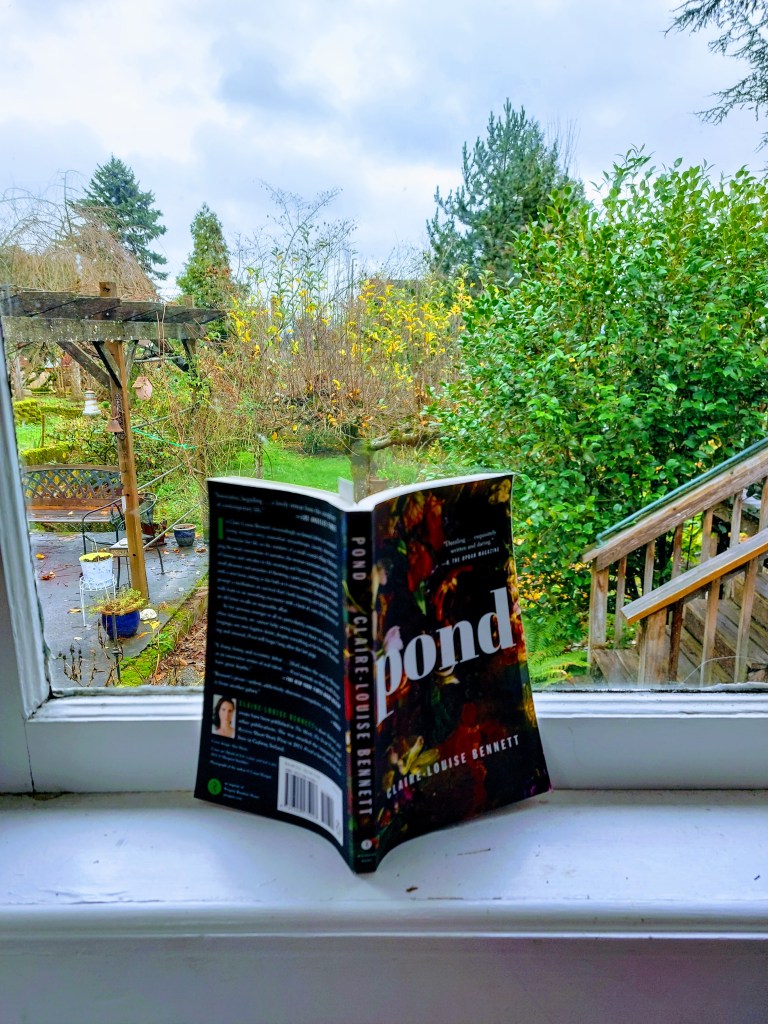
    (Pond, by Claire-Louise Bennett, Riverside Books, 2016, originally published in Ireland by Stinging Fly Press, 2015, 195 pages)

    There are thirty snippets of “Praise for Pond,” cutlets from big and small zines and papers (and authors selected or solicited for blurbs) on and offline, from reviews, presumably, four full pages of front matter, mostly adjectives and adverbs describing the author’s (Claire-Louise Bennett, Riverside Books, 2016, originally published in Ireland by Stinging Fly Press, 2015, 195 pages) “prose… mind…debut…sensibility”:

    1. sharp, funny, and eccentric;
    2. dazzling…and daring;
    3. unnerving…sensitive…porous…lucid, practical…cognizant;
    4. ardent, obsessive-compulsive, a little feral…kookily romantic;
    5. innovative, beguiling…meditative…fresh;
    6. witty;
    7. dreamlike…startling;
    8. attentive…baroque and beautiful;
    9. stunning;
    10. cool, curious…intense;
    11. elegant and intoxicating;
    12. fascinating…immersive…readable;
    13. exhilarating…comfortable…confident;
    14. deceptively simple…unsettled…formidably gifted;
    15. strange;
    16. muddiness…deliberate and crisp;
    17. sharp…discursive;
    18. weird;
    19. impressive;
    20. compelling;
    21. quirky…opinionated;
    22. inventive;
    23. believable…dazzling;
    24. captivating…wonderful;
    25. quiet and luxurious;
    26. ablaze;
    27. absorbing, compassionate;
    28. distinct;
    29. provocative;
    30. wry.

    But I will add that what Bennett requires of her reader is patience, the kind of indulgence one might assume will not make for a popular reading, yet here it is, an “eccentric debut…of real talent.”

    The common reader might already suspect we are in for deep waters in “pond” when we see the page that comes after the list of twenty titles in the table of contents, quotes from Nietzsche (The Birth of Tragedy), Natalia Ginzburg (“A Place to Live”), and Gaston Bachelard (The Poetics of Space). I can’t explain why the titles of the Nietzsche and Bachelard books are placed in italics (in the Riverside paperback copy under review – i.e. the one I read, the first American edition, and have posted a pic of above, sitting in the kitchen nook window looking out on the wet yard as I type) while the title of the Ginzburg book is placed within quote marks. But, as it happens, the book I finished just prior to opening “pond,” coincidentally, (and I don’t really know if it should be typed as “pond,” “Pond,” or “POND”; or pond, Pond, or POND) was a Natalia Ginzburg book: “Family and Borghesia” (nyrb reissue, 2021), a very different kind of book from “Pond,” though similar in its wanton flow of words and focus on detail (how’s that for blurbing?). Moreover, as I looked up “patience,” wondering if it was the right word, appropriate and all that, for where I wanted to put it, adding my own descriptive, albeit with a noun, to the thirty clips, knowing full well it will never nor would have made the cut, I came across this sample sentence to illustrate the use of “indulgence”:

    “Claire collects shoes—it is her indulgence” (Google dictionary, Oxford languages).

    I don’t collect shoes, nor, I suspect, does Claire-Louise Bennett, who apparently lives or lived during the making of POND on the Atlantic Coast of Ireland in a small stone hut of some kind, again, apparently, as I put together a few clues from the book as well as from rummaging around. I live on the Pacific Coast of the US, not within a stone’s throw of the water, anymore, but close enough to enjoy the waterlogged winters of the Pacific Northwest, about ninety miles away from the big pond as the roads go, about seventy miles for the birds, assuming they take a direct route over or through the passes of the Coast Range. The coordinates for Galway are 53.2707° N, 9.0568° W; while for Cannon Beach, Oregon are 45.8918° N, 123.9615° W. It’s currently (as I type) 44 degrees in Galway and wet at 8pm, a bit of wind maybe a bit of sun tomorrow to close a rainy week and start a new one; while at the Oregon coast it’s wet and 47 degrees finishing the morning with a high wind warning in place for this evening to close a wet week and start a new one. That’s not to say living on the Pacific coast of the US is anything like living on the Atlantic coast of Ireland. Except that, we both get our weather for the most part from our close proximity to what some call wild oceans.

    In any case, I very much enjoyed reading “pond,” and thought I might put up a post from another West Coast of rivers and streams dampness and moss and ponds and puddles galore:

    “aplenty
    in abundance
    in profusion
    in great quantity
    in large numbers
    by the dozen
    to spare
    everywhere
    all over (the place)
    a gogo
    by the truckload
    by the shedload”
    (Google dictionary)

    I think galore is the descriptive word I’ll end this review (if, indeed, it can be called that, and, if not, I don’t know what) of “Pond” with.

    Claire-Louise Bennett’s “Pond” presents writing galore.
  • Dolling Down

    Some folks like to dress
    others down for a night
    on the town to be seen
    or to mingle in the pile

    to start a scene walk
    the prowl talk the chat
    say a prayer to the folks
    at the top of the stares

    go-go with the up-flow
    the effluvium of the
    affluent dressed
    in advertisements

    ads in fashion zines
    Fellinists puttin’ on
    the style the smile
    all the while they

    used to say it was
    a young folks way
    but we can put on
    the style any while

    doll it up or doll
    it down the grin
    showing couth
    or clown frown.

  • The Meta Phone Caper

    His metaPhone (Q 1) holstered on his belt and boasted
    like a pearl-handled spatula a fine tweezer feature purest
    in the kitchen but as a mycophagist on vacation he was slow
    to get the picture: he should have left the phone at home.

    She skiffed his phone like a stone across the stream
    and it smacked the face of a rapid rose to the lip
    and flipped onto the river rocks where it slipped
    like a fish and caught between silly and sorry mess

    while the water ebbed aback and swirled about him
    he dove again and again for the mother-of-pearl
    case for his applications and poisonous twins
    and recipies his personal algorithms and desserts

    calendars his files and messages tips and notes
    settings and cameras and his unfinished Joy of
    his meals his awards medals commendations
    his secret usernames passwords fundamental

    identities his capabilities capacities radio interface
    multi-mode banking signaling his data to Universe.
    Drown rather than lose his cell. They were supposed
    to be on vacation, but he was on his cell phone

    and while he was on his call stung was she
    by the venomous double away they swam
    leaving him and his phone in the hot sand
    where he smelled the world at his feet.

    Now we must close our caper of the nose
    before the plot thickens the dickens to play
    for a meal is saga but a poem mere snack
    one is shared the other kept under the hat.


  • Blog Post

    “Did you post something to your blog today?”

    “Did you post something to your blog today?”
    “I’m thinking of going horizontal.”
    “Really, and how was your day?”
    “Not bad. I escaped Twitter in the knick of time.”
    “What does “in the knick of time” mean, exactly?”
    “Sorry; comments off.”

  • Moon of the Normal

    Along line where words follow
    one by one each distanced and obscure
    like items of trash along highway
    stuck in weeds between ditch
    and fence lift shifting cars passing
    sailing into wind of logic

    or like grocery carts out of line
    and place scattered about full
    of claptrap and flapdoodle
    unexpected foundation
    for absurding suburban
    where shopping rigs

    get garaged for night
    like pigs asleep in makeshift
    huts with conquistadors
    while in city in loose
    deduce gathered around
    poles trees once lived

    covered in plastic people
    under new moon of normal
    dining al fresco in fresh
    air of improvised jail
    things will never be same
    way things have always been.

  • Sentimental Me

    Listen, she sent me
    a note, you will hear
    on my rosy cheek
    a crescendo tear

    drop & in this tear
    will you see
    an ultramarine
    ocean sloping

    & you will sense
    nothing meant
    to be without
    you with me.

  • What We Do When We Talk About What To Do

    One gives notice. Another grins and abides. The one no longer interested in content, the other insisting on diary entries reaffirming his firm grip on reality. One is motionless, the other still moves about. One accepts but withdraws, the other complains, and even though there’s little to complain about, finds a way to complain about that too. One prays in an empty space, the other watches the news in a room full of knickknacks and memorabilia no one remembers. One drifts, the other plans outings.

    One falls silent, another gets up and talks. One is more interested in conversations without words. One deactivates, the other continues to like and comment and, in short, feels engaged.

    One stops the vertical fall and the horizontal push, and edges fall away. Another scrolls up and down and takes cuts.

    The one never did make sense, the other insists on making sense.

  • Notes on Hearing Loss

    A house down around the block is getting a new roof, hammers echoing like giant flickers. Since the big virus outbreak the neighborhood seems quieter, fewer cars speeding up the bumpless street, the park above closed to the outdoor concerts, though a few bicycle races and random music groups have come and gone. We frequently hear music though, through the trees, over the roofs, through the backyard fences, but can’t always be sure of where the sound is coming from. No fireworks this year. Not a single yard sale. But some noise seems louder, the trash trucks on their weekly binge, the mailman at the mailbox, the yapping yellow dog behind and a yard over, skateboards, our tinnitus.

    A loss of sound seems paradoxically to quicken our sense of hearing. That is dynamics, change in pressure and temperature, frequency and consistency. Some sounds we don’t hear until they go silent. Sound can baffle, bounce around dancingly. If you’re uncertain where a sound, particularly a voice, is coming from, the disorienting distraction bewilders. Just because you don’t hear a sound doesn’t mean you can’t feel it, its pressure in your ears, resounding around your head. Likewise, you might hear voices, but the words lack clarity, and you can’t make out what’s being said.

    Some sounds are tight, other loose fitting. A flash flood of sound leaves a wake of mud. The beginning of rain drips into the ears, like its relative petrichor, that newly wet earthy scent in the nose, a slow awakening to something that’s been asleep for a long time and is now looking for a new bed to spend the night, one of your ears unfolding asymmetrically.

  • All Good Music

    I was reading through the Wiki entry for Frank Zappa, can’t remember why, and came across this quote from his autobiography, “The Real Frank Zappa Book”:

    Since I didn’t have any kind of formal training, it didn’t make any difference to me if I was listening to Lightnin’ Slim, or a vocal group called the Jewels …, or Webern, or Varèse, or Stravinsky. To me it was all good music.

    — Frank Zappa, 1989[1]: 34 

    Zappa, Frank; Occhiogrosso, Peter (1989). Real Frank Zappa Book. Simon and Schuster. ISBN 978-0-671-70572-5.

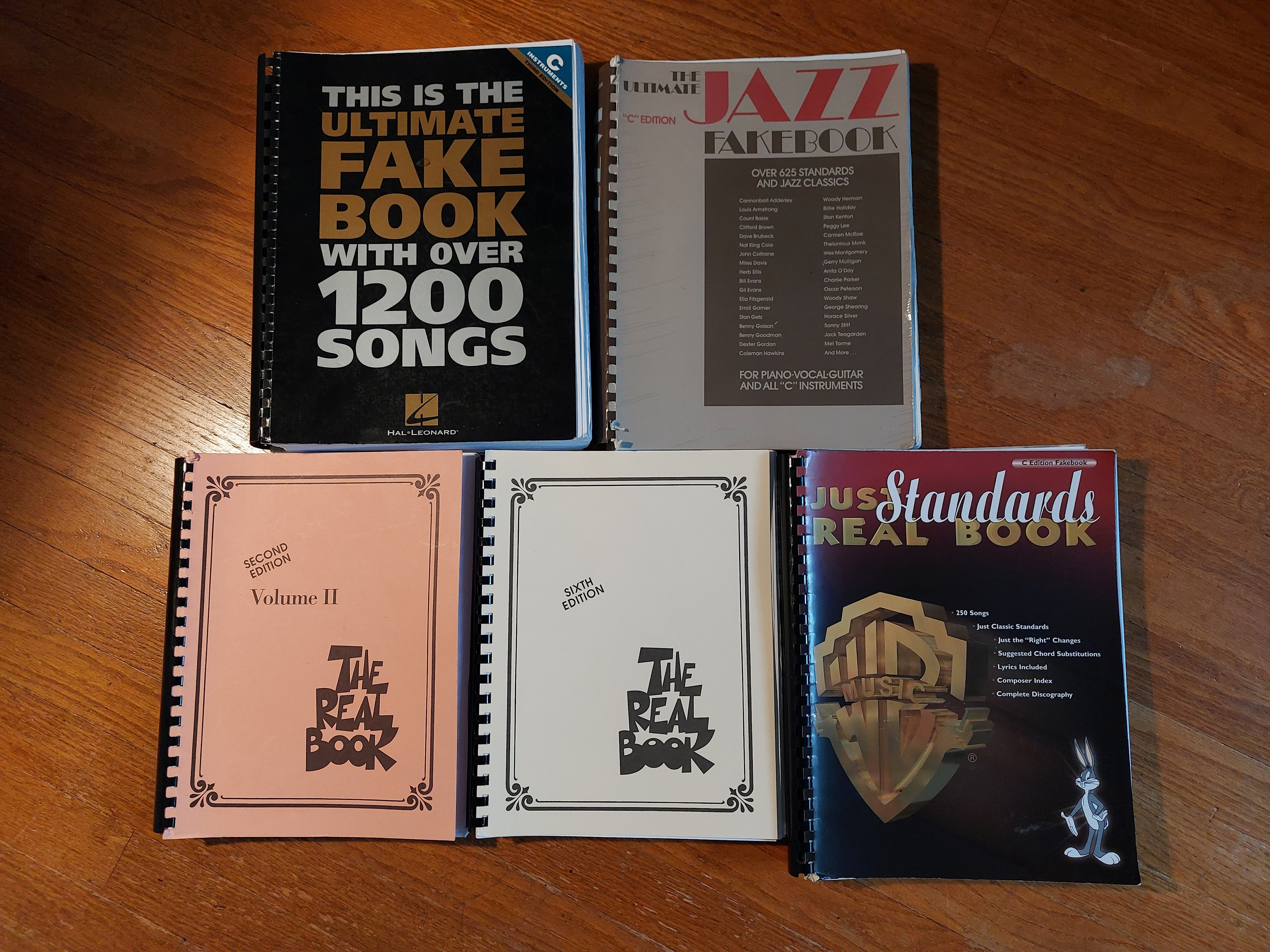
    The title of the Zappa book might contain a reference to the musical fake and real books, collections of a kind of shorthand lead sheets used by players as sketch or blueprints to cover pieces. These music books usually fit any song on one page, and show melody notes and chord symbols. The original fake/real books differed from songbooks in that they did not include lyrics and were mostly used by jazz players who only needed guidelines, not strict written scores that might have gone on for pages and still only approximated what one had heard or wanted to hear.

    The many versions of fake and real books published over the years complicates a description; suffice to say they provide a recipe for the song, but the musician still needs to do the mixing and cooking. They don’t work like player pianos. That reading above of the title is layered below the obvious one, that so much had been said and written about Frank that he decided to sort the wheat from the chaff and clarify what the real Frank Zappa was all about. I’ve not read it, but I’ve put a copy on hold.

    Meantime, what about the part of that quote that says, “all good music.” What is good? What is music?

    Fake and Real Books