• Portrait of a Lady Cat

    the see-thru wire black cat 
    leans to the blue
    porcelain pot
    falls prey to squirrels
    or a pair of bigger black
    crows her back arched
    tail curved ? happy
    tells wants to interact
    head turned to the front
    porch for her portrait pose

    to remember these
    first days of summer
    forgotten cold kittish days
    of blows weathered thru
    you as if you were made
    of wire hollow and hungry
    but today the leaves unfurl
    the sun gentle rises
    like a young man
    getting dressed for work
  • Song Stuff

    Dolly Parton has written over 3,000 songs. We used to say we “made up” a song, since we didn’t write anything down, notes or lyrics. We made up our songs guitar in hand. It would take about 150 hours to play 3,000 songs, or you could play the same song on repeat for a week, which you might if you thought you had a hit. If you draw your song subjects from the lives of your intended audience, you’ll probably gather some listeners, if not reach the top 40. Dolly, born and raised in the Great Smoky Mountains, no doubt heard as a child ballads that originated in the British Isles. These ballads came from an oral tradition, told stories, the setting often changed to fit a new environment. The accompaniment might drone wearily to an exaggerated wintery fiddle pathos. On the other hand, songs of spring might jump, jig, and reel. Ballads are folk songs, and while anything can be a song subject, songs of love and hate, war and peace, life and death, faith and betrayal – those subjects are ever popular. Songs are made using all kinds of rhetorical devices. We might think of songs as meant primarily for entertainment, but songs can teach, preach, tickle, and scratch. A good musician can make a bad song sound good, and a bad musician can make a good song sound bad. The Psalms are songs. What’s good is what’s real, even if it’s bad.

    I was perusing Greil Marcus’s updated “Mystery Train: Images of America in Rock ‘N’ Roll Music.” This sixth revised edition (2015) contains “Notes and Discographies” that run over 200 pages. But Dolly’s only mentioned twice, once in the original section, in the Elvis chapter: “Listen to Dolly Parton’s downtown hooker yearning for her Blue Ridge mountain boy; listen to the loss of an America you may never have known” (129), and again in the notes section under “Cameos: From Charlie Rich to ‘Louie Louie’” (360-363), where “A Real Live Dolly Parton” (1970) is said to include her song “‘Bloody Bones,’ a ditty about orphans who burn down their orphanage.” But while that Dolly album does contain a piece called “Bloody Bones,” it’s not a song but a story she tells, and it’s not about orphans but about her family growing up and how they all went to bed at the same time, and mostly in the same bed, there were 12 kids in a little country house, and they stayed in bed afraid of the boogie man and such tales their Mom shared. Well, Dolly’s not rock n roll, so maybe Marcus hurried through it. That’s likely going to be a problem for your discographers if you go around putting out 3,000 songs. The prolific Bob Dylan has only written about 600 songs. Anyway, Dolly did write a song about kids cooped up under some sort of evil matron, and they do burn the place down, sort of Matilda style. It’s titled “Evening Shade,” and it’s on the album “My Blue Ridge Mountain Boy” (1969).

    So I’ll take this opportunity now to lighten the load for my future discographers and say I’ve written (made up) only around 6 songs, with lyrics, that I keep in my active repertoire, another 8 or so instrumentals.

    With lyrics: “Bury My Heart in the Muddy Mississippi” (1978); “Pretty Vacant and We Don’t Care” (1985); “Goodbye, Joe” (1995); “Two Riders Were Approaching” (2021); “Down by the Bay” (2022); “I Talk to Myself” (2023). Dates I’m just guessing, plus revisions are always ongoing. There is no right or wrong but how you feel at the moment. When you get stuck, improvise your way out of it.

    Instrumentals: no dates shown – been playing and improvising most of these for years, but I’ll list them in approximate order, beginning with the oldest, from around 1970, which contains a riff an Army sergeant showed me. I just title them to remind myself of the idea and where it came from: “Sergeant Oliphant’s Blues;” “Saddle Up and Go;” “Double D;” “Em Surf;” “Good to Go;” “Patio #1;” “Patio #2;” “Blues for Tommy.”

    You can hear versions of my made up songs on my Live at 5 Instagram channel. Live at 5 was a Pandemic exercise that brought the extended family and friends together almost nightly for songs and comments and sharing while we were all hiding out from the virus.

    https://instagram.com/joe.linker?igshid=ZDc4ODBmNjlmNQ==

  • Notes on Kingsley Amis and “Lucky Jim”

    War leaves everyone destitute, champs as well as losers. At least that seems the case in some quarters in England following its WWII victory. But out of the drained sensibilities comes Lucky Jim, whose primary motive is to avoid being chumped. His new arms are not mod Joyce’s “silence, exile and cunning,” but scoff, erosion, and contumely. He finds himself immersed in a milieu devoid of usefulness, stupefied:

    It wasn’t the double-exposure effect of the last half-minute’s talk that had dumfounded him, for such incidents formed the staple material of Welch [Jim’s mentor] colloquies; it was the prospect of reciting the title of the article he’d written. It was the perfect title, in that it crystallized the article’s niggling mindlessness, its funereal parade of yawn-enforcing facts, the pseudo-light it threw upon non-problems. Dixon had read, or begun to read, dozens like it, but his own seemed worse than most in its air of being convinced of its own usefulness and significance. ‘In considering this strangely neglected topic,’ it began. This what neglected topic? This strangely what topic? This strangely neglected what? His thinking all this without having defiled and set fire to the typescript only made him appear to himself as more of a hypocrite and fool. ‘Let’s see,’ he echoed Welch in a pretended effort of memory: ‘oh yes; The Economic Influence of the Developments in Shipbuilding Techniques, 1450 to 1485. After all, that’s what it’s…’

    Page 9 of “Lucky Jim,” by Kingsley Amis, first published in 1954; New York Review Books Classics 2012 with an Introduction by Keith Gessen.

    Jim’s problem (to date still unresolved for so many in galleries of classrooms) is simply what to do, and while Beckett is now back in Paris resolving “Nothing to be done,” Jim Dixon is back in England, having made his way through a back door into contemporary academia, which doesn’t necessarily equate to a decent job:

    ‘Well, you know, Jim. You can see the Authorities’ point in a way. “We pay for John Smith to enter College here and now you tell us, after seven years, that he’ll never get a degree. You’re wasting our money.” If we institute an entrance exam to keep out the ones who can’t read or write, the entry goes down by half, and half of us lose our jobs. And then the other demand: “We want two hundred teachers this year and we mean to have them.” All right, we’ll lower the pass mark to twenty per cent and give you the quantity you want, but for God’s sake don’t start complaining in two years’ time that your schools are full of teachers who couldn’t pass the General Certificate themselves, let alone teach anyone else to pass it. It’s a wonderful position, isn’t it?’

    177

    Some guys will do anything to avoid working on commission:

    Dixon agreed rather than disagreed with Beesley, but he didn’t feel interested enough to say so. It was one of those days when he felt quite convinced of his impending expulsion from academic life. What would he do afterwards? Teach in a school? Oh dear no. Go to London and get a job in an office. What job? Whose office? Shut up.

    177-178

    But why would office life, in sickness or in health, not be preferable to the games teachers play, particularly the major league players:

    Amis and Larkin graduated into a literary world still dominated by the modernism of Eliot and Pound, and haunted by the shadow of William Butler Yeats. Though Larkin went through a long apprenticeship to Yeat’s poetry, both men eventually came to think that the modernists had made English-language poetry vague, pretentious, and verbose…Chelsea represented the artsy crowd, the modernist crowd, the posh crowd that had taken English literature too far into the realm of abstraction, had turned it into an elite pursuit. Not that the rest of contemporary literature was any better.

    Page x-xi of Keith Gessen’s Introduction.

    While much of today’s poetry remains “vague, pretentious, and verbose,” some reaches further into the pit of the common reader’s hand reaching out for not meaning but significance lately lost thanks largely to poetry being conquered in academia by the philistinism of the sociologists and psychologists, not to mention the political polemicists. Yet, as Keith Gessen points out in his “Lucky Jim” NYRB Introduction: “But of course then as now the world was filled with young college graduates convinced of the sheer absolute idiocy of everyone, living or dead” (xiii). But how accurate is that statement? Not to say that everything is not idiotic, but that everyone thinks that everything is idiotic. And anyway, anyone can feel that way. It doesn’t take a college degree. And it might be true for high-schoolers these days, or high school dropouts, or college graduates in search of a job in their area of obsolete, irrelevant, or antiquated study, or retirees from any number of careers or pseudo careers. If everything is idiocy, one can at least prefer one’s own.

    The problem is not only what to do but how to do it and how to think about what to do and how to think about doing it and to feel about all of it and how to remain free in spite of all of it, if one can even keep track of what is meant by it. And all without undo influence from the idiots one once might have admired but have now come to scorn but not enough to ignore. Gessen puts hate as the great motivator for both Amis and his pal Larkin. But hate is far too strong a word to describe what they were all about, or what Jim is about. To be unable to achieve satisfaction is not to hate the losing streak, the white shirts, the wrong cigarettes, the useless information, the starved imagination. One might though hate that one still feels one wants to be a part of it, even if that part entails making fun of it. If you live a life of pure loathing, what’s left you in the end to loathe but yourself?

    And “Lucky Jim” is a comic novel, not one of fear and loathing, and with literary precursors. If Jim (or Amis) makes fun of “The Canterbury Tales,” it’s in their being removed from life and buried in a classroom. Given his tastes and dislike of the phony and the mannered, it’s understood he values Chaucer’s use of flatulence to create lasting, well digested literature. He doesn’t hide the compost. He loves it. And he’s not angry about it. And if Jim “hates” Welch’s son, Bertrand, his evil nemesis, it’s for good reason. Bertrand makes an excellent foil character. One feels an author’s love for his Iago, Lady Macbeth, Polonius. In any case, Henry Miller had already written his Tropics, and they’re not about graduate school. Ginsberg is working on Howl, but neither are the Beats angry young men. They are bent on living. They will eschew an air-conditioned nightmare, thank you.

    And an elderly Jim would no doubt prefer self-loathing to schadenfreude. Smug and complacent, he is not. And he’s not falsely self-deprecating. He doesn’t insult himself as bait for what he might fear an otherwise hostile audience. He’s not self-satisfied. He recognizes his faults but doesn’t take credit for them.

    An interesting companion reading to “Lucky Jim” might be Barbara Pym’s “Excellent Women,” published two years earlier, or her “Jane and Prudence,” a year earlier, or “Less than Angels,” a year later. It hardly seems the same world, but it is. One might find Pym’s heroines rescued from the arms of a horned and horny but hardly hating Kingsley Amis.

  • The Day After

    The day after 
    the hottest day ever
    snowfall covered
    sunburned green fields.

    Subterranean streams
    flooded root cellars
    and mothers combed
    sediment from wet hair.

    Ocean waves reached
    the heartland
    where the fathers
    buried their weapons.

    Honeysuckle blossomed
    on trellises rising
    out of snowdrifts
    and by evening

    of the second day
    of the Age of Weather
    digesting ducks turned
    around and drove home.
  • The Hottest Day Ever

    and the balloon man 
    sd let there be light
    but he forgot
    to include the night

    sun filled every
    puddle with sand
    that day the moon
    failed to follow

    the air smelled
    of rum molasses
    and beach tar stuck
    to the swing seats

    nowhere to hide not
    an ice cream truck
    in sight or sound
    no marbles or skips

    pirates stole
    even the gloom
    all the motel
    rooms full

    the only noise
    the gasps
    from the leaky
    balloons

  • If a Leaf Trembles

    If a leaf trembles 
    birds like angels dart.

    Sitting out with guitar
    on couch in impromptu
    outdoor green parlor
    under the Japanese maple.

    The air marine mid eve
    drizzle drops like notes
    in a slow waltz fall
    through the leaves
    into my dry curly hair
    small droplets subtle
    piecemeal for the birds
    talking, "Wouldn't a Joe
    pilus be nice for our nest."

    Later a dark sleep rain
    summer wide opened
    window wet percussion on
    the roof leaves and walk
    a tale of early summer
    warm wet mysterious night.

    And in the morning door
    opened with coffee
    in hand awe greeted
    by a sparrow building
    nest in welcome wreath.
  • Outside Willow Bell Pub

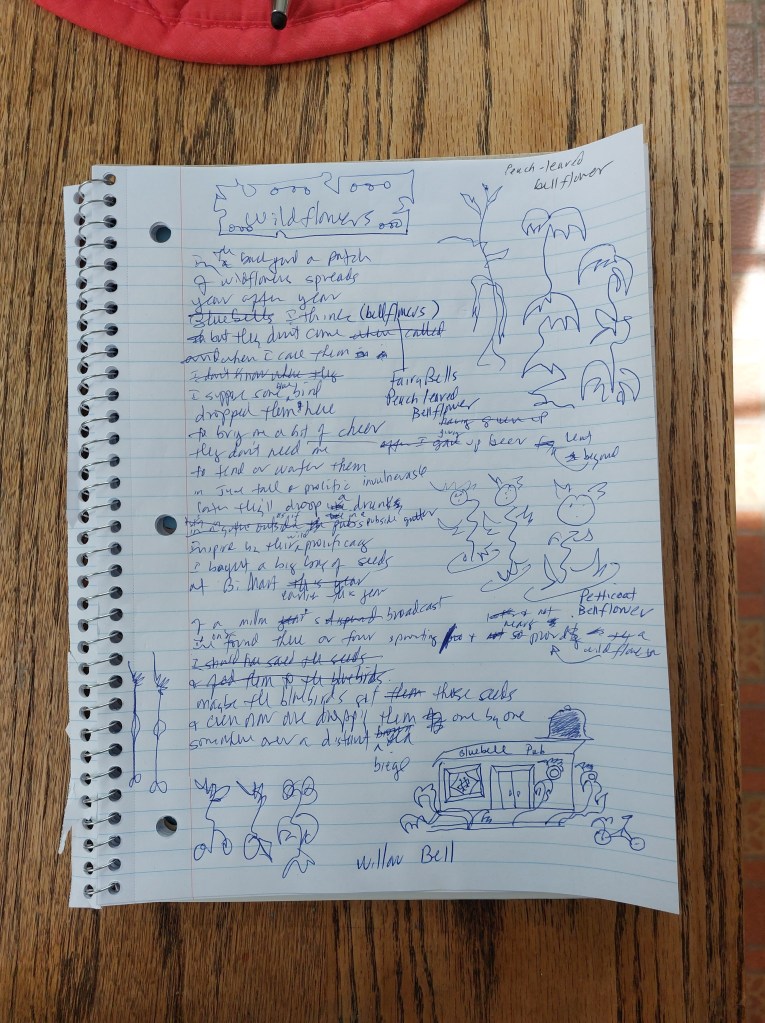
    In the far backyard
    a patch of wildflowers
    spreads perennially –
    Bellflowers, I think,
    Peach-Leaved Fairy Bells
    (I looked them up),
    but they don’t come
    when I call them in.

    I suppose some scrub-jay
    dropped them here
    to bring me a bit of cheer
    giving up beer beyond Lent.

    The flowers don’t need me
    to tend or water them,
    in June, tall and prolific,
    invulnerable. Late Fall,
    they’ll droop adrunk,
    in the pubside gutter.

    Wilderness inspired,
    I buy a big bag of seeds
    at Bi-Mart in early Spring,
    but of a google broadcast,
    only a few sprouted,
    and not as proudly
    as the Petticoat Bellflowers.

    Maybe the bluebirds
    picked up those seeds,
    and even now drop them,
    one by one, somewhere
    over a distant biege sea.

  • Tales of Summer

    Summer creeps up 
    on us a dusty
    horny toad
    nowhere to go.

    The squirrel
    of spring pool
    ball path
    soon still.

    The mellow hibiscus
    the rose of Susan
    afternoon cold tea
    winter up in the air.

    A California scrub
    jay scolds a crow
    as I put marigolds
    out on the porch.

    Kevin tinker off
    and me hitchhiking
    Vista del Mar home
    from Junior Lifeguards.

    At Refugio Beach
    Bruce catching
    lizards in the rocks
    along the creek bed.

    Seems odd to fall
    asleep still light
    out and wake up
    still in light.

    Soon too hot
    to hold this
    device for words
    of summer morns.
  • Notes on Sebastian Barry’s “A Long Long Way”

    It was sometime over the recent long Memorial Day weekend I received a worn copy of Sebastian Barry’s “A Long Long Way” (2005), a gift from my old friend Dan, first person blogger at Tangential Meanderings at WordPress. I had mentioned Barry to Dan after reading a New Yorker piece about the Irish author’s writing (March 20, 2023). I had never read Barry.

    I dug into “A Long Long Way” as into a trench somewhere along the Western Front. Barry in his technique seems to take the encyclopedia entries that summarize events and rewrites them using imagined characters, though apparently the Dunnes were part of his own family. My interest in WWI grew, and I read that a few years ago a trove of diaries written by soldiers during the war was digitized:

    Many older people in Britain knew veterans of World War I. But the diaries provide a different level of detail, says Michael Brookbank, 84. On a recent day, he was drinking a coffee in the archives cafeteria. He had come to learn more about his father.

    “My father very rarely talked about the war, and I think that is common with most of the veterans of the war,” says Brookbank. “The experiences that they went through and the conditions that they lived in were just something that, unless you were actually there, nobody could really comprehend.”

    “From The Trenches To The Web: British WWI Diaries Digitized.” Heard on Morning Edition, 23 Jan, 2014. Ari Shapiro. Read here.

    That idea of what it might take to comprehend, and of what point there might be to talk about it, about anything, one might add, incomprehensible to another, plagues many veterans. And in the Army, one does not step out of place, let alone speak out of place. Who does tell the stories then? And who will listen with comprehension?

    The reader has no privileges. He must, it seems, take his place in the ranks, and stand in the mud, wade in the river, fight, yell, swear, and sweat with the men. He has some sort of feeling, when it is all over, that he has been doing just these things. This sort of writing needs no praise. It will make its way to the hearts of men without praise.

    New York Times book review of “The Red Badge of Courage,” 31 October, 1896.

    Crane, like Barry must have, had read accounts of those who had experienced the war in some way (Crane had not), and used them to create a truthful but fictional (a psychological rendering) account. The danger here, for most writers, is the chance the result will sound like a second hand telling. Also that it might affront those who actually did the fighting, or who in some way, psychologically, if not physically, experienced the war. But that begs the question: does a distant war not create an experience for the moms and dads, the girlfriends, the boyfriends, the folks back home, reading the headlines, the news, the letters from the front? And does not that experience test the dichotomy of mind and body – the psychological is physical.

    In his blog “Time Now: The Wars in Iraq and Afghanistan in Art, Film, and Literature,” Peter Molin, himself a veteran and writer, furthers the discussion of who can write what with what authority:

    The question of whether a writer who hasn’t been to war can write well about war also intrigues me. Gallagher cites Ben Fountain as the example par excellence of an author who never served in the military, let alone saw combat, but who can still convey what it is like to be a soldier. I love Billy Lynn’s Long Halftime Walk, too, but have noted that Fountain evades extended description of battle. Is that a place he just didn’t feel comfortable going? Brian Van Reet, a decorated vet, portrays two horribly mangled veterans in comic-grotesque terms in “Big Two-Hearted Hunting Creek.” Would a civilian feel as comfortable doing so? Is there something wrong with someone who isn’t disabled portraying characters who are? Both these cases reflect the issues of credibility and authority that permeate discussions of war writing.

    “Veterans Writing,” Peter Molin, 29 September 3013.

    Sebastian Barry, in “A Long Long Way,” gives all his characters the credibility of war experience, even those who have no comprehension of what they’re going through, of the dehumanizing effects war tattoos on one’s memory, and a tattoo becomes a story:

    ‘And what happened to her, Pete?
    ‘Who?’
    ‘That Belgian woman, Pete, that you – just like the sainted Germans did, just like all those stories we were told, Pete, what they did to the women.’
    ‘Don’t be so holier than thou, Willie. You’d’ve done the same.’
    ‘What happened to her, what happened to her?’
    O’Hara said nothing for a moment.
    ‘All right, all right.’ But he didn’t seem able to say it for another few moments yet. Then he nodded his punched face. ‘She died of what had happened to her. She was bleeding all those hours. She was not treated right. She was fucking torn to pieces, wasn’t she? And she died. And we tried to save her.”
    ‘You think so?’
    ‘It’s just a story, Willie, a story of the war.’
    ‘You can keep your story, Pete. You can keep it.’

    168

    Willie’s girlfriend’s (Gretta) father shares a test he uses to qualify one’s experience. It has to do with knowing one’s own mind. Gretta repeats it:

    ‘We have to wait, Willie.’
    ‘For what’ he said, a touch desperately.
    ‘For the war to be over and you to be home and you to know your own mind. There’s never any sense in a soldier’s wedding, Willie.’

    77

    If Barry’s characters and scenes seem stereotyped it’s because we’ve seen them so often. There’s not much of a plot. Boy goes to war, not really understanding why, maybe comes back, maybe not, still not understanding why. All the arguments are pandered down the ranks, where, in the end, they don’t hold water. The grunts do the work, the dirty work, for which they receive insult and despair. Barry’s approach gives the reader a kind of historical fiction without the overt history, such that the Easter Rising happens real time, with Willie and his cohort working laboriously trying to figure out what’s going on and why and how they should feel about it, what side they should side on, a process of getting to know one’s mind.

    Who is the narrator? Not exactly Willie, neither can it be Barry. Some figure hovering over the gas clouds, looking through, picking out a figure here or there to zone in on. There are many to choose from. But the main characters are Willie, his sergeant-major Christy Moran, Willie’s father, Willie’s girlfriend, Gretta, Willie’s sisters, a few of Willie’s platoon members, Father Buckley, a Catholic priest who makes the rounds through the trenches trying to clean the spiritual and mental messes (which he does a fair enough job of). And Pete O’Hara whose single act of betrayal does more damage to Willie than anything the other side may have thrown at him.

    The theme is irony, though it might seem somewhat backwards – the characters seeming to know something the reader does not, in spite of the reader’s armchair advantages. The book is composed of set pieces (gas attack, up and over charge, furlough – and the results thereof, field boxing match) and the action is described in realistic detail, too much detail some readers may feel. There’s humor, the excellent cussing of the sergeant-major, sarcasm and wit. On the whole, maybe it’s all a bit romantic, though, so full of purple vestment, not maudlin, but still sentimental, like the customs of Memorial Day, even if that day has yet to come anywhere in the novel. The dialog is brisk and easy and rings true. The point of the novel, if the reader must have one, is probably the Irish need and desire to have and know its own mind, which might also explain the need for every narrative trick, the deceit and betrayal writ large and small, the pawn-like movements that when stacked one upon the other make up the family histories that add up to a country’s history.

    The title comes of course from the song, used to march by:

    Up to mighty London
    Came an Irishman one day.
    As the streets are paved with gold
    Sure, everyone was gay,
    Singing songs of Piccadilly,
    Strand and Leicester Square,
    Till Paddy got excited,
    Then he shouted to them there:

    It’s a long way to Tipperary,
    It’s a long way to go.
    It’s a long way to Tipperary,
    To the sweetest girl I know!
    Goodbye, Piccadilly,
    Farewell, Leicester Square!
    It’s a long long way to Tipperary,
    But my heart’s right there.

    Paddy wrote a letter
    To his Irish Molly-O,
    Saying, “Should you not receive it,
    Write and let me know!”
    “If I make mistakes in spelling,
    Molly, dear,” said he,
    “Remember, it’s the pen that’s bad,
    Don’t lay the blame on me!”

    Molly wrote a neat reply
    To Irish Paddy-O,
    Saying “Mike Maloney
    Wants to marry me, and so
    Leave the Strand and Piccadilly
    Or you’ll be to blame,
    For love has fairly drove me silly:
    Hoping you’re the same!”

    Jack Judge, 1912.

  • A Light Touch

    Light illuminates nouns 
    brings persons places
    and things into the field -
    light is a verb that creates.

    Too little light we see
    ghosts waddling to and fro -
    whole life on the sun
    is a bath in orange juice.

    Light her touch when she
    lits down and makes light
    work of your worries and woe -
    light she comes light she goes.
  • Wheels within Wheels

    Thomas Merton, in his preface to his collection of essays titled “Mystics and Zen Masters” (1961-1967, The Abbey of Gethsemani, 1967 FS&G), suggests a closeness in claims of those across cultures attempting contemplative lives:

    The great contemplative traditions of East and West, while differing sometimes quite radically in their formulation of their aims and in their understanding of their methods, agree in thinking that by spiritual disciplines a man can radically change his life and attain a deeper meaning, a more perfect integration, a more complete fulfillment, a more total liberty of spirit than are possible in the routines of a purely active existence centered on money-making. There is more to human life than just ‘getting somewhere” in war, politics, business – or “The Church” (viii).

    Entering the Church, apparently, does not guarantee a contemplative future. And when Merton asks, “What, exactly, is Zen?” (12), he already knows there can be no satisfactory answer. Writing in the 1960s, Merton was in tune with his Catholic audience under the influence of John XXIII’s Second Vatican Council, which called for an aggiornamento, a modernization, bringing the church up to date.

    Merton even suggests Zen, having lost, like Christianity, its Medieval “living power” (254), is in need of an updating. Today, we might ask, What, exactly, is Christianity?

    In Christianity the revelation of a salvific will and grace is simple and clear. The insight implicit in faith, while being deepened and expanded by the mysticism of the Fathers and of a St. John of the Cross, remains obscure and difficult of access. It is, in fact, ignored by most Christians (254).