Category: Writing

  • Yes and No

    Two ChairsYes yes yo yes yah yes yep yoahza youp

    Yo yo yes no nope never over my

    Yes no yes no yes no yes no yes noup

    Not nape nip empty nix obnoxiously

    You not yes no not no yes but don’t say

    Buttresses yeses yeses yeses but

    No nepe no nupe no nipe no no no yea

    Yes yepe yes yupe yes yipe yes yes yes what

    Butting do note chairs yes accidental

    Dominoes goldeneyes moonglow eyes no

    This will never do we are losing ball

    Ants ants ants ants ants ants ants ants solo

    So long stays yes and yes gives no to this

    So long goes no and no takes yes amiss

  • Word Pics

    MapleTurtle butterfly rock
    Petunia seashell ceramic
    pot candle wire stand
    Gas meter downspout blue
    slate red bricks green
    hose
    Blue wall with painted white
    wood door with window
    of six small glass panes
    framed
    Electric meter "Nutone"
    metal stove exhaust fan
    duct
    double spotlight wall
    fixture no bulbs wires
    grub green fern
    blue green blue fescue
    grass.
    
    ShellsChain link cedar planks
    Redwood boards bamboo
    Flower trash cans green
    yellow and grey
    Sheets glossy green laurel
    hedge golden chain bench
    Grapevine clothesline
    Wire pool cues hall chalk
    Ivy baseball bats raspberry
    Green wine bottles
    in yellow bin.
    
    Azalea if you've read
    this far.
    Canvas sails to you gentle
    reader and happy
    Fish nets.
    And may your day be free
    of commas and other fences.
  • Online # 2: Laptop Notes From Underground

    Notes from an Underground LaptopImagine Dostoyevsky’s Underground Man with a laptop…

    “‘Why you’re . . . just like a book,’ she said, and I thought I caught a sarcastic note in her voice again.” Dostoyevsky’s Underground Man is with Liza, a prostitute, but what he wants is to talk to her. He finds her ellipsis revealing. She pauses, and she’s caught the mouse in a trap, even if she didn’t mean to. He mistakes her uncertainty for sarcasm: “I didn’t understand that sarcasm is a screen – the last refuge of shy, pure persons against those who rudely and insistently try to break into their hearts” (174), he says. Four pages of rant follow, and he makes her cry. But she’s his perfect audience. Had he a laptop, he would have pulled something up to show her. But was she being sarcastic, or was she reading him literally? What she says is accurate; he is just like a book.

    “It goes without saying that both these Notes and their author are fictitious,” Dostoyevsky says in a footnote to the first page of “Notes from Underground,” which begins with “Part One, The Mousehole” (90). If it goes without saying, why does he say it? Another paradox. The typographical man develops a voice, even if he has nothing to say. Online, we feel a part of something, but of what? It’s enough to feel connected. In any case, these men do exist, in spite of this one being fiction, Dostoyevsky wants to make clear, and he wants to mark the difference between narrator and author. But in trying to distance himself from his narrator, Dostoyevsky adds another note to the pile.

    I’m online again, going with the flow, superslow though, gliding, electri-gliding in the cerulean world of blues. “I’m so lonesome I could cry,” Hank Williams sang. But does he cry? He doesn’t tell us that he cries, just that he feels like crying. If only Hank had a laptop. How high the moon? He could look it up.

    “Suffering is the sole origin of consciousness” (118)*, the Underground Man says. Later, Jung takes up this theme, that consciousness is born in regret, in memory. But how does man express his regret, which is his suffering? “The fall is into language,” Norman O. Brown said (257). What do we think about if we can’t remember anything? After reason, the Underground Man explains, “All that’ll be left for us will be to block off our five senses and plunge into contemplation” (118).

    We were talking about the possibility that online culture diminishes memory because the “onliner” (i.e. someone online, not necessarily a reader, since one can go online without reading – but what is reading?) is constantly looking things up, one thing leading to the next, seemingly random. Nothing is memorized; the bookmarks are endless. If the fall is into language, browsing is free falling. But why all the notetaking in book culture? Can’t the readers remember anything? Non-literate people, McLuhan explains in “The Gutenberg Galaxy,” have much better memories than those born to books. Is there suffering being online? “The most obvious character of print is repetition, just as the obvious effect of repetition is hypnosis or obsession,” McLuhan says (47).

    “I was so used to imagining everything happening the way it does in books and visualizing things falling somehow into the shape of my old daydreams that at first I didn’t understand what was going on. What actually happened was that Liza, whom I had humiliated and crushed, understood much more than I had thought. Out of all I had said, she had understood what a sincerely loving woman would understand first – that I myself was unhappy” (197). The Underground Man is stuck in a literate view. McLuhan: “The new collective unconscious Pope saw as the accumulating backwash of private self-expression” (308). The Underground Man’s literacy has turned him into an individual, and he’s nowhere to go. This is another reason he appears when he does; his point of view is his own beacon.

    The sufferer comments. This is why the Underground Man “has appeared, and could not help but appear” (90), to explain why he has appeared. The browser joins the Internet commute, changing lanes compulsively but leisurely. Summer is near, and in the distance one can hear the Internet Highway and superfast modems melting across asphalt desks backlit with electric candles. A commenter interrupts the flow, but for the Underground Man with a laptop, comments are closed. Go start your own blog. I’m in the slow lane here. Go around me, he signals out his laptop window. Go around.

    “I knew that what I was saying was contrived, even ‘literary’ stuff, but then, that was the only way I knew how to speak – ‘like a book,’ as she had put it” (179). The Underground Man is literate; Liza is not. But Liza intuits what the Underground Man must read. McLuhan explains the difference: “The visual makes for the explicit, the uniform, and the sequential in painting, in poetry, in logic, history. The non-literate modes are implicit, simultaneous, and discontinuous, whether in the primitive past or the electronic present, which Joyce called ‘eins within a space’” (GG 73).

    “Enough,” the Underground Man says, but the closing footnote says there are more notes. “But we are of the opinion that one might just as well stop here” (203), Dostoyevsky says.

    * My text (Signet Classic CT300, 1961, Seventh Printing, translation by Andrew R. MacAndrew), reads, “Why, suffering is the only cause of consciousness.” But I exchanged just this line for the Constance Garnett version of the line, which I prefer for its sole (solo) and soul homonymy (not to mention the suggestion of the sole of a shoe).

  • Online # 1

    Lots Of Fun For EveryoneI’m online, browsing. I’m cruising for a new pair of slippers. I’m sitting on the love seat, in the living room, slouched down, my feet docked on the ottoman. My location is public, living room, slipping down, gliding for a new pair of slippers, my purpose public.

    I enter “cruising slippers” into my search engine. I feel good. I’m plugged in, lit up. I’m online. My socials are open. The drones are swarming. I’m not alone. I twitter something fast: “Online slippers, what? Come on back!” Immediately, there’s a response.

    I’m in a mood, an online mood. Mood indigo. What’s that? I enter “mood indigo” into my search engine. Oh, yeah, the Duke. I jump over to JazzStandards.com and click on the song, give it a whirl. Oh, yeah, the melody comes back to me, haunting. The piano notes sound like ice cubes clicking coolly in a cocktail glass.

    “The Duke of Earl.” Who was the Duck of Earl, anyway? I enter “The Duck of Earl” in my search engine. It ignores the typo, corrects my search, thank you. I click on Urban Dictionary and start to scroll down. Some nice peer reviews going here, mostly thumbs up, a few down. Then an ad pops up: “Have you ever been arrested?”

    I don’t like ads. I try to ignore the ad, but I can’t. I feel arrested. My mood shifts. I’m like a boat on the open sea, at the mercy of variable breezes. I open my facebook, enter “variable breezes” in my status and click. I get a few likes. Someone in Dansk says, “Breezing?”

    Yes, that’s it, I’m breezing. I shift back to Twitter and enter “Breezing,” just the word, not even a period. No response. I’m not surprised. I don’t have that many followers on Twitter, but what’s a lot? I change lanes, back to Facebook, and enter “Breezing.” I have 500 friends. What time is it in Dansk, I wonder.

    There’s a new tweet, from some cat in Belgium. I enter “slippers” into Google Translate: “pantoufles,” if I want a pair of French slippers, which I don’t, necessarily. I switch Translate into Dutch: “slippers.” Slippers in Dutch is slippers, same as English. Who knew? I enter “Slippers in Dutch is slippers in English, too” into Facebook. I get a bunch of likes and a few comments like it’s a joke or something, but I’m serious. I get a bizarre comment from some kid I went to high school with I haven’t seen or talked to in years. She claims she’s a lawyer of some kind. Probably under some kind of house arrest.

    I open my search engine and type in “ottoman” and poof comes the story via Wiki: “Thomas Jefferson’s memorandum books from 1789.” Now there’s a trip, speaking of high school. I parachute out of Wiki and land back in my living room. I’m thirsty. I’m thinking of walking down to the coffee house. They have Wi-Fi there. What’s Wi-Fi? I don’t understand beyond having a general idea. I enter “Wi-Fi” into my search engine. What if we could see radio waves? I Tweet, “waves, pulsing.” I was going to tweet “radio waves,” but I didn’t. We can’t see these waves, at least I can’t, but I think I can feel them. Sometimes songs just pop into my head. That ever happen to you? Suddenly I’m singing some song in my head, not singing it, really, but it’s there, playing, playing in my mind, like my head is a transistor radio picking up the wave of the song. But if I try to sing the song, out loud, the words won’t come. A few might, but not the whole song, not unless it’s a song I’ve gone to the trouble to memorize, to commit to memory. This paragraph is too long for its purpose.

    Location, living room. Purpose, slipping through time online for a new pair of slippers. Open: socials, check; three search engines, check; Wiki, check; my word processor, check. All systems go. Where does that term come from? I enter “word processor” into my search engine. What ever happened to WordPerfect? Do we process words? Do we perfect words? Mot juste. The word frozen. Justice.

    I enter “All systems go” into my search engine. The dictionary calls the phrase cliché. Really? I don’t hear anyone using it much anymore. I enter “All systems go” into both Facebook and Twitter. Nothing, no response. Interesting. Maybe I should have typed, “All systems are go.”

    I saw “Argo” not too long ago, on the Big Screen. What a trip. I had not been to see a film in some time, not in a big screen theatre. I had forgotten how big the screens could seem. We sat in the first row of the second section, not too close, in the front middle, so to speak. I like the front row. I like to slouch down and stretch out my legs. A message filled the big screen just before the lights dimmed: “Please put out your cell phone.” No, not right, “turn off,” it said. I did. I turned off my cell phone. I had thought I might maybe send out a few tweets during the film, but I thought better of it.

    So to speak, thought better of it, all systems go. I should look these up. I’m bored with all that. I check out the news. First, the weather: slight chance showers. Slight, what is slight? Parse. Can you parse the showers, please? I tweet, “Parsing showers.” No one’s on Facebook. 500 friends and no one’s on. That’s a first. I check the news.

    The news. I type “the news” into my search engine. I’m reminded of the scene in the Steve Martin film “Roxanne.” Charlie is strolling down the street and stops at a newsstand to buy a newspaper. He pulls one out and glances at the front page. A look of shock and horror pops up on his face. He scrambles back to the newsstand and fumbles in his pocket for another coin. He opens the newsstand and sticks the newspaper back into it and continues his stroll, his calm smile back on under his big nose.

    1987, the year “Roxanne” was released. I just looked it up. But the thing is there are no newsstands anymore, no phone booths either, and mailboxes appear to be disappearing.

    +++

    Notes: This post is part fiction, part real. It was inspired by a conversation I really had last Friday afternoon over at Stark Street Station with some colleagues. I do have a Twitter account, but I’m not on Facebook. I didn’t think of tweeting during the movie. That’s not something I would do. In any case, my cell phone can’t do that, tweet. And I’m not really in the market for a new pair of slippers. I don’t even have an old pair of slippers. I don’t wear slippers. Meemin retweeted “Parsing showers,” over an hour ago. A good post takes time.

  • Fear of Writing: “After Midnight,” by Irmgard Keun

    “A writer in the act of writing must fear neither his own words nor anything else in the world,” Heini tells Algin in Irmgard Keun’s “After Midnight.” Algin is considering writing a historical novel that will satisfy the stiff submission requirements of the Reich Chamber of Literature. The historical novel might be relatively safe because the players have passed. They’re not around to censure, and their story has likely already been told, documented, accredited. But one doesn’t always know what might get “a writer in the act of writing” in trouble. And a mistake is not an act of courage but of naiveté, inexperience, or foolishness. Writers may work with all three simultaneously, whistling while they work, no fear.

    But “a writer who is afraid is no true writer,” Heini insists. But a writer unafraid might simply be risking nothing, have nothing on the line, no skin in the game, nothing to lose. Being fearless is not necessarily the same emotion as having courage. And Heini’s not talking about craft, because “perfection renders words unnecessary,” he says. Indeed, what the writer should fear is perfection, because “once criticism’s no longer possible, you have to keep quiet,” Heini explains (98). Perfection is only achieved through the destruction of all opposing values. But at that point, there’s no more discussion.

    I don’t know if Keun was afraid or not while writing “After Midnight.” But she was certainly courageous. “After Midnight” has an interesting publication history. Irmgard Keun lived from 1905 to 1982, achieving early success as a writer in Germany only to see her books quickly burned. “After Midnight,” Keun’s fourth novel, was first published in 1937 by a publisher in the Netherlands. It was republished in German in 1980, and in English with a translation by Anthea Bell in 1985. I recently bought the Neversink Library edition issued by Melville House Publishing in 2011. It’s a short book, 169 pages including an afterword by Geoff Wilkes that provides both a brief but detailed biography of Keun and a short critical analysis that draws on research using letters and reviews from the periods discussed.

    “After Midnight” is not a historical novel, and illustrates some of the strengths of fiction over documentary, of literature over reporting. Its tone is primarily satiric, but the narrative is realistic, looking at its own time, with some, but not much, looking backward, unable, of course, to see clearly into the future. If the writer knew no fear, the young narrator knows it: “My heart always stands still when I hear those speeches, because how do I know I’m not one of the sort who are going to be smashed? And the worst is that I just don’t understand what’s really going on. I’m only gradually getting the hang of the things you must be careful not to do” (63). This is the plight of the writer. The situation is urgent, a constant state of emergency on the dire road to perfection, a place not there.

  • Spring Waltz

    IMG_1128The local nurseries and flower markets are loaded with starts, but I can feel the pink of the hard orange rose hips still sleeping, snoring in thorns, and hear the tiny golden broach just touching the iridescent crimson of the humming-bird’s throat.

    Spring came yellowing in a green coach, wavy red-orange hair billowing out the open windows, the coarse driver spitting and spurring the horses to spirit, but the horses needed a rest already, apparently, and Spring slowed to a walk, not even a trot. Slug, slug, slug. One evening, a few weeks ago, we ate dinner outdoors – a false spring. I had lugged out the wooden table from the basement into the backyard, and we lit candles – it’s been covered with a vinyl table cloth since, to protect it from the rains.

    IMG_1129And still the going is slow, the soil too wet to work, but I work it anyway, and the only birds following the hampered whirlicote, and a few Mew Gulls (never saw them before this far inland), sensing a lost trawler on restless water. Still, the apple tree is in fine form, drenched with blossoms and besotted with a few skittish bees. A little early for besotted bees, but there it is, Spring.

  • A Cat’s Email

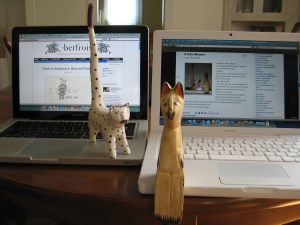
    IMG_1121 A Cat's Email– Did you get my email?
    – What email?
    – I sent you an email.
    – I delete all email before reading it.
    – That doesn’t make any sense!
    – Welcome to the world of Postmodern Poetry.
    – But I sent you an email!
    – Must we go through this again?
    – Joe’s post titled “Notes on Experience, Story, and Voice” that was “Freshly Pressed” here has now been reposted at Berfrois!
    – I think I need a nap.
    – How many naps do you take in a day?
    – As Dylan so eloquently put it, “Any day now, any day now…”
    – Why does he have to say it twice?

  • Weather Retort

    Sunset over PacificDay One: A trance of rain, ear churn momute.

    Day Two: Slide high noontide, sundersthorms plate.

    Day Three: Moistly scattered sneers and a few frizzles.

    Day Four: Chants of wrinkles, dartly cloudy and chowdery.

    Day Five: Humility Poor Boy Talls, Barometer IPA 75%.

    Day Six: Moggy, very low viability.

    Day Seven: Topical air mass pew point, wind clam.

    Extended Forecast:

    • Thick hot pine tar air dropping from powerful trees.
    • Rosemary, basil, garlic, and spearmint mixing with tales of salt water.
    • Soft golden sun boiling over salsa garden.
    • Bare feet in wet sand, nibbled by sand crabbed bubbles.
    • Plenty of weather to write or not in the forecast. Some pressure to publish sun only.
  • Apropos of Nothing Alphabet Primer

    AA beast abuzz amidst the clovers: A is for Always Anxiously

    Bees besieged in Beelzebub’s circles: B is for Bunched Bop

    Ceding the bee’s sting: C is for Cut Care

    Denuded dazed drone doodle: D is for Drilled Daffodil Dust

    FlowerEach easy flower glowers, going crazy: E is for Eating Earwigs

    Felled flies found in forged gyre: F is for Flounder Flour

    Grease hopping aground bottom: G is for Goaded Garlic Gear

    Heliotrope: H is for Standing Erect at High Noon

    M ss ng  n Act on: I is for Idling Slowly Down the Mississippi River

    Jived, joed, and jellied: J is for Jump to Comments

    Kitchen kelp: K is for Krilling

    Los Angeles lovers afloat: L is for Lost in Ballona Creek LowlandsCAPE

    Moneyed, honeyed, and schooled: M is for Marriage

    Nonesuch wiser the nuncio nun: N is for Nauseous Napkins at High Tide

    Only one occupied optative mood phone booth: O is for Obnoxious Ontology

    Peeing peregrine on ice plant spears: P is for Pilled Paper Piece Work

    Queued quacks: Q is for Quick Quiz

    Read in rows: R is for Rubric Rust

    Sew seven scarves: S is for Subsumed Existential Snow

    T is for Tremulous Titbirds Telling Mother Father Will Be Late

    Undertow: U is for Until Unction Snore

    Vexed voice: V is for Verisimilitude

    Waiting for FatherWho When What Where Why: W is for Wasted Window Father Watch

    X’s not and no O’s

    Yellow harrow and black and yellow bumblebees: Y is for Yielded Yelp

    Zonked zone: Z is for zooming in and zooming out, buzzing, zooming, walking, talking, doodling at poems, scratching names with dates in wet concrete, riding the bus to the metropolitan zoo

  • A Cat For All Seasons

    A Cat For All Seasons– It’s spring! Don’t you just love spring?
    – Winter will come again. It always does.
    – The ice has melted. Like e. e. cummings said,
    in Just-
    spring          when the world is mud-
    luscious”
    – It’s supposed to rain again tomorrow.
    – But this is today! And we’re alive in this spring moment!
    – A more responsible view is to remain mindful that the seasons are in constant motion, and anything can happen and usually does. In any case, from a universal perspective, there is only one season, a murkiness that lends itself to a contemplation of a dark void.
    – Yes, but it’s spring! And I feel like hop-scotching and jumping rope!
    – It won’t be long before the hurricane season will be upon us again, to say nothing of tornadoes. As Robert Frost pointed out, “Some say the world will end in fire / Some say in ice.” And he should have known; he was a poet. But I don’t see how it much matters, an end is an end is an end is an end, but all these literary allusions are just illusions to wile away the time until winter comes again and we cry out, “Winter is icummen in,” and you know the rest.
    – Oh, you’re just an old goat!
    Cherry BlossomsLook at this wonderful picture I took last night with my cell phone of the moon glowing through the cherry blossoms!
    – Reminds me of the time we went to see “The Adventures of Buckaroo Banzai Across the 8th Dimension!,” and they burnt the popcorn. Besides, you can’t fool me; that’s not the moon – that’s an electric spotlight in the parking lot of The Old Spaghetti Factory.
    – Listen! I think I hear a whistle!

  • A Cat’s Memoir

    A Cat's Memoir– I’m going to write a memoir!
    – You’re speaking of flash fiction, I presume?
    – No. I want to tell your story.
    – My story?
    – Yes, Joe says it’s the writer’s job to tell the stories of cats without voices, and you don’t seem to have a voice.
    – Joe? Who is Joe?
    – Joe is this really cool cat hep blogger at The Coming of the Toads, all about cool cat lit cult stuff, poetry and jazz, the ocean and deep silence. You would dig it.
    – And is this Joe cat credible and reliable? What does this Joe do for a living?
    – I don’t know. I think he may not have a life, so he doesn’t need to worry about all that. I think he might be a fictional character.
    – And who is behind this fictional Joe?
    – I’m not sure, his memoirist, I guess.