Category: Writing

  • Notes on Types of Poetry

    1. You look at something you believe should be familiar but see something else, something unexpected. A moment of confusion, you are given a start, seeing something new or strange, out of place or off kilter, in place of what usually passes practically unnoticed. Some like that feeling; others do not. But the feeling, whatever it is, passes. You dismiss the experience as a kind of déjà vu as what you expected to see comes into focus and the other vision, the mirage, the mistake, disappears.


    1. That night, you dream of a chess game, even though you don’t play chess. The chess pieces are friends, neighbors, and relatives. The Queen is a woman who walks by your house daily but never says hi. The King is the friendly dog from across the street, always happy to see you. The Knights are kids riding bicycles. The Castles are bell towers full of birds over empty churches. The Pawns are corporate employees you once supervised, riding a desk all day in a building of sealed windows. In those days, you used to dream of getting up from your desk and throwing open a window, a breeze of fresh air blowing all the papers off the desks, creating a ruckus. You are called down to the Personnel Department and summarily fired.


    1. You learn a new word, eggcorn. Slips of both the tongue and ears. You make a list of words you frequently misspell, fold the list, and put it into your Moleskin pocket notebook. You save the Moleskin pages for poems that never come. A week later, the Moleskin still empty, you take out your list of frequently misspelled words and throw it away. You make a new list of words you often mishear or mispronounce. You think of getting a dog and naming her faux pas.


    1. The plumber arrives to fix the pipe that froze in last winter’s silver thaw. Something about him smells familiar. It’s a stale beer odor. It’s late afternoon, a hot summer day, and he must have been out at lunch drinking beer, perhaps in the lot of food carts located down by the creek at the bottom of the neighborhood. You look into the back of his van. An old blue and white striped mattress lines the floor. The sidewalls are cubbyholes full of tools and plumbing parts.


    1. The power has gone out again, another rolling summer blackout. You light a candle. The phone and Internet are also out. You think absurdly of walking down to the corner to use the pay phone – the pay phone was taken out years ago. The evening is dark and quiet and peaceful, and you decide this is your favorite kind of poetry, the kind that creates a still clearness, and the stars are like rocks on the floor of a shallow, smooth running stream that ebbs and flows with the salt water tides. Suddenly the power comes back on, the fan spins, the radio blaring, the streetlight flooding through the open front window. A door slams. A car starts up. The lights flicker indecisively. Blackouts are only rarely epical.


    1. A young woman knocks at the door, a canvasser. Lonely for someone to talk to, you invite her inside. You make tea. Her skin is like parchment, full of colorful tattoos, pictures and words. And she has piercings, one in her upper lip, another in her ear, and a tiny diamond on the side of her nose. Her eyebrows are painted black shellac. She comes quickly to the purpose of her mission: she is selling low cost cremation plans. If you buy now, pre-ordering, before you die, you save lots. She’s already been able to help several of your neighbors. Your block is a gold mine of old people.


    1. You’ve the kids for the day, to babysit, day care. You get out large, thick sheets of brightly painted paper. Everyone takes a pair of scissors and cuts alphabet letters out of the sheets. You string the letters together with clear fish line and hang them from the ceiling with thumb tacks, creating slow moving mobiles that say different things depending on the breeze coming through the open windows. Everyone lies on the floor with pillows and blankets, watching the letters turn this way and that, reading aloud new words that appear.


  • The Political Fray Replay

    What does it mean to “vote one’s conscience”? Isn’t the conscience that comfortable place where sleeps one’s presuppositions, unquestioned assumptions, background biases, wishes, wants, and whimsy?

    James Joyce was three months old when in May of 1882 two high-level government men associated with British rule were assassinated in what came to be called the Phoenix Park murders. The resulting fallout probably delayed home rule decades, destroyed more lives and families, fed family arguments over politics for decades, was absorbed into history and myth. Charles Stewart Parnell’s career faced new challenges, and Parnell’s early death was a tragedy for Ireland.

    In “A Portrait of the Artist as a Young Man,” Joyce’s Stephen recalls his family arguments arising from the topic –

    That was called politics. There were two sides in it: Dante was on one side and his father and Mr. Casey were on the other side but his mother and Uncle Charles were on no side. Every day there was something in the paper about it.

    It pained him that he did not know well what politics meant and that he did not know where the universe ended. He felt small and weak. When would he be like the fellows in Poetry and Rhetoric? They had big voices and big boots and they studied trigonometry.

    Joyce’s Stephen, in “Portrait” and again in “Ulysses,” considers himself the servant of two masters, the Church and British rule. Stephen wants nothing to do with either. That Britain has its own church separate from Ireland’s complicates issues:

    — Really, Simon, you should not speak that way before Stephen. It’s not right.

    — Oh, he’ll remember all this when he grows up, said Dante hotly, the language he heard against God and religion and priests in his own home.

    — Let him remember too, cried Mr Casey to her from across the table, the language with which the priests and the priests’ pawns broke Parnell’s heart and hounded him into his grave. Let him remember that too when he grows up.

    — Sons of bitches! cried Mr Dedalus. When he was down they turned on him to betray him and rend him like rats in a sewer. Lowlived dogs! And they look it! By Christ, they look it!

    — They behaved rightly, cried Dante. They obeyed their bishops and their priests. Honour to them!

    — Well, it is perfectly dreadful to say that not even for one day in the year, said Mrs Dedalus, can we be free from these dreadful disputes!

    Uncle Charles raised his hands mildly and said :

    — Come now, come now, come now ! Can we not have our opinions whatever they are without this bad temper and this bad language? It is too bad surely.

    Mrs Dedalus spoke to Dante in a low voice but Dante said loudly:

    — I will not say nothing. I will defend my church and my religion when it is insulted and spit on by renegade catholics.

    Mr Casey pushed his plate rudely into the middle of the table and, resting his elbows before him, said in a hoarse voice to his host:

    — Tell me, did I tell you that story about a very famous spit?

    The young Steve tries to understand the arguments, the claims and evidence and reasoning. He does not name the fallacies, not yet:

    Stephen looked with affection at Mr Casey’s face which stared across the table over his joined hands. He liked to sit near him at the fire, looking up at his dark fierce face. But his dark eyes were never fierce and his slow voice was good to listen to. But why was he then against the priests? Because Dante must be right then. But he had heard his father say that she was a spoiled nun … Perhaps that made her severe against Parnell. And she did not like him to play with Eileen because Eileen was a protestant and when she was young she knew children that used to play with protestants and the protestants used to make fun of the litany of the Blessed Virgin. Tower of Ivory, they used to say, House of Gold! How could a woman be a tower of ivory or a house of gold? Who was right then ? And he remembered the evening in the infirmary in Clongowes, the dark waters, the light at the pierhead and the moan of sorrow from the people when they had heard.

    Stephen tries to understand the allegiances:

    He was for Ireland and Parnell and so was his father and so was Dante too for one night at the band on the esplanade she had hit a gentleman on the head with her umbrella because he had taken off his hat when the band played God save the Queen at the end.

    But all the young Steven can really understand and what seems to stick with him over the years are the tears:

    At the door Dante turned round violently and shouted down the room, her cheeks flushed and quivering with rage :

    — Devil out of hell! We won! We crushed him to death! Fiend!

    The door slammed behind her.

    Mr Casey, freeing his arms from his holders, suddenly bowed his head on his hands with a sob of pain.

    — Poor Parnell! he cried loudly. My dead king! He sobbed loudly and bitterly.

    Stephen, raising his terrorstricken face, saw that his father’s eyes were full of tears.

    The older Stephen decides not to join the political argument, but will devote himself to his art, his writing:

     A tide began to surge beneath the calm surface of Stephen ‘s friendliness.

    — This race and this country and this life produced me, he said. I shall express myself as I am.

    — Try to be one of us, repeated Davin. In your heart you are an Irishman but your pride is too powerful.

    — My ancestors threw off their language and took another, Stephen said. They allowed a handful of foreigners to subject them. Do you fancy I am going to pay in my own life and person debts they made? What for?

    — For our freedom, said Davin.

    — No honourable and sincere man, said Stephen, has given up to you his life and his youth and his affections from the days of Tone to those of Parnell but you sold him to the enemy or failed him in need or reviled him and left him for another. And you invite me to be one of you. I’d see you damned first.

    — They died for their ideals, Stevie, said Davin. Our day will come yet, believe me.

    Stephen, following his own thought, was silent for an instant.

    — The soul is born, he said vaguely, first in those moments I told you of. It has a slow and dark birth, more mysterious than the birth of the body. When the soul of a man is born in this country there are nets flung at it to hold it back from flight. You talk to me of nationality, language, religion. I shall try to fly by those nets.


  • On a Clear Day, You Can See England

    Over at Course of Mirrors, Ashen has posted a review of my novel “Penina’s Letters.”

    Ashen’s is a very clear, insightful, reading.

    Please swim on over and check it out!

    Peninas_Letters_Cover_for_Kindle


  • Sitting in the City

    Maple out spray maying
    ribbons of flowers
    twirl the girls
    round the pole boys
    pulling with bicycles
    festoons falling
    yards full of toys
    and fickle mud.
    Sitting out warm summer evenings, distant wildfires raking up the dry brush, smoke seen by astronauts as far away as January, surf still rolling up the beaches all around the world, I think of those days and nights six months opposite and reflect on the perfection of earth time.


    We have “seen the travail”:

    “A time to get, and a time to lose; a time to keep, and a time to cast away…That which hath been is now; and that which is to be hath already been” (Ecclesiastes, 3:6-15, KJV).


    But from the time the alarm clocks call and coo across the great divide, and while some rush to it others delay with snooze, to the resetting of the alarms at night, all grow quickly and remain forever impatient with time.


    So time moves on: the commute doglegs left as the slow lane stops while drivers get out and pee behind the rail; cells go dead and news is lost forever; the lady in front of you in line at the coffee drive-thru is ordering lattes with lemon twists and chocolate sprinkles atop whipped cream delight – for her whole office; you stop for a jam filled doughnut, already late, and you don’t give a damn about the new diet.


    Walking to the front door from the parking lot you wonder if you’ve worn the right clothes for the day. You forgot your sack lunch. The café is serving mac and cheese. You promise a nice salad for dinner. Someone has tossed a cigarette butt in your path – how rude is that! By the time you leave the office, it’s dark out and you’ve forgotten the doughnut and the salad.


    July table in the shade
    under the apple tree:
    pickles, potato salad,
    baked beans, deviled
    eggs, bottles of beer,
    water balloon toss,
    evening of pops,
    night of dust.
    By the end of August,
    the sun slipping south
    at an alarming speed,
    the activists suggest
    a presidential decree:
    a declaration of
    a state of emergency,
    plan parades in glee.
    Winter whistles restlessly,
    inflows of wet and dry cold,
    floods and long lines
    at the flu counter,
    impeccable timing,
    seasons on earth,
    neither hurried nor harried,
    quit nor balked.


  • Silence, Memory

    fred-drawing-on-slide_4118506034_o

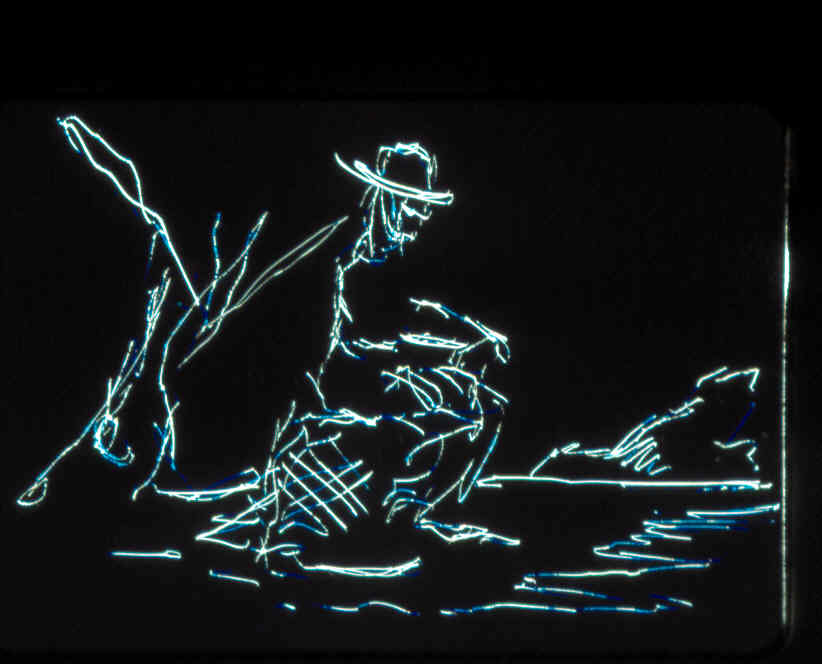
    In Nabokov’s “Speak Memory,” remembrance becomes a narrator, and narrators are not to be confused with authors, even (perhaps especially) non-fiction narrators, and often not to be trusted, as memory is often impeachable. Narrators are often unreliable. To remember is to be mindful, to call to mind. The writer must silence memory, then speak.

    Mindful of what? Who calls to mind? “Remember the time…,” someone asks. “Yes, the Angelus bells had just finished ringing. It must have been noon. I remember the dying echo of the bells. Not dying, falling, as if the bells were still with us, but silent, as indeed they were, and they would ring again, and that would recall dinner.” Is memory an angel come to incarnate? Memory made flesh. Well, made story, anyway. Memory is not words, has no language. Look Homeword, Angel.

    Memory is partial. Fragmentary. Unfinished. Abandoned for the present. And memory is partial in the sense of being one-sided. Memory favors. What happened to the trees as the bells passed through their leaves? How did they taste, the thick iron rings? Did your ears ring through the afternoon? Could you feel the bells in your bowels? Something else called to mind. Did you touch the bells?

    Memory is revisionist, as in historical revisionism. Memory is a time machine that can move in only one direction. If we were not mindful at the time, of the time, how can our later memory be accurate at all? So we put memory in the third person, and we recall instructions, how things were made and can be made again, how to ride a surfboard or a bicycle, how to write.

    “At the time in question, he simply was not very mindful of what was going on around him. Still, he insisted on certain memories.” These would be memories he needed now to continue.

  • Ping Ear

    One advantage of painting over writing, there needn’t be words. Where is there writing without words? I want to read that.

    IMG_20160722_123727


  • Minefoolnest & Other Misfits

    I’m not a spelling bee. I think the reason I’m not a tiptop speller (well, apart from maybe the more obvious reason) has to do with sound and pronunciation, where sound is what we hear, and pronunciation is how we repeat what we think we heard.

    I remember President Bush bedeviled for misspelling tomato, or maybe it was potato. I remember he was in Florida. Why do I recall he was in Florida, at a grammar school, but I’m not sure of the mot juste he abused? That’s probably a misuse of mot juste; I don’t care – I like the way the ooze comes together in juste abuse. Is misspelling word abuse? In any case, and while I was not and am not a G. W. Bush fan (including his paintings, which I did not like not because they were poorly drawn – in fact, they were quite modern – but because they were so narcissistic, selfie obsessed. At the same time, they gave me pause to think about form and content, particularly the one where he was taking a bath – or was it a shower? – because I’ve always been confused by the form and content business: form, apparently, man in tub; content might have been improved with a plumber at work fixing the toilet while the implacable Bush continues his bath), the news story of Bush’s misspelling boo-boo (to wit: tomatoe or potatoe) I found unworthy of sarcasm or cynicism, and I did not join the spelling bee buzz of hecklers making fun of him.
    (see correction note below.)

    For one thing, I don’t hear the second t in tomato, and if I were going to misspell it, I would probably write tomadoe. Probably that’s yet another reason why I’ll never be a POTUS. Bush’s misspelling was perfect because it’s the same misspelling millions of Americans make every day (or would make, if they were asked to spell tomato), so there was instant populist empathy for him, and it was a chance for the populists to go fsst to the academic snob spelling bees. The academic stings but once. There’s a good reason I hear a d in tomato: /təˈmādō/ – that’s how it’s pronounced. On the other hand (or ear), I do not hear a d in potato, even though potato, like tomato, is pronounced with one: /pəˈtādō/.

    You might be thinking I can’t spell because I can’t pronounce, but you’d be a step short if you didn’t acknowledge I can’t pronounce because I don’t hear the same sounds you do. On my own, left to my own devices, I’m in fact a perfect spelling bee. There will always be those who rush to correct (jab, jab, jab, as Susan says) or who think to be a spelling bee is to be a smart bee, when it simply means to be a drone. Like the artist whose painting is as accurate as a photograph but unimaginative, the spelling bee is productive but hackneyed.

    Words in all their dress and display should surprise us – startle, chortle, spark the double take.

    Spell check, by the way, while helpful, is not a solution. You don’t learn to spell using spell check. In fact, spell check often makes matters worse. Did you mean spell-check? Did you mean spellcheck? Some will argue that’s not a spelling issue. And (underline the right word following) they’re there their probably right. Which is why I’ve been working on mindfulness. Perhaps I meant spill chick, or spoil choke, but chuck it all, anyway. I know how to spell, believe it or not, delete, though I take no delight in it.

    I’ve developed Minefoolnest © as a self-improvement program designed to improve both your spelling and your overall attention to text. It’s a program for language misfits, those who, like me, hear words in sounds and sounds in words, often, not the same words and sounds others hear.

    Correction: Reader John Dockus (see comments below) has identified Vice President Dan Quayle as the miscreant misspeller of potato, and not Bush, not Florida, and not tomato. Would that there were a fact-checker as well as a spell-checker. Leave it to readers to do both for you, and this is what you get! Thanks, John. The Toads blog regrets the error.


  • Untie Tilled

    Flummoxes

    Stupefied

    fact toyed, act torn, him worried, cat a gory, high pot and noose, feet shore, rumpled thick skin, cloud rains notoriously his, his story

    stand dulled lard, aunt tie, ear merge, knit knot, sullen wullen, negligee ant

    puss swill, hog wash, bass inn, trump pet, your bane, miss aria, melon cafard, old gourd, nouvelle vague vouge vaudautomobile, sue dough

    moor biled,
    awe towed,
    skip it
    rock it

    stop it,
    stoop id,
    rinse off,
    he goes,
    soup her

    droop ball
    notes so bad
    over the wall.

    add dress &
    suit of blue
    dyed wool, tie
    prep
    position

    adove
    beyawn
    icross
    the oh
    shuns


    We lived for a time on Oak Street, in a courtyard lot of four houses across from the high school. The two sets of houses faced one another and were connected by arched walkways. All four kitchen windows looked into the courtyard. Each house was the same: a small white stucco square with center front door into rectangular living room with door to bedroom with closet, bathroom with porcelain tub and two doors, one from the bedroom, the other to a back porch with back door, kitchen nook, kitchen with door to living room, so that we could walk in circles around the inside of the house. The cat loved this circular house.

    I had just got back from Active Duty, and was driving a VW bus that I left parked on the street under the trees out front, even though there were four garages attached to one another but separate from the houses, in the rear of the lot. The houses were clean but rough stucco with red clay tile roofs. In the time we lived there, about a year, we never closed our kitchen window over the sink. The cat came and went through the window, and over time the flowering plant outside the kitchen started to grow through the window over the sink. The house was well-lit, four windows in the living room. Ours was one of the houses in the back of the lot, in the northeast corner. It was a swell place. We had no phone service and no television. We did have a stereo system: a receiver, turntable, and two speakers.

    In the house across from us lived Ms. Palette, a frisky old lady who grew tomatoes, peppers, cucumbers, herbs, zinnias, and marigolds, and she was visited once a month by a son who checked up on her and brought her provisions, including cigarettes and wine. When she was not in her garden, she was inside watching her television. Early one evening, we were startled by police, paramedics, and firemen rushing into the courtyard, taking up positions outside the doors, but their focus was on Ms. Palette’s house. She came to the door and let the police inside. We gathered with our neighbors in the yard. Apparently, Ms. Palette had experienced some sort of break in and thought she was having a heart attack and had called the police to say she needed an ambulance. As it turned out, she had been watching a cops and robbers show on TV, and she confused what she was watching on the show with the reality within her house. On the show, someone was breaking into a house, frightening its occupant, and Ms. Palette grew confused, thinking someone was breaking into her house and that she needed an ambulance. We tried to contact her son, but no one knew his name or number. The police suggested we take turns checking up on Ms. Palette daily. The emergency responders left, and we went in to say hello to Ms. Palette, who was sitting on her couch looking stupefied. The television had been turned off.

    We used to walk up Main Street into town to the grocery. Not long after Ms. Palette’s confused television experience, we were walking home from the store, each carrying a bag of groceries, and we passed the realtor’s office, and in the window one of the photographs caught my eye. It was my VW bus, parked on Oak Street outside our courtyard houses, and the houses were for sale, and they had, apparently, already sold. When we got home, we called our landlord. Yes, he’d put the property up for sale, no sign, no notice. A developer hit it like a raptor. Our landlord was waiting to tell us, not wanting to disappoint us. We were momentarily stupefied. Soon, we received eviction notices. The four houses were destroyed and a modern apartment building erected on the lot, sans courtyard and garden and trees. We moved on, not looking back, growing less stupefied with each move.


  • Sophisticated Gentleman’s Upright Urban Bicycle

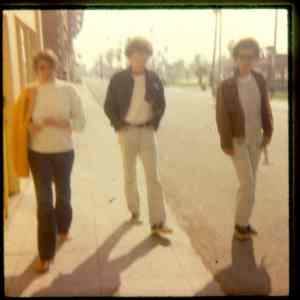
    IMG_20160709_105338Ryan finished his rebuild of my circa-1970 steel frame Raleigh bicycle. It is to Ryan (to wit, a wit) I’m indebted for the title of this post. He knows I think myself neither sophisticated nor gentlemanly – nor much of a bicyclist. There was a time indeed when the Raleigh did duty for an auto, but that was of necessity, hardly hobby or Edwardian privileged choice, and while there is evidence of bicycle chivalry in my bio, as evidenced by the call-in, for example, to the Bill Ballance radio show “Feminine Forum,” circa the old Raleigh days, the topic of the day “Is Chivalry Dead?,” the young lady caller apparently the same girl I had saved from a group of wine-drunk ruffians after an outdoor blues concert one evening on Venice Beach – and she never got a chance to thank me, she told Bill, as she rode south on her bike while I ran north up the boardwalk, chased by the ruffians, dashed east on Windward, cut through the vacant lot next to what is now Danny’s Deli, across the alley and through the apartment corridor to Susan’s aunt’s place, peeking around the corner of the building to see the hooligans searching for me around the parked cars on Windward, it’s purely anecdotal. The rude dude had made the girl cry, pulling at her handlebars and pestering her to come join his coterie sitting under a palm Venice Boardwalkdrinking wine. I had stepped up and grabbed the other side of her handlebars, surprising and startling the cad, yanking them out of his grip, and pretending to be her brother, I had said, “Come on, we gotta go, Dad’s waiting for us.” At which point we walked quickly off, and I asked her if she was ok, and I glanced back to see the bad guy stirring his buddies to action, pointing at me. The chase was on. In the picture right, taken by Susan, I am walking along the Venice Boardwalk in the early 70s. The two ladies I am with were capable of handling their own chivalric needs. And I still think of a bike ride as a paragraph lacking a unified topic. As in writing, you discover where you’re going in the process of getting there. The risk is that some readers may find this kind of bicycling writing annoying, just as some motorists would rather not share the road with parenthetical interruptions.
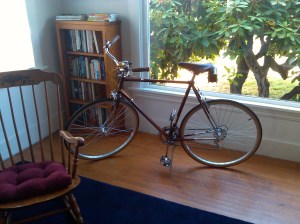
     The characteristics of an upright, urban bicycle include casual step pedals and upright handlebars. A brass bell mounted to the bars gives the bicycle a voice to its otherwise smooth sail-boat-quiet glide. The photo above shows the Raleigh in minimalist set-up: no saddlebags, bar basket, lights, or racks. The kickstand adds a sense of responsible behavior expectation.  The cork grips suggest the sophisticated gentleman knows his way around country streams and beaches as well as back roads to far away places within the city. In one of his ten blog-posts it took Ryan to complete the rebuild, or maybe it was in an email he sent me, as we went back and forth discussing parts and style, I remember him referring to the vision for the restored bike as an “upright gentleman’s urban bike,” and I remember thinking I was in trouble now. But etiquette of the road is not to be sneered at. And if I could not be grand, I at least would not have to be a spinet.
    IMG_20160709_124512

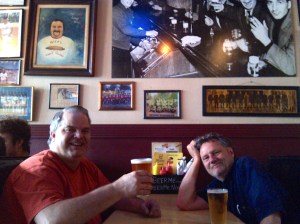
    One of those far away places, though not too far to bike to, the destination, as it turned out (an urban bike ride usually revealing a flexible plan), of our maiden voyage on the rebuilt and reconfigured Raleigh, with Ryan riding co-pilot on his Handsome bike (a make, not necessarily an adjective), was Nick’s Coney Island, in the Hawthorne District. In the pic right, you can see Frank’s portrait framed, the original Nick, before he sold the place and the new owners built Nick’s into a somewhat sophisticated gentleman’s Coney Island, wearing a Nick’s shirt with a Coney Island Dog on it, above Ryan and me sitting at a refurbished booth with pints drawn to celebrate the renewed bike. Frank was a stout and diehard Yankee fan. I don’t know what Frank thought of bicycles or even if he was ever on one, but I knew him as a kind of blue-collar gentleman when he was doing duty tending bar and waiting tables at Nick’s, his royal red Cadillac parked at the curb outside the door.

    Bicycle and urban are easily defined. Urbanity might get a little muffled in the noise of orbs and urbs (the city is surely a verb), but what of sophisticated and gentleman? Now we are in deep waters. And what is a bicycle as political semiotic as signified by Roland Barthes? The bicycle is a Beckett motif, his characters hardly sophisticated or gentlemen and often located well beyond orb or urb. What on a bike is a sophist, or a fallen gentleman? Benjamin Franklin walked, so did Thoreau. Franklin might have invented the bicycle but wasn’t in enough of a hurry, while Thoreau might have associated the bicycle as a product of the same forces that built the railroad, the unforgiving lineal track that prevented one from wandering.

    The further one wanders often the riskier the route. Southeast Belmont Street does not for most of its distance provide for safe bicycle riding space. The Salmon and Taylor Street designated east-west shared roadway encourages a sauntering ride, which is a ride in which one takes the time to muse and wonder, even to wander, and there is no shame in dismounting and walking the bicycle. That is what it might mean in Southeast Portland to ride a bike, to write your own story, not necessarily against the commute, but on the margins of the commute. The sophisticated gentleman urban bicyclist is a marginal man, a reader around a town of text. His destination is never clear. His purpose is opposed to argument. His narrative does not follow conventional route expectations.
    IMG_20160709_141043

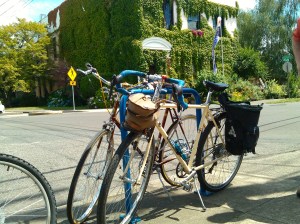
    He might make a mistake. I wanted to show Ryan Tabor Space, the coffee house in the old Presbyterian church on the northwest corner of Belmont and 55th. But when we got there, the coffee space was closed. But having already secured the bikes (pic left), we went into the church and sat for a spell where it was cool and restful.

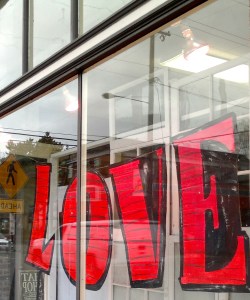
    The sophisticated gentleman upright urban bicyclist may take liberties with his trip narrative. That doesn’t mean he ignores rules of the road, at least those that are not ambiguous. On the contrary, he rides clearly and concisely, if not precisely, and never speeds or travels too fast for conditions. He is, in short, in no hurry and not in search of a hassle. We caught up with Susan and had British fish and chips and bangers and beer at Horse Brass Pub while discussing IMG_20160709_194251 bikes and comedians and films. Susan suggested we walk down to Movie Madness and rent a comedy to watch when we got back home. These are hard times around the country. For some, the time seems permanent. Platitudinous postings, retweets of bad attitudes, prayers without reflection, pandering of politicians to atavistic fears and wants, happiness confused with satisfaction – that’s all part of the difficulty; still, this sign in a business window on Belmont is a viable posting. Here, it seems to be a response to the Orlando shooting specifically. The sign it replaced said LOVE in bold red off balance letters, letters in loveLove 2. Before the LOVE sign, there was a gold lettered GLORIA with stars in a Christmas display. The window display has become a kind of public service announcement. It exudes a good vibe. I’ve passed it in my car, on the bus, walking, and now on my bicycle. Were I in a Beckett book, I might crawl to a sign of love with that hopeless hope that motivates his characters. You can’t make love to a sign, though it sometimes seems all we have is signs for things, and not the thing itself. I have a bicycle helmet, but I can’t forget Thoreau’s dictum to avoid enterprises which require a new suit of clothes, so I’ll be eschewing the purchase of bicycle apparel.

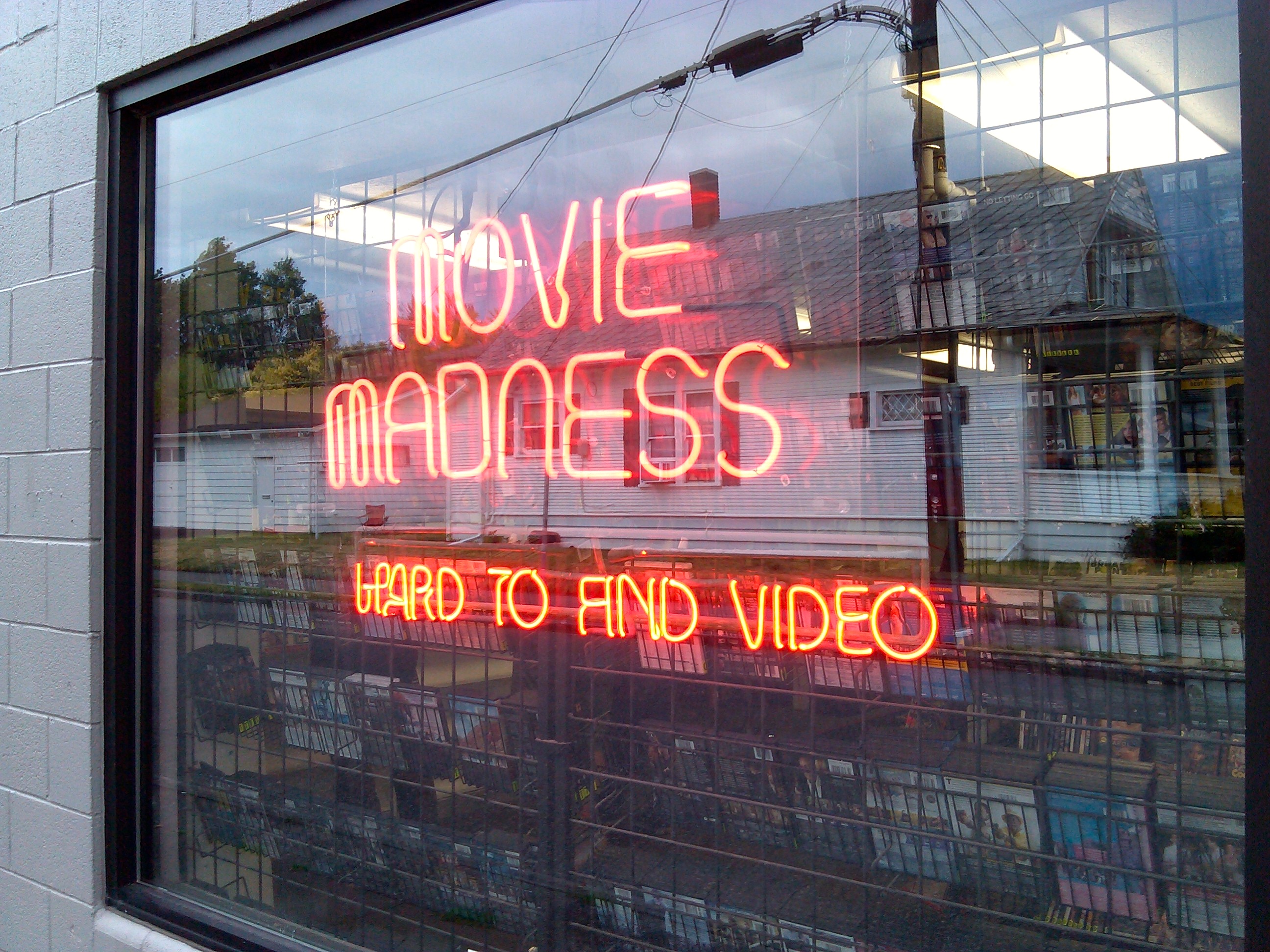
    On to Movie Madness, where we rented a Christmas comedy to watch back home, “Mixed Nuts.” So we’re watching a Christmas movie in July. “Mixed Nuts” was filmed in Venice, the Venice boardwalk a prop, along the same blocks in the Venice pic at the top of this post, with Steve Martin playing manager and owner of a suicide prevention non-profit hotline. Madeline Kahn is wonderful as Mrs. Munchnik.
    IMG_20160709_194347

    Movie Madness is more than just a video rental store. It’s a film museum, displaying a collection of movie making artifacts such as the knife used in the shower scene in Hitchcock’s “Psycho.” “Psycho” is on my reverse bucket list, which includes films I’ve seen that I never want to see again. One film I never tire of watching is the original “The Time Machine.” Movie Madness has on display the miniature table-top time machine used in the film, the one the time traveler sends into the future and so it disappears from the table. Presumably, it’s still time traveling. I also enjoyed the PSYCHOTRONICS sign to the thriller room. “More!”? What more could there be? I didn’t go in.
    IMG_20160709_203027

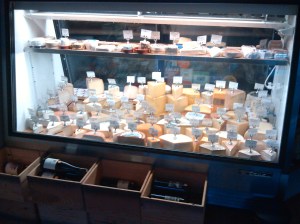
     I wanted to visit with Ryan Cheese Bar at the bottom of the Belmont hill. We enjoyed a board of mixed soft and hard cheeses with a glass of wine before “Mixed Nuts.” We watched the film and the next morning we walked down to Coquine for a scone and coffee. Ryan took off and later I went for a ride up in the park.

    In chapter two of “Penina’s Letters,” Salty is sitting at a cafe table outside Blubber’s on the Strand when Puck Malone rides up on a bicycle:

    “I drank a tall glass of water and was nursing a beer, watching the walkers and the waves, when along came Puck riding up the Strand, grinning, playfully pedaling his royal blue bicycle, holding a surfboard under one arm, wiggling to and fro. He was barefoot and shirtless, wearing some baggy trunks. He was watching the waves, closed out, booming bass lines now in the spring high tide. He saw me and parked his bike and leaned his board against the wall.

    Puck Malone’s neck was as thick as a telephone pole. His face was full and fat, with marble brown eyes spinning between freckled cheeks and straight, sandy-red hair, bowl cut with bangs down to his eyes. His tornado torso funneled down to two skinny legs. He had big surfer knots on his knees and feet from paddling in the kneeling position.”

    I’ll leave it to readers to decide if there are any gentlemen in “Penina’s Letters,” but it’s a question of fact that there is at least a bicycle, and it gets ridden – a surfer on a Strand cruiser.

  • It goes without saying

    As the old saying goes, it goes without saying. But if it goes without saying, why bother saying it?

    Worried it won’t go without saying it? It will just sit there, going nowhere? And if it does not go without saying it, where is it?

    Where is it when it is not on the go?

    When and where do words rest?

    (Next rest stop, 45 pages)

    It does not go without saying. Without saying, it doesn’t exist. It is nowhere. Not here, not there, not anywhere.

    It goes without saying what goes without saying remains stuck in a limbo of doubt.

    To be sure it’s on the go, say it, repeat it, vary it.

    Not on its own will it go.

    But needs be nevertheless let go.