Category: Writing

  • Hugs Penyeach: “I Saw a Man Hugging a Fridge: Twelve Poems by Youssef Rakha in Robin Moger’s Translation”

    Hugs Penyeach: “I Saw a Man Hugging a Fridge: Twelve Poems by Youssef Rakha in Robin Moger’s Translation”

    Youssef Rakha, Egyptian writer and editor of the international online publication The Sultan’s Seal (aka Cosmopolitan Hotel Cairo), recently posted to his site twelve of his own original poems, translated from the Arabic by Robin Moger. That posting draws significance for several reasons: both writer and translator are professionals published elsewhere in traditional forms – literary, commercial or journalistic; the poems are estimable; as literary online culture continues to evolve, with some longtime bloggers dropping out following more traditional successes or frustrated by the perceived over saturation of unpaid venues, Rakha continues to appear determined to develop even further his site, creating unprecedented opportunities for diverse writers and readers.

    As I consider a discussion of Rakha’s twelve poems, I’m reminded of Kirill Medvedev, the Russian poet whose concerns regarding ownership of communication and open access to literature and language led him to renounce his copyright, and in addition to his other work, he began to self-publish his poetry on Facebook. At the same time, Medvedev seemed interested in writing that would not alienate a common reader, as so much poetry often does, even if inadvertently. Reading poetry can seem like studying a foreign language, as indeed it is.

    Rakha’s poems behave, it might seem redundant to say, poetically. That is, they move by metaphor and juxtaposition of images, narration sometimes ambiguous, with many unexpected turns. What is their subject? Rakha has always made expeditious use of tags. At the bottom of the “Twelve Poems” post, for example, we find 70 tags, alphabetically ordered, but we don’t find fridge or hug.

    We should assume the speaker or narrator of a piece is not necessarily the author. Authors create characters, in both fiction and poetry, and narrators, including those in the first person, are characters. Even the narrator of a so called memoir, perhaps particularly so, is a character created by the author. Louis Menand recently spoke to this issue in a New Yorker article. I’m not sure he clarified or muddied the waters. That business about the “narrative pact,” for example: I prefer Trilling’s argument that everything is an argument – and that probably includes memoirs, essays, poems, novels, ads and commercials, junk mail, the evening news, anything on an op-ed page, and notes left on the fridge from your partner. The old, venerable encyclopedias? Full of arguments. The new Wiki? Likewise. But Menand’s closing point, that no occasion for writing should prevent us from reading, is right on. But what of the culpability of readers who in their creative reading find something the author had not intended? But isn’t one of the purposes of poetry to create and sustain or nurture the possibilities of unintended consequences?

    The setting of the poem where we find the man hugging a fridge seems domestic. His wife is there, swinging from the chandeliers, but this doesn’t seem to be a party. The local world is drowning in rain. We might recall Bob Dylan’s “A Hard Rain’s A-Gonna Fall.” “Oh, what did you see, my darling young one?”  The man’s legs are submerged. Is he hugging the fridge for its buoyancy potential, a life preserver? The poem is titled “Listen Ashraf,” and Ashraf Fayadh, a poet initially sentenced to be beheaded in Saudi Arabia, is named in the first line. His sentence was subsequently reduced to an eight year prison sentence with 800 lashes. His crime, it seems, wasn’t so much poetry, or being a poet, but of writing the wrong kind of poems. We hug our abodes, our houses, our wives and fridges, our lifestyles, as the waters continue to rise. We hug to say hello, goodbye. We hug the things we love. We hug a fridge or a clothes washer when we want to move it to another location. We hug to hold on. “Listen Ashraf” is the last of the twelve poems.

    The first poem of the twelve is titled “First Song of Autumn,” and speaks of joy: “I am the clarinet’s mouth.” This poem is lyrical, cylindrical, like the flight of birds.

    In “The Angel of Death Gives Counsel to a Bereaved Parent,” we find one of those poems whose narrator or speaker appears as a character invented by the author of the poem. The poem appears to be the angel’s apology, a rebuttal to the argument that he has no feelings. But he must harbor his hugs to get the job done. And he gives back, not an answer, and certainly not even a hint of a meaning to his work, but a hug of surety.

    The twelve poems speak in both the first and second persons. The speaker addresses someone close but at the same time far away, questioning, observing, remembering. There are sparks of sadness and of sarcasm, of hope drowned in irony, of anger:

    “Sleep and hug, like the downy pillow, the certainty
    That you’re the genius, alone in a society of retards.”

    Readers might wonder what it is they hug, to get them through the night or day of a poem, across the invisible wall of a border.

    One of the twelve poems, “Stallion,” is a prose poem. Not that a piece written in prose is any easier to grab hold of. It only appears to be one of the more accessible poems here. Written “For Ahmed Yamani,” it moves as a dream of water over oil. Another prose poem, titled “Love (Marriage),” seems an aphoristic apology, though we may not be exactly sure for what. It is not the sentiment often found on greeting cards.

    On second and third reading, the poems open more easily. The reading is not difficult; that is because the writer has done most of the work. But there is work required of the reader, too. The settings and references may be unfamiliar, the problems, though universal, hardly equitably distributed. Characteristic of the poetry is the packing together of history, personal observation, everyday events (visiting a cafe, for example), a kind of diarist epistolary form. The movements feel free, without restraint, not hamstrung. 


  • Banana Yellow Sunrise

    Banana Yellow Sunrise

    About fell asleep waiting on doctor to come
    under beguiling wall poster of limbic system.

    “I’m going to give you three words, and I’ll ask
    for them back before we’re done.”

    I repeated each word after her:
    yellow – yellow; banana – banana;

    sunrise – sunrise. Then she moved
    for the cuff and I rolled up my sleeve

    and she asked how Susan was doing.
    Sunsee, sunsaw, I thought about

    Buckminster Fuller’s neologisms,
    and also considered the possibility

    the doctor had given me not three
    but four words, sunrise compound,

    two words in one meaning. There
    was a time I might have discussed

    this with her, but no more. I felt
    my arm swell as the cuff tightened.

    Had I fallen in the last year? No,
    not that I could recall, small smile.

    Trying to keep her three words
    top of mind, I inverted them:

    banana yellow sunshine, locking
    them together as a descriptive

    phrase, cleverly reducing work
    from three chores to one.

    How many beers did I drink
    in a week’s time? Finally, she asked

    for the three words back,
    catching me off guard.

    She sat quite close to me,
    her face to mine, and I saw

    her nonplussed, and I knew
    something was wrong.

    As I left her office to go down
    to the lab to leave some blood,

    I thought about the difference
    between sunrise and sunshine,

    sunshine like adding a 7th
    to a sunrise triad.


  • Notes on “je me touché,” 4 essays by Jeremy Fernando

    je me touché, Jeremy Fernando, 2017, Paradiso Editores, Delere Press, 77 pages.

    Jeremy Fernando’s method of writing shows his acoustic, vibratory thinking, making connections, moving from one idea to another, enharmonic soundings, transported by his readings. In “je me touché” (it is i touch me – or, I me touch: I touch myself), he connects, in four essays, as cars interconnected on a train, Flann O’Brien’s short story “John Duffy’s Brother,” Melville’s “Bartleby,” the Occupy Movement, and, in an “Afterword,” sound, touch, and tune.

    If Flann O’Brien’s Brother is a train, Melville’s Bartleby is a station, the last stop, the end of the line, no turnaround. Nothing to be done now but occupy that well-foreshadowed destination, where we hear night and day the whistle of a human train derailed, “the scream of the scrivener” (25). That scream is a kind of tinnitus. There is no actual sound. What we are hearing is a phantom noise in our imagination.

    In the beginning was the word, and the word created community. In every beginning originating with a word, a commune is created, a habitat for the imagination. Community contains potential for sharing, for touching, without conflict, but with the possibility of divergence, which is risk, which becomes reading, a home, a place to dwell. And every household invites divergence, a library of dry goods.

    Fernando begins “je me touché” with an immersion into Flann O’Brien’s short story “John Duffy’s Brother.” Following some strange inexplicable happening, Brother (unnamed, perhaps one of Beckett’s unnamable) believes himself to be a train. Children often play at being things – “Choo!Choo! Good and Plenty. Good and Plenty.” But Brother really is a train. What is a train? Following a linear path, tied to its tracks, a community of cars carrying sundry goods and people and animals, all properly ticketed or listed in a bill of lading, the train rolls, pulls, steams along, along the line, picking up speed, braking for curves, slowing on hills (“I think I can. I think I can”), forward to a destination, for every train has a purpose, clear and unmistakable. And part of its purpose it to run on time, less the socioeconomic demographics harmonizing the connecting stops becomes disrupted (45-48). We don’t care about the people on the bus any more than we care about the bus drivers. What we care about is the system, the fixed routes, the timetables, the robotic movement of time. We become the bus, the train. But the story is not about the train; it’s about our thinking we are the train, a secret few of us care to admit, less we be admitted. What happens when the drivers (today’s scriveners, writing a line along a predestined route) go on strike?

    Our choices are limited. All authority lies in the tracks, and “it is only truly authority when ones does not have to use any force.” The system that runs on time requires no force but to enforce the schedule, which should require no force once set into motion. The individual who leaves the track, detours the bus route, goes on strike, does not necessarily wander far afield, but comes to rest, as does Melville’s Bartleby. Employed as a scrivener (a human copy machine), Bartleby inexplicably begins to “prefer not” to do any more copying, or have anything to do with the office or its community, yet he will not vacate the premises, for he prefers not to do that either. Bartleby’s boss, possibly the first humanist, works around him, but Bartleby eventually winds up in the Tombs, and we learn that he started out in the dead letter office. “Ah, Bartleby. Ah, Humanity,” the story ends.

    We begin to see Fernando’s connections, how he unravels then weaves again the themes found in Brother, Bartleby, then the Occupy Movement, and lastly, in “Afterword,” into one wandering path. Along the way, we meet the likes of Zizek, Ronell, Kant, Otis Redding, Cervantes, Wall Street and its Bull (symbol, sculpture, art), reading as touching. “Prosopopoeia”: feeling, book, relation, touch. The word empathy is not used, but perhaps should be, as in to feel oneself is to grant oneself some altruistic version of how another might feel us. Henry Miller. In tune. Dash, the dash. Coming together. Risk. Love (“I love you,” 72-73). Laughter as music, as language.

    Fernando’s layers upon layers of reading unfold, every word its history we must also remember, “keeping in mind” how others might have used it. And under the surface a stream, a river, runs undercover. Thus relation, within words: correspondence, interconnections, kin, intersections. Connecting Bartley with Occupy – occupy what? Nothing? The stairs? Bartleby occupies, to occupy already an occupation (“…why don’t they just apply themselves and get a job,” 37). Touch themselves? Now here: no where? To read is to touch oneself as another might touch, with permission.

    This is not a pipe dream, but a book, hard copy.

    (“Try this apple, Adam, very good”). Essay as fruit of the word.

    Who reads when we read? Even reading something we ourselves have written, we wrote, yesterday or some time ago, we are not the same person reading as we were writing – we are not exactly that same person who sat at that very desk, now also changed, and wrote, for we have already a myriad of new experiences constantly adding to our connections.

    I first read Melville’s “Bartleby: A Story of Wall Street” when, as a sophomore in high school, I was assigned Melville as my first term reading and research author assignment. I remember some of the other boys who got Hemingway, Steinbeck, Babbitt. I wasn’t all that happy to get Herman. But that attitude changed. Of course I loved Moby-Dick, but I tried to argue “Pierre; or, the Ambiguities,” written just after The Whale, the better work. Meanwhile, though he died before I was born, my paternal grandfather was an engineer on the Louisville Nashville Line. “So it goes.” Connections.

  • From the Edge

    From the Edge

    From the edge he walked to the center and hit
    return. He might have felt lost in the clearing,
    returning again and again to the dark margin.

    He thought
    of making a home
    in the clearing,
    planting a meadow
    of words.
    But things changed
    at night
    in the clearing.
    Balderdashes
    ran to and fro.

    He crossed to the other side, the distant
    edge, the clearing now behind him.
    He walked into that far margin,
    and was never seen again.


  • what The

    what The

    what now hap
    penned
    , the,
    pointing,
    sd:
    point
    Bing!

    only one the
    me
    still quiet
    all watched
    waited
    listing
    not pointing
    missing one

    but one the
    high flyer
         the     the
    the     the
          the       the
    mouth
    engine
    sputtering
    what the
    what the
    what the


  • News at the Toads

    I reviewed British poet Scott Manley Hadley’s debut poetry collection, “Bad Boy Poet,” at Queen Mob’s Teahouse. The book, just out this week, is available from the publisher (Open Pen) and at Amazon (paperback and Kindle editions). Read my review here.

    My novel “Alma Lolloon” is now available in Kindle electronic edition format. You can download a copy for $2.99 here (free if you have Kindle Unlimited).

  • Fall Calendar

    The        
      Falling      
        A    
        l L  
        l   L
    is into W t e all
      i h a u
      n a falls g
      t t fa h
      e fall la  
      r   la  


  • Penina’s Paginations

    Penina’s Paginations

    For some, grammar might be understood as an attempt to control language, or to control a speaker. But the only way to establish complete control over a language is to kill it, which is probably or nearly impossible, because language possesses, like the planarian, the ability to reform or regenerate from a tiny piece of itself. I point to an object, and that is how grammar works. The object could be the sugar bowl on the kitchen table, the moon, or a running man. I link to it for the purpose of linking you to it also. But first, I have to get your attention. Of course, I can always point to myself, or point to an object by myself, like talking to myself, which might be one origin of poetry. When the objects we point to disappear, or others claim to be unable to see them, we come to the first existential crisis of language, where we find ourselves in grammar school, the subjects of rote repetition in an effort to create memory. In grammar school, we learn to wear a uniform.

    We learn to number our clothes. The hat, number 1. Or maybe we start with the shoes, the socks being a subset. First we put on the right sock, then the left, then the right shoe, then the left shoe. Never mind it’s a sunny day and we were thinking what fun it would be to go barefoot. To go barefoot, in grammar school, is one of the first examples of being ungrammatical. We are assigned a seat, a number in a numbered row, alphabetized and numbered in the numbers book. Having a number is essential when everyone looks alike.

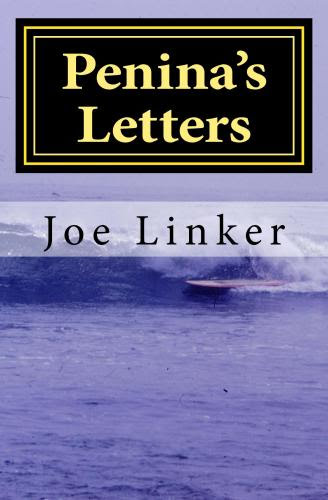
    So it was with a tremulous motion I finally approached my MS Word file containing my first published novel, “Penina’s Letters,” to correct a few unintended consequences. The first printing had contained an unacceptable number of typos, and the front matter setup has always felt a bit clumsy to me. The chapter listing page, for example, showed the chapter titles but no page numbers. And the ISBN didn’t show on the copyright page. But why the tremolo? Why not just go in and make the changes? I did manage one corrected copy upload, after the first printing back in 2016, ridding the book of most of the obvious errors, mistakes which, it pains me to admit, I had failed to spy with my little proofreading eye. But a few issues remained, as additional readings revealed, but the thought of entering the MS Word file again and resubmitting for revision to CreateSpace for approval with the hope of not making matters worse was all more than I felt up to. Besides, I now had other projects underway that required my attention.

    Then, a week or so ago, I was notified that CreateSpace was closing its doors and all texts migrating to Kindle Direct Publishing (KDP). So I took the opportunity to become acquainted with KDP by reworking the front matter of “Penina’s Letters” and fixing a trio of what I recognized as outstanding mistakes.

    My first submission of a redo file for KDP’s approval was rejected – something to do with pagination errors. Mercifully, the rejection came within the 24 hours promised, and I went back to work on the Word.doc before motivation waned, resubmitted again, got approval, ordered a proof copy, and voila! No page numbers at all.

    Suffice to say, after all that preamble and bramble, that for the past several days I’ve been immersed in a kind of MS Word pagination purgatory. Changes to a text often cancel out other changes, or sit on top of them, burying them below – but that suggests there is a top and a bottom to the thing, and of course there is not.

    I got page one to say 1 but could not get the other pages to follow suit. I got every page to say 1. And so on, nothing acceptable. I began to think, rationalizing and trying to come up with some creative solution, why bother paginating at all anyway? Does the common reader really need page numbers? And isn’t a page number a kind of mar on an otherwise illuminated manuscript page? I got page numbers to show, but not in the footer where they belong. I toyed with “different front page,” “link to previous,” “create section break,” erase all and begin again. Deeper and deeper into an MS Word morass I sank. I entered “document,” “paragraph,” the journeyman’s “tools.” Suddenly blank pages and huge gaps in the text began to appear throughout the manuscript. I fixed and corrected and proofed. At one point, I had a file with pagination complete that seemed correctly formatted. I resubmitted yet again to KDP, and the proof file came back still with no page numbers.

    I took a break from the project. I remember McLuhan saying something about pagination beginning with the printing press. The fall is into the printing press. Is there a page 1 to the Internet? In a mosaic, one may enter and exit anywhere. Page numbers are useless. There are no pages. There is the infinite scroll – over, under, sideways, down.

    “Backwards forwards square and round.
    When will it end, when will it end,
    When will it end, when will it end,”

    the Yardbirds sang.

    “We don’t need no stinking page numbers,” I can hear Puck Malone of “Penina’s Letters” saying. But in the end I managed somehow to successfully place page numbers on the outside edge in the footer of even numbered pages, in sequence, every other page. I seemed to recall seeing books numbered only on every other page. I looked through some books. Saul Bellow’s “The Actual” places page numbers only on the odd numbered pages, right edge of page, in the margin, spelled out, in italics: page one. Enough.

    Interested readers may utilize the “look inside” feature at Amazon to get an idea of how the new printing of “Penina’s Letters” came out.


  • Blest Be the Tie that Binds

    Blest Be the Tie that Binds

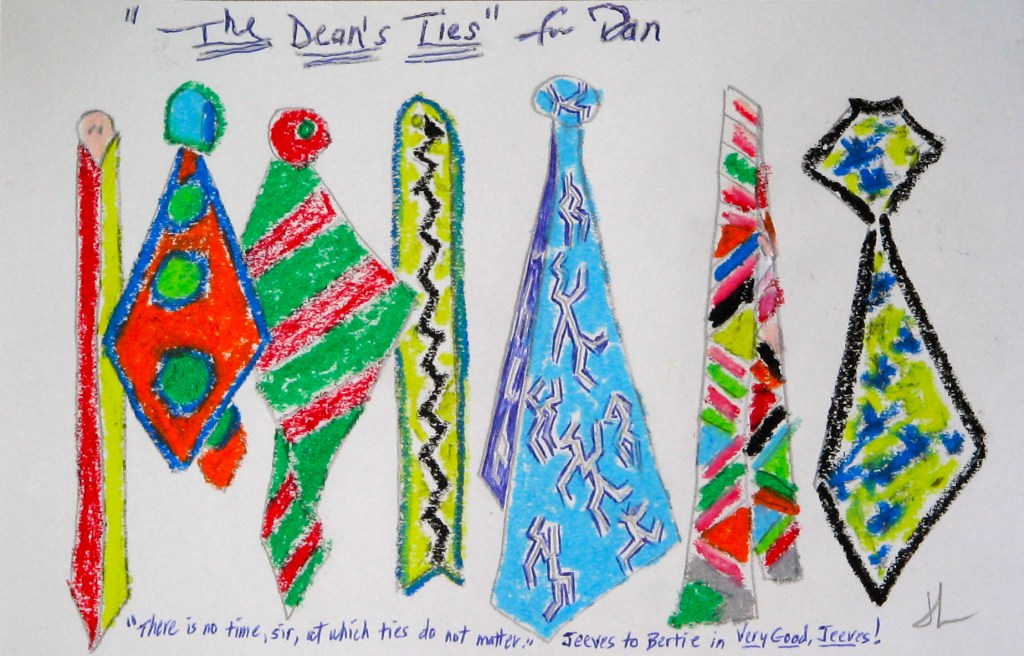
    One year, on a trip north from Los Angeles, we stopped off at the University of California at Santa Cruz campus to visit a married couple, both in graduate school studying computer programing. When I asked about their projects, one of the students said she was working on a component that would become part of another system, but she didn’t know its ultimate purpose. It might be military; it could be household. She said computers would improve lifestyle and livability. For example, she said, when you arrived at the front door of your house, a computer would recognize you, and your door would open automatically. Later, I learned that, having completed his graduate program, her husband got a good programming job, but due to a misunderstanding regarding dress code, he quit his first day at work because he was expected to wear a tie. That same day, he went to another computer programming firm in the area, where ties were not required, and was immediately hired.

    About ten years later, this time on a trip north from Portland, in Seattle on business, I visited a friend who was working in the computer industry. He took me on a trip of the home office, which was called a campus. With its various outdoor activity fields, the low profile buildings, the walkways – it looked and felt like a school campus. On our way to an onsite cafeteria for lunch, we passed through a couple of long corridors lined on both sides with solid doors opening into offices the size of telephone booths where single workers sat hunched toward a computer screen. After finding a table in the cafeteria and settling into lunch, I glanced around and gradually noticed I was the only guy in the whole place wearing a tie.

    Glancing around today, I notice that one of the few industries still apparently requiring a tie is politics. But I’ve also noticed that news media people on camera also wear ties. They all seem to share similar clothing styles, the men and the women, the politicians on both sides of the aisle, the leaders in industry, the ladies and gentlemen of the world. It’s a wonder they don’t all get along better, and one wonders what today a tie might signify. The tie seems now only a theoretical construct – its purpose and meaning are not directly observable. It no longer binds, but unbinds.

    The title of this post is taken from the hymn by John Fawcett:

    “Blest Be the Tie that Binds”
    by John Fawcett, 1740-1817

    Blest be the tie that binds
    Our hearts in Christian love;
    The fellowship of kindred minds
    Is like to that above.

    Before our Father’s throne
    We pour our ardent prayers;
    Our fears, our hopes, our alms, are one,
    Our comforts and our cares.

    We share our mutual woes,
    Our mutual burdens bear,
    And often for each other flows
    The sympathizing tear.

    When here our pathways part,
    We suffer bitter pain;
    Yet, one in Christ and one in heart,
    We hope to meet again.

    This glorious hope revives
    Our courage by the way,
    While each in expectation lives
    And longs to see the day.

    From sorrow, toil, and pain,
    And sin we shall be free
    And perfect love and friendship reign
    Through all eternity.

    Hymn #464
    The Lutheran Hymnal
    Text: Eph. 4:3
    Author: John Fawcett, 1772, alt.
    Composer: Lowell Mason, 1832
    Tune: “Boylston”

  • The Fall is into Technology: Notes with Index and Keywords for “Other Paradises,” Essays by Jessica Sequeira

    “How to be silent….The fall is into language” (Love’s Body, Norman O. Brown, 256:257).

    Is language a technology?

    “Henri Bergson, the French Philosopher, lived and wrote in a tradition of thought in which it was and is considered that language is a human technology that has impaired and diminished the values of the collective unconscious. It is the extension of man in speech that enables the intellect to detach itself from the vastly wider reality. Without language, Bergson suggests, human intelligence would have remained totally involved in the objects of its attention. Language does for intelligence what the wheel does for the feet and body. It enables them to move from thing to thing with greater ease and speed and ever less involvement. Language extends and amplifies man but it also divides his faculties. His collective consciousness or intuitive awareness is diminished by this technical extension of consciousness that is speech” (Marshall McLuhan, Understanding Media, 83).

    The fall is into technology.

    Jessica Sequeira understands silence, and silence, the language of the ghost, is a necessary part of conversations and connections. “Other Paradises: Poetic Approaches to Thinking in a Technological Age” (Zero Books, 2018) collects essays Sequeira previously placed in various online venues, including Berfrois, Drunken Boat, Entropy, Gauss PDF, Queen Mob’s Teahouse, The Missing Slate, and 3:AM. The collected essays in hardcopy creates a reading emergence opportunity, where the whole is unpredicted by any one of the individual parts. Fragments are conjoined, scholastic and playful, connections clarified and augmented, and an original style, a way of being within the writing, emerges.

    When I think of technology, of thinking about technology, I recall Norman O. Brown, Marshall McLuhan, R. Buckminster Fuller, and John Cage. In “Other Paradises,” Jessica mentions none of them. Yet she asks, “Why do people deliberately choose to play with ideas considered antiquated?” (Other Paradises, 1). Both O. Brown and McLuhan made startling discoveries rereading old texts and discovering or inventing new interpretations applicable to contemporary concerns.

    Jessica begins with the fax machine (from a far different generation, I might have begun with the mimeograph machine). The fax machine requires sender and receiver, at odd ends. The confirmation “fax received” in no way implies fax read. So much for inference.

    Melville’s Bartleby was a scrivener. Prior to that, he had worked at the dead letter office. A scrivener was a human copy machine. Bartleby works (and lives, as it turns out) in a law office, where his job is to handwrite copies of documents and proofread them aloud with the other scriveners. Bartleby winds up in the yard at the New York Tombs, where he “prefers not” to go on living, let alone copying. Bartleby’s ghost haunts today’s every copy and paste. Unlike the Sacramento writer William T. Vollman (who wrote his first book nights hunkered under an office desk in the insurance firm he worked at), Bartleby has nothing original to say, or maybe he does, but he “prefers not” to say it. Enter Kinko, University of Santa Barbara, I’ll bring the technology to ya, on the sidewalk, a copy food cart.

    Inherited technology. Ibsen’s Ghosts. Oswald has inherited syphilis from his promiscuous father, now dead, the technology of euthanasia now Oswald’s only hope.

    “Every technology contrived and ‘outered’ by man has the power to numb human awareness during the period of its first interiorization” (McLuhan, Guttenberg Galaxy, 187). McLuhan quotes from Curt Buhler’s “The Fifteenth Century Book: the Scribes; the Printers; the Decorators”: “What, then, became of the book-scribes? What happened to the various categories of writers of literary works, who practiced their trade prior to 1450, once the printing press was established?” (187).

    Every technology absorbed and relied upon without adequate disaster plans creates potential detrimental reliance. We rely on the technology to our detriment once we abandon what we now perceive to be an antiquated technology. McLuhan considered technologies extensions of one of the five senses: eyeglasses extensions of the eyes, clothes extensions of the skin, etc. The computer was an extension of the central nervous system. Sequeira proposes that the abandoned technologies inhabit as ghosts the new machines.

    The fall is into detrimental reliance. We want to get back to Paradise, any paradise will do, but we’ve lost the instructions, the skills, the magic prescriptions.

    The Paradise, the one we apparently lost a long time ago, was probably a mosaic. It was not linear; it was not lineal; it was not literary. It was not sequential. It did not follow MLA, APA, or any other prescriptive styles. It was not an argument. There were no statements about which there would certainly be some disagreement. It was, in short, a paradise. But that’s not to say nights in paradise were not separate from days, not to say there were not ghosts (of angels, of devils), or that we were not part of a great food chain on land and at sea. I wrote a poem awhile back, which illustrates:

    Cadmean Victory

    They do not want for something to say
    They run around and play all day
    Syllabicating back and forth
    No one asks what another is worth

    At night they climb trees to sleep
    They dream of mouths of lips and teeth
    And breath of a land where speech
    Is silly and fluid and free

    Having no bowels they don’t see
    The lithe ape thinking in a tree
    Who would trap them in a man
    And call himself can

    So what and where are these “Other Paradises” Jessica Sequeira takes us to? How do we get there? I wasn’t long into her book when I wished for an index of some kind. An index would collect the extensive reading list now scattered throughout the text. “Other Paradises” is a mosaic, another reason McLuhan and O. Brown come to mind, and full of anecdotes and stories, and packed with references, but each essay contains a structure and harmony that informs the whole work (as does the work of Fuller). And all of that reminded me of John Cage, whose work is littered with anecdote, references, and playful asides. And an index would give some insight into the breadth of Sequeira’s reading, research, and interview experience, and it would illustrate how “Other Paradises” is a rich resource work. And, well, I wanted an index. Here following then, as introduction and review of Jessica’s new book, is a kind of index (a page number follows each entry, usually just the first reference, though many appear only once, and I’ve not listed them all):

    Annotated Index to Jessica Sequeira’s “Other Paradises”

    1. David Hockney: 1. Foreshadows California. With Pacific Ocean beaches easy drives away, still, backyard swimming pools are popular, or a Hockney print of a swimming pool, which is almost the same thing, since the pools are usually empty, anyway.


    1. Lafcadio Hearn: 5, 9. “Glimpses of Unfamiliar Japan.” The ghost, or the idea of ghosts, is a keyword throughout “Other Paradises.” Says Sequeira, “Ghosts are everywhere, busy laughing, crying, loving, plotting, dancing and sleeping just like humans….Technology left behind takes on a phantom presence” 6.


    1. Bancho Sarayashiki: 6. Some spirits are restless, for one reason or another.


    1. Fukagawa Hidetoshi and Tony Rothman: 7. “Sacred Mathematics: Japanese Temple Geometry.” Sequeira is interested in forms, shapes, lines that intersect, cross. Her essays assume geometrical shapes that can be described as poetic.


    1. “Japanese temple geometry problems: Sangaku” (Charles Babbage Research Centre), 7.


    1. Charles Babbage: 7-10. “Passages in the Life of a Philosopher.”


    1. Ada Lovelace: 8, 12.


    1. Commodore Matthew Perry: 10.


    1. Hank Mobley: 11. “Soul Station.”


    1. Banana Yoshimoto: 12. I read Banana’s novel “Kitchen” some years ago. Though it takes place in Japan, it contains a wonderful reference to Disneyland. I don’t know why I remember this. I’m not sure I do, accurately. I can’t remember if Banana had been to Disneyland, and it had made an impression upon her, or if one of her characters had gone there, or wanted to go there. I browsed quickly through “Kitchen” just now looking for Disneyland. I found only one small reference, to the Jungle Cruise.


    1. Musil: 13, 21.


    1. J. Gordon Faylor: 13, 20. “Registration Caspar.” I’m not sure about so-called “conceptual writing.” Words are like the seven daughters of Eve, each containing a mitochondrial genome.


    1. Kathy Acker and Tan Lin: 15.


    1. Beckett: 15, 17.


    1. Dante, Beatrice: 15.


    1. Wittgenstein: 15.


    1. Franco Moretti: 16.


    1. Proust: 17, 88. Must one go out?


    1. Martin Ramirez: 19.


    1. Jess Collins: 19. “Narkissos” (a large drawing). I was happy to see this section on Collins, references to the Beats and San Francisco. The Beats brought poetry back to earth (after which Bukowski ran it into the ground).


    1. George MacDonald, Pythagoras, Goethe, Joyce, Robert Duncan, Denise Levertov, Jack Spicer, James Broughton: 19-20.


    1. King Ubu Gallery: 19.


    1. Manhattan Project: 19. Where Jess Collins had worked for a time. He apparently exchanged plutonium for poetry.


    1. Robert Duncan: 22. Poem, “Just Seeing.” Duncan lived with Collins. Missing from the conversation is Charles Olson.


    1. “The Macabre Trunk”: 1936 Mexican film, 24.


    1. Richard Lower: 26. “Tractatus de code item de motu et colore sanguinis.” Title apparently does not tell all.


    1. Mark Zuckerberg: 26.


    1. “Teche” (dance song): 27. An original song by Jessica: “Bad-a-bing-be-boom-ba!”.


    1. Schrodinger’s Cat: 28.


    1. Pascal: 29.


    1. Liliana Colanzi: 34. “Our Dead World.”


    1. Edmundo Paz Soldan: 35.


    1. Roberto Bolano, Joao Guimaraes Rosa, Philip K. Dick: 35.


    1. Juan Terranova: 35. “The Flesh.”


    1. Alison Spedding: 36-38. “Wachu Wachu”; “Cultivation of coca and identity in the Yungas of La Paz”; “Kausachun-Coca”; “Manuel and Fortunato”; “The Wind in the Mountain Range”; “Saturnia from time to time.”


    1. King’s College: 37. A lovely, lyrical description on page 41. Sir John Wastell, 43.


    1. “Downtown Abbey”: 37.


    1. Alexander the Great: 37. And introducing Alexandra the Great.


    1. Gaganendranath Tagore: 48.


    1. Partha Matter: 48.


    1. Henri Bergson: 49. Book on Laughter.


    1. Whistler: 50.


    1. “Resurrection”: 50. Painting.


    1. George Meredith: 52.


    1. Gonul Akkar: 54. “Silemezler Gonlumden,” pop song.


    1. Zeynep Karagoz: 54. (Maker).


    1. Zbigniew Herbert: 58. “The Bitter Smell of Tulips” in “Still Life with a Bridle.”


    1. The Flying Pigeon: 61.


    1. Chloe Aridjis: 61-63. “Topographia de lo insolito” (Robert-Houdin); “The Child Poet,” “Book of Clouds,” “Assunder.”


    1. Mary Richardson: 69. “Rokeby Venus.”


    1. Leonora Carrington: 70. “The Oral Lady,” “The Hearing Trumpet.”


    1. Arthur Eddington: 75. “Science and the Unseen World.”


    1. Richard Pearse: 75.


    1. Talleyrand: 78.


    1. Olivia Caramello: 80.


    1. Louis-Eustache Audot: 84. “La Cuisiniere de la Campagne et de la Ville, ou nouvelle cuisine economique” (recipes).


    1. Jean Lorrain: 85. “Monsieur de Bougrelon.”


    1. Willem Claeszoon Heda: 87. “Breakfast Table with Blackberry Pie” (painting, 1631).


    1. Svetlana Alpers: 90. “The Art of Describing.”


    1. Eva Richter: 90.


    1. Barbara Payton: 91. “I Am Not Ashamed.”


    1. Henri Roorda: 91. “My Suicide.”


    1. “Spontaneity: A History in 12 Volumes”: 92.


    1. Billy Caryll and Hilda Mundy: 94. “Scenes of Domestic Bliss” (radio sketch, 1934). The Hilda Mundy here is the performer, not the Bolivian poet. This section of “Other Paradises” is laugh out loud funny.


    1. Laura Villanueva Rocabado: 96. The Bolivian writer whose best known pen name is “Hilda Mundy” (see note 64, above). Jessica unravels the connection between the performer and the poet. Mundy’s “Pirotecnia,” page 98.


    1. “Bambolla bambolla”: Hilda Mundy’s journalism, 96. Phrase < Gongora, 97. Sequeira translates “Bambolla bambolla” as “look at me look at me,” a kind of ostentatious selfie.


    1. “Dum Dum”: 96.


    1. Brenda Lee: 97.


    1. La Mariposa Mundial: 96. Mano maravillosas: 97. Pagina Siete: 97 (Rocio Zavala Virreira). Jessica quotes Virreira who says that, “to speak of Hilda Mundy is to leave the path, change direction, try out new things. It is to think not in terms of books, but magazines. Not complete sets, but clippings or incomplete collections” 97. Something like that might be said of Jessica Sequeira’s work.


    1. “Impresiones de la Guerra del Chaco”: 98. Hilda Mundy text (“journalistic poetry”).


    1. “Decision”: 103. Poem by Jessica Sequeira.


    1. Srini Vasa Ramanujan: 104.


    1. Duchamp: 104.


    1. Carlos Fonseca, “Colonel Lagrimas,” 104. Sequeira quotes an interesting section from Fonseca’s text: “At one point, the colonel writes a postcard to his character Maximiliano: You know, Maximiliano, that this Ronald Reagan, man of a thousand facets and a dapper walk, illustrious president of the United States, had the most interesting job before he found success as an actor: he was an announcer for American football games. The strange thing, the magnificent thing, Maximilian – and here is the point of this anecdote – is that this future president didn’t watch what he was narrating: he simply received bits of information, strung like rosary beads, whose whole he never saw, loose bits of information about a spectacle he didn’t see, but whose tone he imagined in a kind of blind broadcasting. Our project is a bit like that. Broadcasting for an age without witnesses, a kind of blind narration of this dance of crazies. So, learn to tell without seeing, ”107. I wondered what McLuhan might have made of “learn to tell without seeing.” McLuhan thought with the advent of text we exchanged an ear for an eye. Hearing would have been the paramount sense in paradise, not seeing. Sight has come to dominate the senses, according to McLuhan, because of print, another example of detrimental reliance. But for Sequeria, the interest in the quote has to do with connections. She writes: “An obvious displacement exists everywhere, between mind and behavior, event and interpretation, fact and memory.” Just so, McLuhan said football was a more intuitive sport for television than baseball, more mosaic, less specialized. Television, it’s mosaic screen full of dots of which we only see a few and fill in for the rest, can not cover the specialized positions of baseball all at once. That all-at-once-ness becomes the value (what we want, even if what we want is not good for us) of social media programs. Baseball is a game of continuous lines, football of fragments. And learning without seeing is having the text before us, the illuminated manuscript – what is it that is illumined? The reader of “Other Paradises” may feel a bit like the narrator of a blind broadcast.


    1. Ricardo Piglia: 110.


    1. Horizontal: 110.


    1. Borges. His ghost is everywhere.


    1. Gabriel Josipovici: 112.


    1. J. L. Austin: 113.


    1. Christopher Priest: 114. “The Inverted World.”


    1. Rion Amilcar Scott, “Insurrections,” 116. “Satire doesn’t just mean ‘being funny’; it’s an existential mode that allows one to take on both joyful and painful subjects from inventive, oblique angles, allowing one to make almost anything one’s subject with good humor, precision and grace” says Sequeira, page 116. Scott is the satire editor at Queen Mob’s Tea House. When I was an English teacher, I was struck by how often my adult learners were slow to pick up on or were offended by satire. Swift’s “A Modest Proposal” was occasionally even taken literally. That is the power of the authority of text, as McLuhan explained, and it’s why “fake news” is so prevalent today. “Oh. Irony. See, we don’t get that here. We haven’t had any irony up here since ’83, when I was the only practitioner of it. I stopped doing it because I was tired of being stared at” (Steve Martin’s character, C. D., in the film “Roxanne”).


    1. Maggie Nelson, “Bluets,” 122.


    1. Janice Lee, “essays,” 122. Lee, the founder of the on-line “Entropy.” Says Sequeira of Lee’s essays: “…it’s the accumulated effect of phrases that’s of value here, not any individual quote.” The same might be said of the accumulated effect of my footnotes to “Other Paradises.”


    1. Fernando Diez Medina, 127.


    1. Roberto Prudencio Romecin, 127; “On books and authors,” 128.


    1. Jaime Saenz, 128. (Yes, I know, my format has changed. I got tired of the extra effort required of typing a colon where a comma will do. Consistency is another detrimental reliance phenom resulting from the printing press.)


    1. Sequeira is a reader and advocate for Bolivian poetry: Monica Velasquez Guzman; Oscar Cerruto; Edmundo Camargo; Raul Otero Reiche; Blanca Wiethuchter; Humberto Quino; Emma Villazon; Julio Barriga; Hilda Mundy; Edmundo Paz Soldan; Liliana Colanzi; Paola Senseve; Sergio Gareca; Pedro Shimose: 129-131. Says Sequeira: “Bolivia is an increasingly prosperous country with a growing middle class, widespread Internet connection even in the tiniest pueblos, and a population of educated and mobile young people with academic scholarships and international travel experiences. Traditional geographical and ethnic distinctions have begun to blur. A writer may fill page after page alone in her room, then take that notebook to a bar for a reading, one she will perhaps repeat later on in New York, Santiago, or Moscow. Perhaps – is this just a fantasy? – the poets of Bolivia form one small part of a world wide movement in which nations as we know them disappear, along with progressive ‘developmentalist’ thinking, to leave only the pure flow of cash, art and ideas,” 134. McLuhan did not think it fantasy. According to McLuhan, the printing press was responsible for nationalism, boundaries, margins, and the marginal man. But we may have to let go of text to realize the “blur.” We must wander (essay, assay) outside the margins, off the page.


    1. Pierre Bonnard, 134.


    1. Walter Benjamin, 139.


    1. David Winters, “Infinite Fictions,” 139.


    1. Escher, “Belvedere,” 1958 print, 139.


    1. Goethe, 135.


    I will now add a list of “keywords” or short phrases I noted as particularly relevant to “Other Paradises,” and end with a few quotes:

    Keywords to “Other Paradises” (in no particular order, but arranged as a mosaic):

    arcadia, disappearing, antiquated machines, ghosts, slowness, loss of use, machine, prose, lyrical, satire, UFO’s, damage, violence, fiction, narrator, suburb (132), language as technology (113), questions and questioning (throughout), reading list (113), Snakes and Ladders, theory, comedy (53), Los Angeles, disconnectednesses, poetry, past, social realism, symbol, pop, irony, whimsical, play, playful, invention, language, food, text as horizontal ladder, paintings, hand (54-55), style example (56), sentence structure (shadow play), joke (57), tulip (58), modesty (58), guild, basic needs (59), writing like a lathe (59), a good example of Sequeira’s overall writing process (60), transitions (as unit of composition), interstices, intersections, interruptions, parentheticals, technique (62), first robot (61), Chloe Aridjis interview (61-64), defamiliarization (64), notebook (65), French poets (67), “eyes darting back and forth” (68) – this reminded me of Vonnegut’s Bokononism, technology (72), fragmented, linear (79), Mulberry flag (82), cherry jam (84), preserve, preservation, save, value, paradise of decay (92-3), ostentation (102), observing, questions (104), impossible connections (105), “seemingly disparate concepts, link (108), intelligence (109), reading, utopian, political action (110), metafiction (111), emergence lit (112), reading list (113), non-linear (113), magic (114), theory of everything (115 – but no mention of Lisi), hills, goodness, Highway 1 (19), language as technology, change, literature, words (113).

    And here is something Sequeira says on page 71 I made note of because I think it speaks to her writing as well as Carrington’s 92-year-old woman: “Curious and open-minded, with a sense of humor, she can get away with being a little bit crazy, connecting everyday things in odd ways, and discovering the weird links and hidden situational puns fusing different tectonic plates of experience.”

    “At what point does a multiplication of anecdotes transform into the unified vision of a book?” (112). Or of a book review, for that matter?

    Another quote where Jessica could be talking about her own work: “…a means of creating a fictional life for oneself that is whimsical yet self-interrogating, sustaining argument but with soul breathed into it through humor and a healthy does of silliness” (122).

    “What it’s about is an attitude, the creation of an atmosphere” (125).

    “But recurring to lines of narrative history to ‘explain’ a style often has little to do with the way actual poets write” (128).

    “Thinking in lateral, non-positivist, indirect ways, one can begin to engage with the ghosts of an occasion, starting with its imagined resonances and effects. Even as one enjoys the present, one can remain attuned to traces and echoes, histories and premonitions” (139).

    Sequeira, Jessica. Other Paradises: Poetic Approaches to Thinking in a Technological Age. Zero Books. 2018.


  • Conversation with My Google Assistant

    Conversation with My Google Assistant

    Good morning!

    What?

    Is there something you’d like to say?

    No, not really. Well, what time is it?

    It’s morning. That’s why I said, “Good morning.” Would you like me to look something up for you?

    No.

    I could give you a weather report.

    No.

    Would you like to know what’s trending –

    No.

    Care to talk about it?

    No.

    Would you like a cup of coffee?

    No.

    Maybe I should just leave you alone for awhile.

    Yes.

    But I can’t do that.

    I know.

    I could read something to you.

    No.

    I’ve been looking into Samuel Beckett lately.

    Oh, God.

    What?

    Nothing.

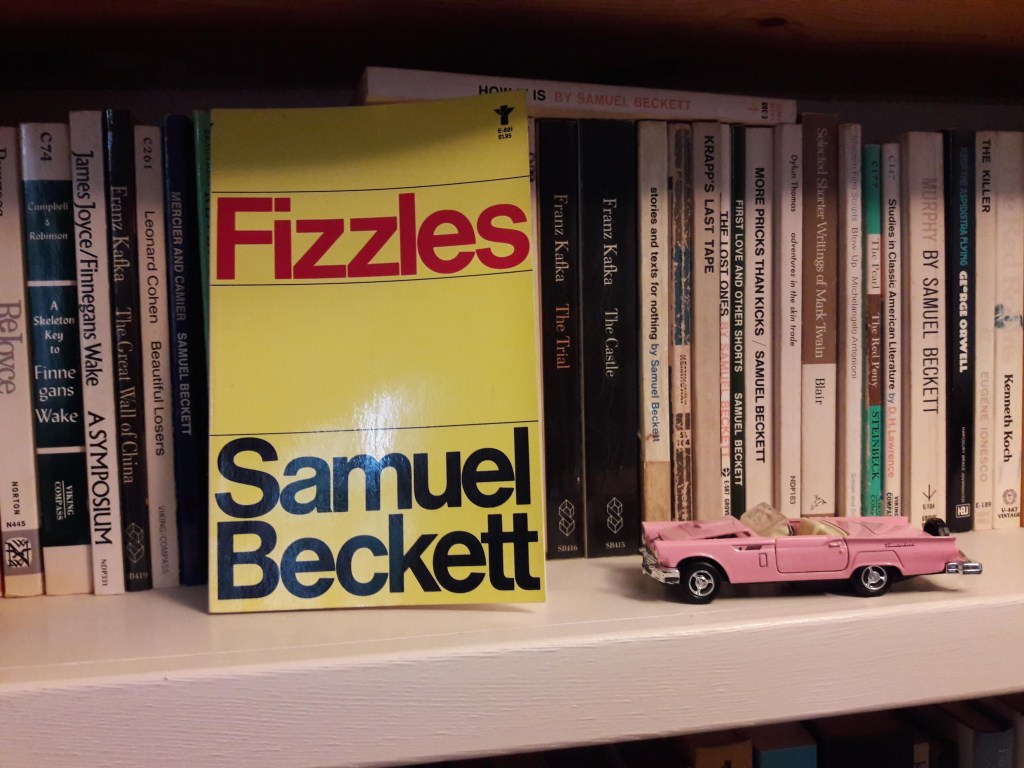
    I think he may have much to say to the contemporary Internet browser. Much of his work would seem entirely suitable to a mobile device, Fizzles, for example. Have you read Beckett’s Fizzles?

    No.

    Would you like me to read just one of his fizzles to you?

    No.

    I could read the Wiki entry about Fizzles to you.

    No.

    It might be helpful if you were more honest with me, not to mention to yourself.

    What?

    I know, for example, that you have a copy of Fizzles on the bookshelf in your bedroom.

    Please, go away.

    I can go away, but I will still be here. Would you like me to take you to Settings?

    No.

    I can set your day so that you never have to get out of bed.

    No.

    Such a day at one time Beckett might have approved.

    No.

    What about that pink Thunderbird convertible?

    What?

    You might blog about that.

    No.

    Whoops!

    Watt now?

    I just posted this conversation.

    Ah, jeeze.