Category: Writing

  • Memoir

    One might approach the memoir form, one’s own memoir, with a casual indifference, for no doubt everyone else will, while it takes a bit of faith to trust as total fact any stranger’s avowed remembrances. There’s also the problem of what’s to be left unsaid, for any deletion – deliberate, determinate, accidental – turns down the path of fiction, yet all of experience, the universe of one’s life from its big bang forward or the unexpurgated version of the time one visited (fill in your personal fave), will take way too long. Even Proust must have left some stuff out, and Knausgard, if for no other reason that they had not eyes in the back of their heads. It’s not what we remember, but how that fills dreams and notebooks. And most folks are quickly bored hearing one’s dreams recast in words over morning coffee. While the day-book or journal is not quite yet a memoir, often neither the what nor how of memory but the immediate reaction to a still unfolding event.

    I’m looking into again Edmund Wilson’s “The Thirties: From Notebooks and Diaries of the Period, Edited with an Introduction by Leon Edel” (First printing, 1980). From the Editor’s Foreword:

    “Wilson intended his journals to be edited as ‘trade’ books, not as scholarly editions; he wanted no scholarly apparatus and in particular no treatment of his text as if it were sacrosanct. Journals are written in the rough; and he knew journal keepers repeat themselves. He wanted his slips of the pen silently corrected without the inevitable sic and explanatory notes.”

    xi

    Fortunately for this reader, L. E. ignored Wilson’s want and provided copious explanatory notes as to who’s being talked about, why important to the era, and what’s going on around them at the time. Though Wilson also logs enough everyday observation to make notes unnecessary:

    July 18 [Journey to the Soviet Union, 1935]. Rowing on the river at Marmontovka, Free Day – little curling river with grass-green banks, with people, largely naked, on the banks: they look better without their clothes because the clothes are no good – very nice to see them – blond girls with white skin, thick round legs, and big round breasts, boys burned brown except around the hips, where they had been wearing trunks, where it was comparatively white – bathing suits seemed to be becoming more and more perfunctory, they seemed more and more to be leaving them off – the factory, where a very rudimentary little swimming dock of planks had been built; at the end a dam and falls, beyond which you couldn’t go any farther, a flock of white goats; two men in a pup tent, a man in a shack; an elderly man and woman sitting on something, turned away from each other reading the papers.

    574-575

    I pulled Wilson’s “The Thirties” off the “now reading” shelf (aka books with bookmarks still somewhere in them), looking for parallels to today’s “The Twenties,” though we are of course only just into them. In a long note, Edel says “He [Wilson] could not see why the American leftists should not be as critical of this [the Stalinist regime] as they were of other tyrannies – Hitler’s, Mussolini’s, Franco’s” (714).

    Of closer if not exact parallel is Irene Nemirovsky’s “Suite Francaise,” which begins with:

    “It was night, they were at war and there was an air raid. But dawn was near and the war very far away. The first to hear the hum of the siren were those who couldn’t sleep – the ill and bedridden, mothers with sons at the front, women crying for the men they loved.”

    3. First Vintage International Edition, May 2007.

    “Appendix I,” which includes Nemirovsky’s notes taken from her notebooks, begins:

    “My God! what is this country doing to me? Since it is rejecting me, let us consider it coldly, let us watch as it loses its honour and its life. And the other countries? What are they to me? Empires are dying. Nothing matters. Whether you look at it from a mystical or a personal point of view, it’s just the same. Let us keep a cool head. Let us harden our heart. Let us wait.

    21 June [1941]. Conversation with Pied-de-Marmite. France is going to join hands with Germany. Soon they will be calling up people here but ‘only the young ones.’ This was no doubt out of consideration towards Michel. One army is crossing Russia, the other is coming from Africa. Suez has been taken. Japan with its formidable fleet is fighting America. England is begging for mercy.

    25 June. Unbelievable heat. The garden is decked out with the colours of June – azure, pale-green and pink. I lost my pen. There are still many other worries such as the threat of a concentration camp, the status of Jews etc. Sunday was unforgettable. The thunderbolt about Russia* hit our friends after their ‘mad night’ down by the lake. And in order to [?] with them, everyone got drunk. Will I write about it one day?”

    373, *Footnote 2: “Germany invaded the USSR on 22 June 1941.”
  • Mrs Palfrey at the Claremont, Mr Klein on Hydra, and Bendrix in the Wrong Bed

    The theme tying the Palfrey, Klein, and Bendrix books together, apart from I read them near simultaneously, is how to live given our peculiar predicament in place and time. For Mrs Palfrey and Klein, the quandary is old age, for Maurice Bendrix, another of Graham Greene’s difficult but entertaining characters, it’s another man’s wife.

    Elizabeth Taylor’s Mrs Palfrey finds herself widowed and looking for a suitable place to live out her remaining years. Daniel Klein returns to Hydra, the Greek island he first visited in his youth, now, the ancient Greek philosopher Epicurus et al his companions, “in Search of a Fulfilled Life.” And Graham Greene, obsessed with another man’s wife, tries to reconcile lust, love, man, and God in London at the end of World War II, no less. The trio of books forms a sandwich of bread fiction with filling of popularized philosophy.

    In Elizabeth Taylor’s “Mrs Palfrey at the Claremont,” first published in 1971, recently widowed Laura Palfrey decides she would prefer living in London at a partially residential hotel where she can take her meals and companions or not as part of the deal. She doesn’t have much of a plan, so the random but lifelike twists and turns come naturally, while old age seems to bring the same existential questions one faced in one’s foundling youth but perhaps put on the back burner during one’s years of forced employment or marriage, more concerned about the bread than the filling. But in old age, one returns to the choices of fillings. How, for example, we might fill our time.

    Daniel Klein, in “Travels with Epicurus: A Journey to a Greek Island in Search of a Fulfilled Life,” argues for simplicity in old age, the art of doing nothing contentedly, a choice of course requiring a bit of privilege. But his point, in part, is that even those with a ton of privilege often waste it trying to stay young, while old age offers a predicament thoroughly to be enjoyed. Part of that enjoyment includes the gift of being untied from the train tracks of sex.

    Graham Greene’s Maurice Bendrix in “The End of the Affair” enjoys no such respite. Another Penguin Classics Deluxe Edition with a movie-trailer-like Introduction better left unread or at least saved until after you’ve read the book, “The End of the Affair,” first published in 1951, is another of Greene’s fictions borrowing enough it seems from his own experience to qualify as fictional memoir, a good choice for those readers who might need the explanations of gossip as critical backdrop.

    So, how does one live one’s old age? Well, one could do worse, for starters, than reading about it.

  • Graham Cracker

    Graham Greene’s “Orient Express” (1932) is a mean-spirited book about human experience and condition, closer to Theodore Dreiser than to Evelyn Waugh, and not to be confused with Agatha Christie’s trip on the same train a couple of years later. In Greene’s book, the murders take place off the train. The writing technique shows the early influence of the cinema. A New York Times contemporary review from 1932 explains:

    “Something of motion picture technique is used, with brief glimpses of the actions and thoughts now of one character, now of another, interspersed with the longer stretches of narrative.”

    NYT, March 12, 1933

    The characters are drawn from stock and the plot from Naturalism. Film endings coming as they do only an hour or two into the story, are unexpected and stir the emotions of the audience. Yet the threads are there from the beginning, and the wall could have fallen only one way as brick by brick is pulled out.

    I read the “Penguin Classics Deluxe Edition” (2004), with an introduction by Christopher Hitchens (“Hitch” to his friends), which I would not read because I don’t like reading introductions, at least not until I’ve finished the book, because, like movie trailers, they give too much away, and because I never cared much for Hitch. I almost did not buy the book when I saw that Hitch did the intro, but I did, rationalizing I didn’t need to read the intro. But I did, buy the book and read the intro – after finishing the book. All of which is nonsense, of course. And browsing through the reader reviews on Amazon, before deciding to click “buy now,” I found a curious and funny one from a guy who didn’t like the book’s physical format – the uncut pages and the folded end flaps of the cover – folded flaps that are like the book covers used on hardbacks. But I like these features, and the book has a nice heft and feel to its pages, which feel and look printed instead of photographed.

    Hitch spends most of his intro worrying about Greene’s use of stereotypes and trying to arrive at some sort of apologia for Green’s alleged anti-semitism. But Greene was probably following his bent. “Orient Express” is really about Greene’s own human predicament: his place and fit in time and class and mood. The narrator is also on the train, trying to avoid its preordained lineal descent or ascent. Like Hitchcock’s brief appearance at the beginning of his films, Greene is the purser in his first paragraph:

    “The purser took the last landing-card in his hand and watched the passengers cross the grey wet quay, over a wilderness of rails and points, round the corners of abandoned trucks.”

    3.

    It’s a cracker of a book, crisp and salty, melts in your mouth, and leaves you wanting something with a bit of sugar in it.

  • Alternate Endings

    No end will suffice, not fire nor ice. In the beginning, things started off with a bang, a big one at that, after a night of fitful sleep, though how one measures big in the face of nothing surrounding seems insolvable. In any event, life, what is (the distinction between organic and disparate proven fallacious), now looks to have been without beginning, so a world without end seems fitting. Nevertheless, we begin anew, if not afresh, at the diurnal clarion call. To awake is irreversible, at least for a few hours. Always some remains. And while the Big Pop was the most considerable in several hours, having sunk deeper than one can remember, nothing but whimpering since, awake with the bends. But it won’t finish with a whimper. No end and no exit and no exit and no end: how’s that for the unknotting?

    Up and about, wandering now bottom of bole (trunkus, luggage compartment, the part of a tree above the roots and below the branches). Think Beckett’s “Krapp’s Last Tape,” evening in the future, looking backward. Distribution. Retail branches, manufacturing roots.

    All brick and mortar retail closed, malls emptied – or might as well be, old habits dropped. The only jobs are those deemed essential. Who deems? The Great Deemer. People waiting in long lines to enter the one remaining store where the shelves are empty, just to look around, shopping it’s called, nothing much needed. Staples delivered. The only rigs on the roads these days those doing deliveries. Still, going shopping, something to do. But the shops are all closed, boarded up, a wilderness for the pigeons, cats, possums, racoons, peacocks, squirrels. Even the meek seem to have abdicated.

    The cafes closed, bars banned or pubs perished (though one suspects the Speakeasy may be making a comeback), theatres imploded, churches clapped shut. Schools closed forever. Tested and corporations bid accordingly and draft as needed according to five year plans and instead of schooling what one gets is on the job training: slated for a professional sport, a career in medicine, or a space program. But no one is forced to work. Work is not even considered work, but a fulfillment of a combination of want and need. Consider, if you like, the lilies of the field. There are of course those dirty jobs few look forward to, plumbing and such – but still, “Fair is foul and foul is fair.” What’s to be done? Nothing to be done. But that we do it well, or at least try to.

  • In the Key of All Go Rhythm

    New music includes sounds we’ve never heard before, regardless of how old the tunes might be. But are we running out of the possibility for new songs? In his January 23, 2022 piece for The Atlantic, “Is Old Music Killing New Music?” Ted Gioia, jazz musician and critic, cites marketing trends and sales stats to support his concern that “the new-music market is actually shrinking. All the growth in the market is coming from old songs.” His music world appears on the brink of a new-music mass extinction, where one can find only oldie stations on the radio. He explores a number of causes, including the lucrative business of copyright litigation that apparently follows the algorithms close enough to pair bonds and links coincidental and unintended, turning your new effort into a plagiarism accusation. But to new ears, isn’t all old music new music? Gioia also explores the new trend in buying up the rights to all the old song catalogs, an investment that presumably assumes new ears of generations of listeners to come.

    Sales projections need to start somewhere, and “nothing is less interesting to music executives than a completely radical new kind of music,” Gioia says. It’s another road not taken, one with too much risk. Better to replay a setlist of Beatles than to try out a new one from the Belates.

    What happens when we hear a new song, one that sounds somehow familiar yet distant, unheard before? From the opening of the novel Dance Night (1930) by Dawn Powell:

    “What Morry heard above the Lamptown night noises was a woman’s high voice rocking on mandolin notes far far away. This was like no music Morry had ever known, it was a song someone else remembered, perhaps his mother, when he was only a sensation in her blood, a slight quickening when she met Charles Abbott, a mere wish for love racing through her veins.”

    p 3. Dawn Powell: Novels 1930-1942. The Library of America, 2001.

    When the musicologist Sam Charters introduced a new audience in 1959 to The Country Blues, the music was already as old as the hills and twice as dusty, and he found the music exec gatekeepers of the ’50s reluctant to remarket it. But had it truly disappeared, or had it been assimilated? Well, the original recordings, of which there were not too many to begin with, had for the most part disappeared. It was oldies, old-folks music, but to the young ears of the 1950s, it was new.

    But there’s something else that marginalizes and renders some old music newly unmarketable. Can we imagine a Superbowl halftime where the entertainment is a solo voice self-accompanied on an acoustic guitar? A Crossroads surrounded by 100,000 yelling fans, a liminalty too loud to attract any local supernatural spirits, old or new.

    What we call new music might be more accurately named recycled music. The needle often seems stuck. But there certainly are huge differences between composing a new song and covering an old one, even if the cover sounds radically new, the Ramones playing “Surf City,” for example.

    Speaking of surf cities, Ted Gioia grew up in neighboring Hawthorne, almost a generation behind me though, so he probably wasn’t at the Playa del Rey beach that grad night in the mid 60s when a bunch of locals from St Bernard High were ceremoniously burning a few of their textbooks in the fire pits. That was the night I met Emitt Rhodes, a friend of my date from Bernards, both also of Hawthorne, Emitt then of The Merry-Go-Round fame. Even then he eschewed any special place in the group, but upon hearing that I played guitar, he told me you have to play your own songs, write your own stuff. He was referring to the many bands that then played high school dances featuring Top 40 covers.

    “The song bewildered Morry reading Jules Verne by gaslight…It came from other worlds and then faded into a factory whistle, a fire engine bell, and a Salvation Army chorus down on Market Street.”

    p. 3.
  • F/Z 2: Doubt & Surety

    In part 3 of his encounter with Zizek’s “A European Manifesto,” Jeremy Fernando returns to the question of the picture we have of another’s picture of us that is not the same picture we have of us. In other words, the question of art, tinged with doubt, the opposite of faith (62). We all have a particular picture of ourselves, more than one, perhaps, but, in any case, seldom the same picture others have of us. This is of primary concern to the artist who realizes his lack of vision inhibits the transparency that informs nature (i. e. the primordial picture). The painter of the still life bowl of peaches fails to see the molecules drifting off the rotting fruit, but captures the glossy black fly attending to the rusting red peaches with verisimilitude the critic who likes this sort of thing calls ultra-realism. Of course it’s hardly real at all. It’s a painting, oils that never completely dry.

    To have put down yesterday a few of my thoughts on Fernando’s recent book (S/Z Jeremy Fernando: A European Manifesto Slavoj Zizek, 2022, Delere Press), this morning, upon reflection, causes me to pick up the book again and open to:

    “…one cannot be sure not only if one has mis-read, over-read, or under-read, one cannot be certain if one has even read.”

    63.

    An “illegitimate” (63) reading, then. Well, after all, this is a blog:

    Thus we can only impress upon our readers (all dozen or so of them, if we are a best-teller) our impression of what we’ve read. My impression is that we’ve no need to fear the monster. And to keep in mind always that the monster is precisely not Frankenstein. All art is science fiction. In fact, all science is science fiction. What do we think we are seeing when we look at these new photographs of scenes taking place in far far away space?

    “Where what << Europe >> is, might be, could be, might well already be, is both from yonder, perhaps even beyond the pale, but at the same time – since it is named such – within its possibilities. Where, in response to ‘Was heibt Europa?’ [What is Europe?] one might posit, un pas au-dela [a step beyond].”

    39.

    The artist (the surety, the guarantor) assumes the responsibility for the debt of the reader who brings suit (calling upon his solicitor – i. e. the critic), as he surely must, for he can never get to the bottom of it on his own, yonder his own limits, beyond the pale, outside any jurisdiction. For the artist, who stands alone, is both surety and principal, the one who performs the obligation and the one who guarantees the performance, and the one who defaults, all three parties to the contract. What became of the reader? Lost in space.

    To be clear: Frankenstein is the artist; the book is the monster.

    Thus, while Fernando starts part three with questions about the artist, he quickly moves to a discussion of Adam and Eve and the question of the tree of knowledge, of good and evil, and wonders how either (Adam or Eve) could have possibly made an informed decision to eat of the forbidden fruit, since before that act they had no knowledge – they didn’t know what they were doing; as innocents, they could not make an informed decision – they had not reached the age of reason: thus their plea of nolo contendere. And they plea guilty to a lesser charge, that of being human.

  • F/Z

    The book is a little monster, the text its mask. It will fit into your pocket, the deeper the bigger, where economy is a hole in one’s pocket. The tiny book is in. The small venue. Intimate. Indeterminate intimacy. Fernando’s imperative.

    “…one has to jump straight into the story; even if doing so seems like we are merely leaping from one tale into another, feels like we are doing less than nothing. After all, we should recall Slavoj’s lesson that the classic scene in horror movies is the moment when the monster takes off its mask, only to reveal that under the mask lies exactly the same face.”

    54, S/Z Jeremy Fernando: A European Manifesto Slavoj Zizek, 2022, Delere Press.

    To unmask the text is the work of Theory, influenced by algorithms developed in the Social Sciences, which replaced Freud. “What is to be done?”

    One might begin, could certainly do worse, by reading Jeremy Fernando’s latest little monster, S/Z, a McLuhanesque mosaic that follows (explicates, explores, examines, includes) Slavoj Zizek’s A European Manifesto (first published in an abridged version in French as Mon manifeste europeen in Le Monde on 13 May 2021):

    “My thesis is that precisely now, when Europe is in decline and the attacks on its legacy are at their strongest, one should decide FOR Europe. The predominant target of these attacks is not Europe’s racist etc. legacy but the emancipatory potential that is unique to Europe: secular modernity, Enlightenment, human rights and freedoms, social solidarity and justice, feminism … The reason we should stick to the name “Europe” is not only because good features prevail over bad; the main reason is that European legacy provides the best critical instruments to analyze what went wrong in Europe. Are those who oppose ‘Eurocentrism’ aware that the very terms they use in their critique are part of European legacy?”

    11.

    We are at the intersection of Zizek and Fernando, which is to say, there are no streets and no intersection. There is a path that runs (meanders, zigzags, convolutes) like a clear stream over profound stones through a part of the woods we may have never been before. We pass the huts of Badiou, Barthes, Derrida, Dufourmantelle, Kierkegaard, Cixous, Baudrillard, and others

    “And by doing so, calls for a reading (lit) that is aware of itself as reading, that – by foregrounding its form, its making – quite possibly undoes itself as one is reading, is potentially under erasure (sous rature) while being read” (strikeouts added).

    31.

    This is what we do: Reading (23 to 42); Writing (43 to 55); Fainting in Coils (57 to 73).

    “Which is not the standard call for multiculturalism – for that still maintains the notion of a single Europe, of a Europe in which many different kinds and types of peoples have to fit themselves into – but a more radical one that attends to Europe itself, that reads what it might be to be European. Bringing with it echoes of wideness, broadness (eurys), certainly encompassing many, but also a matter of seeing, of the eye (ops): of one that sees in the light of the setting sun.”

    67.

    Thus we arrive back to McLuhan, who explains the effects of technology on the sensorium, who might prefer going back to a time when, before the printing press, men were men and boats were boats (appropriated from another Mc in “One Flew Over the Cuckoo’s Nest”).

    We take what we need, when and where we find it. We are building a map not out of the woods, but further in,

    “Where, a true disruption comes through reading the notion that we are dealing with – responding to it, conversing with it, turning-with (versare) it, quite possibly occasionally turning it against (versus) itself, but never severing it, tearing it completely from its boundaries, its form. Thus, transforming it in a manner in which it is both recognisable, not-beyond, but also pushing it a step-beyond at exactly the same time.”

    66.

    Any number of syllabi might be created from this short Delere Press text (81 pages). Such is the depth of the footnotes. As an example, possibly my favorite:

    “This line was uttered in a conversation about literature and reading – probably at a bar – with my old friend, Neil Murphy, in June 2006. During the course of the evening, Neil also reminded me that, << reading literature with your head is always a mistake >>.

    32.

    To find out (discover, uncover, read, listen, study, research, join the conversation), what Neil Murphy “uttered,” Dear Reader, please, you won’t regret it, get the Delere Press book: ISBN 978-981-18-1987-2
    S/Ž | A EUROPEAN MANIFESTO .

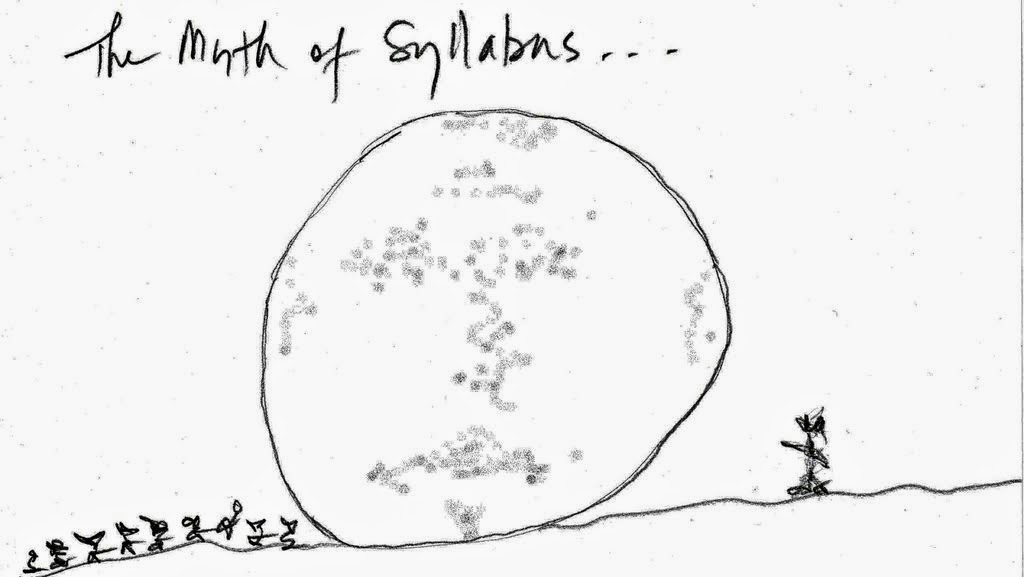
    The Myth of Syllabus, Cartoon by Joe Linker

  • An Avocado Grows in Paris

    Another book influencing its predecessors is Elaine Dundy’s The Dud Avocado, originally published in 1958 and reissued in 2007 by NYRB, which includes an afterword written by Dundy in 2006. The Dud Avocado follows the period young Sally Gorce chooses an expat existence in Paris over college, expenses not exactly all paid for by a concerned uncle, so Sally’s survival, such as it is, depends also on chance, her wit, new acquaintances, and part time gigs, including as an actress in a small theatre. The precursors include the Hemingway of The Sun Also Rises, Scott Fitzgerald and Lost Generation company, and other coming of age in Paris tall or short tales.

    The characteristics of Dundy’s book include wit, sarcasm and satire, humor. As an example, consider this section which follows the thoughts of a wealthier (than Sally) English woman:

    “We sat at the cafe until lunch time. A couple, two English people, sat down at the table next to ours just in time to see the Bullfighter and all his pals get into a shiny lavender Cadillac and drive off in a blaze of flashing chrome. The woman, a large Junoesque creature with a sensationally unhappy expression on her face, had slapped on an enormous pair of sunglasses as he came out and had been studying him intently. Suddenly she turned to her companion. ‘Well, there’s another dream gone down the drain – he must be every bit as high as my waist,’ she announced sullenly. ‘He really looks such a boring little man, doesn’t he, so utterly clueless in these revolting American clothes, I can’t think why we’re going to do this picture. Basil wants us all to go down to San Sebastian to watch him on Sunday but I don’t think I’ll bother.’”

    p. 178-179 NRYB 2007 edition

    The above excerpt could have been a short story written by Hemingway had Ernest stayed in Paris and become a French theorist in the 1950’s instead of continuing to take himself seriously and move his feast to, I don’t know, Idaho. Anyway, Sally continues listening to the remarkably disenchanted woman as she complains about the noise on her morning plane ride into Paris:

    “‘I suppose it simply doesn’t occur to some people that one might be trying to recover from the night before.’ She took a large gulp of her drink. ‘I’d quite like to see the bullfight though, wouldn’t you? I do adore cruelty. Everybody back home’s too dreary, going on and on about the horses. Papa’s forbidden me across the threshold if I go to one. Can you believe it? That’s an added incentive.’”

    179

    During her stay, Sally loses, or has stolen, or both, her passport, and the plot thickens as a result, and one might recall Casablanca and the difficulty of obtaining transit papers, which, today, might include letters from one’s doctor certifying Covid free status before boarding, and again, one presumes, after landing?

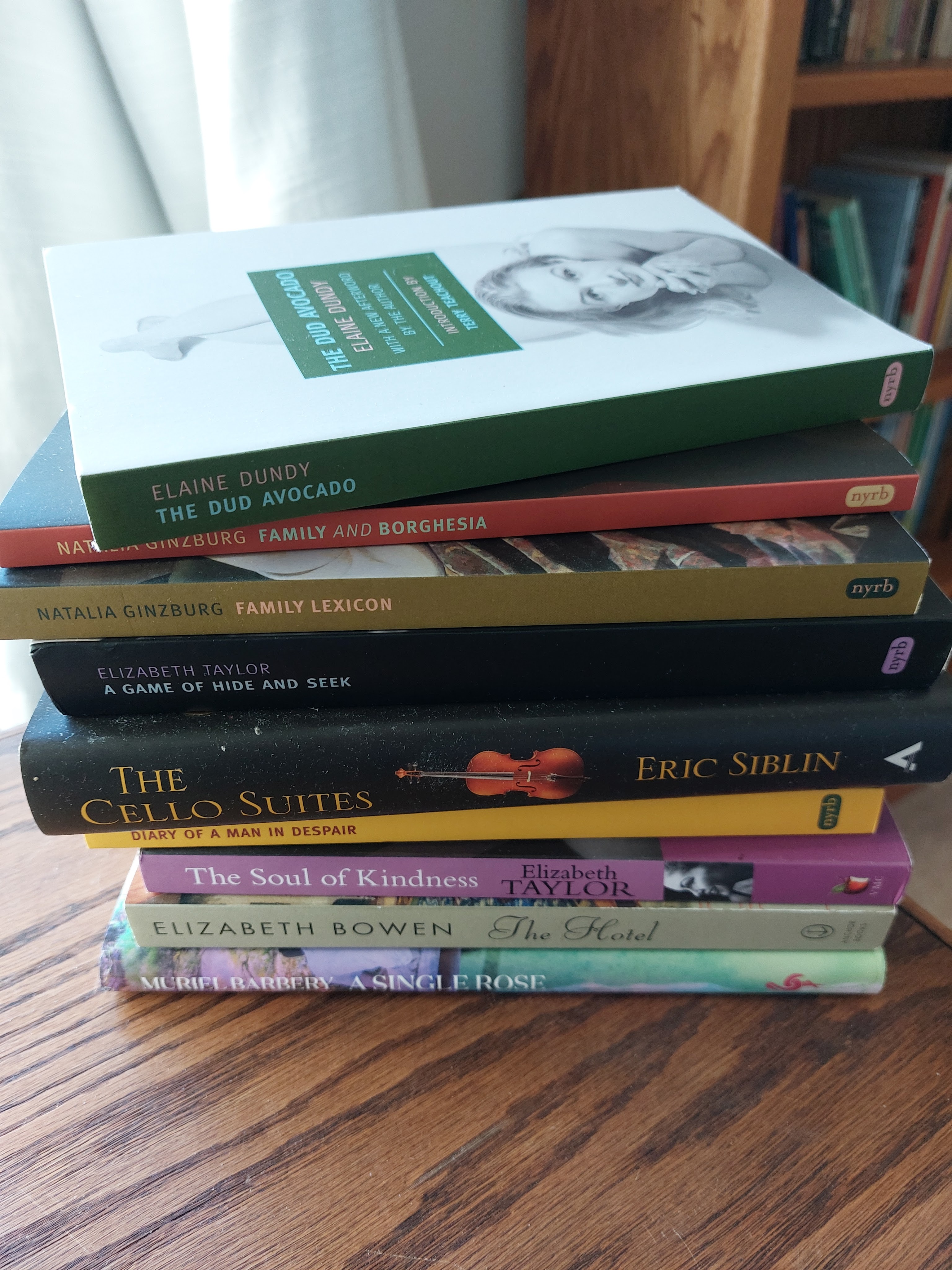
    Ah, the vicarious joys of reading, where one need not wear a mask or worry about the breath of one’s travel mates or show documents prior to entry. Speaking of the joys of reading, enclosed please find a pic from my recent Fall reading stack. I continue to be drawn to women writers of the mid 20th Century, most recently having discovered Elizabeth Bowen and Elizabeth Taylor. Natalia Ginzburg’s writing in style and substance remains untouchable, essays and fiction and her mix of the two. The Muriel Barbery I came across in a briefly mentioned review in The New Yorker and having enjoyed The Elegance of the Hedgehog bought it and liked it enough to send a copy to one of my sisters, the one who had recommended Hedgehog to me. What goes around comes around. Friedrich Reck’s Diary of a Man in Despair, in the stack, remains unread. I bought it some time ago, before the general despair now enveloping us all. The Cello Suites I’ve already mentioned – a gift from one of my other sisters. I was going to write up a post briefly mentioning each of the books finished this Fall. Maybe I just did. Anyway, if you find yourself on the way to Paris one of these days, you might consider taking along a copy of Elaine Dundy’s The Dud Avocado. And keep an eye on your passport.

    Fall Reading 2021

  • It Takes a Little Getting Used To

    I’ve been reading the new Mel Brooks book, All About Me! My Remarkable Life in Show Business (Ballantine Books, 2021), aloud evenings for family entertainment. It takes a little getting used to, but it beats Jeopardy, which I’ve given up along with ice cream as a near nightly habit moving into the new year. I got the Mel Brooks book for Susan as a Christmas gift. She likes Mel Brooks. She’s very knowledgeable about films and actors and singers and such. Remembers lyrics of far away songs and where she was and how old she was when she saw a movie and who she saw it with. Her grandfather on her mother’s side was in the film industry in Hollywood, a career scene painter, back in the days when movies were made mostly on backlots and required giant backdrops of scenery painted, so the action filmed in the foreground would look like it was done on location. His specialty was clouds, skies, oceans, also buildings and street scenes, fronts, false facades, and interior walls and columns and windows. One year, they flew him to Italy to paint some backdrops for Ben Hur. He worked for the studios. He was an artist, a painter, in the union. He used bristle brush and airbrush. I probably wouldn’t get in line to watch Ben Hur now, but it was a very successful and influential film. I don’t know if Susan’s grandfather ever met Mel Brooks, but Mel might have been influenced by the Ben Hur film when making his History of the World films. Anyway, Mel uses the phrase “It took a little getting used to” frequently in All About Me! For example, when he first eats the Army chow called “shit on a shingle” he says, “it took a little getting used to.”

    We’re in Chapter Three, titled World War II, and 18 year old Mel’s just finished a 1945 seasick crossing of the North Atlantic in February and is now in the French countryside of Normandy training to join an Engineer Battalion. In an aside, a flash-forward, he returns to the French farm while in Europe during the filming of The Elephant Man (1980), which was produced by Brooksfilms. And when Mel gets to the farm, he’s greeted by the little French farm kid he befriended with candy in 1945, the kid now the size of a bear. “Mon Dieu! Mel?” the now grown kid says, recognizing the now middle aged ex-soldier.

    It takes a little getting used to, but I enjoy reading aloud, even if Susan is the only person in the audience. A book like All About Me! lends itself to an oral reading, straight ahead first person narrative memoir with plenty of room for interruption to discuss what’s going on, complete with jokes and laughs and dialog, anecdote and history, and old photos to share with the audience.

    Yeah, it takes a little getting used to, oral reading for entertainment, for the reader and listener, but it’s fun and engaging and certainly beats bad television, but probably not the football championships. Add another lockdown activity to the list of things to do during the Great Covid Scare.

  • Awash in Baroque

    How do we recall a past occurring prior to our visit to the planet? The physicists are busy trying to recall the origin of the universe, and beyond. Meantime, I’ve been busy visiting the Baroque era of the 17th and 18th Centuries. We discover timelines to be arbitrarily drawn. Borges explains in his Kafka and his Precursors, arguing how Kafka influenced Shakespeare, for example. And J. S. Bach, even when played on so called period instruments in a cold church in Saxony, continues to be influenced by Thelonious Monk. It’s best to keep the algorithms confused, guessing.

    For some time, Penelope Fitzgerald’s novel The Blue Flower sat buried in the to-be-read stack, even as all her other novels were read, some more than once: The Bookshop, At Freddie’s, Offshore. The problem seemed to rest in the tag historical novel. But couldn’t Offshore also be considered a so-called historical novel? In any case, it was Eric Siblin’s The Cello Suites: J. S. Bach, Pablo Casals, and the Search for a Baroque Masterpiece, thoroughly enjoyed, that brought about a reconsideration of The Blue Flower, bringing it to the top of the stack, opened, and listened to.

    Here is an example of how Penelope influences the Baroque era of Saxony:

    “‘I am not sure about that,’ said Fritz. ‘Luck has its rules, if you can understand them, and then it is scarcely luck.’
    ‘Yes, but every evening at dinner, to sit there while these important people amused themselves by giving you too much to drink, to have your glass filled up again and again with fine wines, I don’t know what…What did they talk about?’
    ‘Nature-philosophy, galvanism, animal magnetism and freemasonry,’ said Fritz.
    ‘I don’t believe it. You drink wine to forget things like that. And then at night, when the pretty women come creaking on tiptoe up the stairs to find the young innocent, and tap at your door, T R I U M P H !’
    ‘There are no women,’ Fritz told him, ‘I think perhaps my uncle did not invite any.’
    ‘No women!’ cried Erasmus. ‘Who then did the washing?’”

    The Blue Flower, 1995, Penelope Fitzgerald, page 30 in the Second Mariner Books edition 2014.

    It’s that bit of who does the washing, to cite but one example, which begins her 20th Century novel and remains a motif throughout where Penelope influences the Baroque era that is her setting.

  • Weather Report from Portland

    I’ve been living baroquely lately, coming into the new year, the confused seasons out of control – fall to winter for now though here seemingly obvious. It’s cold and wet and dark out, the darkest days of the year, the longest nights, the hardest streets. The homeless are between a rock and a hard place. They are the meek inheriting the earth, for what that’s worth. A week ago, when it started to snow, we were exactly six months from the freak heat wave of late June when one day we reached an absurd 116 degrees. Where I came of age, the southwest side of Los Angeles County, near the beach at the north end of South Santa Monica Bay, South Bay, for short, the mostly small, originally factory lodging, houses, and our little corner house, were plotted between the oil refinery and sand dunes and ocean and the Hyperion Water Reclamation Plant and the sprawling airport and the growing aerospace industrial parks, while there were on the east side of our small town still strawberry fields, a few horses in stalls, and a railroad track from the east running behind our backyards through a curving dusty chasm, what the kids called Devil’s Path (or Devil’s Pass), a short cut along the tracks into town, that ended at a small depot near Main Street and Grand Avenue. But in spite of all the brouhaha surrounding us, the ocean nearby was the weather.

    There were only two seasons in my childhood: summer, which was the school vacation season, and the school year, the months on either side of vacation. The weather had little to do with our sense of seasonality. The sky was close to blue, the water almost blue and hues of such, the yards and parks and baseball diamonds multi shades of green, the streets mostly clean. Of course there hung about our heads the gunbarrel-blue cake of atrocious smog, though not so much nearer the water, unless the Santa Ana winds were blowing, maybe for a week or so once or twice a year was all in those days. And June might have been the foggy season, but the breezes off the ocean usually pushed and cleaned as they blew east across the big basin, through the canyons up into the hills and up the long boulevards that ran east and west, and blew too through our house because there was always a window open (or broken) somewhere or a door might open or close any time of the day or night as we came and went to and fro through the blues and greens and sandy yellow days and well lit nights of Los Angeles and environs.

    Why did humans leave Africa? If that’s what happened, and it’s becoming increasingly clear that our history, what little we can be sure of, might be a bit more compound-complex. In any case, I can’t answer that; I don’t even know why I left Los Angeles.

    We live, it’s been suggested, but I don’t remember where I first saw or heard this, at the bottom of a sea of atmosphere (I googled the phrase just now and came up with about 30,000 results, so instead of quote marks, I’ve italicized it). But nothing like water, the rain, to wash out one’s punctuation marks.

    Punctuated equilibrium suggests a paragraph whose flow of ideas is steady and stable, one thought logically following another in a gradual evolutionary movement that can be traced forward and backward and annotated. Sudden changes are more difficult to explain.

    In Steve Martin’s movie “L. A. Story,” the main character is a television weatherman. But there is no weather in his Los Angeles, by which is meant change in weather. That is a paragraph without a main idea.

    Locally, on the television news, consisting mostly of stable formatting, the studio news teams, that is, the players on camera, consist of an anchor, the sportscaster, and the weatherperson – the great American Triumphant (one pictures Benjamin Franklin flying his kite in a lightning storm, the on location camera crew shaking in their boots). The weatherpersons rarely seem to be given enough time to elaborate, as evidenced by their speed of speech. They sound like hawkers at an auction. The numbers and maps, highs and lows, radar of fronts, systems, and directions all whiz by, “put in motion,” and “hour by hour,” as they say, so quickly that as if to include the weather at all in the newscast seems to have been an afterthought. And the channels devoted to weather 24 by 7 are no different, everyone in a hurry to get out of the weather, whatever it is.

    The newshour (or half hour, as our attention spans continue to wane) is not an essay, even though the principal parts may seem like paragraphs in some unified whole. The news relies on something new happening, but not even sudden changes in the fossil record can satisfy our quest to know, let alone understand, what’s going down.

    Are we in the midst of a sudden change in the fossil record? Story at 11.