To a neighborly inquiry, yes, we saw the vicious attack on the venerable E. B. White, first in the Chronicle, then, with several bystanders jumping on for a kick or two, in the Times. We first became aware of Pullum at Emdashes, where, we thought, Martin Schneider – omitting needless words – handled the matter clearly and concisely and to a close, but we like following links, so from Emdashes, we followed a link to Levi Stahl’s discussion; without explaining too much, he dismisses the academic Pullum to move on to a more tasteful topic, E. B. White’s letters.
We are aware of the shortcomings of Elements, having on our own often tried to tackle the issue of what’s correct when. Pullum posts his own follow-up, fed up with the commenters (we have added his blog to our feeds). In his follow-up, he heads off going to his book, but it seems fair to ask if not White then what. Pullum’s book is a descriptive grammar, so it “…will not…make recommendations about how you should speak or write” (p. 3). It should come as no surprise to anyone that there are disagreements and conflicting opinions. For example, and as we’ve pointed out, White said to write with nouns and verbs; Erskine said to write with modifiers. Of course, the answer is to write with words, and good luck choosing the right ones, putting them in the right order, and separating them with the right punctuation.
In the June 28, 2004 New Yorker, we enjoyed Menand’s dissing of Truss, and he helps explain why we prefer White to the standard grammar text. Menand (like White before him) writes as a generalist, not a specialist. Menand argues, and we agree, and we think that White also agreed, that the rules don’t really have much to do with effective writing. If they did, most academic writing would not be nearly so anemic. Pullum complains in his Chronicle piece that “Some of the recommendations are vapid, like ‘Be clear’ (how could one disagree?).” Yet much academic writing would improve if the writer would only make some attempt at following this obvious, White tenet. In Menand’s piece, titled “Bad Comma,” he has something more to say than corrections of Truss. We don’t find that Pullum has much more to say, at least not on the evidence of the two pieces we see here.
We’ll ask White to help us with a close, from the March 4, 1944, New Yorker: “A good deal depends on the aims of a publication. The more devious the motives of his employer, the more difficult for a writer to write as he pleases. As far as we have been able to discover, the keepers of this house have two aims: the first is to make money, the second is to make sense”; two aims that academic writers are not usually saddled with.
None of which directly answers Pullum’s argument. Pullum has two points: one, that Elements is flawed; two, that the flaws have afflicted generations of students who as a result of their immersion in Elements cannot now write. Pullum provides support for his first point; his second is insupportable. There might be scores of students unable to write, but it doesn’t follow that it’s the fault of Elements. But what about our point that the argument is somehow embroiled in academic versus commercial ends, that Pullum’s secret thesis is the advancement of the purpose of his text – a poor advertisement if he wants to compete with the incredible ethos surrounding White, an ethos based not on Elements, but on his actual writing success. That point is irrelevant to Pullum’s argument. But we have two claims too: first, students can’t write because they’ve been taught writing from grammar handbooks and textbooks, wrong from the start; second, that the textbooks are unnecessarily academic and rarely involve the kinds of reading experience necessary for students to improve their writing skills (the textbook industry’s commercial success is driven in large part from forced new editions, captive student readers, and exorbitant pricing).
At the same time, there are academic efforts that have made both money and sense: for example, Zinsser’s On Writing Well; Toward Clarity and Grace, by Joseph Williams (whose “The Phenomenology of Error” is must reading for anyone seriously interested in this argument); and Notes Toward a New Rhetoric, by Francis Christensen. We never said Elements was the only book to read, just that it is a worthwhile book to read and carry. And we are grateful to Mr. Pullum for updating its errors – his analysis will add fuel to the discussion of the choices suggested in Elements.
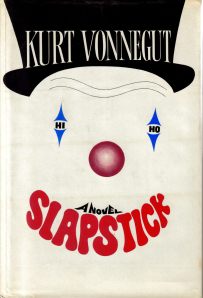 Why facebook? Why not faceweb? The web is not a book. Then again, what is a book? What is a web? The web is like an illuminated manuscript.
 …facebook, face + book, already a metaphor, specialized. Books are sequential, linear; facebook is mosaic, multidirectional: The face as book, borrowing book as ethos for the face that is prepared, so a face with credibility, reliability, with a fixed point of view. Really? Eye contact; I contact, enter-face. “Manuscript culture is conversational if only because the writer and his audience are physically related by the form of publication as performance” (McLuhan, [The Gutenberg Galaxy], 1962, p. 105). Webworm.
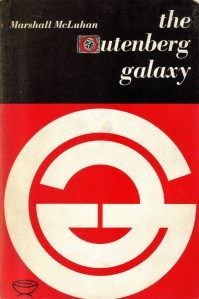 Madison Avenue was first to show interest in McLuhan’s ideas. What were those ideas? He did not argue an aesthetic, as
  There is no place to hide in the existentialism of Sartre and Beauvoir, but one does not go there to hide, but to realize. Jesus was the first existentialist (as Kierkegaard showed), and the early Christians lived by choice, reborn in an existential rejection of a status quo existence, rejecting their birth rights (and wrongs), if they had any, their birth situation, for a choice that gave meaning to their lives. The early Christians chose choice; they chose freedom, and the choice was all encompassing.
 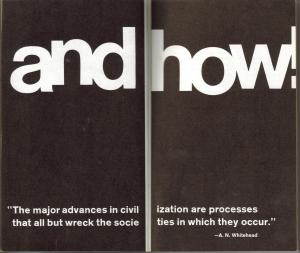 We know technology
  John Linker’s
 The mixture of violence with comedy in Flannery O’Connor’s stories offers up an absurd exaggeration of the ordinary. The Coen brothers must be fans, and Flannery a precursor to their film style. Flannery’s ritual, taken from the church and put out on the street, in the fields, or confined to crowded houses, yet still proudly clad in the absurd array of ecclesiastical colors, seems to undermine any serious attempt at self-discovery, yet speaks to where we come from, who we are, where we might be going, and who might be watching.
  The Coming of the Toads