My poem “A Grammar of Love,” which appeared in the May 24, 2009 print edition of The Christian Science Monitor, and which you might enjoy, is now posted on the CSM website.
Category: Reading
-
Ruth Reichl Comforts with Apples, Beckett with Words
“How’s the carrot?” Vladimir asks. “It’s a carrot,” Estragon replies….“That’s what annoys me….I’ll never forget this carrot.”
If a food writer describes an ice cream cone with such description that we can taste it – ah, but that’s just the problem, we can’t taste words. Words have shape, perhaps even texture. They fill our mouths, or used to, when we read like the monks, but words don’t have flavor. This is the existential predicament of the restaurant and food critic.
Perhaps it explains the poetic license of their exaggerations. Reichl, explaining her resorting to fiction to enliven a restaurant review, explains to her editor at the LA Times, “Haven’t you noticed that food all by itself is really boring to read about?…It’s everything around the food that makes it interesting. The sociology. The politics. The history” (p. 250). Nevertheless, “…this won’t do,” her editor replies. “In journalism you have to tell the truth” (p. 250). She then goes on to describe the historic Hancock Park neighborhood of Los Angeles, where “…the houses were decrepit…” (p. 251). It’s been awhile since we’ve driven through Hancock Park, but surely only a food critic could describe the dwellings and lawns there as bedraggled.
But then the perspective is from one for whom meals last five hours, and where “For great balsamico, the process takes an entire lifetime, the vinegar becoming more concentrated as it progresses through subsequent barrels of oak, chestnut, mulberry, and juniper” (p. 59). She can comfort with words, and the words do, for the most part, describe food.
“Crritic!” says Estragon, “(with finality).”
Reichl, R. (2001). Comfort me with apples [with recipes]. New York: Random House.
-
Kicking E. B. White When He’s Down
To a neighborly inquiry, yes, we saw the vicious attack on the venerable E. B. White, first in the Chronicle, then, with several bystanders jumping on for a kick or two, in the Times. We first became aware of Pullum at Emdashes, where, we thought, Martin Schneider – omitting needless words – handled the matter clearly and concisely and to a close, but we like following links, so from Emdashes, we followed a link to Levi Stahl’s discussion; without explaining too much, he dismisses the academic Pullum to move on to a more tasteful topic, E. B. White’s letters.
We are aware of the shortcomings of Elements, having on our own often tried to tackle the issue of what’s correct when. Pullum posts his own follow-up, fed up with the commenters (we have added his blog to our feeds). In his follow-up, he heads off going to his book, but it seems fair to ask if not White then what. Pullum’s book is a descriptive grammar, so it “…will not…make recommendations about how you should speak or write” (p. 3). It should come as no surprise to anyone that there are disagreements and conflicting opinions. For example, and as we’ve pointed out, White said to write with nouns and verbs; Erskine said to write with modifiers. Of course, the answer is to write with words, and good luck choosing the right ones, putting them in the right order, and separating them with the right punctuation.
In the June 28, 2004 New Yorker, we enjoyed Menand’s dissing of Truss, and he helps explain why we prefer White to the standard grammar text. Menand (like White before him) writes as a generalist, not a specialist. Menand argues, and we agree, and we think that White also agreed, that the rules don’t really have much to do with effective writing. If they did, most academic writing would not be nearly so anemic. Pullum complains in his Chronicle piece that “Some of the recommendations are vapid, like ‘Be clear’ (how could one disagree?).” Yet much academic writing would improve if the writer would only make some attempt at following this obvious, White tenet. In Menand’s piece, titled “Bad Comma,” he has something more to say than corrections of Truss. We don’t find that Pullum has much more to say, at least not on the evidence of the two pieces we see here.
We’ll ask White to help us with a close, from the March 4, 1944, New Yorker: “A good deal depends on the aims of a publication. The more devious the motives of his employer, the more difficult for a writer to write as he pleases. As far as we have been able to discover, the keepers of this house have two aims: the first is to make money, the second is to make sense”; two aims that academic writers are not usually saddled with.
None of which directly answers Pullum’s argument. Pullum has two points: one, that Elements is flawed; two, that the flaws have afflicted generations of students who as a result of their immersion in Elements cannot now write. Pullum provides support for his first point; his second is insupportable. There might be scores of students unable to write, but it doesn’t follow that it’s the fault of Elements. But what about our point that the argument is somehow embroiled in academic versus commercial ends, that Pullum’s secret thesis is the advancement of the purpose of his text – a poor advertisement if he wants to compete with the incredible ethos surrounding White, an ethos based not on Elements, but on his actual writing success. That point is irrelevant to Pullum’s argument. But we have two claims too: first, students can’t write because they’ve been taught writing from grammar handbooks and textbooks, wrong from the start; second, that the textbooks are unnecessarily academic and rarely involve the kinds of reading experience necessary for students to improve their writing skills (the textbook industry’s commercial success is driven in large part from forced new editions, captive student readers, and exorbitant pricing).
At the same time, there are academic efforts that have made both money and sense: for example, Zinsser’s On Writing Well; Toward Clarity and Grace, by Joseph Williams (whose “The Phenomenology of Error” is must reading for anyone seriously interested in this argument); and Notes Toward a New Rhetoric, by Francis Christensen. We never said Elements was the only book to read, just that it is a worthwhile book to read and carry. And we are grateful to Mr. Pullum for updating its errors – his analysis will add fuel to the discussion of the choices suggested in Elements.
-
E. O. Wilson’s Happy Ant in Mary Midgley’s Primate Picnic
Human freedom creates morality, for to exercise our freedom we are held in a cage of motive. The stuff of motive is found in literature, and we thought we might there experience freedom unrestrained by complicity, and our awareness of others’ actions might be total. Through literature we would enjoy our freedom without ourselves being questioned as to our motives.
Those are the sorts of things I found myself jotting down in my notebook while reading Midgley’s book. Why was I reading Mary Midgley? I’d been meaning to read some Midgley ever since her interview last year in The Believer – which she consented to only after being assured it was not a religious magazine.
Midgley takes on E. O. Wilson, who viewed humanity as a dysfunctional ant colony, saw the potential for individual happiness from a sociobiologist’s viewpoint, the neurobiologist the queen of the ant hill. The Humanities work best when non-specialized, and acknowledging a plurality of motives, looking behind the Main Street facades, but enjoying the stroll. But when the Humanities also buy into reductive thinking, and fragment, capabilities are lost, for, as Buckminster Fuller showed, specialization leads to extinction – when the organism loses its ability to adapt. Midgley’s term of Wilson’s progress is “bilogicised,” where he excludes “amateur thinking,” and the “merely wise,” as if there is such a thing as an amateur human, people who live just as a hobby. But looking at today’s superhighways one wonders if Wilson wasn’t on to something with his ants. But do ants cry? Laugh? Stray from the scented path? Take irrational risks? Celebrate birthdays? Humans are not ants, even if they both do like to picnic.
Midgley explains that moral judgments are not only possible, but necessary, and not only necessary but mandatory, compelling, and binding: mandatory in that to be human is to be moral; compelling in that our moral judgments forge our path through the otherwise inhospitable jungle of the universe; binding in that we must live the results of our judgments – we can’t escape our own judgments.
If we are in the universe, and we have a moral purpose, how can the universe not have a moral purpose? For why is there something? Why is there simply not something, but nothing? Does not this fact of something trump the possibility of nothing, and suggest a moral to the story? Perhaps we are short-lived, but if we are short-lived why have we evolved to a moral purpose, that moral purpose evolving consistent with our evolving consciousness? Perhaps we are the universe’s only chance at a moral purpose, of realizing a moral purpose for itself.
If the human is denied a moral purpose, we lose our freedom, are literally “demoralized,” and we are our own cage, a bag of genes.
Specialization leads to extinction, which explains why the specialists practice reduction of their competitors, wanting to “cannibalize” every threat to the dominance of their singular point of view, and thus lose the ability to adapt. The cannibalization takes the form of propaganda, a disguised values’ trap, where one is led to miscalculate the future results of one’s current actions.
Sung to the tune of Teddy Bears’ Picnic: If you go out in the woods today you’re in for a big surprise, for today’s the day the primates have their picnic.
Midgley, M. (1994). The ethical primate: Humans, freedom and morality. New York: Routledge.
-
Eca de Queiros and a Metaphysical Googlelarity
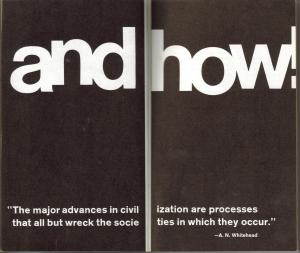 We know technology changes us, rearranges the sensorium; the printing press, for example, gave the eye dominance over the ear, as McCluhan explained. But is technological change bad for us? What do we value? What do we want? We survive by our abilities to adapt; change is irrelevant. The question shouldn’t be “Is Google Making Us Stupid?” but, is Google making us happy?
 In Eca de Queiros’s The City and the Mountains (1895, new Margaret Jull Costa translation from New Directions, 2008) civilization is defined and confined by its “machines and instruments” (p. 50): “Defeated, my Prince slouched into his study and did the rounds of all those machines intended to complete or facilitate Life – the Telegraph, the Telephone, the Phonograph, the Radiometer, the Graphophone, the Microphone, the Writing Machine, the Adding Machine, the Electric Press, the Magnetic Press, all his tools and tubes and wires…” (p. 120).
There’s even a link, 1895 version: “Then, desperately, he linked No. 202 up with the telegraphic wires of The Times, so that his study, like a heart, would pulsate with the whole Social Life of Europe” (p. 114-115).
But the ruling class isn’t happy, and getting on their machines does nothing to improve their foolishness: “Like some icy, melancholy sun, the Electricity blazed down on the silence and on the pensive immobility of all those backs and all those décolletages. From each attentive ear, cupped by a hand, hung a black wire, like a piece of intestine…superior, civilized beings devoutly and silently drinking in the obscenities Gilberte was bleating down the line at them from beneath the soil of Paris, through wires buried in the gutters, close by the sewers…” (p. 62-63). They are all logged on, severally, to the “Theaterphone.”
The problem is the city, civilization, machines that lack the ability to bestow grace: “But the City has its most deleterious effects on Man’s Intelligence, which it either imprisons in banality or drives into wild extravagance” (p. 93). The city lights do not illuminate most of its inhabitants: “If the illusion of the City could at the very least make all the people who maintained it happy, but it patently fails!” (p. 94). And so they leave for the mountains of the title, taking only a small part of the “super-civilized Prince’s sumptuous collection” with them.
Were it 2009, would they be taking their laptops, which, like Stevens’s jar in “Anecdote of the Jar,” would likely jar the nature of the mountains and their own alike, like nothing else in Portugal? We find out in the second half of The City and the Mountains.
-
John Cage, Cowboy Surf Shop, and Garage Jazz
John Cage was the first garage musician, freeing music at once from the academy, from high culture, from ubiquitous radios, from naturalism – from preconceived notions of what sounds should sound like. Cage valued sounds; he desired sounds, required sounds. Cage captured sounds he found in his environment and remixed them in his garage, creating a philosophy of music that encouraged listeners to experiment, restoring sound to primeval element. Cage’s music is not devoid of sentimentality, and heralds both warnings and callings – electronic blasts to the chest, bees dancing in the labyrinths of our ears.
We are anxious to hear the sounds we make, our own voice, which we hear in unison, subverting our self-consciousness. The echo, reverb, was the first natural recording. Garage Band allows us to extend the range of our voice, format, and get loopy – all Cageian values. We’ve been listening for a long, long time; how much training do we require?
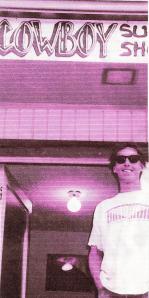 John Linker’s Cowboy Surf Shop employs his various interests – folk, alternative, literature, surfing, and playing guitar as something to do with your hands. In one piece, “Rock ‘n Roll Eden,” a Lou Reed cover, we hear a voice reading from Jack London (Jack’s ranch, in the Valley of the Moon, is not too far from John’s place). A diversion from teaching duties, John’s project is a demo, a rough draft, experimenting with loops, voice-overs, a variety of instruments (sans drums – bass picks up both rhythm and percussion), and improvisation on covers and originals.
When in the Army in the late 60’s we used to hang around the motor pool after hours playing guitar. Spec. 4 Martin, who had worked at Fender, offered this criticism: “You never play the same thing the same way.” As we’ve discussed, Cage was not a jazz fan, but what we require now is garage jazz, inviting thought: what is garage; what is jazz.
-
Distance of First Person Plural
For some time we’ve been thinking of addressing the blog’s use of the first person plural. Are we a group blog, or command central for some multiple personality? Are we looking for safety in number?
At St. Anthony’s in the early sixties we lined up outdoors in front of our classrooms following recess, shortest in the front to tallest in the rear, boys stage left, girls stage right. Reverend Mother called out “Distance: 1, 2, 3.” On 1, we placed our left hand, extending our arm, on the left shoulder of the student in front of us; on 2, we extended our right arm, the line pressing backward and up the hill as we distanced ourselves from each other, so the tallest in the back became taller still, and a kind of order overcame and stilled the playground. The unruly mob dissipated; the shouts on the street diminished. And on 3 we dropped our arms to our sides and stood silently at attention, individuals now, each responsible for I. We disappeared from view. Deviations deserved detention; no one wanted to be a you. All was still, until a whistle blew, and we marched into the classrooms.
Readers familiar with The New Yorker may recall the editorial “we” of the early “Notes and Comment” section of that magazine, to which E. B. White often contributed, writing, against his intuition, in the first person plural, the required editorial voice of the section. White apparently thought the practice silly; nevertheless, we recommend you try writing in the first person plural as a writing exercise.
You might enjoy the distance of the joke, a kind of detachment that comes from not taking yourself too seriously, though some suggest that’s just non-committal. You can get trapped in we, and that’s not good. But losing yourself in we might make for a good writing experience, might even improve your writing. The assumption that most academic writing of course should stay out of it altogether, whence the “one” of the formal academic style, as in “one wonders what this is all about,” ignores the results – often directionless and unfriendly prose. One wonders who this one is too, and if there might be a more clear and concise way to identify oneself and one’s view. It’s a question of distance.
-
Flannery O’Connor and the Coen Brothers
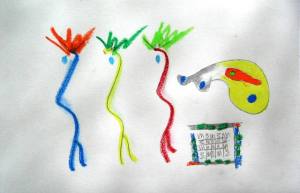 The mixture of violence with comedy in Flannery O’Connor’s stories offers up an absurd exaggeration of the ordinary. The Coen brothers must be fans, and Flannery a precursor to their film style. Flannery’s ritual, taken from the church and put out on the street, in the fields, or confined to crowded houses, yet still proudly clad in the absurd array of ecclesiastical colors, seems to undermine any serious attempt at self-discovery, yet speaks to where we come from, who we are, where we might be going, and who might be watching.
 -
Susan Sontag and a Valentine for Flannery O’Connor
Flannery O’Connor’s stories stir a natural absurd mix of violence and comedy. Characters argue and alienate themselves from one another. They have difficulty communicating, and they torment one another. Yet, throughout the stories, we find humor – comedy in situation, language, and setting. What better day to read a Flannery story than Valentine Day?
In O’Connor’s short story “Parker’s Back,” Parker, having experienced the epiphany at the scene of the tractor crash, drives straight to the tattoo parlor, where he’s a frequent visitor, yet the tattooist at first doesn’t recognize Parker, and there’s humor in their brief exchange, Parker calling out that surely the tattooist must know him. “You must have been in jail” the tattooist says. “Married,” Parker answers.
That “The world of the absurd delighted her” (Sally Fitzgerald) is clear in any reading of Flannery’s stories. Albert Camus also delighted in the absurd. But it’s Susan Sontag who best illuminates “Parker’s Back.” Borrowing Sontag’s terms, from her essay on Norman O. Brown’s Life Against Death, Parker is body, and Sarah, his wife – well, is not body, but what is she?
Sarah dislikes color, and color, for Flannery, is sacramental raiment; her stories create a collage of peacock feathers. “Christian asceticism,” O. Brown writes, “can carry punishment of the fallen body to heights inconceivable to Plato, but Christian hope is for the redemption of that fallen body.” Sarah, who is “saved,” rejects Parker’s vestmented body. “…by putting his ideas in the framework of Christian eschatology,” Sontag tells us, “…Brown’s analysis, by allying itself with some of the submerged promises of Christian eschatology, opens up the possibility of a psychoanalytic theory of history which does not simply reduce cultural history to the psychology of individuals.”
Of course, Sontag also gave us this – from “Against Interpretation”: “…interpretations of art today poisons our sensibilities. In a culture whose already classical dilemma is the hypertrophy of the intellect at the expense of energy and sensual capability, interpretation is the revenge of the intellect upon art…it is the revenge of the intellect upon the world. To interpret is to impoverish, to deplete the world – in order to set up a shadow world of ‘meanings.’” Happy Valentine Day, Flannery.
-
Albert Camus on the Economic Collapse
 An old friend from our South Santa Monica Bay days writes, “Did I hear that right? 5 day forecast for around here is in the upper 80’s. Visibility for miles. Air quality is wonderful. But, this is January.”
In the mornings we went surfing, and in the afternoons we played whiffle ball in the yard or in the street. Maybe we walked to the five and dime for a pack of baseball cards, but if there were no good cards in the pack there was still the bubblegum, the smell like a perfume. Summers we camped on the beach at Refugio and for days wore nothing but our swim-trunks.
 We are reminded again of Camus’s “The Sea Close By”: “I grew up with the sea and poverty for me was sumptuous; then I lost the sea and found all luxuries gray and poverty unbearable” (p. 172). And this, from “Return to Tipasa”: “In the depths of winter, I finally learned that within me there lay an invincible summer” (p. 169).
Camus, Albert. (1970). Lyrical and critical essays. Vintage Books: New York.
-
E. B. White and the plumber

In December of 1930, E. B. White wrote a piece for the New Yorker about the garbageman. “They have the town by the tail and they know it,” White concluded, after a brief study of the can collector’s habits. We like to watch the trashman too, the descendants of White’s subjects, wrestling now with new regulations, recycling, knowledge of toxic waste, but still masters of noise and dust, their barking trucks heard for blocks, avalanches of glass announcing last call for trash. But while today’s garbageman may still have the city by the tail, surely it’s the plumber has it by the nose.
My father was a plumber, and asked us to join him in the trade; shucks, I wanted to continue school. But I worked with him summers and accompanied him on enough evening calls to achieve a kind of apprentice status. A neighbor would knock, a friend would call, a parishioner, a friend of a friend – a brief diagnosis on the phone and I was told which tools to grab from the garage and we were off, a doctor making a house call. Dad almost never accepted money for these evening jobs. He would accept a beer, sit, and talk.
No job was too awful, foul, or hard. With his bare hands he swept away monstrous crawl space spiders, reached into cold plugged up toilet bowls, chiseled oakum into cast iron joints – which I sometimes got to pour the molten lead into with the long handled ladle from the boiling pot. Our antagonists were usually stripped threads, worn washers, busted pipes, and all manner of backened slop. Dad did not relish repair work; by day he was a new construction plumber, working with new parts, not used. What he did relish was the opportunity to get out of the house and talk to people. He was the James Joyce of the plumbing trade. He could talk to anyone, for he had them, and he knew it, by the nose.
Time passing and enter George, the veteran plumber we now call when wet to the knees and elbows but I still can’t fix it. We called George recently to help us with a pipe cracked during the big freeze and snows. After the job we sat with George in the living room; he did most of the talking, and we listened. Before the pipe broke, I had been reading E. B. White, but after George left, I let E. B. sit, and I paused to think of my father, the plumber, and my decision to continue school.
 The Coming of the Toads