Category: Reading

  • Get Real

    To make art, to make things
    out of other things, to engage
    in artifice, a confidence game:
    “Get real,” your critics say.
    The earth is a rug
    constantly being pulled
    out from under you.

    The artificial is real: the bread
    and wine camouflage the need
    to sacrifice the poor lost lamb,
    not to mention the virgin,
    created by man made
    design critics to avoid
    her real predicament:

    “Poor and rich belonged to the same world and placed themselves on a common, even sliding scale, but beggars could not. The ptochos was someone who had lost many or all of his family and social ties. He was a wanderer, therefore a foreigner for others, unable to tax for any length of time the resources of a group to which he could contribute very little or nothing at all…a ptochos was a shocking reality for the Greco-Roman world” (272). 1

    “The beatitude of Jesus declared blessed, then, not the poor but the destitute, not poverty but beggary…Jesus spoke of a Kingdom not of the Peasant or Artisan classes but of the Unclean, Degraded, and Expendable classes” (273). 2

    1. Gildas Hamas quoted in John Dominic Crossan’s “The Historical Jesus: The Life of a Mediterranean Jewish Peasant” (272). 2. Crossan gloss of Gerhard Lenski (273).

    Who then or now could write
    a poem who is not at least poor
    real poor or in spirit or metaphor?
    Yet the beggars make their signs
    and hold up their poems
    along the roadsides,
    the least of publications,
    the yeast of city life.

    “What is needed, then, is not insight into the Kingdom as future but a recognition of the Kingdom as present. For Jesus, a Kingdom of beggars and weeds is a Kingdom of here and now” (Crossan, 283).

    What is real
    will not be
    found staring
    at the universe
    through artificial eyes
    to catch a glimpse
    of dawn’s first light,
    nor descending
    to the bottom
    of the sea
    in rich pods
    to study ancient
    shipwrecks,
    nor in any travel
    nor in any poem.

    But surely we must
    avoid the real
    at all cost
    and become more
    artificial.

  • Storybooks

    Sitting outside in the morning lull from our summer heat wave when I look up to see a coyote jogging by in the street. She looks at me but continues running up the hill. I get up and walk to the street and see her now at the top of the hill in the middle of the next intersection, paused, looking right and left, then crosses, continuing north. It’s not unheard of to see coyotes in our neighborhood, but it’s 9:30 – usually the reports we hear of a coyote sighting are from someone up at dawn, out jogging or heading off to work.

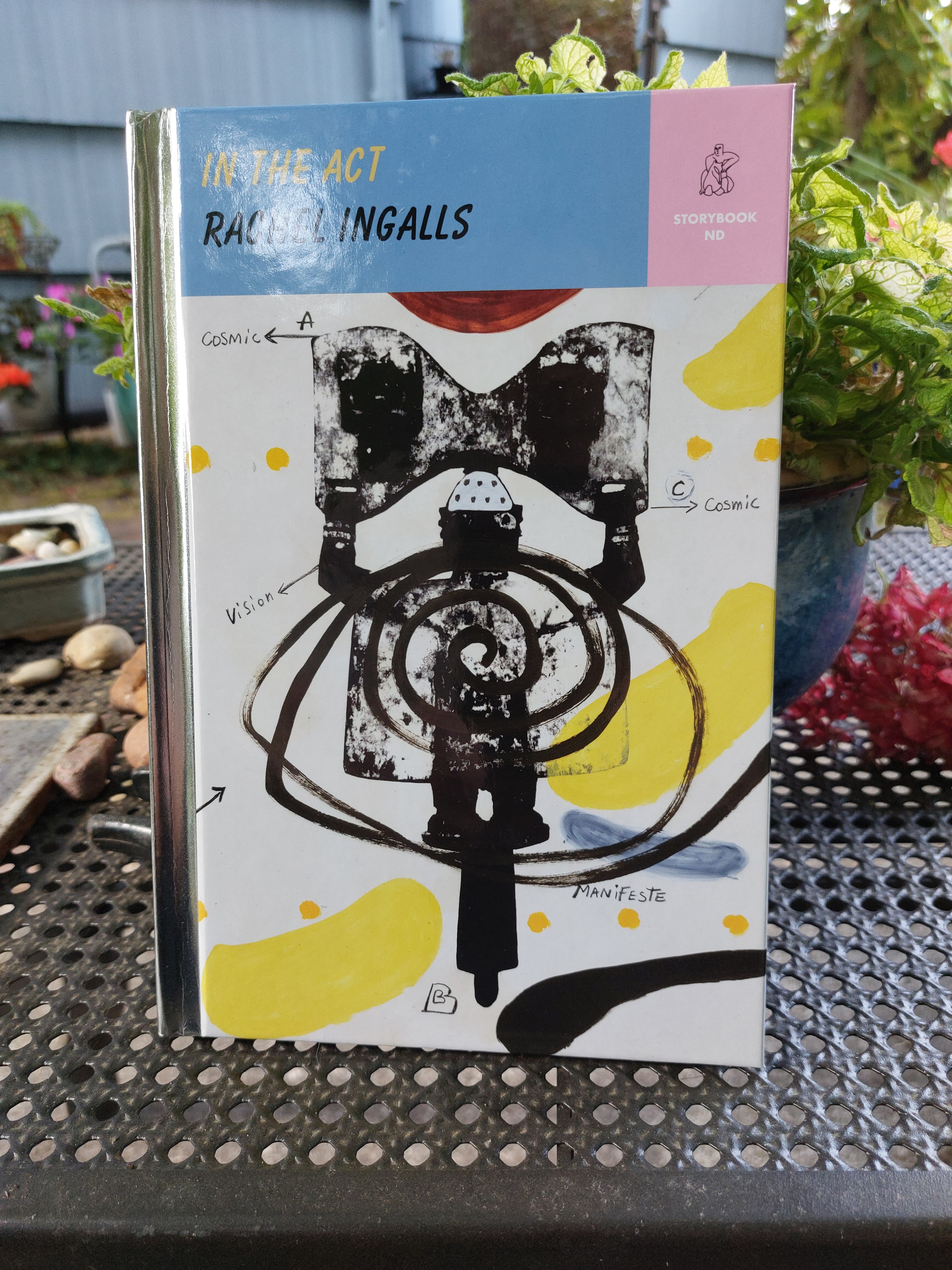
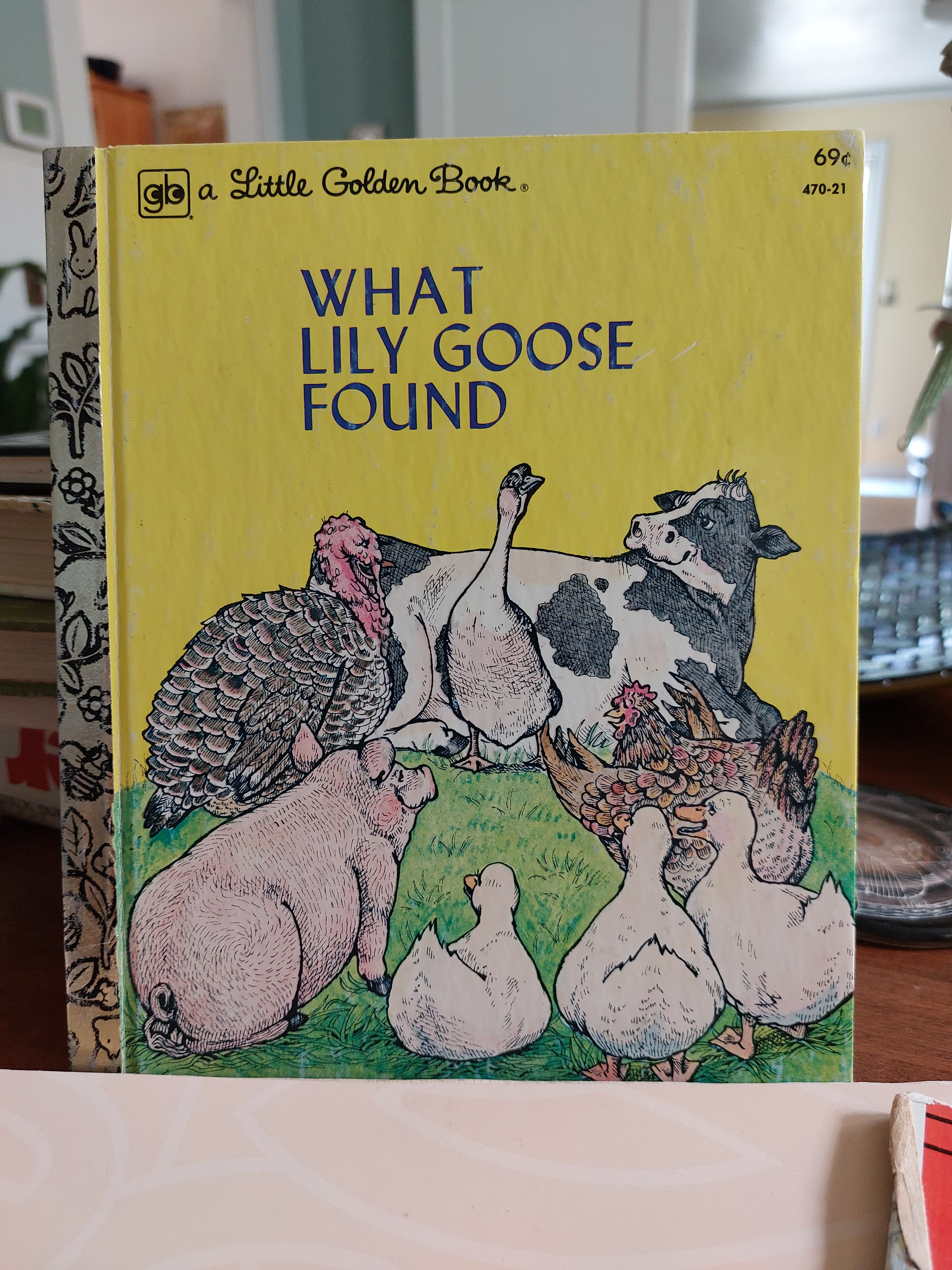
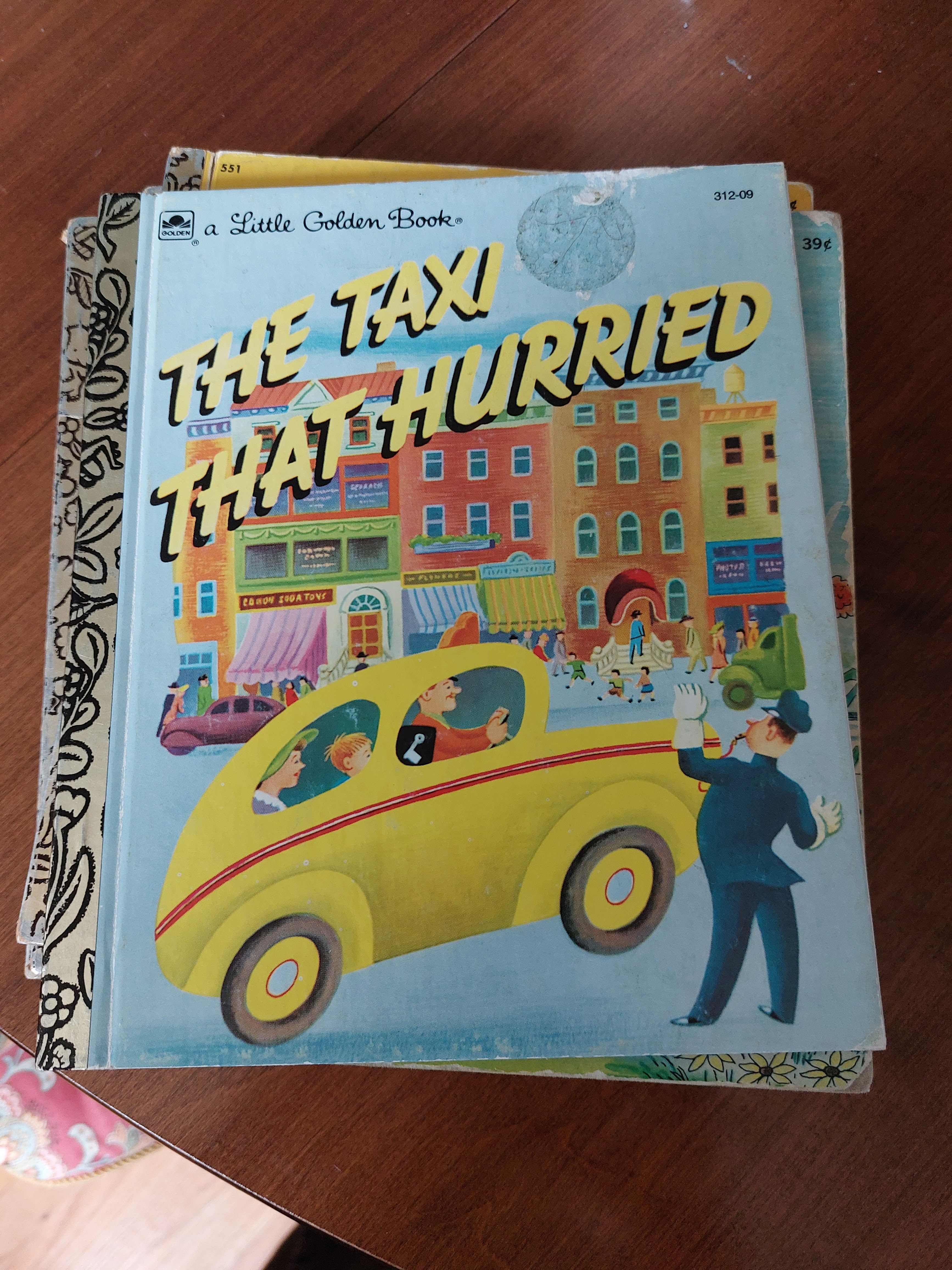
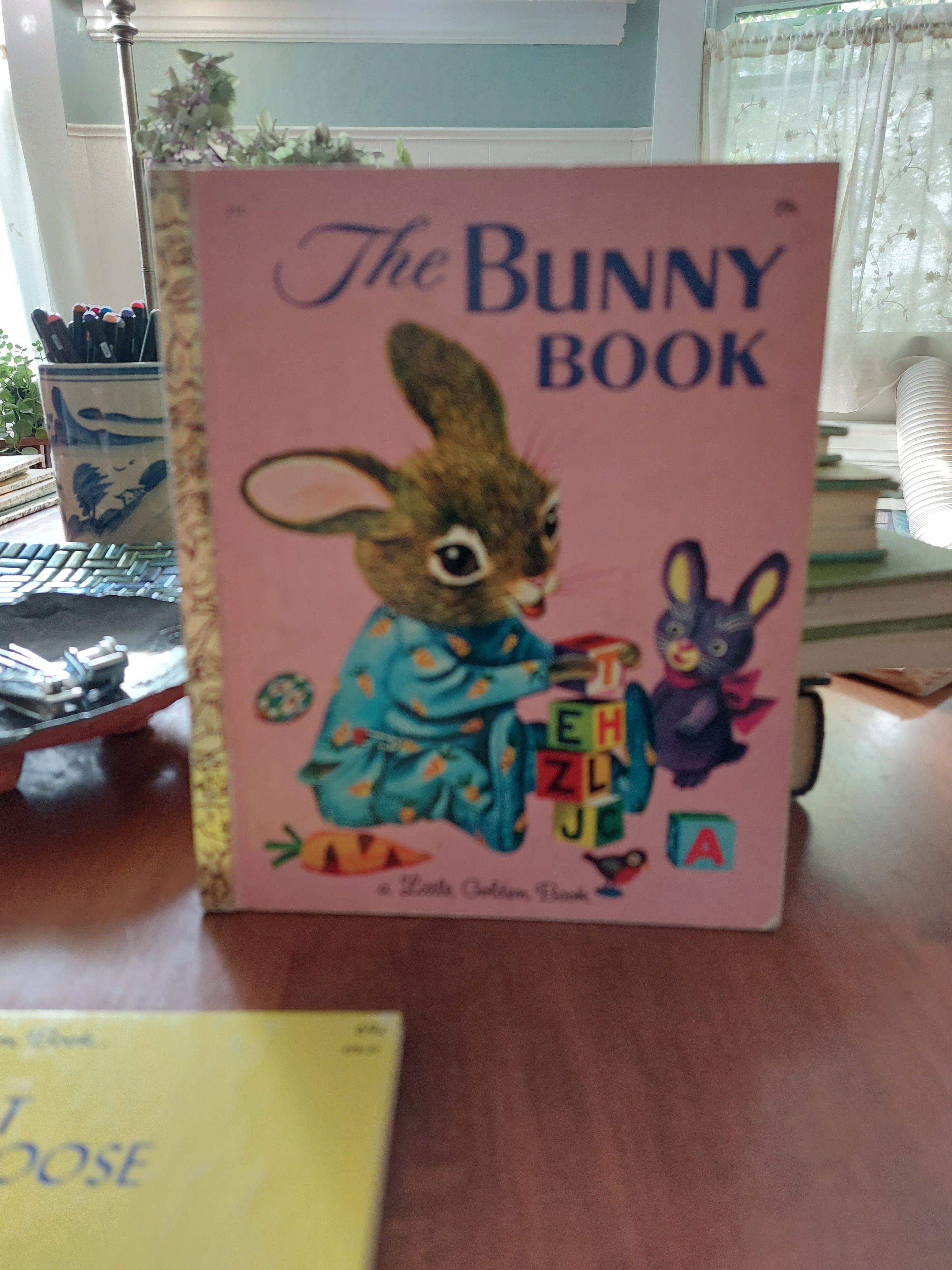
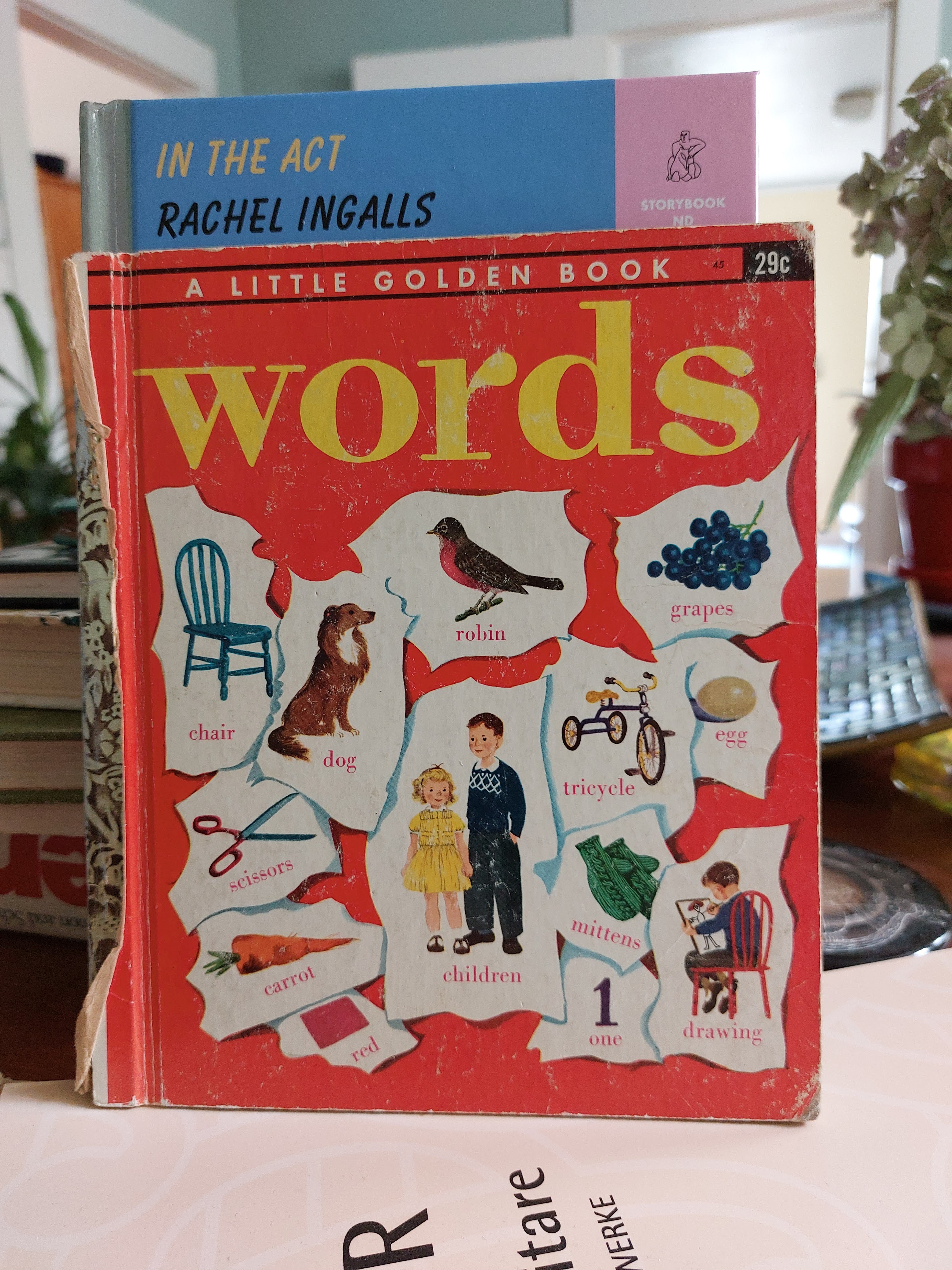
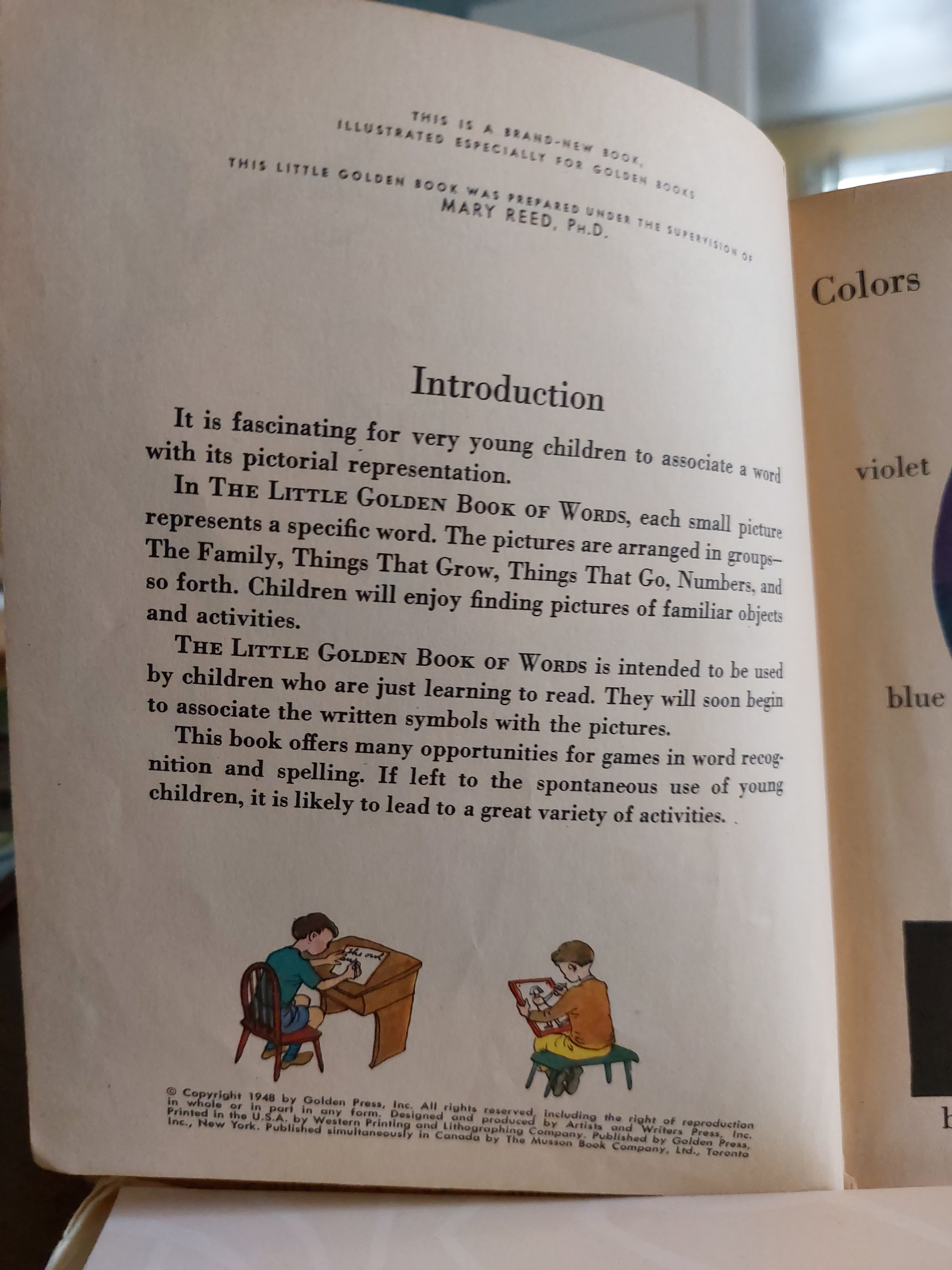
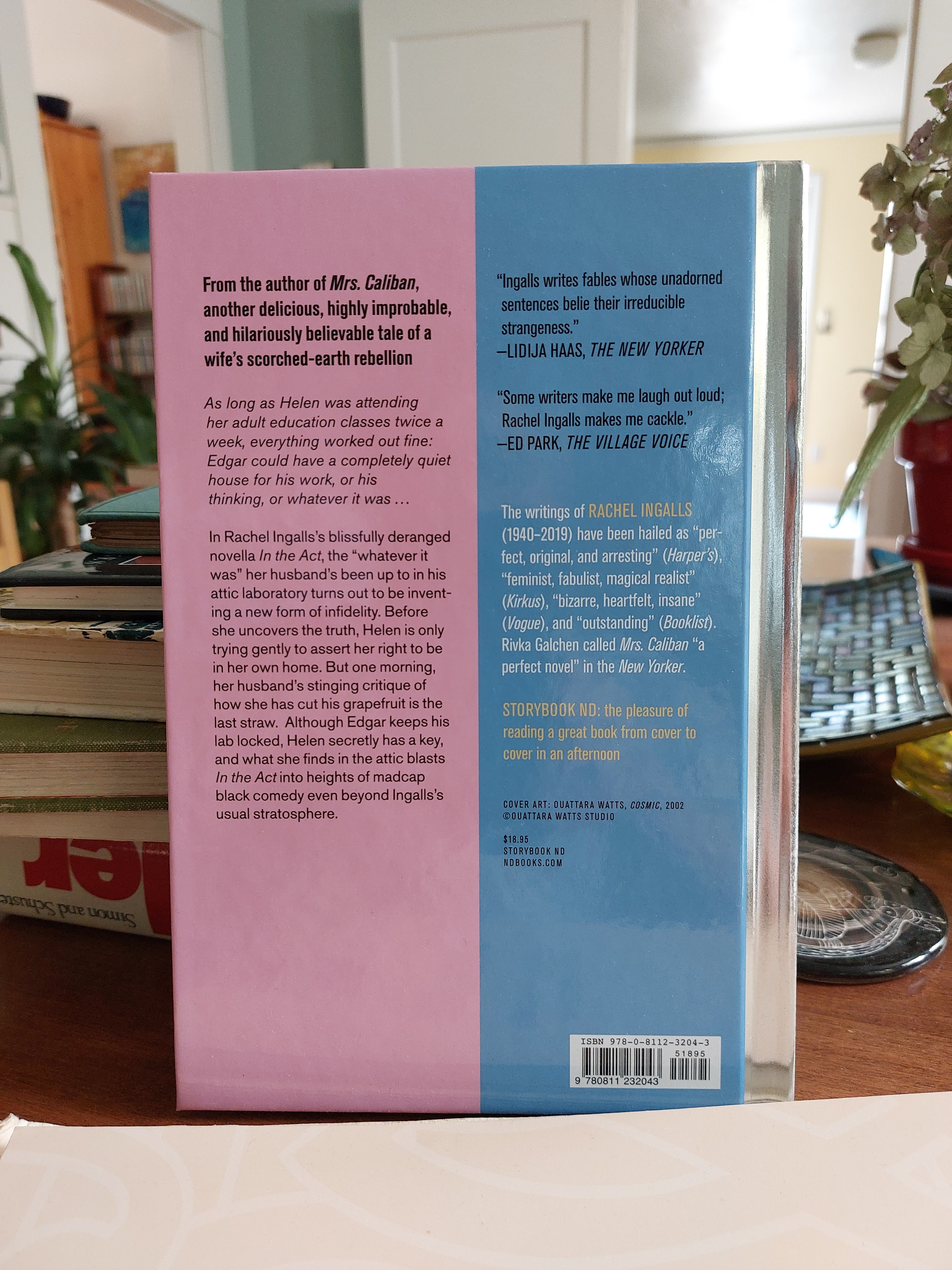
    Sitting outside with a stack of Little Golden Books: What Lily Goose Found; The Bunny Book; The Taxi That Hurried. The line of books for young readers began in 1942. I wonder if there was ever one about coyotes, Google it, and find Dale Evans and the Coyote, 1956. I’m not going to tell you here what Lily Goose found, nor am I going to tell you what Helen found, in her husband Edgar’s attic laboratory, in Rachel Ingalls’s In the Act (1987, ND 2023), one of the eight titles in the new New Directions series called Storybook ND, curated by Gini Alhadeff.

    Does the content of the eight Storybook ND titles change when packaged within the iconic Little Golden Books form? It’s a masterful marketing ploy, packaging modern adult stories in the universally recognized and often nostalgically referenced children’s book format. Anyway, I fell for the ploy, buying all eight in a discounted package deal directly from New Directions, answering an email offer, postage included.

    The first book I can remember reading alone, self-astonished at my knowing the words and being able to run them together – reading – was a Curious George book. I don’t remember which one. But the Curious George books were not Little Golden Books. But similar. I remember holding the book, looking at the page, turning the pages. It was a bit like your first bike ride without training wheels. Suddenly you were up and off and riding away. Where you were going was hardly the point. Or why. It was all about how. And movement, flow. But it wasn’t long after that I borrowed a wooden clothespin from my mom and with an old playing card attached to the rear fork of the bike, so that it flapped noisily in the wheel spokes, was now riding a motorcycle. What made it a motorcycle was the sound. That you were actually riding a metaphor was hardly the point. To metaphor is to carry forward.

    And I was astonished too reading my first Storybook ND, picked randomly from the stack of eight, the Rachel Ingalls In the Act. Part of the marketing pitch talks about reading a complete book in one afternoon in a single sitting – like you would a Little Golden Book. I’m not a fast reader, so I doubted this would apply to me, but In the Act, at 61 pages and moving at the speed of sound, proved irresistible. It’s a domestic story, husband and wife relationship, that if I were to summarize, might sound like a Coen Brothers film. Edgar Allan Poe with a sense of humor. The setting, the dialog, the motives, the turning points, the buildup and resolution – every word counts and the flow is like riding a bike. You don’t want to put it down, and you want the afternoon to last.

  • Shapers: Part Two of Ashen Venema’s Mythical Odyssey

    I’ve been reading Ashen Venema’s Course of Mirrors blog for over 10 years now, and in that time, she’s shown remarkable reselience and steadfastness, sharing essays, poetry, photography; recollections, insight, learning; humor, pathos, teaching – all the while working on a major work, which might become a trilogy (along the lines of Dune, Rings, Star Wars, Potter). The first part, a novel titled “Course of Mirrors: an Odyssey,” I reviewed in June 2017. Its sequel, titled “Shapers,” is now out. I purchased an ebook version via Amazon. A paperback version is also now available via Amazon US and other channels. Both books were published by Troubador.

    If you’re looking for a quick read, “Shapers” is not it. Its 360 pages are dense with encyclopedic-like entries that explain the far-out world readers must navigate. At the same time (though time is presented as protean), this new world won’t seem entirely foreign. For example, Chapter Two begins with a description of a fictional place and time that sounds uncomfortably familiar – uncomfortable if we go to fantasy to escape our real-time predicament:

    Rhonda, the larger of the Western Isles, used to be an empire competing with rival powers in seizing territory around the world. Indigenous people were uprooted and traded as slaves, until colonies were gradually granted independence. Over time, migrations ensued. People left ancestral homes to seek education and work in the lands of their conquerors, including Rhonda. Traditions mingled, sparking rapid industrial and technological growth along with a moral, intellectual and spiritual freedom that promised each individual unlimited potential.

    This sudden material expansion exhausted earth’s resources and caused rivers of waste flowing into oceans. Machines replaced hands, feet, eyes and even brains. Citizens with nothing meaningful to do were prone to emotional outbursts, filled prisons, or were over-medicated for stress. The ideal of freedom was like an inflated balloon. It burst into anarchy.

    Rhonda concluded that freedom was dangerous. By AD 2540, a correction project had long been in operation, employing the aid of a shunned people known for their unconventional approach to science, psychology and psychic phenomena – the Shapers. As long as they left politics alone, they were granted autonomy of research and funding. Their underground dwellings and laboratories circled around air-funnels lined with mirrors, through which sunlight was reflected down. Rhonda’s rationality project seemed a success. Emotionally unstable citizens were sent to the Shaper Portal for correction. They returned relaxed. The methods through which such miracles were achieved remained unquestioned, as long as they worked.

    Page 37

    Myth is a fictional story used to explain something real – an event, person, thing – even if the telling incorporates unreal (fantastical, imaginary, other-worldly) tools. The theme of “Shapers” explores the human existential crisis of individual freedom that entropically devolves into chaos or extinction, versus imprisonment in some structure of rule or servitude that leaves one arguably safe from existential dread but at the cost of one’s freedom. Where myth survives as something real, believed in, its explanation is simultaneous with the culture that creates it or evolves from it, its aims, its reality. One can’t see beyond one’s own mythical circumstance. Myth helps explain the errors of one’s way, should one go astray. Some contemporary myth, like the life stopping descriptors used in modern psychology, may seem to have the aim of self-actualization, but like most New Age approaches, simply attempt to justify one’s lifestyle – to oneself; the other doesn’t matter. Myth communicates using symbol, metaphor, and a great deal of hyperbole. We can read “Shapers” as myth, and explore symbols and structure, or we can go to it for entertainment and pleasure.

    Another characteristic, apart from myth, of the science fiction genre, is its tendency to waver between camp and seriousness, such that much if not all sci-fi is to so-called serious literature what the B movie is to film. In any writing, the verisimilitude of dialog quickly becomes problematic. If the setting is completely made up, how should the characters talk? How will people talk in the year 2540 – like they do today? Do people talk in paragraphs or in quips?

    “I like feeling secure and comfortable, it makes for peace,” Shakur said.

    “Pockets of peace, I like them too,” Oruba said. “I relax into habits, beliefs, attitudes, but all too easily fall asleep to the wavelength of universal guidance.”

    Shakur frowned. “I thought a calm mind maintains that wavelength.”

    “Not when creative intensity is lost, then the spiral of life falls flat and we’re stuck in a sluggish labyrinth of time, not in harmony with the ever-changing cosmos.”

    “Aren’t we one with the cosmos anyway?” Shakur asked.

    “Yes and no. There’s the yearning for the womblike feeling of oneness and safety, and there’s the resonance with forces that animate us. These forces make for eccentricity and difference, but when constrained for the sake of order and control, leaders become bloated with power. The more rigid the system, the more it imprisons people.”

    “I get it,” Shakur said, grinning. “Leo thought he was a god and now he’s a rat.”

    Oruba roared so suddenly, he dropped his plate of canapés. “He’s luckier than you imagine, he found love – he’s gone on a journey. He escaped the system.”

    Mesa was not amused. “I can see how Rhonda’s system is corrupt,” she said, “and change is necessary. But Armorica is not corrupt, its people are peace-loving.” She paused. “Maybe too much, I admit… we slowed change, and with it, time.”

    Forming a square with his fingers and thumbs through which he looked at his friends, Oruba said, “We observe through frames. We line up these fragments to create a composition.” He popped a quail’s egg into his mouth and chewed it slowly to relish its taste. “We continually shuffle and weave these fragments into new compositions of light. But for truly new visions to emerge we must suffer collisions. They tend to shift surfaces and expose the roots of our memory and experience. There you find the sap of life, from which spins the golden thread of intention and vision.”

    “I’ll shut up for now,” Shakur said, “but I will ask you the question again.” He made a sweeping gesture at the garden. “We had a collision here, and I’m digging towards Tilly’s vision of a rose garden.” Filling up glasses, he added, “A toast to celebrate our friendship! I’ve no right words for this, other than I’m going to miss you terribly!”

    Page 352

    How does one travel in time? But we all do it, are doing it now. The week or day passes quickly or slowly, we think, the longest day the longest suffering. But to shift from one time to another is the provenance of sci-fi. Why time travel? To warn, to fix, to meddle? Can we look forward to a future of gourmet meals as we discuss modes of reality? The scientists seem in charge, in more ways than one. And what of the trinity? If God is three for the price of one, do we also, made in his image and likeness, share our individual reality with two others who also claim to be us? We lived once, why not again? Is once any less mysterious than twice?

    Ashen Venema is both a scientist and an artist. In “Shapers,” we find her bringing the two perspectives together to view our contemporary predicament. She asks the question, What will happen given our current trajectory? The narrative of “Shapers” includes third-person omniscient and first-person diary. The technique adds diversity and interest to the writing. There are other aids provided to help the reader navigate and keep place, including glossary and cast of characters and other front matter, and 29 numbered chapters, each broken into several titled parts.

    Of course, any book today may quickly pass unnoticed. Which ones should we read? Without ad campaigns, movie deals, marketing ploys – alas – the challenges become surreal. But a book review might help. If you’ve read this far into this one, your next move should be to get Ashen’s “Shapers” and join the fun. It might be noted that English is not Ashen’s native language. This is a strength for someone traveling to distant worlds and conversing with diverse cultures. And she is a scientist only if psychology is a science. Psychology experiments with and explores inner worlds; the other scientists explore and tinker with outer worlds; the artist brings the two together in a single view. All of which, in a recipe of fiction, makes for good reading.

  • Notes on Kingsley Amis and “Lucky Jim”

    War leaves everyone destitute, champs as well as losers. At least that seems the case in some quarters in England following its WWII victory. But out of the drained sensibilities comes Lucky Jim, whose primary motive is to avoid being chumped. His new arms are not mod Joyce’s “silence, exile and cunning,” but scoff, erosion, and contumely. He finds himself immersed in a milieu devoid of usefulness, stupefied:

    It wasn’t the double-exposure effect of the last half-minute’s talk that had dumfounded him, for such incidents formed the staple material of Welch [Jim’s mentor] colloquies; it was the prospect of reciting the title of the article he’d written. It was the perfect title, in that it crystallized the article’s niggling mindlessness, its funereal parade of yawn-enforcing facts, the pseudo-light it threw upon non-problems. Dixon had read, or begun to read, dozens like it, but his own seemed worse than most in its air of being convinced of its own usefulness and significance. ‘In considering this strangely neglected topic,’ it began. This what neglected topic? This strangely what topic? This strangely neglected what? His thinking all this without having defiled and set fire to the typescript only made him appear to himself as more of a hypocrite and fool. ‘Let’s see,’ he echoed Welch in a pretended effort of memory: ‘oh yes; The Economic Influence of the Developments in Shipbuilding Techniques, 1450 to 1485. After all, that’s what it’s…’

    Page 9 of “Lucky Jim,” by Kingsley Amis, first published in 1954; New York Review Books Classics 2012 with an Introduction by Keith Gessen.

    Jim’s problem (to date still unresolved for so many in galleries of classrooms) is simply what to do, and while Beckett is now back in Paris resolving “Nothing to be done,” Jim Dixon is back in England, having made his way through a back door into contemporary academia, which doesn’t necessarily equate to a decent job:

    ‘Well, you know, Jim. You can see the Authorities’ point in a way. “We pay for John Smith to enter College here and now you tell us, after seven years, that he’ll never get a degree. You’re wasting our money.” If we institute an entrance exam to keep out the ones who can’t read or write, the entry goes down by half, and half of us lose our jobs. And then the other demand: “We want two hundred teachers this year and we mean to have them.” All right, we’ll lower the pass mark to twenty per cent and give you the quantity you want, but for God’s sake don’t start complaining in two years’ time that your schools are full of teachers who couldn’t pass the General Certificate themselves, let alone teach anyone else to pass it. It’s a wonderful position, isn’t it?’

    177

    Some guys will do anything to avoid working on commission:

    Dixon agreed rather than disagreed with Beesley, but he didn’t feel interested enough to say so. It was one of those days when he felt quite convinced of his impending expulsion from academic life. What would he do afterwards? Teach in a school? Oh dear no. Go to London and get a job in an office. What job? Whose office? Shut up.

    177-178

    But why would office life, in sickness or in health, not be preferable to the games teachers play, particularly the major league players:

    Amis and Larkin graduated into a literary world still dominated by the modernism of Eliot and Pound, and haunted by the shadow of William Butler Yeats. Though Larkin went through a long apprenticeship to Yeat’s poetry, both men eventually came to think that the modernists had made English-language poetry vague, pretentious, and verbose…Chelsea represented the artsy crowd, the modernist crowd, the posh crowd that had taken English literature too far into the realm of abstraction, had turned it into an elite pursuit. Not that the rest of contemporary literature was any better.

    Page x-xi of Keith Gessen’s Introduction.

    While much of today’s poetry remains “vague, pretentious, and verbose,” some reaches further into the pit of the common reader’s hand reaching out for not meaning but significance lately lost thanks largely to poetry being conquered in academia by the philistinism of the sociologists and psychologists, not to mention the political polemicists. Yet, as Keith Gessen points out in his “Lucky Jim” NYRB Introduction: “But of course then as now the world was filled with young college graduates convinced of the sheer absolute idiocy of everyone, living or dead” (xiii). But how accurate is that statement? Not to say that everything is not idiotic, but that everyone thinks that everything is idiotic. And anyway, anyone can feel that way. It doesn’t take a college degree. And it might be true for high-schoolers these days, or high school dropouts, or college graduates in search of a job in their area of obsolete, irrelevant, or antiquated study, or retirees from any number of careers or pseudo careers. If everything is idiocy, one can at least prefer one’s own.

    The problem is not only what to do but how to do it and how to think about what to do and how to think about doing it and to feel about all of it and how to remain free in spite of all of it, if one can even keep track of what is meant by it. And all without undo influence from the idiots one once might have admired but have now come to scorn but not enough to ignore. Gessen puts hate as the great motivator for both Amis and his pal Larkin. But hate is far too strong a word to describe what they were all about, or what Jim is about. To be unable to achieve satisfaction is not to hate the losing streak, the white shirts, the wrong cigarettes, the useless information, the starved imagination. One might though hate that one still feels one wants to be a part of it, even if that part entails making fun of it. If you live a life of pure loathing, what’s left you in the end to loathe but yourself?

    And “Lucky Jim” is a comic novel, not one of fear and loathing, and with literary precursors. If Jim (or Amis) makes fun of “The Canterbury Tales,” it’s in their being removed from life and buried in a classroom. Given his tastes and dislike of the phony and the mannered, it’s understood he values Chaucer’s use of flatulence to create lasting, well digested literature. He doesn’t hide the compost. He loves it. And he’s not angry about it. And if Jim “hates” Welch’s son, Bertrand, his evil nemesis, it’s for good reason. Bertrand makes an excellent foil character. One feels an author’s love for his Iago, Lady Macbeth, Polonius. In any case, Henry Miller had already written his Tropics, and they’re not about graduate school. Ginsberg is working on Howl, but neither are the Beats angry young men. They are bent on living. They will eschew an air-conditioned nightmare, thank you.

    And an elderly Jim would no doubt prefer self-loathing to schadenfreude. Smug and complacent, he is not. And he’s not falsely self-deprecating. He doesn’t insult himself as bait for what he might fear an otherwise hostile audience. He’s not self-satisfied. He recognizes his faults but doesn’t take credit for them.

    An interesting companion reading to “Lucky Jim” might be Barbara Pym’s “Excellent Women,” published two years earlier, or her “Jane and Prudence,” a year earlier, or “Less than Angels,” a year later. It hardly seems the same world, but it is. One might find Pym’s heroines rescued from the arms of a horned and horny but hardly hating Kingsley Amis.

  • Notes on Sebastian Barry’s “A Long Long Way”

    It was sometime over the recent long Memorial Day weekend I received a worn copy of Sebastian Barry’s “A Long Long Way” (2005), a gift from my old friend Dan, first person blogger at Tangential Meanderings at WordPress. I had mentioned Barry to Dan after reading a New Yorker piece about the Irish author’s writing (March 20, 2023). I had never read Barry.

    I dug into “A Long Long Way” as into a trench somewhere along the Western Front. Barry in his technique seems to take the encyclopedia entries that summarize events and rewrites them using imagined characters, though apparently the Dunnes were part of his own family. My interest in WWI grew, and I read that a few years ago a trove of diaries written by soldiers during the war was digitized:

    Many older people in Britain knew veterans of World War I. But the diaries provide a different level of detail, says Michael Brookbank, 84. On a recent day, he was drinking a coffee in the archives cafeteria. He had come to learn more about his father.

    “My father very rarely talked about the war, and I think that is common with most of the veterans of the war,” says Brookbank. “The experiences that they went through and the conditions that they lived in were just something that, unless you were actually there, nobody could really comprehend.”

    “From The Trenches To The Web: British WWI Diaries Digitized.” Heard on Morning Edition, 23 Jan, 2014. Ari Shapiro. Read here.

    That idea of what it might take to comprehend, and of what point there might be to talk about it, about anything, one might add, incomprehensible to another, plagues many veterans. And in the Army, one does not step out of place, let alone speak out of place. Who does tell the stories then? And who will listen with comprehension?

    The reader has no privileges. He must, it seems, take his place in the ranks, and stand in the mud, wade in the river, fight, yell, swear, and sweat with the men. He has some sort of feeling, when it is all over, that he has been doing just these things. This sort of writing needs no praise. It will make its way to the hearts of men without praise.

    New York Times book review of “The Red Badge of Courage,” 31 October, 1896.

    Crane, like Barry must have, had read accounts of those who had experienced the war in some way (Crane had not), and used them to create a truthful but fictional (a psychological rendering) account. The danger here, for most writers, is the chance the result will sound like a second hand telling. Also that it might affront those who actually did the fighting, or who in some way, psychologically, if not physically, experienced the war. But that begs the question: does a distant war not create an experience for the moms and dads, the girlfriends, the boyfriends, the folks back home, reading the headlines, the news, the letters from the front? And does not that experience test the dichotomy of mind and body – the psychological is physical.

    In his blog “Time Now: The Wars in Iraq and Afghanistan in Art, Film, and Literature,” Peter Molin, himself a veteran and writer, furthers the discussion of who can write what with what authority:

    The question of whether a writer who hasn’t been to war can write well about war also intrigues me. Gallagher cites Ben Fountain as the example par excellence of an author who never served in the military, let alone saw combat, but who can still convey what it is like to be a soldier. I love Billy Lynn’s Long Halftime Walk, too, but have noted that Fountain evades extended description of battle. Is that a place he just didn’t feel comfortable going? Brian Van Reet, a decorated vet, portrays two horribly mangled veterans in comic-grotesque terms in “Big Two-Hearted Hunting Creek.” Would a civilian feel as comfortable doing so? Is there something wrong with someone who isn’t disabled portraying characters who are? Both these cases reflect the issues of credibility and authority that permeate discussions of war writing.

    “Veterans Writing,” Peter Molin, 29 September 3013.

    Sebastian Barry, in “A Long Long Way,” gives all his characters the credibility of war experience, even those who have no comprehension of what they’re going through, of the dehumanizing effects war tattoos on one’s memory, and a tattoo becomes a story:

    ‘And what happened to her, Pete?
    ‘Who?’
    ‘That Belgian woman, Pete, that you – just like the sainted Germans did, just like all those stories we were told, Pete, what they did to the women.’
    ‘Don’t be so holier than thou, Willie. You’d’ve done the same.’
    ‘What happened to her, what happened to her?’
    O’Hara said nothing for a moment.
    ‘All right, all right.’ But he didn’t seem able to say it for another few moments yet. Then he nodded his punched face. ‘She died of what had happened to her. She was bleeding all those hours. She was not treated right. She was fucking torn to pieces, wasn’t she? And she died. And we tried to save her.”
    ‘You think so?’
    ‘It’s just a story, Willie, a story of the war.’
    ‘You can keep your story, Pete. You can keep it.’

    168

    Willie’s girlfriend’s (Gretta) father shares a test he uses to qualify one’s experience. It has to do with knowing one’s own mind. Gretta repeats it:

    ‘We have to wait, Willie.’
    ‘For what’ he said, a touch desperately.
    ‘For the war to be over and you to be home and you to know your own mind. There’s never any sense in a soldier’s wedding, Willie.’

    77

    If Barry’s characters and scenes seem stereotyped it’s because we’ve seen them so often. There’s not much of a plot. Boy goes to war, not really understanding why, maybe comes back, maybe not, still not understanding why. All the arguments are pandered down the ranks, where, in the end, they don’t hold water. The grunts do the work, the dirty work, for which they receive insult and despair. Barry’s approach gives the reader a kind of historical fiction without the overt history, such that the Easter Rising happens real time, with Willie and his cohort working laboriously trying to figure out what’s going on and why and how they should feel about it, what side they should side on, a process of getting to know one’s mind.

    Who is the narrator? Not exactly Willie, neither can it be Barry. Some figure hovering over the gas clouds, looking through, picking out a figure here or there to zone in on. There are many to choose from. But the main characters are Willie, his sergeant-major Christy Moran, Willie’s father, Willie’s girlfriend, Gretta, Willie’s sisters, a few of Willie’s platoon members, Father Buckley, a Catholic priest who makes the rounds through the trenches trying to clean the spiritual and mental messes (which he does a fair enough job of). And Pete O’Hara whose single act of betrayal does more damage to Willie than anything the other side may have thrown at him.

    The theme is irony, though it might seem somewhat backwards – the characters seeming to know something the reader does not, in spite of the reader’s armchair advantages. The book is composed of set pieces (gas attack, up and over charge, furlough – and the results thereof, field boxing match) and the action is described in realistic detail, too much detail some readers may feel. There’s humor, the excellent cussing of the sergeant-major, sarcasm and wit. On the whole, maybe it’s all a bit romantic, though, so full of purple vestment, not maudlin, but still sentimental, like the customs of Memorial Day, even if that day has yet to come anywhere in the novel. The dialog is brisk and easy and rings true. The point of the novel, if the reader must have one, is probably the Irish need and desire to have and know its own mind, which might also explain the need for every narrative trick, the deceit and betrayal writ large and small, the pawn-like movements that when stacked one upon the other make up the family histories that add up to a country’s history.

    The title comes of course from the song, used to march by:

    Up to mighty London
    Came an Irishman one day.
    As the streets are paved with gold
    Sure, everyone was gay,
    Singing songs of Piccadilly,
    Strand and Leicester Square,
    Till Paddy got excited,
    Then he shouted to them there:

    It’s a long way to Tipperary,
    It’s a long way to go.
    It’s a long way to Tipperary,
    To the sweetest girl I know!
    Goodbye, Piccadilly,
    Farewell, Leicester Square!
    It’s a long long way to Tipperary,
    But my heart’s right there.

    Paddy wrote a letter
    To his Irish Molly-O,
    Saying, “Should you not receive it,
    Write and let me know!”
    “If I make mistakes in spelling,
    Molly, dear,” said he,
    “Remember, it’s the pen that’s bad,
    Don’t lay the blame on me!”

    Molly wrote a neat reply
    To Irish Paddy-O,
    Saying “Mike Maloney
    Wants to marry me, and so
    Leave the Strand and Piccadilly
    Or you’ll be to blame,
    For love has fairly drove me silly:
    Hoping you’re the same!”

    Jack Judge, 1912.
  • Wheels within Wheels

    Wheels within Wheels

    Thomas Merton, in his preface to his collection of essays titled “Mystics and Zen Masters” (1961-1967, The Abbey of Gethsemani, 1967 FS&G), suggests a closeness in claims of those across cultures attempting contemplative lives:

    The great contemplative traditions of East and West, while differing sometimes quite radically in their formulation of their aims and in their understanding of their methods, agree in thinking that by spiritual disciplines a man can radically change his life and attain a deeper meaning, a more perfect integration, a more complete fulfillment, a more total liberty of spirit than are possible in the routines of a purely active existence centered on money-making. There is more to human life than just ‘getting somewhere” in war, politics, business – or “The Church” (viii).

    Entering the Church, apparently, does not guarantee a contemplative future. And when Merton asks, “What, exactly, is Zen?” (12), he already knows there can be no satisfactory answer. Writing in the 1960s, Merton was in tune with his Catholic audience under the influence of John XXIII’s Second Vatican Council, which called for an aggiornamento, a modernization, bringing the church up to date.

    Merton even suggests Zen, having lost, like Christianity, its Medieval “living power” (254), is in need of an updating. Today, we might ask, What, exactly, is Christianity?

    In Christianity the revelation of a salvific will and grace is simple and clear. The insight implicit in faith, while being deepened and expanded by the mysticism of the Fathers and of a St. John of the Cross, remains obscure and difficult of access. It is, in fact, ignored by most Christians (254).

  • Loomings & Readings

    “High time to get to sea,” Melville’s Ishmael says, feeling weary and wornout, petulant and putout. I’m with Ishy these days, but like Camus, find myself far from the sea – too, too far, not close by at all.

    So it came to me, unable to put in with my surfboard at 42nd in El Porto as I might have were it somehow still 1969, to start a bookclub. Talk about absurd! Where’s Camus when you need him?

    In any case, I find myself these days growing closer to music, away with words, music without words, instrumentals I guess their called in popular lingo. So I’m already ditching the idea for a bookclub, and thinking of a garage band. We’d do train songs (with a few words), maybe in homage to my grandfather who was an engineer on the Louisville Nashville Line, though I never met him.

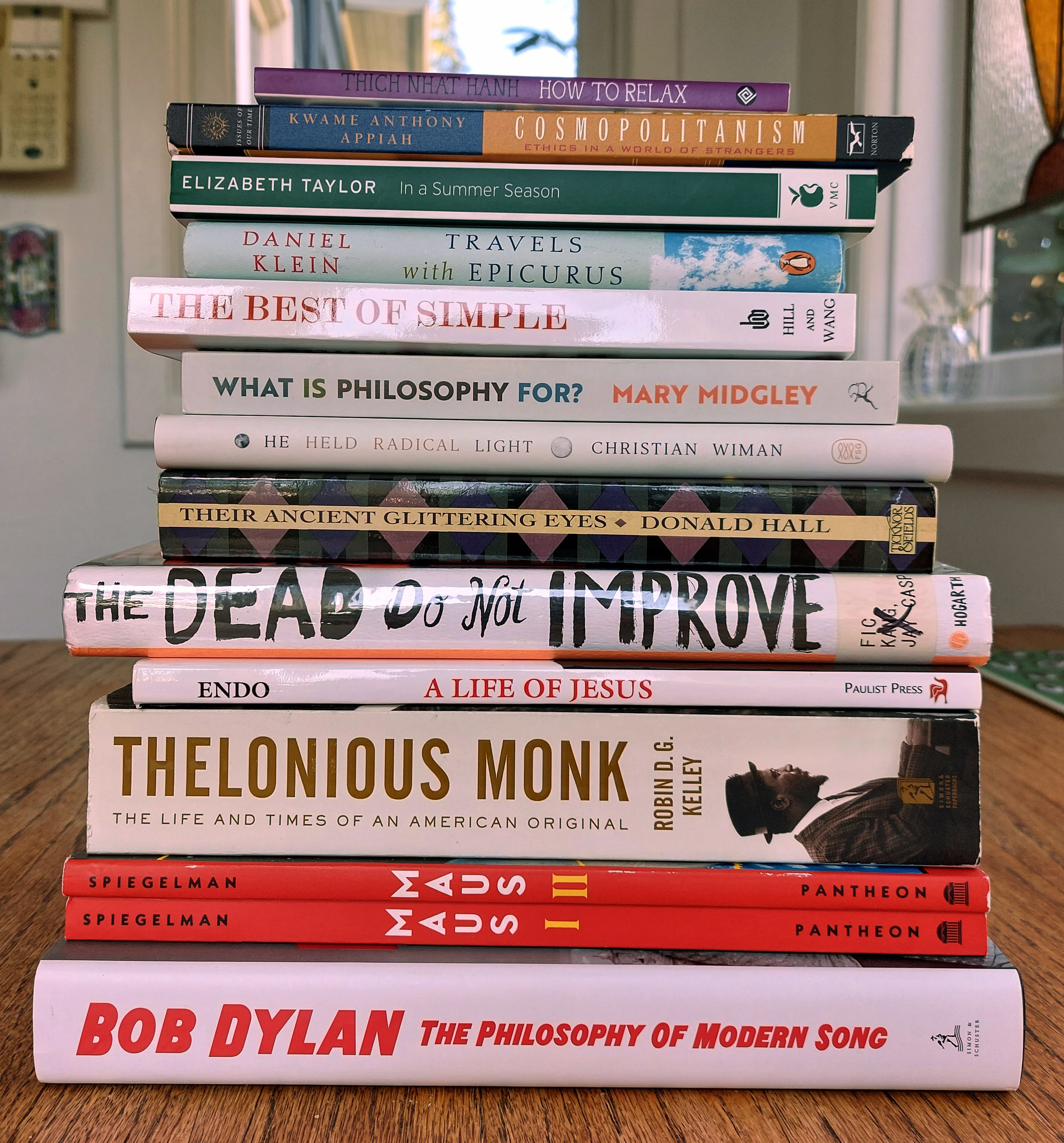
    Where did the idea for a bookclub come from? My stack of recently read books is about to topple over. This set began with Art Spiegelman’s “Maus: A Survivor’s Tale,” which he worked on through the 1980’s and won a Pulitzer in 1992. It’s a graphic novel in two parts about his father’s life in Germany during World War II and later living postwar in New York. Its ghostly and maniacal scenes are not quiet surreal, but leave a similar feeling – for it is, after all, predicated on the cartoon. It’s a comic book. The irony of that is so penetrating. It’s told in first person that shifts between his father’s recounting and Art’s narrative coming of age the son of survivors. It’s a masterpiece. And I don’t know how anyone could read it without wanting to share it. But who wants to relive it? The secret sharer puts it in a blog few read. Never mind the book club.

    But speaking of music, I also recently read Robin G. Kelley’s biography “Thelonious Monk, The Life and Times of an American Original” (Free Press, 2010). Monk’s mistreatments (self-inflicted or at the hands of others) are legendary; for example, the noted jazz critic Leonard Feather did more than criticize Monk – he attacked him for not being what Feather wanted him to be: “He has written a few attractive tunes, but his lack of technique and continuity prevented him from accomplishing much as a pianist,” Feather said (150). To be an original (in technique, continuity, or otherwise) is not necessarily to be accepted; on the contrary. Kelley’s book includes a good amount of history, Monk’s 20th Century environments: the causes and outcomes of the race riots of New York neighborhoods; the difficulties of surviving in the music industry; the difficulties for families of musicians who must travel to make a living; the prevalence of drugs in American cities, and the changes over time of police response; war, economic collapse, building and rebuilding, travel. Kelley gives us 600 pages, any one of which we might turn down a different street for readings to learn more about those subjects – again, the idea of a bookclub. But repeatedly we find Monk’s music dismissed by many of his contemporaries for its difficulties – difficulties which entertain rather than perplex today’s ears. Interestingly, the Beats and their poets found partnership in clubs that helped Monk finally flourish.

    Bob Dylan’s “The Philosophy of Modern Song” (2022) would make a good bookclub paring with Kelley’s Monk book. Dylan is another American Original, and his writing might strike many ears with difficulties similar to Monk’s piano. I’m almost never disappointed with Dylan, and this latest warrants reading and re-reading and listening. I put together a YouTube playlist of the 66 songs Dylan explicates in his book. Many of them have been recorded by more than one artist, so the trick is to get the version that most coveys the feeling of its mystery – that being how something so simple as a popular song can both create and evoke an entire era or single day in the life of an American coming of age in the age of “modern song.” And for those readers turned off by philosophy, not to worry, there’s not much philosophy to sing about here – the philosophy, like music theory, remains in the background.

    Speaking of philosophy, somewhere recently I noticed a new Mary Midgley book out, and quickly got a copy and read it. And, as it turns out, it’s her last one (Bloomsbury, 2018). Imagine living to 99 and the title of your last book? “What is Philosophy For?” Indefatigable, indomitable, Mary (look her up on YouTube and tune in to one of her conversations) defeats Dawkins and his ilk with real philosophy – that is to say, thought without propaganda.

    Shusaku Endo’s “A Life of Jesus” (Paulist Press, 1973) is a strange book. I like strange books. It’s about the Gospels, how they came to be first talked then written. The environments and people described are different from what we might come away with from the Bible versions. Here, for example, we get a fuller picture of John the Baptist, where he came from and what he wore, what he ate, what he said and did. Life can be strange in the desert. Essentially, we get closer to Jesus in the sense that the time itself comes alive. There is no question but that Jesus was a real person; he lived, in a real place, in a real time. The question of his divinity and why it has to remain such a mystery, almost a game, Endo does not quite answer, though it’s clear that he is a believer. It’s strange even to try to put this into words. I really like Endo’s book, and will read it again. It reminded me in some ways of Pasolini’s “The Gospel According to Saint Matthew” (film, 1964).

    A couple of books recently read did produce some disappointment: Christian Wiman’s “He Held Radical Light” (FSG, 2018) and Donald Hall’s “Their Ancient Glittering Eyes” (Ticknor and Fields, 1992). Don’t get me wrong; I liked both books. I even sent the Wiman to one of my sisters, thinking it would be to her liking also. These are both books about poetry, about poets, about poems and how and when they might be read and their purpose and import, their meanings, and the poetry and surrounding discussion I did enjoy. What I found disappointing was the emergence of an ego, a manic wanting on the part of both Wiman and Hall to write the poem to end all poems. Silly, that. It’s easy to see why and how poetry fails to live up to any kind of popular status in the marketplace – except for what we might find in popular song, in the philosophy of popular song, a philosophy that is lived but rarely talked about.

    I also read and enjoyed Jay Caspian Kang’s “The Dead Do Not Improve” (Hogarth, 2012). I had read that it was about surfers in San Francisco, so of course was interested. It’s not too much about surfing though. It’s a mystery, and accomplishes what it sets out to do. It’s entertaining, provoking, somewhat in the classic noir tradition, its characters representative of types of a kind, also of that noir setup. The dialog is fresh and accurate, the scenes clearly drawn, you get the smell and the feel of the place. The plot is convoluted, a bit like a shuffled deck of cards, and then reshuffled.

    That pretty much concludes my daytime recent book readings. To bed (to read) I’ve been taking Elizabeth Taylor lately (not the movie star). Reading now her “In A Summer Season.”

    In the end, writing about writing is rarely as interesting as the writing one is writing about, but there are exceptions, and those exceptions I’m always on the lookout for. Meantime, I’m still working on the guitar. I’ve been playing guitar almost as long as I’ve been reading. Have no intention of giving up either, but talking about reading, like talking about music, is a different pastime than writing or playing original pieces.

  • Weather or Not

    Last week, contemplating a drive south, I looked up road closures on a couple of routes. At the same time, I was reading Elizabeth Taylor’s “In a Summer Season”:

    “As a person much confided in, she had learnt how to let her mind wander a little on a tether, and now she looked out of the taxi at the sun flashing high on buildings and thought what a lovely late afternoon it was. The trees in Portman Square were hazy with buds and the sky was as pale as pearls. It was the first spring-like day there had been; behind were months of icy winds, little bouts of snow, thawings, then freezings, a wretched time since Christmas.”

    Page 15, Virago Press 1983 edition, first published 1961.

    I look out my window. Here in Portland, not to be confused with Portman Square, we have not yet come to “this first sunny evening of the year, the house had all its windows thrown open, as if of itself, like a flower, it had responded to the sun” (p. 19).

    Elizabeth Bowen’s “In the Heat of the Day” also begins in London with weathering words, but at the other end of the cycle:

    “The season was late for an outdoor concert; already leaves were drifting on to the grass stage – here and there one turned over, crepitating as though in the act of dying, and during the music some more fell. … War had made them idolise day and summer; night and autumn were enemies.”

    Page 3, first Anchor Books edition, July 2002, originally published 1948.

    With every passing day, the past recedes like a tide, images of shells, seaweed, colorful beach towels – open umbrellas grow out of the sand like sea anemones, barnacle dressed rocks litter the floor of our thoughts, night and day, and the waves break farther and farther out but go on and on “like the drip drip drip of the raindrops,” Cole Porter said. But to get back to the Bowen: “The incoming tide was evening. Glass-clear darkness, in which each leaf was defined, already formed in the thicket behind the orchestra and was the other element of the stage” (p. 4).

    Elizabeth Bowen’s “The Death of the Heart” also begins in weather:

    “That morning’s ice, no more than a brittle film, had cracked and was now floating in segments. These tapped together or, parting, left channels of dark water, down which swans in slow indignation swam. The island stood in frozen woody brown dusk: it was now between three and four in the afternoon. A sort of breath from the clay, from the city outside the park, condensing, made the air unclear; through this, the trees round the lake soared frigidly up. Bronze cold of January bound the sky and the landscape; the sky was shut to the sun – but the swans, the rims of the ice, the pallid withdrawn Regency terraces had an unnatural burnish, as though cold were light. There is something momentous about the height of winter. Steps rang on the bridges, and along the black walks. This weather had set in; it would freeze harder tonight.”

    Page 3, Anchor Books, May 2000. First published 1938.
  • Doubt and Drift

    Faith is belief in what cannot be proven. If something can be proven, faith in it is no longer necessary. But most of us can’t prove anything. We spend most of our lives swimming around in a sea of faith – faith in people, places, things; faith in history, institutions, religions; faith in ideas, nature, love. We live by faith in these things, not just that they exist, but faith in that they work as designed, faith in how they should work, and faith in how they do work.

    We no longer have faith in the news. “Popular distrust of the news media has been traced to the coverage of the stormy 1968 Democratic National Convention,” Louis Menand discusses in “Making the News: The press, the state, and the state of the press” (The New Yorker, February 6, 2023, 59-65). Underlying any loss of faith comes the realization that too much may have been invested in the building blocks of truth, facts, and how we think we do things the way we do because we’ve always done them that way. These blocks turn out to be soft and fuzzy and protean. What is true changes with the times, predicaments, what we want.

    “As Michael Schudson pointed out in ‘Discovering the News’ (1978), the notion that good journalism is ‘objective’ – that is, nonpartisan and unopinionated – emerged only around the start of the twentieth century. Schudson thought that it arose as a response to growing skepticism about the whole idea of stable and reliable truths. The standard of objectivity, as he put it, ‘was not the final expression of a belief in facts but in the assertion of a method designed for a world in which even facts could not be trusted. … Journalists came to believe in objectivity, to the extent that they did, because they wanted to, needed to, were forced by ordinary human aspiration to seek escape from their own deep convictions of doubt and drift.’ In other words, objectivity was a problematic concept from the start” (p. 60).

    We might find complementary or corollary application to other areas. Menand uses the 1968 convention to illustrate how the news is not reported but made, and that once the recipe for how it’s made is made manifest, and there follows general doubt and drift from the sources – from the who, what, when, where, how, and why of the story – the remaining mess makes for great leftover meals for anyone wanting to take advantage of that doubt and drift to further their own agenda, investment returns, popularity, hold of the reins. We might find corollary application of the argument in the doubt and drift in our times from religion, health care, higher education, police protection – all areas once strong with the faithful but we now look out and find empty pews. Damage control, by which is meant control of the news over the story, becomes paramount in restoring the faith.

    But we reach a point where faith can’t be restored. The Jesus Movement becomes the Free Press of religion. Indie becomes the barbaric invasion of not traditional music, film, publication, art, but of the open-gate making, distribution, and profit (or not) of free expression. We can no longer die for our country, only for one another. We take medical advice with a grain of salt. The man wearing the badge, the clerical collar, the stethoscope, the suit and tie – might as well be wearing a newspaper. The homeless person is one of us. The Emperor wears no clothes. The Wizard is a humbug – and like he said, he might be a good guy, but he’s a bad wizard. We are out here on our own.

  • Wonder of the On-Line Literary World

    This month, Berfrois, the small literary magazine, has closed its virtual doors. For the last 14 years, Berfrois, under intrepid editor Russell Bennetts, an economist out of England, has published daily writing, forming over time an eclectic list of contributors and an audience of intercultural competence. The end of active writing appearing in Berfrois comes 100 years after the closing of the modernist journals period, which ran, according to the Modernist Journals Project, from the 1890’s to the 1920’s, ending in 1922:

    We end at 1922 for two reasons: first, that year has until recently been the public domain cutoff in the United States; second, most scholars consider modernism to be fully fledged in 1922 with the publication of Virginia Woolf’s Jacob’s Room, James Joyce’s Ulysses, and T. S. Eliot’s The Waste Land. We believe the materials in the MJP will show how essential magazines were to the rise and maturation of modernism.

    Modernist Journals Project, About page, retrieved 15 Dec 2022.

    They were mostly referred to, and still are, as small literary magazines, little magazines. Most did not last long. Blast ran just two issues, 1914 and 1915. They were of course hard copy, printed magazines, small publication runs, small format. The most famous now might be The Egoist (1914-1919) and Little Review (1914-1922), which ran installments of Joyce’s “Ulysses.” Harriet Monroe’s original Poetry ran from 1912 to 1922 (still alive today as a kind of First Wonder of the Corporate Literary World).

    Is today’s on-line literary world, in 2022, now “fully fledged”? It might be, given the disastrous turn of events surrounding the social media platforms that create, sustain, and destroy – in situ. What can it possibly mean to be on Twitter, for example, with a million followers? Even 100 followers would be impossible to keep up with, even if managing your Twitter feed was all you did. Yet most tweets are never read by anyone. At most, they have the life span of a mosquito, and can be just as viral and vile. We shall be glad to see our current winter of discontent freeze them all in their tracks. For the tracks of tweets carry no real cargo.

    Most poems are never read either, but that’s a different story. And I digress. Some of my own writing appeared in Berfrois. Mostly prose, discursive writing. Berfrois published the academic, the non-academic, and the anti-academic. Its editorial voice appeared often to be one of casual interest. In a sense, Berfrois was a general interest magazine, and sought to publish the best it could find of both the best and the worst – for what is often considered today’s worst of writing ends up being tomorrow’s best.

    One of the most attractive features of Berfrois was the lack of advertising. It sought to be reader funded before its time. It might have found a good home at today’s Substack, where we find everybody that’s anybody cashing in their lotto tickets. “Thousands of paid subscribers.” Sounds lucrative, but a poor warrant to join a new fray.

    A bit of money but a lot of time it takes to run these endeavors. And we run out of both, lose steam, wonder what all the fuss is about, what it might be like to go for a walk down Broadway unnoticed or dismissed, or to wander to and fro with no desire whatsoever to be followed. In the meantime, a heartfelt thanks to Russell Bennetts for his contributions via Berfrois to the life of modern journals.

  • Leaves

    “The road of excess leads to the palace of wisdom,”
    said William Blake in his “The Marriage of Heaven
    and Hell” (1790-1793). And later says, “A fool sees
    not the same tree as a wise man sees,” a leavening
    thought, where leaves allow for us to see the sky
    and its Cyclopean eye in easy earned middle class
    moderation, where all things are divided by two.