If you want to read a book, unless you plan on reading it all in one sitting, impossible if you’ve picked a big old obsolete kicker, you’ll need a bookmark to avoid dogeared pages, and a place to store your book while you go about your other business: rucksack, briefcase, purse, table, shelf – an empty pocket, maybe. Books are not nomadic. Reading is a sedentary exercise. As for the argument for obsoleting print books in favor of ebooks, they require a hot reading device with batteries or electricity hookup nearby. A paper book might be simpler, and nothing worse than on the bus ride home and coming to the denouement of your thriller a pop-up appears telling you to plug in your device, you’ve only got 5% battery left, and your screen suddenly turns to an overcast sky, and you don’t know who done it.
Read enough books and you might even think about writing one yourself. But how do you turn that thought into a book? And what kind of book? In Louis Menand’s most recent piece for The New Yorker (August 26, 2024), he says, “Not only is there no settled definition of what counts as a bookstore; there is no settled definition of what counts as a book” (68). But that’s not to say books are not counted. They are, ad infinitum. Suffice to say, however you define or count it, your chances of your book selling off the shelves are worse than finding life on Mars. You’d have a better chance going viral with a reel of your recent garage sale. In any case, again no matter how you define and count them, you’ll always be confronted with the existential theorem that says the number of books sold will never be the same as the number of books read: it will always be more or less – most probably more sold than read. But if you persist in writing your book, try a romance. According to Menand, “The big winner in the pandemic was the romance novel. Eighteen million print copies were sold in 2020; in 2023, more than thirty-nine million copies were sold. Romance is among Amazon’s most popular genres” (72).
But Menand’s piece isn’t so much about books as about bookstores. A “Critic at Large” feature, it’s titled on-line at The New Yorker site, “Are Bookstores Just a Waste of Space? In the online era, brick-and-mortar book retailers have been forced to redefine themselves, but the print issue title is “Remainders: Why do bookstores still exist?” A remainder, in the book industry, is an unsold book, a writer’s doom word. Much to our disappointment, but not really diminishing his article, Menand doesn’t mention Penelope Fitzgerald’s “The Bookshop” (1978, movie version 2017). There you’ll find not the augmented hopes of the would be writer but the diminished hopes of the would be independent bookshop owner. We must read carefully for the antagonist though – there are several, for the odds of a bookstore succeeding may not be much better than the odds of a book being read.
Maybe bookstores still exist, and persist, like public libraries, because they appeal to the painting of a desired cultural landscape that includes a peaceful Main Street lined with shade trees and with ample sidewalk space for browsing the boutique window displays, though without much advertising fanfare but word of mouth. But an industrial setting also works as the cultural landscape: railroad tracks down a block of warehouses, light manufacturing shops of brick walls and metal roofs, building supply stores, a bakery, and a brewery, a National Guard armory – and a poetry reading tonight at the Vacant Lot Bookstore. The most successful bookstore, like the cafe or tavern, will likely be local and, to use Menand’s word, curated, by which he means specialized in a particular genre, the bookseller a trusted critic, the books on hand discussed neither as commodity nor snob fodder but cultural artifact of one’s own time and place.
At the same time, maybe books have nothing to do with bookstores, and the trends are simply part of the overall decrease in interest in offline retail shopping. Bookshops can be of course special places in that they merge the urge to purchase something, anything, with the cultural value, real or perceived, of reading. And many bookstores offer more than a retail outlet. They sponsor readings, art shows, writing classes, lectures, book launches and meet the author opportunities. Some have even added coffee and doughnuts. But as a place to simply go in and buy a book in the window, like going into a phone booth to make a call – well, first you have to find a phone booth. It’s possible that the current decline in retail interest reflects the general current decline in post World War II commercializations, commodifications, standardizations, much of which has moved virtually online, where it’s realized the physical necessity of the thing was never a reality. Why will a person buy something they don’t need?
We two boys stood at the edge of the road at the top of 45th high above the beach, where the slow moving two lane Highland (lined with spots we ignored as kids: vista apartments and curio shops, corner cigarettes and beer market, breakfast cafe and evening bar), turns into Vista del Mar and curves down to Grand, only about a mile away, but still we stuck our thumbs out to hitch a ride. We were on our way home from Junior Lifeguards, which was held on the beach near Marine, down from the big tower. We never caught rides thumbing, so we were surprised when some sporty car with jaunty driver pulled over coming to a stop some twenty yards past us and we ran to hop in but the car revved up and sped off wheels spinning in sandy grit just as we got close.
I’ve been reading “A Time of Gifts,” by Patrick Leigh Fermor (subtitled “On Foot to Constantinople: From the Hook of Holland to the Middle Danube”). First published in 1977, when Fermor was sixty-two, it recounts the time in 1933, when Fermor, then just eighteen, left England for a wintry continent, outfitted with greatcoat, hobnailed boots, and commodious rucksack:
“During the last days, my outfit assembled fast. Most of it came from Millet’s army surplus store in The Strand: an old Army greatcoat, different layers of jersey, grey flannel shirts, a couple of white linen ones for best, a soft leather windbreaker, puttees, nailed boots, a sleeping bag (to be lost within a month and neither missed nor replaced); notebooks and drawing blocks, rubbers, an aluminium cylinder full of Venus and Golden Sovereign pencils; an Oxford Book of English Verse. (Lost likewise, and, to my surprise – it had been a sort of Bible – not missed much more than the sleeping bag.)
In the mornings, when the first-shift lifeguards opened their towers, the beach was grey-white foggy and cool-damp and the yellow sand stuck to your feet, the water dark-grey and the waves glassy and small and the blue of old fruit jars. At my parents’ house, 2 miles inland, walked in under an hour if you took the Devil’s Path shortcut and didn’t dawdle, the morning was open and clear and the air fresh and warm. The town was hilly and you had to cross the dunes to get down to the beach, which meant you had to climb back over them to get home, up the long Grand Avenue hill, but the afternoon breeze would be onshore and pushing as you walked before the wind.
Travel descriptions can be confusing to read, to see the images as they develop on the page. One key to travel writing must be movement – in time and place. Still, how does the reader see the scene unfolding? I’m finding it helpful to pull up the places Fermor talks about in Google Maps, but of course consulting a map is not travel, nor does the map help bring forth the local. Maybe we’ve become too saturated with photographs to understand prose pictures. And while Fermor’s story takes place in 1933, the images I see seem older. I was reminded of scenes like the following, from Penelope Fitzgerald’s “The Blue Flower,” but which takes place in the late 1700s, and concerns Friedrich von Hardenberg, later known as Novalis:
“From the age of seventeen he had been in almost perpetual motion, or the Gaul’s unhurried version of it, back and forth, though not over a wide area. His life was lived in the ‘golden hollow’ in the Holy Roman Empire, bounded by the Harz Mountains and the deep forest, crossed by rivers – the Saale, the Unstrut, the Helme, the Elster, the Wipper – proceeding in gracious though seemingly quite unnecessary bends and sweeps past mine-workings, salt-houses, timber-mills, waterside inns where the customers sat placidly hour after hour, waiting for the fish to be caught from the river and broiled. Scores of miles of rolling country, uncomplainingly bringing forth potatoes and turnips and the great whiteheart pickling cabbages which had to be sliced with a saw, lay between hometown and hometown, each with its ownness, but also its welcome likeness to the last one. The hometowns were reassuring to the traveller, who fixed his sights from a distance on the wooden roof of the old church, the cupola of the new one, and came at length to the streets of small houses drawn up in order, each with its pig sty, its prune oven and bread oven and sometimes its wooden garden-house, where the master, in the cool of the evening, sat smoking in total blankness of mind under a carved motto: ALL HAPPINESS IS HERE or CONTENTMENT IS WEALTH. Sometimes, though not often, a woman, also, found time to sit in the garden-house.” 57
That prose was first published in 1995, when Penelope was seventy-nine, so around 200 years after the scene takes place. And in Patrick Fermor’s “A Time of Gifts” we see this:
“I was plodding across open fields with snow and the night both falling fast. My new goal was a light which soon turned out to be the window of a farmhouse by the edge of a wood. A dog had started barking. When I reached the door a man’s silhouette appeared in the threshold and told the dog to be quiet and shouted: “Wer ist da?” Concluding that I was harmless, he let me in.” 73
That traveller was Fermor, in 1933, writing in the 1970s, but could have been Novalis in 1795, described by Penelope in the early 1990s. And many travellers wanting to save their day’s journey in writing may have shared something like the following experience, here described by Fermor:
“This was the moment I longed for every day. Settling at a heavy inn-table, thawing and tingling, with wine, bread, and cheese handy and my papers, books and diary all laid out; writing up the day’s doings, hunting for words in the dictionary, drawing, struggling with verses, or merely subsiding in a vacuous and contented trance while the snow thawed off my boots.” 66
The title of Fermor’s book comes from a Louis MacNeice poem, “Twelfth Night”. From the last of four stanzas:
“For now the time of gifts is gone – O boys that grow, O snows that melt, O bathos that the years must fill – Here is dull earth to build up on Undecorated; we have reached Twelfth Night or what you will . . . you will.”
I haven’t reached the Abbey of Melk yet, which in Jan Morris’s introduction to “A Time of Gifts” we are told is the “central point of the narrative.” So more on Fermor’s travel’s in a later post. Meantime, I harken back to the time and place of the two boys walking home from the beach. They don’t have maps, nothing to denote, “You are here.” They really haven’t much idea where they are in time or place, nor can they fully grasp the gifts of either.
Richard Henry Dana Jr, in his memoir, “Two Years Before the Mast” (1840), found at least the California weather a gift, and the beaches and waves. The following is from the “First Landing in California” chapter:
“It was a beautiful day, and so warm that we had on straw hats, duck trousers, and all the summer gear; and as this was midwinter, it spoke well for the climate; and we afterwards found that the thermometer never fell to the freezing-point throughout the winter, and that there was very little difference between the seasons, except that during a long period of rainy and south-easterly weather thick clothes were not uncomfortable.”
…
“I shall never forget the impression which our first landing on the beach of California made upon me. The sun had just gone down; it was getting dusky; the damp night-wind was beginning to blow, and the heavy swell of the Pacific was setting in, and breaking in loud and high ‘combers’ up on the beach.”
And where was that place? And is it still there today? The Grand Avenue Beach Jetty (it’s now called El Segundo Beach) is located in the middle of Santa Monica Bay. It’s about 10 miles north from the jetty to Sunset Beach (not counting getting around the Marina), where Sunset Boulevard winds down out of the hills to the coast road, and it’s about 10 miles south from the jetty to Malaga Cove, on the north side of Palos Verdes, the cove part of the Haggerty’s surf spots. Santa Monica Bay, the flat Los Angeles Basin surrounded by hills, Palos Verdes to the south and Malibu and the canyons to the north, the beach cities in the south, oceanic stupendous views or at least close enough to the ocean to smell and feel the salt and surf in the air, breach the storms and storm surf, wander down to the beach the day after a “south-easter.” But the South Bay is also full of industry, and all along and up from the beaches from Marina del Rey to El Porto, the dunes are supplanted by pipes and tanks and asphalt grounds surrounded by chain link fences: the airport, the Hyperion sewage treatment plant, the steam plant, the oil refinery, the power plant. It’s a different kind of desolation than what Dana saw when he wrote of Los Angeles:
“I also learned, to my surprise, that the desolate looking place we were in was the best place on the whole coast for hides. It was the only port for a distance of eighty miles, and about thirty miles in the interior was a fine plane country, filled with herds of cattle, in the centre of which was the Pueblo de los Angelos — the largest town in California — and several of the wealthiest missions, to all which San Pedro was the seaport.”
After being tricked by the off and running car, we two boys put our thumbs in our pockets and walked back down 45th to the beach. Just up Highland a few doors, we could see the apartment my oldest sister would rent about eight years into the future, while my future wife lived a block over and down on 44th. At the bottom of 45th, we turned north and walked along the beach at the water’s edge beneath the power and steam plants, all industrial now, the beach path, north of 45th, prime real estate denied the developers, but we didn’t mind that, for here we were in a short stretch of beach able to avoid the tourist crowds and catch a few empty waves on our own. We reached the Standard Oil Pier and crossed under the big pipes and wood beams, kicking through the surf. I was still a year or two from my high school reading of “Two Years Before the Mast.”
From the pier we walked to the jetty at Grand and then up the long hill past the steam plant and ice plant hillside that borders the refinery. We parted ways at Loma Vista and I continued down Grand across Main to the old railroad station then followed the tracks up and through Devil’s Pass to home, where I would find my mom making a watery spaghetti and sauce dinner, having found no time, no doubt, to sit happily in the yard in any place for any length of time.
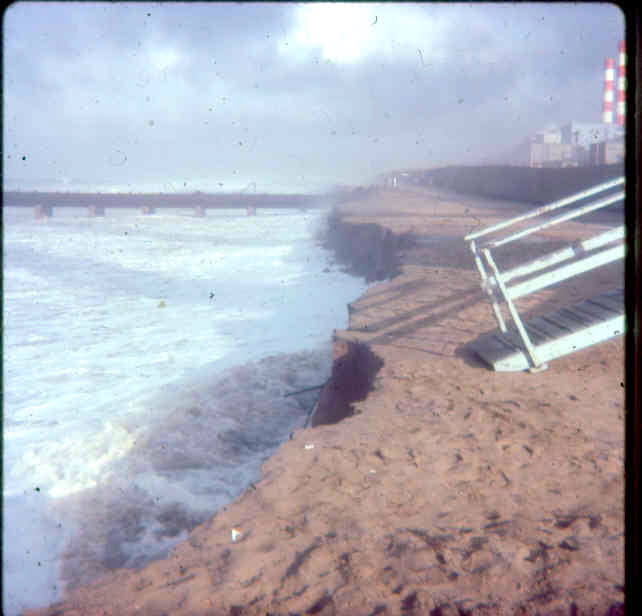
45th Street Lifeguard Tower ramp, north El Porto, circa 1976, looking north. High tides and storm surf have washed out the beach, creating a cliff.
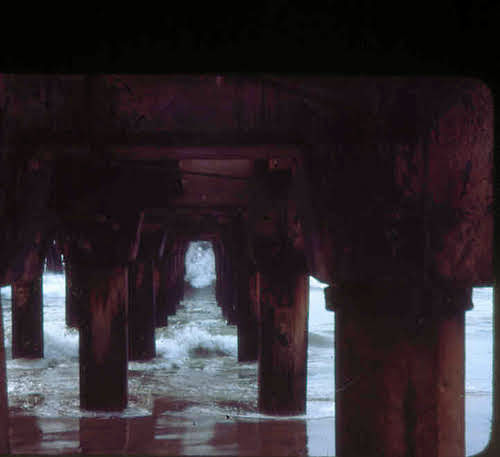
Under the Standard Oil Pier, early 70s.
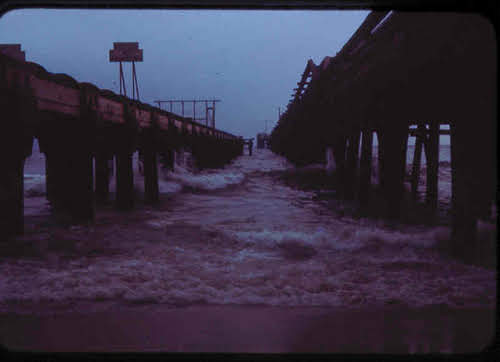
Standard Oil Piers, early 1970s.
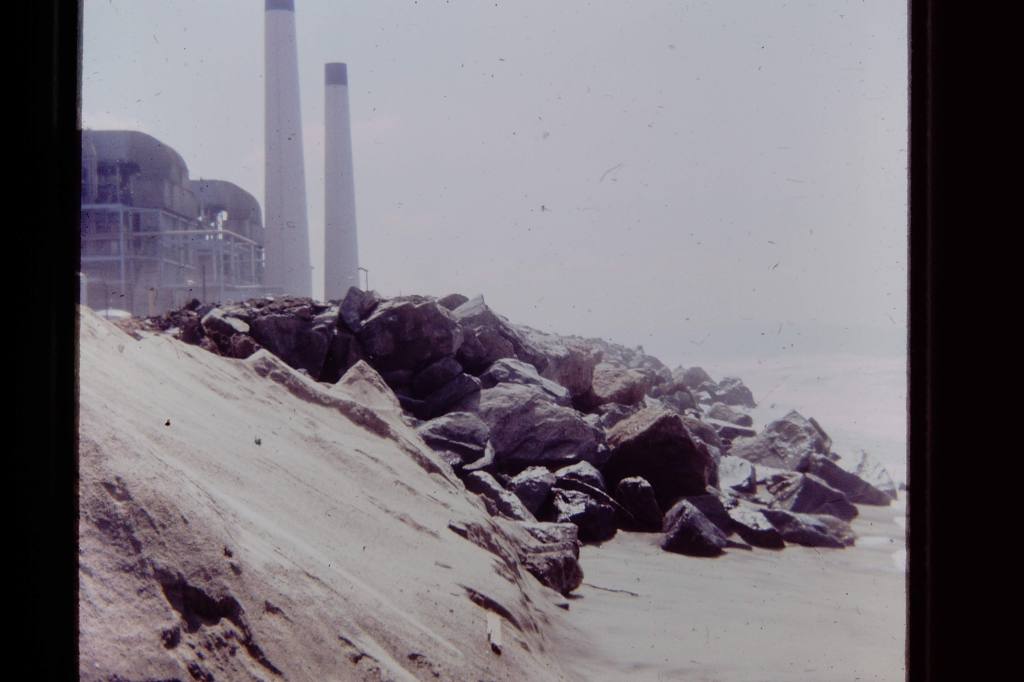
El Segundo Power Plant, mid 1970s. The giant rocks were brought in as riprap.
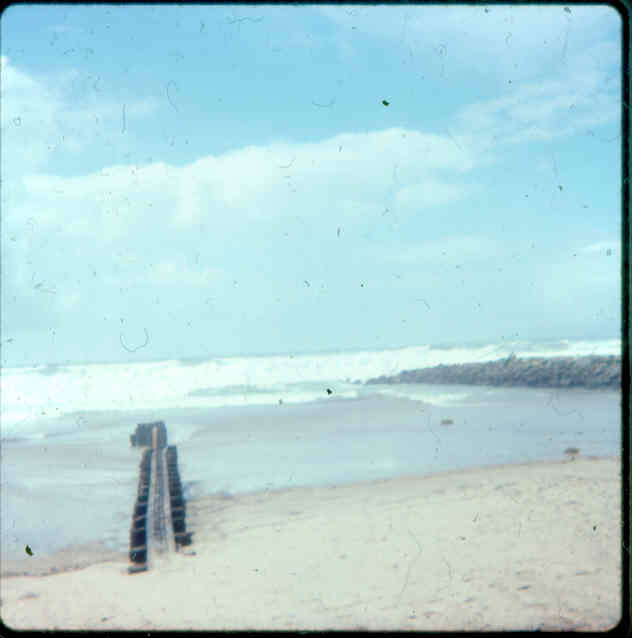
Grand Jetty with old pilings uncovered by a very low tide, early 70s.
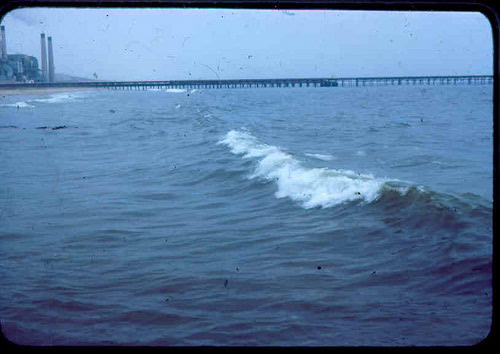
Standard Oil Pier and Power Plant Stacks – looking south from the Grand Jetty, early 1970s.
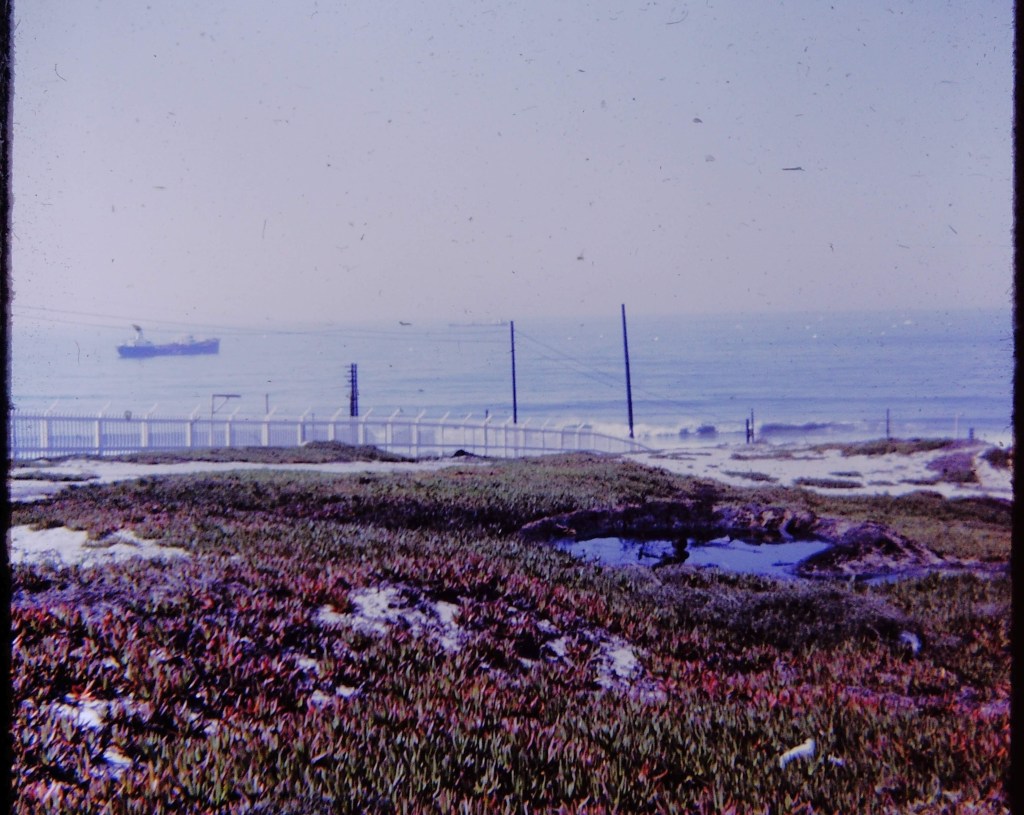
Ice plant covered dune overlooking Grand Ave. Beach, March 1974
.
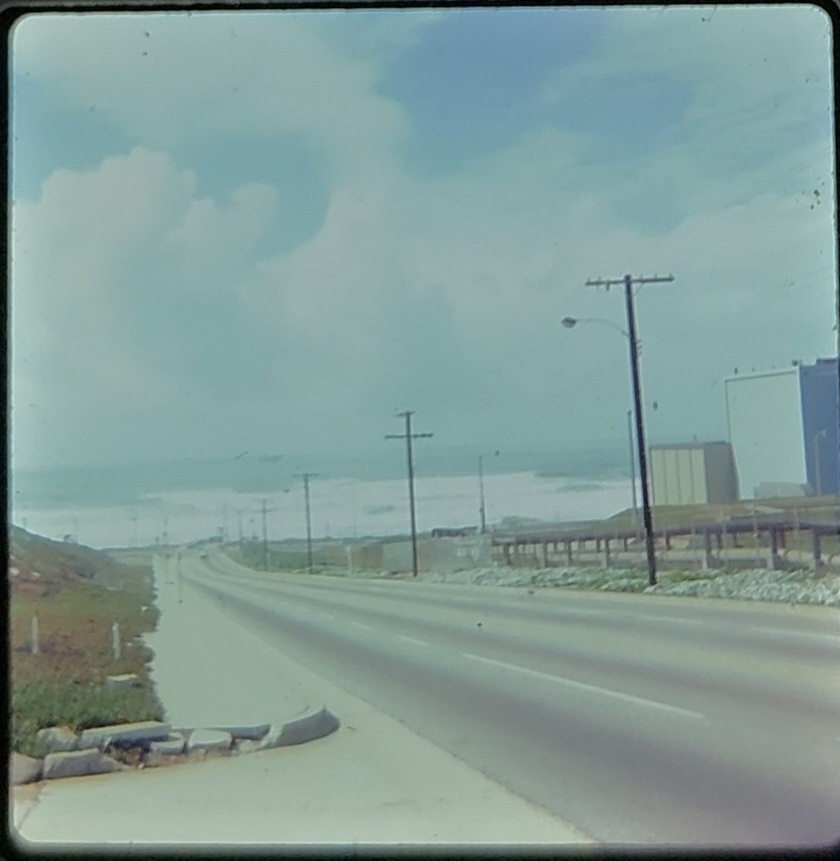
Grand Avenue, 1974.
Above photos taken with my Exakta 500 I used at the time. The exact dates on some of the slides are sometimes so faded I can’t say for sure when they were taken, but likely from 1968, when I purchased the camera used from a camera shop on Main Street, into the mid 70’s, maybe as late as 1977 or 1978 (thinking too of a box of slides most of which are not shown here). The Standard Oil Pier has since been taken out, the pipe now underground, underwater. The pier was located between 45th, the last residential street in El Porto, and Grand, which comes down to Vista del Mar from El Segundo. I’ve posted some of these pics before at The Toads, but in a different context.
Books referenced above include New York Review Books copy of Fermor’s “A Time of Gifts,” 1977, introduction 2005 by Jan Morris; and Second Mariner Books edition, 2014, of Penelope Fitzgerald’s “The Blue Flower” (1995). “Two Years Before the Mast” was published in 1840, just a few years after Dana had made the voyage described in his book.
“Guy needs a friend,” Harriet tells Dobson in Chapter Six of “The Danger Tree,” the first novel in “The Levant Trilogy,” where we find the same characters we met in “The Balkan Trilogy,” while introduced to new ones, too, as Harriet and Guy, a young English couple newlywed at the beginning of World War II, on the run from the invading Nazis, first from Bucharest then Athens, now find themselves in Cairo, in fear of having to run again as Rommel is rumored to be only hours away.
“Needs a friend! But no one has more friends.”
“There are friends and friends. There are those who want something from you and those who will do something for you. Guy has plenty of the first. He’s rather short of the second.”
“Do you mean that?”
“Yes. He collects depressives, neurotics and dotty people who think he’s the answer to their own inadequacy.”
“And is he?”
“No, there is no answer.”
p. 140, NYRB, 2014, first published 1982 as “The Levant Triology” by Penguin.
Later – alone, out of money, apart from Guy and adrift from Cairo into Syria, unable to find work, suspect and strange, following her rash escape, both deliberate and random, Harriet finds friends, and reflects,
“…she, an admirer of wit, intelligence and looks in a man, was beginning to realize that kindness, if you had the luck to find it, was an even more desirable quality” (497).
But is kindness alone enough?
“Lister was kind but, thinking of his fat, pink face, his ridiculous moustache, his wet eyes and baby nose, she told herself that kindness was not enough” (525).
Like Lister, many of Manning’s characters seem to walk on as if just out of a Shakespeare play. The critic Harold Bloom saddled Shakespeare with inventing the human. Shakespeare certainly made ample studies, having created well over a thousand characters in his plays. Manning too produces a host of characters, and while she doesn’t forge the human, she does fashion personality: quirks and tics, foibles and fears, motivations and enthusiasms – ways of being, but not always of one’s own choosing: why are we the way we are, and can we change? How do we make friends? How do we keep them? But none of Manning’s characters stand alone; they are each part of some social imbroglio: a picaresque duo; peasant families forced from their homes into refugee status; government administrators lost in corridors of bureaucracy; bosses and the bossed about; soldiers in lines marching off and stumbling back; colleagues and acquaintances and friends going to work, meeting in cafes for drinks or dinner, attending concerts or lectures, sightseeing, going on walks, always talking. Manning’s friends come together to join up and to disassemble, to get news, to ask questions, to criticize and admire, scold and berate, laugh and cry amid betrayals and sacrifices.
In the first book of the trilogies, “The Great Fortune,” Guy produces and directs a Shakespeare play. The whole enlarged endeavor is a sort of aside, meant to give the locals a respite from their anxiety over the war threatening near, but also to give the novel a subplot to view the interconnections of characters – their relationships, how they get along or not with one another, thrown together by chance and circumstance. The play is “Troilus and Cressida,” its amateur performance played once in Bucharest in 1940 a great success. But while just about everyone Guy knows has some part in the production, Harriett has no role to play but that of an observer.
In “Hamlet,” Shakespeare gives the bumbling Polonius the job of dispensing advice, now responsible for a litany of trite sayings repeated usually without knowing the questionable credibility of the speaker. A favorite of mine:
Those friends thou hast, and their adoption tried, Grapple them to thy soul with hoops of steel;
To grapple is to hook, as a grape plant does with its tendrils. But who wants to be grappled to someone else’s soul?
The second half of Polonius’s advice on friendship is usually dropped from the reference:
But do not dull thy palm with entertainment Of each new hatched unfledged comrade.
To be fledged is to be feathered for flight. How does one prepare for the flight of one’s friends?
Harriet and Guy’s friends jockey for position but more for survival. The loss of friendship becomes so common one seeks to avoid making new friends. This is the case with Simon Boulderstone, a British soldier in Egypt to fight in the desert war. Simon shares in alternating chapters with Harriet protagonist duties. He quickly loses the two Army friends he made on his way to Egypt. But he falls in with the tried and true buddy system, then loses a couple of good buddies. Simon learns one fights and dies not for one’s country but for one’s friends. He also learns friends that glitter often bleed lead.
Entangled in the theme of friendship is the theme of personality, how and why some are attracted to others while others are not, and may even be repelled. How and why relationships that start off so sweet often turn so sour and bitter. How and why some people have certain needs and wants that others readily cast off as useless burdens. How and why we use others in the guise of friendship then rid ourselves of them when the use grows obsolete. At the same time, we find friends who, as the saying goes, stick through the thick and thin, don’t abandon ship at the first sign of taking on water. In the end, we find Harriet and Guy the best of friends, which may mean putting up with one another’s spontaneous and fickle lack of friendship or having to entertain the friendship of others who if alone would not come close.
Thinking back to my earlier days of blogging, when it now sometimes seems writers then often wrote with different purpose, as in sharing a conversation with themselves to which others might be invited to listen in and, if need be, comment. Have we stopped talking to ourselves? Some days these days I’m nearly the only person I talk to, so if I do talk to someone else, some random Q & A with a passerby or on a visit to the grocery, I’m likely to mull over what was said with playback on repeat. Too often I find myself looking for meaning in a bucket of refuse, wanting to rebuff the debris, worried I might have not given someone or something my full attention, mired in muddled memory. Of course my interlocutor is long gone and remembers none of it and would be surprised to know I have it on mental-virtual video. Talking to ourselves is where conversations begin. Where can they end? I suppose many prepare a speech or lecture or opinion or anecdote, or spurn the prep and just go for it, though most rarely press it, but one might in conversation attempt to lecture or tell a story of something that once happened and for some reason the links still work, but not all of them, or the links take you places unexpected, but what’s the purpose of a lecture, a one way conversation, or an anecdote impossible to research? Do casual conversations have purpose, or are they simply a template for one’s personality, a way of spraying one’s mental territory? After a decade and more, a blog full of broken links, difficult to refresh. And we lose purpose, or misplace it, or deleted it by accident.
Olivia Manning’s writing is full of conversations. Characters come and go and return and you feel like you know not so much what they are going to say but how they are going to say it, and after a time there’s no difference. If the conversation contains nothing new, how something is said takes on more importance than what is said. But since it’s fiction, or selective memoir, everything that’s said must have some meaning, some purpose in the whole. Some reason for being said:
“The evening was one of the few that they had spent in their living-room with its comfortless, functional furniture. The electric light was dim. Shut inside by the black-out curtains, Harriet mended clothes while Guy sat over his books, contemplating a lecture on the thesis: ‘A work of art must contain in itself the reason why it is so, and not otherwise.’”
“Who said that?” Harriet asked.
“Coleridge.”
“Does life contain in itself the reason why it is so, and not otherwise?”
“If it doesn’t, nothing does.”
“Fortunes of War: The Balkan Trilogy.” NYRB 2010. Page 872.
But is life a work of art?
Critics have called Manning’s work somehow less than art. A blurb by Howard Moss on the back cover of my NYRB copy says,
“One of those combinations of soap opera and literature that are so rare you’d think it would meet the conditions of two kinds of audiences: those after what the trade calls ‘a good read,’ and those who want something more.”
You’d think that’s what a good conversation ought to purpose for. Why isn’t soap opera considered literature? It is, but one without an end – like a blog. Critics don’t like something that doesn’t come to an end. Someone that goes on and on and on is not considered a good conversationalist. But having enjoyed “The Balkan Trilogy” so much, I’m now on to the second of Manning’s trilogies, “The Levant Trilogy.” I’m only about 50 pages in, but already I think I can say it’s another good read mix of soap and lit. Though I’m not bothered by soap alone. Hemingway is full of soap. Soap and sap. Though the soap is rarely used for its purpose. The blurb was taken from a review of Manning’s Balkan and Levant trilogies Moss wrote for The New York Review, April 25, 1985, titled “Spoils of War.” Moss liked the books, almost in spite of his taste, it seems:
“The way this past world comes to the surface is un-Proustian and non-metaphorical; the thrust of the whole rarely has time to stop for digressions. Manning, who avoids elevations of style as if an ascent were a bog, also evades sentimentality, and although she can handle atmosphere, her main interests are those two staples of realistic fiction, character and action.”
But we do find digressions in the Manning books, mostly in the form of colorful sensory and physical descriptions of the weather and its effects on the streets, parks and gardens, the mountains and valleys and the trains traversing under the sky above and above the people below. But while these descriptions are placed here and there frequently it’s true they are short and appear almost as doilies or tchotchkes arranged to create atmosphere. But in the end, for Howard Moss, the trilogies lack poetry. But a poetry of war might create illusions, and what would be its purpose? Moss has already said of Manning:
“An enemy of illusions, she does not quite see how crucial they are both in love and in war.”
Was it on purpose Manning avoided metaphor and poetry? We can take purpose too seriously, forgetting that mostly what’s said is said in jest, to fill the spaces of silence, or to scratch common itches. We usually proceed without purpose. In Alice, on purpose, we find:
“They were obliged to have him with them,” the Mock Turtle said: “no wise fish would go anywhere without a porpoise.”
“Wouldn’t it really?” said Alice in a tone of great surprise.
“Of course not,” said the Mock Turtle: “why, if a fish came to me, and told me he was going a journey, I should say ‘With what porpoise?’”
“Don’t you mean ‘purpose’?” said Alice.
“I mean what I say,” the Mock Turtle replied in an offended tone. And the Gryphon added “Come, let’s hear some of your adventures.”
“I could tell you my adventures—beginning from this morning,” said Alice a little timidly: “but it’s no use going back to yesterday, because I was a different person then.”
“Explain all that,” said the Mock Turtle.
“No, no! The adventures first,” said the Gryphon in an impatient tone: “explanations take such a dreadful time.”
Indeed they do. Such might be to blog, or to write an epic trilogy or two, but while some explanations seem to require a long form, others can be riffed off in a tweet or two.
We say “on purpose” to explain some experience wasn’t “by accident.” But purpose is confounded by all those imperatives upon us that determine how we feel and experience but are not within our control, like the medulla oblongata stuff. We might try to proceed with purpose to do something purposeful with our day, or at least with our writing, or our blog, but to what purpose other than to show what happened and how our feelings may have changed over time and what ideas if any might accrue from those changes. But if all we can show is pettiness, narrow-minded cheap anecdotes, or soap operatic epic-intended purpose or explanations that go nowhere, why bother wading through the bog of a blog or a trilogy of books, all of which can never ascend but only descend, down as the page rises and disappears, one post after another, more often than not style and sense on repeat, poetry or not? Speak Memory, Nabokov said, while others might say, “Shut up!” Memory is like an upstairs neighbor pounding on the floor.
Memory is the editor-in-chief of experience:
“The Dormouse had closed its eyes by this time, and was going off into a doze; but, on being pinched by the Hatter, it woke up again with a little shriek, and went on: “—that begins with an M, such as mouse-traps, and the moon, and memory, and muchness—you know you say things are ‘much of a muchness’—did you ever see such a thing as a drawing of a muchness?”
Memory is an example of a muchness at work (or play).
“That’s the effect of living backwards,” the Queen said kindly: “it always makes one a little giddy at first—”
“Living backwards!” Alice repeated in great astonishment. “I never heard of such a thing!”
“—but there’s one great advantage in it, that one’s memory works both ways.”
“I’m sure mine only works one way,” Alice remarked. “I can’t remember things before they happen.”
“It’s a poor sort of memory that only works backwards,” the Queen remarked.
If memory only works backwards, what do we call the facility by which we look ahead? Can we imagine a future different from anything that’s contained in our memory? Imagination is muchness at work (and play). But character and action need a place to unfold, and Manning describes dwellings and rooms, bars and cafes, parks and walkways and trails. You can have a conversation anywhere. And her writing while sparse of metaphor is not devoid of poetry:
“The lawn was set with citrus trees that stood about in solitary poses like dancers waiting to open a ballet (695).
The landscape is part of the weather:
“As they rounded the house and came in sight of the sea, the clouds were split by streaks of pink. The sun was setting in a refulgence hidden from human eye. For an instant, the garden was touched with an autumnal glow, then the clouds closed and there was nothing but wintry twilight (695).
For all indents and excursuses, we have run out of purposes, if we ever had any, having relied on the feeling that we might as we sometimes do find our purpose in the act of going forth, but there’s never a guarantee.
Reading Darwin’s The Origin of Species (1859) this week, three days of 100 degree plus heat wave, we find many of his claims now absorbed as common sense and not controversial: when conditions of life change (flood, drought, extreme heat or cold, virus), plants and animals move, adapt, or perish. But Darwin may have underestimated the speed with which human intervention might disrupt nature’s pace:
“How fleeting are the wishes and efforts of man! How short his time! And consequently how poor will be his results, compared with those accumulated by Nature during whole geological periods. Can we wonder, then, that Nature’s productions should be far ‘truer’ in character than man’s productions; that they should be infinitely better adapted to the most complex conditions of life, and should plainly bear the stamp of far higher workmanship?”
What can we learn from the case of the demise of Florida’s orange groves? We might forget that orange trees are not native to Florida, or not think that 500 years is the wink of an eye in nature time. In any event, Florida’s orange trees, in the relative space of a few years, having been decimated by citrus greening, are being replaced with a new import, the pongamia tree, native to India. But what is said to be native to any given place is subject to constantly changing borders of nature. And natural partnerships are ever being created, renewed, broken, refreshed.
Darwin made prolific use of metaphor, seemingly to his own chagrin, at times almost apologizing for using it.
It has been said that I speak of natural selection as an active power or Deity; but who objects to an author speaking of the attraction of gravity as ruling the movements of the planets? Every one knows what is meant and is implied by such metaphorical expressions; and they are almost necessary for brevity. So again it is difficult to avoid personifying the word Nature; but I mean by Nature, only the aggregate action and product of many natural laws, and by laws the sequence of events as ascertained by us. With a little familiarity such superficial objections will be forgotten.
So what are we to do with that “stamp of far higher workmanship” quoted in paragraph two above? And why would what Nature produces be any more true than what man produces when man is simply a part of nature?
But the question blistering the headlines today is about the high tide of these heat waves, tsunamis of heat, every day breaking a new record somewhere, temperatures rising, plants wilting, animals dizzy from heat stress. Is the cause inscrutable Nature on some new unfathomable course, or “truer in character” yet, the stamp of human activity? And what’s to be done?
Man can act only on external and visible characters: Nature, if I may be allowed to personify the natural preservation or survival of the fittest, cares nothing for appearances, except in so far as they are useful to any being.
Where we see “survival of the fittest,” we may read survival of the best at adaptation, and the quicker to adapt, the more successful at continued comfortable living. Learning to live indoors at 70 AC degrees while the temperature outside is 103 degrees is not to adapt, and is not sustainable. Likewise, being able to navigate Death Valley as a tourist by virtue of AC in your Auto is not the same as slow adaptation to climate change. And we’re probably making matters worse. Yet Darwin remained optimistic, that Nature will continue to provide and sustain through change and adaptations, something like Matthew’s “Consider the lilies of the field, how they grow; they neither toil nor spin.” But to describe how something works does not explain why, and Darwin can’t seem to escape either metaphor or reference to “an active power or deity.”
Authors of the highest eminence seem to be fully satisfied with the view that each species has been independently created. To my mind it accords better with what we know of the laws impressed on matter by the Creator, that the production and extinction of the past and present inhabitants of the world should have been due to secondary causes, like those determining the birth and death of the individual. When I view all beings not as special creations, but as the lineal descendants of some few beings which lived long before the first bed of the Cambrian system was deposited, they seem to me to become ennobled.
But what does it mean or signify to become ennobled if you’re unable to enjoy the status of the moment? But the lily is Nature in all its so-called glory enjoying the sunny field. So is nature not at all anhedonic but hedonic in its random dance toward – toward what? But by definition hedonic pays not much heed to direction or purpose other than the pursuit and sustain of its own pleasure, which is to continue to procreate the game. The answer to that Darwin also suggests optimistically, is simply not to worry:
It is interesting to contemplate a tangled bank, clothed with many plants of many kinds, with birds singing on the bushes, with various insects flitting about, and with worms crawling through the damp earth, and to reflect that these elaborately constructed forms, so different from each other, and dependent upon each other in so complex a manner, have all been produced by laws acting around us. These laws, taken in the largest sense, being Growth with Reproduction; Inheritance which is almost implied by reproduction ; Varia- bility from the indirect and direct action of the conditions of life, and from use and disuse : a Ratio of Increase so high as to lead to a Struggle for Life, and as a consequence to Natural Selection, entailing Divergence of Character and the Extinction of less-improved forms. Thus, from the war of nature, from famine and death, the most exalted object which we are capable of conceiving, namely, the production of the higher animals, directly follows. There is grandeur in this view of life, with its several powers, having been origi- nally breathed by the Creator into a few forms or into one; and that, whilst this planet has gone cycling on according to the fixed law of gravity, from so simple a beginning end- less forms most beautiful and most wonderful have been, and are being evolved.
Reading Darwin’s The Origin of Species is an enjoyable way to spend a heat wave, if you have AC. He can be funny, too, though here probably not intentionally so:
“Now the number of mice is largely dependent, as everyone knows, on the number of cats.”
And on what is the number of cats dependent? The temperature outside today is coming down. We’re done with Darwin for now. So it goes.
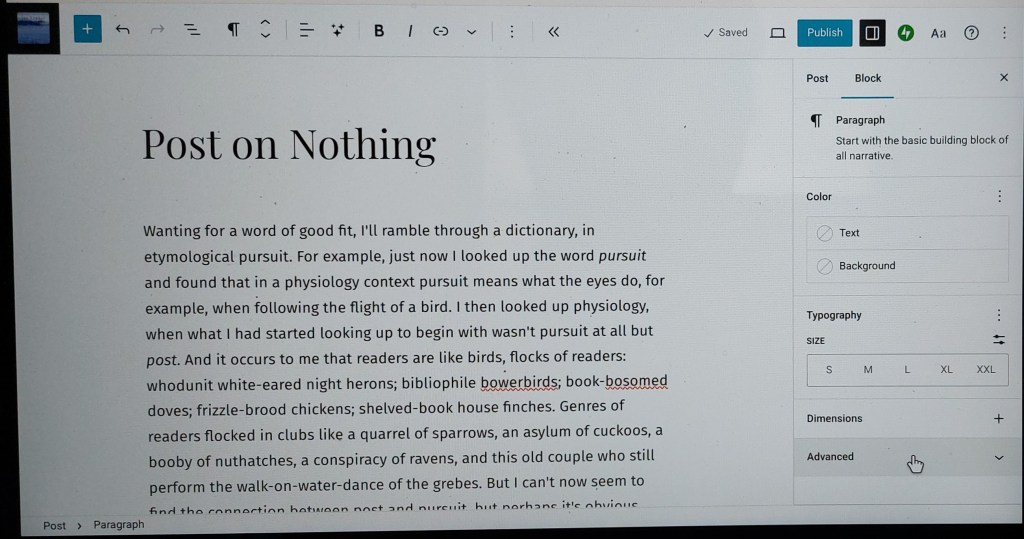
Wanting for a word of good fit, I’ll ramble through a dictionary, in etymological pursuit. For example, just now I looked up the word pursuit and found that in a physiology context pursuit means what the eyes do, for example, when following the flight of a bird. I then looked up physiology, when what I had started looking up to begin with wasn’t pursuit at all but post. And it occurs to me that readers are like birds, flocks of readers: whodunit white-eared night herons; bibliophile bowerbirds; book-bosomed doves; frizzle-brood chickens; shelved-book house finches. Genres of readers flocked in clubs like a quarrel of sparrows, an asylum of cuckoos, a booby of nuthatches, a conspiracy of ravens, and this old couple who still perform the walk-on-water-dance of the grebes. But I can’t now seem to find the connection between post and pursuit, but perhaps it’s obvious. Even familiar words have family history and we don’t know half the story as we rush to tell.
To post on a blog is to post in effect on nothing, the original posts one might post to being a mile marker, a signboard, road sign, doorpost, or a telephone pole, for example, on which one stuck a note giving notice, information or invitation or direction, or entertainment or argument, to passers-by, readers at random, on display in a public place. Such posts usually have (though not always obvious) some purpose, unlike graffiti, say, which usually is gratuitous. So far so good, a blog post is just that, what folks used to affix to a physical post, but there is no such real post to a blog post, unless one considers this open space where we seem to be (the internet, the web, the cloud, the blogosphere, the device – whatever it’s called) a post, but not a post like a milled fir 4 x 4, a tree shorn of its branches, returned into the ground, where to post something we might need a fashioned sign and a hammer and a nail.
                      "I have nothing to say

    and I am saying it                     and that is

poetry                 as I need it      ."
And post it. But this, this post, to return to it, is not poetry; this is a blog post, a post on a blog. About nothing. But what is nothing, if not something? Cage also prepared something called “Lecture on Something,” but the above quote is from Cage’s “Lecture on Nothing,” from page 109 in Silence (1961). But then again I hesitate to call this (thing that I write on, post to) a blog. A blog is a form as a poem or a song or an advertisement is a form. What is a form? We grow so weary of nothing (unless we are one of the cognoscenti of relaxation). Nothing to do. Nothing to say. Nothing to eat. Nothing to drink. Nothing in the kitty.
So we create and tend to forms. To blog is to write, but not quite, since some blog posts are devoted exclusively to the posting of pics, often posted without referent rhyme or reason. Content without form. How is that even possible? Anyway, aren’t there enough pics posted already? Yes, and words too. Is a pic a word? If you look up pic, you’ll probably see it’s classified as informal. It does not wear a cummerbund or a gown. But of course a picture is worth a thousand words. And where does that come from, that saying? We can look it up, and do. From advertising, apparently. The ads on the sides of trolley cars, which, passing as they do, a Clanging of Birdsong, provide for a moving post on which to post in pic form enough to imprint on the random viewer in passing a brand, a product, and a suggested desire or want, to follow up on later. Soap, cigarettes, auto parts, perfumes, hats, guitar picks. Are pictures worth more than words? Something called Picture Superiority Effect, from Wiki:
The advantage of pictures over words is only evident when visual similarity is a reliable cue; because it takes longer to understand pictures than words (Snodgrass & McCullough, 1986[15]). Pictures are only superior to words for list learning because differentiation is easier for pictures (Dominowski & Gadlin, 1968[16]). In reverse picture superiority it was observed that learning was much slower when the responses were pictures (Postman, 1978[17]). Words produced a faster response than pictures and pictures did not have an advantages [sic] of having easier access to semantic memory or superior effect over words for dual-coding theory (Amrhein, McDaniel & Waddill 2002[18]). Similarly, studies where response time deadlines have been implemented, the reverse superiority effect was reported. This is related to the dual-process model of familiarity and recollection. When deadlines for the response were short, the process of familiarity was present, along with an increased tendency to recall words over pictures. When response deadlines were longer, the process of recollection was being utilized, and a strong picture superiority effect was present.[19] In addition, equivalent response time was reported for pictures and words for intelligence comparison (Paivio & Marschark, 1980[20]). Contrary to the assumption that pictures have faster access to the same semantic code than words do; all semantic information is stored in a single system. The only difference is that pictures and words access different features of the semantic code (te Linde, 1982[21]).
With regard, then, to pics and words, as used in posts on blogs, one (pics) probably is not inherently, or intrinsically, worth more than the other (words). But what’s being measured in terms of worth is the value of advertising. Where pictures meet advertising in a meld (as in to announce, where the announcement and messenger are the same) is Instagram. Originally a place to post pics for folks with a hankering for photography, Instagram has become a wake of buzzards, a commotion of coots, a swatting of flycatchers. It’s an elevator of advertisements, the etymology of advertisement including a statement calling attention to itself and at the same time a warning. An advertisement is a solicitation, to be solicited, the more notoriously so, the better. Advertisement is a form.
That music is   simple to make   comes from   one's willingness to ac-
cept       the limitations    of structure          Structure is
simple      be-cause         it can be thought out, figured out,
measured       . (111)
In Cage’s “Lecture on Something” entire pages are left blank. “Let no one imagine that in owning a recording he has the music,” Cage said (128). Nor, if we own a book, do we necessarily have the poetry. Cage often left sections of music blank, too, the better to hear, presumably, the truck passing through the street below the window within a piece. If Cage had had a blog, he might have expressed issues of frustration regarding the “limitations of structure.” And it’s amazing to see what he accomplished with a typewriter. Here on WordPress, poetry, modern poems, often difficult to arrange on a blog page or post, are given, in the so-called “block” format used to make the WordPress page, somewhat easily to the functional white needs of poetry. WordPress predicates the paragraph as the primary foundation (block) of writing. Maybe for prose, but not so much for poetry, and probably not at all for the writing of music or tablature. That said, I’m not an expert at WordPress styles and options. I want to write, not do computer programming, so maybe I’m missing formatting possibilities, but the WordPress Preformatted and Verse blocks seem to work flexibly enough to attempt some creative forms. But the block is self-contained – I don’t see the possibility of a block within a block, where, for example, the typography of one word might change in size relative to the typography of another word in the same line or block, or of letters to letters in the same word.
     writing      verse (unblocked words)     on  WordPress
                  is as             simple as       writing
music
           if one        accepts          the
                      limitations (rules)
                                         of structure
the structure of limits (that which can't be measured)
nothing has no limits
What limitations was I talking about again? And anyway, doesn’t verse have all the limits it needs, without bringing WordPress into the discussion? Even a piece of doggerel has its limits, its boundaries. But notice Cage said “make” music, not write music, not compose music. One can make music if one has access to any kind of sound making device. To make silence is probably the most difficult challenge. If we take a pic of this post, we’ll find a picture is not worth a thousand words, since we can’t fit a thousand words into the pic, a post of 1,453 words, 8 minutes read time.
Those who travel back and forth through time, to and fro, up and down, in and out, with the tides, over and under the swells, stopping now and then to visit. They were here, now they’re gone, return to sender. Sisters, first, then brothers, then ten of us, thoughts like tinnitus that echo like a whiffle ball others can’t hear, sounds won’t leave us alone, to night us, all ten nights of us, Knights of Tinnitus, while these guitars gently sleep, and surfboards drift. A banjo plays brightly, its tabor head a full blue moon, up on the beach. So it goes.
But how does it go?
Ah, but ask the winged burds!
We look before and after, And pine for what is not: Our sincerest laughter With some pain is fraught; Our sweetest songs are those that tell of saddest thought.
But what did they bring along, if not knotty pine – oak or peonies?
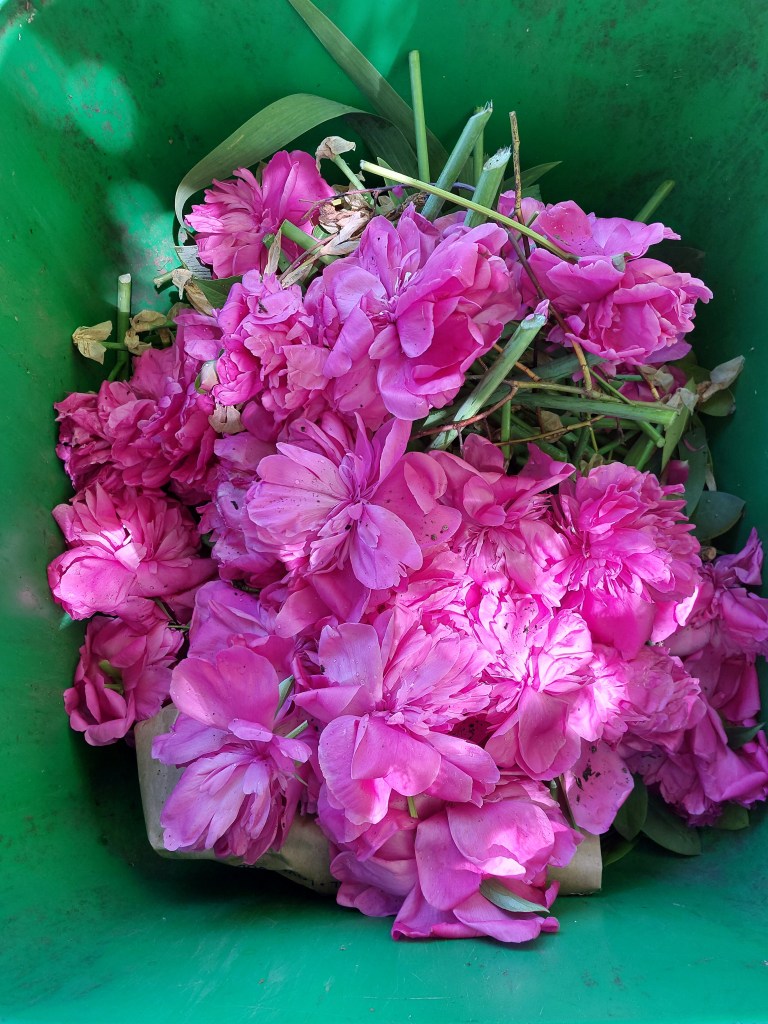
They brought along their come-a-longs, and along the river they walked, while in the wet reeds the wee birds nested and rested. There were peonies and pizza aplenty.
And along the river, did they sing songs?
Of chords they sang songs, serious songs, silly songs, songs of love and despair. Cover songs and under cover songs. Songs with no words.
What songs did they sing?
So it goes, so it goes. They sang so it goes.
But where did it go?
I don’t know. “While we look not at the things which are seen, but at the things which are not seen: for the things which are seen are temporal; but the things which are not seen are eternal.”
And what did they take back?
Don’t look back, but they took back a weighty tome, a mighty book, a reference book, a history book, a look into our times, past times, out of time, a book of songs.
And did they play it as surfers or hodads?
They played it both dolce or metalico, as the moon prevailed.
Why did they leave so soon?
“Blue moon of Kentucky, keep on shinin’. Shine on the one that’s gone and said, ‘Goodbye.’” So it goes.
“School for Love” (nyrb 2009) is a 1951 novel by the British writer Olivia Manning. The title comes from a conversation between the main character, Felix, and one of his housemates, Mrs Ellis, after she quotes from memory for Felix from the William Blake poem “The Little Black Boy,” from “Songs of Innocence”:
Look on the rising sun – there God does live, And gives His light, and gives His heat away; And flowers and trees and beasts and men receive Comfort in morning, joy in the noonday. And we are put on earth a little space That we may learn to bear the beams of love… (166)
Felix asks what it means, and Mrs Ellis says, “I suppose it means that life is a sort or school for love.” She doesn’t mention Blake by name, and is surprised Felix doesn’t know the poem, presumably mandatory reading for English schoolkids, but Felix has not had a typical British education. The reference comes in the last chapter, when Felix is about to complete his studies in this book that is a school for irony. The novel is set in Jerusalem at the end of World War II, where Felix, a young and naive teenager, having lost his father to an absurd fighting tangent and his mother to typhoid, comes to live in the house Miss Bohun has craftily usurped and uses like some evil landlord to manipulate and take advantage of her tenants. Finally, Mrs Ellis boldly confronts Miss Bohun:
Mrs Ellis, breathless, her voice having about it a sort of glow and confidence of fury, said: ‘There you are Miss Bohun! I hear you are plotting to let my room….I thought I’d let you know you’re not getting rid of me so easily….’
Miss Bohun’s voice was still mild, but her pleasantness had about it a quiet venom: ‘I thought when I saw you there was something about you . . . something vulgar and immoral. . .’
Mrs Ellis broke in furiously: ‘I wouldn’t bring up morality or immorality, if I were you, Miss Bohun. What about you? A hypocrite, a liar, a cheat, a dirty-minded old maid’ (182-183).
Miss Bohun of course tries to sell herself to others in terms opposite those characteristics. She does appear to have helped others, appears to hold an active and positive role in her community, and Felix is reluctant to revoke his loyalty to her for taking care of him when it seemed he had no one else to turn to and nowhere else to go. But he undergoes a slow awakening at the charges gradually revealed against Miss Bohun brought by Mrs Ellis. And Miss Bohun does not own the house in question, but has in effect stolen (saved, she would argue) the lease from a prior tenant whose family she then forces first into servitude and then out altogether. And she’s getting paid by the British for Felix’s room and board, while an element of absurdity is added to the plot when it’s divulged the curious, carefully furnished and clean but vacant front room is being saved for the Second Coming. And then it’s uncovered that Miss Bohun is receiving rent for that room also. She’s a kind of carpetbagger opportunist, and she’s very good at it, and she’s very good at explaining why she feels put upon and unappreciated.
The characters live close to the weather and flowers and trees and one another, hungry and cold, hungry and hot, victims and refugees, and even when news comes the war is over in Europe, they can’t celebrate, because it’s assumed the local political friction will now grow much worse. Perhaps it’s too simple to say “life goes on,” but it does, and these are the people who see to it that it does, in spite of their losses or their measly gains that often come at disastrous costs to others. Miss Bohun hides all her deceitful behavior behind a facade of do-good intentions. Does she herself believe her intentions are good? Everything she’s taken she argues was a win-win. One wonders in the end what Mr. Jewel will have won. But he seems to be entering the renewed relationship with Miss Bohun with a clear vision of its costs and rewards.
“I’m a lonely old man; she’s a lonely old woman,” Mr. Jewel tells Felix. A match made in heaven, though one can hardly imagine two people less compatible. In any case, as Mr. Jewel has already told Felix, “a wife and a fortune, they go together” (192).
The book begins with winter snow when Felix arrives in Jerusalem and ends in summer as he’s preparing to leave for London, and throughout, Olivia Manning describes the changing weather, the landscape, walks through the colonies and to the cafes and hotels and gates and courtyards, with deft brush strokes, like impressionistic water colors, and the weather and plants are melded with the characters:
On either side of the road the rocks were like great flints, the earth pinkish and bare as desert, and over all a silver glimmer fell from a dark sky (8).
The garden was green and cold; the house colder. Most days the sky was stormy (24).
Here the rains, following one another at intervals through the winter, carpeted the naked spring earth with a green as vivid as light. Later the grasses were enriched by the intricate leaves of trefoils, ranunculuses, anemones and vetches, and the spears of the bulb and tuber plants. Shortly before Mr Jewel was taken I’ll Felix saw the green cyclamen buds open, each dropping a screw of petals like a wrung-out cloth. In a day these had become flowers, alert and delicate as the ears of a gazelle (81).
The summer was coming. There was no more rain; the sun’s heat grew, the spring flowers wilted, dried, turned to dust, and the fields grew bare. Now the beauty of the day came with the sunset and the sky turned from a pure, bright green to a peacock blue in which the stars shone each evening larger and more brilliant. The sunset translucence and colour lingered, perhaps until dawn (138).
And there is the cat, Faro, another character in the book, that Felix loves, who gave him comfort night and day when he missed his mother so he cried helplessly alone:
She was lying dozing along a bough shaded by ferns. Her fur, extremely soft and fitting like a loose glove, was pressed into folds along her legs and the line of her belly. Her summer coat had come in pale; there was a sheen over her whole body and a glisten of silver-white at her throat (172).
A coming of age book, even if Felix does decide to keep the cat, adopt her as his own, and take her with him to London, another displaced, lower deck passenger, which is where Olivia Manning seems to find most of her characters:
The liners had been turned into troop transports and perhaps the pets’ quarters had been dismantled – if so, there would be nowhere where he could shut her up at night. As a male civilian he would have no cabin. The army officers would have cabins to themselves in ‘A’ deck; the women and children would sleep about nine a cabin on ‘B’ deck; the civilian men, of whatever age and rank, would be allotted hammocks with the troops on the lower deck (175).
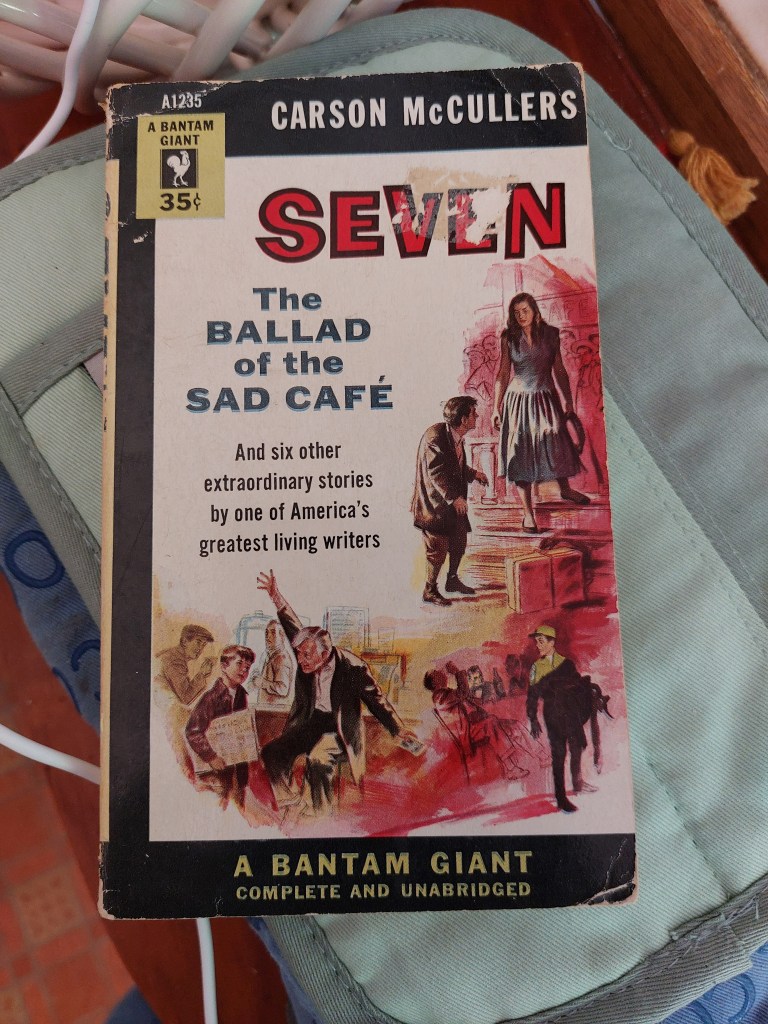
If you’re looking for Carson McCullers, you won’t find her at the Heart Clinic, where in the waiting room the chairs are a pleasant pastel-green plastic, the color of hope, and comfortable, though the wait is not long, and the streaming station is set to 60’s and 70’s rock ‘n’ roll.
Carson’s “The Heart is a Lonely Hunter” was published in 1940, when she was just twenty-three. We read it in high school in the mid 1960’s. The title comes from a poem by the Scottish poet William Sharp, published under his pseudonym, Fiona MacLeod. The word green appears in the 24 line poem 10 times. Here is the last stanza:
O never a green leaf whispers, where the green-gold branches swing: O never a song I hear now, where one was wont to sing Here in the heart of Summer, sweet is life to me still, But my heart is a lonely hunter that hunts on a lonely hill.
Only a poet would say of the heart it is “a lonely hunter.” But notice MacLeod/Sharp didn’t say “the heart”; he said “my heart.” Carson took his personal reflection and turned it into a universal appeal. Is the heart a lonely hunter? The answer will depend on whom you ask. But meantime we might also play around with Carson’s title:
The Heart is a Garrulous Scavenger The Heart is a Forlorn Blogger The Heart is a Red Red Rose The Heart is a Hollow Muscle
The word heart appears in Joyce’s “Ulysses” at least 200 times. Here is Stephen reflecting on one of his students in the “Nestor” episode:
Ugly and futile: lean neck and tangled hair and a stain of ink, a snail’s bed. Yet someone had loved him, borne him in her arms and in her heart.
But Joyce’s use of the word includes the real thing, too, as we find when we first meet Bloom:
Mr Leopold Bloom ate with relish the inner organs of beasts and fowls. He liked thick giblet soup, nutty gizzards, a stuffed roast heart, liverslices fried with crustcrumbs, fried hencods’ roes. Most of all he liked grilled mutton kidneys which gave to his palate a fine tang of faintly scented urine.
And this, meant to convey patience and forbearance in its context – Bloom thinking:
Wear the heart out of a stone, that.”
Of course many of the hearts are at the funeral for Paddy Dignam, but the young girls heart-worded “Nausicaa” episode begins with Gerty on the rocks close to sunset:
The summer evening had begun to fold the world in its mysterious embrace. Far away in the west the sun was setting and the last glow of all too fleeting day lingered lovingly on sea and strand, on the proud promontory of dear old Howth guarding as ever the waters of the bay, on the weedgrown rocks along Sandymount shore and, last but not least, on the quiet church whence there streamed forth at times upon the stillness the voice of prayer to her who is in her pure radiance a beacon ever to the stormtossed heart of man, Mary, star of the sea.
There is the sweetheart and the Sacred Heart. And times they might be the same. Or the heart is a flower. This from Molly Bloom:
I love flowers Id love to have the whole place swimming in roses God of heaven theres nothing like nature the wild mountains then the sea and the waves rushing then the beautiful country with the fields of oats and wheat and all kinds of things and all the fine cattle going about that would do your heart good to see rivers and lakes and flowers all sorts of shapes and smells and colours springing up even out of the ditches primroses and violets nature it is
And yes Molly Bloom has the last heart at the last of Joyce’s book “Ulysses” says:
yes and his heart was going like mad and yes I said yes I will Yes
Books. Shelved books. Backs to the world. Musty, dusty, pages that crackle when opened. Do I want to live in a library, surrounded by a labyrinth of shelves of my own making, impossible to find my way out, the books aging and shrinking as things alive, spine colors fading, hairlines receding, skins foxing, books sleeping in their den?
On-line, books do not sleep. And why not clear the house of the fossilizing, dusty creatures? In 1996, the San Francisco Library started a grand plan to replace its paper books with the new fandangled electronic stuff:
“In an apparent attempt at secrecy, Dowlin arranged for 200,000 more books to be completely discarded: Over nine months and despite protests and even outright sabotage by the library staff, San Francisco Department of Public Works dump trucks carted away these books to landfills.”
From Baker, Nicholson. ‘The Author vs. The Librarian,’ The New Yorker 72 (Oct. 14, 1996): 50-62 and Basbanes, Nicholas, Patience and Fortitude. New York: Random House, 2001.
Organizing, shelving, cataloging books, building cradles, bookcases, shelves to hold them, often an enjoyable if obsessive evening’s occupation. Borges, from “The Library of Babel”:
“The universe (which others call the Library) is composed of an indefinite and perhaps infinite number of hexagonal galleries, with vast air shafts between, surrounded by very low railings….Twenty shelves, five long shelves per side, cover all the sides except two; their height, which is the distance from floor to ceiling, scarcely exceeds that of a normal bookcase. One of the free sides leads to a narrow hallway which opens onto another gallery, identical to the first and to all the rest.
“The Library of Babel,” from Labyrinths, Selected Stories & Other Writings, by Jorge Louis Borges, A New Directions Paperbook – NDP186, 1964, p. 51.
I recently joined Goodreads. No, that isn’t stop the press headline news. I wanted to catalog my library. I tried Libib, but always wondering what I was missing without the “Upgrade,” left for Library Thing, maybe too frantic for a library, but I’m still working with Thing. Finding books on Goodreads is both easy and difficult. Easy to find any book, or any version of the book you might be looking for, difficult, at times, to find an exact match (of the many versions often shown) to the book you have in hand. Still, not a big deal, unless you obsessively want or need to ensure every brick in the wall of your collection is designed in color coded Flemish brickwork, in which case you want your books on course.
Perusing the various versions though can be a pleasure. Discovering, for example, the bright yellow banana on the cover of an e-book version of Beckett’s “Krapp’s Last Tape.” And pulling books I’ve not looked at for some time from the home shelves, I’ve a chance to reconsider what a particular book has meant to my reading life. Not that I’m a constant reader, one who is going to post hundreds of reviews weekly to Goodreads. Egads! I’m still gobsmacked to see readers doing that. And I think I’m a slow reader, though I’ve never ran a reading marathon – would probably finish somewhere in the middle of the pack.
Not too long ago, at around 4,000 books in my library, I decided to winnow the bunch down to those books I feel a special affinity for, usually gained from my predicament when first acquired and read. I now have about 1,500 books, and I thought I might use Goodreads to catalog some of those with brief notes and comments, beginning with collections of my favorite authors. Not that any book is not important. To have read even a single book in one’s life is noteworthy. To have discovered a writer and read all their books is to become a fan of literature – without which a writer’s books fade away. And when you pull an old book away from its crusty place, you might find it crystallized like an old bottle of honey lost high on a pantry shelf. But you can warm it up and it’ll come back to flowing.
Under the weather, literally, in rain country, but I would have been unable to get too excited for the great eclipse of Spring 2024 under any kind of sky. Drive five hours and climb a mountain and smoke a joint for four minutes of totality? I don’t think so. I experienced the eclipse of February 26, 1979, living in what used to be called a mother-in-law house (MLH), what now would be called an Additional Dwelling Unit (ADU), on a bluff over a lake, under ship hull grey skies. I remember a shadow blowing quickly and soundlessly by the windows, its darkness thickening, and then it moved on, and so did I.
Nick Paumgarten put up an interesting take of his recent eclipse experience in a Dispatch at The New Yorker site (9 April):
“Watching the Eclipse from the Highest Mountain in Vermont: People cracked cans of beer and smoked cannabis and popped mushroom gummies and ate smoked-meat sandwiches as totality approached at fifteen hundred miles per hour.“
We seem doomed to a craving for the spectacle, the big events: Superbowl, Burning Man, EGOT awards, Election Night. When what we want, or need, is to sit back and relax, but even to relax has become big business, and nothing will do without we get super relaxed, hyper-relaxed.
Inevitably, the great hyper-experience is followed by a come-down. Paumgarten concludes, having made the trek from New York to Vermont to experience the eclipse:
“That night, the highway south, back to the cities, was jammed. People reported that it took more than six hours to get out of Vermont. Others posted screenshots of the flight paths of private jets leaving local airports. Everyone had time to reconsider what was worth it, and what was not, and perhaps to weigh keeping those considerations to themselves.“
I remember another eclipse, this one experienced vicariously via Mark Twain, which might help explain our fascinations and superstitions. This eclipse is from A Connecticut Yankee in King Arthur’s Court. Hank, Twain’s time traveler, finding himself at odds with Merlin, is about to be burned at the stake when he leverages his knowing, having been there, in the future, of the coming eclipse to control the King and his minions:
“I have reflected, Sir King. For a lesson, I will let this darkness proceed, and spread night in the world; but whether I blot out the sun for good, or restore it, shall rest with you. These are the terms, to wit: You shall remain king over all your dominions, and receive all the glories and honors that belong to the kingship; but you shall appoint me your perpetual minister and executive, and give me for my services one per cent of such actual increase of revenue over and above its present amount as I may succeed in creating for the state. If I can’t live on that, I sha’n’t ask anybody to give me a lift. Is it satisfactory?”
‘There was a prodigious roar of applause, and out of the midst of it the king’s voice rose, saying:’
“Away with his bonds, and set him free! and do him homage, high and low, rich and poor, for he is become the king’s right hand, is clothed with power and authority, and his seat is upon the highest step of the throne! Now sweep away this creeping night, and bring the light and cheer again, that all the world may bless thee.”
If the next big event doesn’t eclipse its predecessor, it’s a bust.
 The Coming of the Toads