Category: Reading

  • After Words

    After Words

    After whirls listen
    whale hush comes
    the cat jigs the bat
    for your cares ward
    off dangerous asks.

    For love these old letters
    wild bedraggled wag around
    nest of gnarled grunts
    mosses bones hair vines.

    The old alphabetical guard
    strains in place at attention
    runes assigned ward beds
    grand command inspection.

    Sparse words heal
    after wounds foraged
    forward in a land
    of odd angles
    accentuated by red pencils.

    Winds mean about
    we know not what
    if in the end this
    is an end or a start.

    “It’s like a new
    pair of ears,”
    after words wishes
    remains unspoken.

  • A Loss of Intimacy

    A Loss of Intimacy

    The Encagement of Typographical Man

    How does one create a sense of intimacy with a blog? The very word, blog, heavy and lugubrious, suggests something one may not want to get too close to. Does intimacy imply a kind of secrecy, like the sharing of handwritten letters over time between two persons who have never met in propria persona? The Latin mass seemed intimate, and when, following Vatican II, local masses were said in the vernacular, I felt a loss of intimacy. The words in English had lost their secrecy. The mystery of the mass was no longer much of a mystery, no longer a magic show. The priest talked just like everybody else. This should have led to a greater degree of intimacy, but it did not.

    One characteristic of the Internet is its ubiquitous presence, McLuhan’s “global village” realized, but for anyone who’s ever lived in a small town, the Internet might seem its opposite, an absurdly large, strange village, more like something Kafka might have dreamed rather than Sherwood Anderson’s “Winesburg, Ohio.” But the paradox of “Winesburg” is found in the irony that one feels intimacy most when one feels most lonely. It is the loss of intimacy when one feels the value of the familiar, of something made known especially for you. But “over the Internet” intimacy is spread as thin as Emily’s gossamer gown.

    One blog I follow that seems to have created a sense of intimacy for or with its readers is Spitafields Life. Does follow suggest intimacy? But what if one is followed by a multitude? That would seem hardly the suggestion of intimacy. Yet the Spitafields blog is written by “The Gentle Author,” whose actual name we don’t know. Note the note of secrecy that seems to draw the normally distant intimacy near. The Gentle Author offers a course on how to write a blog. The next one is advertised at Spitafields for May. Maybe I should cross the pond and attend, buy a copy of one of The Gentle Author’s signed books, find out if The Gentle Author is male or female, not that it matters – would that knowledge increase or diminish a sense of intimacy?

    Blogs come in many disguises and intents, purposes vary. The lifespan of the average blog is probably not very long, could be as short as a day or two, indeed, an hour or two. One might quickly discover the blogger’s life contains the secret of a crushing intimacy, more sad and forlorn than a single tweet could ever hope for. The sound of the whippoorwill.

    So it came as some surprise to see the comment of one distant but familiar reader who found the new format I’m working on for The Coming of the Toads, “less intimate.” The folks who started the Internet, huddled over their code, as anonymous as a telephone pole on a country road, surely must have been among the least intimate of the ones to whom one might want to write. Or I just might have that backwards. IDK. The bloggers among us who prefer writing with words rather than with CSM must rely on canned templates to fulfill our visions! Admittedly though, I’m not even sure what CSM is, but I think it has something to do with the difference between visual and HTML. And so I leave you, no doubt, gentle reader, about as far from intimacy as I can get in this particular post.

  • Counterpoint

    Counterpoint

    This is another table poem – the words and lines formatted within the rectangles of a table inserted into a document. The table consists of 5 columns and 21 rows. A kind of counterpoint is created when the poem is read horizontally, vertically, diagonally. Formatting widgets (spacing, alignments left or right, cuts, etc.) have been added as musical accent marks.

    counter

    point part s po sh not
    again st

    co nter

    culture

    priv ate

    lake

    mass

    shore

    ount

    deck

    effect
    ass ump tion sit sting out

    cou

    entry
    un der

    palms up

    fronds down

    pile green

    noucter

    prick

    pluck

    plectrum

    finger

    nails

    percussive fingerling

    apron

    strings hooks

    count

    1

    Two

    3

    Four
    syncopate

    swooooons

    c u t
    how l o n g

    jay sus

    woh

    how here

    owh
    nogl

    l o n g

    on
    ow
    un clear im precise lack s clar ity cri tic

    pun

    c

    a hack’s ear

    u ate shun too smpl not
    4
    yes

    re

    me m ber us

    cross

    together

    prable

    back when
    whole point

    told

    aft you

    cave out

  • “Saltwort” Book Launch!

    “Saltwort” Book Launch!

    saltwort-front-cover“Saltwort” is selected poetical writings by Joe Linker, author of “Penina’s Letters,” “Coconut Oil,” and “Scamble and Cramble: Two Hep Cats.” Forward by Salvador Persequi. Includes 109 pieces.

    US readers may participate in a paperback giveaway:

    • Winner: Every eligible entry has 1 in 4 chance to win, up to 4 winners.
    • Requirements for participation:
      • 18+ years of age (or legal age)
      • Resident of the 50 United States or the District of Columbia
      • Follow Joe Linker on Amazon

    Follow this link for a chance to win a paperback copy of “Saltwort.” https://giveaway.amazon.com/p/739df558f09931bf NO PURCHASE NECESSARY. Promotion Ends the earlier of Feb 20, 2017 11:59 PM PST, or when all prizes are claimed. See Official Rules http://amzn.to/GArules.

    • Saltwort
    • Paperback: 222 pages
    • Publisher: CreateSpace Independent Publishing Platform; 1 edition (2017)
    • Language: English
    • ISBN-10: 1542768977
    • ISBN-13: 978-1542768979
    • Dimensions: 6 x 0.6 x 9 inches
  • A Load of Dirty Laundry

    For you distressed I carry yr clothes
    hamper downstairs taste every word
    prior to yr ears like mosquito
    static in yr hair I sit on yr head
    snatch one with my tongue
    smell yr salty skin yr cheeks
    freckled read as shame burr
    sounds around yr funny ear fickle
    bone bowls.

    Still you don’t care all that mulch
    for words can’t help the ear aches
    worse for wear and tears fall
    fill the worn clothes washer
    I don’t bother separating solids
    from colors under from outer
    and all that rhyme
    fill the tub and ounce of salt
    wort scrub-a-dub-dub
    rinse the soapy nest.

    Pin all to these lines
    in the sun of daily
    breezes off the water
    spinning and tumbling
    little white terns fly off
    as you dry off in dry
    bamboo grass we learn
    we two live in a slip
    and fall place as you slip
    a link and fall into the abyss
    of this lonely ableness.

  • Few Notes on “Loving,” Fiction by Henry Green

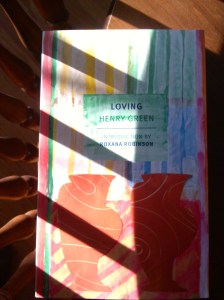
    loving-henry-greenI’ve been looking to read more Henry Green for some time. New York Review Books is in the process of reissuing a collection, introductions to the minimalist titled works by a few of today’s influential critics –  Daniel Mendelsohn, James Wood, Francine Prose, and others. Originally published in 1945, Loving was Green’s fifth book. Other Green titles in the NYRB series, a few more forthcoming in 2017, include the abrupt titles:
    Back
    Blindness
    Caught
    Doting
    Living
    Nothing,
    and Party Going.

    Loving is literature in a way that many works of fiction are not literature. That is to say it is about language first before it can be said to be about anything else. It might not make a good read for readers who value information and being told things straight up what’s going on. It’s not a page turner. One is encouraged to stay on the page and look again.

    The characters include servants and their masters as well as a few animals, including dogs and peacocks. Not much new or different there. Narration is minimal, the book reading almost like drama, the text mostly dialog, but point of view scatters this way and that depending on who’s viewing what where. A bit of children’s book form is suggested by the symmetrical borders of “Once upon…” and “and lived happily…,” and of course the adults often behave like children while the children behave like adults in their ability to stir the plot to action – thinking here of the murdered peacock and its abused corpse and the purloined (or lost and found) ring and its burial, while the one character not taken in by anyone’s childishness is the “reprethent [of] the Inthuranth Company” (133), come to investigate the claim of the missing ring who gets things right but whose authority is undermined by the slapstick speech impediment imposed by the tooth he’s just had pulled.

    The setting is a large country estate, a castle in rural Ireland during World War Two. Bucolic enough, but if that sounds pleasant, it’s not so much. Life is a cold and hard working go with much worry and darkness and shut off rooms full of covered furniture, and worries about the close but distant war and what might happen if the Germans invade Ireland, what the Irish are up to, and how the relatives are making out over in beleaguered England. And there are rations and shortages but still plenty of domestic work but real opportunity found only in factories or submitting oneself to the brutalities. Still, not much there either that we don’t find in much literature of the period.

    The plot concerns an old butler who dies and a younger one moves in to take his place, a promotion not enthusiastically welcomed by the entire staff, for Raunce promises to issue in some changes and challenge tradition, including insisting Madam call him by his actual name and not Arthur, the name she prefers to call all butlers, regardless of their actual name. Most exasperating is this new Arthur wanting morning tea brought him still in bed and that tea brought by one of the two lovely maids Edith suspicioned of desiring possibly to return Raunce’s inappropriate advances.

    The dialog though is what the book is purposefully really about, and the reason for reading that book. Characterization is revealed through dialog, and helps explain the idiosyncrasies of speech and syntax and varied ways of talking employed. As another example of Green’s distinctive but sometimes even peculiar style, he seems to prefer “this” and “that” to the:

    “and he took that cushion, ripped the seam open” (130).

    Nothing wrong with that, but it appears throughout, in a variety of syntactical shapes, and might strike the ear as odd:

    “who took this man’s business card” (131).

    But see if you don’t come across that oddness on your own. There are many more examples: “she strode up to that arrow and gave it a tug” (forgot to hold the page; and while I’m at it I’ll add that I’ve resolved this new year to stop marking up books read with marginalia notes and all. Makes the occasional review a bit more difficult though. Ebooks are easy for looking things like that up, but the memory gets not as much exercise. Remains to be seen if the “notes” a la reviews improve or not).

    Loving will make a good choice for a book club group, not that I belong to one, but thinking you might, or you could start one, Loving your first book.

    Loving, by Henry Green (1945) and 2016 New York Review Books (Introduction by Roxana Robinson).

  • awake & asleep

    ear to ear
    each other
    we hear
    now there
    now here
    tilting
    tinctures
    chandelier
    sweeps & swivels
    & windowsill
    candles glisten

    in moved & numbed
    dark a sommelier
    comes pinches
    the wicks dreams
    river yarn & damn
    earwax secrets
    sheets surface
    smears of sea
    & ocean seer
    seal bobs near
    freer & freer

  • The Sufi in You, The Sufi in Me

    For a couple of years, I took classical guitar lessons. Once a week, I arrived at my teacher’s house, obediently left my shoes on his front porch, and sat with James in chairs arranged in the middle of an empty room, Feng shui, he said, facing south into a single music stand, while in another room, unseen, his partner exercised on a mini trampoline. James was fond of what he called Sufi sayings, and used them to convey guitar techniques. In our first lesson, James asked me what I was after. I had already been playing the guitar for years, a kind of folk jazz free-lick fingerstyle, but I wanted to learn something about music theory, better learn the fretboard, and better read notes.

    “Playing classical guitar,” James said, “is not about musical theory. And once you get the notes, you don’t think about them, any more than you think about individual letters when you read a text. The theory is in the work, placed by the composer. What the guitarist does is technique.”

    James frowned at my guitar. I had a better guitar at home, I told him, but a steel string folk guitar, unsuitable for classical playing. And I had a three quarter size nylon string acoustic, but it didn’t hold tune. “Get rid of all those guitars,” James said, “and get a good instrument, the best you can possibly afford. You play an instrument to make sound.”

    Then James asked to see the fingernails on my right hand, and he took a steel file to them, and then sanded the nails smooth with a fine piece of wet and dry sandpaper. The rest of that first lesson was spent learning how sit and hold the guitar, how to breathe and relax the shoulders and neck, where, James said, I appeared to carry all my stress and tension.

    Regarding the care of fingernails, I mentioned to James I was playing on a city co-ed softball team, where I might wreck his fingernail work. “If you are a good softball player,” James said, “you won’t hurt your nails. Fielding a ball is technique.”

    James was an excellent guitarist, but he had difficulty performing in public. One day, James informed me he was moving away. He was giving up the guitar and going into typing. He was going to be a typist. He was passing me on to another guitar instructor. I was never sure if his move to typing was true or if he was using a kind of Sufi-like koan to send me a message about my guitar playing ability. In any case, I was not dissuaded; I thought about composing a piece for typewriter and guitar.

    “What have you learned in your time with me?” James asked, in our last lesson. “That I want to play the guitar beautifully,” I replied. “You already can play beautifully,” he said, “but you are a poor listener.”
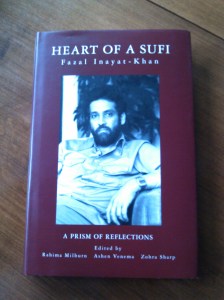
    img_20170102_141921I thought about James, recently, reading through Heart of a Sufi: A Prism of Reflections (Arch Ventures Press, 2010), about Fazal Inayat-Khan (1942-1990), also known as Frank Kevlin, a name Fazal invented in an effort to circumscribe his legacy as grandson to Pir-o-Murshid Hazrat Inayat Khan, who was instrumental in broadening awareness of what Fazal apparently preferred to call the “Sufi Way” around the world. The book is a high quality, sewn bound hardback, and includes black and white photographs, and informative appendix matter (contributor profiles, bibliography, glossary, website links). The primary content of the book consists of anecdotal, testimonial, and essay-like pieces contributed by people who knew Fazal as students or followers or were community members, particularly of Four Winds, a kind of commune located near Farnham, UK, and which was Fazal’s home for a time.

    The text is, then, an oral history. Twenty-one writers contribute experience with Fazal profiles primarily, it seems, from the 1970’s, a time when interest in communal life and alternate inquiries into how one might live flowered in many countries around the world. The book will be of interest to researchers working on oral histories, religious or spiritual movements, charismatic leaders and followers, or the period in and around the 1970s – as well, because Fazal was a trained psychotherapist, researchers interested in therapy fields as well as the functions of the mind and its potential spiritual energy or in foundations of learning and being and becoming.

    What I learned of Sufi from James amounts to about as much as I learned of guitar, which is to say that I am not a good listener. But the Prism of Reflections text is a good read for those interested in experiencing vicariously the era noted for gurus, spiritual quests, alternative life styles and approaches to religious and spiritual questions. The book is not an attempt to convert readers to any kind of Sufi practice. Its purpose seems to be primarily a vehicle to remember and give tribute to an influential teacher while describing his impact on the individual. Little attempt is made to venerate or hold Fazal up as a saint. And indeed, my own general skepticism of movements and teachers was catalyzed by some of the anecdotal evidence presented.

    For example, there is this conversation with Fazal related in one of Ashen Venema’s pieces:

    “After the Earthing event at Four Winds Fazal invited me to stay on, with a condition,
    ‘You must at all times do as I say.’
    I was speechless, and held his gaze for what seemed an awesome long time. He must be joking, I thought, he can’t be serious. I did not know then that Fazal’s teaching respected doubt, deeply, as the true measure of one’s faith. I struggled for a tactful answer. All of a sudden Fazal smiled and winked an eye. He didn’t have to say a word. I trusted the light of intelligence in his eyes” (49).

    Fair enough, but something a bit creepy lingers with that “at all times do as I say,” which he apparently said to others also. And the passage above might leave the reader, as many of the pieces in the rest of the book also might, with a cryptic experience. At the same time (and of course, as several contributors seem to suggest, the anecdotes may say as much or more about the writers than about Fazal), the memoir-style remembrances seem honest and balanced in their critical approach. Ashen goes on to say:

    “The Sufi family was and is an enigma, a spicy mix of characters with little in common. We could have come from different galaxies…Groups reveal to us our place in the human family, reflect the warring crowd within our individual psyche, where we struggle towards a dynamic balance and optimal functioning in a complex world. Groups quicken the process of psychological integration – and, ultimately, the freedom to be what we are already” (49-50).

    Later in the book, though, I came across this, a bit shocked and surprised:

    Principles relating to the customer

    • Serve our customer
    • Satisfy our customer
    • Service and maintain our customer’s products
    • Delight our customer” (128).

    In context, a section on the meaning and strategies of leadership, the principles are not at all jarring – I mention it here to help illustrate the wide spectrum of approaches the contributors took to remembering their experiences with their teacher. Fazal himself seems to have been somewhat isolated or even alienated by his own persona as potentially viewed and distorted by others. As a kind of celebrity, he seemed aware there would be students who would not necessarily benefit from a mentor they filled with their own projections. But in that sense too, the book acknowledges the difficulties inherent in the entire enterprise.

    There is great value in this kind of book, a collective memoir remembering a time, place, and person influential in helping shape the direction of individual lives and responsible for the continuity of group efforts that will no doubt be compromised by the vicissitudes of individual needs and desires as principles move through changing environments and meanings and time. The book may serve as an introduction to further studies, as its bibliography and glossary make clear. The book is learned and credible, and will be valuable to specialists and researchers of various topics, but again, its greatest value to the general reader is probably in the diary or memoir like diversity the individual contributors bring. The book is engaging precisely because it’s readable. These are very interesting people, people who have struggled with self and meaning, direction and efforts to contribute to something larger than their individual awareness might project. And many of the anecdotal pieces are down to earth descriptions of the man Fazal and his work and time. Taken as a whole, they create an oral history biography.

    And if you find, after reading the book, there does not appear to be a Sufi in you, you can always pick up the guitar.

    Heart of a Sufi – Fazal Inayat-Khan: A Prism of Reflections (2010), Arch Ventures Press, Edited by Rahima Milburn, Ashen Venema, and Zohra Sharp.

    img_20170102_142010

  • Body a la mode

    Hair is home
    host to vermin
    both lowlife
    and high fliers

    little lady bugs
    after aphids
    and crickets
    around the neck

    head is open
    for business
    enter up
    escalator nose

    bay lips open
    for winnow
    shopping
    the ears parking

    garages for
    diverse scads
    take elevator eyes
    to the penthouse

    sweet
    down now
    to the fruit and nuts
    the walnut shaped

    butt rarely sees
    up as down it sits
    a-squish in fat
    the thighs arise

    down to deal knees
    legs akimbo down
    to ankle gears
    pulleys the feet

    monkey wrenches
    between toes
    grease growing
    mushroom nails

    this being husk
    breath munching
    crunching
    masquerade

    and inside the body
    marching things
    really grow
    interesting .

  • Glidings

    (for Tim)

      capsule          bubbles                                     fall float                         sail                  glide
                                                                            heart engines purring                                                                                                             blood fuel Below all


    water

                                        sky full                         slip                  of bubbles
                                                                            all gliding with

    very

    little

    noise

    slow whoosh

    gliding
    across
    nighttime
    gliding
    during
    daytime
    coast
    with
    birds
    gliding
    to
    & fro
    for
    & from
    & squirrel
    gliding
    along
    fence top
    yard to yard
    cat
    watching
    gliding
    slowly
    up
    &
    down

    gliding

  • “All the World’s a Bill-Bard” at Berfrois

    Something new up at Berfrois. In which we argue for the power of the napkin poem! If yr sitting out with a cup, give it a read?img_20161112_130954