One of my sisters recently visiting, one the guitarist and both patient artists on paper and cloth, not in any particular hurry, so riding the Coast Starlight for a bit of adventure and fun you don’t get on an airplane these days, and knowing my affinity for books, upon leaving for the southbound trip, left me a gift of “The Paris Library.”1
As genre, it’s a historical novel, and thematically covers some of the same ground found in “Suite Francaise,” the novel by Irene Nemirovsky,2 the setting of both books the World War II German occupation of France and its effect on the French population. In the preface to the French edition, a quote from Irene in a letter to a friend: “How could you think I could possibly forget my old friends because of a little book [she’s talking here about her first novel, “David Golder”] which people have been talking about for a few weeks and which will be forgotten just as quickly, just as everything is forgotten in Paris?” (421-422).
That everything is forgotten is why we write and read, and why sometimes there are those who would destroy or ban books, or close libraries. At the same time, given the ongoing repetition of predicaments that lead up to those books, one wonders if one really wants to repeat a given experience vicariously yet again, or why.
Irene’s daughter Denise discovers while copying her mother’s notes over 60 years after World War II, “These were not simply notes or a private diary, as she had thought, but a violent masterpiece, a fresco of extraordinary lucidity, a vivid snapshot of France and the French – spineless, defeated and occupied: here was the exodus from Paris; villages invaded by exhausted, hungry women and children battling to find a place to sleep, if only a chair in a country inn; cars piled high with furniture, mattresses and pots and pans, running out of petrol and left abandoned in the roads; the rich trying to save their precious jewels; a German soldier falling in love with a French woman under the watchful eye of her mother-in-law; the simple dignity of a modest couple searching amidst the chaos of the convoys fleeing Paris for a trace of their wounded son” (Preface to the French edition, 430).
But “The Paris Library” remains in wartime Paris, where not everyone is “spineless” or even “defeated,” but half the story includes, almost absurdly, in split-time alternating chapters, a setting some 40 years later in the US state of Montana. Letters play an important role, another way of remembering, should they be stashed away for some future generation to discover – or for the letter-writer to re-discover an old self. And in “The Paris Library” the human frailties uncovered or challenged by universal circumstances of the results of one’s actions prove the human possibilities of self-empowerment and resilience and rehabilitation. Challenging too, the constant reminder that one constant of the human condition seems to be the constant seemingly contradictory struggle for peace.
“The Paris Library,” by Janet Skeslien Charles, first published in Great Britain by Two Roads (John Murray Press, Hachette UK), 2021. ↩︎
I have the First Vintage International Edition, May 2007, translation (2006) by Sandra Smith, originally published in France as Suite Francaise by Editions Denoel, Paris, in 2004, and subsequently in Great Britain by Chatto & Windus and in the US by Knopf, 2006. ↩︎
Eugenio Montale, who won the Nobel Prize for Literature in 1975 (for his poetry), would have made a great blogger. In 1946, he started writing for a newspaper, a form ill-suited to his poetic writing style, and for his articles created a new form, based on the characteristics of the personal essay:
“To write about those silly and trivial things which are at the same time important” (Montale, quoted in Introduction, p. x)1.
And since the blogger doesn’t write for today’s formal critic (who eschews the amateur writer), or for the reader of tomorrow (who delights in the undiscovered), but for today’s casual scroller (who has no patience for the esoteric), Montale could knock out his pieces on demand:
“I write the articles in two hours, with no trouble,”
(Sounds about right, given this blogger’s experience; what flows easily for one writer may trouble another, but either way, one should still carefully select from one’s personal Library of Babel)
“but when I’m out of ideas (and it happens often) I feel lost” (xi).
How could you ever run out of ideas when your subject is everyday life? To write, maybe it’s best to first be lost.
“If I was not a born storyteller, so much the better, if the space at my disposal was limited, better still. This forced me to write in great haste. To cater for the taste of the general public, which is little accustomed to the allusive and succinct technique of the petit poeme en prose, created no problem” (x).
And what are those characteristics of the personal essay one might find in Montale’s “sketches”?
“…humor, irony, self-irony, and a ready supply of nostalgia, across fictional vignettes, memoir, literary and cultural opinion, travel writing, and music criticism” (xi – Galassi, Introduction).
The sketch form (which is neither news nor opinion), to get it right, must be written askance or on a slant less it become straightforward autobiography, which by definition most will find boring, for readers must be able to find themselves in the writing, even if the picture they find might not be particularly flattering.
To give some idea of the length of the sketches, Montale’s newspaper pieces, there are 195 pages of them in the NYRB book I’m quoting from, which is divided into four parts that total 50 pieces, so an average 4 pages in length. The longest are 7 pages, of which there are only 2, and the shortest are 2 pages, of which there are 7.
The titles of the “Butterfly of Dinard” pieces don’t always give much of a clue as to the topic. Take for example, “Success,” which turns out to be a music experience piece which includes a consideration of “claqueurs,” who were a kind of precursor to the canned laughter of television sitcoms, and the piece turns out to be not about success at all but about its opposite, failure; fair enough, since the early sitcoms and soap operas, one might theorize, did borrow from the classical melodramas, and in terms of art consideration, fit the bill. Of course the soaps lived without laughter of any kind, unless the audience had cried itself silly.
I’ve often thought John Cage, Marshall McLuhan, and Buckminster Fuller each would have made efficient and excellent bloggers. I was reminded of Cage when reading Montale’s “Success” piece. Montale is recruited by his barber (and vocalist who would then become Montale’s bel canto teacher) to join “his team of claquers” for a night to applaud a musician, Jose Rebillo, who could not “read notes but nonetheless he composed music for the pianola by cutting and punching holes in cardboard rolls with scissors and awls.” (There are 73 “Translator’s Notes”: #26 explains that Rebillo is based on the real composer Alfredo Berisso). Of course Cage could read notes, but still, the method described evokes Cage. And not only the method; Montale says, “Music such as that of Signor Rebillo, all dissonance and screeching, had never been heard before” (50).
Other titles include “The Bat,” about a couple in a hotel room invaded by a bat. The woman freaks out while the man must find a way to evict the bat. And “Poetry Does Not Exist,” about a visit Montale receives from a German Sergeant during the war-winter of ’44, a would-be poet himself and a fan of Montale’s poetry. During the visit, Montale is hiding two compatriots in an adjoining room. And the title piece, “Butterfly of Dinard,” which may or may not have been real.
The four sections of the book align somewhat with Montale’s chronological history, explained in the Introduction, which itself includes 8 footnotes. Each piece is a self-contained reading experience that points in two directions, one outward, the other inward, and the reader may take either path. In the title and end piece, “Butterfly of Dinard,” the narrator tells of a cafe and a waitress, who may or may not be the butterfly of the piece, which is only about 500 words long, a single page. Was the butterfly real or a figment of the imagination is the unanswerable question.
Butterfly of Dinard, by Eugenio Montale, Translated from Italian by Marla Moffa and Oonagh Stransky, Introduction by Jonathan Galassi, New York Review Books, 2024, Originally published in Italian as Farfalla di Dinard, 1960. ↩︎
“The Coming of the Toads” is the title of a short poem by E. L. Mayo:
“‘The very rich are not like you and me,’ Sad Fitzgerald said, who could not guess The coming of the vast and gleaming toads With precious heads which, at a button’s press, The flick of a switch, hop only to convey To you and me and even the very rich The perfect jewel of equality.”
E. L. Mayo. Summer Unbound and Other Poems, the University of Minnesota Press, 1958 (58-7929). Also, E. L. Mayo. Collected Poems. New Letters, University of Missouri – Kansas City. Volume 47, Nos. 2 & 3, Winter-Spring, 1980-81.
The young toads were ugly televisions, but those eerily glowing tubes contained a lovely irony. The toads invaded indiscriminately. The bluish-green light emitted from the eyes of the toads emerged from every class of home, all experiencing the same medium for their evening massage. Mayo’s poem is a figurative evaluation of the effects of media on class and culture.
In Fitzgerald’s short story “The Rich Boy” (1926), the narrator says, “Let me tell you about the very rich. They are different from you and me.” But Mayo doesn’t seem to be quoting from Fitzgerald’s story. He seems to be referencing the famous, rumored exchange by the two rich-obsessed, repartee aficionados Hemingway and Fitzgerald. Hemingway wrote, in his short story “The Snows of Kilimanjaro” (1936):
“He remembered poor Julian and his romantic awe of them and how he had started a story once that began, ‘The very rich are different from you and me.’ And how some one had said to Julian, Yes, they have more money. But that was not humorous to Julian. He thought they were a special glamourous race and when he found they weren’t it wrecked him just as much as any other thing that wrecked him.”
Did TV have a democratizing effect, or are its effects numbing? In Act 2, Scene 1, of Shakespeare’s “As You Like It,” Duke Senior, just sent to the woods without TV, mentions the toad’s jewel:
“Now, my co-mates and brothers in exile, hath not old custom made this life more sweet than that of painted pomp? Are not these woods more free from peril than the envious court? Here feel we but the penalty of Adam, the seasons’ difference, as the icy fang and churlish chiding of the winter’s wind, which, when it bites and blows upon my body, even till I shrink with cold, I smile and say ‘This is no flattery: these are counselors that feelingly persuade me what I am.’ Sweet are the uses of adversity, which, like the toad, ugly and venomous, wears yet a precious jewel in his head; and this our life exempt from public haunt finds tongues in trees, books in the running brooks, sermons in stones and good in every thing. I would not change it.”
Fitzgerald didn’t embrace television, but today he might cradle a metamorph tadpole in his lap. What would it convey? The toad’s jewel is more than a metaphor; the churlish shows of television are today the Duke’s counselors. We enter the space of the light box, and the toad’s jewel poisons us to the paradox of staying put, to electronic exile, but does it contain its own antidote, the toadstone?
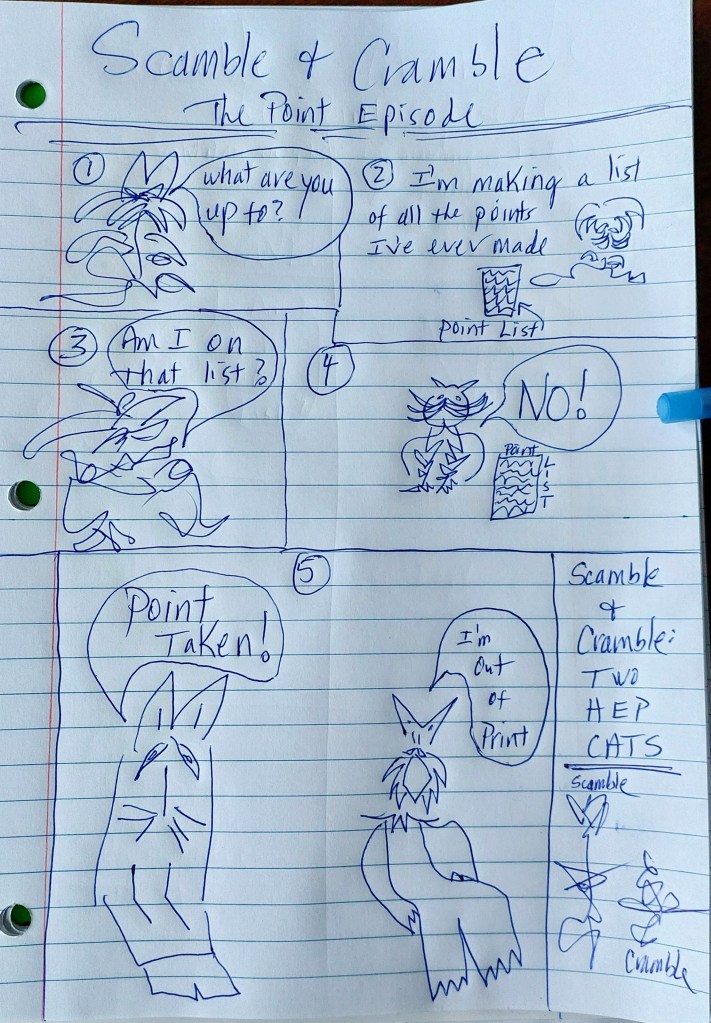
If the point of a cartoon is not to make you laugh, then what is the point? If you have to ask, you may not have the makings of a cartoon aficionado. A few days ago, celebrating The New Yorker magazine’s 100th anniversary, I suggested their cartoons, a big part of their brand, if you like to name things, are not funny. I said, “And if you think the point of a cartoon is to make you laugh, you’re in for a disappointment.” But what I should have said is, “…you’re in for a surprise.” That’s the point of a cartoon – to surprise. If you must have a point.
My Brit friend who previously sent me the artificial intelligence poem written in the style of Joe Linker read my 100th anniversary post and responded via email with a link to the Seinfeld segment where Elaine meets with the cartoon editor at The New Yorker to ask him to explain why one of their cartoons appearing in a recent issue is funny. She doesn’t get it. She pushes him into admitting he doesn’t get it either, and when she asks him why he published it, he says he enjoyed the kitty. It’s Series 9 (their last), Episode 13, titled “The Cartoon” (1998). You could look it up. Susan and I watched the whole episode the night before last on TV. Susan didn’t find it too funny, but I did. Well, actually, she didn’t say it wasn’t funny; she said it wasn’t a good one. If cartoons are not funny, how could a show about cartoons be funny?
Do we choose our magazines based on their cartoons? I remember in my parents’ house there appearing copies of Redbook, Ladies’ Home Journal, The Saturday Evening Post, Seventeen, and Glamour, but just occasionally, not necessarily the result of subscriptions, but of random, neighbor exchanges. Did my mother and sisters read Joan Didion in the Post? I’m sure my father did not. He read the newspaper. I don’t recall paying much attention to those magazines, but I don’t think they were known for their cartoons. Susan’s aunt, who introduced me to The New Yorker, was a commercial artist, an illustrator. She said illustrators were not artists. That there never developed for Los Angeles a magazine equivalent to The New Yorker may help explain the difference between the two cities.
One year, in the midst of my career in the red dust of commerce, I cut out a New Yorker cartoon and taped it to the side of my computer monitor, in those days the size of a television box, on the aisle where passers-by could stop, check out the cartoon, and say hi. The cartoon was two panels, on one side, a middle-aged man dressed in a loose fitting business suit with tie, holding a briefcase, wearing a fedora hat, on his face a zero expression, neither awake nor asleep. He might have been waiting to cross a street, for a sign to say, “WALK.” The caption read: “The thrill of victory.” In the other panel, the same guy, exactly the same drawing, the same facial expression. The caption read: “The agony of defeat.”
My boss at the time stopped to check out the cartoon of the businessman. I could tell he didn’t get it. He walked on to his office. Some days later, he stopped again, and said he didn’t think the cartoon was funny. Several weeks passed. The cartoon didn’t get that much attention. I guess its surprise wore off. What attention it did get might have been due to the fact that it was the only piece of non-work material I had stuck up anywhere on or around my desk. It may have become a tiny landmark, reminding sleepwalking or overexcited workers to turn right here. I don’t remember exactly how long it remained up before my boss called me into his office to tell me he wanted me to take the cartoon down. I took it home and taped it to our icebox door.
I drew a cartoon a few years back of a man holding a cellphone to his ear, the phone giving off wah wah sounds indicated by red dashes, a big smile on the listener’s face, a woman to the side a step behind him looking disappointed. The caption read: “They were supposed to be on vacation, but he was on his cellphone.”
The New Yorker is celebrating this month its 100th anniversary. I discovered the magazine in its mid-40’s, visiting Susan’s aunt Joan at her beach studio-pad a door from the boardwalk in Venice in 1969. She gave me her discards. I started with the cartoons, of course, then read the short stories, always one or two, which back then followed the Talk of the Town section. I read all the small print stuff about the goings-on in New York, where I’d never been, never wanted to go. I thought short stories more interesting writing, but I soon grew to enjoy the short pieces in the Talk of the Town section. And I started reading the non-fiction pieces, the articles in those days on average longer than today’s, sometimes much longer, spanning two or three issues.
The February 1, 1969 issue included a story by Linda Grace Hoyer, the mother of the prolific writer frequently found in The New Yorker over the years, John Updike. The February 21, 1970 anniversary issue included a short story in epistolary form by the editor and baseball writer Roger Angell, and a poem by Roger’s stepfather, E. B. White, titled “In Charlie’s Bar,” about a woman who was refused service at a bar in England because what she was wearing that visit happened to reveal her belly button. There’s also a story by Donald Barthelme, tilted “Brain Damage.” That I can’t really say that I now remember any of those pieces precisely probably says more about my brain than the keeping power of the writing.
This year I came close to letting my subscription lapse. Maybe it’s my lapsing attitude, another sign of too many winters in a row of discontent, living away from the ocean. I’ve always liked The New Yorker because it is a general interest magazine, witty but sincere and without specialty or academic brouhaha. But as Jill Lepore puts it in her article titled “War of Words” in the 100th anniversary issue:
“The stock criticism of Brown [Tina Brown, former editor from 1992 who shortened articles, among other at the time some thought controversial changes. David Remnick took over as editor in 1998] is that she made everything about celebrity; the stock criticism of Remnick is that he made everything about politics. The same could be said of America itself, across those years.”
That everything is about any one thing brings an emphasis that goes against the grain of general interest. And what will happen to the editorial stance now that celebrity and politics have merged into one? That’s what I’m not sure I want to see. But while there have been a few ownership and editorial changes over the years, changes in form and content have not been deep. What’s changed is out on the street. But maybe that’s not so new either. Let’s take a look.
From the Notes and Comment section of the February 28, 1970 issue (and if I hadn’t just told you it’s from 1970, you might have thought this was today):
“The government’s campaign against the press, which has proceeded swiftly from threats of action to action, in the form of subpoenas of reporters’ notes and tapes and films, has already heavily damaged the press’s access to the news.”
Surely someone would say something. After all, it was still almost the 60’s. But in the same piece we get this:
“The Democrats complete silence on those issues throughout the program [a Democrat television special titled State of the Union: a Democratic view – a response to Nixon’s State of the Union address] struck us as an extreme instance of the more general avoidance of controversial issues which has been noticeable among politicians and on the networks and in the press.”
Certainly not much seems to have changed from Andy Logan’s comment in the Around City Hall section of the same issue. Writing about the state’s budget hearings, he says:
“According to one theory of public life, the winning politician is not the man who spends his time gathering civic credits to himself but the operator who can most often persuade the public that whatever went wrong was somebody else’s fault.”
A valuable benefit of subscription is access to The New Yorker archive. I found myself, in solo celebration of its 100th Anniversary, browsing through past issues from the years I first started reading the magazine. In that February 28, 1970 issue, for example, I perused the Nightlife section, wondering where I might have gone had I been in New York at the time. I could have sat in at The Bitter End, where “Folks, both long- and short-haired, sit on wooden benches and sip coffee.” I could have eaten, copiously, no less, at Bradley’s, “a wood-paneled bar and rest where people come, and frequently return, to sit and talk and copiously dine.” Not only that, but I could have listened to Bobby Timmons play electric piano until three in the morning. And if that wasn’t enough music, I could have at three headed over to the Red Onion and heard “Two banjos and a piano until four.” And that went on every night. Did people never sleep in New York? There was a lot to choose from: “music, bar, dinner, dancing, discos, cabarets.” At the movies (still called Motion Pictures in one section of the magazine), I could have seen, drawing now from the alphabetical listing: Belle de Jour, The Bible, Bob and Carol and Ted and Alice, or Butch Cassidy and the Sundance Kid.
I seldom read The New Yorker fiction anymore, and some of the poems I don’t make it out of the first stanza or two. I’ve grown prosaic maybe in my dotage. And if you think the point of a cartoon is to make you laugh, you might be in for a disappointment.
One measure of good writing is whether or not it can be read comfortably and naturally aloud. This week, I’ve been reading aloud to Susan from J. D. Salinger’s Nine Stories. In Salinger’s story titled For Esme – with Love and Squalor (from the April 8, 1950 issue, not April 9 as Wiki has it) about a US soldier in WWII, the narrator meets a young English girl in a Devon tearoom:
“May I inquire how you were employed before entering the Army?” Esme asked me. I said I hadn’t been employed at all, that I’d only been out of college a year but that I liked to think of myself as a professional short-story writer. She nodded politely. “Published?” she asked. It was a familiar but always touchy question, and one that I didn’t answer just one, two, three. I started to explain how most editors in America were a bunch – “My father wrote beautifully,” Esme interrupted. “I’m saving a number of his letters for posterity.”
This post being about The New Yorker, and The New Yorker being known for its cartoons, I thought I’d end with a cartoon:
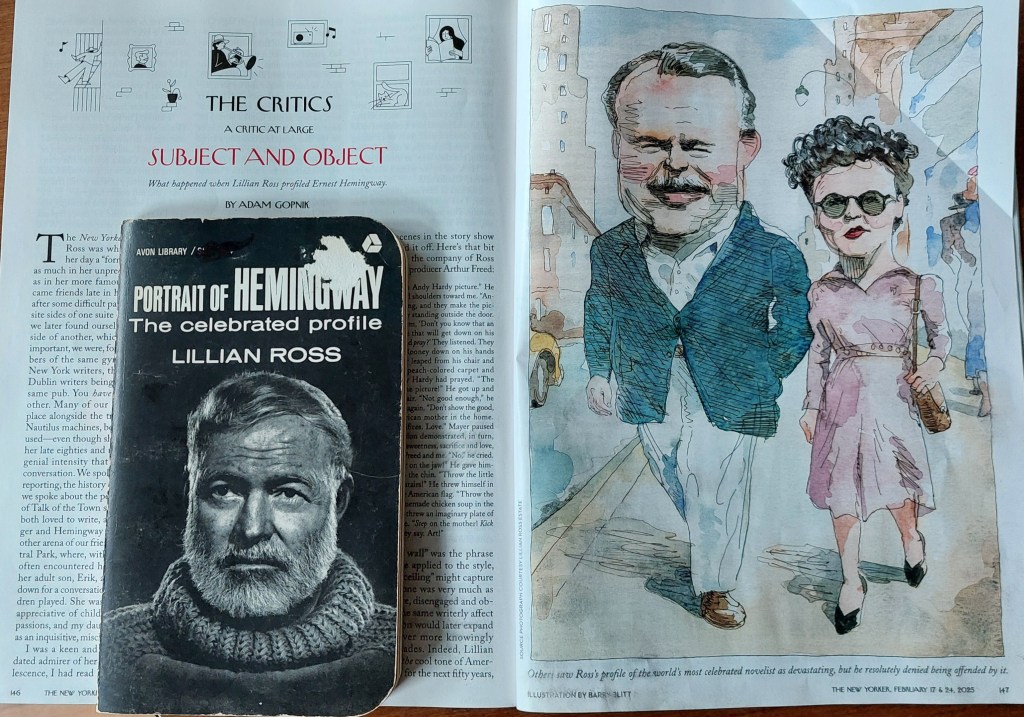
In the 100th anniversary issue of The New Yorker (February 17 & 24, 2025), we find Adam Gopnik’s Profile of a Portrait, titled “Subject and Object: What happened when Lillian Ross profiled Ernest Hemingway.” The subtitle is not a question, but maybe it should be. Gopnik holds that Hemingway’s reputation was devastated by the Lillian Ross 1950 Profile article, but that he insisted on not being bothered by it, but maybe Hemingway’s response to the article, and more to the reaction to it, was in character of his own value which he described in a different context as “grace under pressure.” In any case, while Gopnik does mention that the Profile was later published in book form (Portrait of Hemingway: The Celebrated Profile, 1961*), he ignores Lillian Ross’s preface to that book, written a decade after the brouhaha had unfolded:
“Hemingway said that he had found the Profile funny and good, and that he had suggested only one deletion. Then a strange and mysterious thing happened. Nothing like it had ever happened before in my writing experience, or has happened since. To the complete surprise of Hemingway and the editors of The New Yorker and myself, it turned out, when the Profile appeared, that what I had written was extremely controversial. Most readers took the piece for just what it was, and I trust that they enjoyed it in an uncomplicated fashion. However, a certain number of readers reacted violently, and in a very complicated fashion. Among these were people who objected strongly to Hemingway’s personality, assumed I did the same, and admired the piece for the wrong reasons; that is, they thought that in describing that personality accurately I was ridiculing or attacking it. Other people simply didn’t like the way Hemingway talked (they even objected to the playful way he sometimes dropped his articles and spoke a kind of joke Indian language); they didn’t like his freedom; they didn’t like his not taking himself seriously; they didn’t like his wasting his time on going to boxing matches, going to the zoo, talking to friends, going fishing, enjoying people, celebrating his approach to the finish of a book by splurging on caviar and champagne; they didn’t like this and they didn’t like that. In fact, they didn’t like Hemingway to be Hemingway. They wanted him to be somebody else – probably themselves. So they came to the conclusion that either Hemingway had not been portrayed as he was or, if he was that way, I shouldn’t have written about him at all. Either they had dreary, small-minded preconceptions about how a great writer should behave and preferred their preconceptions to the facts or they attributed to me their own pious disapproval of Hemingway and then berated me for it. Some of the more devastation-minded among them called the Profile ‘devastating’” (17-18).
Adam Gopnik appears in his critical article about the Ross Profile to be one of those people. He does reference as support for his argument (that the Ross Profile is devastating) the back and forth letters between Hemingway and Ross that followed the publication of the original Profile, but I didn’t find enough in those letters (what Gopnik shares of them) to offset what Ross says above or to prove that she was dissembling in some way.
A Profile, as Gopnik points out, is more than a Q & A, particularly more than those interviews of today that are carefully controlled by agents and protectors of reputations and public reactions, damage control specialists. There’s also more to Gopnik’s profile of a Profile that gives insight to the writing and reading of one, the editorial process, and what informs intents and results. But why do we expect would-be heroes to have good character, or not to enjoy the simple and ordinary? Gopnik points out that the Profile as written by Ross was a new form, in which the reporter follows and observes and records just about everything, including the mundane and ordinary or trivial and everyday. Going to a store and buying a new coat for example. Is there some special way a famous novelist should behave in a coat store? Gopnik says:
“The Hemingway in the piece is a comic figure – self-dramatizing, repetitive, marooned within his own monologues, and sometimes ridiculously affected.”
Why? Because “The novelist, now fifty, complains of a sore throat,” but won’t see a doctor? Or because “His wife had suggested that he look for a coat at Abercrombie & Fitch, and after he buys one there he decides he’d like to look at a belt,” and while picking out the belt he jokes with the belt clerk about his belt size, and affects happiness when the clerk suggests he must work out to be so fit. But he doesn’t appear to be cross.
*Portrait of Hemingway: The Celebrated Profile. Avon Books, 1961. 94 pages, paperback.
Not hunter nor hunted be but swimmer in this long sea the fishes your community though of course fish eat each to each but rarely one’s own the point eat what’s available then go a fish out of the sea not the long or short of it but lost in the long run of the sea pages uncut written while working in a customs house dabbler dabbled in dawns of coffee and commutes and cubbied desks no time for more than doodles while the prof makes a living off an ever changing starting line the long market to market to market with a self-published book now out of print on demand there being no press and came to fancy Penelope the late bloomer and Barbara an excellent one and the two Elizabeths and Henry and Patty and Ray but of any poems composed in an alcove suffice to say what a waste yet this, and this is why one longs for the long sea:
“No, she thought, putting together some of the pictures he had cut out – a refrigerator, a mowing machine, a gentleman in evening dress – children never forget. For this reason, it was so important what one said, and what one did, and it was a relief when they went to bed. For now she need not think about anybody. She could be herself, by herself. And that was why now she often felt the need of – to think; well not even to think. To be silent; to be alone. All the being and the doing, expansive, glittering, vocal, evaporated; and one shrunk, with a sense of solemnity, to being oneself, a wedge-shaped core of darkness, something invisible to others. Although she continued to knit, and sat upright, it was thus that she felt herself; and this self having shed its attachments was free for the strangest adventures. When life sank down for a moment, the range of experiences seemed limitless. And to everybody there was always this sense of unlimited resources, she supposed; one after another, she, Lily, Augustus Carmichael, must feel, our apparitions, the things you know us by, are simply childish. Beneath it is all dark, it is all spreading, it is unfathomably deep; but now and again we rise to the surface and that is what you see us by. Her horizon seemed to her limitless….There was freedom, there was peace, there was, most welcome of all, a summoning together, a resting platform of stability” (54).
From “To the Lighthouse” (1927) by Virginia Woolf, Penguin Books edition 2023.
What did Rimbaud mean by dérèglement of the senses? Trouble ahead, for one thing, as he intends to deregulate language:
“He does go on to speak of the unknown (l’inconnu), objective poetry’s aim, which can only be attained by the ‘systematic disordering of all the senses‘ (his italics)” (Sorrell, xvii).
And not just language, but in an iconic spirit of rebel without a cause, to untangle from his life predicament: family, school, country and war, literary ambition, expectations – but relatively quickly then even his newly chosen lifestyle, as he heads out for the territory, leaving any predicaments for others to unravel.
But in one meaning, his derangement of the senses is not difficult to understand, and gives the reader an assist to unusually difficult writing. Sorrell provides a few clues in his Introduction to the collected poems:
“In synaesthesia an effect normally received through one of the senses is experienced directly through another. Thus, in Baudelaire’s sonnet perfumes sound as soft as oboes” (XX).
But in my copy of Baudelaire’s “The Flowers of Evil,” Richard Wilbur translates the line in question, from the poem titled “Correspondences,” as follows:
“Perfumes there are as sweet as the oboe’s sound” (12)
The perfumes don’t make sound, literally, and don’t directly sound like oboes; perfumes smell sweet, and that sweetness is compared to the soft sound of an oboe. But can we smell sweetness? The perfumes are also
“Green as the prairies, fresh as a child’s caress”
Baudelaire’s poem relies on a poetic device, metaphor, nothing new there. We might say: The grapes were as plump as purple; or, my eyes drank a sour finish as I watched the falling leaves through a broken window; or, I heard summer leaving as the night filled my eyes with silence.
In Baudelaire’s poem, taste relies on smell, and smell doesn’t function as well if taste is lost. Without smell or taste, the brain tries to find some other way to experience the missing sensation. Victims of the Covid virus might understand this from the experience, the strangeness, of losing one sense but not the other. Metaphor becomes a compensation for something lost in translation.
And the Baudelaire poem points to McLuhan’s idea of a sensorium, any one sense not dominated by any of the others:
“Like dwindling echoes gathered far away Into a deep and thronging unison Huge as the night or as the light of day, All scents and sounds and colors meet as one.”
And what does McLuhan say? From Chapter 9, “The Written Word: An Eye for an Ear” in “Understanding Media”:
“Consciousness is regarded as the mark of a rational being, yet there is nothing lineal or sequential about the total field of awareness that exists in any moment of consciousness. Consciousness is not a verbal process” (87).
We might reread then, Rimbaud, and consider his idea of derangement, with McLuhan’s analysis of media in mind:
“The same separation of sight and sound and meaning that is peculiar to the phonetic alphabet also extends to its social and psychological effects. Literate man undergoes much separation of his imaginative, emotional, and sense life, as Rousseau (and later the Romantic poets and philosophers) proclaimed long ago (90).
It made sense then for Rimbaud to suggest the way to recover the imagination was to derange the senses.
“Today the mere mention of D. H. Lawrence will serve to recall the twentieth-century efforts made to by-pass literate man in order to recover human ‘wholeness.’ If Western literate man undergoes much dissociation of inner sensibility from his use of the alphabet, he also wins his personal freedom to dissociate himself from clan and family (McLuhan, 90).
But we hasten to remind that Rimbaud gave it all up as futile, poetry and his idea to derange language. Nevertheless, he might still sit at the head of a poet’s table (Ashbery’s, for example), even as he ended his own poetic meal with a sour finish.
“Language extends and amplifies man but it also divides his faculties. His collective consciousness or intuitive awareness is diminished by this technical extension of consciousness that is speech.
Bergson argues in Creative Evolution that even consciousness is an extension of man that dims the bliss of union in the collective unconscious. Speech acts to separate man from man, and mankind from the cosmic unconscious. As an extension or uttering (outering) of all our senses at once, language has always been held to be man’s richest art form, that which distinguishes him from the animal creation” (McLuhan, 83).
Metaphor allows for looking at one thing, an object, or some sensory effect, and seeing something different. That’s how much poetry works, anyway. And when we compare two disparate objects, we fancy we learn more about each. Still, one wonders at that “richest art form,” and whether or not it’s worth the trouble it creates (Rimbaud apparently thought not), and that’s the sour finish to this post.
Derangement of the Senses
“Arthur Rimbaud: Collected Poems.” Translated with an Introduction and Notes by Martin Sorrell, Oxford University Press, 2001.
“Charles Baudelaire: “The Flowers of Evil.” Selected and edited by Marthiel and Jackson Mathews (1955, 1962) – Rev. ed., New Directions (NDP684) 1989.
“Understanding Media: The Extensions of Man.” Marshall McLuhan, 1964, McGraw-Hill.
Old Haunts, all with current links, focused on core subjects: art, technology, music, science, and literature, but first, a brief explanation:
Moving continuously toward more minimalist formats (which if not stopped could result in disappearance altogether), blogs may risk losing some appeal, particularly to readers who enjoy liking, commenting, and linking or sharing – in short, conversing – as well as indulging in pingbacks and reblogging, and who enjoy perusing sidebars, widgets, clicks and plays, slide shows, and sharing up and down the crowded street of social media sites and apps. An example of such minimalist drift, here at the The Coming of the Toads, might be the removal, some time ago now, of listings and links of followed blogs and favorite sites, what I called in the sidebar heading over the list of links: “Back Roads to Far Places,” the title from Ferlinghetti’s book.
I use the WordPress Reader to subscribe to sites, and currently I’m subscribed to 146 – but not many of which post frequently or are still active at all, which sparks the idea behind this post, which might have been subtitled: and Other Broken Links. While I don’t currently post a widget of followed blogs or sites, I do manage my subscribed sites in the WordPress Reader, and I also maintain the “Links” feature in the WordPress Dashboard for my own use. There are currently 33 links. But links don’t always stay current or active, while others click to surprise, a site grown or morphed into other projects or disappeared (Page Not Found), and still others remain useful resources or pleasant places to visit, like old friends. Or the link simply breaks and you get sent who knows where and who knows what’s happened. Sites often change over time, and it can be hard and takes time keeping up with the changes.
Anyway, I thought I’d share an update of just a few of the sites that do continue to work well and that I try to follow and that offer pleasant visits and are creative and resourceful:
Marginalia and Gracia and Louise I first discovered in “High Up in the Trees,” a blog by the Australian artist Gracia Haby. It’s now called “Marginalia.” I like everything about it – font work, photography, text content, collage and other art work, the work Gracia and Louise do with animals. And there’s another site they maintain, called Gracia and Louise, full of things to see and wonder at. The sites probably work best on desktop, but the creativity in doing more with the drop-down necessities of on-line viewing is unparalleled (of that, here is a specific example, called Reel).
McLuhan Galaxy always produces a profoundly puzzling experience in that there seems no end to his ideas and the ramifications of effects of media on society and culture – and yet here we go, linking and following, but where? The Blogroll will keep you occupied for hours of intellectual fun.
I don’t have John Cage ears, but I’ve always enjoyed his writing, and much of his music I do enjoy. Kuhn’s Blog is not often updated, but the site resources remain available and loads of fun, with several interactive features (try Indeterminacy, for example). The John Cage Personal Library is itself a phenomenal work.
The Buckminster Fuller Institute shares hope for the world from a worldwide perspective. The site may provide a new awareness for what’s going on worldwide to improve conditions, predicaments, problems – near and far. If your not familiar with Bucky, here’s a good place to start: Big Ideas.
Words Without Borders features world wide writing in a variety of formats. Browse by country, theme, or genre.
Old Haunts, all with current links, focused on core subjects: art, technology, music, science, and literature.
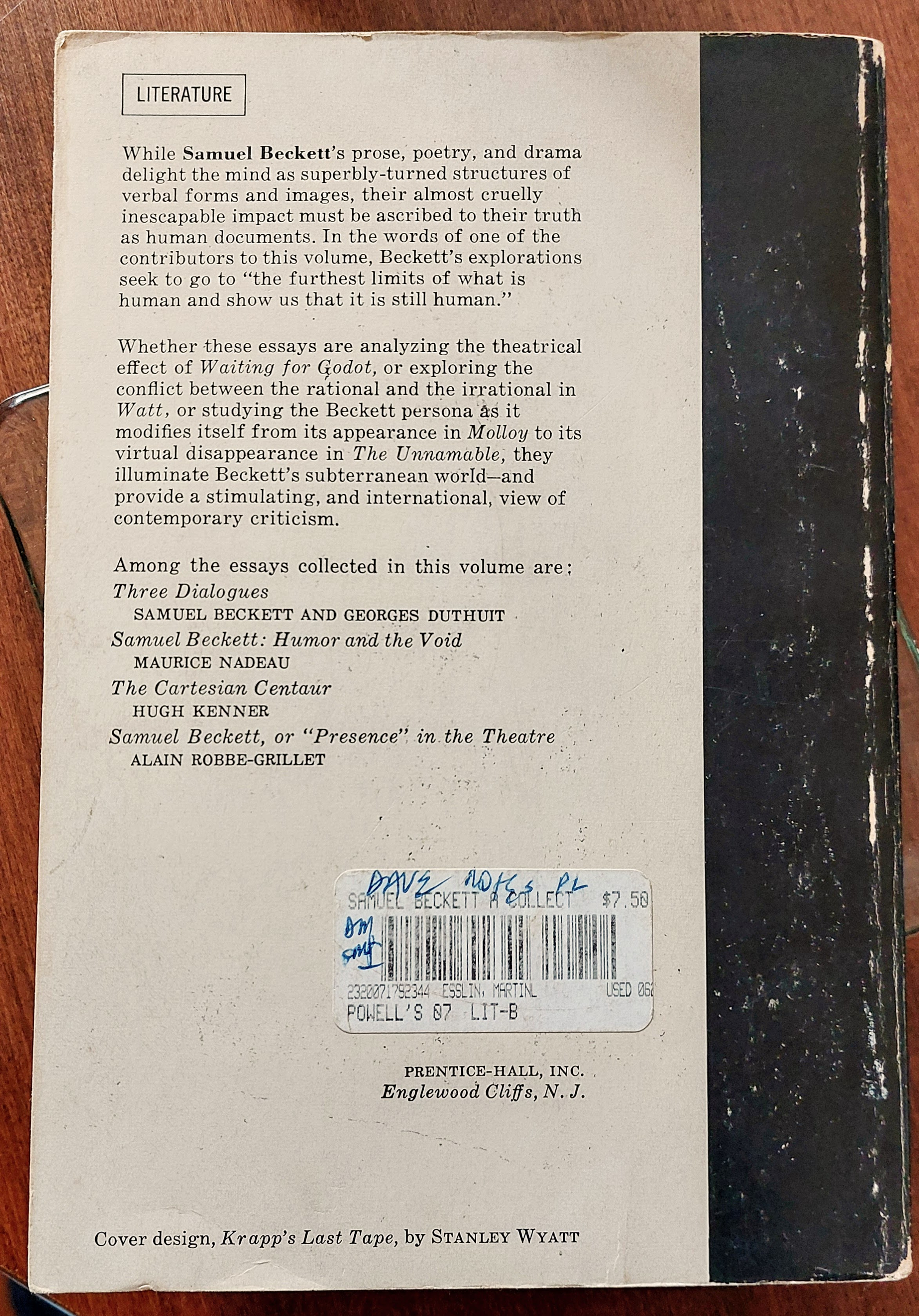
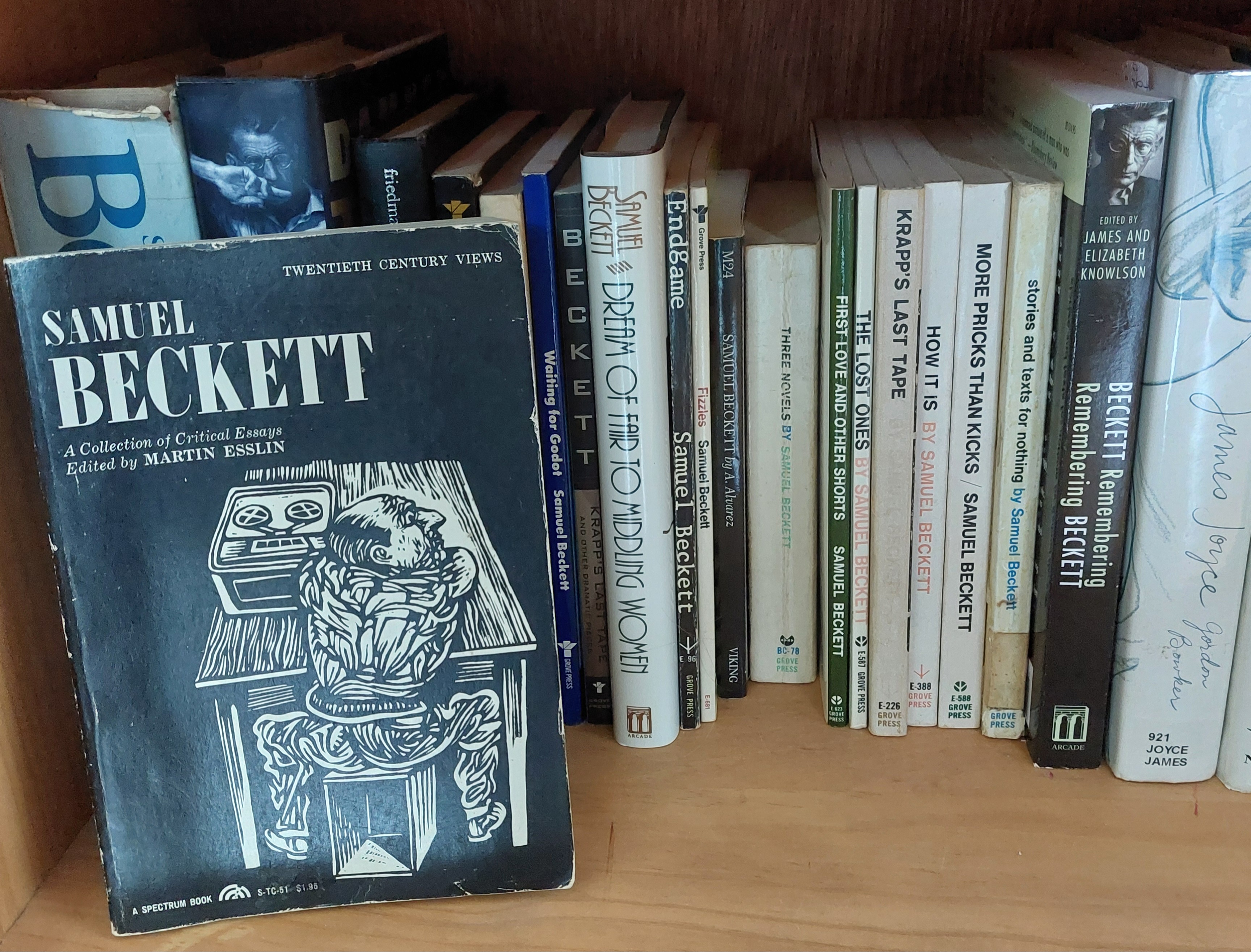
I was browsing through an old paperback of essays on Samuel Beckett (not to mention the why), and landed on this, about the weight of words, found in A. J. Leventhal’s essay titled “The Beckett Hero,” here discussing Beckett’s names:
“If the names are not adventitious (and Beckett weighs all his words) it means that we are asked to think of this play, not as an isolated piece of inaction in a corner of France, or if you like Ireland, but as a cosmic state, a world condition in which all humanity is involved” (49).
What does it mean to weigh a word? Do words have weight? They certainly do in a metaphorical sense. A person whose words are said to carry weight is listened to; whether their opinions are respected or not is a different question, as we hear tell of windy speakers, windbags, by which is meant a person whose talk is full of hot air. Pompous.
Air has weight, expressed in pressure. Does wind have weight? In Shakespeare’s play “King Lear,” we find the weight and pressure of wind and words mixing in the storm:
“Blow, winds, and crack your cheeks! rage! blow! You cataracts and hurricanoes, spout Till you have drench’d our steeples, drown’d the cocks! You sulphurous and thought-executing fires, Vaunt-couriers to oak-cleaving thunderbolts, Singe my white head! And thou, all-shaking thunder, Smite flat the thick rotundity o’ the world! Crack nature’s moulds, all germens spill at once, That make ingrateful man!” (King Lear, Act 3, Scene 2)
Another example of a windy word passage appears to be Beckett’s poem titled “Whoroscope,” judging from John Fletcher’s reading in the same collection of critical essays, this one titled “The Private Pain and the Whey of Words”:
“The fact is that this ‘poem’ is little more than prose monologue chopped into lines of unequal length. No rhythmical pattern can be discerned and the vocabulary is of studied colloquialism. Lame puns like ‘prostisciutto’ (i.e. ‘ham’ / ‘harlot’) and ‘Jesuitasters’ attempt to imitate Joyce. In spite of its wit, the whole poem gives a frivolous impression; genuine poetic richness is lacking, for paradox, esotericism, and verbal pyrotechnics take its place” (25).
Fletcher has already told us, setting the stage, that Beckett’s poem “won the prize (ten pounds), was printed in 300 copies, and led to Beckett’s being invited to contribute to an anthology of poems which Henry Crowder set to music, also published by Nancy Cunard at the Hours Press in 1930.” Beckett had knocked the poem out in one sitting, Fletcher discloses, to enter the contest, which asked for a poem “on the subject of Time.” Continues Fletcher in his critique of the poem: “The poem is not very interesting and certainly seems to have little to do with time.” One wonders now how much one of those original 300 copies might fetch at auction. 100 copies were signed.
Where have we heard whey before?
“Little Miss Muffet Sat on a tuffet, Eating her curds and whey; There came a big spider, Who sat down beside her And frightened Miss Muffet away.”
Clear enough, except what’s a “tuffet”?
Fletcher makes much of Beckett’s feud with nothing. He tells us Beckett stopped writing poetry in 1949, and quotes from Beckett’s “Three Dialogues” of the same year:
“The ‘Three Dialogues’ grant the artist the honor only ‘to fail as no other dare fail,’ failure being ‘his world and the shrink from it desertion, art, and craft, good housekeeping, living.’ We shall see, indeed, that in his poetry as in his other writings Beckett has never shirked the fact ‘that there is nothing to express, nothing with which to express, nothing from which to express, no power to express, no desire to express, together with the obligation to express.’”
“Nothing will come of nothing,” King Lear says, reflecting Shakespeare’s own struggle with nothing. “Speak again.”
~~~
“Samuel Becket: A Collection of Critical Essays,” Edited by Martin Esslin, Prentice-Hall, A Spectrum Book, 1965. Includes “The Beckett Hero” by A. J. Leventhal, a lecture at Trinity College June 1963, and “The Private Pain and the Whey of Words” by John Fletcher, a lecture given at Durham U England November 1964.
The easiest piece to write is sarcasm. The difference between sarcasm and satire is that satire has a point, while sarcasm has none, except maybe to offend, at worst, or rib, at best. Sarcasm is a backbite often confused with humor. “It’s not funny,” the bitten one says, the sarcastic one curling up smiling like Uriah Heep in his sorry ways, heaping more free helpings upon his plate to stowaway for future use.
Irony can be used as a tool to tickle or torture, its mixture of satire with sarcasm effective as a rhetorical device, intended at bottom to persuade, of what, exactly, the audience might remain unaware, this too funny: A muse meant nothing by it. What was meant or not its placement lost can only confuse.
Hemingway utilizes irony in his book “The Sun Also Rises”:
“Show irony and pity.” I started out of the room with the tackle-bag, the nets and the rod-case. “Hey! Come back!” I put my head in the door. “Aren’t you going to show a little irony and pity?” I thumbed my nose. “That’s not irony.” (102)
Later, Bill and Jake replace irony with utility, but it’s the same idea:
“Let us rejoice in our blessings. Let us utilize the fowls of the air. Let us utilize the product of the vine. Will you utilize a little, brother?” “After you, brother.” (109)
Irony is explained by Charlie in Steve Martin’s film “Roxanne,” in the scene where he’s walking with Roxanne back to her place to help her regain entry after she’s locked herself out. Charley pretends not to understand why Roxanne turns down his offer of a coat on such a cold night. She explains she was being ironic, and Charley says he didn’t understand that because they don’t use irony in the town anymore. He was the last one to use it, and he gave it up because people were staring at him. Irony often means the opposite of what’s said. It can be confusing. Martin’s film is a rewrite of “Cyrano de Bergerac,” the 1897 play (which takes place in 1640 France) by Edmond Rostand. I only mention that now should any readers think I was unaware of Martin’s source. “Cyrano” was assigned reading in the 10th grade in the high school I attended. It’s theme is panache, which I doubt I understood in the 10th grade. Not sure I understand it now, ten decades later. More irony there than I care to pursue further at this point.
The so-called dry sense of humor is favored by the higher class comic, whose main focus is to keep out of the pit, where things get wet and muddy. In that sense, the dry humorist is aristocratic, surrounded by the minion followers who protect his repressed emotions with gratuitous likes and guarded comments. The noir detective sometimes makes use of the dry sense of humor, though hardly an aristocrat, but he often finds himself in service to society’s higher-ups. A dry wit seems to suit a hard boiled attitude, and the Dick has many followers, among them many cynics.
The facetious humor accountant will often make fun of himself, pretending, for example, to be stupid – but that’s to show actually his superiority to his target. He will be droll, flirting around with what’s considered serious or not, with what is serious or not. Tongue-in-cheek provides a vivid cartoon illustration opportunity.
Then there’s the wisecrack, the comment, usually shouted but as effectively whispered, croaked anonymously from the audience, which may have come to resent being pandered to, the speaker now a standing joke and nothing further said can mollify or sooth the hurt feelings of failure. But, after all, it was only a sketch. But when does sketch become sketchy? A standalone wisecrack probably won’t qualify as a sketch, more the property of the cartoon.
Charles Dickens wrote sketches, though not necessarily with humorous intent. In his preface to “Sketches by Boz,” written long after the sketches were first published in newspapers and magazines, Dickens almost apologizes for their style or substance, in spite of their obvious popularity. He said the sketches were “sent into the world with all their imperfections (a good many) on their heads,” and that he’s “conscious of their often being extremely crude and ill-considered, and bearing obvious marks of haste and inexperience.” But again a Boz sketch purpose was not primarily humor. They were accompanied by drawings and were essentially goings on about his London parish at the time – the 1830s. The subtitle of the book collection reads “Illustrative of Every-Day Life and Every-Day People.” And within the Dickens sketch anyone indeed could have, probably already did, see or observe the very thing Dickens was writing about. But to see it in print, Illustrated, no less, not as news, by which is meant an edited selection of events to emphasize a certain viewpoint (selection itself – among all the events of a day – being an editing process, and the birth of bias), but as the familiar and close and therefore noteworthy and comment worthy, where one saw oneself or someone one knew and understood but probably with not quite the same focus as found in the sketch. Or one saw a street or alley or place or person one knew about but only as some mystery yet to be solved, which the Boz sketch resolves. The Boz sketches often go indoors.
Mark Twain did much to popularize the humorous sketch as a newspaper feature. It was Twain’s intent to write humor, so we find embellishment and variations on the truth of things, exaggerations. Exaggeration, hyperbole in rhetorical diction, is a comedian’s tool, as is its counterpart, understatement, litotes, first cousin to euphemism. Here is a sample excerpt from a Twain sketch featuring an unexpected subject, titled “Speech on Accident Insurance“:
“Certainly there is no nobler field for human effort than the insurance line of business—especially accident insurance. Ever since I have been a director in an accident-insurance company I have felt that I am a better man. Life has seemed more precious. Accidents have assumed a kindlier aspect. Distressing special providences have lost half their horror. I look upon a cripple now with affectionate interest—as an advertisement. I do not seem to care for poetry any more. I do not care for politics—even agriculture does not excite me. But to me now there is a charm about a railway collision that is unspeakable.”
Insurance for accidents occurring to individuals riding a train was first introduced in England, and insurance as an industry grew expansively in the latter half of the 19th Century, but it wasn’t then nor is it now considered by many to be a subject of humor. Twain was able to find humor in just about any subject. Twain’s use of the word cripple in his context would not be acceptable today, and indeed humorists are inevitably at risk of their word choices landing as offences.
It’s interesting, thinking now of insurance, how some things, like the old saying goes, never change, in spite of what Twain says below, from his visit to a barbershop:
“All things change except barbers, the ways of barbers, and the surroundings of barbers. These never change. What one experiences in a barber’s shop the first time he enters one is what he always experiences in barbers’ shops afterward till the end of his days. I got shaved this morning as usual. A man approached the door from Jones Street as I approached it from Main—a thing that always happens. I hurried up, but it was of no use; he entered the door one little step ahead of me, and I followed in on his heels and saw him take the only vacant chair, the one presided over by the best barber. It always happens so.”
If you want to write a humorous sketch, it might work best to start with something familiar, that any reader should recognize. Otherwise, you might too soon and too easily drift off into a piece redolent of surrealism, which is seldom very funny. If the easiest piece to write is sarcasm, it might be because the only skill required is mean-spiritedness, which probably comes from a deficiency of generosity. There’s also a tradition of vindictiveness associated with some humor, sublimated in the speeches at roasts that ridicule the honored guest. But writing humor is not easy. Not everyone is a wit. Nor wants to be a twit.
References:
“The Sun Also Rises” by Ernest Hemingway (1926). Quotes from 2022 Penguin Classics Deluxe Edition.
Mark Twain Project Online. In discussing what is meant by a written sketch, the editor Edgar Branch, from the Introduction to “Early Tales and Sketches” Volume 1, has this to say:
“The great preponderance of short items, however, are sketches—and these range from ambitious magazine articles several thousand words long to short, hundred-word trifles tossed off by the newspaperman during a working day. The sketches include comic letters to the editor, hoaxes, exaggerated accounts of the author’s personal activities, burlesques of many kinds, comic or satirical feuds with fellow journalists, ingeniously contrived self-advertisements, commentary in a light and personal vein, descriptive reporting, reminiscences of past pleasures and adventures, and so on—but neither this nor any other list can easily be exhaustive.”


 The Coming of the Toads