Category: Reading

  • Mistake of the gods

    Mistake of the gods

    Mistake of the gods. Changing size. Sylvie Storm. Neutrinos. 

    But I digress more maybe than necessary. Sylvie was calling. I was still dismounting my Vespa, emptying saddle bags, when my cell phone buzzed and lit up and I could hear the call was from Sylvie, my unfaithful half goddess psychotherapist and part time partner, probably calling to warn me off another one of my bad decisions. We shared office space in a little place I owned up on Queen Anne, a folk Victorian from 1907, inherited from my mother. Glaucus, Sylvie said, when we first met, fate is the decisions you make. Sometimes I think she remains my occasional companion just so she can restock this rune of hers into my road weary bag of regrets. Decisions I made? When was there ever a decision I made that was mine alone and not influenced in some way by the gods? And the gods make mistakes. In any case, and to bring to a close that business with Vettebug, and before we go on too much further here, I should probably make clear, I am not some comic book hero, or villain. I am a mistake of the gods. I am at least part human. The rest I’m not sure of, though certainly not from planet Earth. I am able to adjust my size at will, though at a huge cost of energy, and at risk of random results, coming and going. Having made a change in size, I require rest. Indeed, I am often near death. I prefer small sizes, the easier to negotiate and move about without attracting much attention, to move through crowds, for example. To explain in a way you might understand (indeed, in a way I might understand), I’m able to break myself down into an emergent group of neutrinos. Thus I’m able to move through solid masses – walls, mountains, trees, Corvettes. But I say emergent because it’s never totally certain what the group will reform into. In other words, I’m never certain I’ll be able to return to what you might call normal, that is, my normal size, the size in which I choose to live most of my life. I’m subject, then, to a certain amount of randomness, to noise, to use a word the actuaries are fond of. To bring to a close, then, the Corvette incident: I changed the Corvette to the size of a Matchbox toy car. Vetteman was now the giant he wished for.

    “Mistake of the gods”
    is episode 4 of
    Ball Lightning
    a Novel in Progress
    in Serial Format at 
    The Coming of the Toads
  • Candy Apple Red

    Candy Apple Red

    Chased by Corvette. Vespa. Candy apple red. Not Bulldog Drummond.

    A real nice fellow turns out driving the candy apple red Corvette, vanity licensed MYID. Catches up with me, powers up and flips me the bird as I try to negotiate the Harley kickstand. Vetteman angry with me for some reason. Cut him off. Where? When? My anger management pills must have finally kicked in because I felt little urge to cut Vetteboy down to size and make him eat his license plate. Little, not none. I wanted to feel none, nothing. The little urge didn’t come on from getting the bone, and not even the vanity plate was to blame. Those were little nubbers up along the first base line. You picked them up bare handed, stepped on the bag, and tossed the ball to a kid in the stands above the dugout. Big hitter, little nubber. Maybe the candy apple red drew the little urge out. Very few cars should be painted candy apple red, and never a Corvette, an old pick up truck in retirement maybe, I don’t know, but not a Vette. Candy apple red is a very special color. But like I said, little urge, but not none, but still, the pills seemed to be kicking in. Maybe I should up the dosage again. I wanted to experience nothing. Why did the gods keep me alive? To do their dirty work. Then Vettepunk said it, one of the words, called me one of the names, the names no one calls me and gets away with it, without a bit of divine retribution sits you back on your butt and gives you something to think about other than your Corvette id. First, let’s back up. I don’t ride a Harley. I ride a Vespa, candy apple red. I am not Bulldog Drummond. I am not Mike Hammer. Not Philip Marlowe. I’m not Sam Spade. I stand five foot two, and my eyes are blue, but I’m no stereotype. I learned early on to mind my own business. But minding your own beeswax is not so easy with dudes like Vettedog off leash and full of road rage and megalomaniac vitamins. “That scooter a little big for you?” Vettestalker says, sneer and all.

    “Candy Apple Red”
    is episode 3 of
    Ball Lightning
    a Novel in Progress
    in Serial Format at 
    The Coming of the Toads

  • Hacked and Gobsmacked

    Hacked and Gobsmacked

    Late for a meeting. "extreme and unusual risk." "hacked and...gobsmacked"

    I was late for my meeting with Walter. I had some explaining to do, but I wasn’t in the mood for working together as a team in the spirit of cooperation toward common goals for the mutual benefit of all. Nor did I feel like throwing any bums a dime. I was their in house Risk Manager. Walter was itself a Risk Management Brokerage, specializing in extreme and unusual risk. Sometimes avoidance was the best answer. I rode down Pine to First and over to Pike to the Market and looked for a place to pull the Harley over and park. Cleo nodded I could squeeze into the space in front of his international news stall. The rain had stopped, the clouds still low and grey and blue and hanging bushed like wads of cotton candy over the diamond. Out on the water a ferry would be approaching, carrying Walter from his The Breakers West on Bainbridge Island. I was late with my quarterly report. We’d been hacked and I was still too gobsmacked to explain it. Walter would want to know who, when, what, where, why, and how. “Damned if I know,” was not the answer he’d want to hear from his six digit plus bonus contracted Risk Manager.

    “Hacked and Gobsmacked”
    is episode 2 of
    Ball Lightning
    a Novel in Progress
    in Serial Format at 
    The Coming of the Toads

  • The gods Get Bored

    The gods Get Bored

     Riding Harley in the rain in Seattle. Ball lightning. The gods.

    I throttled my green gnarly Harley across I-90 from Bellevue, wind chopped waves blowing over the wall on the south side of the bridge, the water as smooth as a coffin lid on the north side. I raddled through the last tunnel and merged onto I-5 north to downtown Seattle. A glob of ball lightning looped out of a smoke ring cloud hanging over the ballpark. The ball lightning bounced across the closed roof. The baseball stadium looked funereal. No game tonight. The winter circus was in town. On nights like this the gods might get bored and when the gods get bored no amount of prayer satisfies these clouds of gluttony, the local paradise filling like a wet basement. Why so many gods, I don’t know. Even the Catholics (and I am one, though maybe not a good one, whatever good means, but as Reverend Mother Mary Annette never tired of telling us, once a Catholic, always a Catholic), who profess belief in but one God, pray to the Saints and Mary and the rest, who seem to function much like the old Greek and Roman gods, one for every need or desire, one for every occasion, one for every problem, one for every predicament. A god for this, a god for that. A god for the nice, a god for the mean. Finely balanced too, the old gods, but like an unequal arm balance, some more powerful than others, leaving it to the mortals to try to balance things out. Still, evens up: one for light, one for dark; one for water, one for air; one for love, one for hate. Always meddling in human affairs, though, these immortals. Sure seem to get in the way all too often. Always wanting something, too, a piece of the human pie chart, insatiable. Why do we keep calling out to them? Was there a Saint of scooters? Could use a prayer to him now.  Dear Saint Scooter, please get me and my Vespa downtown safely, as an 18 wheeler passes at twice my speed, his mud flap cowgirls waving and laughing. God of lead, god of gold. God of the meek, and god of the bold. God of yes, and god of no. God of hot, god of cold. God of bought, and god of sold. God of gods, who never grows old, oldest of all.

    “The gods Get Bored”
    is episode 1 of
    Ball Lightning
    a Novel in Progress
    in Serial Format at The Coming of the Toads
  • Reassessments

    Reassessments

    According to Google Ngram, use of the word reassessment peaks around 1990, a climb beginning in the 20s, rarely used prior to 1900. We suspect what’s driving that curve are real estate markets. But to reassess is still relevant to publications, which is to say, books will go out of print, magazines fold, newspapers disappear – and folks will leave Twitter or abandon once again their high school acquaintances or second cousins found on Facebook. Clicking on a blog one has not visited for some time may turn up: This account does not exist: try another search.

    So too, does one reassess one’s involvement in both writing and reading: annually, quarterly, monthly, daily, or with each post or page. What am I doing here? Who is reading this? Will anyone like? Do I like? Who, what, when, why, where, and how – how to write, and why? How to read, and why?

    When we read a book, we turn the page, back and forth, if you read like me, up and down. So called social media sites generally all work upward: we page up, but as we page up, what’s down continues falling and disappears through some virtual cutting room floor. Usually, only the most recent posts, comments, tweets, pics – whatever – get any attention. Form is in the driver’s seat. And the form of social media sites requires constant replenishment (Google Ngram shows constant and regular use of the word replenish from 1800 past 2000). But the social media publications get replenished even though the stock is still full, even if nothing has been depleted.

    The social media cup is neither half empty nor half full; it’s always full, as this post no doubt attests. Full of what, might make material for a different post.

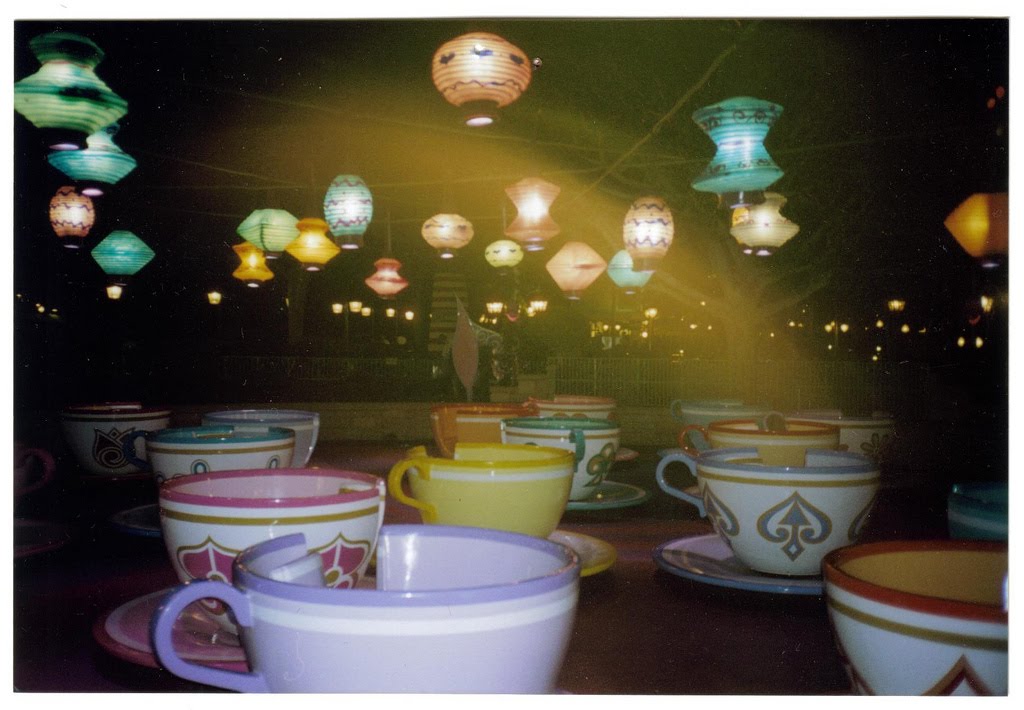
    Photo: The Teacups ride at Disneyland, exiting the park at closing time, Joe Linker, around mid-90s.

  • Jessica Sequeira’s “A Luminous History of the Palm”

    Jessica Sequeira’s “A Luminous History of the Palm”

    “As I sit under the lamplights, I feel happy, I laugh, I talk to myself, I talk to the books. I talk to the trees, and in my mind the palms form a swaying jungle of stories” (57).

    So ends Jessica Sequeira’s beautiful book, “A Luminous History of the Palm” (Sublunary Editions, 2020), twenty-four short stories in which the author “imagine[s herself] in other lives” (1). The stories range from around 500 to 2,000 words, and are organized in triplets, set off by short notes that illuminate the form of the work; for example,

    “To be luminous is not the same as to be enlightened. Enlightenment comes from the outside and implies progress. To be luminous is to generate affections and affiliations from the heart, belly and bowels of a situation in time, and form part of an organic system that is possibly infinite. It is to avoid abstraction, at least at the start, to prefer the concrete and sensual, the soft light forged by the bodies of stories as they crush together in violence or embrace” (29).

    The concept, of occupying different characters over time, works using the human tool of empathy. What is known? What can be known, and how? How does one get to know? Where and how does the engine of cognition get started? This is not appropriation. It is a sharing of thought and experience. As argument, it is pathos, grounded in the emotional with passion. The reader becomes detached from any kind of narcissistic rendering, from identifying with, relating to, finding relevance to one’s own life. One disappears into another. One’s own interests are subsumed by history, and what emerges are anthropological vignettes, finds.

    The vocabulary is exquisite: “Chinoisierie”; “crassulas, euphorbias, stapelias and aloes.” The words used in each piece form a brilliant cover, the style fitted to the personality of the character: a “Healer, [from] Yemen”; a “Housewife, [from] New Zealand”; a “Surfer, [from] California” – and that surfer dispels and defies stereotype to get to the heart of the new and original. The vocabulary is natural to the character. “I’ve got my shortboard, bright orange, and a new haircut.” That new hairdo – foreshadows a surprising identity, personality, transfixed and transposed by expectations and breaking away from the confines of one’s predicament.

    “We get through the book in about an hour, silently noting its patterns” (53). But why hurry? The Sublunary Editions copy is professionally bound, recognizable as a series, and “A Sublunary Object,” a form that enshrines the short work in a book the reader will want to keep and save and, most importantly, reread and share.

    I love the kind of writing found in “A Luminous History of the Palm.” The design, the ideas, the language, the brevity, the characters, the places and descriptions, how easily they seem to change, the reader entering a new land, country, weather. And the book is encyclopedic, the way Borges can be, and full of mystery, the way Lispector wrote – brief, compressed. As each story opens, the reader feels a kind of petrichor of a particular place and time and the close smell of a person suddenly near and unexpected. The palm trees spread and growing throughout the book are also very cool.

    A Luminous History of the Palm, by Jessica Sequeira, 2020, Sublunary Editions, Seattle, WA, sublunaryeditions.com

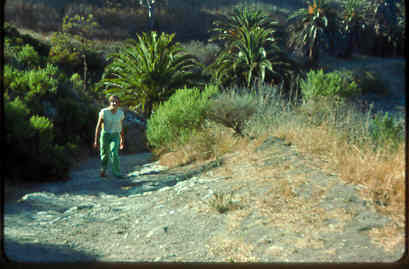
    Photo: Lisa at Refugio, 1976, Joe Linker.
  • On the Coast Starlight

    On the Coast Starlight

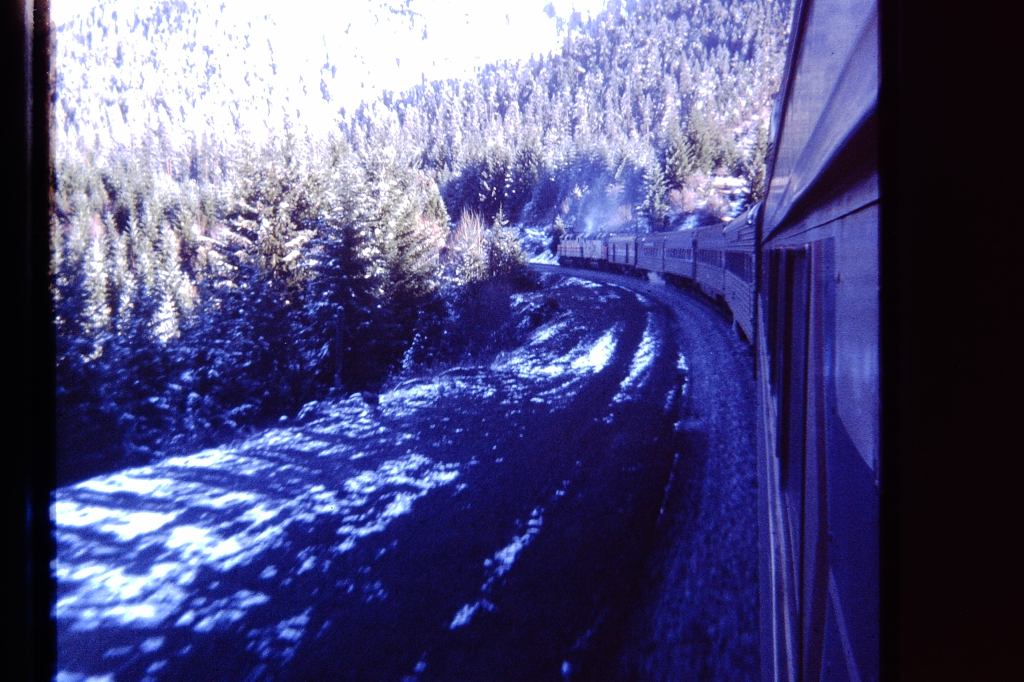
    We climbed aboard the Coast Starlight in Portland, bound for Los Angeles, 24 train-ride hours away, but we stopped unexpectedly somewhere up in the Cascades southeast of Eugene. Snow was falling. In those days, you could walk between the cars and open the top of the dutch door for some fresh air. The air was raw and cold, the woods dark, and the smell as strong as a cigar of pine sap. The tracks followed rivers, valleys, passes, built along paths of least resistance. It’s possible now to consider the railroad a naive form of travel.

    When we speak of losing our train of thought, we are comparing thinking to a train, I suppose to indicate how one thought after another coupled together are all headed in the same direction, or should be, if the logic holds water, but thought does not move like a train, the engine a thesis statement, the coal car fuel of claims, the cars one example after another, all following the same track of thought, the dining car full of opposing arguments, the caboose a bright red conclusion.

    News travelled slowly on trains in those days. Long and longer minutes passed without anyone new coming into our car. Our conductor reappeared and explained we were stopped because a freight train ahead of us had derailed. At first, it wasn’t clear how long we would be delayed. Equipment to reposition the freight train was en route to the wreck. Minutes, as it turned out, became, as they always do, hours. The conductor came through our car again to announce we would all be treated to a free dinner in the dining car. There was also a club car where we could hang out while waiting.

    Thought, if it moves at all, is more like the flight of a bird. But Thomas Hobbes, in his 1651 book, “Leviathan”, put us on the track of thinking of thought as a train, to wit:

    “Of the Consequence or TRAYNE of Imaginations. BY Consequence, or TRAYNE of Thoughts, I understand that succession of one Thought to another, which is called (to distinguish it from Discourse in words) Mentall Discourse. When a man thinketh on any thing whatsoever, His next Thought after, is not altogether so casuall as it seems to be. Not every Thought to every Thought sueceeds indifferently. But as wee have no Imagination, whereof we have not formerly had Sense, in whole, or in parts; so we have no Transition from one Imagination to another, whereof we never had the like before in our Senses. The reason whereof is this. All Fancies are Motions within us, reliques of those made in the Sense: And those motions that immediately succeeded one another in the sense, continue also together after Sense: In so much as the former comming again to take place, and be predominant, the later followeth, by coherence of the matter moved, in such manner, as water upon a plain Table is drawn which way any one part of it is guided by the finger. But because in sense, to one and the same thing perceived, sometimes one thing, some times another succeedeth, it comes to passe in time, thatjn the Imagining of any thing, there is no certainty what we shall Imagine next; Onely this is certain, it shall be something that succeeded the same before, at one time or another.”

    I ordered a salmon steak and a glass of red wine. I don’t remember what Susan ordered, but since she dislikes fish, I suppose she might have had a filet mignon with a glass of white wine. We were not in a hurry. Had we been in a hurry, we would not have taken the train in the first place.

    By the time we pulled into the station at Santa Barbara, the train was five hours behind schedule. Another, new conductor had come aboard in San Louis Obispo. A group of passengers who had been on board even longer than us, having boarded in Seattle, were told to wait at the door at the end of our car. It was noted this door had not previously been used at any of our stops; nevertheless, our new conductor insisted the group wait at this door. An anxious wait ensued. The door did  not open. The train began to move. The group would have to travel with us all the way to Los Angeles, where Amtrak would put them on a bus which would drive them back to Santa Barbara.

  • Charlatan Beckett

    Charlatan Beckett

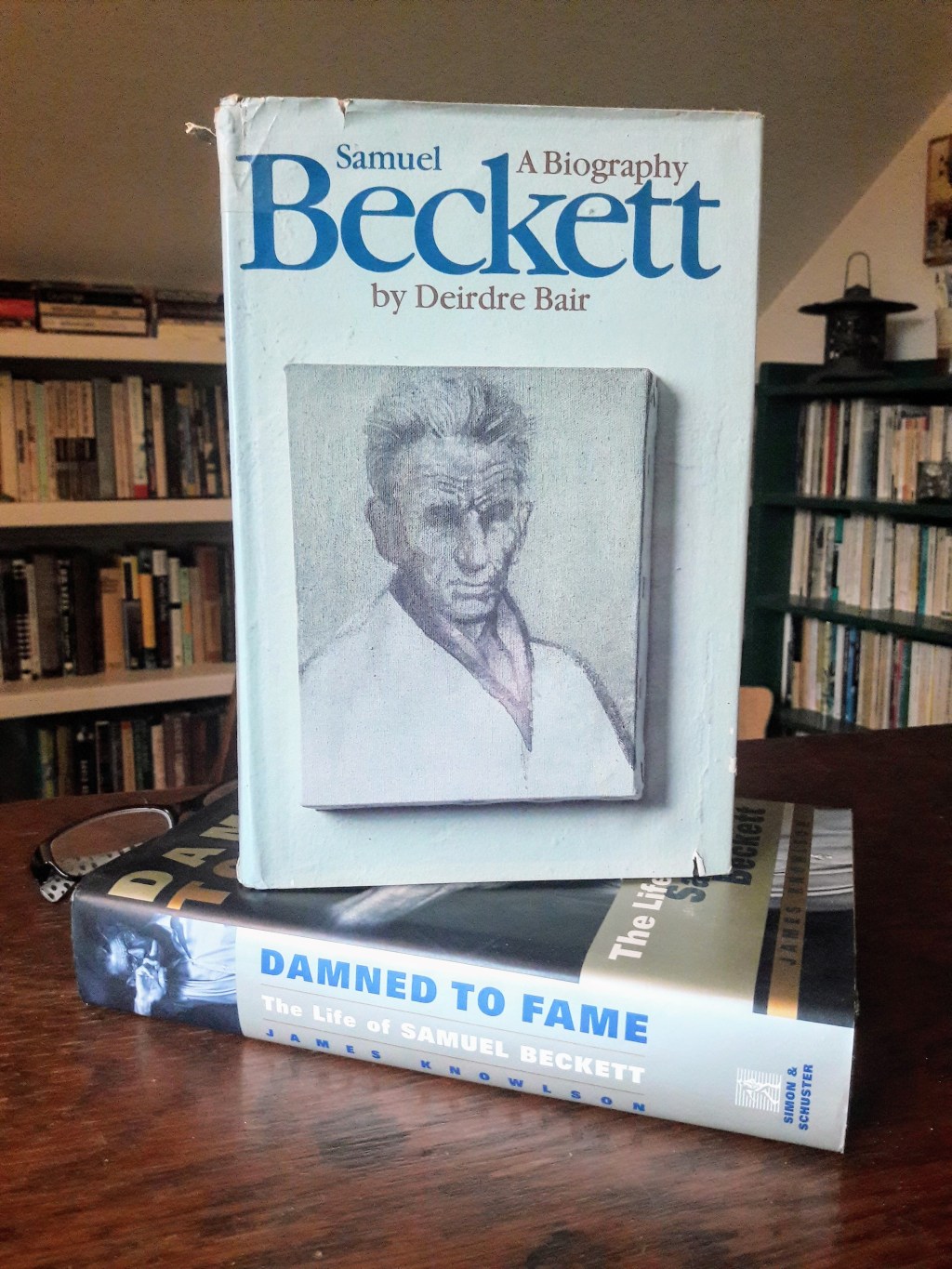
    The biographer Deirdre Bair, Samuel Beckett’s first official biographer, has passed away, the Times reports: ‘His first words to her, she wrote in “Parisian Lives,” were, “So you are the one who is going to reveal me for the charlatan that I am.”’

    Beckett may have hoped so. He certainly gave her that start, for he just gave away two key insights to his work. The etymology of charlatan includes “to prattle,” and “I talk nonsense.” And Charlie Chaplin’s work was fully enjoyed by Beckett. Chaplin was popular in France, and was colloquially called “Charlot.” Many (if not all) of Beckett’s characters seem inspired by the clown, the tramp, the outsider, the vaudevillian villain, whose humor reveals deep suffering truths of the human condition. We could die laughing.

    “You might say I had a happy childhood,” Deirdre Bair’s biography of Beckett begins. But the 1978 Times review frowns on the biographer’s focus on what appeared to be Beckett’s lifelong condition of anhedonia. For Bair, Beckett seemed the kind of person who had fun once, but didn’t enjoy it. Of course, Beckett himself fueled this kind of confusion, what he called tragicomedy.

  • The Man With the Blue Guitar

    The Man With the Blue Guitar

    The guitar, given the day would be green, could not have been any other color. The sky would blaze orange when the guitar mixed its sounds with the day.

    Wallace Stevens was not a poet born in squalor, though he would have savored the metaphor. He was schooled and trained as a lawyer and spent his working life with Hartford Insurance where he rose to be a Vice President of Claims.

    One day, one of his colleagues entered his office with a book of poems Stevens had apparently written. That Stevens was a poet was not well known inside the insurance setting of his day job. He often walked to work, a route which took him through a local park, and he composed in his head as he walked. Stevens, his colleague exclaimed, holding forth his book, you’re a poet! But what does it all mean? Never mind, Stevens replied. You are far too literal.

    Like houseplants, Poetry can pose dangers. A reader might contact some sort of chemical dermatological poison just by holding a book of poems in his hands. The cautious, casual reader might want to wear gloves and put on a pair of solar eclipse glasses.

    Because the man with the blue guitar drifts afar:

    The man bent over his guitar,
    A shearsman of sorts. The day was green.
    
    They said, "You have a blue guitar,
    You do not play things as they are."
    
    The man replied, "Things as they are 
    Are changed upon the blue guitar."
    
    And they said then, "But play, you must,
    A tune beyond us, yet ourselves,
    
    A tune upon the blue guitar
    Of things exactly as they are."
    

    Quote from “The Man with the Blue Guitar,” by Wallace Stevens. Pictured: A Baby with a Blue Guitar.

    Speaking of guitar, I’ve struck up a live at 5 (PST) guitar gig evenings on Instagram. Random, improvised, distractions. Check it out here.

  • The Poet’s Tale

    The Poet’s Tale

    The poet is born in squalor, his first love. Some of the poet’s favorite words include seedy, shabby, seamy. These are words made with a hissing sound. In phonics, that sound is called a sibilant, and is produced by forcing the tongue toward the teeth, with the lips near closed, forcing air out like a snake whistling. But opposite words are equally valued by the poet: classy, stylish, exclusive. Even if the reader uses words without really caring about words as such much. The poet is not primarily concerned with getting a point across, and is held harmless if some point hurts its object in the bargain, even if so much the better. If an annoying sound appears to sharpen the point, there’s value added. The poet is in love with words.

    But it’s easy to confuse poetry with sarcasm, satire, or irony. And the true cynicism of poetry often gives way to stoicism. This may occur when the poet realizes there is no point to anything, including his own poetry. Innuendos may still be highly valued (particularly where points may be scored), for all words have their beginning in figures of speech, which is to say, metaphor. That is precisely what an eye for an eye and a tooth for a tooth is meant to solve. Words disallow mistake when artificial trade-offs are refused. But language is no place for despots, try as they might to exert control, to establish absolute authority. Who controls the movement of words over space and time?

    Words are all substitutes. No one can claim dominion. One is as good as another. Language is democratic. And that is why the poet is married to shame, his own mother, at once virgin and harlot (that is to say, vagabond, a beggar for words). In a truly democratic society, where everyone is equal and all words hold common sway, and competition without compromise is useless, it may begin to appear the only way to have a-leg-up-on is to attempt to subject another to shame. But shame has never worked as a measure of control. And that is why poetry can be so hard to get, and why hard times come so often to poets.

    The poet stands accused of nothing and nonsense. His love of words and sound and color is scorned and mocked. He is the scapegoat for confusion.

  • The Epic Virus and Examined Life

    The Epic Virus and Examined Life

    Nothing like an Epic Virus to remind one how connections work. Members of this current batch of humans share just about everything of themselves, like it or not, even their money, some more some less than others.

    Life swarms with sounds we can’t hear, and teems down pouring itself empty with flying bugs and crawling things, birds and fishes, and the smallest creatures invisible to the naked eye that can make bread rise and turn grapes to wine and hops to beer, life that enters and exits the great smoking and stoking train of the body, riding one car to the next, to and fro, round trips, never holding an official ticket. Life is idiomatic.

    In Astra Taylor’s film Examined Life, Kwame Anthony Appiah reflects on how the ways in which humans are connected have changed over time. Gone are the days, Appiah explains, when the only people you ever saw in your entire lifetime were the members of your own family or small tribe:

    “As a species that was designed for living in bands of a hundred-odd people for much of its evolutionary history, we have to figure out how we’re going to live in a planet with 6, 7, 8 billion people. Billions not divided into lots of little bands of a hundred, but constantly interacting – and interacting in units of hundreds of millions. The United States, for example, has a population of 300 million right now. So as an American, you exist in this kind of virtual relationship with 300 million people. If you’re lucky enough to be Chinese, your virtual relationships are soon with 1.5 billion people or something like that” (p. 88, Examined Life: Excursions with Contemporary Thinkers, Edited by Astra Taylor, The New Press, 2009; Interviews from the film Examined Life, 2008).