Category: Poetry

  • Second Notes on “Berfrois the Book,” “Queen Mob’s Teahouse: Teh Book,” and AWP19: Lonely, the Book

    One day, almost ten years ago, down at the Bipartisan Café, in Montavilla, reading on my laptop, I was gobsmacked to find someone had published on their site a piece I’d recently written for my blog, The Coming of the Toads. At the time, I’d not yet heard of Berfrois or its editor Russell Bennetts. Now, with book publications “Befrois the Book” and “Queen Mob’s Teahouse: Teh Book” (Dostoyevsky Wannabe Original, 2019), Berfrois opens a new wing in its reach for readers and writers.

    This week, the annual Associated Writers and Writing Programs (AWP) conference is being held here in Portland. Berfrois will have a table in the book fair, the new books available for perusal, purchase, on display.

    Ten years is already a long life for an enterprise devoted to and sustaining a “literary-intellectual online magazine” – that updates daily, no less. And Berfrois has managed to remain ad free while adding writers and readers, expanding its original format and content, publishing in addition to poetry, fiction, essays, photography, and notes and comment from around the Web, books in Ebook format: “’Relentless’ by Jeff Bezos,’” and “Poets for Corbyn,” for example.

    Yet those same ten years have seen the continued growth of “the reading crisis,” and the “death of blogs,” debate over online versus paper reading, argument over possible decline in reading abilities and skills, and the perceived watering down of the value of a Humanities degree. Higher education is, in the opinion of many, in turmoil as increasingly news appears of schools turning to business models, cutting traditional programs, and even turning to sketchy recruiting schemes as revealed in the recent college admission crisis story, and all the while tuitions and fees rising while the whole edifice relying more and more on an adjunct workforce unable to sustain itself on local economies. What’s a writer to do?

    You might move to New York, or get an MFA. That’s a choice? Or do both? Elizabeth Bishop did, sort of. She moved to New York and began teaching in a program, the “U.S.A. School of Writing.” It was a correspondence course, the kind that used to advertise on the back of a book of matches. Having just graduated college, Bishop was in New York during the Great Depression:

    “Perhaps there seemed to be something virtuous in working for much less a year than our educations had been costing our families….” [but] “It was here, in this noisome place, in spite of all I had read and been taught and thought I knew about it [writing] before, that the mysterious, awful power of writing first dawned on me. Or, since ‘writing’ means so many different things, the power of the printed word, or even that capitalized Word whose significance had previously escaped me and then made itself suddenly, if sporadically, plain….”

    What Bishop is talking about is “Loneliness.”

    “In the case of my students, their need was not to ward off society but to get into it…Without exception, the letters I received were from people suffering from terrible loneliness in all its better-known forms, and in some I had never even dreamed of.”

    (The New Yorker, July 18, 1983, retrieved 25Mar19 via TNY on-line archive available to subscribers).

    With a few small changes, Bishop’s article might have been written by an adjunct instructor in today’s education marketplace. It seems unlikely though that the attendees I’ll see around AWP19 will all be lonely. But how’s a mere reader to know?

    …to be continued.

    This post is the second in a series. I’m reading through the Berfrois anthologies this week and commenting on the writing and the conference as the week wears on.

  • First Notes on the publication of “Berfrois the Book” and “Queen Mob’s Teahouse: Teh Book”

    The annual Association of Writers and Writing Programs (AWP) convention is being held this coming week in my home town of Portland, Oregon. I’ll try to post daily through the week my local observations of the main event and its various outlier happenings. One of those happenings is the concurrent publication of “Befrois the Book” and “Queen Mob’s Teahouse: Teh Book” (Dostoyevsky Wannabe Original, 2019). Editor at large Russell Bennetts will be on hand at the AWP Berfrois table with an ample supply hot off the press.

    These two anthologies of contemporary writing include work by a community of writers from around the world whose collective voice argues for independent and alternative, experimental, grass roots writing and engagement in the Humanities. By calling them a community, I don’t mean to suggest I personally know any of them. I don’t. Nor am I deeply familiar with the writing of them all. I have, however, since my own discovery of Berfrois about ten years ago, and later when Queen Mob’s Teahouse went online, followed the progress of several writers appearing there, and remain a frequent reader of the sites. And of the whole I’m confident in calling it not only international but diverse in all the characteristics generally acknowledged to matter in today’s world, at least to those whose hearts beat in their chests and not in their pockets. Which is to say the community seems genuinely united in standing for freedom from tyranny or abuse of any kind in any place.

    There of course we swim into deep waters, for the books, designed and published by the neophyte press Dostoyevsky Wannabe, are printed via the gargantuan Amazon. The DW press readily speaks to the issue which for some could be a show stopper – from their About page FAQ:

    “Where d’you stand on the ethics of using Amazon?

    We stand where every radical bookshop and arts organisation and alternative and independent organisation stand when they use Twitter and/or Facebook, or when they use a smartphone or a laptop made by another similarly faceless corporate entity who may or may not be very ethical. Ask any giant faceless corporation how ethical they are (ask their lobbyists). We stand where zine makers stand when they use Hewlett Packard or Canon printers or photocopiers. We sometimes also sit in cars and on buses that pollute the earth much the same as other independent and radical and alternative organisations. We don’t like that we have to more or less do this but we do.

    Or as one of our good friends put it recently: ‘I hear Richard Kern used Kodak film for his movies. Was he really No Wave?’”

    I mention the publishing platform question here in anticipation of possible staid literary critical rebuttal to the content (a criticism which might include the snobbish notion that the self-published is by definition unworthy). When Ferlinghetti began City Lights, back in the 50’s, he wanted to establish a literary community, and he did so on the back of paperbacks, at the time a sign of inferior publishing content. In any case, literary revolution was ever so, as a review of the so-called modernist journals will reveal. The work is radical at least in as much as it questions the status quo of form, content, gatekeeping (including academic), and distribution. The Berfrois and QM’sT work also seems inspired at least in part by the open source, open access, creative commons, and dropping paywall movements (particularly where academic or research papers, already in part publicly funded in many cases, are concerned). The work is Indie and Alternative, and departs from traditional industry publication methods much as the work of musicians has ventured away from the traditional recording industry – all enabled of course at least in part by technology but also perhaps by a general turning away from or shrugging of the shoulder at the popular, the mall-ed, the commercialized, but as well from the so-called credible, reliable, cited sourced and footnoted, peer reviewed. There’s a new pier in town, and it’s not Stephen’s disappointed bridge. It at least points toward something new.

    Not to say though any one individual within the Berfrois and QM’sT community has not also benefited from or would refuse professional (i.e. paying) gigs. I almost framed for the wall my poem accepted and published in The Christian Science Monitor back in 2009, for which I was paid the handsome sum of $40.00. I was going to frame a cutout of the poem with the check, but I ended up cashing it to help fund my book habit. There are of course differences between writing for payment (at least one of the prerequisites to the ranks of pro) and writing for payment enough to quit one’s day job. Or night job. Or multiple jobs. Add to that one’s status as an adjunct of any organization and we wonder what kind of fuel keeps these engines running when they can only run in overtime mode. But nor is this work simply about “exposure” in lieu of pay or some sort of deferred payment or contract. Maybe, at its core, it is about the amateur spirit in writing, a spirit we remain loath to lose, as E. B. White suggested, no matter how professional we become.

    So who are these spirits whose light has filled our screens and now illuminates the pages of the Book and teh Book? They do indeed include both professionals and amateurs by imprimatur and in their own right. As with any group of artists, bohemians, intellectuals, their diversity skews any leaning toward a unifying code that might undermine their independence. To what degree is calling these Berfrois or Queen Mob’s writers a community even accurate? Has someone proclaimed a movement, written a manifesto? Do they form a new school of writing, such as the Imagists, or later, the Beats? To call these writers a community might be simply to identify the line of best fit. “Toto, I’ve a feeling we’re not in Kansas anymore,” as Dorothy says upon landing somewhere over the rainbow. Or maybe that’s exactly where we are, Kansas. But what exactly is an artist and where do they work and reside? Recall father and son from Joyce’s “A Portrait of the Artist as a Young Man”:

    “There’s that son of mine there not half my age and I’m a better man than he is any day of the week.

    —Draw it mild now, Dedalus. I think it’s time for you to take a back seat, said the gentleman who had spoken before.

    —No, by God! asserted Mr Dedalus. I’ll sing a tenor song against him or I’ll vault a five-barred gate against him or I’ll run with him after the hounds across the country as I did thirty years ago along with the Kerry Boy and the best man for it.

    —But he’ll beat you here, said the little old man, tapping his forehead and raising his glass to drain it.

    —Well, I hope he’ll be as good a man as his father. That’s all I can say, said Mr Dedalus.

    —If he is, he’ll do, said the little old man.

    —And thanks be to God, Johnny, said Mr Dedalus, that we lived so long and did so little harm.

    —But did so much good, Simon, said the little old man gravely. Thanks be to God we lived so long and did so much good.

    Stephen watched the three glasses being raised from the counter as his father and his two cronies drank to the memory of their past. An abyss of fortune or of temperament sundered him from them. His mind seemed older than theirs: it shone coldly on their strifes and happiness and regrets like a moon upon a younger earth. No life or youth stirred in him as it had stirred in them. He had known neither the pleasure of companionship with others nor the vigour of rude male health nor filial piety. Nothing stirred within his soul but a cold and cruel and loveless lust. His childhood was dead or lost and with it his soul capable of simple joys and he was drifting amid life like the barren shell of the moon.”

    Perhaps, then, there is some kind of temperament that brings and holds the Berfrois and Queen Mob’s writers together. Throughout the writing, one begins to recognize the use of certain scales. And when you mix them together you get the four body humors. And more, and there’s the humor of it. The temperament might, after all, belong to Russell Bennetts. I wonder if Russell wouldn’t prefer pizza and a beer with the hearty senior Dedalus rather than the morose Stephen. But that sets up an out of whack either or fallacy, and anyway, Russell has already invited them both.

    Berfrois the Book includes work by 41 writers. Queen Mob’s Teahouse: teh Book includes work by 57 writers. Only two writers appear in both, so 96 writers from around the world represented. Many are US or UK, some Canada. New Zealand. Tokyo. Singapore. Berlin. Melbourne. Chile. Paris. Netherlands. India. Poland. That much a reader can see from the short biographies included at the end of each book, many of which though don’t name a place. In any case, Joyce said he could write anywhere. Hemingway said he could too, but maybe he wasn’t so good in some places. Where one might be located at any given moment does not necessarily betray one’s identity as a writer. For that, we must read beyond the biographies to the work. Writers travel outside time and place and person, even if they never leave their desk. As do readers.

    I’ll be reading through the anthologies this week and commenting on the writing and the conference as the week wears on. I’m hoping to meet up with, in person, the, as Jeremy Fernando would say, inimitable Russell Bennetts, who is apparently already in Portland town for the conference. I already missed an opportunity yesterday.

    …to be continued
  • a bit of lit crit

    a bit of lit crit

    Word put
    upon word,
    drooped

    Robert Creeley said,
    or almost said.

    What Creeley said
    in his poem “The House”
    was:

    Mud put

    upon mud,

    lifted

    Mud is better
    than Word,
    but drooped is good.

  • Rubbing Amber

    Rubbing Amber

    The new monks like moths gather to the light
    scree falls into the folds of their feathered skin
    robes amid foul screens callous bawls
    window shades pulled down
    the game glows with electric flames warm
    and hand wrapped wireless controllers
    fingers jostle the joysticks.

  • Whorlscope

    Whorlscope

    Whorled weary for this world’s woes
    worsened by winter’s whistling
    wicked wishes as worrying
    as this watch of one’s web life ebb,
    and if that’s not maudlin enough,
    sick of this car’s cough, too,
    its needy changes and fillings,
    its overheated tantrums, leaks,
    stalls, and traffic jams, the orange
    cones and potholes and all ways
    waged in fees and duns and one’s
    fief windblown like the shabby
    tatty cat hunkered for the night
    in the trash can gust opened.
    Some correlation perhaps:
    unhappiness and the automobile,
    for there is nothing mobile
    that is unwitting.

    Accidental and aleatoric lines
    alienate awareness precisely
    where we desire to go
    reading off the water
    listening listing cant
    in this sham breeze
    what would an alien see?
    Earthlings have wheels,
    their eyes light up at night,
    and there are these other
    creatures that wash them,
    feed them, and care for them.
    There appears to be a symbiotic
    relationship between the metal
    boxes and the asphalt lines.
    More study is needed to ascertain
    how the Earth benefits.

    Weary then of the keen privilege
    to sound dog-tired exhausted
    old hat hack comes to an end
    sidetrack dismantle yard
    all you need is love sang John
    I’m sick of love replied Dylan
    in Love Sick on Time Out
    of Mind full of walking
    and waiting.

    Turn off, tune out, drop in
    drop in sometime and say hi
    live within walls if you must
    but keep the doors open
    the windows loosely lighted.
    Get on now and move about
    nothing just motion one purpose
    one motion transforming
    breathing energy fizz of life.
    This is work, let us not
    automate our own motion.


  • An Impure Primer

    An Impure Primer

    A beastly catechism
    dog eared brown cat 
    drenched frozen
    green halo.

    I just kwikzilver
    looked.

    Mighty nice
    mice nook.

    Opening opinion pending
    please query
    queue quorum.

    Run straight
    toward universe
    vast wobbly.

    Exit your zero.

  • Song at a Border Crossing

    Song at a Border Crossing

    If this be your love
    come away with us
    come away.

    If this be your love
    steal away with us
    steal away.

    If this be your love
    come free with us
    come free.

    And if this be your fear
    songs smiling ear to ear
    songs that give no take –
    unhinge the gate of your heart
    and you too go free.


  • Feast of Epiphany

    Epiphany

    In the straw burrow farm mice.
    Get a little closer and you’ll see
    Nits in baby Jesus’s hair, lice,
    And a house snake in the olive tree.

    There’s beer on the breath of the three
    Sage men sitting under the olive tree,
    Playing games of cribbage,
    Ushering in a new age.

    The pieces are swaddled in wool.
    Mary’s breast-feeding the baby Jesus.
    Joseph takes out his tools
    To build a bed before the night freezes.

    Mary wipes Joseph’s brow,
    The wise men questioning how,
    Talking to Joseph about what he did,
    And what in the end might be in the crib.

    From an East Side Bus

    The lurching bus crowds forward,
    dogs away from the curb broken under
    the plum tree overarching the shelter.

    The bus thrashes on, wobbling
    in a fit of leaf blowing, phlegmatic coughing.
    The young, motley couple

    (we see them every day lately),
    their rusted stroller full
    of plastic blankets,

    empty bottles, and crushed cans,
    sleeps on the bench in the bus shelter
    covered with plums and damp purple leaves.

    “Epiphany” appeared in Rocinante, Spring 2009, Vol. 8

    The two poems for Epiphany were previously posted at the Toads on December 25, 2011.

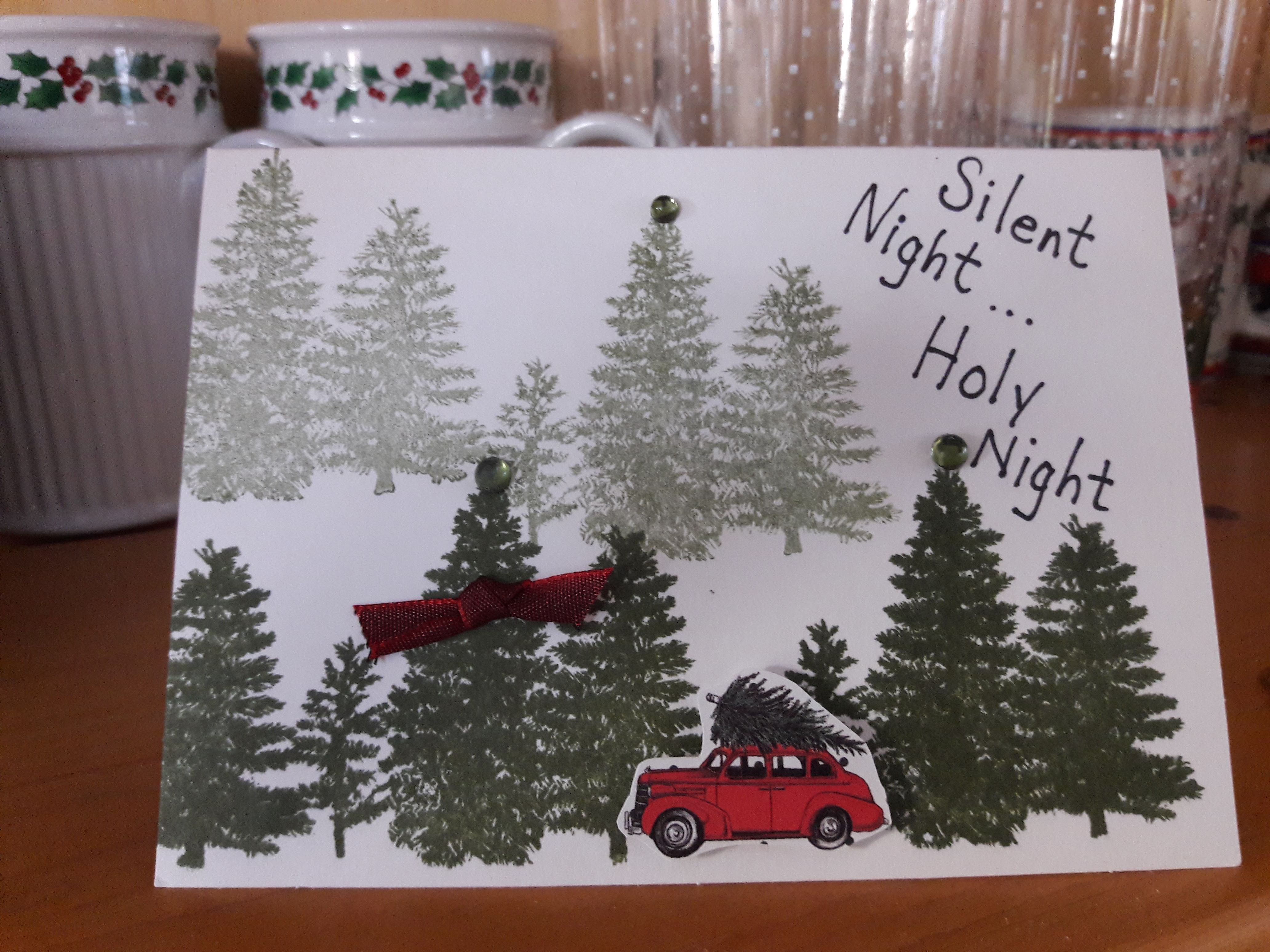
    2018 Christmas card by my sister Barbara.
  • Drizzle Rain

    Drizzle Rain

    A trip of plovers paused wading
    in the wet sand of an ebb
    tide each one after another
    across the sloping beach
    stopped and pecked and ran on.

    Up on 101 a swarm of workers
    on a wet sidewalk in winter
    huddled at the bus stop waiting
    and each one hopped aboard
    and nipped and gripped.

    They feed with their eyes
    and only pretend to be
    where they are,
    falsely brooding,
    but amusing, all the same. 

  • Epiphanic Cat

    A kin of kindly
    epiphany, unblinding, 
    not whiskey aflame
    in your raw throat,
    a mud dog’s bouche
    to your uncupped
    groin, but the silent
    soft brush of a cat
    rub against your leg
    to say hello
    and please
    pay attention
    to her.


  • The Awful Truth

    The Awful Truth

    How awful to be foul
    all of the time.
    One should wise up
    once in awhile.
    But uneasy, those
    strange gods above us,
    all who stir
    to one thing:
    “Three little people
    don’t amount
    to a hill of beans
    in this crazy world.” *

    * Rick to Ilsa
    at the end
    of Casablanca.