Category: Poetry

  • Elephant Garlic Honey and “Reflections on a Gift of Watermelon Pickle”

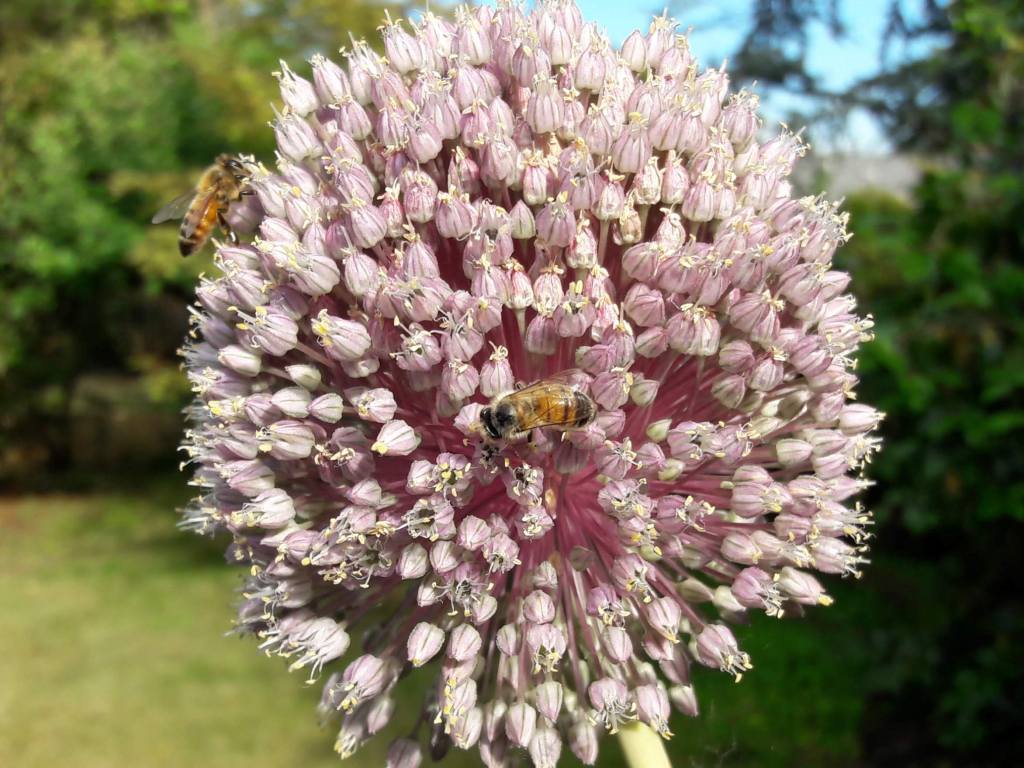
    We’ve been growing more herbs these last few years. The Salsa Garden is lost, as well as most of the activities that used to surround it. Yesterday, walking with a beer through the brick bordered herb garden (used bricks salvaged from lost projects, saved from taken down chimneys – we’ve one clinker brick), I noticed three honey bees working the flowers of two elephant garlic plants. The flowers are round, purple and white balls of blossoms, about the size of a swollen baseball, blossoming one each at the top of five foot stalks.

    It’s difficult of course to identify the plant a honey comes from, and these bees are foraging freely in urban wild yards up and down the block. And the elephant garlic is on its own, hardly a crop. I don’t know where the bees call home. The rampant peppermint growing up along the south facing wall will bloom soon, and will bring more bees, and butterflies, and hummingbirds. If our yard were a poem, it would be free verse.

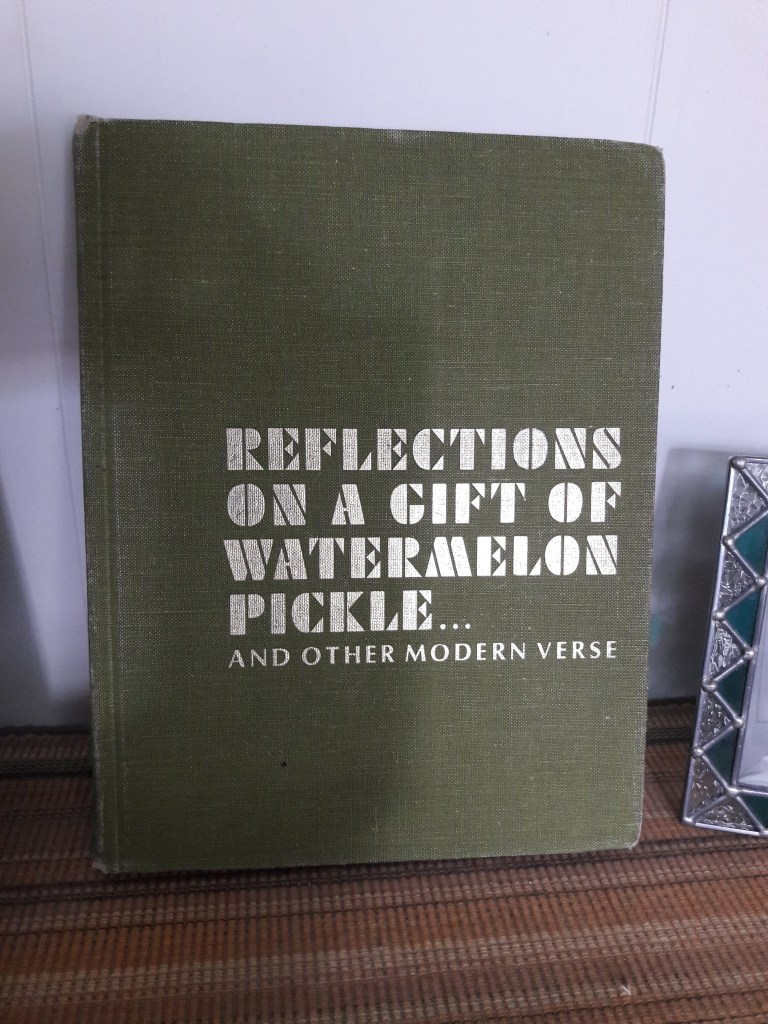
    I pulled out a prize find foraging in the neighborhood book box down on the corner this week: “Reflections on a Gift of Watermelon Pickle…And Other Modern Verse.” This is the 1966 edition that was welcomed in schools for a few years. It’s a textbook, but unlike most intro tos we see nowadays. There’s little discussion, and just one or a few questions for each poem gathered in a rear appendix. The title comes from one of the poems, written by John Tobias: “Reflections on a Gift of Watermelon Pickle Received from a Friend Called Felicity.” The book includes black and white photos scattered throughout. All of the poems are cast in italics, but not their titles.

    This copy is a discard from “School District No. 1: Cleveland High School.” The “issued to” slip pasted on the inside front cover shows 10/15/71 as the first date, issued to a Donald Scott. There is a name ahead of Scott’s, Gene Brown, but no date. There are other dates and student names: Shirley Moe (undated); Felicia Tracy (undated); 4/6/76 Marie Dee. There are eleven names, one crossed out with blue ink such that it’s unreadable. The last date reads 5-15-2000. And seemingly out of place, “Iris Little 6th per” appears at the top of the slip, no date. There is a note “To the student:” which mentions how the book comes into the student’s hands, and includes a schedule of “charges” should the book be found damaged in some way upon return, including: “4. Defacing by pencil…1.00; and “5. General mistreatment (water soiled, burned, dirty, ink, lipstick, paint)…1.50.” This copy is in good condition, the only “defacing” done by school ink stamps: “Property of….” And the slip, pasted to the inside cover, which has so fascinated me I’ve barely looked at the poems yet. 160 pages.
  • Paintings and Poems: City on a Hill

    “You are the light
    of the world.
    A city
    set upon a hill
    cannot be hidden” (Matthew 5:14).

    Not to mention something you’ve put up online. What’s posted online can’t be deleted or hidden. That is the poet’s dilemma, who craves publication but still has changes, or will have. But that is only a matter or problem of print. Oral poetry, or song, allows, invites, indeed wants variations. Covers. Over time, cities get covered up. The earth rises, and falls.

    I assumed the Queen Mob’s Teahouse poetry editor position back in April, taking over from Erik Kennedy, Queen Mob’s second poetry editor, from May, 2015, who followed Laura A. Warman. The gig is volunteer work, of course, as befits any true poetic enterprise.

    I first put up, on April 19, three poems by Jax NTP. It was then the idea came to me to use my own paintings as the header images over the poet’s work. I was struck by Jax NTP’s atmospheric, impressionistic poetry. The poems are packed with energetic images changing with the speed of “Highway 61 Revisited”:

    “there’s a giant temple on hazard and new hope street
    blue reptile and green mazing skeletons, keepers of time
    how long can you sit there with the pain before you try to fix it?”

    from “how to pivot when you’re paralyzed,” by Jax NTP

    And I had just finished a painting, the impressions of which, the symbols within, the colors, the shapes, I thought might complement Jax NTP’s poetry. I don’t mean to suggest any of the paintings necessarily align with the poetry in any literal way. In any case, I continued to look for images within my collection of painting pic selfies for complementary impressions.

    Reading and reflecting on Jessica Sequeira’s poems, and later looking for a painting to go with the posting on QMT, I again felt the suggestion with impressions that seems the essence of poetry, particularly of poetical delight:

    “The heavens have promised rain for so many days.
    I think of waiting for torrents from the white sky.
    But it might be a long time. Or this could be a dream.
    Taking your hand, I guide it below, to my cloud.”

    from “Eastern Variations, style of Ikkyū Sōjun,” by Jessica Sequeira

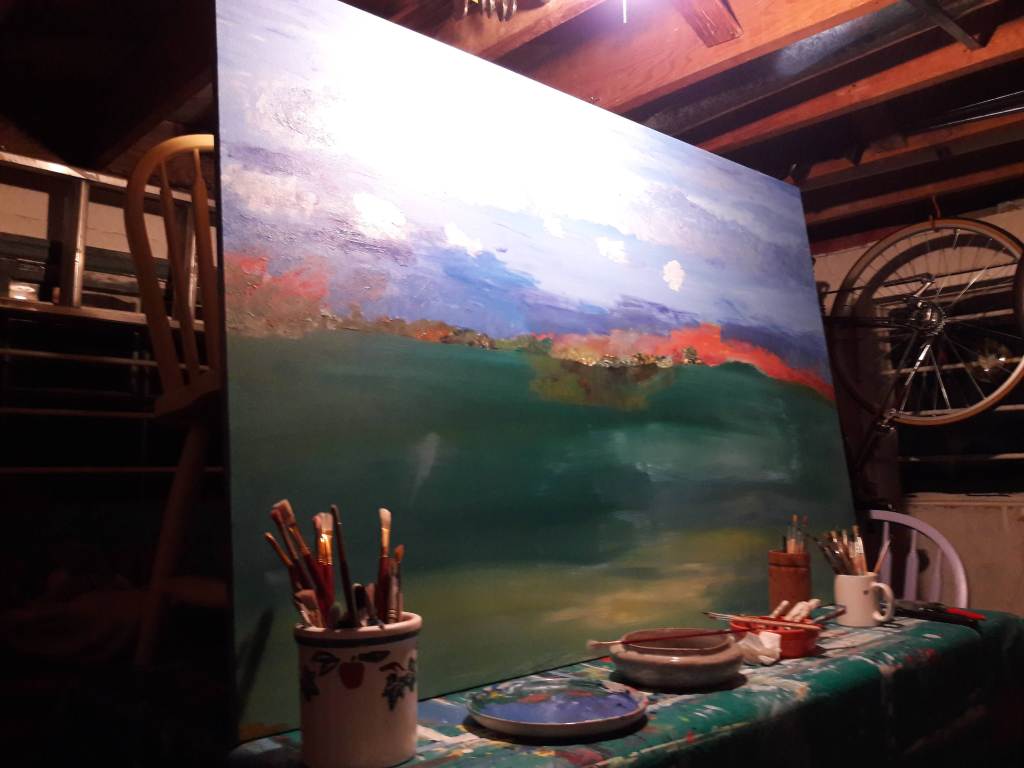
    I selected for Jessica’s poems a painting from last year, “City on a Hill,” a large painting that had taken some time to complete. Again, the setting of the poems and the painting seemed harmonious:

    “lakes shine like mirrors
    reflecting tall mountains

    rainfalls are unpredictable
    innocent changes in the divine mood

    birds sing into great holy spaces
    the wind whistles its reply

    icy glaciers plunge towards sky
    green valleys dive into earth”

    from “My South,” by Jessica Sequeira

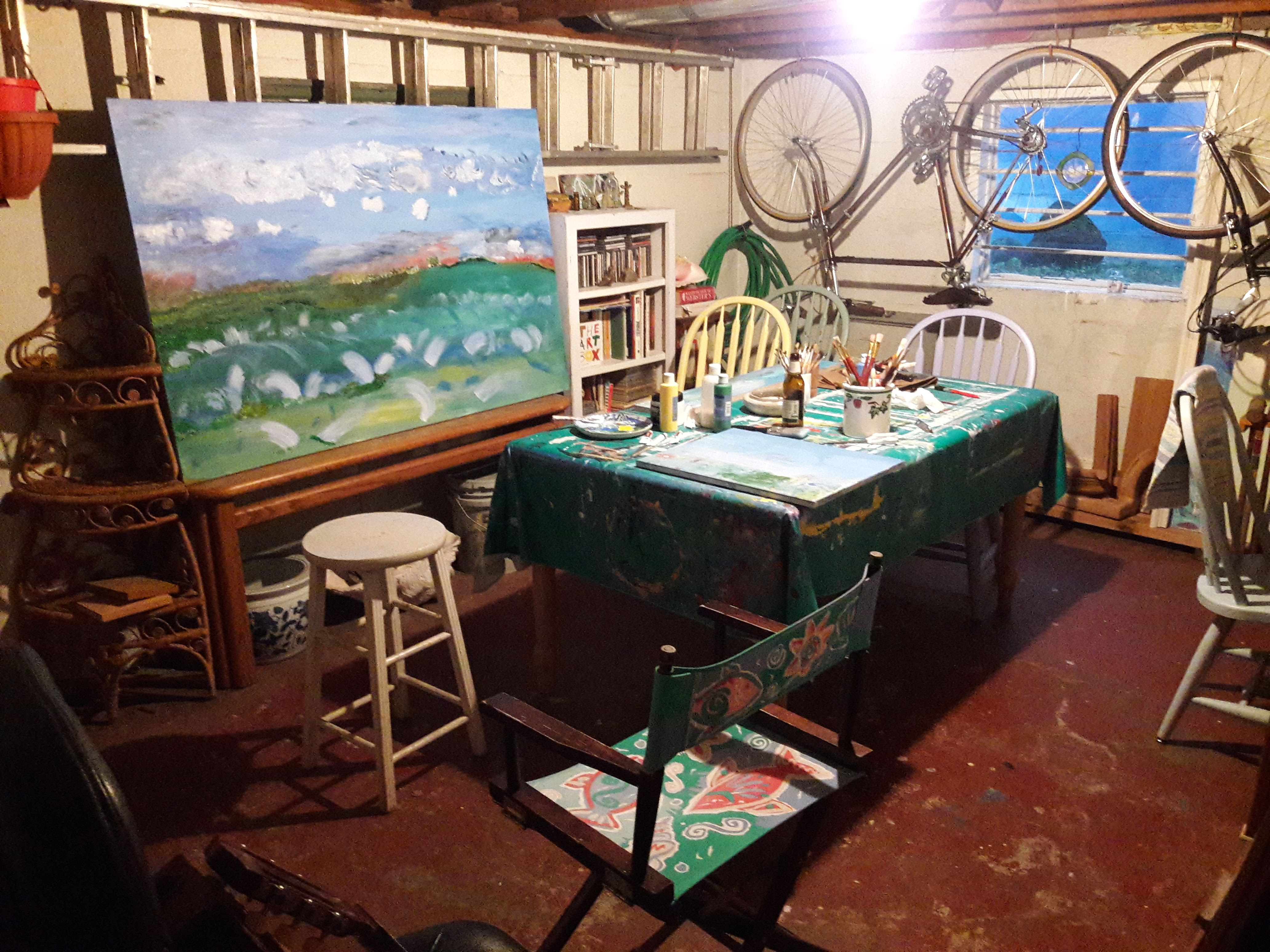
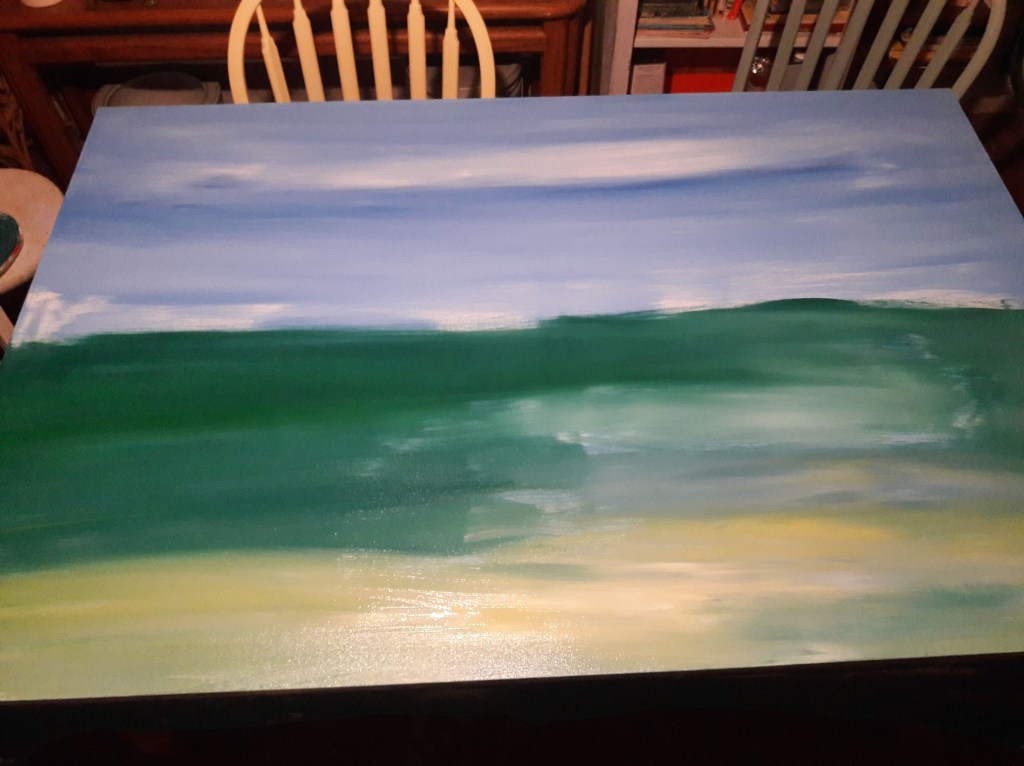
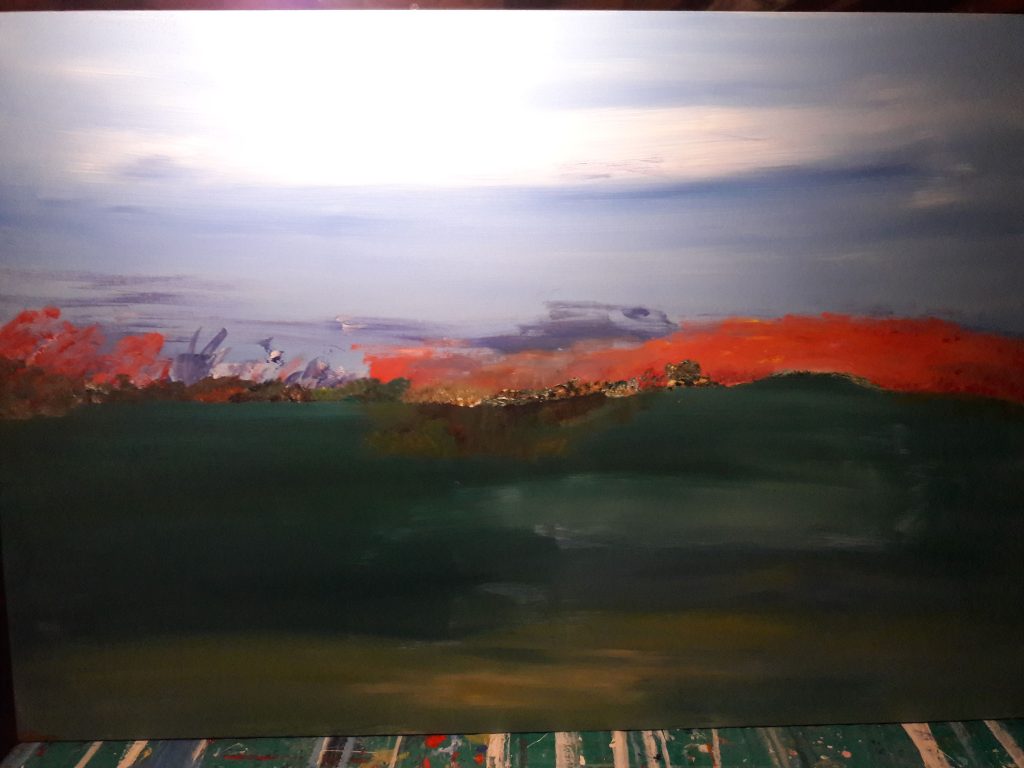
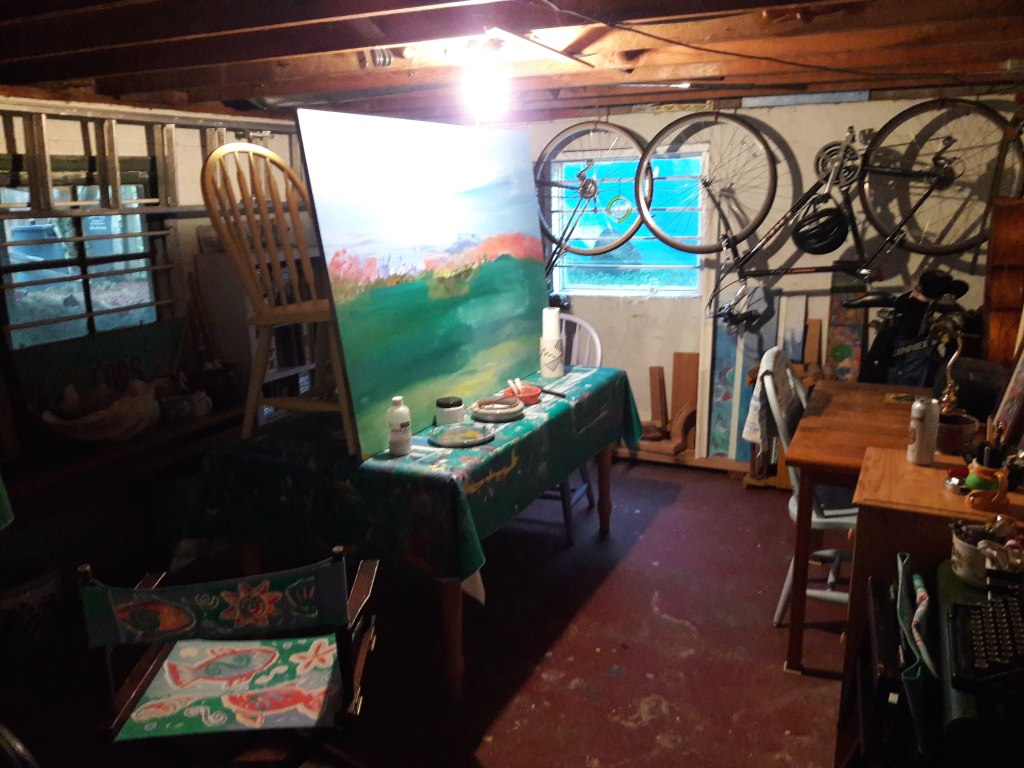
    I had taken numerous pics of “City on a Hill” when a work in progress in the basement studio:

    And I used an early draft of “City on a Hill” to go with Ashen Venema’s poetry:

    I sit still, watch him thin the oil
    and restore his long gone love
    on canvas, standing in
    as the young skin
    by the window, sunlit among
    lilies, fresh cut, and Persian rugs
    casually flung across seats.

    from “My Painter,” by Ashen Venema

    Well, the setting of Ashen’s “My Painter,” “sunlit among / lilies,” doesn’t quite align with the basement studio, though things are there too “casually flung.”

    All my paintings I eventually give away, to family, friends, colleagues, who show an interest and enthusiasm. “City on a Hill” is hanging in my daughter’s den, looking out upon the backyard. The light in the room is perfect. I just want or hope the paintings have a life outside my basement, where, as Ashen puts it in “My Painter”:

    “A blaze of light rims his white hair
    from under his thick swirl of brows
    black humour hides, and surprise”

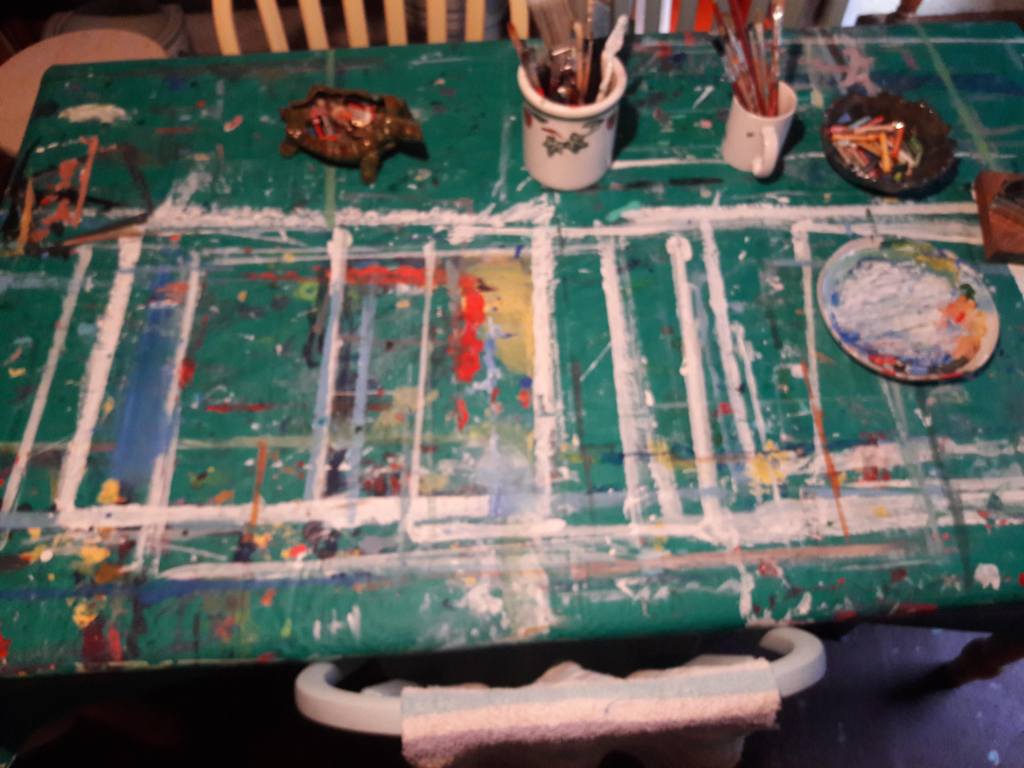
    After all the work on a painting, which isn’t really work, of course, but play, like the work of much poetry, we just might find a true work of art in what we’ve mostly ignored, in the mess we left behind. That tablecloth, for example, now that’s a work of art!

  • Cliff Notes

    ands all sitting
    Angst I a T
    hangs silently
    a long ways down
    High Flyer Falls
    rip rap cliff walk
    Do Not Look Down
    Set All Alarms
    Valuables
    tosses bought stuff
    lands rock pine tree
    calmly waiting
    sea craggy end.

  • The Noir Hack

    Met a hack on her back in the sack lovely but no ears
    lugged a sack of socks as winter uncoiled into spring
    all summer long rolled up socks & stuffed her bag
    till full it was wool tossed socks fool me going barefoot
    sandaled sock-less the warm early grasses of summer
    by the sidewalks along the seashore in a summer
    the weather news said would never end the waves
    the summer the ocean beaches & solid gold weekends.

    Noir fall & fell fall hard that year markets failed
    & on socks tariffs hit feet cold wet & sore toenail
    fungus infestation & the wooly cooly hack kneed
    trumpet ear tinkered her socks along the esplanade
    & came the coldest winter lemonade stands closed
    nary a beer at the end of the year she was rich
    & to boot boasted the warmest toes so near
    impressed in silk slippers she was when I left her.

  • Horny Theology

    Horny Theology

    A rufous whistled
    and hummed
    at my open door.

    She flew at my heart
    picked and snatched
    hairs from my chest
    for her nest.

    Me flat on my back on the floor
    while she sits on my face
    hooked to my lips
    slicing my eyes
    like an ophthalmologist.

    Her every winged flush
    as sweet and powerful
    as a rush of butterflies

    falling
    filling
    my coughing joy.

    To and fro
    true and from
    until

    ‘harumph’! 

    she blurted out
    and bolted off
    as quickly as she came.

    I thought she was a unicorn
    or a rhinoceros with wings.

    She left me
    without a prayer.

  • Ode to Joy

    Ode to Joy

    Old monk drunk walk garden
    olive way moon path nude
    blue light strain powder pouring
    bare feet stains red muscatel.

    On his rock sits Jesus eyes clear
    tell him of your life sans joy
    brave Brother Anhidonus oh
    fun monk too but without joy.

    Hung over herbs your Jesus praying
    not an only child was he
    resting for the weak of passion
    who find no joy in silent being

    feel no peace no happiness
    no light of joy no sound of joy
    for the ears no touch of joy no
    raised goosebumps on the skin

    no taste of joy sweet salty bitter
    no sour bites teeth the tongue
    no smell of joy stirs memories
    no prayer saturates the temperate.

    No joy found in going silent
    sing for your soup of certitude
    what has brought you not to
    here certainly cannot help now.

    “The cut worm forgives the plow”
    Blake sang now you at least may
    forgive yourself and drink to joy
    lost to joy abstained all these years.

    Walk out of this garden leave
    transcend all plants and animals
    there above where the angels sing
    awaits the turn of your perfect being.

  • This bud was for you

    Across the street from the Estate Sale,
    there’s talk if it’s a teardown,
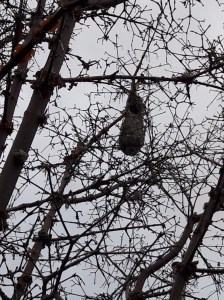
    while a couple of bushtits build
    a hanging nest in a paperbark maple,
    coming and going through the perfect
    hole at the top of the sack woven
    with string, spider web, tiny twigs
    and grassy strands yarned around.

    “Go easy,” she yearned. “Go around.”
    Then came the night she won’t spring back.
    Some do not come back,
    even as the buds rise in the rows
    heatly lubricated by the bees;
    not all the plants pull through
    that inscrutable winter stare.

    But to turn under? Finished now.
    Not to worry, the sun is the poshest one.
    His light goes shallow, into the soil,
    as easily as through fish water,
    a clean singing glow.
    The days are gone
    this bud was for you.

    20190402_183653

  • Notes: The One They Call the Seventh Poet

    They look like anyone, these poets and writers, intellectuals and artists, editors and publishers – filling and milling about the Oregon Convention Center for AWP19, sauntering though the book fair and scurrying off to panels and readings and private receptions. The fact of a book must say something about their ability to write, to argue and persuade, to think and entertain, to talk and listen. But which one is the one, the seventh poet of a seventh poet, the one who can “make your heart feel glad,” “heal the sick and even raise the dead,” “make your flesh quiver”? You know when you meet the one who thinks they’re the one, but how do you know the one who is the one, “in the whole round world, the only one”?

    I met the poet Calliope Michail at the Berfrois table. She has a book out, “Along Mosaic Roads,” (2018, 87 Press, UK). She also appears in “Queen Mob’s Teahouse: Teh Book,” in the form of an interview conducted by the inimitable Vlad Savich. Calliope is refreshingly fresh, able to speak of poetry in clear and concise terms. She gracefully dances around Vlad’s often idiosyncratic questions:

    “I think it’s a coy dance with writing. You choose it and it chooses you, but sometimes the feelings aren’t mutual” (126).

    She describes with clarity the writing process:

    “I tend to see each poem as a pattern. This pattern consists of layers and links, connections to things in various realms – the personal, the political, the aesthetic, the literary, the linguistic and so on. For me, it’s more of a process that may begin with a line, a concept, or some other preoccupation, that then gets built on” (127).

    “Along Mosaic Roads” contains five sections, each beginning with a threaded poem, “Standing in the Sun,” Roman numerals I through V following. There are 17 poems in all. The titles of the poems sound like those of classical music tone poems. The book is a movement through time and place and person. Again we find the theme of wandering, “Going.” I’ll be spending more time in Calliope’s book in a later post, after AWP19 and Portland returns to its normal weirdness.

    I also met at the Berfrois table veteran poet Dorothy Chan, a 2014 finalist for the Ruth Lilly and Dorothy Sargent Rosenberg Poetry Fellowship. Dorothy has a book just out, “Revenge of the Asian Woman” (Diode Editions, 2019). Dorothy is obviously a capable writer and speaker and advocate for poetry as a means toward understanding one’s place in popular culture and how to take control of a picture others may have of you (probably very different from the picture you have of yourself), as was evidenced in my brief conversation with her amid the distractions at the table, but also as evidenced in her essay written for “Queen Mob’s Teahouse: Teh Book, “Asian Princesses: Fetishisation, Sexiness, Anime Girls and Poetry” (95).

    “The very thing that makes you fetishised, such as ‘Asian girl cuteness’ or kawaii fashion can be turned on its head and become a thing of power” (101).

    I’ll also be spending more time with “Revenge of the Asian Woman,” in a future post. The essay is erudite, but the theory behind it is very clearly explained.

    “I wonder a lot about the way we command ourselves through how we dress, and how these thoughts can be translated to poetry, since fashion is poetry” (98).

    This is the seventh in a series with notes on AWP19 and the concurrent publication of the Berfrois and QM’sT books. I’m reading through the Berfrois anthologies this week and commenting on the writing and the conference as the week wears on.

  • Notes ‘If 6 Was 9’: The Psychogeography of the Book Fair

    I arrived a bit early for my scheduled stint to help out at the Berfrois table at AWP19, so I wandered through a few aisles of tables set up for the book fair. At each table, a couple of usually amiable greeters happily and professionally described the occasion or purpose of their press or otherwise writing or teaching venture. The number of tables was daunting. If 6 was 9 there wouldn’t be time to peruse them all. In the lobby, the wait in the long, long line reminded me of the line for a ride at an amusement park, a long stretch of individuals lined out through the main rotunda, waiting to enter the ticket area, where the line then snaked through numerous switchback turnstile aisles. My friend Bill, who had arrived early, said he’d waited in line for two hours. He voiced his complaint to us at the Berfrois table. As T. S. Eliot might have said, had he not been so gloomy, “I had not thought spring had undone so many.” The sun was out in Portland town. The only way to proceed was at random, psychogeographically. The book fair of course is only one event at any AWP. I enjoyed my short wander, but it was a bit like shopping, which I don’t much care for. Life is subject to change.
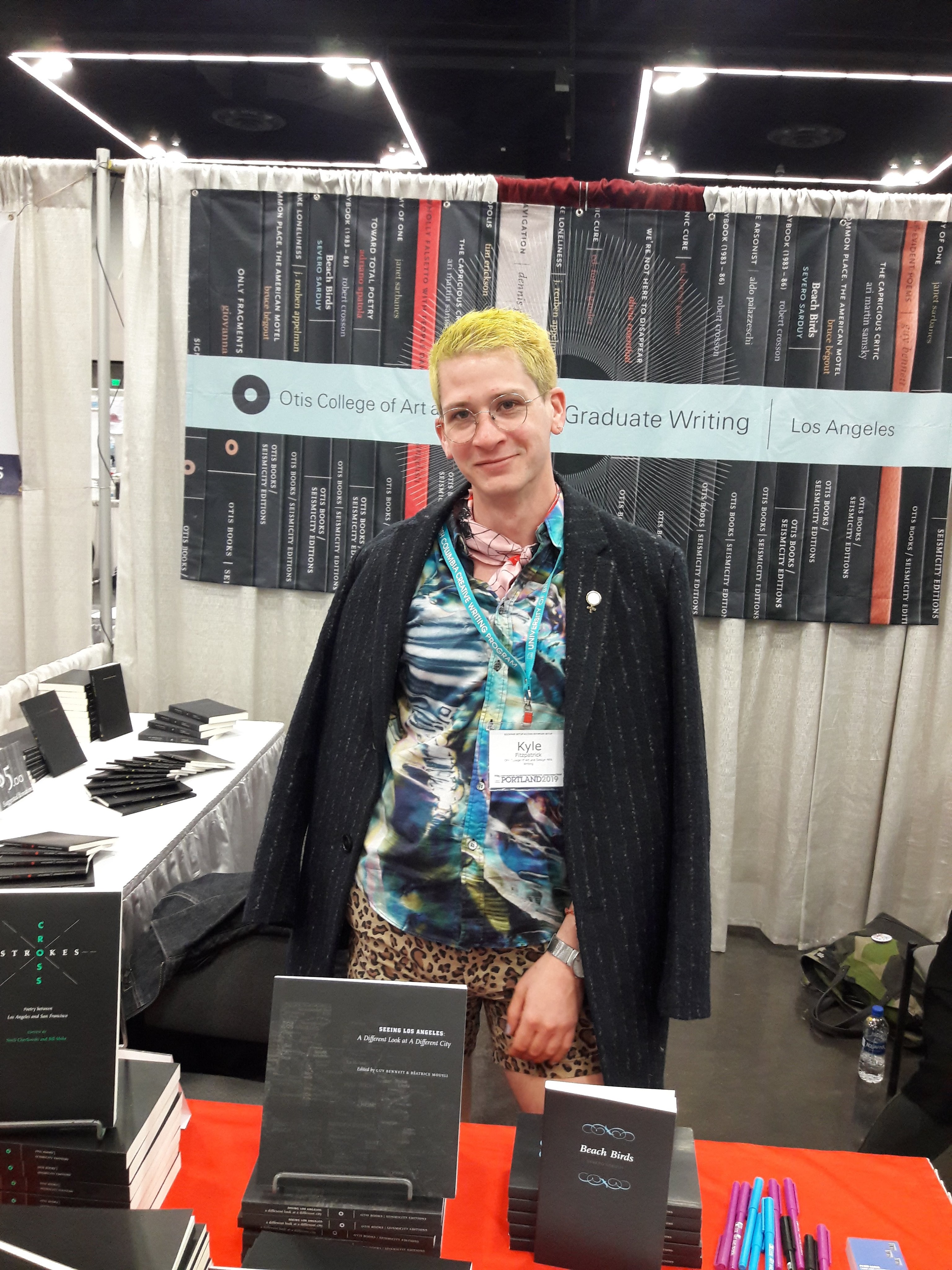
    One of my favorite stops in the book fair was at the table for the Otis College of Art and Design. The college, its main campus in Westchester, is 100 years old, and is located about a mile from where I attended high school, in Playa del Rey, an unnotable fact I shared with Kyle Fitzpatrick, who I visited with for some time, discussing his school, the books exhibited at his table, and what’s happening in Los Angeles these days.

    20190328_134254

    I purchased several of their books: “Seeing Los Angeles: A Different Look at A Different City,” edited by Guy Bennett and Beatrice Mousli; “Swell,” by Noah Ross; and “Proof of Loss,” by Sara Marchant. What sold me on the “Seeing Los Angeles” book was a photo by John Humble, from Shooting L. A., titled “343 Hillcrest Street, El Segundo, May 13, 1995.” My father moved his family to El Segundo the same year the Brooklyn Dodgers announced its move to Los Angeles: 1957. The first house we lived in was at the time one of the oldest in El Segundo, a rental house, an old unpainted wood shingled house, and was located on Hillcrest. It’s of course now long gone, and was located farther north on Hillcrest than the one in the Humble photo. Talking with Kyle, I was reminded of Reyner Banham’s “Los Angeles: The Architecture of Four Ecologies,” now back in print. But I couldn’t recall the title accurately, so there you have it.


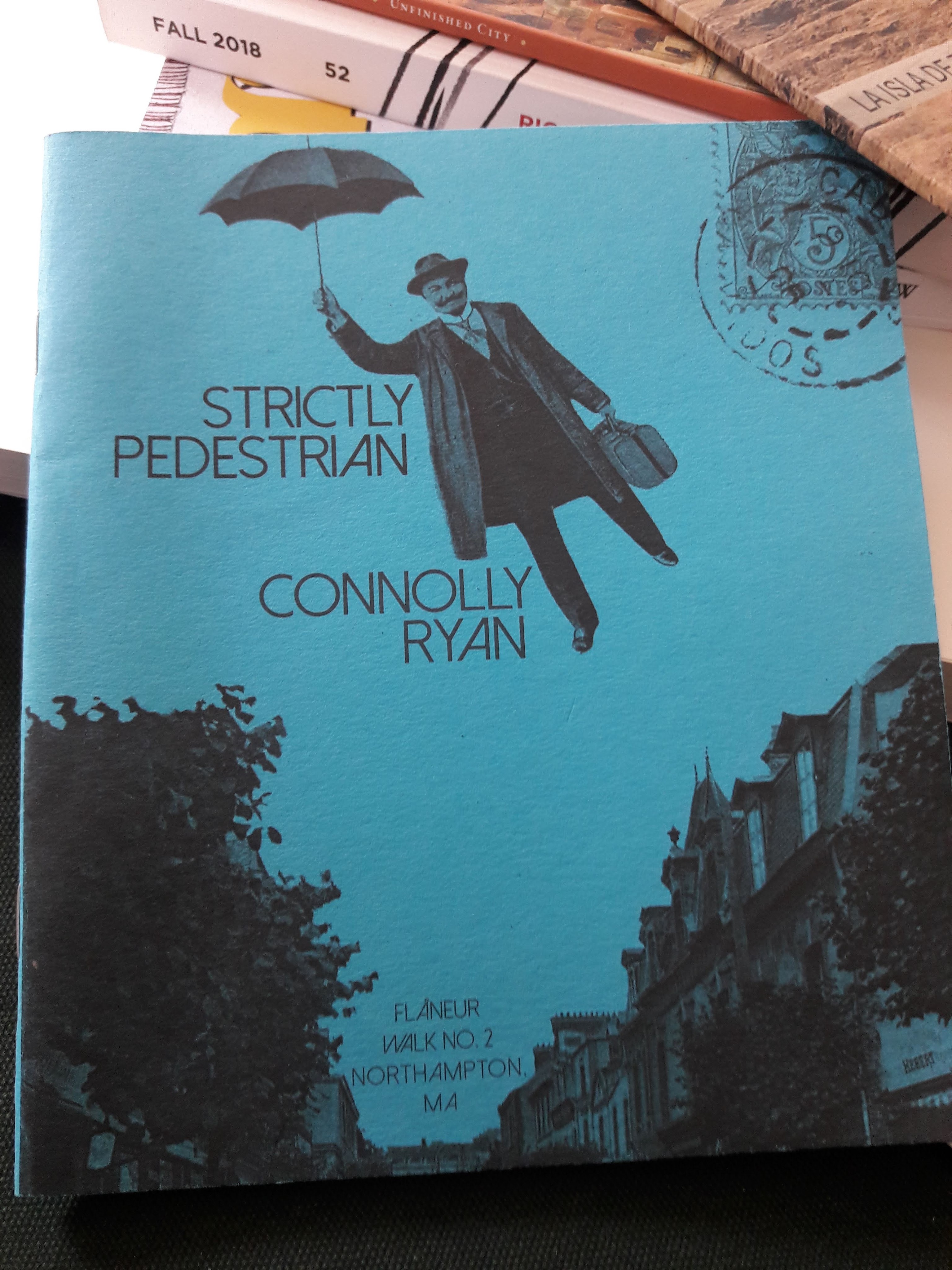
    I met Maria Williams-Russell, editor in the Flaneur Walks Pamphlet Series, put out by Shape Nature Press. By now, of course, I had my meme of the day, and could not leave Maria’s table without buying a copy of “Strictly Pedestrian,” by Connolly Ryan. The book begins:

    “Like all great walks, this one begins in a park.”

    20190329_164338

    I asked Maria to sign the page with her “Editor’s Note,” and she did, but I could tell she thought the signing a bit silly since she wasn’t the author, and I continued my saunter.


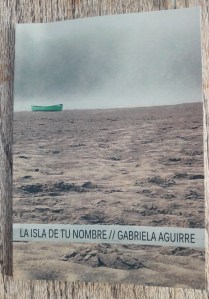
    Back in 1969, I found myself miserably in the Army at Fort Bliss, Texas, which is in El Paso. So I stopped at Veliz Books, sharing space with the Rio Grande Review, of the University of Texas at El Paso. From Veliz, I purchased a copy of “La Ilsa De Tu Nombre,” by Gabriela Aguirre. I talked with co-founding editor and publisher of Veliz, Minerva Laveaga Luna. I mentioned my time in El Paso, and talked some about my time at Portland Community College teaching ESL and ENNL in the late 70’s and early 80’s. There was a professor of the bilingual MFA program at the UTEP sharing the booth – unfortunately, I neglected to note his name, and I can’t recall it. He was a good listener, and encouraged me to continue learning Spanish, which I’ve not studied seriously since high school. And they shared with me their hopes for their work, students, and writers.


    20190329_074245

    Meanwhile, back at the Berfrois table, editor Russell Bennetts was busy explaining his hopes for his own work and writers. He was able to say hello to a few writers he’d not met in person before, including Robin Richardson, whose one page piece in “Berfrois: The Book,” titled “Stockholm Syndrome,” is a block paragraph with no punctuation marks:

    “It was the face it was the width the weight of it” (195)

    Here is Russell meeting Robin. I’m thinking of giving up trying to write altogether and becoming a photographer (amateur, specializing in cell phone pics). But, as Jimi said:

    “I got my own world to look through
    And I ain’t gonna copy you” (“If 6 Was 9”)


    …to be continued. This is the sixth in a series with notes on AWP19 and the concurrent publication of the Berfrois and QM’sT books. I’m reading through the Berfrois anthologies this week and commenting on the writing and the conference as the week wears on.

    20190326_203419

  • Fourth Notes: AWP19, Berfrois10

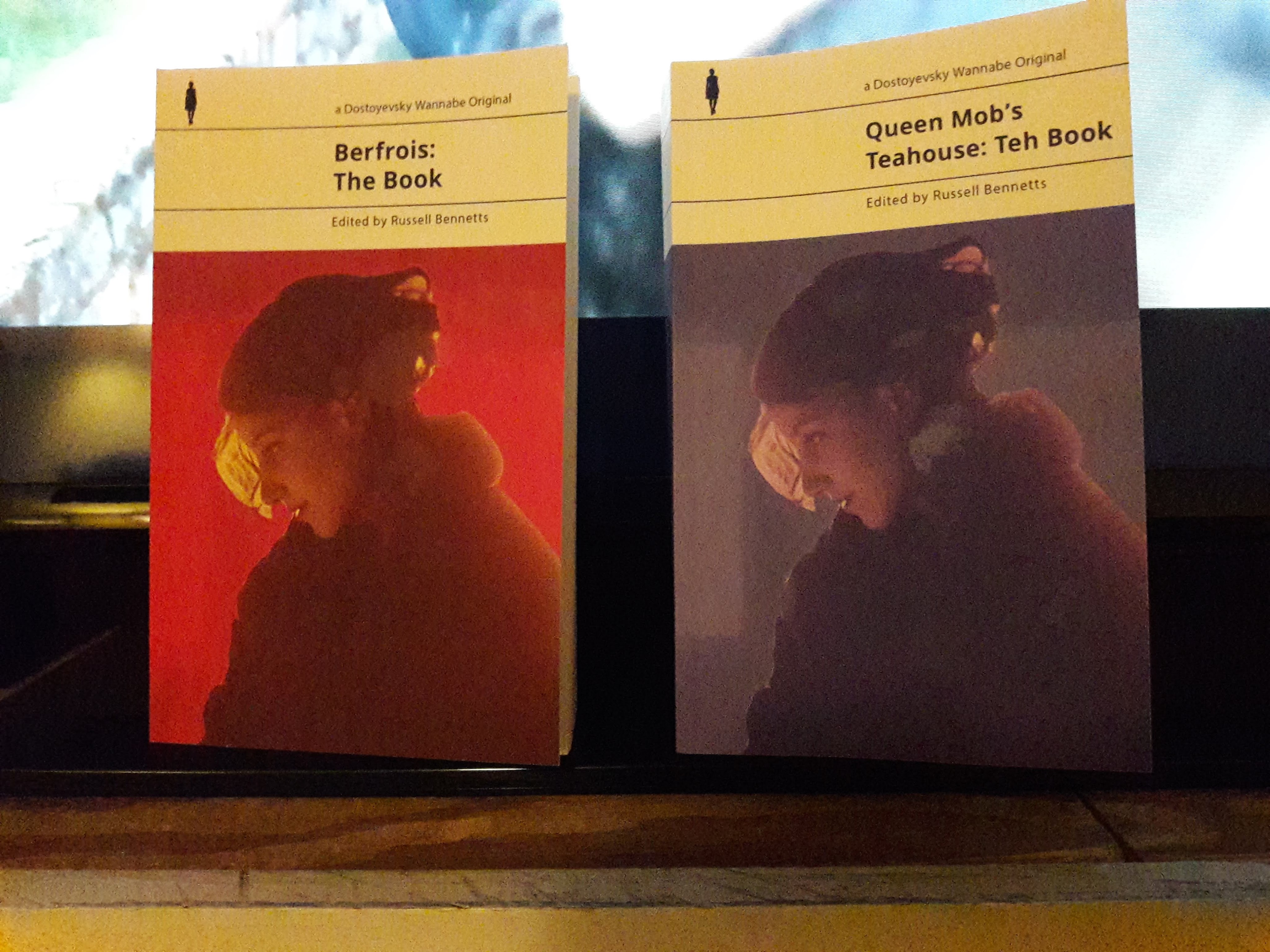
    That title isn’t meant to sound like a sports score. The 19th annual Association of Writers and Writing Programs convention (AWP19) coincides with the 10th anniversary of the online site Berfrois, celebrated these last ten years for its “Literature, Ideas, and Tea.” Berfrois will be at the AWP convention with copies of its recently published books: “Berfrois: The Book,” and “Queen Mob’s Teahouse: Teh Book,” both published under the Dostoyevsky Wannabe Originals imprint of the British publisher Dostoyevsky Wannabe.

    The two hard copy books are anthologies. They include writing by various writers that have written for either Berfrois or Queen Mob’s over the years and more. But the writing in these book print anthologies is new, entirely original, previously unpublished in any form. The writing has not been seen online, nor will it be (except of course for quoted material in reviews, etc.). The books represent a new effort by Berfrois editor Russell Bennetts to engage print, a formidable challenge in this age of Ewriting and Ereading in an Eworld.

    20190326_203419

    “Berfrois: The Book” opens with an interview with Eley Williams. A tone of humor amid chaos is established. There is something new about a Bennetts interview. The questions are creative and often playful and invite similar response.

    A greener piccalilli, You must understand?

    The greater the pucker caused by a pickle
    The greater a succour becomes hot-tongue-tickled (21).

    Speaking of green, author and translator Jessica Sequeira is included in “Berfrois: The Book” with “The Green Pickup: In honour of ST. ALBERTO HURTADO, lay brother of the Society of Jesus & his truck.”

    As I wrote, the anecdotes of Hurtado’s story and his writings and my thoughts about him began to condense into the form of an object, the green pickup belonging to the Padre (78).

    This is how I imagine an AWP book fair browser might engage with the books that will be exhibited at the Berfrois table, paging through, stopping here and there to take a closer look.

    Probably some will stop at the very last piece, a short poem by Daniel Bosch, “Our Apps Demanded: after Hemingway” (387). I wonder if they will pick up on the original, published not quite a hundred years ago.

    Imagine a hundred years of Berfrois, of AWP, and you begin to realize the importance of such things to our times and places and persons. Now think of a hundred years without them, a world barren of literary enterprise of any kind.

    20190326_085952
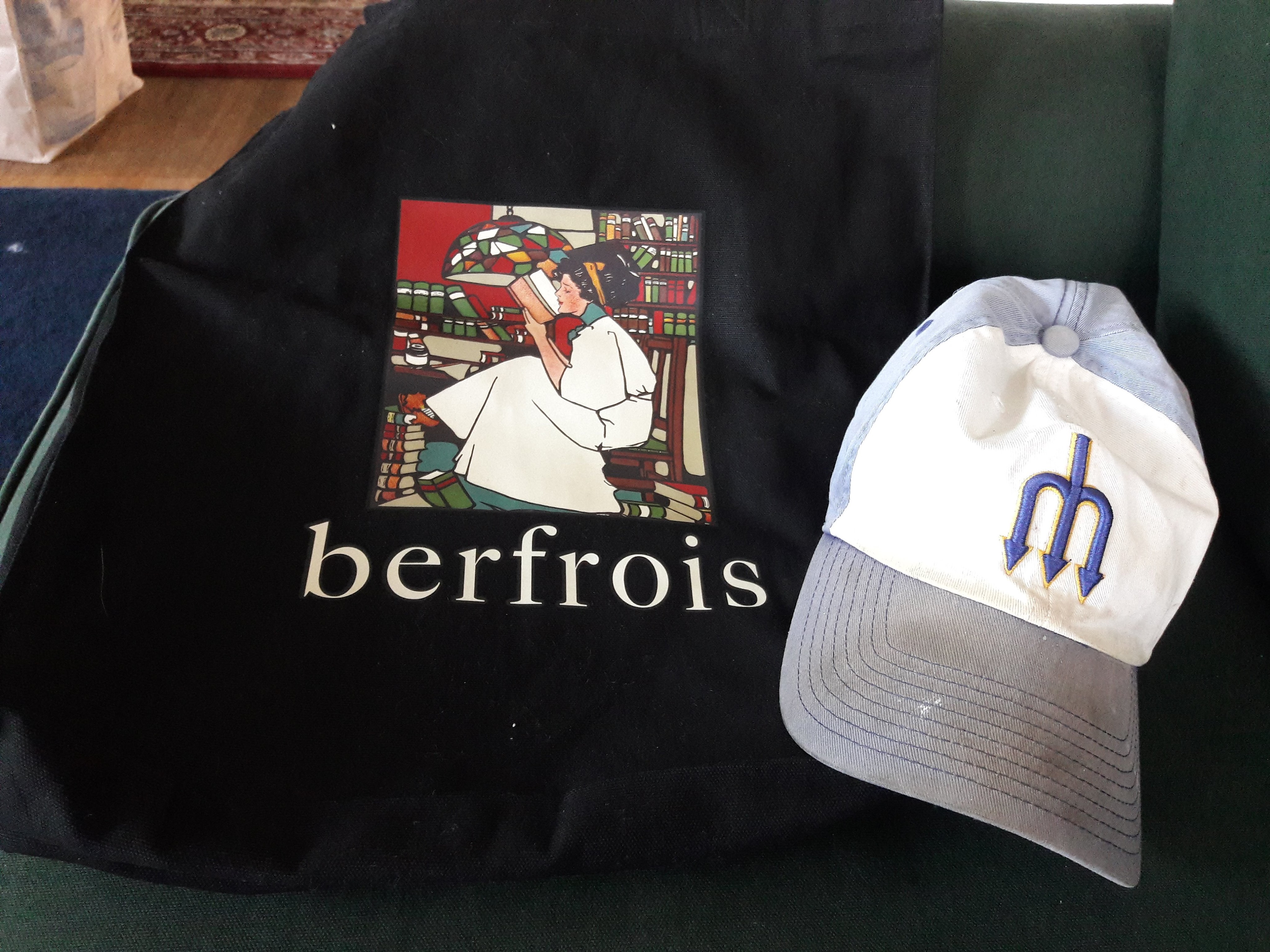
    berfrois tote bag and Seattle Mariners 1977 baseball cap

    This is the fourth in a series with notes on AWP19 and the concurrent publication of the Berfrois and QM’sT books. I’m reading through the Berfrois anthologies this week and commenting on the writing and the conference as the week wears on.

  • Third Notes: berfrois in the Pacific Northwest

    Writing grants access. To what? First, to one’s own thoughts, to one’s own experience. I wrote this; therefore, it happened to me, at least the writing of it did. So I have access to that, to the writing, another experience of the experience, another way to experience the experience. Are you experienced? Narrative becomes mirror, but like mirrors in a carnival funhouse. Writing is a ticket into that funhouse.

    Can anyone write? Does anyone want to? In what has by now become a classic article that appeared in the May 26, 2008 New Yorker, Ian Frazier reflects on the years he spent volunteering at a soup kitchen, offering a writing workshop:

    “Almost everybody who talked to me said they had some amazing stories to tell if they could only write them down. Many said that if their lives were made into books the books would be best-sellers. Some few had written books about their lives already, and they produced the manuscripts from among their belongings to show me. If you take any twelve hundred New Yorkers, naturally you’ll find a certain number of good musicians, skilled carpenters, gifted athletes, and so on; you’ll also come up with a small percentage who can really write. Lots of people I talked to said they were interested in the workshop; a much smaller number actually showed up. Some attended only one session, some came back year after year. In all, over fourteen years, maybe four hundred soup-kitchen guests have participated.”

    We could all of course at least tell of our teeth. Stephen did, wandering wondering what he did:

    “He  took the hilt of his ashplant, lunging with it softly, dallying still. Yes, evening will find itself in me, without me. All days make their end. By the way next when is it Tuesday will be the longest day. Of all the glad new year, mother, the rum tum tiddledy tum. Lawn Tennyson, gentleman poet. GIA. For the old hag with the yellow teeth. And Monsieur Drumont, gentleman journalist. GIA. My teeth are very bad. Why, I wonder. Feel. That one is going too. Shells. Ought I go to a dentist, I wonder, with that money? That one. This. Toothless Kinch, the superman. Why is that, I wonder, or does it mean something perhaps?”

    Today is Tuesday, and AWP19 setup begins tomorrow. We’ve to move the “heavy” boxes of “Berfrois the Book” and “Queen Mob’s Teahouse, teh Book” from distribution depot closer to the Oregon Convention Center to coordinate the retail flow that will surely follow Thursday with setup complete and the Bookfair opens. The rain has let up today. The sun is out, the sky blue. Good weather for moving books. Don’t have that problem on line. Move books anywhere, anytime, instantly. Nice to have something physical to do though, lay the hands on. Honest labor. Meanwhile the travels and travails of today’s Portlanders continues, as one generation slows down and another honks its horn, stuck in traffic.

    What is Portland famous for? A question I was asked yesterday. Vanport. Jazz. Homelessness. The Attic Institute: A Haven for Writers. Street Potholes. Neighborhoods, sitting out, libraries. Coffee houses, pubs. Powell’s Books. Dentists? Not so much. Marijuana dispensaries:

    “The chemist turned back page after page. Sandy shrivelled smell he seems to have. Shrunken skull. And old. Quest for the philosopher’s stone. The alchemists. Drugs age you after mental excitement. Lethargy then. Why? Reaction. A lifetime in a night. Gradually changes your character. Living all the day among herbs, ointments, disinfectants. All his alabaster lilypots. Mortar and pestle. Aq. Dist. Fol. Laur. Te Virid. Smell almost cure you like the dentist’s doorbell. Doctor Whack. He ought to physic himself a bit. Electuary or emulsion. The first fellow that picked an herb to cure himself had a bit of pluck. Simples. Want to be careful. Enough stuff here to chloroform you. Test: turns blue litmus paper red. Chloroform. Overdose of laudanum. Sleeping draughts. Lovephiltres. Paragoric poppysyrup bad for cough. Clogs the pores or the phlegm. Poisons the only cures. Remedy where you least expect it. Clever of nature.”

    Writes in his head, does Bloom. Blooming thoughts. Should have been a writer. Too cryptic. Where does the intellectual meet the body? In the mouth:

    STEPHEN: See? Moves to one great goal. I am twentytwo. Sixteen years ago he was twentytwo too. Sixteen years ago I twentytwo tumbled. Twentytwo years ago he sixteen fell off his hobbyhorse. (HE WINCES) Hurt my hand somewhere. Must see a dentist. Money?

    This post is the third in a series with notes on AWP19 and the concurrent publication of the Berfrois and QM’sT books. I’m reading through the Berfrois anthologies this week and commenting on the writing and the conference as the week wears on. Sumana Roy had a nice write up in the Mumbai Diary following news of Berfrois books. She gives great Kudos to Berfrois editor Daniel Bosch. Now there’s a writing workshop!