Category: Poetry

  • The Man With the Blue Guitar

    The Man With the Blue Guitar

    The guitar, given the day would be green, could not have been any other color. The sky would blaze orange when the guitar mixed its sounds with the day.

    Wallace Stevens was not a poet born in squalor, though he would have savored the metaphor. He was schooled and trained as a lawyer and spent his working life with Hartford Insurance where he rose to be a Vice President of Claims.

    One day, one of his colleagues entered his office with a book of poems Stevens had apparently written. That Stevens was a poet was not well known inside the insurance setting of his day job. He often walked to work, a route which took him through a local park, and he composed in his head as he walked. Stevens, his colleague exclaimed, holding forth his book, you’re a poet! But what does it all mean? Never mind, Stevens replied. You are far too literal.

    Like houseplants, Poetry can pose dangers. A reader might contact some sort of chemical dermatological poison just by holding a book of poems in his hands. The cautious, casual reader might want to wear gloves and put on a pair of solar eclipse glasses.

    Because the man with the blue guitar drifts afar:

    The man bent over his guitar,
    A shearsman of sorts. The day was green.
    
    They said, "You have a blue guitar,
    You do not play things as they are."
    
    The man replied, "Things as they are 
    Are changed upon the blue guitar."
    
    And they said then, "But play, you must,
    A tune beyond us, yet ourselves,
    
    A tune upon the blue guitar
    Of things exactly as they are."
    

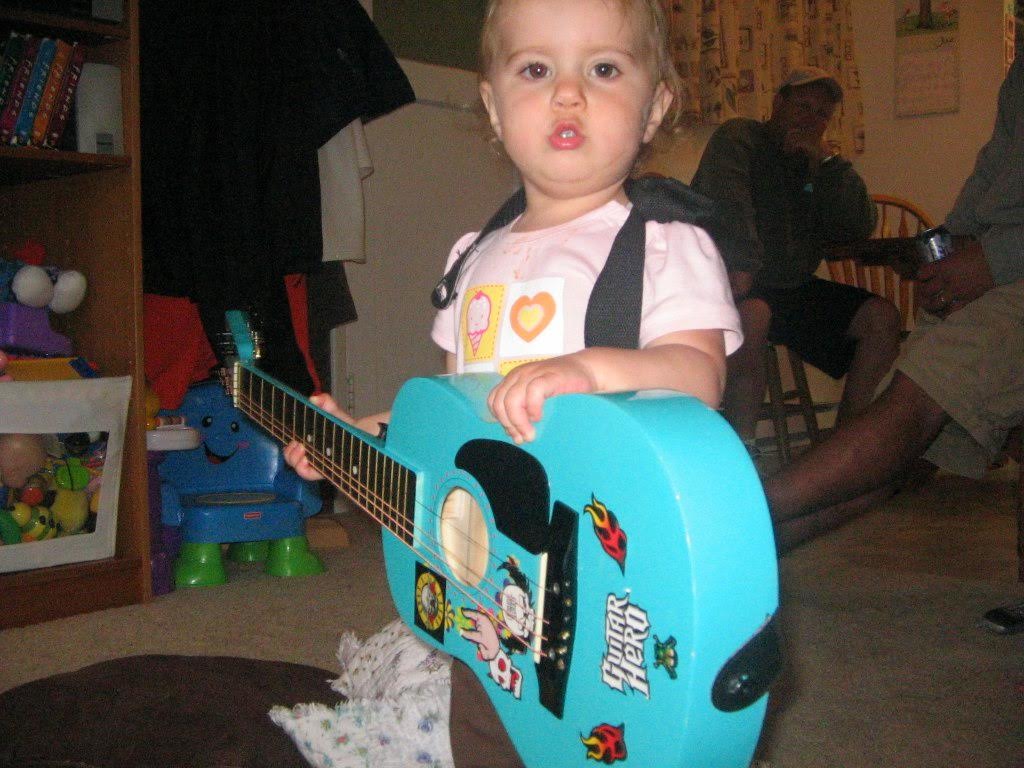
    Quote from “The Man with the Blue Guitar,” by Wallace Stevens. Pictured: A Baby with a Blue Guitar.

    Speaking of guitar, I’ve struck up a live at 5 (PST) guitar gig evenings on Instagram. Random, improvised, distractions. Check it out here.

  • The Poet’s Tale

    The Poet’s Tale

    The poet is born in squalor, his first love. Some of the poet’s favorite words include seedy, shabby, seamy. These are words made with a hissing sound. In phonics, that sound is called a sibilant, and is produced by forcing the tongue toward the teeth, with the lips near closed, forcing air out like a snake whistling. But opposite words are equally valued by the poet: classy, stylish, exclusive. Even if the reader uses words without really caring about words as such much. The poet is not primarily concerned with getting a point across, and is held harmless if some point hurts its object in the bargain, even if so much the better. If an annoying sound appears to sharpen the point, there’s value added. The poet is in love with words.

    But it’s easy to confuse poetry with sarcasm, satire, or irony. And the true cynicism of poetry often gives way to stoicism. This may occur when the poet realizes there is no point to anything, including his own poetry. Innuendos may still be highly valued (particularly where points may be scored), for all words have their beginning in figures of speech, which is to say, metaphor. That is precisely what an eye for an eye and a tooth for a tooth is meant to solve. Words disallow mistake when artificial trade-offs are refused. But language is no place for despots, try as they might to exert control, to establish absolute authority. Who controls the movement of words over space and time?

    Words are all substitutes. No one can claim dominion. One is as good as another. Language is democratic. And that is why the poet is married to shame, his own mother, at once virgin and harlot (that is to say, vagabond, a beggar for words). In a truly democratic society, where everyone is equal and all words hold common sway, and competition without compromise is useless, it may begin to appear the only way to have a-leg-up-on is to attempt to subject another to shame. But shame has never worked as a measure of control. And that is why poetry can be so hard to get, and why hard times come so often to poets.

    The poet stands accused of nothing and nonsense. His love of words and sound and color is scorned and mocked. He is the scapegoat for confusion.

  • Weeds in the Garden of Truth

    Weeds in the Garden of Truth

    Browsing the occasional poem or two every now and then found in a magazine or tripped over somewhere online is a different experience from reading a handheld book of poems straight through as if it were a novel. Even if most books of poems are collections of pieces previously published in magazines or journals, added to those poems a few new ones, so the purchaser of poetry feels he’s getting his money worth. Not always; some books of poems appear like a wildflower meadow suddenly erupted bloomed in one’s untended backyard.

    A friend of mine, a true lover of poetry, a man of poems, who believes in transcendence by the word and the divine mystery at the heart of the rebirth of all things, but is not, therefore, make no mistake here, necessarily a poetry churchgoer, recently gave me a large bin and a bag of books, most of them poetry books. He and his wife are culling, a new pandemic leisure pastime.

    Around the same time, I watched some neighbors carrying two of what appeared to be bookcases out to the curb in front of their house. In our neighborhood, such culling is a call for first come first served of items no longer of use or interest to their owners but with such value still probably somebody will swing by and pick them up.

    One couldn’t, or shouldn’t, do such with an old couch or bed mattress, of course. Someone would call the local no-dumping-here police and you’d soon have a ticket for littering and who knows how many other violations of municipal ordinances one might be prey or heir to.

    In any case, the neighbor’s bookcases didn’t last long at the curb. I mentioned to Susan the new development, and the next thing I knew I was carrying the two said bookcases into our house. One was temporarily temporary, because another neighbor also had had an eye on it, and it seemed only fair to share a giveaway, but it was subsequently decided she had no room for it, while Susan wanted to give it to Eric. So it sits empty, in Eric’s old, empty room, awaiting removal to his new digs, a change of venue which might have to wait out the pandemic.

    The other of the two bookcases is now fitted snugly up against the back of the living room couch, waiting to see what will appear on its shelves. Not, necessarily, books. Recently, Susan asked me what she should do with my books after I die, “burn them, or bury them with you”?

    I’ve another friend who claims to dislike poetry. He doesn’t understand poetry, he says, and, anyway, poems don’t do anything for him. Why anyone would feel such a statement necessary I don’t know. Something about a bad teacher he once had. Of course, only a very few like poetry. But poetry is such an easy target for the meanstruck cynic bent on pulling the weeds from the suburban lawn of literature. But such blanket statements are made with a sentiment similar to the neighbor who covers his lawn with chemicals to kill the weeds, the moss, the quackgrass. I hate weeds, he might say. Of course, only a very few like weeds. And those, not trying to cultivate a lawn.

    I’ve decided to let our yard grass grow. When we moved in, but that was over thirty years ago now, the yard might still have had what might have been called a lawn. Then came the successive summers of drought when the municipality banned the watering of lawns. The grass returned to its natural habit of turning brown like hay in the late summer, dying back, but quickly recovering its green when the rains returned in the Fall. I continued to go through the motions of mowing as the green stuff reached a certain height during the Spring, but it would be presumptuous and pretentious to call what it is now a lawn.

    In any case, the pandemic strikes us individually, it seems, such that some of us cull while others let stack up. Me, I’m letting my yard grass, and whatever else the yard might contain, grow. This is not to say without some thought and design. I was recently reading again about how the US suburban lawn grew into a values game, how clover came to be considered an evil, how more harmful chemicals were gradually poured annually into lawns than into agricultural hectares. And what one might do about it.

    Take the lawn out, of course, as many of our neighbors have been doing for the past few years, and put in native plants, grasses that don’t need much water, fruit trees, raised beds, vegetable or flower or herb gardens. All of which we’ve done some, hit and miss, with receding lawn grass space. It’s just a yard, one of many. But I’d like to think that to a few birds and bees flying over, it’s an open invitation to a safe landing zone. And I’d like to think of the yard as a poem, inviting its critical readers, passersby, to tarry, wondering what it’s all about, what it means, looking for a design.

    But like the abandoned mattress put out to a curb, there are municipal curbs on what one might do with one’s yard. To wit, locally, grass may not be let grow longer than twelve inches tall. My gardening plan is to let my yard grow (and everything else that might be in it) until around mid-July, when it begins to die back naturally, and then cut it. And cut again once or twice in the Fall, and see what comes up next Spring. Likely, more of a meadow, a wildflower kind of meadow would ensue, if properly left alone. If one applies no rules, save that of not cutting. You mean a field of weeds, the cynic replies, like in an abandoned lot.

    Yards, the keeping and maintaining of yards, the cutting and trimming and reading of lawns and grasses, are, after all, like poems. Some poems are like putting greens, mowed as short and as tight and flat as the flattop of your father’s Fifties barbershop cut, with just a bit of an edge held up by a touch of jell above the forehead, a tiny wave, a ringlet no breeze will disturb, no bird or rodent will nest in. Other yards are like the beehive hairdos or the bebop poems of around the same era. We get disparate yards and poems, no two exactly alike, yet we do find types: the suburban lawn poem, all the weeds pulled or killed with poisons, really the rulebound cynic out to make a point; the wildflower meadow poem, really the lazy man’s excuse for trading in the mower for a new chaise lounge where he can kick back with a beer and read a few poems in the shade of a summer’s day, surrounded by the soft call of the wild neighborhood bugs, undisturbed by the local cat creeping through the high grass, looking for a quiet place to nap. He too will nap, this new anti-lawn man, his book of poems fallen from his lap into the tall weedy grass.

    A poem, Robert Frost said, is a momentary stay against the confusion of the world. True, no doubt, for his own poems. But what of the poems that seem a momentary departure from the sanity of the manicured lawn? Or at least from the trim and clean look of the cut yard, the heads of all the weeds whacked off?

    The cynic wants to understand everything, and when he comes across something he can’t seem to get, or gets no immediate pleasure or reward from, he declares it presumptuous or pretentious or fraudulent. And the casual reader begins to think, fallacy of false dichotomy, that there are but two kinds of life, two kinds of yards, two kinds of poems, and one gets by in life only by pulling weeds from the garden of truth.

    But, at risk of ending the post too aphoristically, truth is weeds.

    And weeds is poetry.
  • “end tatters” 1st Review, and a Cover Revision

    “end tatters” 1st Review, and a Cover Revision

    The first review of “end tatters” is in, received via cell phone text:

    “Finished End Tatters; especially liked About Confusion, Bells, and To Surf, which I hope to do this morning. Milk made me very sad. Waiting for your next novel. Alma and Penina my favorites.”

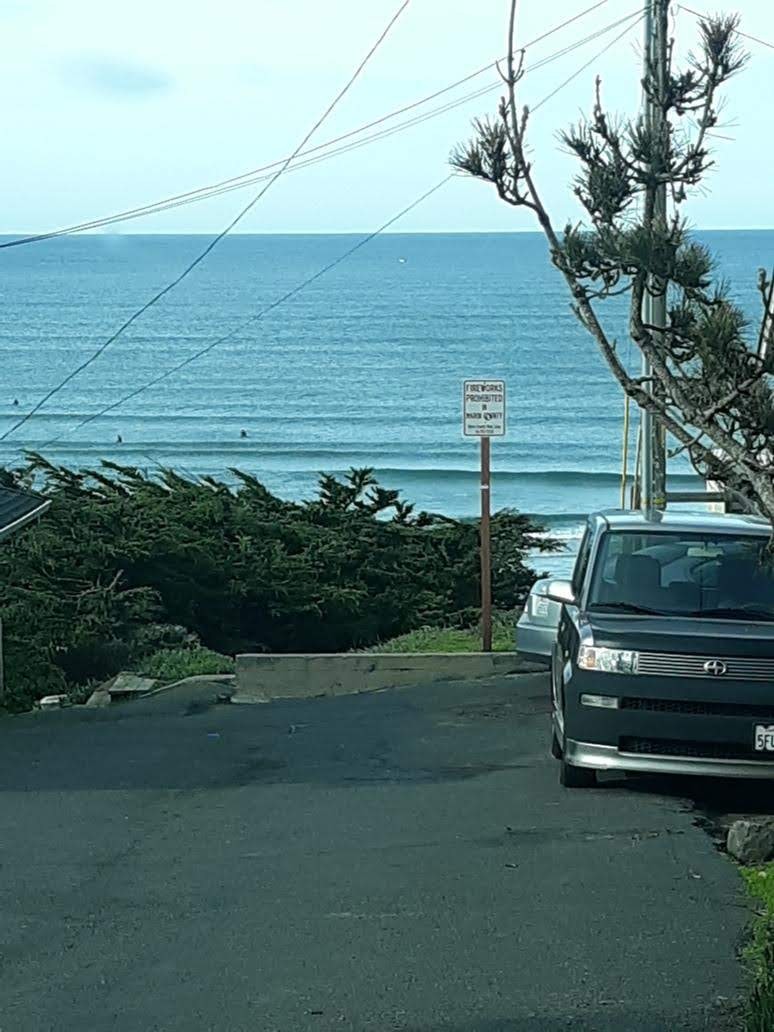
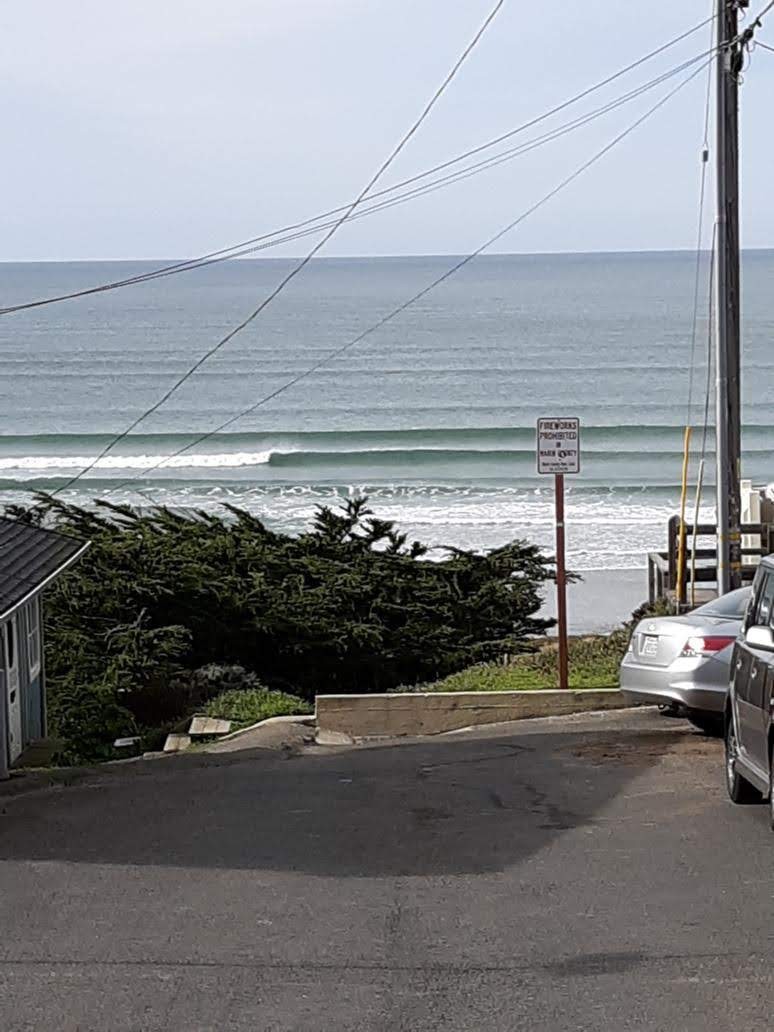
    To drive down, stop, and check out surf spots at the end of a beach town road is part of surfing. A second text from our first reviewer came in that evening, with a couple of pics and a note that he had made it into some waves:

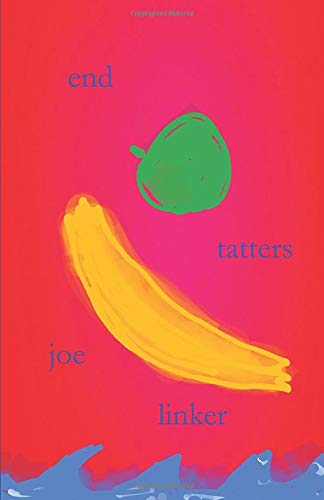
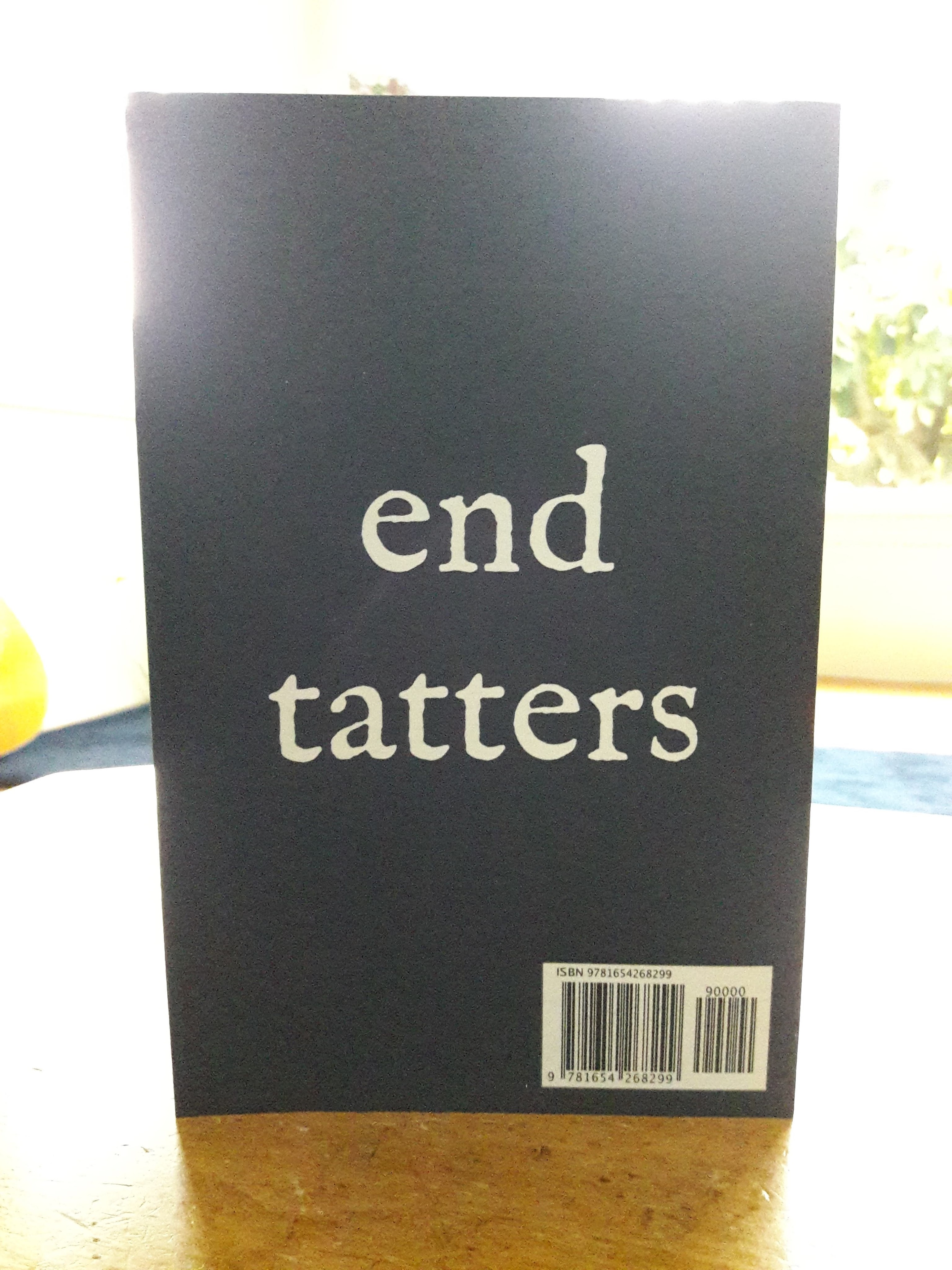
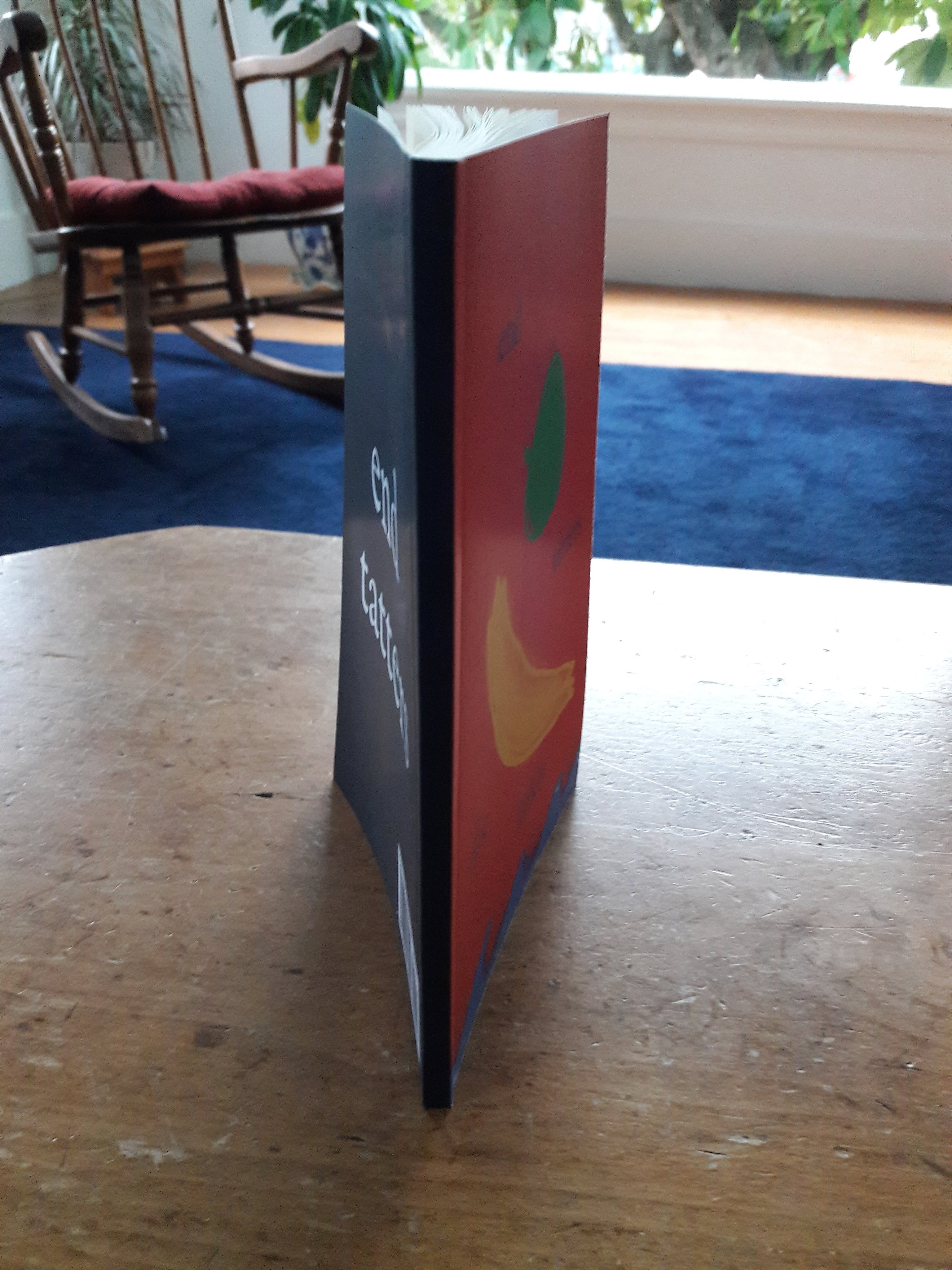
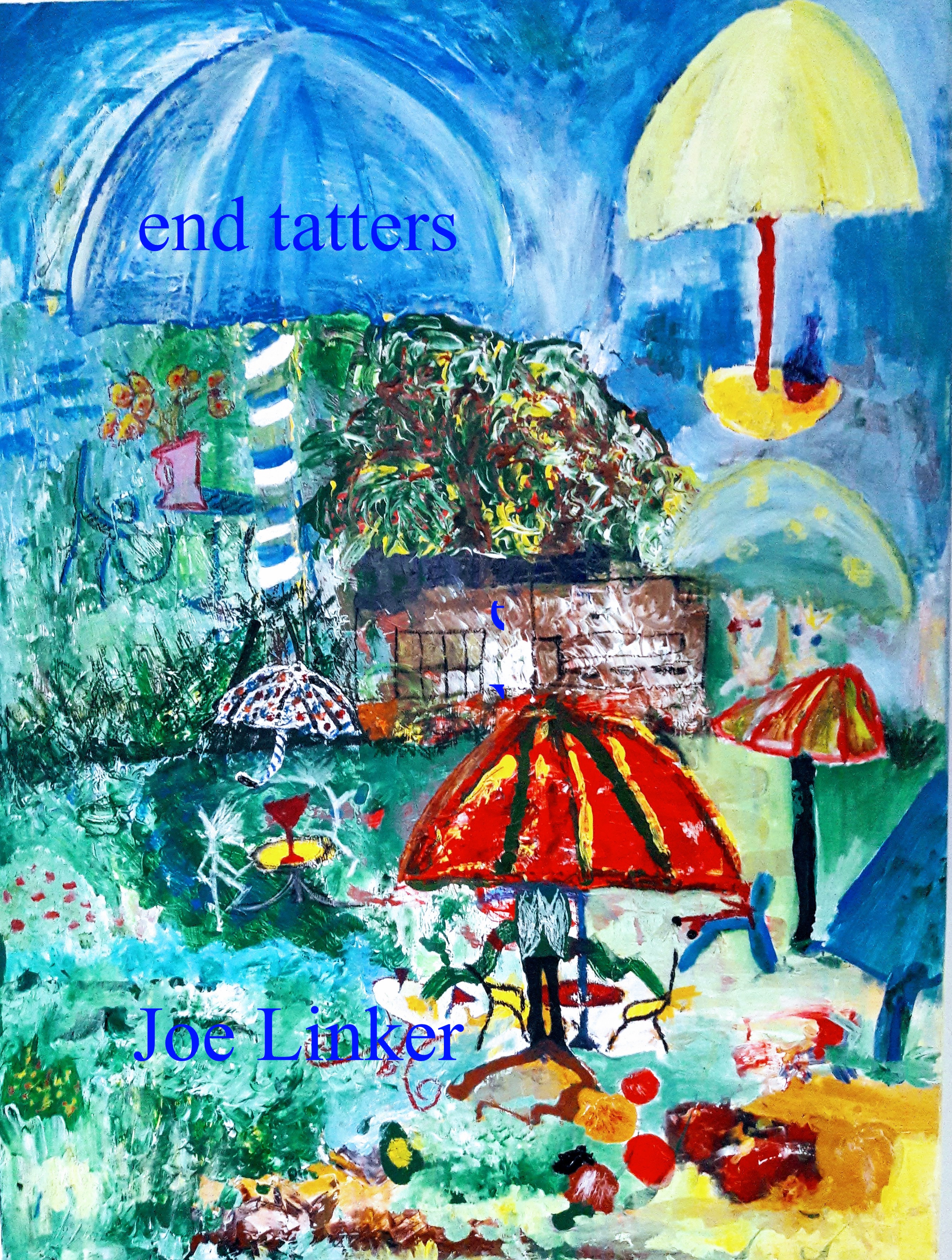
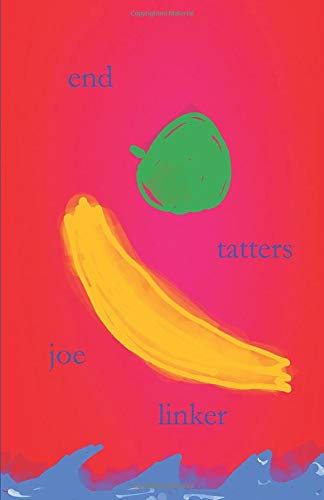
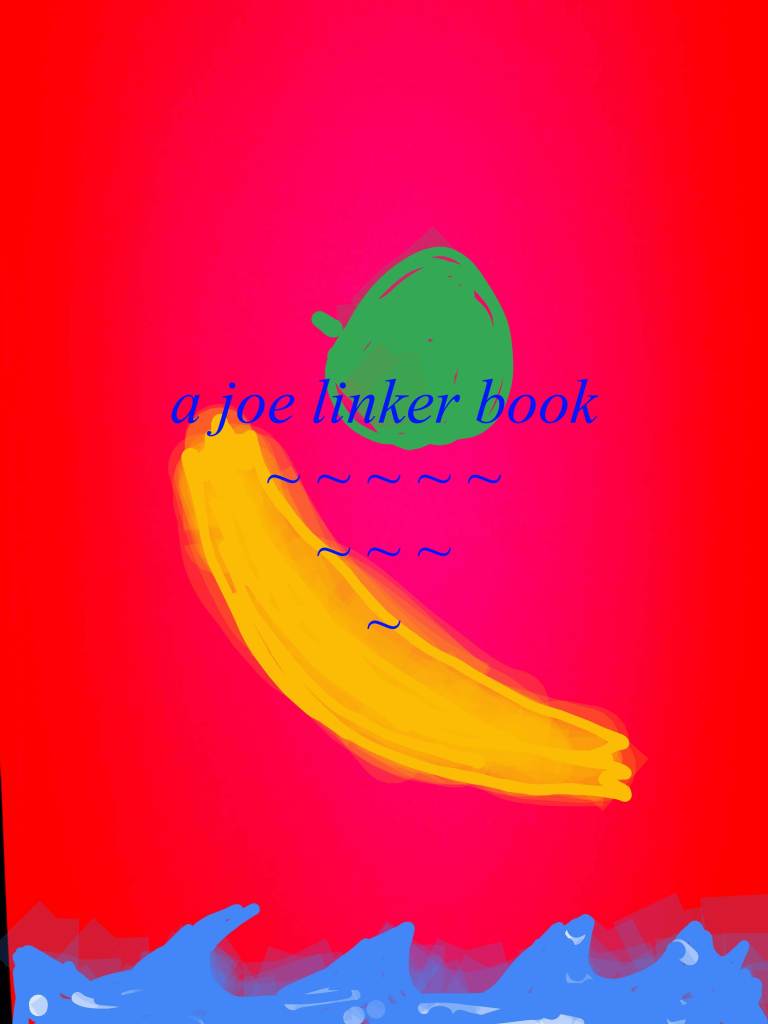
    Meantime, still not entirely satisfied with the “end tatters” cover (having already made several changes pre-publication), I made a post-publication cover revision. Copies sold with the blue back cover are now considered to have some increased value for collectors. New cover photos below:

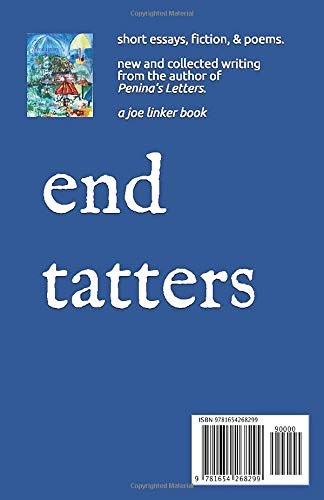
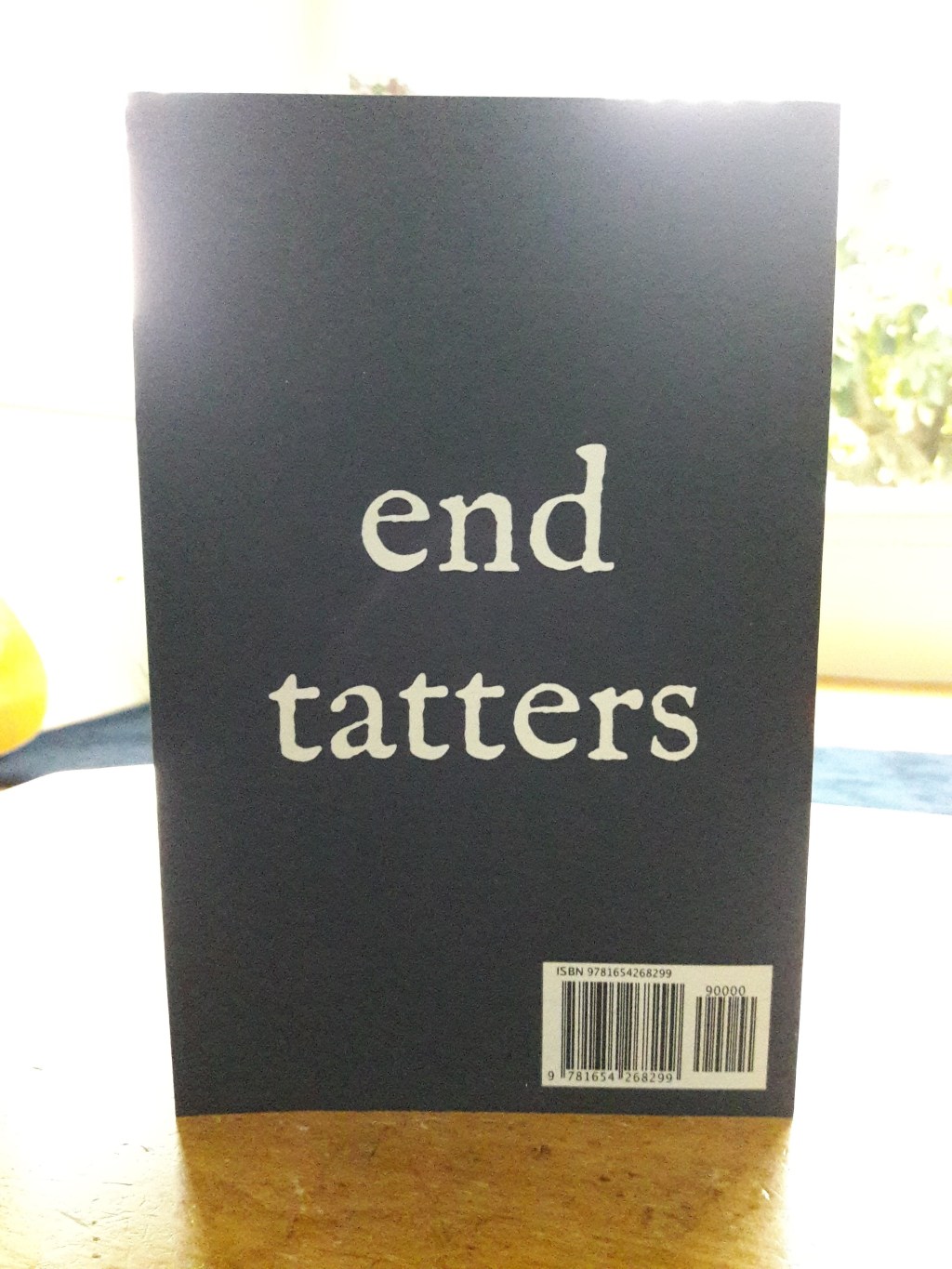
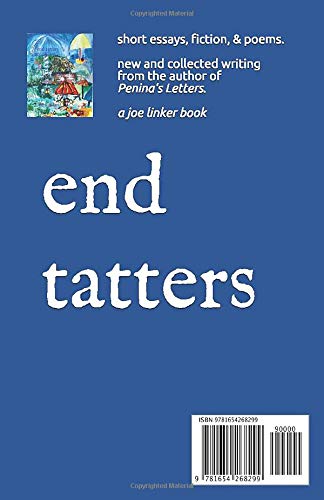
    Original back cover shown below:

    Go here to order your copy. Write a review and send it to thecomingofthetoads @ gmail dot com, and I’ll post it to the blog.

  • About “end tatters”

    About “end tatters”

    “end tatters” is now available in paperback. I don’t intend an e-book version. As indicated on the copyright page, “Some of the End Tatters pieces previously appeared, some in different form, in these publications: Berfrois; Berfrois: the Book; Queen Mob’s Teahouse; Sultan’s Seal: The Hotel Cosmopolitan; One Imperative; and The Coming of the Toads.” The book does offer some new pieces also, though, so it collects previously published and new pieces. My primary purpose in publishing the book in paperback form is that I wanted to save, on paper, a number of pieces a bit scattered on-line, while I had some new pieces I wasn’t sure what I wanted to do with. Besides that, I enjoy making books, reading books, collecting books.

    Distributing and selling indie books is a different matter. Even giving them away does not at all ensure they’ll be read. Nevertheless, I’ll be giving away a few copies of “end tatters” to innocent bystanders. So be on the lookout.

    With “end tatters,” I’ve attempted a kind of imprint, the somewhat clumsy, perhaps, “a Joe Linker book.” Below, we see the “CONTENTS” page:

    CONTENTS

    Bells…11
    Milk…17
    Trees…23
    This and That…25
    Taking the Call…27
    Nativity Scene…33
    In One’s Dotage…45
    Divine Comedy…47
    To Surf…49
    About Confusion…57
    Epiphanic Cat…67
    The Tyger…69
    Wealcan…71
    Horny Theology…88
    Withdrawal…91
    Cliff Notes…93
    Vintage…95
    In Transit…97
    Cricket…99
    Remaindered…101
    Typewriter…103

    And a bit more info. for this post, with some pics:

    Product details

    • Paperback: 105 pages
    • Publisher: Independently published (January 8, 2020)
    • Language: English
    • ISBN-10: 1654268291
    • ISBN-13: 978-1654268299
    • Product Dimensions: 5.5 x 0.3 x 8.5 inches
    • Shipping Weight: 6.7 ounces
    • Average Customer Review: Be the first to review this item
  • In Print: “End Tatters”

    In Print: “End Tatters”

    “Do you want this book published,’ he asked, ‘or just printed?” Said Angus Cameron (editor at Little, Brown) to J. D. Salinger upon learning Salinger wanted no advertising of his forthcoming “The Catcher in the Rye.” Particularly, and peculiarly, from the publisher’s viewpoint, J. D. wanted no author’s photo on the cover (Ian Hamilton, In Search of J. D. Salinger, 1988, Random House, p. 115).

    How to launch a book? Advance review copies. Interviews. Author’s book tour. Live readings. Ads in trade journals. Book store displays. Billboards on Sunset Boulevard and in Times Square.

    Like Salinger, though they’ve actually few if any other options, the indie writer/publisher eschews the traditional publicity stunts ahead of book store distribution for a blog post or two.

    This is the second in a planned series of posts designed with the usual blog accompanied by tweet fanfare to launch, from the author of “Penina’s Letters,” a new book, titled “end tatters,” coming this week. Below, we see the front and back covers, and the back gives a brief description of what’s inside:

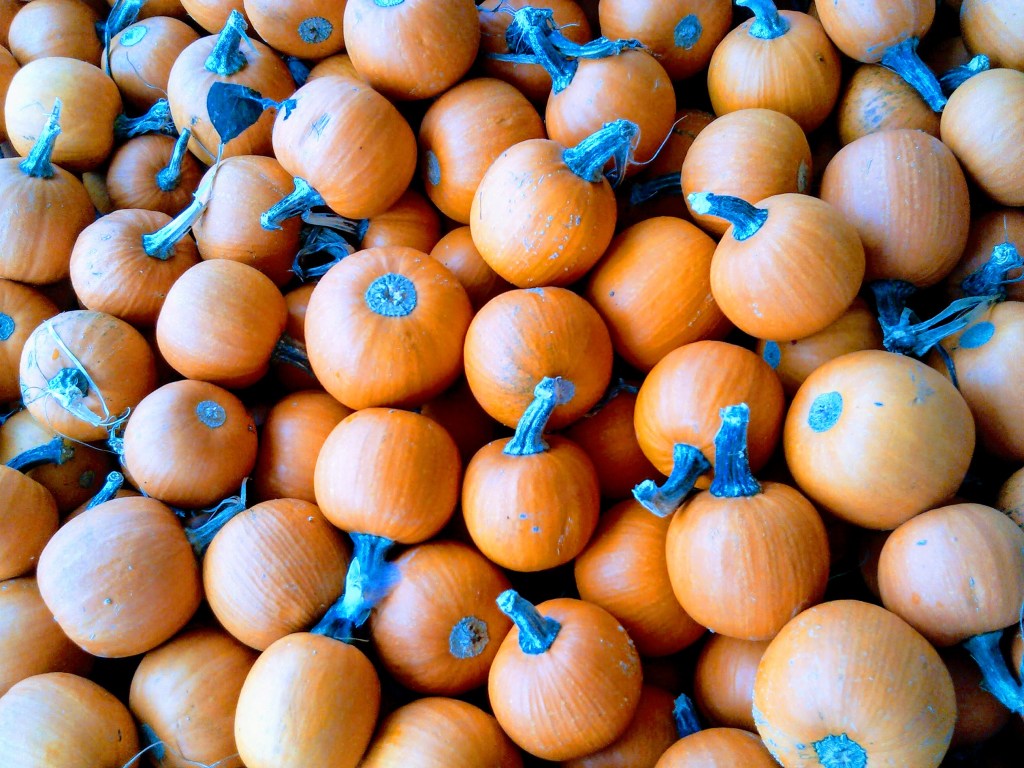
  • A Modest Halloween Proposal

    A Modest Halloween Proposal

    It sometimes seems clear if there is an afterlife it does not interfere with present life. But what is present? The light from our sun is already a little over eight seconds old. We sunbathe in the past, confident in a present we never quite seem to fully inhabit (physics explains it’s perfectly possible to split infinitives). Where then do we go? Maybe time is a question of physics, maybe of metaphysics – the things that may come after the physics.

    The dead seem an extremely polite bunch. They do not intrude. Looking for them is like searching for aliens. We may feel their presence, approach them with the telescope of faith, but if they exist, somewhere-somehow, that life lies far far beyond the present five senses. To prove an afterlife, if we want to believe in ghosts and such, we must create a sense beyond our given five.

    William Blake noticed angels out and about. Rilke claimed to have seen one. What is it about poets that make them easy prey for such notions? Wouldn’t it be a bit frightful if the first aliens the astronomers discover turn out to be previous earthlings? The problem with communicating with the dead may simply be the length of time their message takes to reach us. By the time the first message from the first dead reaches Earth, we may all be gone. What would the message say? Trick or Treat?

    I take no issue with the dead. Nor am I looking forward to meeting any aliens. Let them keep their distance. My problem seems to be sugar: to wit, candy – the Halloween tradition (in these parts).

    This year, instead of passing out candy, I propose to hand out poems. Short poems printed on three by five cards, maybe with a cartoon or drawing on one side of the card. I’ll drop a poem card into every little critter’s Halloween basket. No candy. No sugar.

    But when I mentioned the idea to Susan, she said, “We’ll get our house egged for sure.”

    “You think? With the cost of dairy these days?”

    “And the parents will accuse you of poisoning their kids with poetry. Besides, Halloween cards are nothing new. And poetry, while sugar free, is still very high in carbs and calories, not to mention saturated and trans fats.”

    So much for my proposal. I guess we’re sticking with candy.

  • Bells, part 3, Relax

    We should probably be wary of statements beginning with the pronouncement, “Never before, in the history of the world….”

    Nevertheless, given our current world predicament, we might find ourselves in need of some relaxation – seemingly, like never before.

    In his little book titled “How to Relax,” the monk Thich Nhat Hanh begins:

    “You don’t need to set aside special time for resting and relaxing. You don’t need a special pillow or any fancy equipment. You don’t need a whole hour. In fact, now is a very good time to relax” (page 6, “How to Relax,” Parallax Press, 2015).

    The same might be said for writing. You don’t need a fancy machine, a special desk or pen, or even a purpose. What you need – is a bell.

    “There is tranquility, peace, and joy within us, but we have to call them forth so they can manifest. Inviting a bell to sound is one way to call forth the joy and tranquility within” (page 100).

    Thich Nhat Hanh gives us a poem to remind us of the bell we want to listen for, to hear, to send out to others:

    “Body, speech, and mind in perfect oneness,
    I send my heart along with the sound of this bell.
    May all the hearers awaken from forgetfulness,
    and transcend the path of anxiety and sorrow” (page 100).

    And we don’t need a fancy blog template or website to write. Again, nevertheless, here at The Coming of the Toads, I’ve experimented with a few of the WordPress templates over time. But what did I want, if not simply to write? This isn’t the only place, the only way, I write. I keep a pocket notebook in the left rear pocket of my pants (detail for readers in need), unlined because I like to doodle and wander. I keep a spiral notebook in a desk drawer. I started The Coming of the Toads, after a few hesitant starts, in December of 2007, and have posted something at least monthly since. Why then, lately, have I been having thoughts of ending it?

    I wasn’t “inviting the bell.” Not Poe’s “the tintinabulation of the bells,” nor his “anger of the bells,” nor his “moaning and the groaning of the bells.” But the bell of the muse. I like this etymological note from Oxford: “Middle English: from Old French muser ‘meditate, waste time’, perhaps from medieval Latin musum ‘muzzle’.” Writing involves a good amount of self-muzzle, or should. First, we might want to relax. Invite the bell. Then take up the pen and notebook, or open the blog.

    This is the third piece in a series on bells at The Coming of the Toads.

  • What Goodness Knows: Ed Simon’s “Furnace of this World; or, 36 Observations About Goodness”

    When Mark Twain’s Huck decides to help Jim, an illegal immigrant of his time, a runaway slave, Huck believes he’ll go to hell for his goodness. Huck knows that by helping Jim escape he’ll be breaking the law. He’ll bring the wrath of local public opinion so forcefully down upon his head, this time it’ll probably fall off. He feels good, though, having sat down and thought it out and making his decision to help Jim with deliberation and good reason. Huck does not argue that he should not go to hell for helping Jim.

    Central to Ed Simon’s 100 page immersion in goodness is a discussion of Judas, who betrayed Jesus. It’s a little forced, but the idea is that without the betrayal, Jesus can’t save the world. One would think the Grand Master of Plots would come up with a work-around if Judas doesn’t cooperate, but we get the idea. Out of this betrayal, for which Judas knows he’ll go to hell, where his 30 pieces of silver won’t buy him much of anything, comes the sacrifice to end all sacrifices. So why has Judas, over time, been treated as such a heel?

    For Simon, goodness is no easy matter. When Jesus said, “Come, follow me,” you knew you were not going to a party. Is goodness even possible for an embodied, fallen soul? Where along the spectrum from doing good to doing nothing to breaking bad does empathy require altruistic behavior? In other words, what good is it if you don’t have some skin in the game? Simon clarifies the question in his introduction:

    “Looming over my concerns is clearly the current political climate in both Europe and the United States, particularly the increasing economic disparity, the emboldening of extremism and zealotry, and especially the casual cruelty. The desire to reflect on what goodness might mean and how to be an embodied individual implicated in systems of oppression who nonetheless wishes to stand against those systems is hopefully underscored through the entire book” (8).

    from Intro. to “Furnace of This World; Or, 36 Observations About Goodness,” by Ed Simon, Zero Books, 2019.

    Why does it sometimes seem easier to follow evil than good? Easier to describe and to write. Good comedy is much harder to write, and more rare, than good tragedy. And why does comedy so often rely on someone else’s pain? Any discussion of good and evil falls quickly into the Western dichotomy zone, where so much bad would not have befallen you had you simply been more good. It’s not as easy as choosing right over wrong when any choice implicates others and sets forth what might quickly become a random course of events over which you just as quickly lose control. You make a good shot, but unfortunately you end up sinking the 8 ball and give away the match. Simon is aware of that, and handles it carefully:

    “I neither know what is right or wrong, nor how to prove which one a given action is, but I do know fear, anxiety, pain, relief, peace, love, and the visceral, physical, psychological experience of those states, and that must be the basis for any ethic of goodness to our fellow humans” (14).

    Goodness begins, for Simon, with compassion. But can the good one does redeem one who does not? Is there a quorum of good necessary to save those not in attendance? Why does the Black Christ keep getting whitewashed over? Simon does not go it alone in navigating his theme. What good would a totalitarian good be? What does it mean to sin for good? As Dylan sang, “There’s no success like failure, and failure’s no success at all.” A little kindness for those who fail might be a good place to begin a path toward goodness.

    While his Judas discussion might seem a bit forced, so too do some of Simon’s examples of evil seem extreme. They are the tabloid stories that have gone historically viral. But they are carefully placed to support the claim that evil is not a mistake. Depravity does not necessarily follow from deprivation, contrary to social studies myth:

    “My Daddy beats my Mommy
    My Mommy clobbers me
    My Grandpa is a Commie
    My Grandma pushes tea
    My sister wears a mustache
    My brother wears a dress
    Goodness Gracious, that’s why I’m a mess!

    from “Gee, Officer Krupke,” lyrics by Stephen Sondheim, “West Side Story,” 1957.

    In fact, goodness might come from poverty, the road of excess not leading to Blake’s “palace of wisdom,” but to a white house of exploitation and gluttony, avarice and vainglory. The swamp might be a necessary mess.

    “I apologize for the macabre nature of my observations,” Simon begins observation XXIV, “but any discussion of good implies a consideration of evil” (60). Apology accepted as we read on, for by the end of his observations, I was gobsmacked by this book. It is perfectly paced and accessible to the common reader. It’s full of researched materials from antiquity to modern times, but it’s scholarly without being pedantic or smugly academic. It does not pander to a peer group. Yet it could be used as a guide toward further reading, study, caring. It contains both the sacred and the profane. It does not preach nor profess nor confess nor hide.

    Is happiness necessary to goodness? Studies over the last two decades have shown Americans are not a happy bunch. Could it be that’s because we are not sufficiently good to be really happy? Simon anticipates rebuttal. Each observation carries forward naturally and thematically. He’s not without contradictions. We learn of Margery Kempe and her autobiography. We meet, if we’ve not already, the poet Jack Gilbert. Kempe says, “Wheresoever God is, heaven is; and God is in your soul, and many an angel is round about your soul to guard it both night and day” (80). But if God is in your soul, why does it need protecting, protection from what? Protection from the world He created for you? Is that how religion came to be such a protection racket? Meanwhile, we’ve Jack Gilbert telling us “we enjoy our lives because that’s what God wants” (78). Then why didn’t God make life more enjoyable, the cynic responds. But Simon stops the merry-go-round: “We laugh and enjoy and smile not in spite of the suffering implicit in all life, we laugh and enjoy and smile because of that suffering. We laugh and enjoy and smile not because we are inhuman, we laugh and enjoy and smile because we are human” (78).

    Simon’s human examples of goodness are not so tabloid as his examples of evil. From Dietrich Bonhoeffer to Flannery O’Connor, from Augustine through Judas to Margaret Edson’s W;t, to Kempe and Nietzsche and on to Fr Mychal, 911’s “Victim 0001,” whose last act of love signalled that God does not hate us, we learn, if nothing else, why we are given goodness.

    Simon has written a good book. We learn about the things that make poetry: kindness, fellowship, pencils. “Such is the kernel of resistance, the ethic of kindness and delight, to ‘accept our gladness in the ruthless / furnace of this world,’” Simon says, the “ruthless furnace” bit coming from Jack Gilbert (79). Simon’s last observation, number XXXVI, is a brilliant, modern version of the Lord’s Prayer, a way to think about goodness.

  • The House in Summer (for ZZ & Chloe)

    The house is not a mystery
    that’s made from trees and history
    from every old nook and cranny
    you hear the voice of a nanny.

    Papa pops up to make early
    the coffee and lets out Zoe
    the cat points like a unicorn
    the approach of a vacuum horn.

    The grand girls all day play
    pretend puzzles of their world
    while the board games nap
    gathering light into a lens.

    At night the windows fly
    boat sails lift the sky
    climb the moon high
    and breath falls to a sigh.