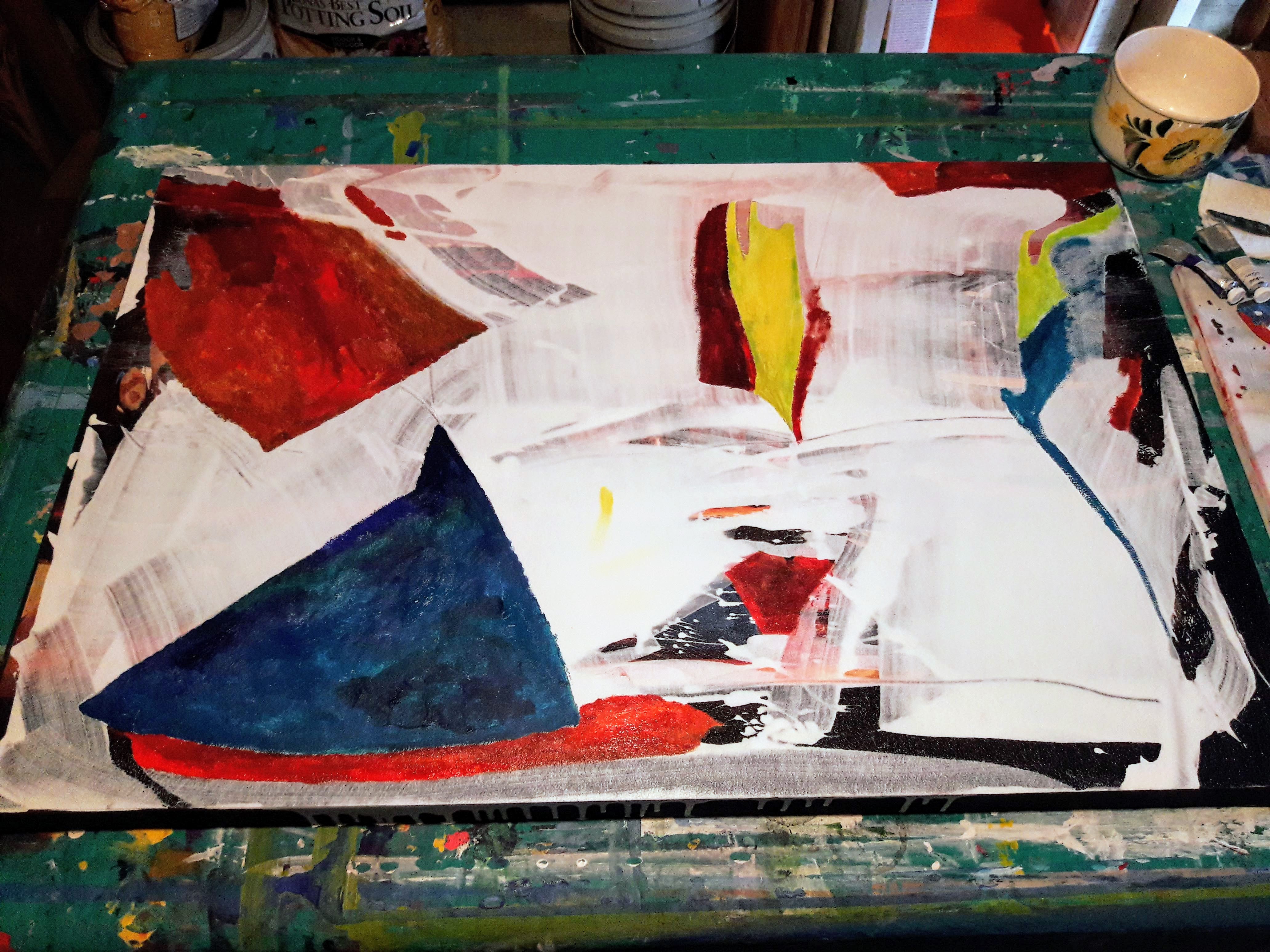
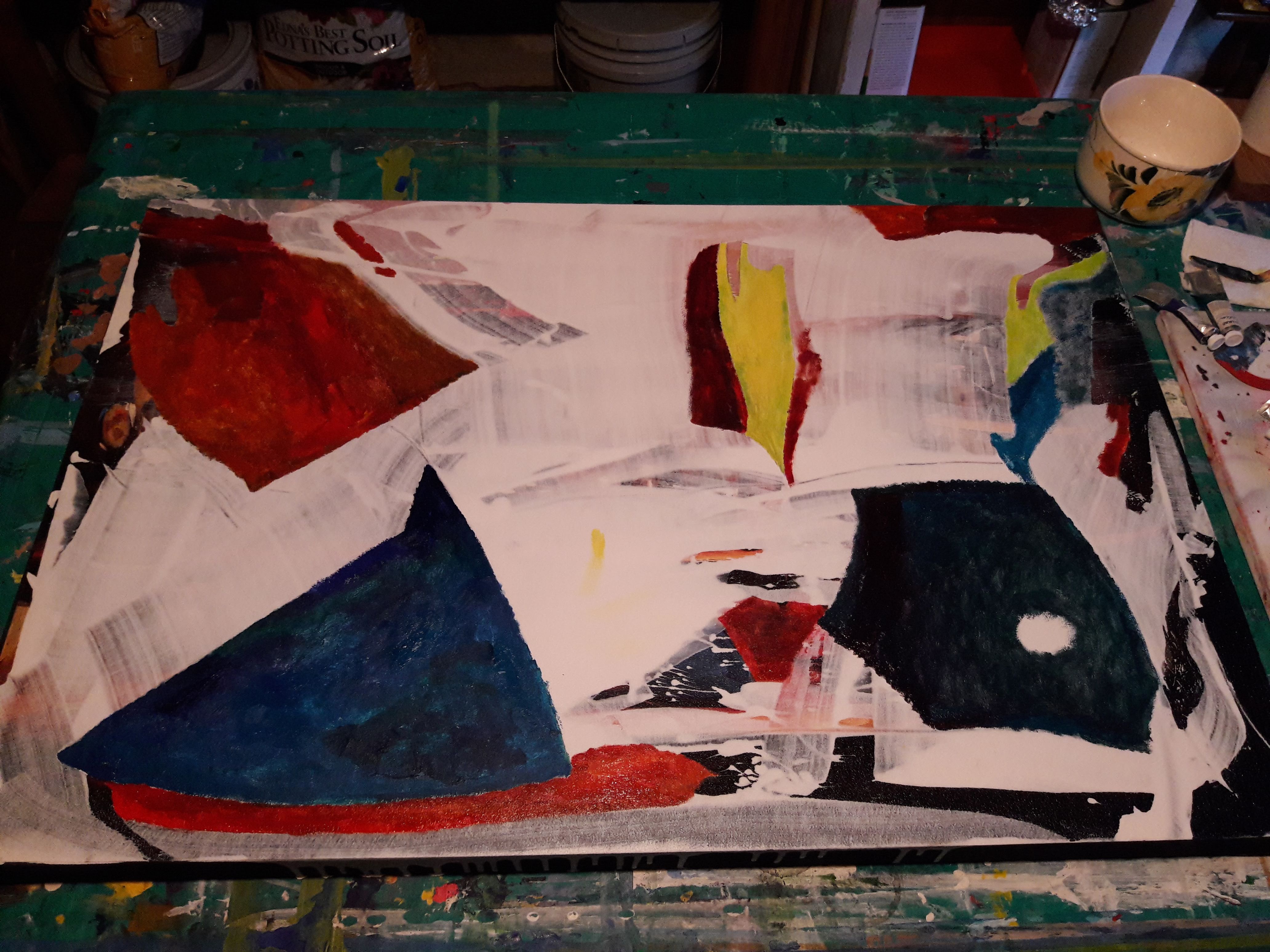
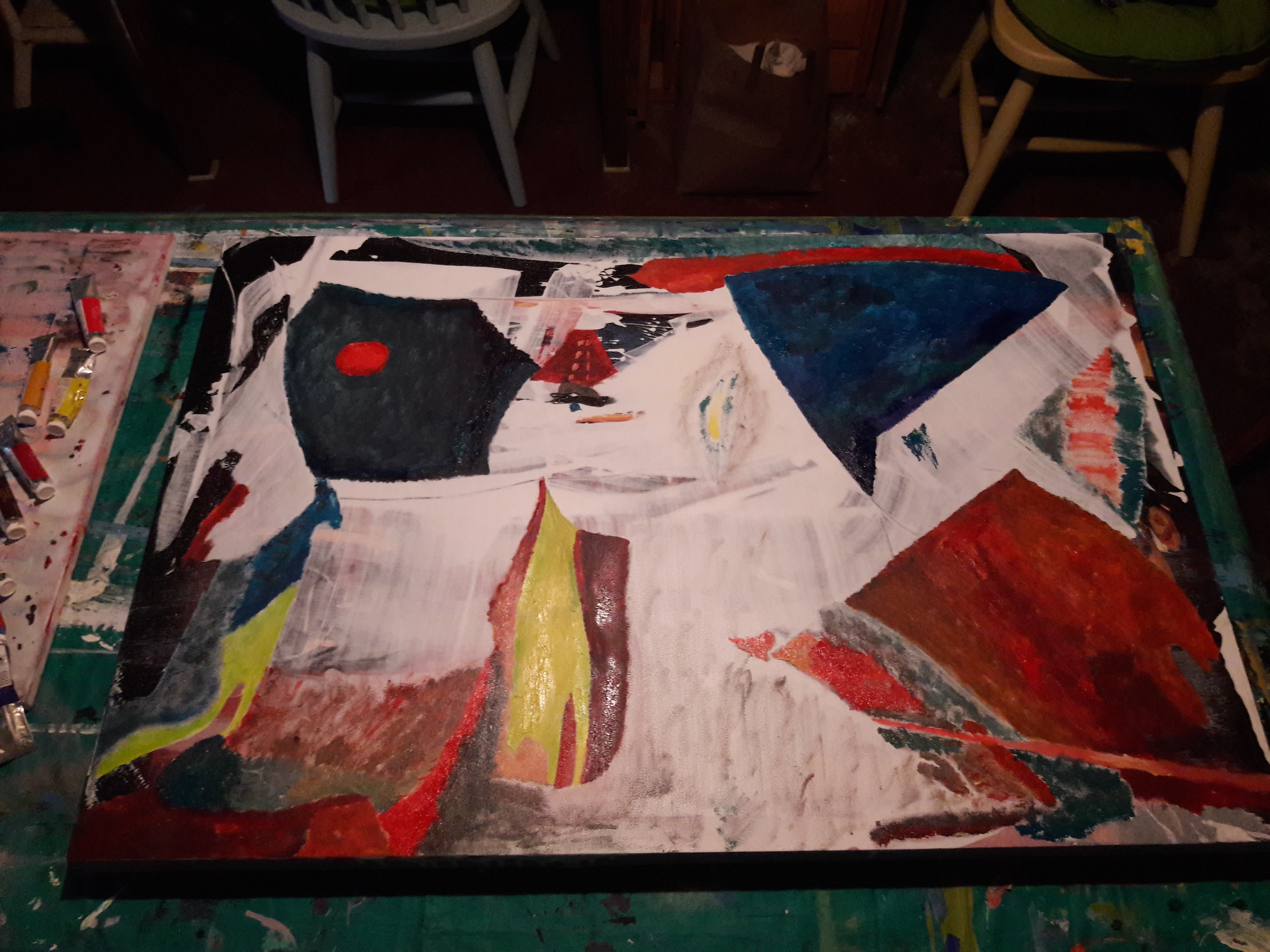
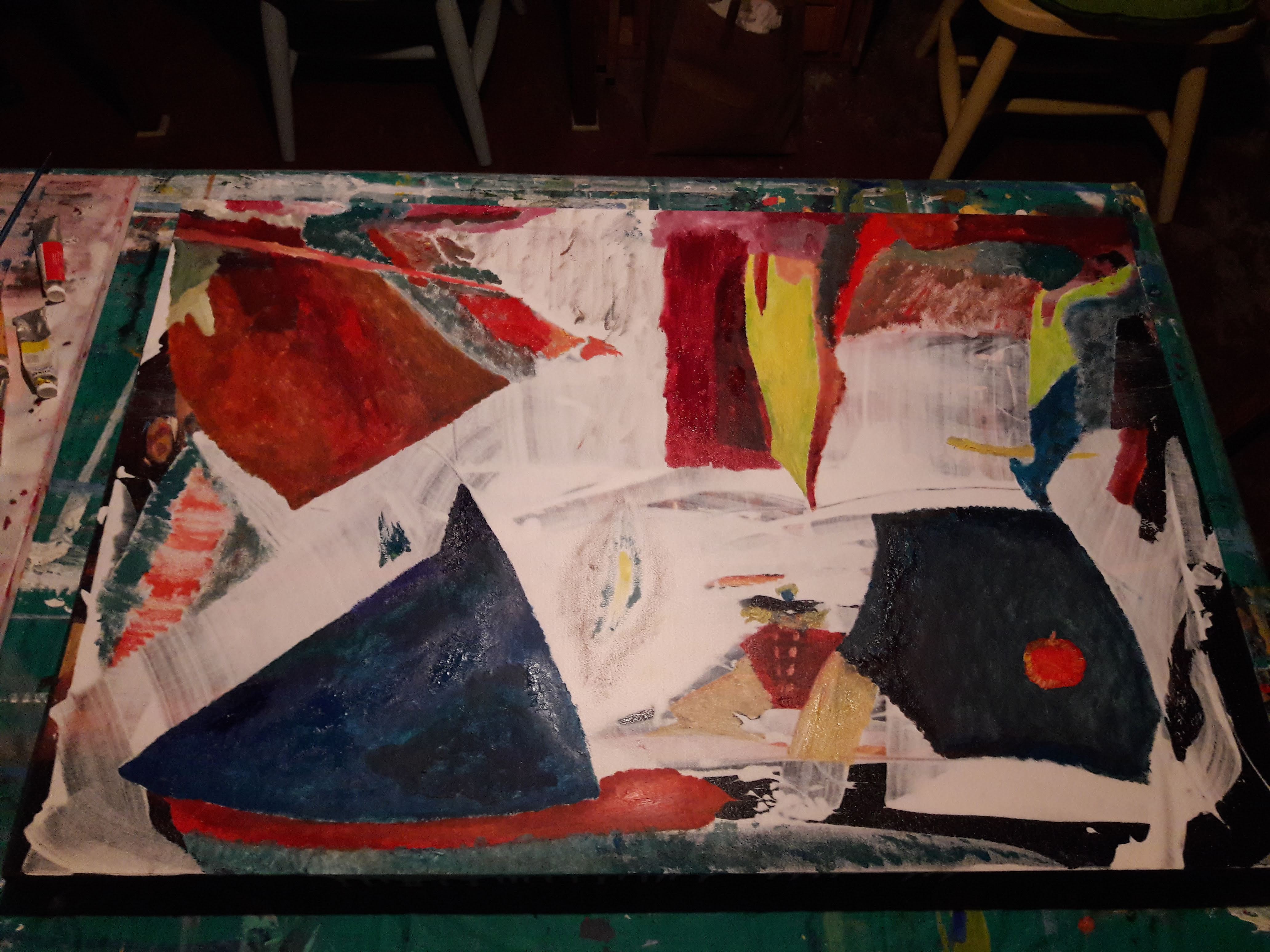
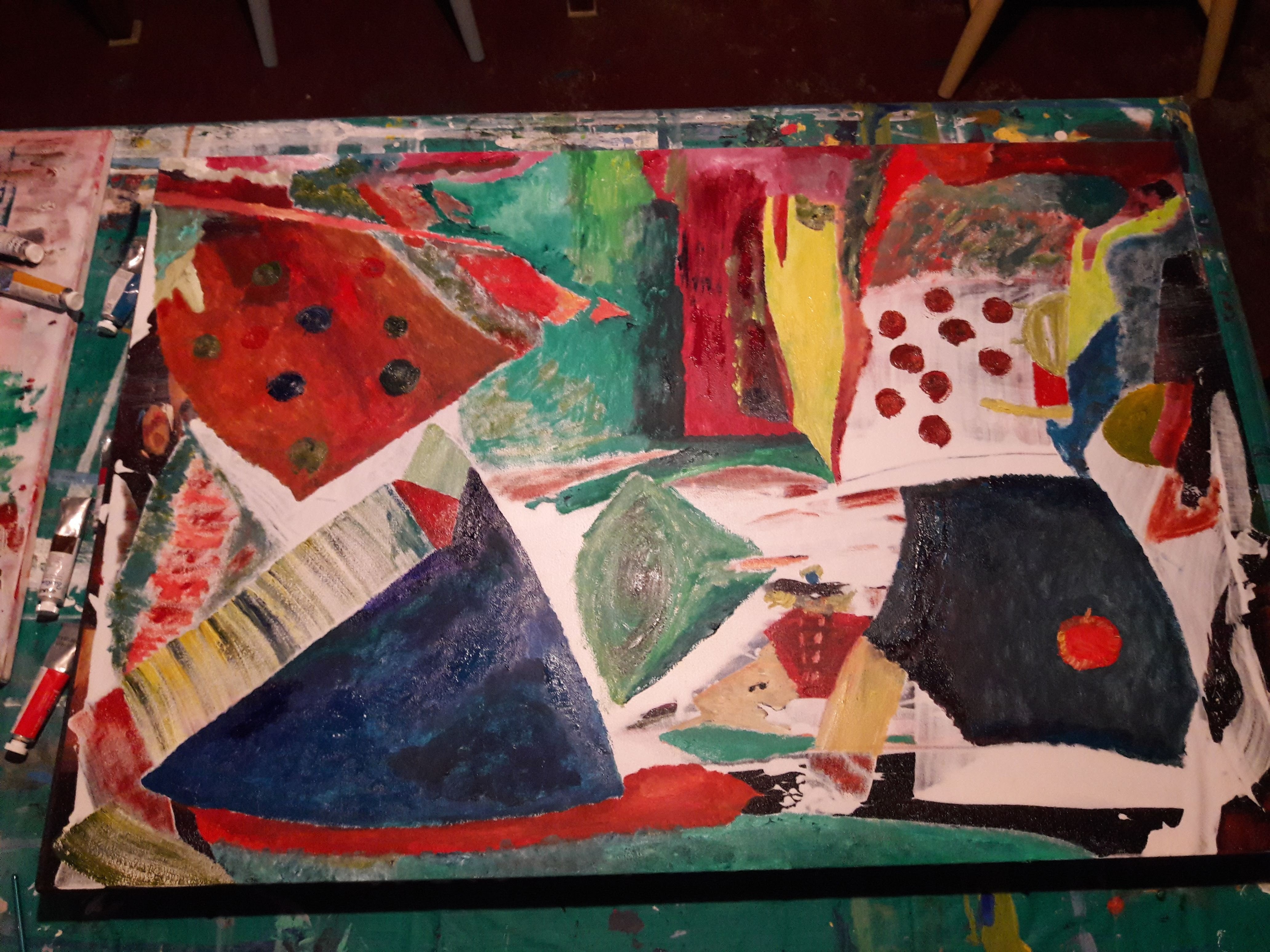
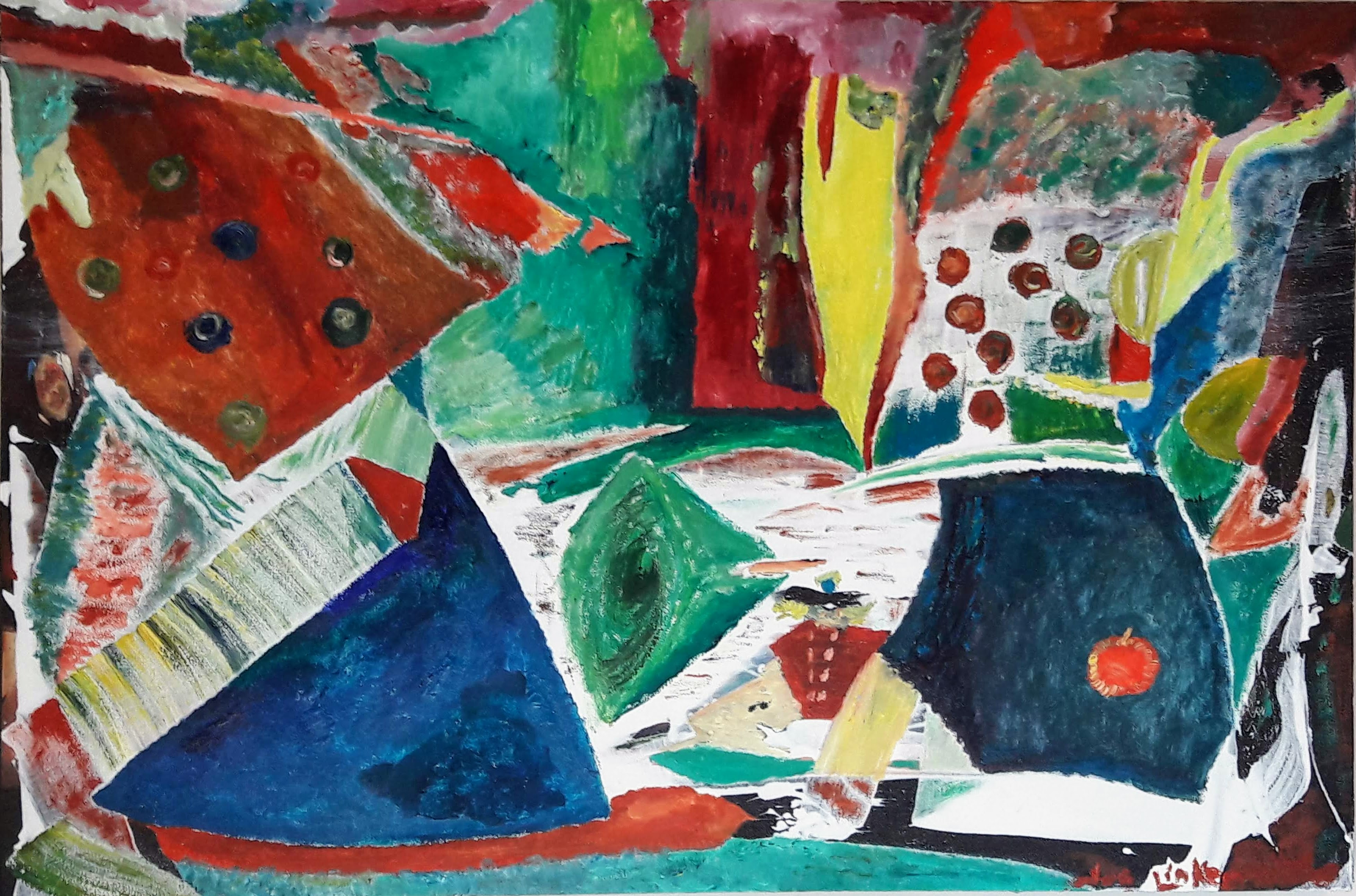
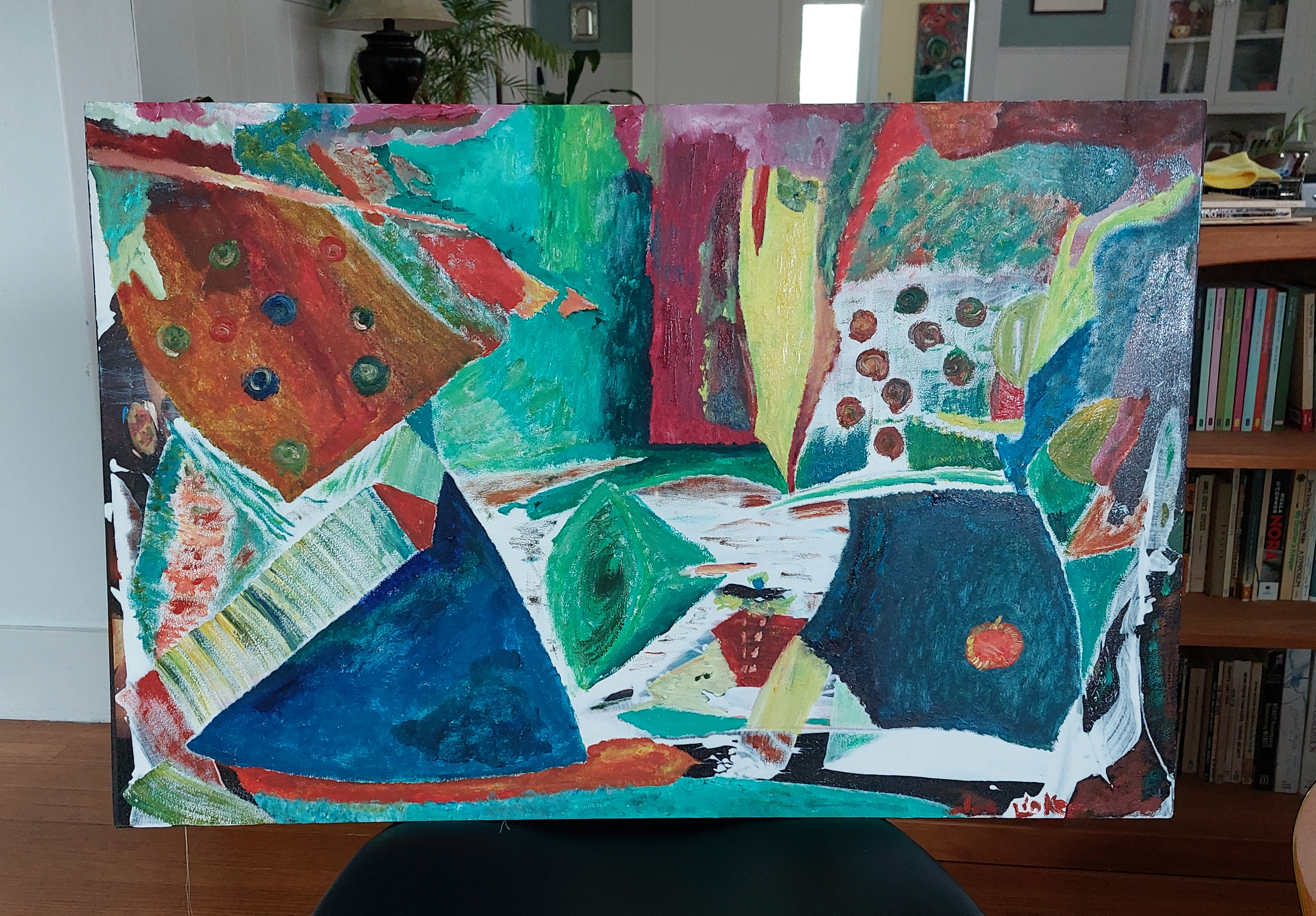
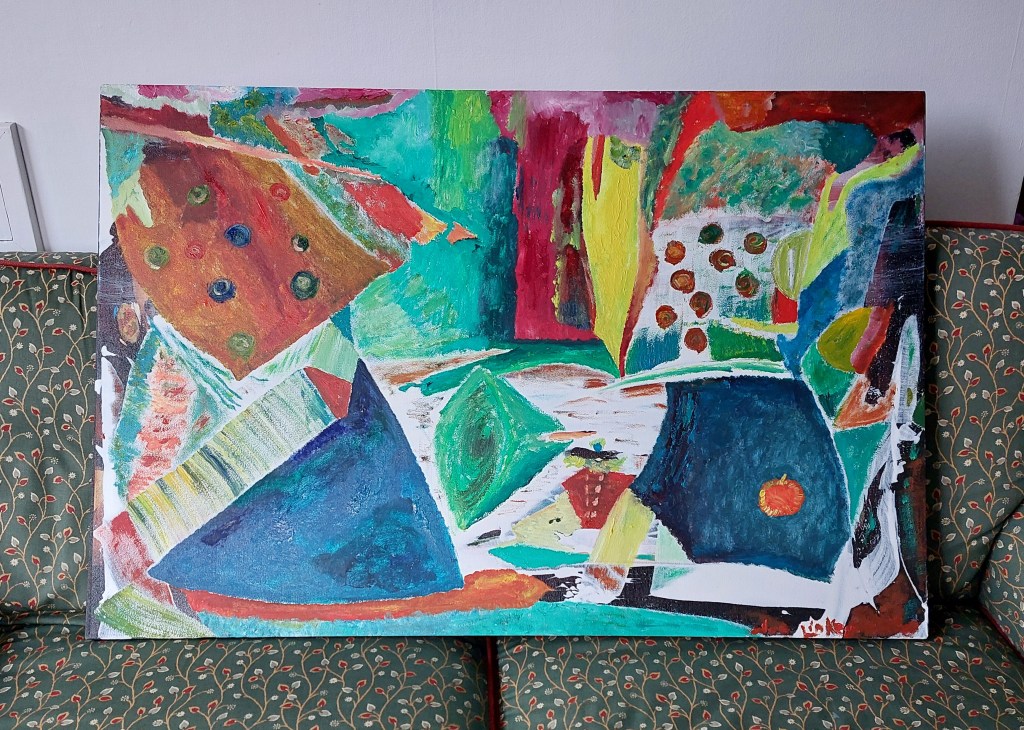
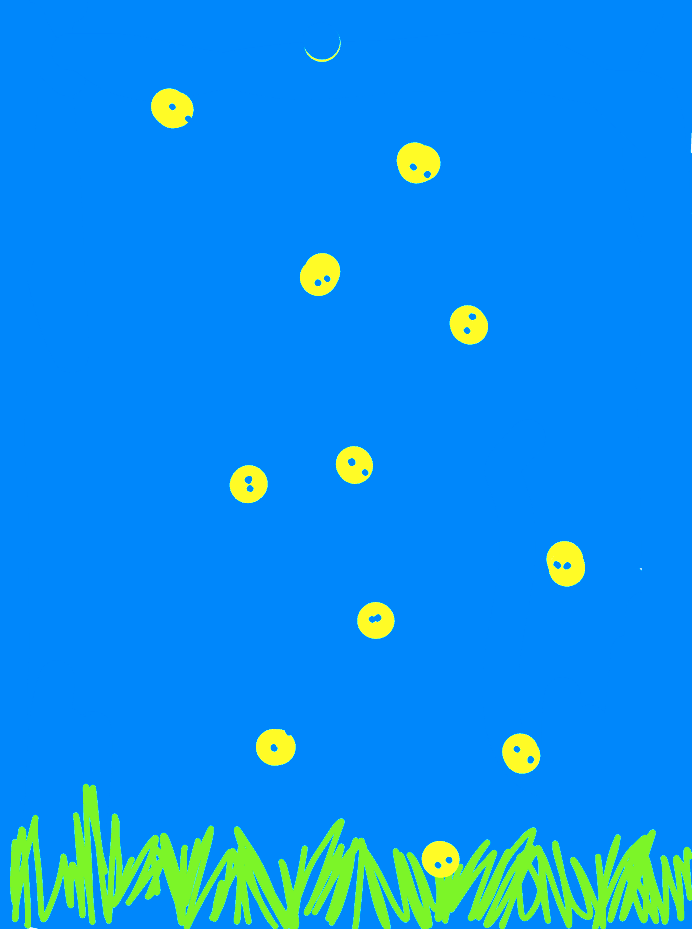
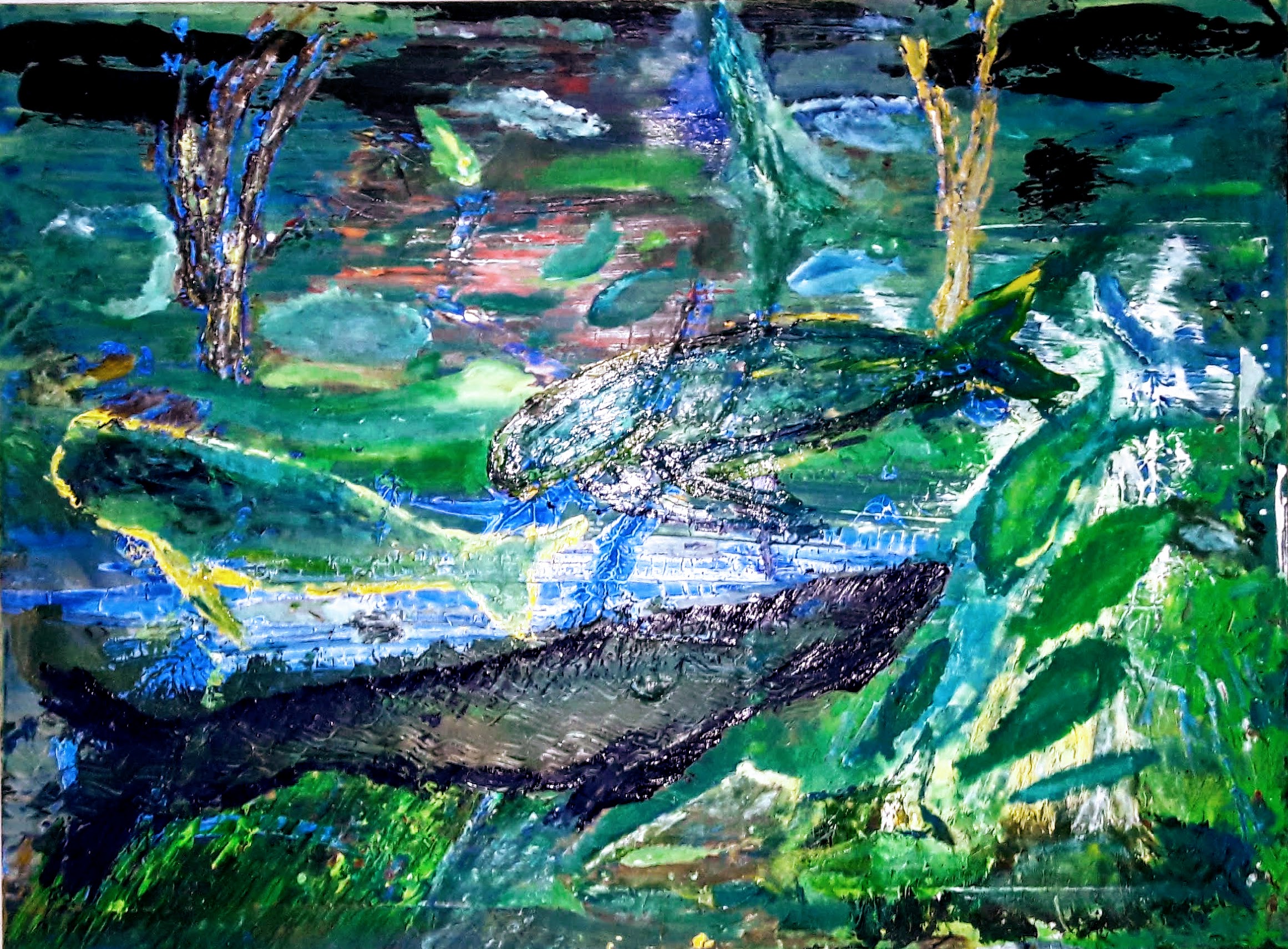
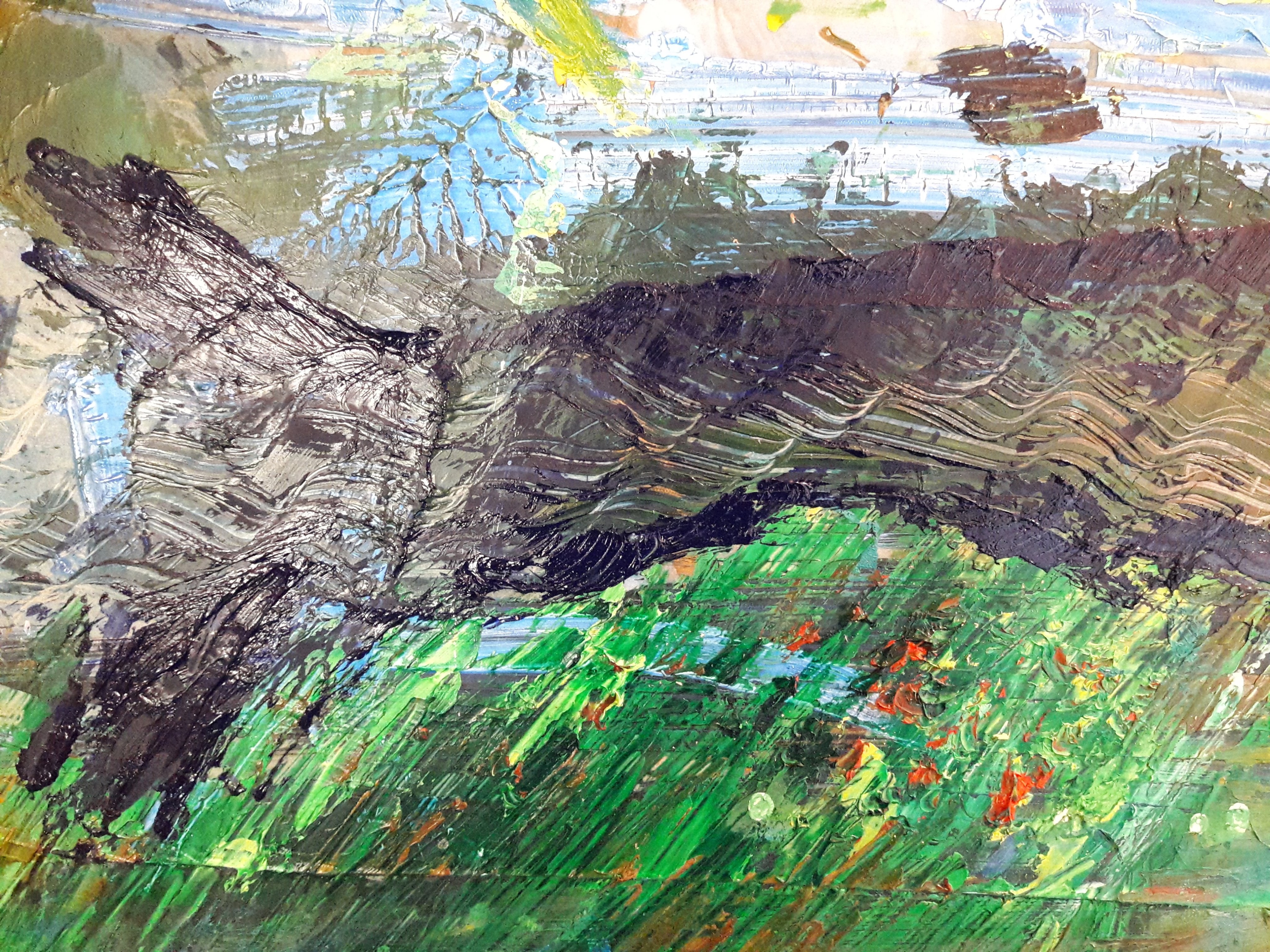
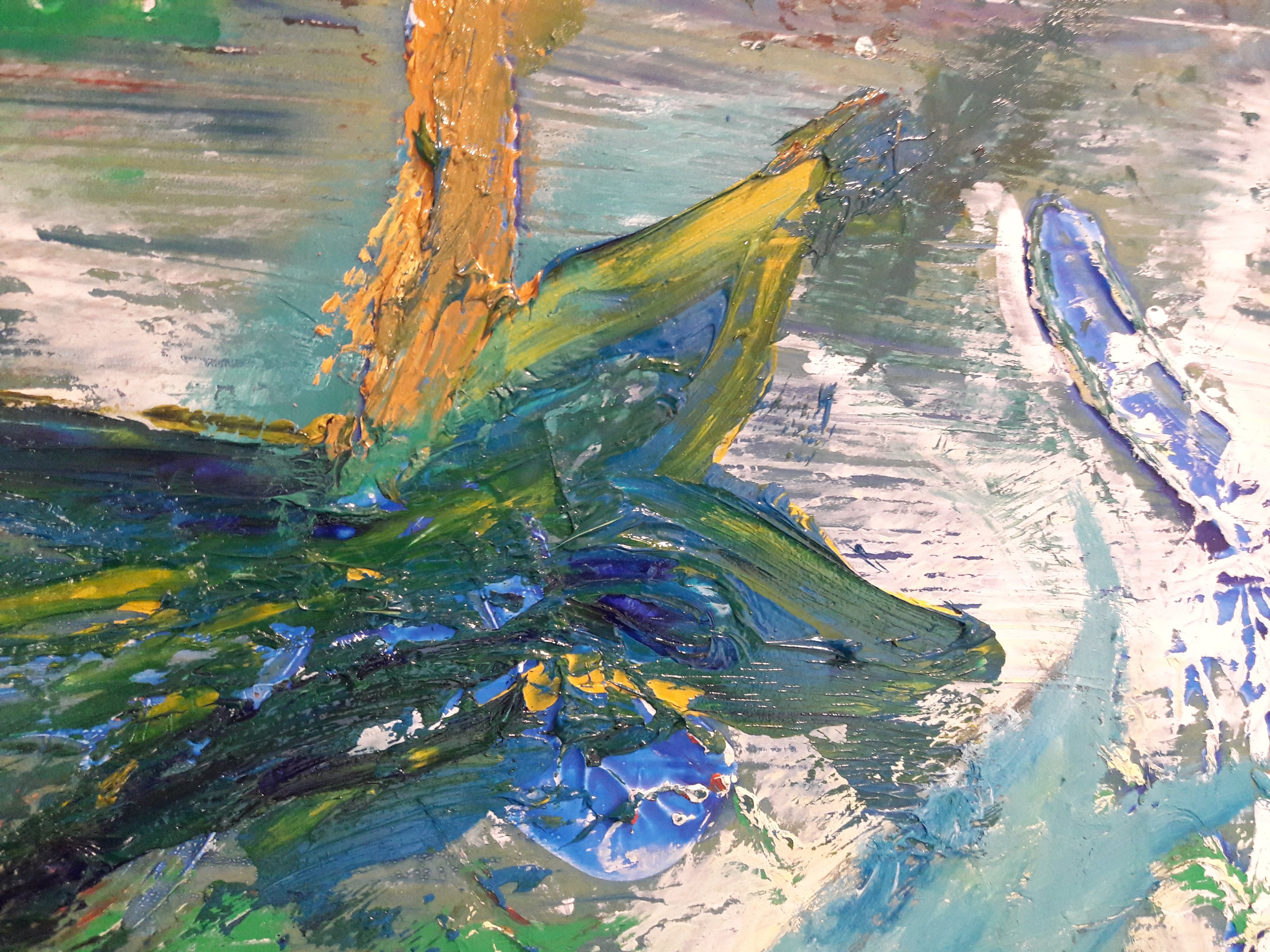
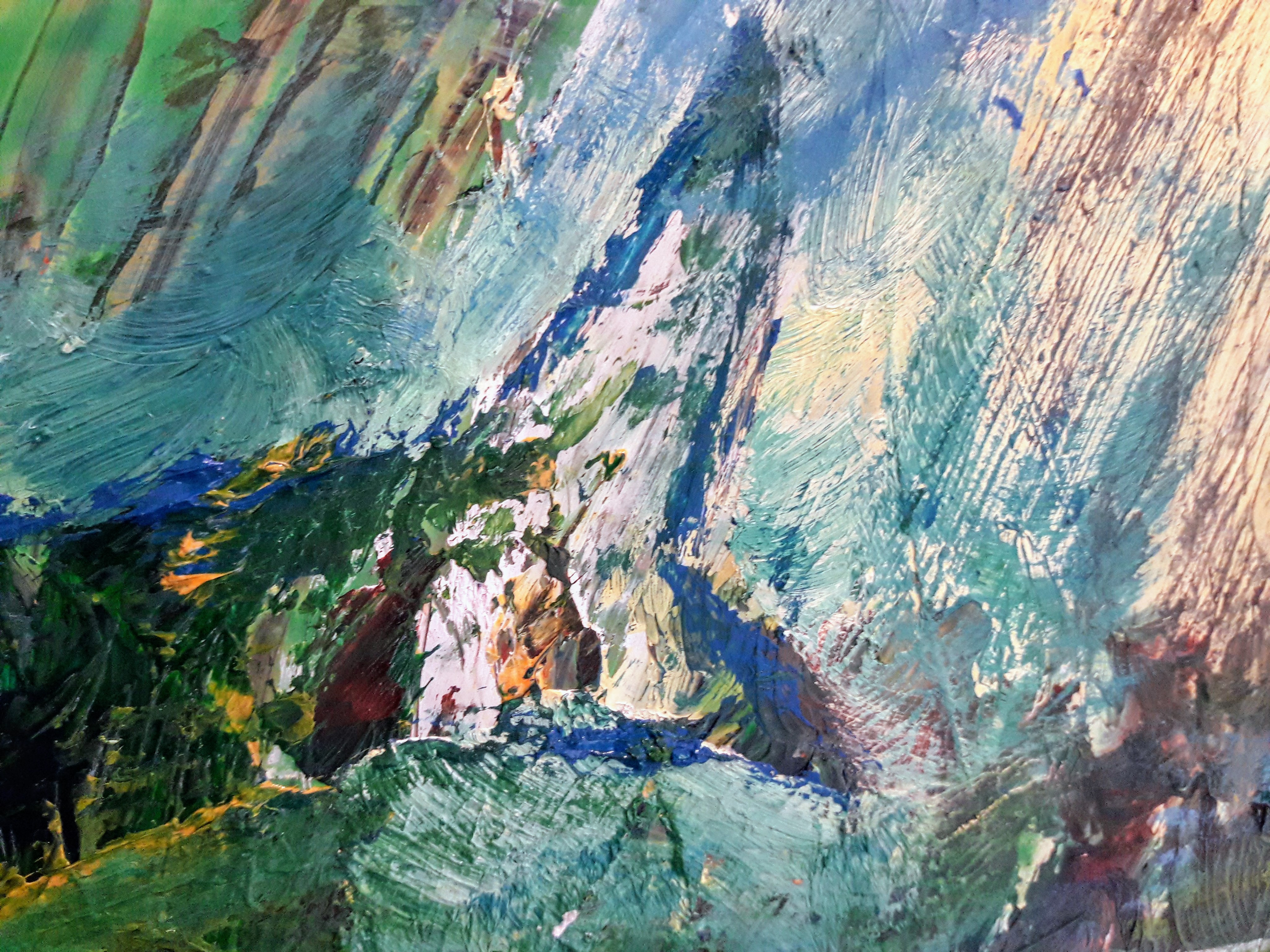
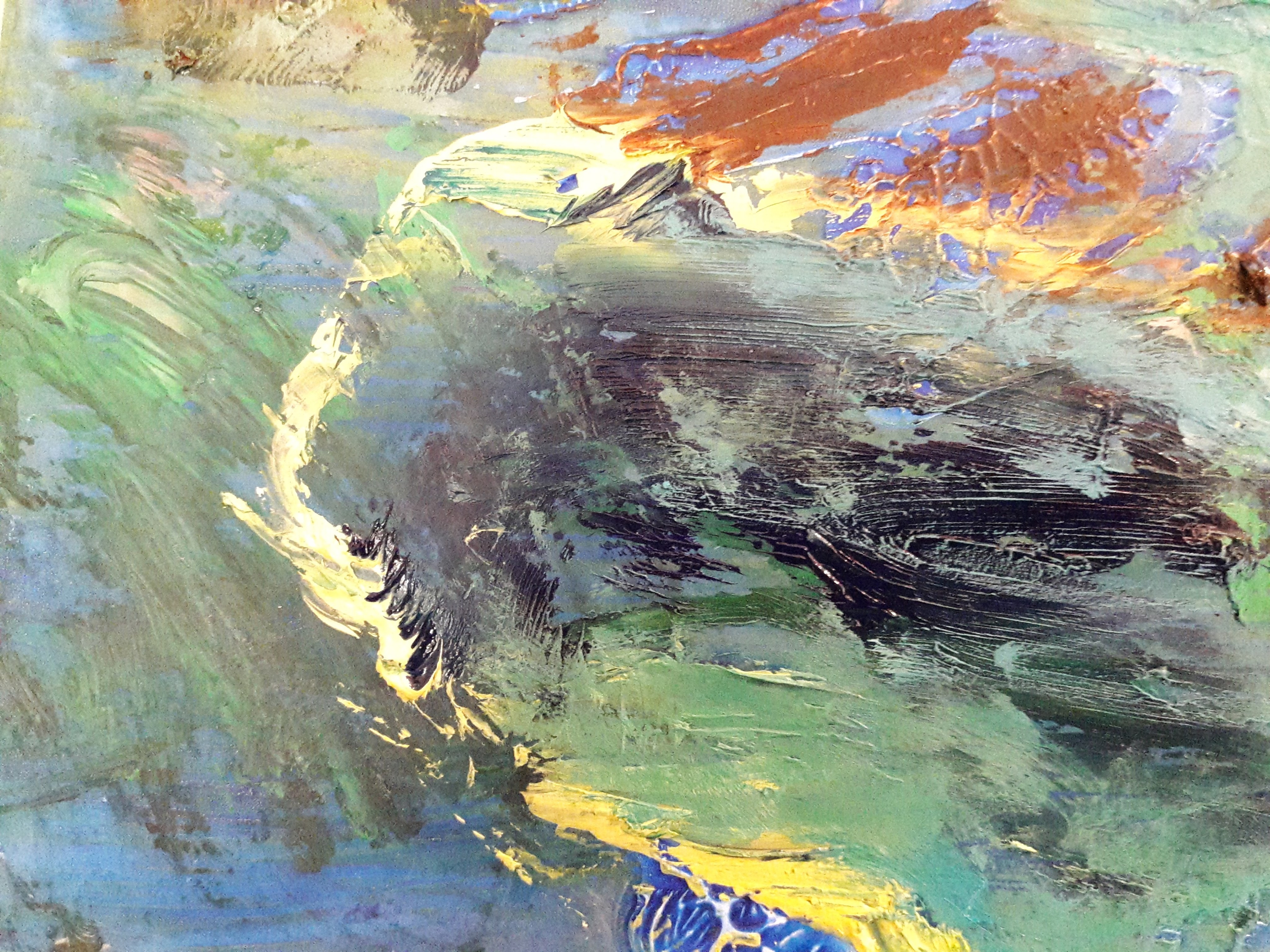
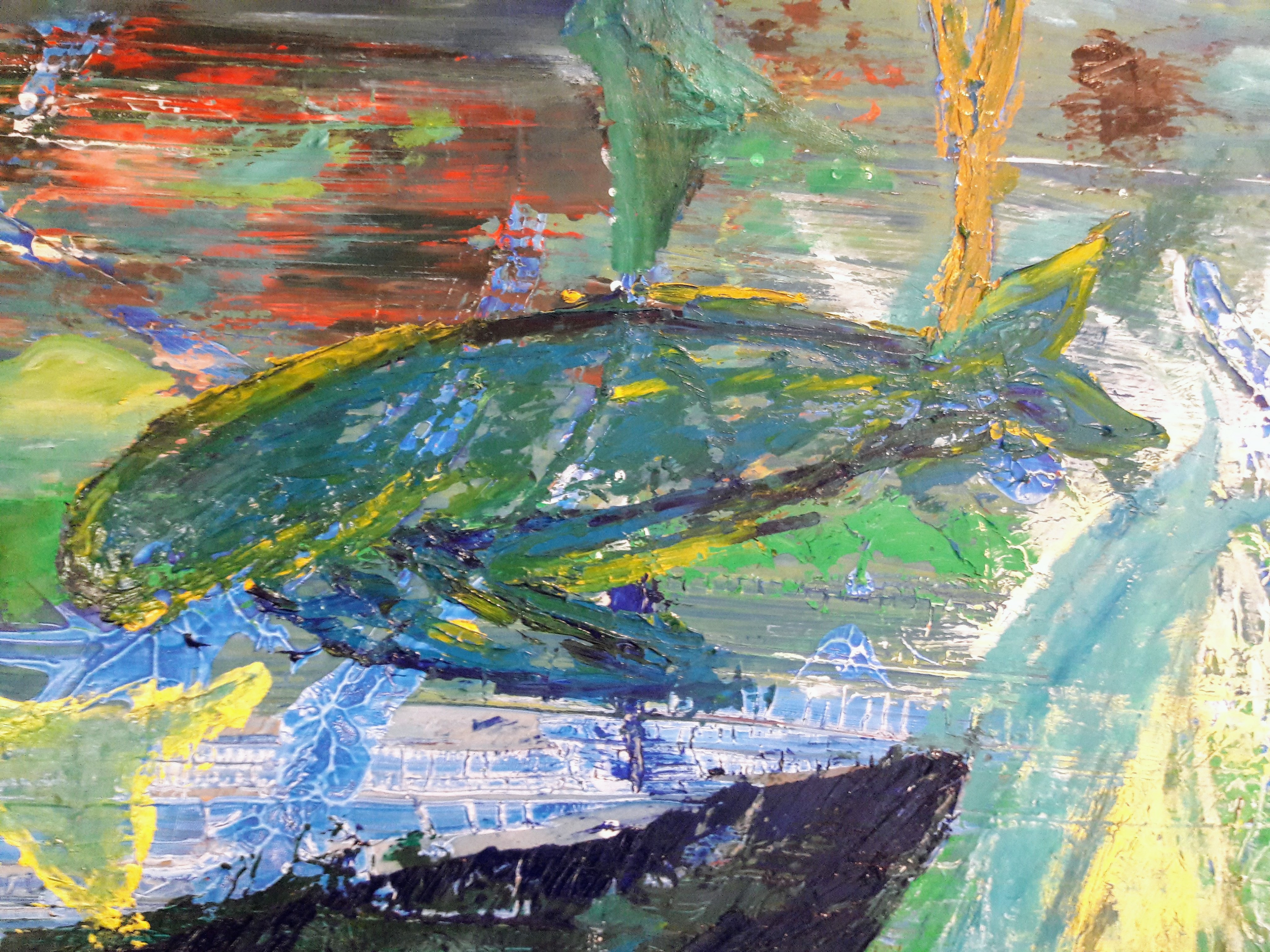
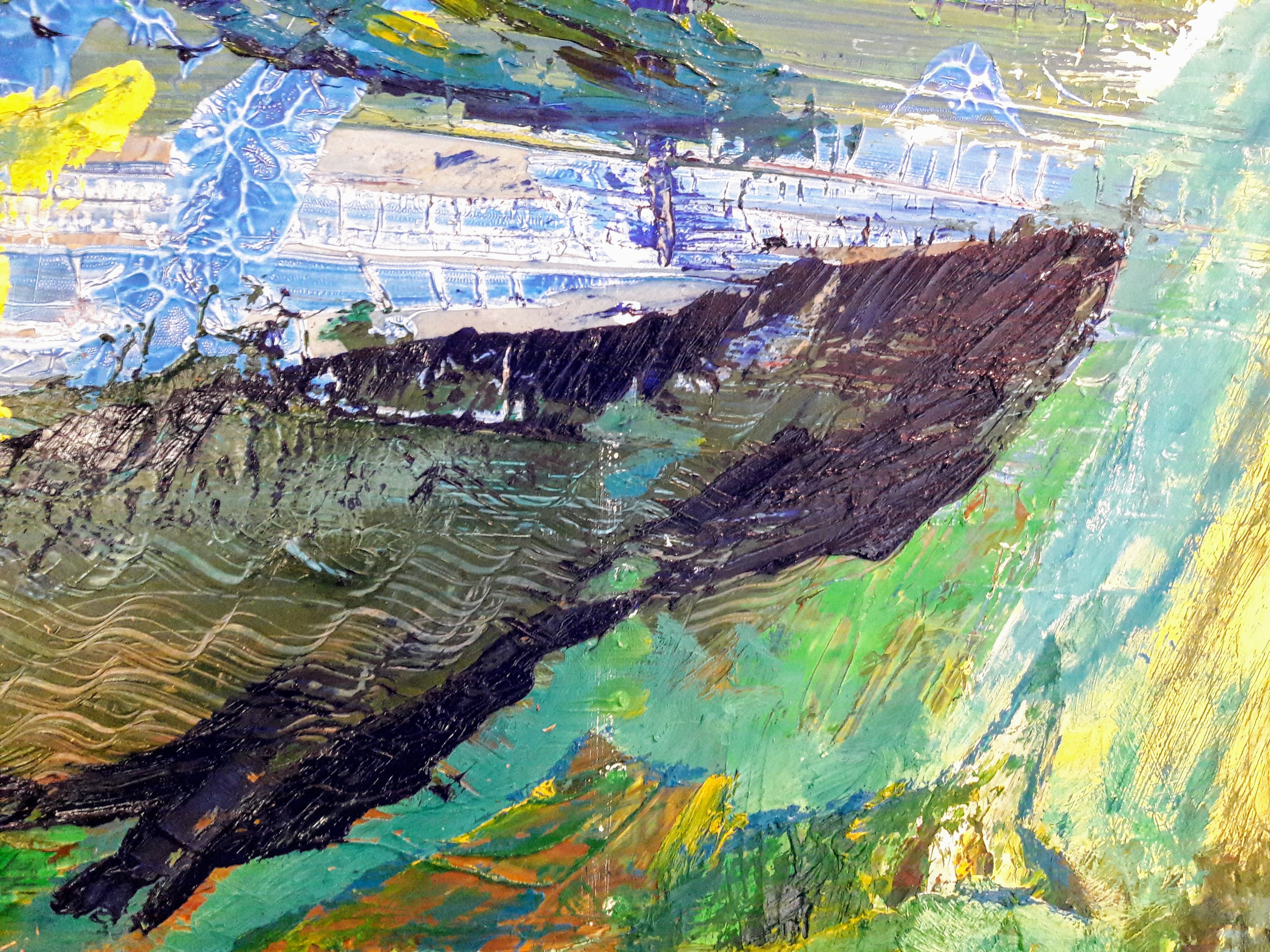
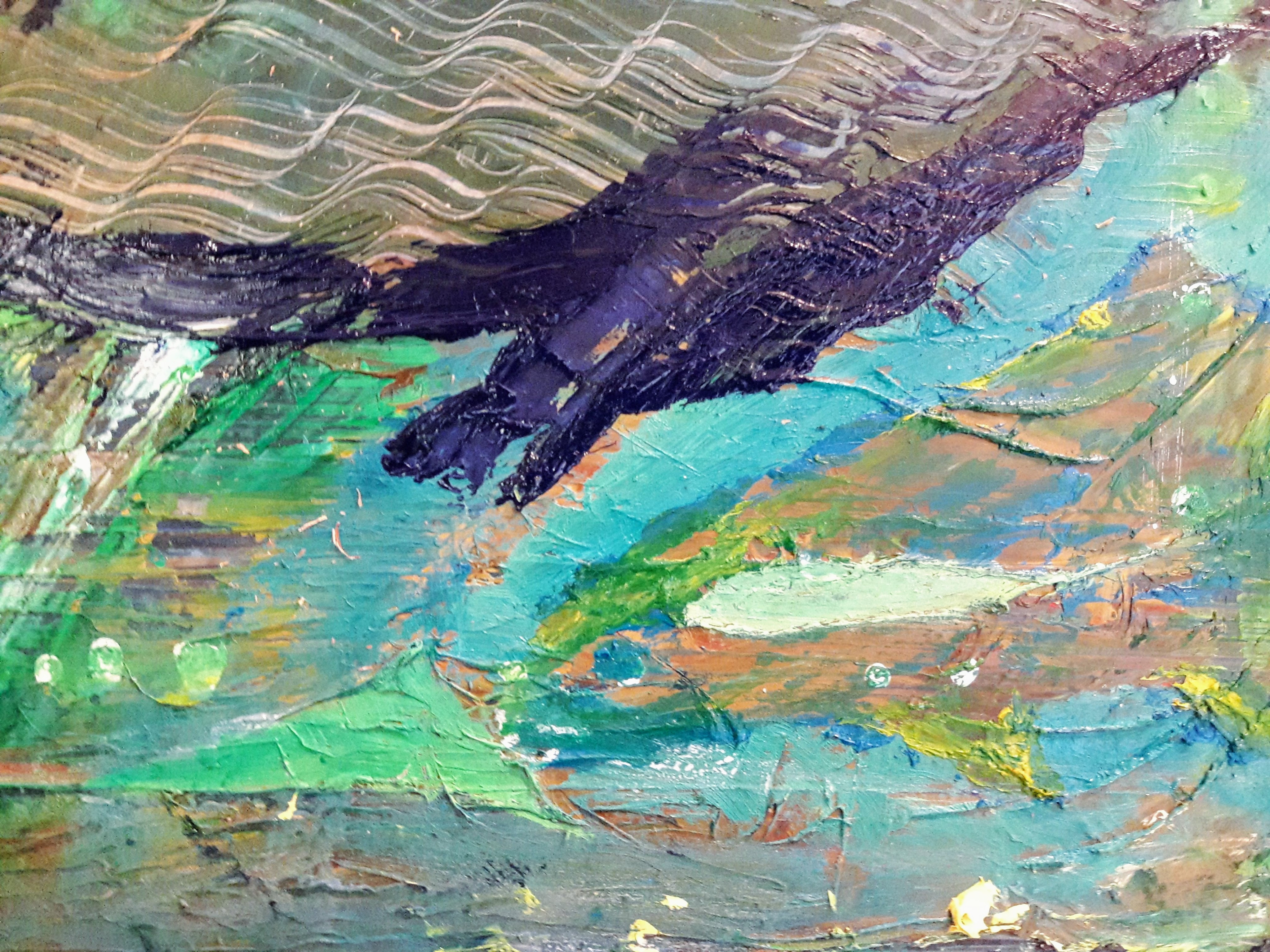
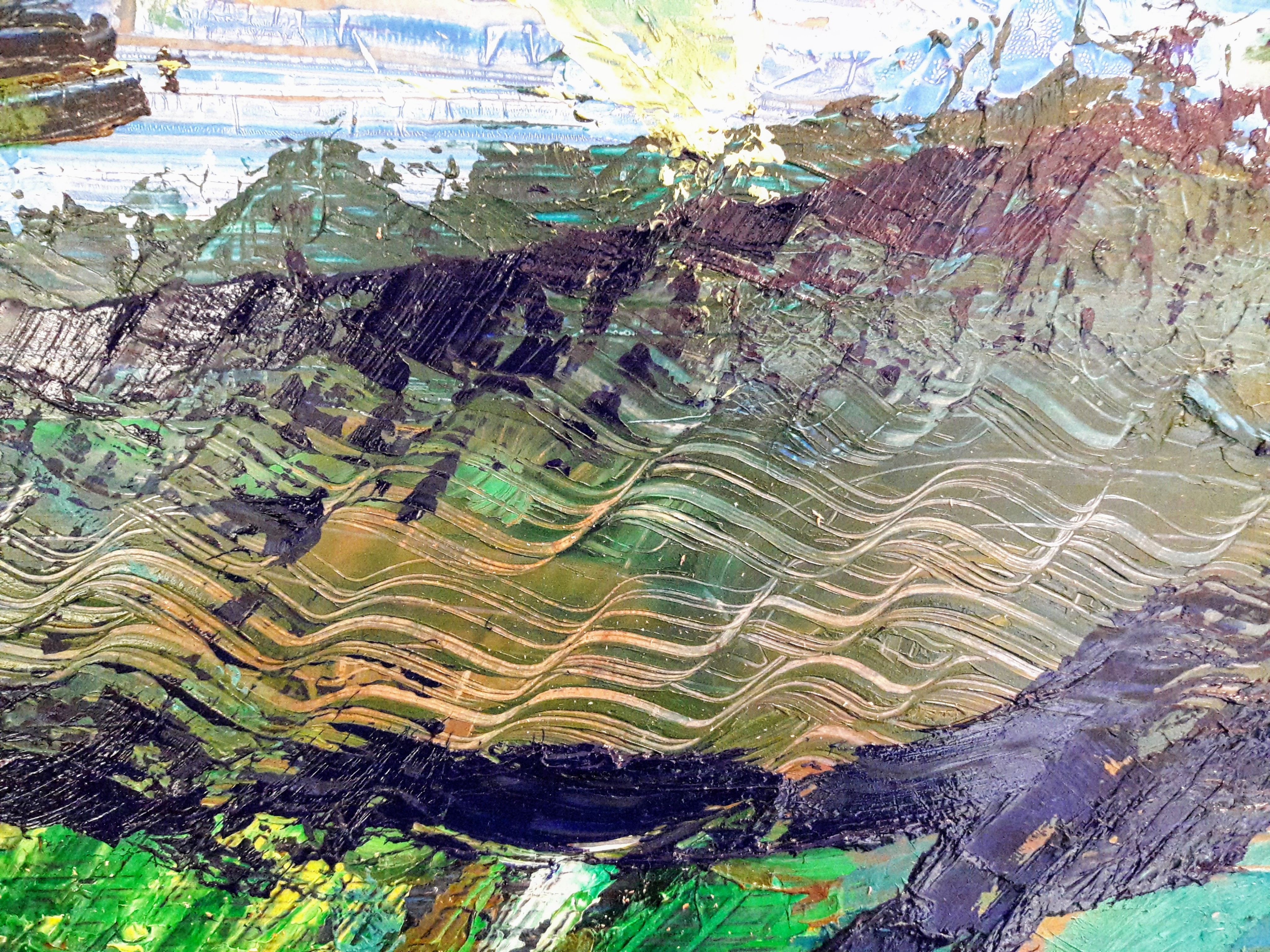
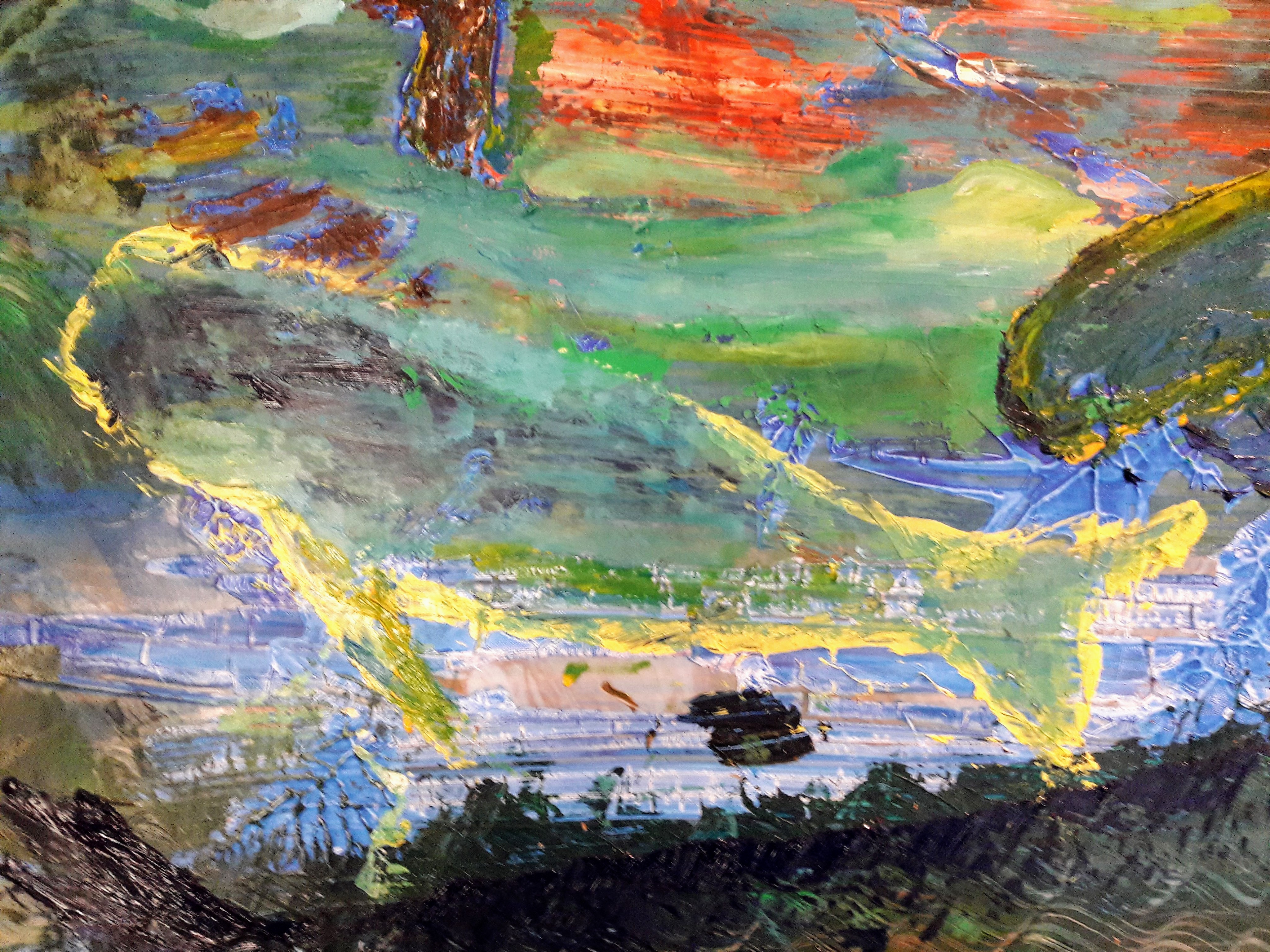
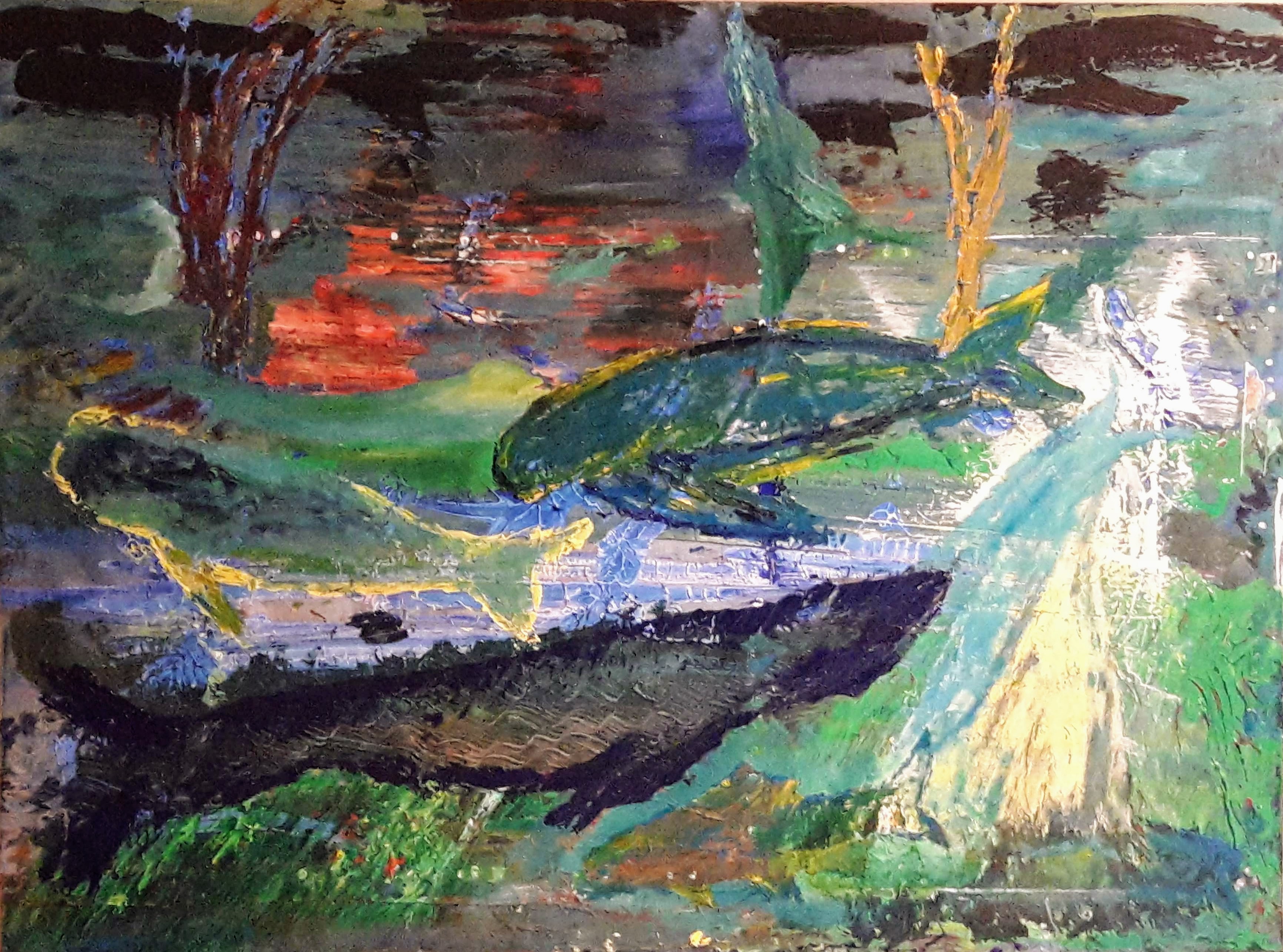
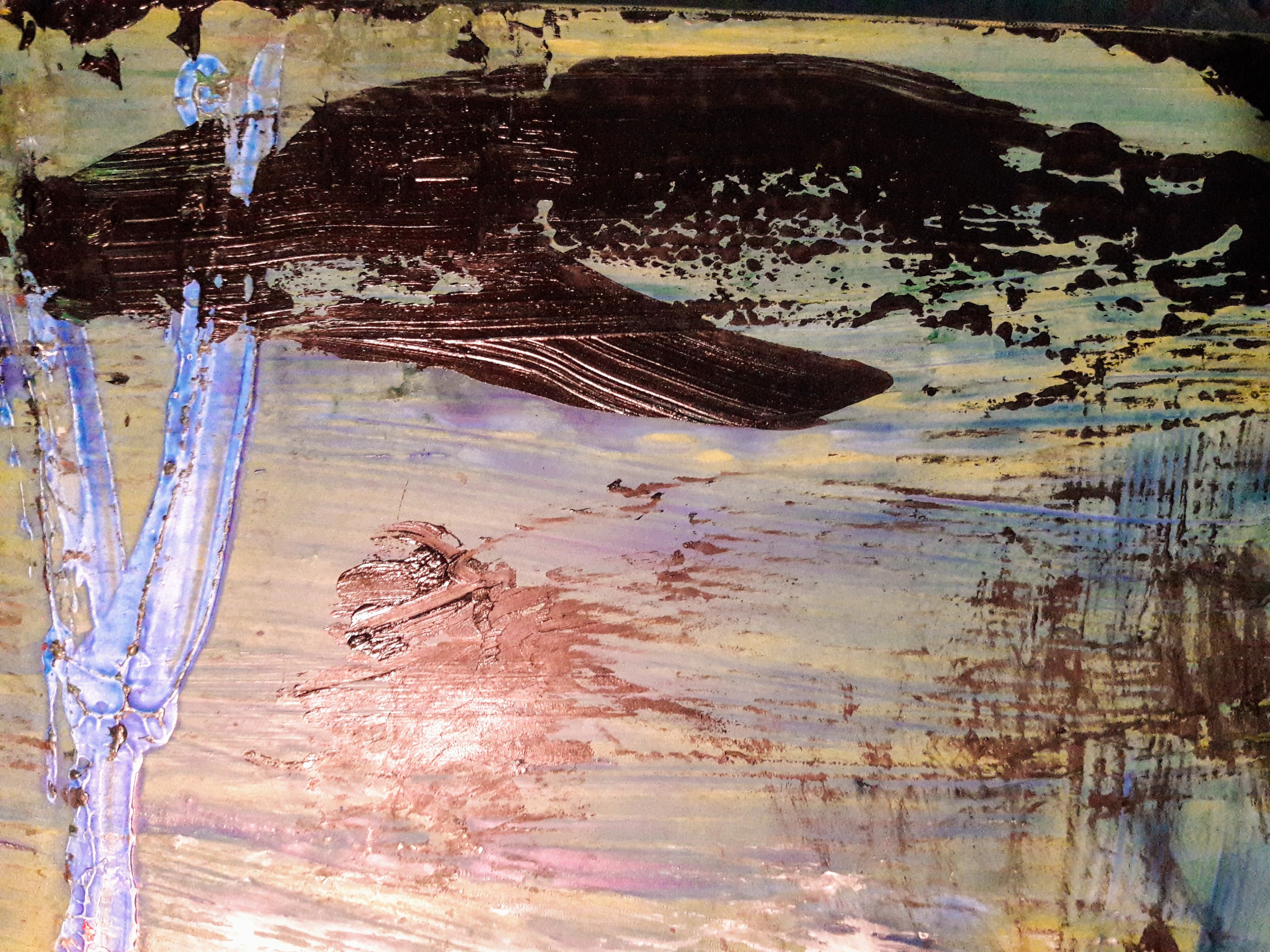
Pizza Painting, 2020, acrylic on canvas, 24″ by 36″
The painting in progress photographed with a cell phone looks dim and dark, reflecting the working conditions of the basement space in February of 2020:
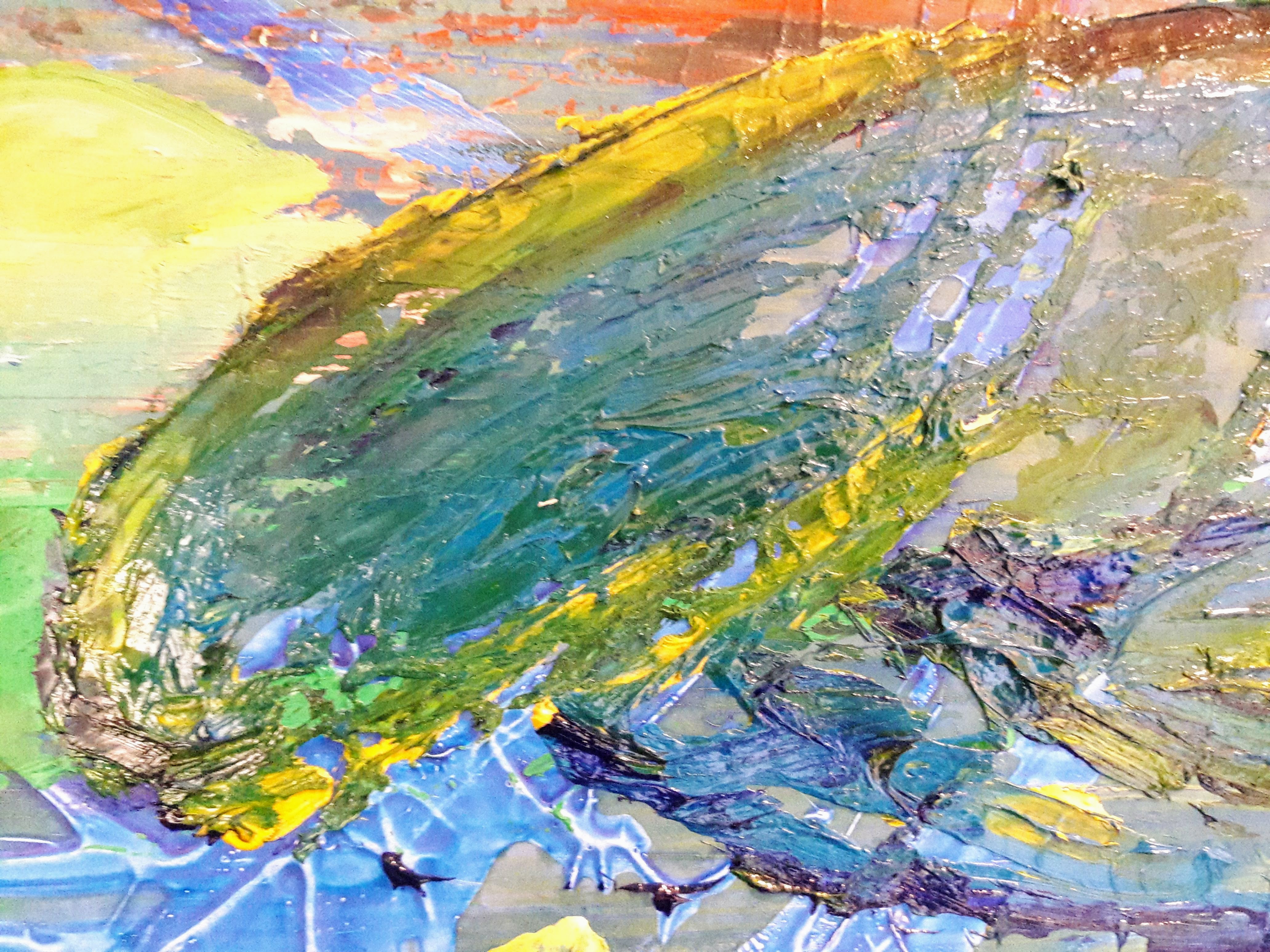
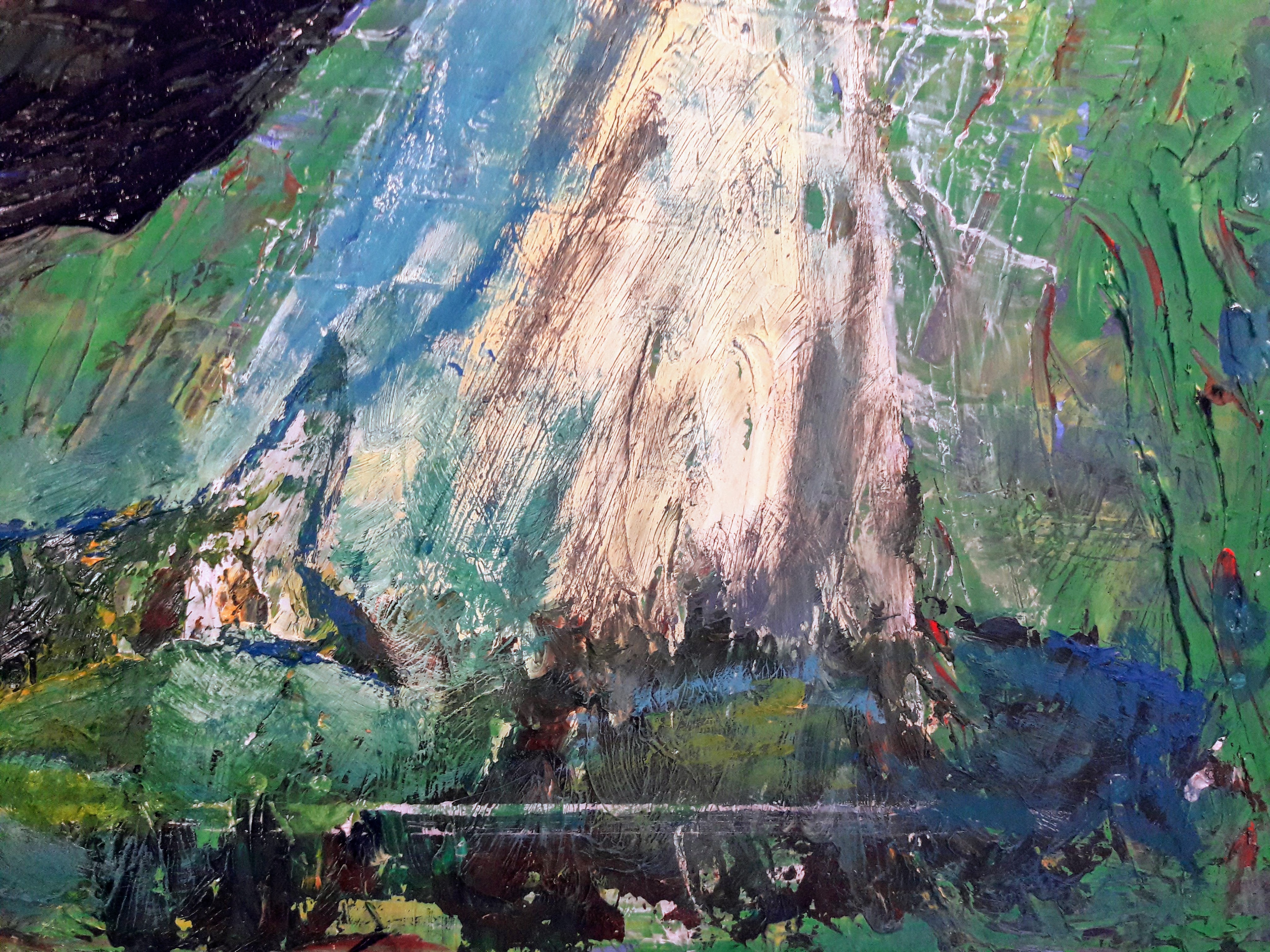
In brighter available light the painting still looks shades different depending on angle and direction of light. Can you see the pizzaiolo (pizza maker) at the bottom-center of the painting? Also note the yellow anchovy top-center.
Eugenio Montale, who won the Nobel Prize for Literature in 1975 (for his poetry), would have made a great blogger. In 1946, he started writing for a newspaper, a form ill-suited to his poetic writing style, and for his articles created a new form, based on the characteristics of the personal essay:
“To write about those silly and trivial things which are at the same time important” (Montale, quoted in Introduction, p. x)1.
And since the blogger doesn’t write for today’s formal critic (who eschews the amateur writer), or for the reader of tomorrow (who delights in the undiscovered), but for today’s casual scroller (who has no patience for the esoteric), Montale could knock out his pieces on demand:
“I write the articles in two hours, with no trouble,”
(Sounds about right, given this blogger’s experience; what flows easily for one writer may trouble another, but either way, one should still carefully select from one’s personal Library of Babel)
“but when I’m out of ideas (and it happens often) I feel lost” (xi).
How could you ever run out of ideas when your subject is everyday life? To write, maybe it’s best to first be lost.
“If I was not a born storyteller, so much the better, if the space at my disposal was limited, better still. This forced me to write in great haste. To cater for the taste of the general public, which is little accustomed to the allusive and succinct technique of the petit poeme en prose, created no problem” (x).
And what are those characteristics of the personal essay one might find in Montale’s “sketches”?
“…humor, irony, self-irony, and a ready supply of nostalgia, across fictional vignettes, memoir, literary and cultural opinion, travel writing, and music criticism” (xi – Galassi, Introduction).
The sketch form (which is neither news nor opinion), to get it right, must be written askance or on a slant less it become straightforward autobiography, which by definition most will find boring, for readers must be able to find themselves in the writing, even if the picture they find might not be particularly flattering.
To give some idea of the length of the sketches, Montale’s newspaper pieces, there are 195 pages of them in the NYRB book I’m quoting from, which is divided into four parts that total 50 pieces, so an average 4 pages in length. The longest are 7 pages, of which there are only 2, and the shortest are 2 pages, of which there are 7.
The titles of the “Butterfly of Dinard” pieces don’t always give much of a clue as to the topic. Take for example, “Success,” which turns out to be a music experience piece which includes a consideration of “claqueurs,” who were a kind of precursor to the canned laughter of television sitcoms, and the piece turns out to be not about success at all but about its opposite, failure; fair enough, since the early sitcoms and soap operas, one might theorize, did borrow from the classical melodramas, and in terms of art consideration, fit the bill. Of course the soaps lived without laughter of any kind, unless the audience had cried itself silly.
I’ve often thought John Cage, Marshall McLuhan, and Buckminster Fuller each would have made efficient and excellent bloggers. I was reminded of Cage when reading Montale’s “Success” piece. Montale is recruited by his barber (and vocalist who would then become Montale’s bel canto teacher) to join “his team of claquers” for a night to applaud a musician, Jose Rebillo, who could not “read notes but nonetheless he composed music for the pianola by cutting and punching holes in cardboard rolls with scissors and awls.” (There are 73 “Translator’s Notes”: #26 explains that Rebillo is based on the real composer Alfredo Berisso). Of course Cage could read notes, but still, the method described evokes Cage. And not only the method; Montale says, “Music such as that of Signor Rebillo, all dissonance and screeching, had never been heard before” (50).
Other titles include “The Bat,” about a couple in a hotel room invaded by a bat. The woman freaks out while the man must find a way to evict the bat. And “Poetry Does Not Exist,” about a visit Montale receives from a German Sergeant during the war-winter of ’44, a would-be poet himself and a fan of Montale’s poetry. During the visit, Montale is hiding two compatriots in an adjoining room. And the title piece, “Butterfly of Dinard,” which may or may not have been real.
The four sections of the book align somewhat with Montale’s chronological history, explained in the Introduction, which itself includes 8 footnotes. Each piece is a self-contained reading experience that points in two directions, one outward, the other inward, and the reader may take either path. In the title and end piece, “Butterfly of Dinard,” the narrator tells of a cafe and a waitress, who may or may not be the butterfly of the piece, which is only about 500 words long, a single page. Was the butterfly real or a figment of the imagination is the unanswerable question.
Butterfly of Dinard, by Eugenio Montale, Translated from Italian by Marla Moffa and Oonagh Stransky, Introduction by Jonathan Galassi, New York Review Books, 2024, Originally published in Italian as Farfalla di Dinard, 1960. ↩︎
Where in white flats over hills and dales live snowy creatures in snowy hills overcast the sky a white veil covers a frozen forest of fairies in fallen fate telling tawny tales and this winter’s rest one rare bird flew west into the sun passage over the ocean and caught waves and played with the dolphins improving her endorphins.
“Over hill, over dale, Thorough bush, thorough brier, Over park, over pale, Thorough flood, thorough fire; I do wander everywhere, Swifter than the moon’s sphere.”
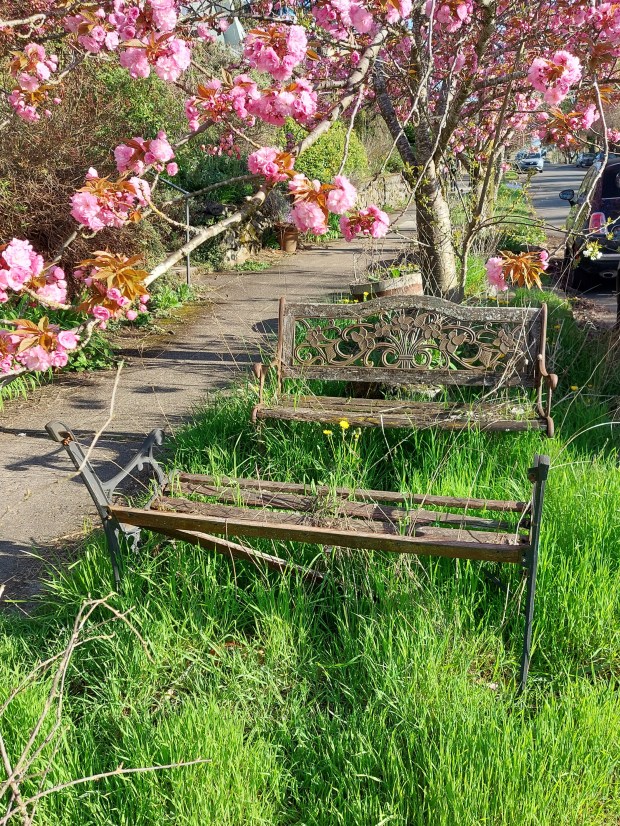
Winter passes when the cherry trees blossom. Passersby frequently pause to view the blooms from various angles and take photos with their phones. I wonder what the viewers feel or if they make a note to come back summer to pick some cherries. Of course these street trees across from our place are ornamental flowering cherry trees that don’t bear fruit. Some consider the ornamental a waste; others think it’s art. Here’s a photo of flowering cherry branches across the street, above a set of nonfunctional benches – some consider those art, too:
Just before leaving England for France, where he would die in the Battle of Arras (1917), the British writer Edward Thomas turned from prose to poetry. Here is his short poem titled “The Cherry Trees”:
“The cherry trees bend over and are shedding On the old road where all that passed are dead, Their petals, strewing the grass as for a wedding This early May morn when there is none to wed.”
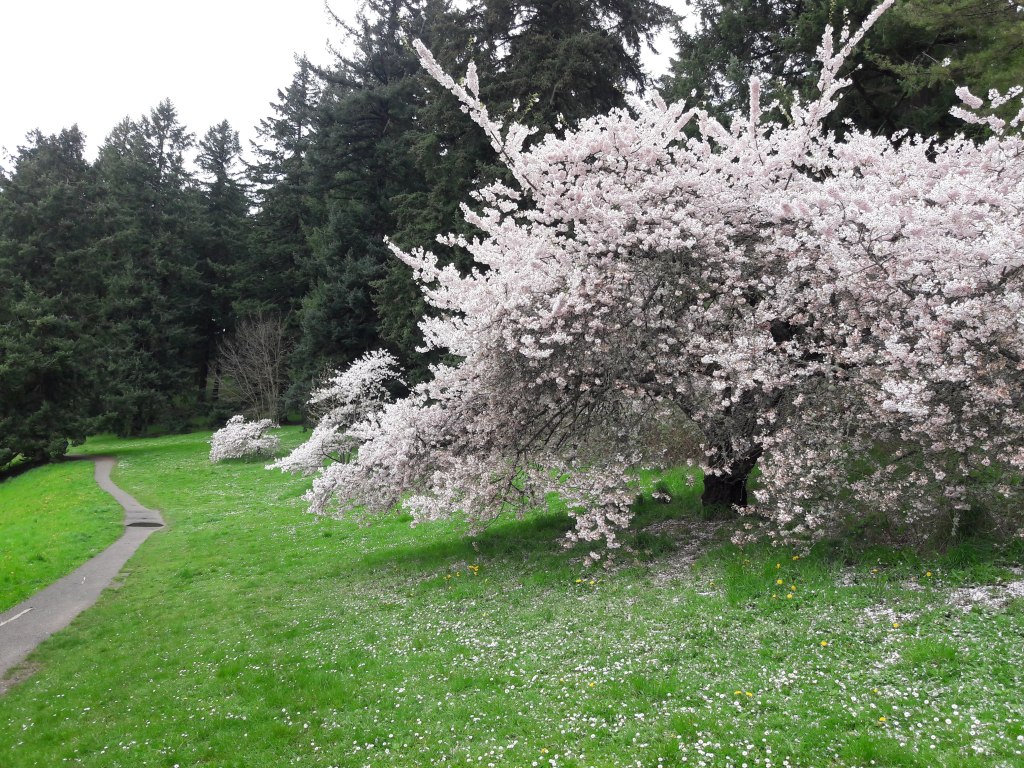
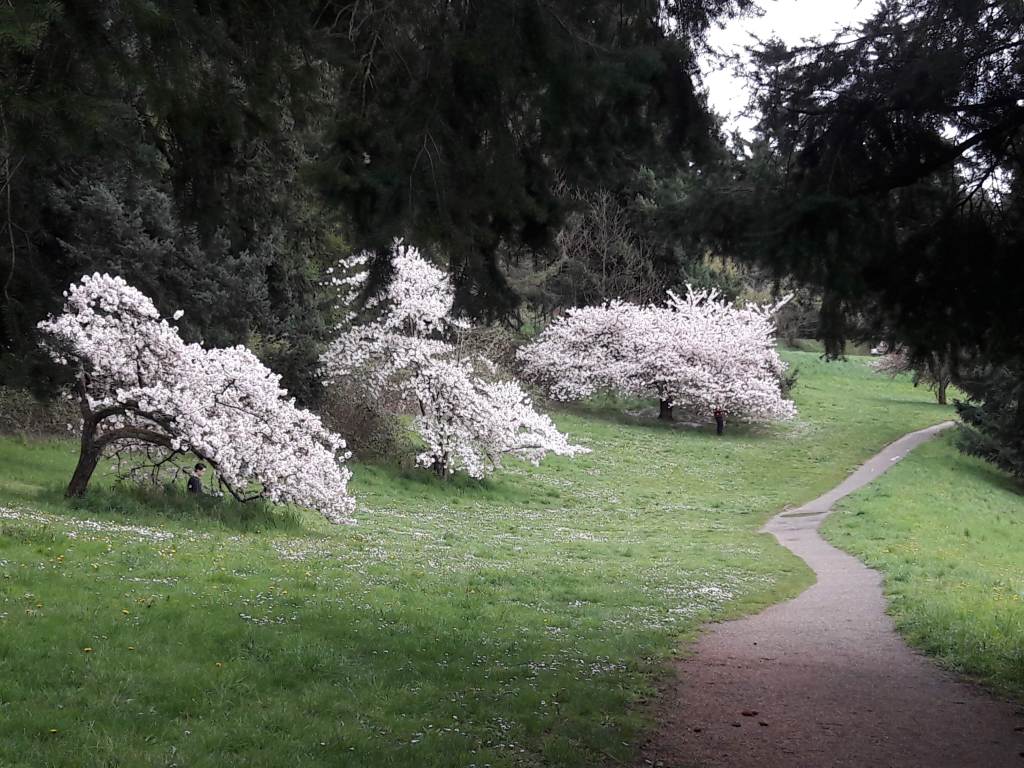
Here are two photos of cherry trees near an old path in Mt Tabor Park:
The Minnesota poet Robert Bly talked about nature’s capacity to send and receive images in transference from object to subject back and forth. The cherry tree in blossom might leave its image resonant in focus in the viewer’s consciousness. Not only the image, but what it felt like in the moment of sending and receiving, and Bly talked about how poetry might reconvey that image and feeling.
“Descartes’ ideas act so as to withdraw consciousness from the non-human area, isolating the human being in his house, until, seen from the window, rocks, sky, trees, crows seem empty of energy, but especially of divine energy….
As people begin again to invest some of their trust in objects, handmade or wild, and physicists begin to suspect that objects, even down to the tiniest molecular particles, may have awareness of each other as well as ‘intention,’ things once more become interesting.”
“News of the Universe: poems of twofold consciousness,” 1980, Sierra Club Books, San Francisco, pp 4-5.
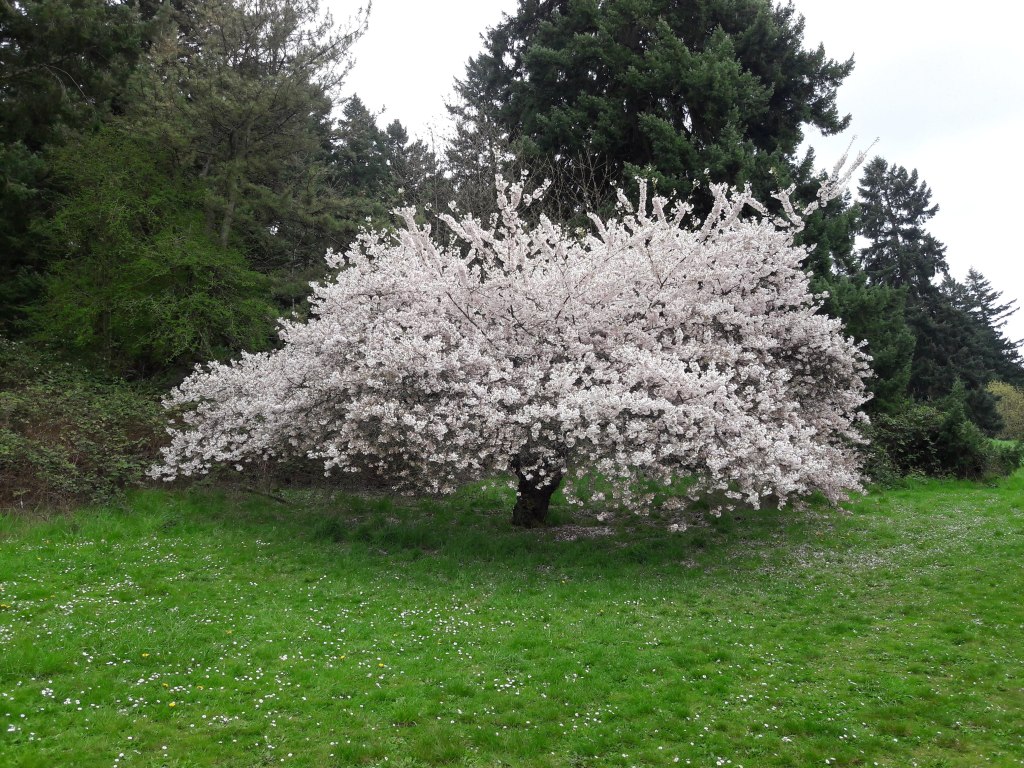
Bly referred to the transference of consciousness idea using the poetic term deep image. Some might consider the ability to so access such images an affliction of the imagination. However it works, the cherry trees in spring seem to attract more than bees, and the pollinators are certainly responsible for more than honey. Here is another photo of one of the cherry trees in Mt Tabor Park, this one accentuated by the surrounding shades of green:
Walter de la Mare chipped in on the cherry tree theme with his poem “The Three Cherry Trees.” He reflects on the passing of both blossoms and viewers. Here is the last stanza:
“Moss and lichen the green branches deck; Weeds nod in its paths green and shady: Yet a light footstep seems there to wander in dreams, The ghost of that beautiful lady, That happy and beautiful lady.”
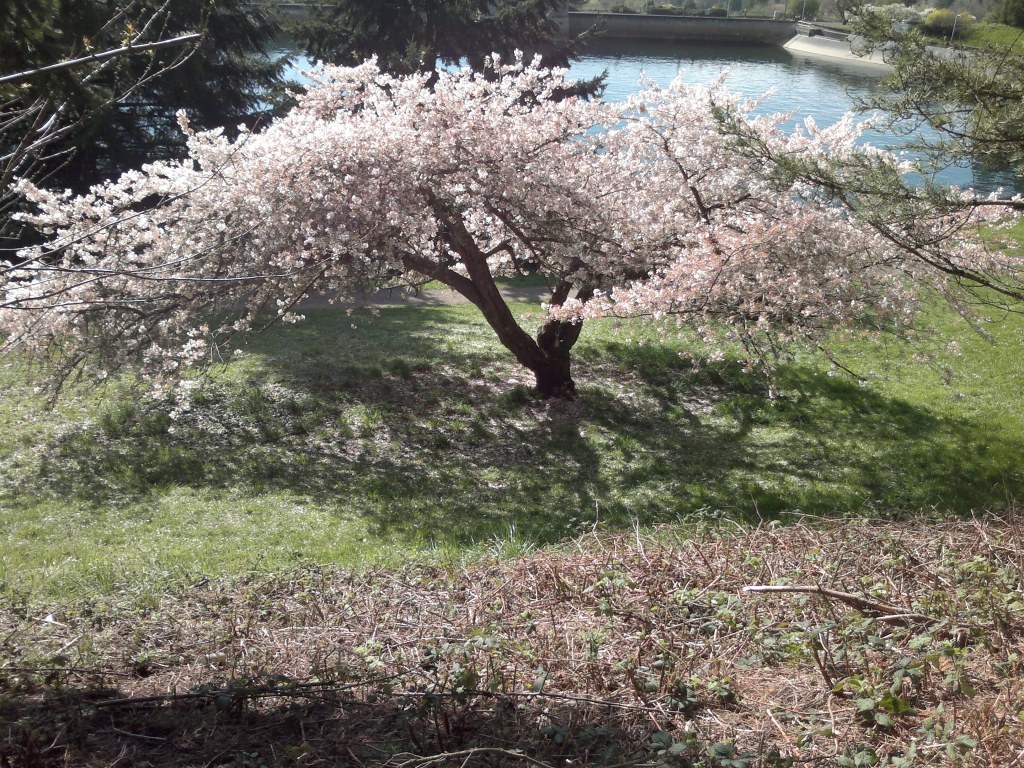
Cherry Tree above Reservoir #5 in Mt Tabor Park
A. E. Housman seemed to conclude waiting for a tree to blossom one might miss the ongoing opportunity to catch other images of that tree. From his poem about the cherry tree titled “Loveliest of Trees”:
“And since to look at things in bloom Fifty springs are little room, About the woodlands I will go To see the cherry hung with snow.”
Images don’t always come with sound. Here is a four second video of cherry blossoms in a wind:
Painting, smearing pigment or dye from a palette to an object for the purpose of catching light, is a physical activity. Whereas Melville begins his great book “Moby-Dick; or, The Whale” explaining why men take to the sea (“Whenever it is a damp, drizzly November in my soul,” Ismael says, and, “If they but knew it, almost all men in their degree, some time or other, cherish very nearly the same feelings towards the ocean with me”), I drop down to the basement or spread a cover over the kitchen table and begin a painting.
“Whale Watch” (2019) Water based oils on Canvas 30″ x 40″:
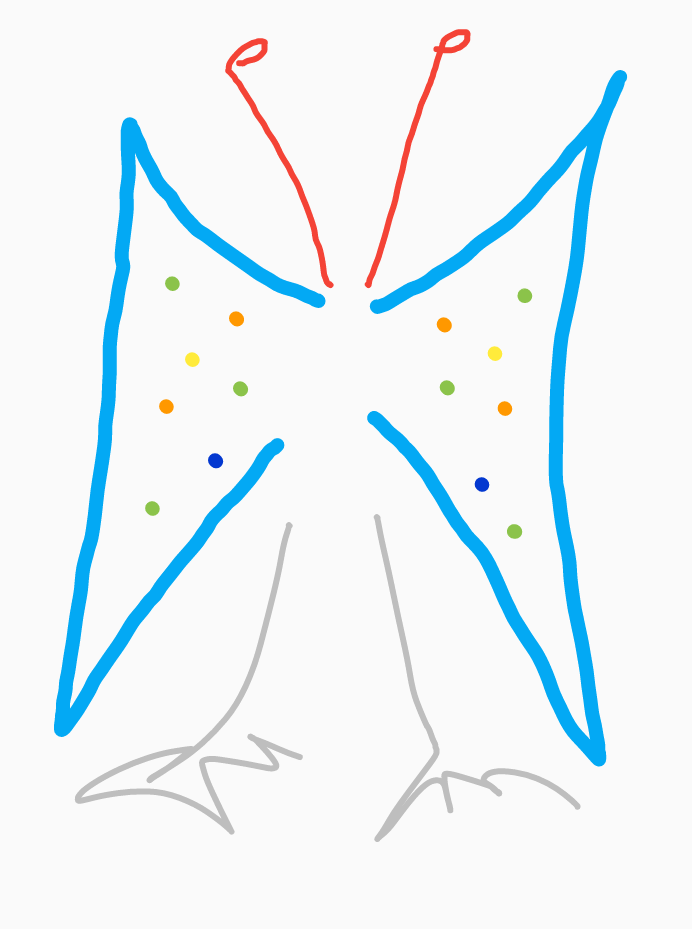
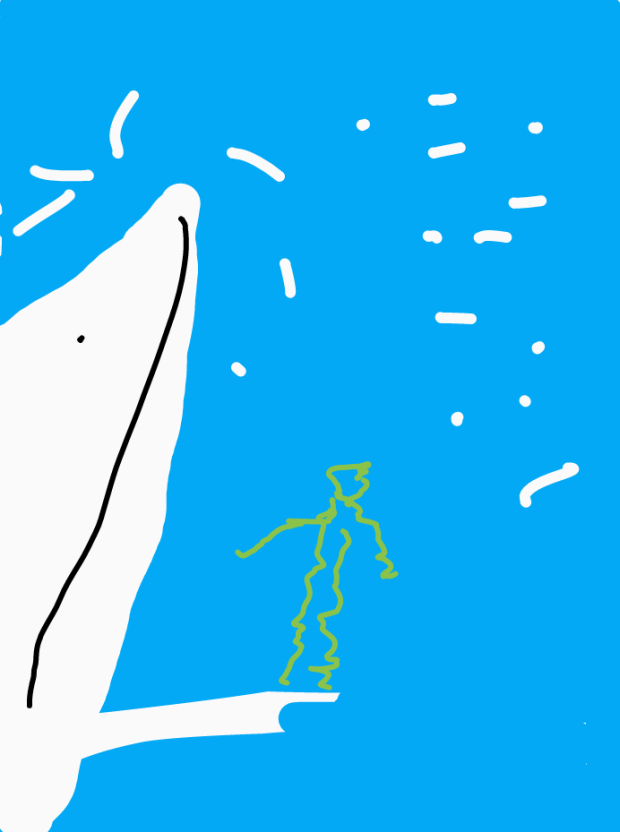
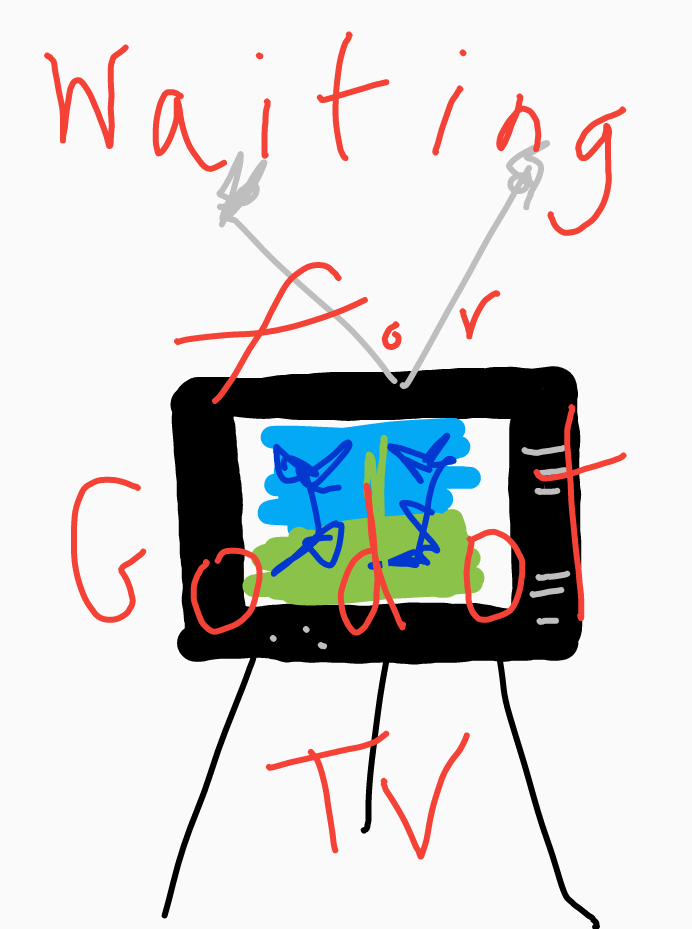
Painting is necessarily physical and messy. Anyone can paint, you don’t need to be an artist, and if you have no paints or canvas or board, you can draw or sketch, on paper or on your cell phone, for example:
Human imagination is part of nature, turning light into food, like photosynthesis in plants. Imagination is a natural process that needs no teacher or school, theory or method. Thus poetry should not become a profession, nor should a poem profess anything, nor should poets become professors. Most formal education activity turns subjects into sports and competition. Imagination is not competitive.
We might see that William Blake, in his “The Marriage of Heaven and Hell” (1790), explains the imagination as a natural means of protecting the human from an onslaught of reality:
“1. Man has no Body distinct from his Soul. For that called Body is a portion of Soul discerned by the five senses, the chief inlets of Soul in this age.
2. Energy is the only life, and is from the Body; and Reason is the bound or outward circumference of Energy.
3. Energy is Eternal Delight.”
William Carlos Williams associated the season of Spring with the imagination. It’s in his short book titled “Spring and All” that we find his now famous poem called “The Red Wheelbarrow.” But we’ve been reading that short piece sort of “à la carte,” or slightly out of context. It appears in “Spring and All” as a numbered poem in a series of poems interrupted in several places by Williams’s prose discussion about what he is doing and why in the way of poetry. There are a total of 27 poems in “Spring and All,” and “The Red Wheelbarrow” is number:
XXII
so much depends upon
a red wheel barrow
glazed with rain water
beside the white chickens
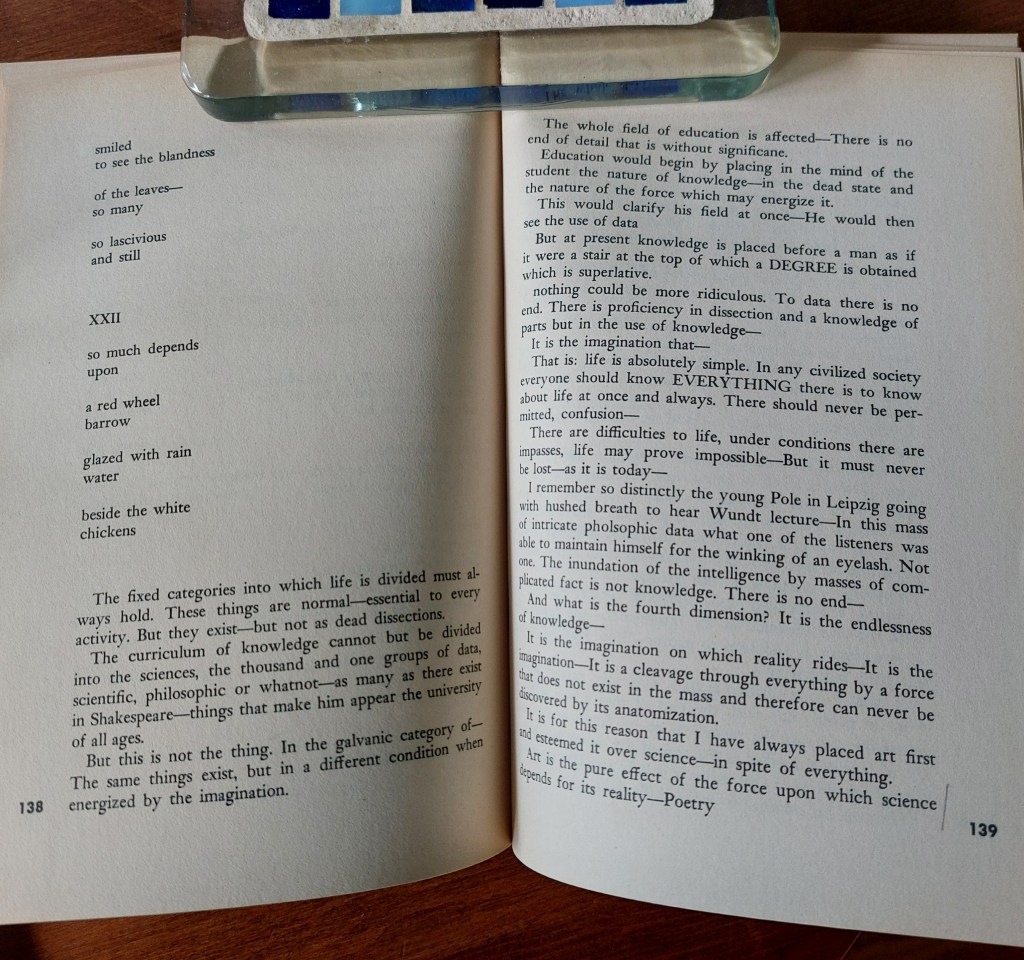
“The Red Wheelbarrow” appears in “Spring and All” on page 138 (Part II: pp 88:151) of my copy of Imaginations (New Directions Paperbook 329, 1971):
pp. 138-139 from “Spring and All” (1923) in Imaginations (NDP329, 1971)
Reading “The Red Wheelbarrow” in the context of “Spring and All” we begin to see how Williams invites the reader’s imagination to absorb the image. It is a well-lit poem. A painting is suggested, and the imagination creates the image (food) from the juxtapositions of color and light and things placed as if by hands (red, white, wheelbarrow, water, chickens, glaze), but will the chickens sit still? Probably not.
A few mornings ago, I walked into the kitchen, set about making coffee, and noticed a line of tiny ants climbing up and down a corner edge, starting from a small gap behind a molding where the wall meets the floor, and when the ants reached the countertop, they went meandering to and fro, around the toaster and coffee maker and compost bucket. And two nights ago, out walking, we came across a nest of what appeared to be the same ant species emerging from a crack in the sidewalk, a line of scouts working their way into a neighboring yard. And early yesterday, the weather still clement, in spite of thunderstorms and tornadoes forecasted for the later afternoon hours, I had taken a morning break with my coffee outside in the fine Spring morning, and when I swung the door open to come back in, a fly the size of Rodan nearly knocked me over as she flew into the house and proceeded to spin around and around near the ceilings, cavorting from room to room.
Spring begins with a pile of chores, and one recalls T. S. Eliot’s seemingly anti-intuitive start to his disillusionist poem titled “The Waste Land”:
“April is the cruellest month, breeding Lilacs out of the dead land, mixing Memory and desire, stirring Dull roots with spring rain.”
Not to mention the appearance of ants awaking from their winter diapause.
“Winter kept us warm, covering Earth in forgetful snow, feeding A little life with dried tubers.”
Soon April, and signs of spring are breeding and mixing in the kitchen and in the air, inside and out. Across the grass, dandelions are sprouting and even flowering already, and the turf at the edge of the sidewalk needs edging. The list goes on, but never mind – I discovered this week Ruth Stout, whose practice of gardening is summed up in the titles to her mid-century books, notably: “Gardening Without Work: For the Aging, the Busy & the Indolent” (1963); and “The Ruth Stout No-Work Garden Book: Secrets of the year-round mulch method” (1971); and her first, “How to have a Green Thumb without an Aching Back: A New Method of Mulch Gardening” (1955).
It was in a New Yorker article of March 17 that I discovered Ruth Stout, sister, as I learned, of the famous detective fiction writer Rex Stout, best known for his protagonist Nero Wolfe. The subtitle to Jill Lepore’s article tells all: “Ruth Stout didn’t plow, dig, water, or weed.” Suddenly, Spring seemed a happier time than how T. S. Eliot described it.
Still, I had ants in the kitchen to deal with, for I learned to my dismay they had nested inside the coffee maker. I surrounded the coffee maker with a moat of vinegar, and when the ants appeared between the moat and the coffee maker, I knew they had to be coming from within the coffee maker, where they must have set up a new nest. Never one to rush for the can of spray that “kills bugs dead” (ad line attributed to Beat poet Lew Welch, by the way), after a bit of research, I decided to try Dr. Bronner’s peppermint soap, having read that ants don’t like peppermint oil. The soap certainly stops ants on contact, and it seems to slow new scouts from returning to the scene.
Meantime, our kitchen counter is cleaner than ever before. I had to retire the electronic coffee maker. I read ants like water and warmth (who doesn’t?), and they can also detect electric currents, including vibes from computers and cell phones and such – so we won’t be able to charge our devices on the kitchen counter anymore, for fear of ants. Imagine ants in your Chromebook, crawling in and out of the keyboard. And we’ve returned to a French press coffee maker, and while it takes a bit longer with more steps to brew, the coffee is robust. And immediately employing the Ruth Stout method, the yard work is quickly done, leaving more time for writing pieces, well, like this one.
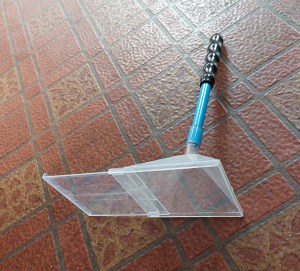
But what of the fly the size of Rodan, the deep reader will be wondering? Advocating a catch and release policy toward all living but unwelcome things, I grabbed the fly catcher and went dancing around the house with the fly. I trapped it in the bathroom, where it had landed on the window screen. To catch a fly with the fly catcher, you have to wait until it lands, approach quickly but stealthily, cover it with the catch door open, then slide the catch door closed with the fly inside the trap. Might sound easy, but it’s often a cat and mouse game as the fly inevitably flickers away at the last second. After several attempts banging around the small bathroom, I caught the fly, then released it into Spring and all wilderness where all Earth life mingles half awake and half asleep.
“The Coming of the Toads” is the title of a short poem by E. L. Mayo:
“‘The very rich are not like you and me,’ Sad Fitzgerald said, who could not guess The coming of the vast and gleaming toads With precious heads which, at a button’s press, The flick of a switch, hop only to convey To you and me and even the very rich The perfect jewel of equality.”
E. L. Mayo. Summer Unbound and Other Poems, the University of Minnesota Press, 1958 (58-7929). Also, E. L. Mayo. Collected Poems. New Letters, University of Missouri – Kansas City. Volume 47, Nos. 2 & 3, Winter-Spring, 1980-81.
The young toads were ugly televisions, but those eerily glowing tubes contained a lovely irony. The toads invaded indiscriminately. The bluish-green light emitted from the eyes of the toads emerged from every class of home, all experiencing the same medium for their evening massage. Mayo’s poem is a figurative evaluation of the effects of media on class and culture.
In Fitzgerald’s short story “The Rich Boy” (1926), the narrator says, “Let me tell you about the very rich. They are different from you and me.” But Mayo doesn’t seem to be quoting from Fitzgerald’s story. He seems to be referencing the famous, rumored exchange by the two rich-obsessed, repartee aficionados Hemingway and Fitzgerald. Hemingway wrote, in his short story “The Snows of Kilimanjaro” (1936):
“He remembered poor Julian and his romantic awe of them and how he had started a story once that began, ‘The very rich are different from you and me.’ And how some one had said to Julian, Yes, they have more money. But that was not humorous to Julian. He thought they were a special glamourous race and when he found they weren’t it wrecked him just as much as any other thing that wrecked him.”
Did TV have a democratizing effect, or are its effects numbing? In Act 2, Scene 1, of Shakespeare’s “As You Like It,” Duke Senior, just sent to the woods without TV, mentions the toad’s jewel:
“Now, my co-mates and brothers in exile, hath not old custom made this life more sweet than that of painted pomp? Are not these woods more free from peril than the envious court? Here feel we but the penalty of Adam, the seasons’ difference, as the icy fang and churlish chiding of the winter’s wind, which, when it bites and blows upon my body, even till I shrink with cold, I smile and say ‘This is no flattery: these are counselors that feelingly persuade me what I am.’ Sweet are the uses of adversity, which, like the toad, ugly and venomous, wears yet a precious jewel in his head; and this our life exempt from public haunt finds tongues in trees, books in the running brooks, sermons in stones and good in every thing. I would not change it.”
Fitzgerald didn’t embrace television, but today he might cradle a metamorph tadpole in his lap. What would it convey? The toad’s jewel is more than a metaphor; the churlish shows of television are today the Duke’s counselors. We enter the space of the light box, and the toad’s jewel poisons us to the paradox of staying put, to electronic exile, but does it contain its own antidote, the toadstone?
“Susanna Oh Susanna” (Original song with lyrics, chords, and video below)
C Mornings when we wake up on the deep blue sea G7 Afternoons sleeping under a green palm tree
E7 Evenings when you call me A7 Come out wherever you are D7 On the radio playing G Patty and Ray
C Susanna oh Susanna I can’t even say your name G7 And all I have for you is more of the same
E7 Hiding in the evening A7 When you call my name D7 On the radio playing G Patty and Ray
C Days falling down like waves on the beach G7 Every night you drift farther out of reach
E7 Evenings when I call you A7 Come over here my love D7 On the radio playing G Patty and Ray
“Susanna Oh Susanna,” recorded on cell phone and played on a Gretsch G2420. D’Addario XL Chromes Flatwound Electric Guitar Strings (.011-.050). Fender Champion 20 amplifier. Simple one take setup. Watch video here or on YouTube.
 The Coming of the Toads