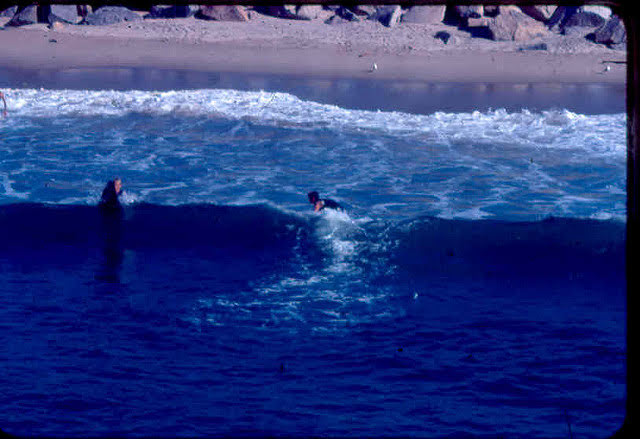
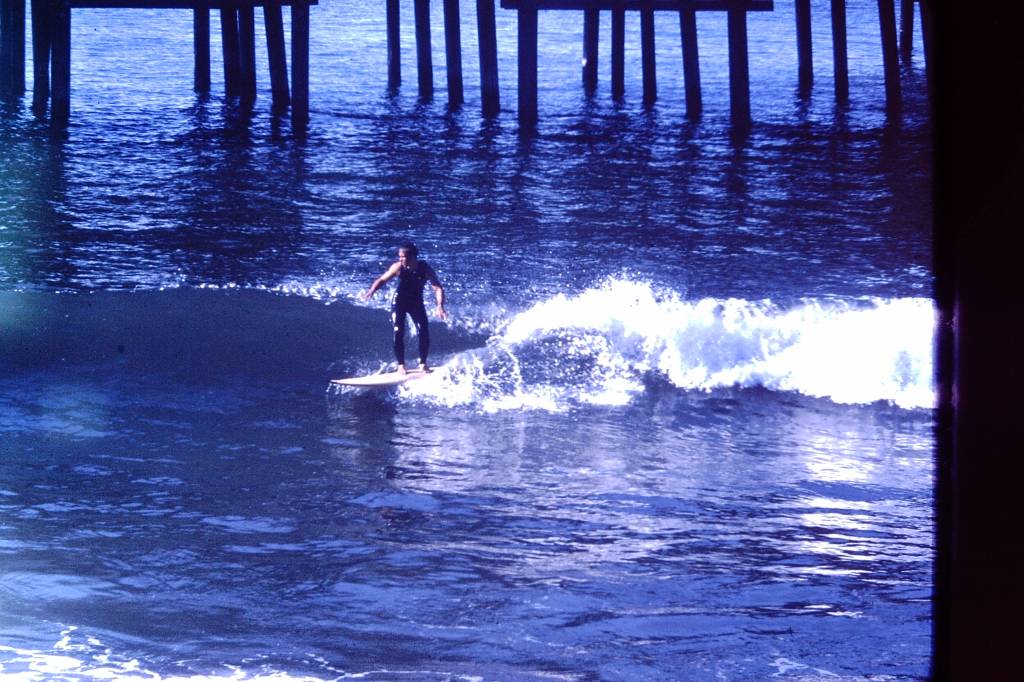
The third in a series of surfing slides taken at the Redondo Beach horseshoe pier late 60’s early 70’s posted for “Sliding into Saturday.” 35 mm Ektachrome slide taken with an Exakta 500 with 120mm portrait lens.
“Sliding into Saturday” is a blog meme, a day-themed prompt for posting electronic copies of old slide transparencies, usually 35 mm slides, but also 120 and 110 formats.
No, I’ve not been living in a hotel; that would be Nabokov at Montreux Palace, Twain at the Chelsea, Simone de Beauvoir at the Hôtel La Louisiane. I’ve been reading books that take place in hotels. Some hot telling going on there, too.
I just finished reading aloud to Susan “The Enchanted April,” by Elizabeth Von Arnim, first published in 1922, our copy a Penguin Classics, 2015. The Mesdames Wilkins and Arbuthnot answer an advertisement and arrange to spend a month in Italy:
“To Those who Appreciate Wistaria and Sunshine. Small mediaeval Italian Castle on the shores of the Mediterranean to be let Furnished for the month of April. Necessary servants remain. Z, Box 1,000, The Times.” (3)
Who could resist? Not the insistent frumpy Mrs. Wilkins, who talks the reserved Mrs. Arbuthnot into the adventure, and the two abandon their troubled husbands in fog everywhere London, recruit two additional to their party to help defray expenses, the young and extraordinarily lovely socialite Lady Caroline and the lonely aging Mrs. Fisher, and train down to the sunny gardeny clime.
Not strictly speaking a hotel, the castle originally a Genoese fortress, built to protect Portofino’s harbor, but Castello San Salvatore functions like a hotel in the book’s closed setting and stage-play like structure, where no character is at first what they might seem to be, and class or social structures or strictures are dissolved to reveal the human frailties of psychological skeletons. But if that sounds like a horror, it’s not; the book is profoundly funny, each character misinterpreting another in a comedy of manners, such that we first see each character not for what they are, or might become, but what someone else thinks they are, or where they might have come from, ignorant of their true origins, problems, needs and wants.
And before “The Enchanted April,” I had recently reread Elizabeth Bowen’s “The Hotel” (1927), her first novel, also set on the Riviera. Bowen’s writing style is different from Arnim’s, though both often feature long convoluted or circuitous sentences, subjects and objects meandering like mallards down steams through a woods, often placed somewhat distantly and not quite directly from predicates. Something like that; I haven’t actually diagrammed any in the old school way. But the common reader may find such writing distracting; it’s not Dashiell Hammett.
And I also recently read Anita Brookner’s Booker Prize winning “Hotel Du Lac” (1984), though here the setting is Switzerland and it’s coming on fall and winter and cold out, reminding me of home:
“The beautiful day had within it the seeds of its own fragility: it was the last day of summer. Sun burned out of a cloudless blue sky: asters and dahlias stood immobile in the clear light, a light without glare, without brilliance. Trees had already lost the dark heavy foliage of what had been an exceptional August and early September and were all the more poignant for the dryness of their yellowing leaves which floated noiselessly down from time to time.” (67)
And time, and now, but it would be inaccurate to say suddenly, still, here we are just a little over a week from winter solstice when the days will begin to, in spite of the cold, last each a little longer and potentially at least warmer. But for now, back to the hotel of books, until the wistaria and sunshine return in bloom and heat and smell and we can open again our own hotel, now closed for the winter.
Jay Caspian Kang’s article in the online New Yorker this week reminded me of the early days at the Toads, when the “Reading Crisis” first appeared. The argument, at the time somewhat famously mentioned in the TheAtlantic article “Is Google Making Us Stupid,” and in a couple of Caleb Crain articles in The New Yorker, including “Twilight of the Books,” was formally discussed in the Congressional Quarterly Researcher. Kang’s article is titled “If You Quit Social Media, Will You Read More Books?”
Never mind false dichotomies, not to mention the embedded claim that reading books is somehow superior to spending time on social media, it’s a worthwhile, as refreshing as the changing seasons, question. I tried just the other day to quit the blog; would I read more books? That resolve lasted not even a week. The habit of writing almost daily for 18 years (the blog, 8 books, plus stuff for various jobs) was harder to kick than I had anticipated.
Last year (as usual late to the book club), I read Kang’s book “The Dead Do Not Improve” (2012), which I enjoyed for its San Francisco setting and its surfing theme, but I’m not sure I learned anything from it, other than Kang’s a good writer, by which I mean his book accomplished its objectives. But I did not read it to learn anything, but for pleasure, but I’m still not too pleased with the title, but I get it: there are no tidy endings in a random world.
That reading anything in any amount suggests being or becoming smarter is already a tired bias held by, well, those purportedly who read the most. But Kang, in the article, admits to trading book time for phone time, and he’s concerned reading skills might be atrophying, and that he’s wasting time on social media even while facing a deadline for a new book that he, well, will want others to put their phones down and read.
But what we do learn from reading, or should learn, though it’s sometimes intuited, such that we might not even realize we’re getting it, is rhetoric, by which we mean the art of persuasion, and, of course, rhetoric can be misused, and only by reading extensively will we come to recognize rhetorical devices being used and their effects on us. Still, as for reading making us better people, there have been and still are well read people who are arguably not the best examples of humanity, but even that doesn’t mean we should give up reading as a way to improve our minds, our spirits, our conversations: as Becket said, “Ever tried. Ever failed. No matter. Try again. Fail again. Fail better” (Worstward Ho, 1983).
There are many activities that keep us from reading: playing a musical instrument, watching a movie or listening to a baseball game on the radio, playing cards, attending church, talking – not to mention work: waitressing, plumbing, nursing, gardening. Does it follow that if we abandon any of these activities we’ll read more?
But if we are reading fewer books, are we becoming more illiterate or non-literate? There’s a difference. It’s impossible to be illiterate in a non-literate culture, as McLuhan showed. And people in non-literate cultures have never been and are not now stupid; on the contrary.
Surprise! Surprise! Surprise! Epizeuxis! Epizeuxis! Epizeuxis! “Hoopsa boyaboy hoopsa! Hoopsa boyaboy hoopsa! Hoopsa boyaboy hoopsa!” The Toads are back in town The Toads are back in town The Toads are back in town And they won’t be bot out! No, they won’t be bot out! And won’t be fooled again!
An astonishing revival! An awesome comeback! Wysiwyg! Wysiwyg! Wysiwyg!
Who’s this? What’s that? I didn’t know they’d gone! Yeah, meet the new toad, same as the old toad. But with a twist you say now the toads are everywhere – “Here Comes Everybody,” or Everytoad, Joyce’s streaming “riverrun” full of toads blinking from every hand on every riverrun road.
Here Comes Everyone and every zero where everything gets down: h → 01101000 e → 01100101 l → 01101100 l → 01101100 o → 01101111 ! → 00100001
The Coming of the Toads blog on WordPress ran for 18 years, from December 2007 into December 2025, with posts monthly, ending with a total of 1,588 posts, this being the last one. Past posts, pages, and archives remain open.
Surfing at Horseshoe Pier in Redondo Beach CA, 1969. Unknown surfer. 35 mm Ektachrome slide taken with an Exakta 500 with 120mm portrait lens.
“Sliding into Saturday” is a blog meme, a day-themed prompt for posting electronic copies of old slide transparencies, usually 35 mm slides, but also 120 and 110 formats.
The modish tech are not like you and me, Oblivious to the tittle-tattle bots that scan Indiscriminately our invisible windows, Performing the dirty work for all of us, You and me and even the next gen AI sprung from Pandora’s Valley, Where we pass all understanding.
Mayo’s poem “The Coming of the Toads” suggests a class irony that stems from the idea technology flattens the distance between elite and common people. The Toads are television sets in the 1950s. But do machines equalize society or disappear people? “The Coming of the Bots” poem, a clear “after Mayo” exercise, suggests a third possibility.
Here’s the Mayo poem, from which The Coming of the Toadsblog gets its name:
The Coming of the Toads
“The very rich are not like you and me,” Sad Fitzgerald said, who could not guess The coming of the vast and gleaming toads With precious heads which, at a button’s press, The flick of a switch, hop only to convey To you and me and even the very rich The perfect jewel of equality.
E. L. Mayo. Summer Unbound and Other Poems, the University of Minnesota Press, 1958 (58-7929). Also, E. L. Mayo, Collected Poems. New Letters, University of Missouri – Kansas City. Volume 47, Nos. 2 & 3, Winter-Spring, 1980-81.
Following my recent immersion in all things Bots, my friend Bill suggested “The Coming of the Bots” might make a good name for a new blog. I’ll leave that to Bill. We can’t see bots, but we can still watch TV. Readers interested in a longer discussion of the Mayo poem and other ideas for the Toads might find the About page of interest. Meantime, I think I’m done with bots for now. I’m going to try to focus on things I can see.
Regarding the invasion of the Bot snatchers: Google Search Console provides a useful alternative to stats. It’s easy to set up and returns queries used to reach your site, as well as actual pages viewed, countries (sans bots!), and average position (the average position of your site in search results, based on its highest position whenever it appeared in a search). Interesting to the stats hobbyist. Simple and relevant.
In between books, having finished Audrey Magee’s “The Colony,” which takes place on an island off the coast of Ireland, involving two summer visitors at odds in purpose and reception, an English oil paints artist come to paint the cliffs and sea, and a French-Algerian linguist come to study the Irish language as spoken by the few locals. “The Troubles” are followed via transistor radio and interrupt but augment the plot chapters like newsreels before the main feature continues.
And so with nothing to read bunkside brought to bed Ferlinghetti’s “Pictures of the gone world,” Number One in the City Lights Books Pocket Poets Series. Originally published in 1955, I have the second edition, January 1995, sporting 18 new poems, which explains some of the references in poem number 34 (the poems are numbered, not titled). Here are a few lines from different parts of “34”:
“Surfers are Poets too…They too are looking for the perfect wave…the endless light at the end of the tube of time…These are not cyberpunks surfing through cyberspace / They are sailors who know that the sea like life has its rages…dashing the poem of your endless summer…”
In bed reading “34” aloud to Susan (for we both endlessly enjoy all things surfer and summer), it occurred to me that I might say that the poem illustrates why Ferlinghetti is a good but not a great poet and why I prefer good poets to great poets. But then I decided not to say it. But then here it is anyway, in miscellany style.
I had also brought to the queen bunk Raymond Queneau’s “Exercises in Style,” previously mentioned here. Endlessly enjoyable, quite the study. The 2012 New Directions edition includes ten newly written versions of the original anecdote written by guest writers “in homage,” and it occurred to me I could add an 11th new version, titled A.I. But I have not done so, and probably won’t.
It began with a surprising increase in traffic. September hit 3,000 views, October 4.5 thousand. In the 18 year history of the blog, the monthly average number of views has rarely touched 1,000, and November is already at 9,000, not quite half way through the month.
The blog stats were being invaded by bots, scrapers and spam bots, almost all from one country, a crawling activity. Why? To collect data, copy text, or probe for vulnerabilities? The bots don’t actually read, click, or loiter. Stats counts them as views because they look like ordinary visitors loading pages, but there’s no real human engagement. Bot is short for robot, but today simply suggests a tirelessly, endlessly automated worker specialized in tasking repetitively without meaning.
Along with the bots came an influx of followers. Simply put, Stats were absurdly inflated and the number of followers a misleading count. A bit of research found the bots posed no significant risk, but they are annoying and pretty much render Stats meaningless, or at least difficult and time consuming to understand. The spam followers featured a kind of spooky presence. What to do?
Try Google Analytics, where it’s possible to filter out unwanted activity from Stats. Still in test mode, but not sure the filter’s working. But even if it works and excludes the bots, that simply means the bots are not being counted; it doesn’t stop the bots from crawling through the site, like neutrinos passing through your body. What else might hold back the bots?
Disallow likes and comments, possible spam entry points. But without likes and comments, and given the unreliability of Stats, one has lost all meaningful information for determining engagement. So turn comments back on, but require users login to comment. Keep the site minimal. To this end, convert the Seedlet theme, which is minimal and was working fine but relied on the classic editor, to something newer that uses the block editor and possibly benefits from more attention and up-to-date programming. So converted to the Twenty Twenty-Five theme, which seems to be working well.
The conversion of the old theme to the newer one was quick and easy. Learning curve not too steep, fun messing around with greater control and more options over things like fonts and text and being able to make changes specific to certain sections or applied to the whole site at once. Still playing around with options. The change did result in a few glitches that probably no one will notice, things that might have been fixed but were not, like the font size in the oldest posts, which still don’t conform to the current selection, or the position of photos in wrapped text, again mostly in older posts, but overall the site seems to be working as designed, effective in its minimalist intent, but if a real viewer sees something is looking unintentionally weird, maybe they’ll leave a comment?
Jack Finney, “The Body Snatchers,” 1955, serialized in Colliers Weekly in November and December 1954. “The Invasion of the Body Snatchers” is the 1956 film based on Finney’s novel. ↩︎


 The Coming of the Toads