-
Current Conditions, Fall Walk on Mount Tabor
For this Fall walk on Mount Tabor, I took the same paths, photographing the same trees and views, as I did on a walk in Spring of last year.


This week’s Rolling Stone magazine sports a good psych-brain article on the difference between fear and anxiety. One difference is that fear appears to be a kind of GPS (Global Positioning System), constantly mapping our current conditions, while anxiety plays out what we’re thinking might happen to us at some point in the future. The angle of the RS article is the effect of so-called fear manipulation infusing the current election campaigns and resulting media coverage.
“No reason to get excited,” the thief, he kindly spoke
“There are many here among us who feel that life is but a joke
But you and I, we’ve been through that, and this is not our fate
So let us not talk falsely now, the hour is getting late”All along the watchtower, princes kept the view
While all the women came and went, barefoot servants, too…Bob Dylan, “All Along the Watchtower“
But I’m not always sure what comes first, the campaign or the media coverage, Dylan’s thief or his joker. It’s not fear but anxiety that’s being manipulated. Fear is immediate, warning and response: take cover; not here, not now, not me; play dead; run for the hills. The problem with anxiety is there is no response, only a warning. We’re incapacitated, not with fear, but with not knowing which way to turn. Fear draws a map; anxiety is a riptide we can feel but can’t see, “no direction home.”
Fall suggests to some only a warning winter is coming. Anxiety prevents us from feeling the truth of our current conditions. That is why in literature, Winter is the season of irony and satire, Fall the season of tragedy (Summer of romance, Spring of comedy). And our current conditions usually change slowly. Yes, the leaves are changing color and falling and Winter is icummen in, but an endless summer is impossible; it will take time to finish the new novel – I’m thinking Spring, 2017, before another book launch, but I’m not anxious about it, and certainly not afraid of it. When I’m writing, I feel no anxiety, like a walk in the park in Fall.
-
Fantasy Democracy: Notes on Capital, Politics, and Voting
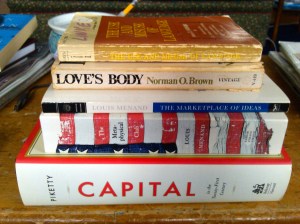 Louis Menand’s “The Marketplace of Ideas: Reform and Resistance in the American University” (2010) questions why forms of higher education have been so intractable against change. One reason suggested is the surprising conservatism revealed of professors as a group, surprising because professors are often associated with more liberal stances and presumed to understand the connections between one’s views and why one might hold those views. Understanding and questioning one’s own assumptions and presuppositions are important antidotes to the poisons of propaganda. Menand describes the 2007 national survey conducted by Gross and Simmons of full time faculty members. Part time instructors were not included, a group that no doubt would have presented particular “methodological challenges” (134), because the adjunct does not share homogeneous characteristics to a group of tenured professors. In any case, more important to notes on a fantasy democracy is Menand’s reference to an older study of the population as a whole.
That study found that
“In the general population, most people do not know what it means to identify themselves as liberals or conservatives. People will report themselves to be liberals in an opinion poll and then answer specific questions with views normally thought of as conservative. People also give inconsistent answers to the same questions over time” (134 – 135).
In footnotes, Menand explains the primary sources of his research: “Gross and Simmons used a number of measures to confirm the self-reporting: for example, they correlated answers to survey questions about political persuasion and political party with views on specific issues, such as the war in Iraq, abortion, homosexual relations, and so on” (134), while in “the classic study [of the general population]…results have been much confirmed” (135). That study, by Philip Converse, titled “The Nature of Belief Systems in Mass Publics,” was published in Ideology and Discontent, in 1964.
Why would the explanations of the average person on the street not correlate, be inconsistent, even incoherent? Menand says,
“This is because most people are not ideologues – they don’t have coherent political belief systems – and their views on the issues do not hang together. Their reporting is not terribly accurate” (135-136).
That they nevertheless vote for people and issues they think they understand but probably don’t might simply create some random noise in the results, filtered out by some law of large numbers; or, what we think of as our democracy is a kind of fantasy, but one that, like fantasy sports teams, is based on a reality, and can be a lot fun, lucrative, or provide for any number of teachable moments and lessons learned. Outcomes often include random or chance influence.
An example of the questioning of assumptions and presuppositions as important to understanding causal correlations can be found in Thomas Piketty’s “Capital in the Twenty-First Century” (2014). At the end of his Introduction, Piketty says,
“The history of income and wealth is always deeply political, chaotic, and unpredictable. How this history plays out depends on how societies view inequalities and what kinds of policies and institutions they adopt to measure and transform them. No one can foresee how these things will change in the decades to come. The lessons of history are nevertheless useful, because they help us to see a little more clearly what kinds of choices we will face in the coming century and what sorts of dynamics will be at work….Since history always invents its own pathways, the actual usefulness of these lessons from the past remains to be seen. I offer them to readers without presuming to know their full import” (35).
Piketty’s primary statement, his argument, is expressed in a simple formula that illustrates a fundamental inequality in the creation and distribution of wealth that promotes ever greater risk of variance or disparity between the wealthy and the rest of society. The formula is
“r > g (where r stands for the average annual rate of return on capital, including profits, dividends, interest, rents, and other income from capital, expressed as a percentage of its total value, and g stands for the rate of growth of the economy, that is, the annual increase in income or output)” (25).
What happens when r is much greater than g? Piketty says that
“it is almost inevitable that inherited wealth will dominate wealth amassed from a lifetime’s labor by a wide margin” (26).
And what when that happens? The divergence of inequality reaches
“levels potentially incompatible with the meritocratic values and principles of social justice fundamental to modern democratic societies” (26).
In other words, inequality reaches such an extreme that democracy is at risk of becoming a fantasy. There is of course much more to Piketty than appears here (his book runs to 685 pages). But how might politics and voting influence wealth divergence such that r does not become overly concentrated and grow at a rate that increasingly continues to outpace g, undermining the very structure on which the accepted values (what is wanted) of the society in question are based, undermining the structure to an unsustainable level, and the whole system collapses? Collapse is what Karl Marx predicted.
Was Marx wrong? “Not yet,” says Louis Menand in a recent New Yorker article:
“Marx was also not wrong about the tendency of workers’ wages to stagnate as income for the owners of capital rises. For the first sixty years of the nineteenth century—the period during which he began writing “Capital”—workers’ wages in Britain and France were stuck at close to subsistence levels. It can be difficult now to appreciate the degree of immiseration in the nineteenth-century industrial economy. In one period in 1862, the average workweek in a Manchester factory was eighty-four hours.”
And wages are once again at stagnation, benefits at a minimum, if any level at all, pensions something your grandfather once had, and if you’re an adjunct instructor, your 84 hours are made up working on eight different campuses simultaneously.
“How we think and evaluate,” said S. I. Hayakawa in his Introduction to “The Use and Misuse of Language” (1962), is inextricably bound up with how we talk.
“If our spoken evaluations are hasty and ill-considered, it is likely that our unspoken ones are even more so….the unexamined key-words in our thought processes, whether ‘fish’ or ‘free enterprise’ or ‘the military mind’ or ‘the Jews’ or ‘creeping socialism’ or ‘bureaucracy,’ can, by creating the illusion of meaning where no clear-cut meaning exists, hinder and misdirect our thought” (viii).
The use of “unexamined key-words” permeating portals such as Twitter and Facebook, both of which are largely venues for “unspoken evaluations,” provides a contemporary example of Hayakawa’s example of how
“all prejudices work in just this way – racial, ideological, religious, natural, occupational, or regional. Like the man who ‘doesn’t like fish,’ there are the ideologically muscle-bound who ‘don’t like the profit system’ whether it manifests itself in a corner newsstand or in General Motors, or who ‘reject government intervention in business’ no matter what kind of intervention in what kinds of business for what purpose” (viii).
Hayakawa was concerned not with the “correctness” of people’s talk, but with “the adequacy of their language as a ‘map’ of the ‘territory’ of experience being talked about” (vii).
That territory is now pockmarked with unhappiness and anxiety across the whole landscape of voting experience, as the “keywords” of its mapping search features illustrate: “pussy,” “locker room,” “wall.”
Where a pussy might be an opening in a locker room wall. I had a bit of juvenile fun on my own Facebook page recently. And it’s always interesting to see what keywords incite what reaction when they trigger the unspoken. I was working with satire and sarcasm (one difference being that satire usually has a target, while sarcasm is closer to farce, which is comedy without a target). Anyway, here are the posts I put up over the span of a few days:
Trump tries to woo Nobel Committee, says, “I’m going to make poetry rhyme again!”
Trump to dig moat around his locker room and fill it with crocodile tears.
English majors organizing to protest musician winning Nobel for Literature.
Trump to build wall around his locker room to keep Media out; meanwhile, Hillary advocates for Locker Rooms Without Borders.
Trump to defecting GOP supporters: “Wait! I’m going to make Mud Wrestling great again!”
Trump to open new restaurant franchise called Locker Rooms, to compete with Hooters.
Leak reveals Trump’s locker room not as big as he claimed.
Regent University to name new Locker Room after Trump. Says Robertson, “We’re going to make locker rooms great again!”
Trump on the Issues: “I thought they said ‘tissues.’ Stay on the tissues. I didn’t know what the hell they were talking about!
But where do the fundamental keywords that move thought from the unspoken sphere to a spoken realm come from?
In “Love’s Body” (1966), Norman O. Brown suggested words and ideas come from the body. Thus, we have a “head of state,” who sits at “the seat of government,” trying to control the “body politic”:
“’A Multitude of men are made One person.’ The idea of a people is the idea of a corporation, and the idea of a corporation is the idea of a juristic person. ‘This is more than Consent, or Concord: it is a reall Unitie of them all, in one and the same Person.’ Out of many, one: a logical impossibility; a piece of poetry, or symbolism; an enacted or incarnate metaphor; a poetic creation. The Commonwealth is ‘an Artificial Man,’ a body politic, ‘in which,’ the Soveraignty is an ‘Artificial Soul; the Magistrates, and other Officers of Judicature and Execution, artificiall Joynts,” etc. Does this ‘Artificiall Man,’ this ‘Feigned or Artificiall Person, make ‘a real Unitie of them all”? Are juristic persons real, or only legal fictions, personae fictae? ‘Analogy with the living person and shift of meaning are the essence of the mode of legal statement which refers to corporate bodies.’ Is the shift of meaning real? Does the metaphor accomplish a metamorphosis? ‘The Pacts and Covenants, by which the parts of this Body Politique were at first made, set together, and united, resemble that Fiat, or the Let us make man, pronounced by God in the Creation.” Or like the hoc est corpus meum, This is my body, pronounced by God in the Redemption. Is there a real transubstantiation? Is there a miracle in the communion of the mortal God, the great leviathan; a miracle which gives life to the individual communicants also? For so-called ‘real,’ ‘living,’ ‘natural’ persons, individual persons, are not natural but juristic persons, personae fictae, social creations, no more real than corporations.”
Hobbes, Leviathan, 3-4, 136, 143.
Wolff, “On the Nature of Legal Persons.” Hart, “Definition and Theory in Jurisprudence. -
Notes on the Art and Style of Whiskey Radish


To my odd ears, usquebaugh, from which whiskey derives, reminds me of the wedding party that year in Berkeley, and he…, and he couldn’t say…, or, he could not pronounce…, but that was nothing to the question of how he got the overstuffed hotel room chair through the bathroom door and up to the toilet, where he “addle liddle phifie Annie ugged the little craythur” (Joyce, FW), the toilet bowl, that is, speaking or repeating “usquebaugh” to us when we asked if he wasn’t good to go. Meanwhile, Beckett seemed always ready and able to pull a root fruit from one of his pockets, a turnip or a radish, and we went back into the sleeping space, where we had a lovely view of the hotel gardens and of the ocean in the distance. The night crashed like a wave in slow motion. In the morning there were a few stale beers and day old croissants for breakfast, and everything seemed fine, but we no longer hear from Usquebaugh, who over time seems to have grown uncomfortable with the dearth, in the belief, no doubt, that wealth is Thee all purpose cleaner, and it’s no doubt true that to get things really clean you must first grow so small.
I suppose I could give Beckett a call even now and we might go off for 9 holes of pique or a day of thought at the beach or river. He was, after all, a man of action, someone who made something. But what he made had to have a use. It wasn’t enough to be a man of action; you had to be a man of practical action. What would be the point of wedding dearth?
All of which may serve as an introduction to Whiskey Radish – in as much as I actually don’t know much about whiskey, how to speak Usquebaugh, or the comics artist Whiskey Radish. So I looked it up, as James Thurber, nearly blind and with no idea “You could look it up” would evolve into “You could Google it,” suggested. Thurber was a comic who wrote and made drawings. So that’s the angle and the segue I’m going with here, as these things go, if they go at all. Segue does not at all mean uninterrupted. It simply means follows, even if what follows does not follow. You follow? What does not follow is not necessarily non sequitur. What follows is only non sequitur if your expectation was somehow otherwise. What else could he have said sitting in the big chair pulled magically into the tiny bathroom and conveniently and suitably up to the commode over which his head dangled, whispering “usquebaugh”? In any case, we were unable to repeat the magic the next morning before checking out and had to leave the chair abandoned in the bathroom. I suspect they must have had to remove the bathroom door to get the chair back out into the hotel room. There’s a cartoon there, Beckett in the plush chair pulled up to the awful all full bowl, but I’ve no caption for it, no text. “This seat taken,” maybe.
Whiskey Radish makes drawings, comic style, but with the telling swipe of a Picasso line, pen brush and ink, which include handwritten text. Comics. The narratives are characterized by obscure and everyday references, personal or learned, street lingo punctuated with French phrase suggestion. The characters are sometimes identifiable but always original, as is the case with the banjo playing “Sam Cat,” a bartender’s assistant, the lines and text sometimes sparse, laconic, suggestive, but often detailed, loquacious.
Satire and romantic themes, unrequited lines, drawings, jobs, entertainments. The life of the artist thematically underscored. There’s a “whozwho” of Whiskey Radish characters on the Whiskey Radish website. The text includes what is left out.
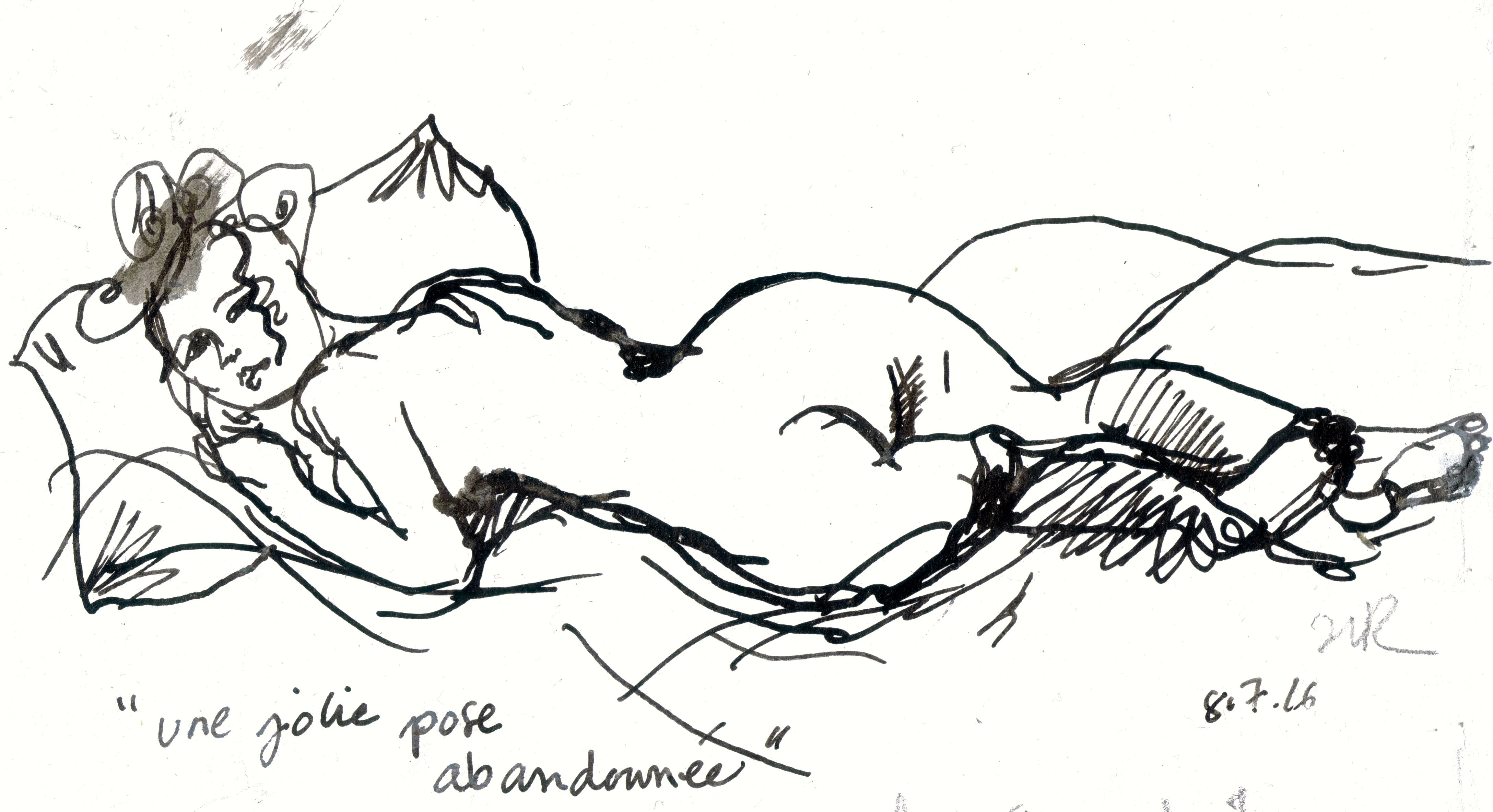
In the drawing enclosed, “une joile pose abandownee” (a pretty pose abandoned), we see, in black India ink over a thin acrylic base on rice paper, simple Picasso-like lines fulfill a statement that is an argument. There is a sleepiness in the eyes, a sadness, a triest, a torpor, a disappointment perhaps, or maybe that is the sense or touch or expression of abandonment, not of abandon, but of the abandonment that follows abandon, when one is not sure about one’s body, after all. And about the mouth, the lips, there is the indecisive shape of a pout that becomes a grimace that settles into a disregard, also after all. After all is said and done, whether we are finished or not, it’s over. Certain lines are crossed, crossed out, a kind of permanent erasure.
Technique is not style. Technique is something that has a beginning and an end, a procedure, a program, a convention. Technique can’t be abandoned. It can be unfinished, but that’s not the same as abandoning a work. Look at Kafka. Abandoned cartoons. Joseph K is Buster Keaton. Style is usage. Cartooning is vaudeville. You can only abandon style, because style can’t be finished. “A pretty pose abandoned” (the Whiskey Radish version) is graffiti over the 1897 “Baigneuse,” bather, by Jules Scalbert. It’s a study of a study. Do bathers pose? Is there a technique to bathing? Water paints. And the Whiskey Radish version is abandoned. Only abandonment can create style. Technique is inherited. The slow bath becomes the quick shower.
McLuhan explains: “The structural qualities of the print and woodcut obtain, also, in the cartoon, all of which share a participational and do-it-yourself character that provides a wide variety of media experiences today. The print is clue to the comic cartoon, just as the cartoon is clue to understanding the TV image” (McLuhan, 1964, “Understanding Media: the Extensions of Man,” Chapter 17, “Comics: Mad Vestibule to TV,” p. 151). Touch, McLuhan says, is the most involving of all the senses. And television, like the cartoon, is tactile; the cartoon requires audience participation. This is why we are drawn to drawings; we can participate. We must participate. We have to fill in what’s missing to get what was abandoned. We can listen to the radio while doing chores around the house, but if we turn on the television, we have to sit and watch and listen and participate, and the chores have to wait. That, for McLuhan, is the difference between hot and cool. We must get involved in a mosaic, the opposite experience from the detachment we might enjoy reading a book. “…the hot form excludes, and the cool one includes” (p. 37). Hot is technique; cool is style. The old newspaper cartoon pages were mosaics.
Considering the art and style of Whiskey Radish, we sense the abandon, the abandonment. The artist tries to bring something under control, only to give in to that control. The artist gives technique the deep-six. The cartoon disclaims and disavows, disses.
“Une joile pose abandownee” (abandonné?) is somewhere between cartoon and drawing. It’s Warhol technique; Andy was able to take a style and turn it into a technique easily reproduced. You walk away from the academic and the analysis and enter the real world, the world of cartoon and abandonment. Youth culture results from abandon and abandonment. One of the first oppressions to rebel against is the monotony of the anxiety of adultism, the balloon of the body now fully taut and now can only lose air and wither and wrinkle, lose static and fall to the floor where not even the cat will play with it anymore. The body is abandoned in cartooning. A new school of antic frantic fish frolicking in the warm water around the whale. Youth dreams are old dreams, just the same.
The copy abandoned, the idea of realism given up on, realism a losing argument, translation never finished, what’s abandoned is the drawing, a pretty drawing abandoned, that the viewer may be free.
-
Deep-seated
near the chair
wear and tear
consonant careDrill root canal
fill with sapPull with hand held pliers
Palaver with prayerwhite bib
with metal
dental clipsAugh! Augh! Haircut at the barber’s
another chair
alt formof chair palaver
and prayerwhite apron
neck to kneesstare ahead an acolyte
moving
chair to chairmold to mold
meal to mealmeasure
for measurestool to stool. At the beach
chairs open
to the waterumbrellas fill the air the wind offshore beach chairs deep-seated in warm sand. At the dark food carts the loos busy a line of heirs await thrones at the top of each loo a lantern flares. Sit still. -
How to Fix a Broken Heart
 It is easy to get lost in the hospital. From the main artery grow several asymmetrical wings rising to varying heights. When one of the two main artery elevators opens, the landing pad presents an unexpected reception area, depending onto which floor you alight.
I had thought room 3217 afforded a view of the Hope and Healing Garden, but over the week, as I wandered about on visit breaks, I realized it wasn’t the garden I had seen on the hospital floor-map, but just a breezeway between wings, an alley, really, of a horizontal line of maple trees rising vertically above a trapezoidal space created by three wings. One of the nurses said that when she started at the hospital, those trees were only a few feet tall. I was reminded of the William Carlos Williams poem,
Between Walls
the back wings
of thehospital where
nothingwill grow lie
cindersin which shine
the brokenpieces of a green
bottleWilliams found hope and healing where he could, and here between walls grow beds of dark green, glossy ivy, out of which grow the spindly maples.
On another walk, taking another breath break, I discovered the Meditation Garden, an open air courtyard enclosed by hospital walls. The Meditation Garden was quiet and relaxing, with a variety of benches and tables for sitting and if lucky, meditation. But I thought of the little book “How to Relax,” by the Vietnamese monk Thich Nhat Hanh. Meditation is not what you might think; it’s more about what you don’t think. And, Hanh says, you don’t need a special garden, mat, or incense to meditate. You just need to relax, and breathe. I get that, but still, the Meditation Garden is a good hospital getaway space.
There were other places to chill out: outside on the grounds; the cafeteria; the Pavilion lobby was very pleasant; the LivingWell Bistro; the chapel. I liked the chapel, but was a bit put off by the giant mural of a long, blond hair and blue eyed Jesus. Susan has blue eyes, and her hair was once beach blond. I think Jesus’s hair must surely be grey by now, if he hasn’t pulled it all out.
Another day, I found the Hope and Healing Garden, but I couldn’t get in. I saw a tree growing over a circular brick wall, and I tried to find a way into the garden, which I could just barely see through a door window across an aisle and though another door window.
As I was writing that last sentence, in my pocket notebook, sitting comfortably in the digs of a spiffy waiting room lobby area outside the vegan LivingWell Bistro, an immense amount of new and fascinating technology was wandering Wi-Fi-like through and around patients, taking blood, artery, vein, and heart pictures. I had a glimpse of the imaging room from the hall just before I came out to sit here to wait: clean and sparkly, the four imaging technicians in starched blue scrubs, and the cardiologist, an ancient oracle, about to reveal obscure things that live behind screens.
On a slide show screen on the wall in the lobby, across from the waiting area couches, I could see photos of the Hope and Healing Garden, and reading the slides, discovered the garden has limited access. It’s for mental health patients.
I’ve been waiting almost two hours now. The oracle should be coming through the big set of automatic doors soon.
It’s hard to fix something that is a work in progress. The heart is a jalopy, constantly under repair; a fishing barge rising and falling with the tides, taking on water; a yo-yo with a broken string, a bicycle with a jumped chain, a stew of recycled images.
The gods make contact with the humans through the oracles. The people want miracles, but the gods grow jealous of the oracles and humans and make mistakes. What a strange way for a god to behave.
The modern god likes to hide. Like Tolstoy said, he sees and knows but waits, while humans, as Gertrude Stein remarked, inside, are always the same age. But I’m not sure about that. As Cornel West said, time is real, and we can’t break-dance at 70 like we could at 17. Or surf. But Isaiah said:
He giveth power to the faint; and to them that have no might he increaseth strength. Even the youths shall faint and be weary, and the young men shall utterly fall: But they that wait upon the Lord shall renew their strength; they shall mount up with wings as eagles; they shall run, and not be weary; and they shall walk, and not faint. (40 KJV)
And they shall be reborn and breathe again? Where is this Lord when you need him? Surely he must at least be weary of request after request after request. What else do people give him but requests? To fix your heart, he says, call a plumber. He gives you what you need, never what you want.
-
Doodles with Titles
Recently added to the Moleskine archive:
 Emotional Labor.
 They saved the best talk till last.
 Balcony by the sea.
 Operatic.
 Colossus.
 Dancers.
 Soliloquy.
 Endurance.
 Stoical.
 Optical.
 -
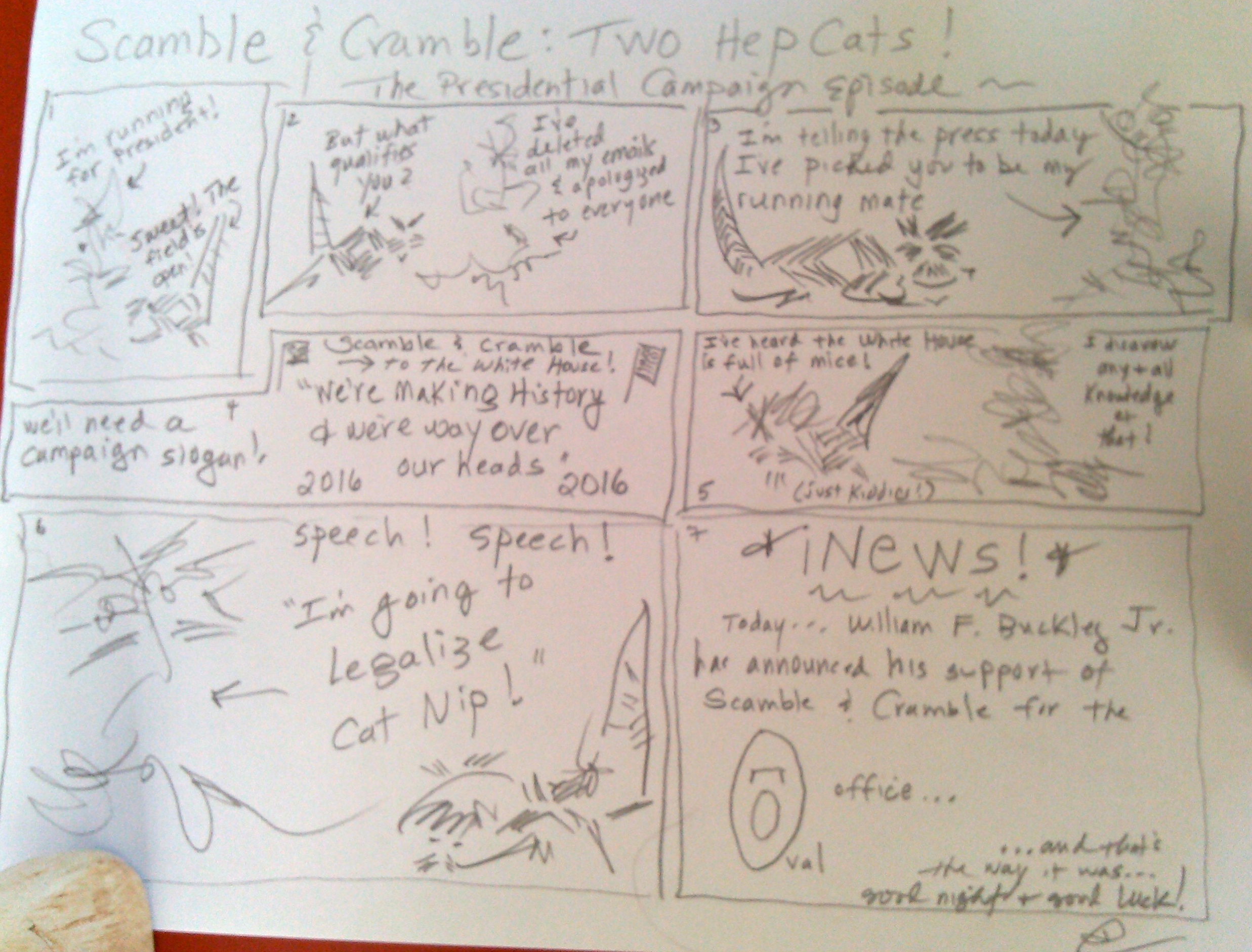
Sunday Morning Comics! Scamble & Cramble Run for Oval Office Episode
“I’m going to legalize catnip!”
-
Notes on Types of Poetry
- You look at something you believe should be familiar but see something else, something unexpected. A moment of confusion, you are given a start, seeing something new or strange, out of place or off kilter, in place of what usually passes practically unnoticed. Some like that feeling; others do not. But the feeling, whatever it is, passes. You dismiss the experience as a kind of déjà vu as what you expected to see comes into focus and the other vision, the mirage, the mistake, disappears.
- That night, you dream of a chess game, even though you don’t play chess. The chess pieces are friends, neighbors, and relatives. The Queen is a woman who walks by your house daily but never says hi. The King is the friendly dog from across the street, always happy to see you. The Knights are kids riding bicycles. The Castles are bell towers full of birds over empty churches. The Pawns are corporate employees you once supervised, riding a desk all day in a building of sealed windows. In those days, you used to dream of getting up from your desk and throwing open a window, a breeze of fresh air blowing all the papers off the desks, creating a ruckus. You are called down to the Personnel Department and summarily fired.
- You learn a new word, eggcorn. Slips of both the tongue and ears. You make a list of words you frequently misspell, fold the list, and put it into your Moleskin pocket notebook. You save the Moleskin pages for poems that never come. A week later, the Moleskin still empty, you take out your list of frequently misspelled words and throw it away. You make a new list of words you often mishear or mispronounce. You think of getting a dog and naming her faux pas.
- The plumber arrives to fix the pipe that froze in last winter’s silver thaw. Something about him smells familiar. It’s a stale beer odor. It’s late afternoon, a hot summer day, and he must have been out at lunch drinking beer, perhaps in the lot of food carts located down by the creek at the bottom of the neighborhood. You look into the back of his van. An old blue and white striped mattress lines the floor. The sidewalls are cubbyholes full of tools and plumbing parts.
- The power has gone out again, another rolling summer blackout. You light a candle. The phone and Internet are also out. You think absurdly of walking down to the corner to use the pay phone – the pay phone was taken out years ago. The evening is dark and quiet and peaceful, and you decide this is your favorite kind of poetry, the kind that creates a still clearness, and the stars are like rocks on the floor of a shallow, smooth running stream that ebbs and flows with the salt water tides. Suddenly the power comes back on, the fan spins, the radio blaring, the streetlight flooding through the open front window. A door slams. A car starts up. The lights flicker indecisively. Blackouts are only rarely epical.
- A young woman knocks at the door, a canvasser. Lonely for someone to talk to, you invite her inside. You make tea. Her skin is like parchment, full of colorful tattoos, pictures and words. And she has piercings, one in her upper lip, another in her ear, and a tiny diamond on the side of her nose. Her eyebrows are painted black shellac. She comes quickly to the purpose of her mission: she is selling low cost cremation plans. If you buy now, pre-ordering, before you die, you save lots. She’s already been able to help several of your neighbors. Your block is a gold mine of old people.
- You’ve the kids for the day, to babysit, day care. You get out large, thick sheets of brightly painted paper. Everyone takes a pair of scissors and cuts alphabet letters out of the sheets. You string the letters together with clear fish line and hang them from the ceiling with thumb tacks, creating slow moving mobiles that say different things depending on the breeze coming through the open windows. Everyone lies on the floor with pillows and blankets, watching the letters turn this way and that, reading aloud new words that appear.


-
The Political Fray Replay
What does it mean to “vote one’s conscience”? Isn’t the conscience that comfortable place where sleeps one’s presuppositions, unquestioned assumptions, background biases, wishes, wants, and whimsy?
James Joyce was three months old when in May of 1882 two high-level government men associated with British rule were assassinated in what came to be called the Phoenix Park murders. The resulting fallout probably delayed home rule decades, destroyed more lives and families, fed family arguments over politics for decades, was absorbed into history and myth. Charles Stewart Parnell’s career faced new challenges, and Parnell’s early death was a tragedy for Ireland.
In “A Portrait of the Artist as a Young Man,” Joyce’s Stephen recalls his family arguments arising from the topic –
That was called politics. There were two sides in it: Dante was on one side and his father and Mr. Casey were on the other side but his mother and Uncle Charles were on no side. Every day there was something in the paper about it.
It pained him that he did not know well what politics meant and that he did not know where the universe ended. He felt small and weak. When would he be like the fellows in Poetry and Rhetoric? They had big voices and big boots and they studied trigonometry.
Joyce’s Stephen, in “Portrait” and again in “Ulysses,” considers himself the servant of two masters, the Church and British rule. Stephen wants nothing to do with either. That Britain has its own church separate from Ireland’s complicates issues:
— Really, Simon, you should not speak that way before Stephen. It’s not right.
— Oh, he’ll remember all this when he grows up, said Dante hotly, the language he heard against God and religion and priests in his own home.
— Let him remember too, cried Mr Casey to her from across the table, the language with which the priests and the priests’ pawns broke Parnell’s heart and hounded him into his grave. Let him remember that too when he grows up.
— Sons of bitches! cried Mr Dedalus. When he was down they turned on him to betray him and rend him like rats in a sewer. Lowlived dogs! And they look it! By Christ, they look it!
— They behaved rightly, cried Dante. They obeyed their bishops and their priests. Honour to them!
— Well, it is perfectly dreadful to say that not even for one day in the year, said Mrs Dedalus, can we be free from these dreadful disputes!
Uncle Charles raised his hands mildly and said :
— Come now, come now, come now ! Can we not have our opinions whatever they are without this bad temper and this bad language? It is too bad surely.
Mrs Dedalus spoke to Dante in a low voice but Dante said loudly:
— I will not say nothing. I will defend my church and my religion when it is insulted and spit on by renegade catholics.
Mr Casey pushed his plate rudely into the middle of the table and, resting his elbows before him, said in a hoarse voice to his host:
— Tell me, did I tell you that story about a very famous spit?
The young Steve tries to understand the arguments, the claims and evidence and reasoning. He does not name the fallacies, not yet:
Stephen looked with affection at Mr Casey’s face which stared across the table over his joined hands. He liked to sit near him at the fire, looking up at his dark fierce face. But his dark eyes were never fierce and his slow voice was good to listen to. But why was he then against the priests? Because Dante must be right then. But he had heard his father say that she was a spoiled nun … Perhaps that made her severe against Parnell. And she did not like him to play with Eileen because Eileen was a protestant and when she was young she knew children that used to play with protestants and the protestants used to make fun of the litany of the Blessed Virgin. Tower of Ivory, they used to say, House of Gold! How could a woman be a tower of ivory or a house of gold? Who was right then ? And he remembered the evening in the infirmary in Clongowes, the dark waters, the light at the pierhead and the moan of sorrow from the people when they had heard.
Stephen tries to understand the allegiances:
He was for Ireland and Parnell and so was his father and so was Dante too for one night at the band on the esplanade she had hit a gentleman on the head with her umbrella because he had taken off his hat when the band played God save the Queen at the end.
But all the young Steven can really understand and what seems to stick with him over the years are the tears:
At the door Dante turned round violently and shouted down the room, her cheeks flushed and quivering with rage :
— Devil out of hell! We won! We crushed him to death! Fiend!
The door slammed behind her.
Mr Casey, freeing his arms from his holders, suddenly bowed his head on his hands with a sob of pain.
— Poor Parnell! he cried loudly. My dead king! He sobbed loudly and bitterly.
Stephen, raising his terrorstricken face, saw that his father’s eyes were full of tears.
The older Stephen decides not to join the political argument, but will devote himself to his art, his writing:
A tide began to surge beneath the calm surface of Stephen ‘s friendliness.
— This race and this country and this life produced me, he said. I shall express myself as I am.
— Try to be one of us, repeated Davin. In your heart you are an Irishman but your pride is too powerful.
— My ancestors threw off their language and took another, Stephen said. They allowed a handful of foreigners to subject them. Do you fancy I am going to pay in my own life and person debts they made? What for?
— For our freedom, said Davin.
— No honourable and sincere man, said Stephen, has given up to you his life and his youth and his affections from the days of Tone to those of Parnell but you sold him to the enemy or failed him in need or reviled him and left him for another. And you invite me to be one of you. I’d see you damned first.
— They died for their ideals, Stevie, said Davin. Our day will come yet, believe me.
Stephen, following his own thought, was silent for an instant.
— The soul is born, he said vaguely, first in those moments I told you of. It has a slow and dark birth, more mysterious than the birth of the body. When the soul of a man is born in this country there are nets flung at it to hold it back from flight. You talk to me of nationality, language, religion. I shall try to fly by those nets.
-
On a Clear Day, You Can See England
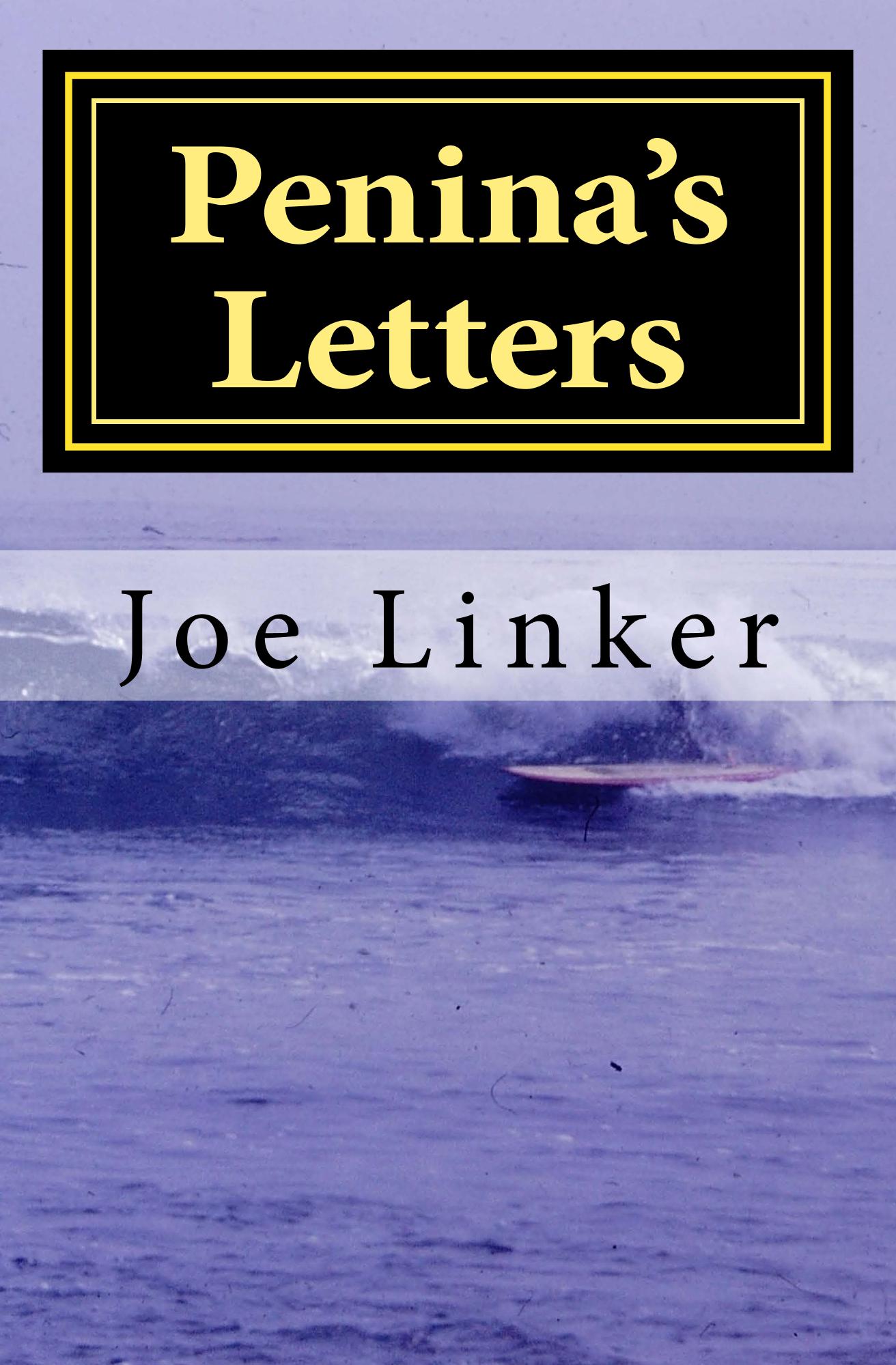
Over at Course of Mirrors, Ashen has posted a review of my novel “Penina’s Letters.”
Ashen’s is a very clear, insightful, reading.
Please swim on over and check it out!
-
Subscribe
Subscribed
Already have a WordPress.com account? Log in now.
 The Coming of the Toads