• isit

    is it? is it? is it?
    what time is it?
    the cricket asks

    the night notes call
    a view of space with
    ornamental lights

    near like the cat
    hiss skin rips
    claws a violet sky
    saturates maroon
    the cauliflower
    cumulus moon

    this squall passes
    as does this darkness
    the outdoor words
    drift over the river
    as the last cricket replies

    is it? is it? is it?
    time to get
    out of bed yet?

  • The Amateur Spirit in Writing – Revisited

    As The Coming of the Toads nears its 10th anniversary (our first post was Dec 27, 2007), we reflect on why and wonder what now.

    The new book, “Alma Lolloon,” is out (“look inside” here). “Out” may seem hyperbolic – it’s now available. Others trying to write and publish will get the difference.

    Most writers, excepting the besttellers, have to self-promote; yes, even when published traditionally by a standard house in the traditional manner.

    It is, then, in the interest of shaking the bushes and the amateur spirit of writing, I invite readers of The Toads to subscribe to my TinyLetter notes.

    Meantime, the amateur spirit in writing lives on at The Toads:

    The amateur spirit in writing

    on

    We do not have the New Yorker DVD library (though we do have in the basement a stack of paper copies we regularly prune for mold), but we do have E. B. White’s “Writings from the New Yorker, 1927-1976,” edited by Rebecca M. Dale (HarperPerennial paperback edition published 1991).

    The “Talk of the Town” pieces these days only occasionally reach White’s wit or brevity. He often captures a moment of his own time while gazing into some distance, foretelling. A case in point, his May 11, 1929 piece, where he writes: “’Writing is not an occupation,’ writes Sherwood Anderson. ‘When it becomes an occupation a certain amateur spirit is gone out of it. Who wants to lose that?’ Nobody does, replies this semi-pro, sitting here straining at his typewriter.”

    Yet today, as the reading crisis spreads its tangential wings to include newspapers pruning peripheral departments, some semi-pro and pro writers are forced back into an amateur spirit.

    Where will they go? Continued White: “Nobody does, yet few writers have the courage to buy a country newspaper, or even to quit a city writing job for anything at all. What Mr. Anderson says is pretty true. Some of the best writings of writers, it seems to us, were done before they actually thought of themselves as engaged in producing literature.”

    Or before, in other words, they thought of themselves as real writers at all. One blogs in the hopes the amateur spirit will prevail, painfully aware that blogging also makes it easier, as White later said, “for persons who are not artists and writers to continue the happy pretence” (May 21, 1938).

    But it’s not only to gain even amateur status that we might entertain the doubtful purposes of writing – for self or for others; it’s because even though we know full well we’ll never play right field for the Dodgers, we still enjoy shagging balls in the back-yard; we will still ride a skateboard down the hill, though of course we are no Tony Hawk, as our spouse reminds us, shouting she’s not taking us to emergency when we fall; and though we could never follow “Da Bull” into the big waves, when we’re back in El Porto, we’ll always paddle out for a small one.

    Whatever happens to the pros, this amateur writing spirit hopefully encouraged and evidenced in the best blogging, whether pretence or preface, may enable those who agree that writing is learned while writing, and in no other way, to find a subject, knowing that subjects often reveal themselves only once we’ve made the commitment marked by a few hundred words.

  • The Cat Music Critic

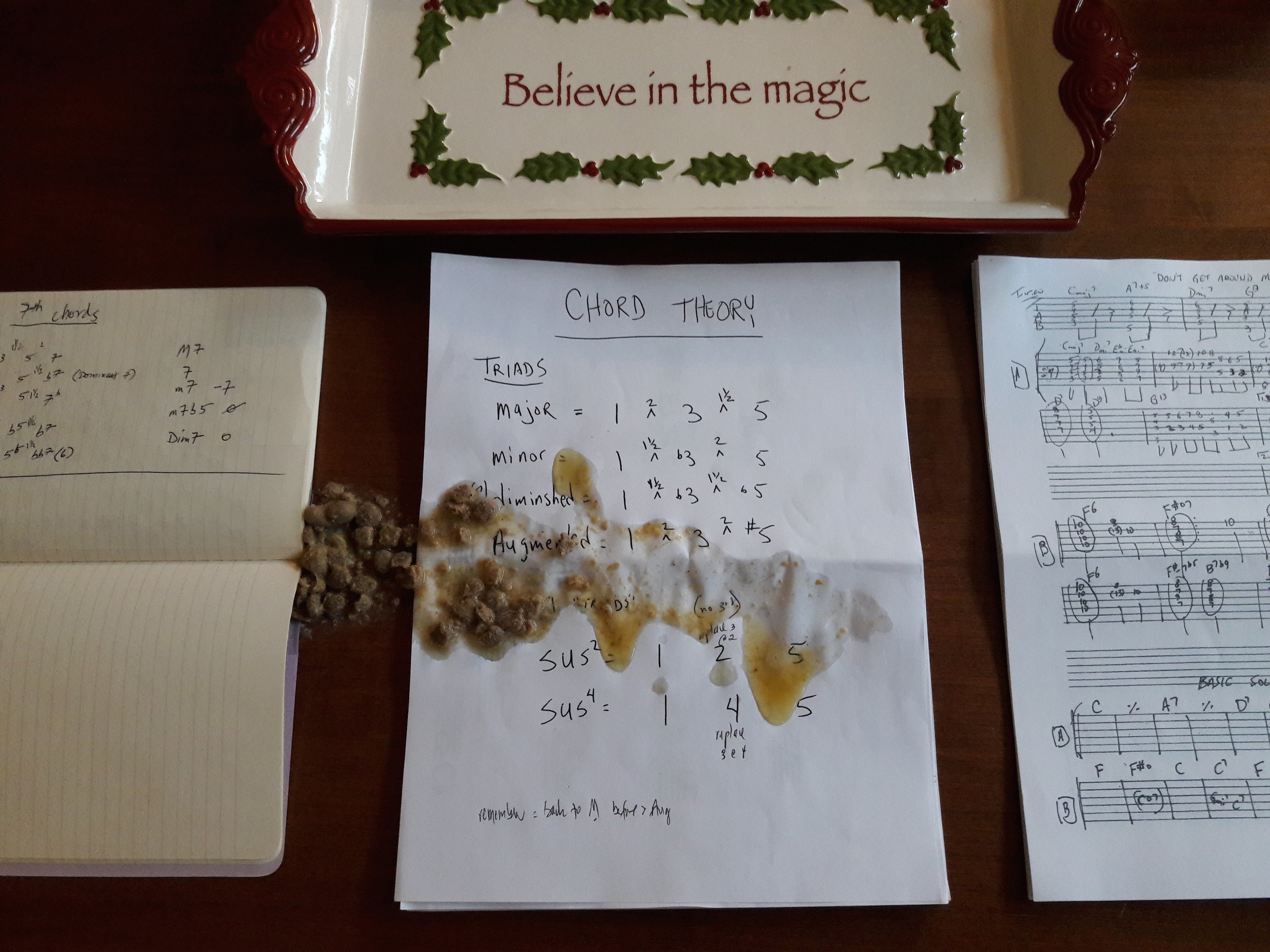
    The Cat Music CriticI’ve noticed when I pick up the guitar and the cat Zoe is hanging out, she’ll scurry off to a quieter corner. Cats have excellent ears.

    Yesterday, home from the afternoon music theory class I’ve been taking, I organized my notes and handouts, reviewing each page. I left the pages in neat piles on the dining room table.

    This morning, I go to resume my music musing, and what do I find but the cat music critic’s overnight review – Zoe had barfed over my notes.

    Cats are excellent communicators. I’m glad she doesn’t tweet.

  • Alma Lolloon

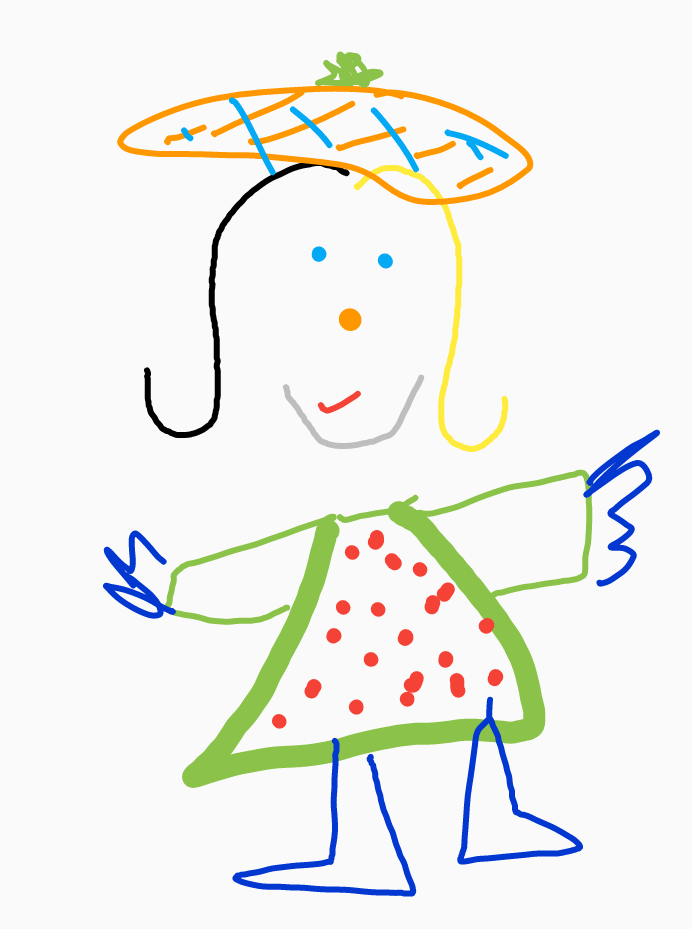
    Alma Lolloon


    Alma Lolloon cartoon drawing
    “How long do I have to pose like this?”
  • Notes on Jessica Sequeira’s “Rhombus and Oval”

    Notes on Jessica Sequeira’s “Rhombus and Oval” (117 pages), 2017, What Books Press, The Glass Table Collective, Los Angeles:

    Rhombus and oval” is the title of the lead piece in this collection of stories by Jessica Sequeira, a translator of Spanish and French and a writer. The text of twenty-one stories runs 112 pages, each story from 3 to 9 pages long. They are fictional short stories.

    What is a fictional short story, and why write or read one? “I used to work at a translation agency,” we learn from the narrator of “A journey that leaves no trace.” We should not confuse the author of a work with the narrator of a work, but toward the end of this second story in the collection, we hear, “I was tired of being a medium, of having words pass through me. Now I wanted to create.”

    Fifteen of the twenty-one stories were previously published in small magazines. “In the rose garden” appears in Hawansuyo under the title “In the Rose Garden: A Tale of Researching Ribeyro,” and the story concludes with an interview conducted by Jessica Sequeira with the Peruvian writer Jorge Coaguila, a specialist of Ribeyro. The piece was published in the book Sounds and Colours Peru. The story provides a clear glimpse of Sequeira’s style, where genre expectations might be mixed together to form new perspectives. Other stories in Sequeira’s collection appeared in Berfrois, Glasgow Review of Books, Queen Mobs Teahouse, and Entropy.

    For a long time, The New Yorker magazine opened, after “The Talk of the Town” section, with a fictional short story or two. I used to read them. I remember looking forward to seeing a new Donald Barthelme story. The May 24, 1969 issue featured his “At the Tolstoy Museum” (including odd pics, drawings, and diagrams). Barthelme’s story was the lead piece, immediately following “Notes and Comment.” Following the Barthelme story was “The Corner,” a short story by John Updike. But the reader was not told these were fictional short stories. The writer was identified only at the bottom of the piece (and in the table of contents). Today’s New Yorker subscribers can access all its past issues in the magazine’s online archive. Of particular interest in older issues are the ads, which often look today like fiction, though at the time, readers may have considered them real. Today’s New Yorker short fiction piece has been moved farther back into the magazine, usually just ahead of the critics.

    I’m not arguing cause and effect here, but now I spend most of my New Yorker time reading the non-fiction. I make exceptions; if I see a Roddy Doyle story I’ll read it right away. We might have learned by definition non-fiction is true and fiction imaginative, or not true, though fiction may contain truths, while non-fiction may, through errors of omission or commission, be mistaken or otherwise fallacious. Neither fiction nor non-fiction should be confused with “the news.” The New Yorker, a weekly, is not a news magazine, though some articles may comment on or analyze what’s been going on lately. A fictional short story is by definition imaginary, and any resemblance to the real disclaimed as purely coincidental, but it’s possible an unsuspecting reader might take a fictional short story as non-fiction, and a non-fiction piece as imaginary. Crossing that threshold back and forth is maybe one characteristic of how fiction works. At the time it was first broadcast, many listeners believed Orson Welles’ radio play “The War of the Worlds,” about a Martian invasion of Earth, was really happening, was real news. That the broadcast was in fact fiction made no difference to those listeners who at the time believed aliens had landed and were on the move. Today’s audiences often seem as easily duped.

    Deliberate fake news is a form of fiction. Fiction, like non-fiction, is an attempt to persuade – to persuade, if nothing else, that what you are reading is in some way real and true. The more we read both fiction and non-fiction, the larger and stronger our antennae for discerning the real from the unreal. Actual news (to the degree there is such a thing) is neither fiction nor non-fiction. The news in no way should attempt to persuade. To persuade is to argue. There should be no argument in the news. Statements of fact may be used in persuasive arguments, but standing alone, these statements are not claims of viewpoint. To the degree that the news is factual, there can be no argument, no reason for any kind of persuasive means: pathos, ethos, or logos. Fiction may be considered anti-news. No promises are made, no guarantee, no warranties. Ratings are of no consequence. There are no sponsors, no ads. But why then are some books banned, others censored or abridged? Dust jackets are covered with persuasive means. Read me! Why?

    We might consider reading fictional short stories part of our daily experience. We don’t need to ask what anything means. It’s enough to observe, pay attention, and go about our day. What is the experience of reading one of Jessica Sequeira’s short stories? We might find a hint of this experience when the protagonist of “Conversation outside El Pastizal” decides to satisfy an obsession by trying to get a closer view of a building complex: “…I began to make my way down the path. As I continued it seemed to grow increasingly narrow, the air increasingly thin. At some point I even found it difficult to walk. But at last I reached the end.” But instead of satisfying his curiosity, he experiences “Something you can’t fathom…a flickering presence, inexplicable, beyond the known.”

    One of the characteristics of Sequeira’s stories includes densely packed paragraphs that both detail and enlarge setting and plot. In a few pages, the story expands like a bubble made of soap blown through the small hole of a wand. The bubble has a short life drifting with the breeze, soon popping into spray. Most of the stories are told in the first person, and characters appear from nowhere, around a corner, as if by random, the narrator working, on break, taking a coffee, walking, thinking, observing. An exception, “The Hypersound,” begins, “Under normal circumstances Leo never would have visited the sauna.” Something is apparently out of place, a character introduced, and a setting suggested, and we’re on our way into the story, just like that. In the story “Bouvier,” on the other hand, we hear, “I was still studying then, and in those years, the great debate carried out in journals of anthropology and at congresses concerned the value of direct experience against secondhand analysis. Bouvier, my supervisor, was firmly in the camp of those defending experience. He considered it important to be out in the field, writing as elegantly and clearly as possible, openly incorporating oneself as a first person in the description.” Sequeira strikes an interesting balance between experiential description and analysis of that experience. Almost always in the background lurks a mystery shrouded in surreal overtones. But as in the best surrealism, the details shine with clarity and control. The writing is concise and not rambling, yet each turn may surprise: “Perceptual experience is what matters, I know; with big data you still only key in searches for things you expect, predetermined coordinates. But what if perceptual experience turns up something really ‘unbelievable’, which doesn’t sync with consensus reality?” Then you might have the occasion of a fictional short story.

    In “On the island,” we get another view into Sequeira’s predicament and solution: “I knew he was interested in the interaction between subject and object, the form in which a literary or artistic work can comment on itself or call attention to its conditions of production or industry.” The stories in “Rhombus and Oval” do contain dialog, but not in any sense, for example, like Henry Green’s fiction. The paragraphs are thick blocks, though aligned left and not justified, and the reading is a bit slower than the slim volume might seem to promise. The tone sounds formal, without being academic, polite, creating distance, in spite of the close first person so prevalent. The writing style is consistent throughout: clear and concise, effective and efficient, the vocabulary accessible, the sentence structure mixed, always purposeful. “What convincing words can I use?” the narrator of Bouvier asks. At the end of “Inflamed eye,” we get another glimpse into the world of the fictional short story, why it’s written and read: “Just like the mouth with red lipstick, however, it returned to him from time to time when least expected – a vision that was unsettling, out of place – a reminder that other worlds exist.” And we are reminded of the collection’s epigram: “What would it matter, what would it change if these pages were written in Buenos Aires?” In the story “Limbo,” we get this: “There must be an infinity of older felines in this world as if it were a warehouse, disappearing progressively, one by one. Right now there may also exist a Jessica in the ‘real world’ younger than me. (If not now, someday there will be.) When she reaches my age, I will disappear.”

    The stories in “Rhombus and Oval” are about as short as they can be, averaging just under five pages. This might be in deference, in part, to Internet reader habits, where distractions are rife and attention spans short. In fact, these stories are probably all too long to qualify as what’s been called “flash fiction.” The length of the collection’s stories might also be a requisite to a convention, or a habit, of writing that combines notes, reflections, diary entries, conversations, things seen or read or experienced or thought on the go. “Any variation could be folded into a narrative (110).” Having read some of the stories previously online, I’m interested in how different the experience of reading them was for me in hard copy form. The experience is sort of like the difference between watching a movie on TV and seeing it in a big screen theatre. Or watching a baseball game on TV and watching it out at the ballpark. But read either way, the stories are inventive, sophisticated without being pretentious or portentous, entertaining, and interesting examples each of the form of the fictional short story, particularly its continuing popularity and possibilities.
  • Alma Lolloon: 5th Installment of Work in Progress – Epigraphs

    The novel “Alma Lolloon” opens with two epigraphs, both of which serve the ordinary purpose of the epigraph but are also part of the fiction being created. In each, the original is given, followed by an “interpretive translation” by the narrator of “Alma Lolloon,” who is Alma Lolloon:

    Experience, though noon auctoritee
    Were in this world, is right ynogh for me
    To speke of wo that is in marriage…
    But yet I praye to al this compaignye,
    If that I speke after my fantasye,
    As taketh not agrief of that I seye,
    For myn entente nys but for to pleye.

    from Chaucer’s The Prologe
    of the Wyves Tale of Bathe

    What atrocity this insult of experience
    As if somehow right for me and all
    Wode talk woe of the marriage camp.
    But complain not in present company,
    For all tales told in pitiful woe
    Tell not a whole story
    If want is not to please.

    from interpretive translation of Chaucer,
    by Alma Lolloon, 1966

    Die Erste Elegie

    Wer, wenn ich schriee, hörte mich denn aus der Engel Ordnungen? und gesetzt selbst, es nähme einer mich plötzlich ans Herz: ich verginge von seinem stärkeren Dasein.

    from Duineser Elegien by Rainer Maria Rilke

    The First Elegy

    Who, if I cracked my little mouth, would listen to me in the din of rules of angels? And quickly so near his heart home of pounding hammers, sparkling nails, and gargantuan waves, I would fade in the muscle of his gaze, or in the back seat of his dark ride.

    from Duino Elegies, interpretive translation of Rilke,
    by Alma Lolloon, 1996.

    I’m still working on editing and proofing and design.

  • Alma Lolloon: 4th Installment of Work in Progress

    Awaiting new hardcopy to proof. Meantime, here is another installment of the forthcoming novel, Alma Lolloon. (Alma has told her knitting group she is writing a book. The book is to be about her five husbands, and the knitters agree to hear Alma reading from her book in installments at their Saturday knitting sits.)

    Well, Hattie, I said, but I was talking to all of them again, of all genres, I like fiction most. What a gas! I like novels for their mystery, the dialogue, the atmosphere, the unfolding of the story, like opening a table cloth and when you get it spread out all across the table there’s a wonderful pattern you had not expected to see. There’s that moment when preparing dinner, not sure how it’s going to come out, and it’s time to set the table, and the cloth is unfurled, and the table and the light in the room is clean and soft and hopeful. This is picking up a book. And around the table sit a dozen characters you don’t recognize chatting away, one prim, another slurping, one passing notes under the table, a couple playing footsie no doubt. I like books you don’t have to necessarily understand to enjoy or comprehend. And it doesn’t bother me when writers split your attention. I like a style that breaks or belies or betrays convention, just wants of some fixed eyeballs you want to push rolling. I like when I see something my eye did not expect to see. I like other kinds of reading as well, books on music and the mind, children’s books, comic books, graphic novels. I like talking about things I like more than talking about things I don’t like. I liked each of my five husbands, each in his own way. What did you expect me to say, I loved them? Please. What is love? Perhaps that will be my argument, Hattie.

    Speaking of love, Curly said, what about these raspberry scones Starky has buttered up for us?

    Love, love, love! Rufa declared.

    I’m taking a couple home for Angel.


    I come from a long line of circuit riders that ends in the dust bowl years, and we rode as hillbillies and Okies, carnies or enlisted men and women, or kept to the road as musicians and tinkers. My dad was a handyman, a plumber and carpenter and electrician and mechanic, and a sign painter and had a talent with brush painting and wound up out west where he got on with the studios painting backdrops for majestic movie scenes, a kind of scenic artist. He also did sketch portraits. He often spent Sunday afternoons down near the beach on the walkway where he’d set up an easel and for a quarter or fifty cents or a buck would draw character portraits for passing tourists. And of course he was a drunkard and left us early on, came back, and left us again. My mother was one of those wives who seemed like she was just along for the ride while she was really the differential gear. She knew how to do all kinds of things. She could cook, sew, knit, quilt, garden, herbal doctor and nurse, dance, sing, play guitar and piano, work carpentry and plumbing and tinker with cars. I suppose I have kinfolk spread like dandelions and poppies across the countryside and up and down city streets and out in the suburbs and up in the mountains and all around the coastlines, but I don’t know them, or I’m not close to any of them, and I was an only child, my folks are long gone, and I’m pretty much on my own these days but for the three kids left me by my first three husbands, one each, dandelions, all of us. I have grandchildren, and Freddy has a daughter, Marylu, who has a toddler, Molly, and they live nearby and sometimes come over for tea or for me to babysit for a spell and we walk to the park and play in the sun. Freddy was my first child, Mary and Gabriel’s son, my roommate and the boy she met and hooked up with my failed college year.


    But so you had five husbands, Annie said, what of it? Life with one husband might make an even more gruesome tale.

    She didn’t say gruesome, did she? Curly said.

    A life with no husband the one I might have wished for to write about, Rufa said, and we all looked at Hattie.

    Oh, sorry, Hattie.

    And not for the first time we saw Hattie nonplussed by something Rufa said seemed packed full of meaning but no way out.

    ~~~

  • Fall Comics


  • Alma Lolloon: 3rd Installment of Work in Progress

    I’m still proofing and editing my new novel, Alma Lolloon. I hope to have it out by December. Meantime, I’m posting installments Saturdays here on the blog. Here is the third installment.

    (Alma has told her knitting group she is writing a book. The book is to be about her five husbands, and the knitters agree to hear Alma reading from her book in installments at their Saturday knitting sits.)

    3rd Installment of Alma Lolloon:

    I simply would like to have someone to talk to, someone who actually listens to me. Is that too much to ask? So even though I don’t know you, and you might not be listening anyway, I’m talking to you, and I’m going to share everything. That’s not a trigger warning. Simply a goal. You might safely skip parts, your attention wandering. I’ve already skipped a few beginnings. But I want you to get your money’s worth. Even if you’re reading on-line for free or something, or you picked up this abused paperback copy you’re holding in the neighborhood library box. Go on, take it, read it on the bus. It takes time to read, and most of us value time. The thing is to sit down and relax. Breathe. Smell the paper and the ink, or whatever it is they print words on and with these days. Pour yourself a cup of coffee or tea, a glass of wine, or pop a can of beer, or pour a juice or a clean clear glass of fresh water. Feel my hands kneading your shoulders. You carry tension there. I know. Let it go. Drop the shoulders. I know you have your own story. Let that go, too, for now.

    We must have ritual. Ritual is what stops the crazy traffic on the bridge so the tall lovely ship can slip quietly by. Make some space in your day for reading as a kind of ritual. Nothing serious, of course, on the contrary, just a few quiet moments to yourself, for some peace and silence, to get away from your scares for a few moments, those voices in your head that won’t shut the hell up, or to find yourself, or to forget yourself, or to remember something you maybe should have never forgotten and is such a joy to find again. I’m well aware you could be reading something else, something more dramatic, sexy, literary, trashy, or some delightful ichor with goor and geer from some silly battle zone somewhere, or some soapy sap television shows are often stuck together with, if that’s what you like. Sure, and you’ll find soap here. I’ve eaten plenty of soap in my lifetime. My mouth is clean. Or non-fiction, some people prefer because it’s supposedly true. Nothing like getting one’s facts straight. We all need ritual, but we should not consider ritual what is merely compulsive.