• Love and the Age of Democracy

    Imagine life as a serf in an empire. Your father wants to give you to a neighboring monastery in exchange for a pig. But this is actually better than his first proposal, in which he promised your hand in marriage to an old man in a neighboring village. Fortunately, the old man died before the deal could be sealed.

    In The Power of Myth Joseph Campbell argues that the emergence in the middle ages of romantic love as expressed by the troubadours created individual consciousness. “Campbell: But with Amor we have a purely personal ideal. The kind of seizure that comes from the meeting of the eyes, as they say in the troubadour tradition, is a person-to-person experience. That’s completely contrary to everything the Church stood for. It’s a personal, individual experience, and I think it’s the essential thing that’s great about the West and that makes it different from all other traditions I know. It was important in that it gave the West this accent on the individual, that one should have faith in his experience and not simply mouth terms handed down to him by others. It stresses the validity of the individual’s experience of what humanity is, what life is, what values are, against the monolithic system. The monolithic system is a machine system: every machine works like every other machine that comes out of the same shop” (p. 187).

    Campbell is talking about consensual marriage, as opposed to arranged marriage. Even today, the price paid for consensual marriages, in that they often go against the grain of the parents’ wishes for their children, as in the Tristan romance, and again in Romeo and Juliet, is personal freedom and existentialism. You’re on your own. This is the same price Jesus paid, but the Church did not follow Jesus, instead creating a new monolithic system. “Come follow me,” Jesus said; we’ll make our own way, against tradition. This is the creation of the individual as an entity separate from the earthly lord who gets his authority from the state or church or both. In consensual marriage we find the roots of egalitarianism and democracy. What’s love got to do with it? All you need is love, and the courage to, as Campbell says, “follow your bliss.”

    Modern corporations are not democracies, nor is the Church a democracy. Men who marry their jobs or the Church can not live an existential life. They are not free. They have no individual consciousness, and they pay no price, as long as they stick with the arrangement. But these marriages are not based on Amor, which is freedom and personal identity for which one pays own’s own freedom and assumes responsibility for oneself. To become one with a desk? Come, follow me. Sit here. Break is at 10:15.

  • Solving the Texas Textbook Massacre, Scandal, and Mystery

    Textbooks are like disposable diapers, fodder for landfills, their obsolescence planned and forced new editions programmed with regularity. When I was a kid we couldn’t write in our textbooks. The nuns used them year after year – textbooks must not have been programmed to self-destruct quite so quickly in those days. We had to cover our textbooks with brown paper grocery bags, cut cleanly according to obsessive instructions, so the covers fit smartly around the edges, taped carefully so no tape touched the textbook. In spite of this care, or perhaps because of it, I don’t remember the title nor the author’s name of a single textbook I used in my twelve years of regular school.

    A few summers ago I started noticing very old textbooks, from the early 1900’s, showing up in local garage sales. I started collecting them. One day I took a bagful down to the local used book store to see what I might get for them, but the owner was chagrined. “I don’t buy books like that,” she said, and wouldn’t even look down into the bag. Yet Powell’s “City of Books,” in Portland, does a brisk business filling newer-used US textbook orders from overseas, and textbooks, new and used, constitute an enormous, bizarrely regulated industry.

    But the mystery of the Texas textbook scandal is why anyone cares, for who supposes students actually read the textbooks? And even if they wanted to, where are the school districts whose funding is deep enough to afford them? Schools that could have afforded new textbooks no doubt spend their money in other, more productive ways: building multi-million dollar sport complexes, for example. And if they have the textbooks, were they distributed? Or are they sitting in a warehouse, as Michelle Rhee discovered when she took over in DC? In any case, given the unaffordable prices and now the tampering with the credibility and reliability of textbooks, Texas teachers should forgo any of the changes forced by their state board of education and ignore textbooks altogether, avoiding their exorbitant costs, forced new editions, inflated purpose, and questionable educational effectiveness; and the rest of the country should follow their example.

    Will the Education debate go the way of the Health Care debate? In the April 5, 2010 issue of the New Yorker, Dr. Atul Gawande said, “But the reform package [Health Care] emerged with a clear recognition of what is driving costs up: a system that pays for the quantity of care rather than the value of it. This can’t continue.” Neither can Education’s reliance on the textbook system, which is also too expensive and values quantity over quality. No one doubts this, but, as Gawande says, “the threat comes from party politics.” So too with Education. There is, Gawande says, “…one truly scary thing about health reform: far from being a government takeover, it counts on local communities and clinicians for success. We are the ones to determine whether costs are controlled and health care improves.” The same might be said for Education: it will count on local communities and local teachers for success, not state boards of education who confuse textbooks, editing, and censoring with teaching, and who would use a textbook to narrow the entrance to knowledge rather than opening the door to full and open access – access that is alive and growing on the Web, and that should be given more support to be leveraged by schools to lower the costs of education while improving the quality of instruction.

    Instead of the traditional use of textbooks, teachers can use primary sources via the Internet. For in depth analysis, including background and extensive researched reports of current events, school libraries should subscribe to the Congressional Quarterly Researcher (the blog is free; access to the full reports requires a subscription – which most libraries provide). Extensive reports include credible pro-con discussion and annotated and linked bibliographies for further reading. Open Culture is another site that includes free resources, including language, culture, and math and science material – including links to podcasts from reputable universities. Stanford’s Encyclopedia of Philosophy is another site that features free and open access to the work of professional scholars (a current fund raising campaign seeks to establish a more permanent and viable funding source – so no, these sites are not free, though they offer free access).

    Students are already using the Internet, and teachers can do more to leverage its resources. Google Books, for all the controversy surrounding the copyright issue, is getting better and students access the site without charge (apart from Internet service) for direct access to both primary sources and critical analysis. Credible and reputable periodicals are on-line, some with full access, others with limited access without a subscription. Scholarly journals are following suit and taking down their wall that limits direct access and frustrates students attempting to learn scholarship and research. And individual blogs such as the Becker-Posner Blog (Becker a University of Chicago Nobel economist, and Posner a federal judge), Caleb Crain’s blog, which augments his professional publications, and the World Wide Woodard blog, the blog of author and journalist Colin Woodard, just to mention a few – there are obviously many more – all provide direct, free, and open access to professional criticism, informed opinion, and scholarly research. Still other sites, like FQXi (Foundational Questions Institute – a physics site), provide forums for professionals to share papers and research, while giving students the opportunity to participate by reading and following the studies and discussion. It was on FQXi that I first saw Garrett Lisi’s recent physics paper, “An Exceptionally Simple Theory of Everything.”

    What we need is an exceptionally simple theory of education. Hopefully it will include open access to primary source documents that might nudge textbooks away from the center of the student’s desk, where the drool is soaking into the garbage bag cover.

    Update: 5-27-2010…It was announced this week that Portland Public High School District has posted just over a 50% graduation rate. I don’t think the problem is textbooks. Meantime, here’s a blog post that touches on a similar crisis in higher ed. Some appear to be worried about the adulteration of their disciplines as ethos moves online. Yet their ships are sinking – see the post referenced below and then read the top post (we agree with Levi): Larval Subjects.

  • …ant, ant, ant, ant, and ant: The Fiction Science of E. O. Wilson; or, What’s Luck Got To Do With It?

    E. O. Wilson’s fiction piece “Trailhead” appeared in the January 25, 2010 New Yorker. The story is science fable, science fiction. The main character in the story, the protagonist, might be the queen ant, or could be the entire ant colony, the superorganism. The antagonist is a capricious nature, and there’s the rub, for the ant is nature, and it’s a curious narrator who separates one from the other to argue a moral.

    This is not the first time Wilson has used science fiction to illustrate a sociobiological theory. In On Human Nature, he creates a “superior extraterrestrial species,” that eats humans, easily justifying their appetite using the same argument that humans use to eat animals. Meanwhile, the aliens are mostly interested in Earth’s ant population.

    What makes “Trailhead” fiction includes the idea that nature, or someone, dispenses luck. But what is luck? From the OED we get “locken to entice.” While, as the OED points out, this is the verb, not the noun, Wilson, in addition to giving us “By luck she had found an ideal site to build a nest,” says “…the dice fell right for the Queen of the Trailhead Colony.” Who rolled the dice? Who or what dispenses luck? In any case, isn’t one man’s luck another’s misfortune? And why is it considered lucky to merely prolong a meaningless life? Answers to these moral questions are implicit in the story, where we find “altruistic workers,” “self-sacrifice,” “viciousness,” and “taboos.”

    But luck drives the theme, for as lucky as the Trailhead Colony queen was, the Streamsider Queen was even luckier: “The Streamsiders had not chosen this site for their own protection. They were just lucky that their Queen had landed there.” Are we lucky that our parents met, that the Big Bang occurred, that our ancestral genes wound up close, but not too close, to the sun?

    The story ends with the defeat of the Trailhead Colony by the invading Streamsiders. “With luck a few survivors [Trailheaders] might then reassemble and restart the colony elsewhere. That is, if they had a real queen. But, of course, they had only their inadequate Soldier-Queen.” The end comes, and “The ants were a doomed people in a besieged city.” They’ve run out of luck.

    Then comes the most surprising part of the theory; the ants are given a choice: “Finally, all that the Trailheaders knew was terror, and the existence of a choice – they could fight or run from the horror.” If luck exists, they will make a run for it.

    Note: Norton has published Wilson’s first novel (he’s 80 years old), “Anthill,” this month.

  • Private Music, Public Music: Vandals Trash Kumbaya – Is Music Making Us Stupid?

    I’m shocked to find the lovely, spiritual folk song Kumbaya trashed by pundits and politicos alike in a bipartisan effort to discredit one of the solid gold traditions my generation sought to carry on – the healing power of music. Yet it should come as no surprise, for music, like politics, suffers from an infection of the big, the bad, and the rowdy. Perhaps it was always so; one’s affections are often awakened by market reality, but we must get to the bottom of this Kumbaya business.

    First, to the phrase Kumbaya (“Come by here” [Lord]) has been added the increasingly popular “ing,” so we now find ourselves Kumbayaing, though hopefully not in public. Kumbayaing is pundit-lingo for working together in teams for the mutual benefit of community members – and what could be sillier than trying to work together? The neologism distorts the song, ignores the music, and mocks the efforts of those who would organize peacefully, all in one cynical, dismissive, and cranky attitude – to Kumbaya is to waste time; holding hands betrays weakness.

    It seems that what we today call Christian Music isn’t liturgical music, or music to gather by, as much as a music market. The religious experience is marketed through music. This isn’t the same thing as music creating a religious experience. Do we not want the Lord coming by here anymore? For “The spirit will not descend without song,” as LeRoi Jones (Amiri Baraka) explains in his study Blues People (1963). Jones explains that the first Christian music in the US was black music born of the slave experience and developed as communal, healing, and organizational. Of course, time and distance also distort, and, as Gary Snyder explains, when ritual is moved from its source it loses some of its power. But the beauty of the music that Jones describes is its very resourcefulness.

    Richard Rodriguez’s influential essay “Private Language, Public Language” went against the grain of the bilingual education movement by insisting that we shouldn’t publicize our private language, the language of our family. Just so, perhaps we shouldn’t market something called Christian Music, for the idea adulterates the tradition and allows the pundits to infiltrate the community without understanding or respecting the values of the community. Consider the following example, where the word spiritual becomes so watered down that it loses all its color and power: Elizabeth A. Brown writes a short review, published in the April 5, 2010 Christian Science Monitor, of The Best Spiritual Writing of 2010 (edited by Philip Zaleski), and what do we find as an example of not just spiritual writing but the best spiritual writing? Nicholas Carr’s “Is Google Making Us Stupid?

    Someone’s sighing, Lord. Come by here.

  • Jeeves and Bertie Wooster in Facebookland

    If Facebook was a country, it would have the 3rd largest population in the world, and the least privacy, so why do people continue to move there?

    Inside Facebook, a site that tracks Facebook demographics, shows the Facebook population growing like aphids on a primrose. The fastest growing segment is the female age 55-65 group, but it’s still a young country, with 35% of its citizens between the ages of 18 and 25. The Facebook Pressroom census shows over 400 million citizens living in Facebookland. The US, with about 4.5% of the world’s population, represents about 6% of Facebookland.

    There are certain advantages to living in Facebookland, no morning commute, for example, and though one occasionally receives the message, “something went wrong,” and things often change without much notice, the infrastructure generally works about as good in Facebookland as it does in other countries – sometimes things go wrong, other times things go on swimmingly.

    One easily imagines P. G. Wodehouse’s Bertie Wooster living in Facebookland. Bertie’s the kind of fellow who would create the occasional heavy weather in the local neighborhood with the ill-thought comment, offending the odd, aged aunt, or posting an unflattering photo, tagging, and upsetting the potential fiancé; but Jeeves would be on hand with the correct password to amend and refresh the errant post. Bertie likes living in the moment; looking neither before nor after, he does not pine for what is not.

    Yet, “One always has to budget for a change in the weather,” Bertie observes to Jeeves, opening another episode with the plate of eggs and b., coffee perfect, at the beginning of Much Obliged, Jeeves. “Still, the thing to do is to keep on being happy while you can.” “Precisely, sir. Carpe diem, the Roman poet Horace advised,” Jeeves fills Bertie in on the classical references. “The English poet Herrick expressed the same sentiment when he suggested that we should gather rosebuds while we may. Your elbow is in the butter, sir.” “Oh, thank you, Jeeves.”

    “I’m thinking of leaving Facebook for Twitter, Jeeves.” “Indeed, sir?” “Yes, Jeeves. Twitter’s the place for the busy metro-man such as myself.” “Yes, sir.” “And rarely do I need more than 144 characters to say what I need to say.” “Indeed, sir.” “Modicum of expression and all that sort of thing, you know.” “Precisely, sir.” “And one can always pop back in and say hello to the Facebook friends, renew and restore and all that, what?” “Indubitably, sir.” “All these newfangled electronic devices, Jeeves, permit one to live in the moment as never before.” “No doubt, sir.” “Might as well give all these musty books the heave ho, what?” “What, indeed, sir.” “Really, Jeeves, we ought to at least get you an email account. Have you heard of Google?” “Oh, yes, sir, and while we haven’t actually tried googling, I believe is the expression, we did early invest a prudent amount in the Google corporate venture.” “Very good, Jeeves.” “Thank you, sir.”

  • Menand’s Meandering PhDs; UFOs; and Joyce’s Jejune Jesuits

    “There are no aliens,” Susan reminded me of Kit’s happy thought number one from Bowfinger (1999), but sensing my disappointment asked to see them – the unidentified flying objects (UFOs) I had just captured on camera. I had snapped them hovering over SE Stark from Flying Pie Pizzeria, where we were celebrating Emily’s birthday. “Maybe they’re coming in for some pizza,” Susan said.

    Having recently read Louis Menand’s The Marketplace of Ideas: Reform and Resistance in the American University, I began to think that chasing flying saucers was indeed an appropriate metaphor for pursuit of the PhD in today’s market. Joyce’s Buck Mulligan agreed, calling Stephen the “jejune jesuit,” for, as Anthony T. Grafton says in his New Republic response to Menand:  “The last hour has come, the times are very bad…Our space is shrinking: only one-third of American undergraduates still major in the arts and sciences, and less than a third of them in the humanities. We get no respect: the media stick to covering our dysfunctions, from the Paul de Man affair to the butchering of Robert Frost’s notebooks…But our worst enemies are ourselves: from William Chace, who argues that we helped to drive away our own students by dismembering the curriculum and substituting ‘for the books themselves a scattered array of secondary considerations (identity studies, abstruse theory, sexuality, film and popular culture),’ to Mark Taylor, who declares that disciplines are obsolete and that ‘there is no longer a market for books modeled on the medieval dissertation, with more footnotes than text,’ to William Deresiewicz, who complains that we cannot talk to plumbers.”

    Plumbers, incidentally, fall under Menand’s definition of a professional: “A professional is a person who is licensed – by earning a degree, taking an examination, or passing some other qualifying test – to practice in a specialized field” (p. 101). Or you can just call a plumber and ask his hourly rate. One wonders if Deresiewicz ever tried to talk to one. In any case, Grafton’s solution sounds like a call to those who would join Joyce’s jejune Jesuits: “…it means finding creative ways to make life instructively hard, for a few years…,” where “a few years,” according to Menand, is a decade of one’s life. For Joyce, who chose to avoid both the Jesuits and the academy, it nevertheless lasted his entire life (Joyce was almost never financially solvent on his own; he lived off private grants – and in that sense he was like a lifelong PhD candidate).

    Juliet Flower MacCannell, writing on Lacan’s Joyce, says that “For Lacan, university discourse is the dominant discourse of our post-Hegelian era. In the introductory section of ‘Joyce the Symptom I’ entitled ‘University and Analysis,’ Lacan writes that Joyce may mean the closing or turning away from this dominant discourse: ‘In accordance with what Joyce himself knew would happen to him posthumously, the university in charge. It’s almost exclusively academics who busy themselves with Joyce. [. . .]. And he hoped for nothing less than to keep them busy until the extinction of the university. We’re headed in that direction’ (JSI, 3).” Frustrated they are too with Joyce’s grandson, Stephen, who, as D. T. Max discussed in “The Injustice Collector: Is James Joyce’s grandson suppressing scholarship?” (New Yorker, June 19, 2006), refuses scholars access to Joyce’s correspondence, and the problem with that is they’ve already picked his books to the bare bone, and, one wonders, to what end, if they’ve not found new readers for them. Perhaps the aliens will find some interest in them.

  • J. D. Salinger’s Advice to Adelia Moore: Write as a Child

    Adelia Moore, apparently an old fashioned English major, knew Jerry, had tea and lunch with him, even argued with him (over Vietnam), and received this stunning bit of advice from him, when she was but 20 years old: “If you haven’t published by age 21, you might as well forget it.” Adelia calls it “…his blunt advice about writing.” But is it advice about writing, or sarcasm about publishing? Was it meant to be taken literally, a literal cutoff – as if to say, “If you haven’t published by the time you’re old enough to drink, forget about it.” Or is it a practical kind of cynicism, as if to say, “You want to make it early, so like me you can kick back and not have to write anything more.” Salinger’s first short story was published in 1940, when he was 21. His last published work was in 1965, when he was 46. He died, a little over a month ago, at the age of 91. In “Tea with Jerry” (March 1, Christian Science Monitor), Moore shares her experience with the private writer in 1969, four years after his last published work. Did he know at the time – might he have added, “As for me, I’ll never publish another word”?

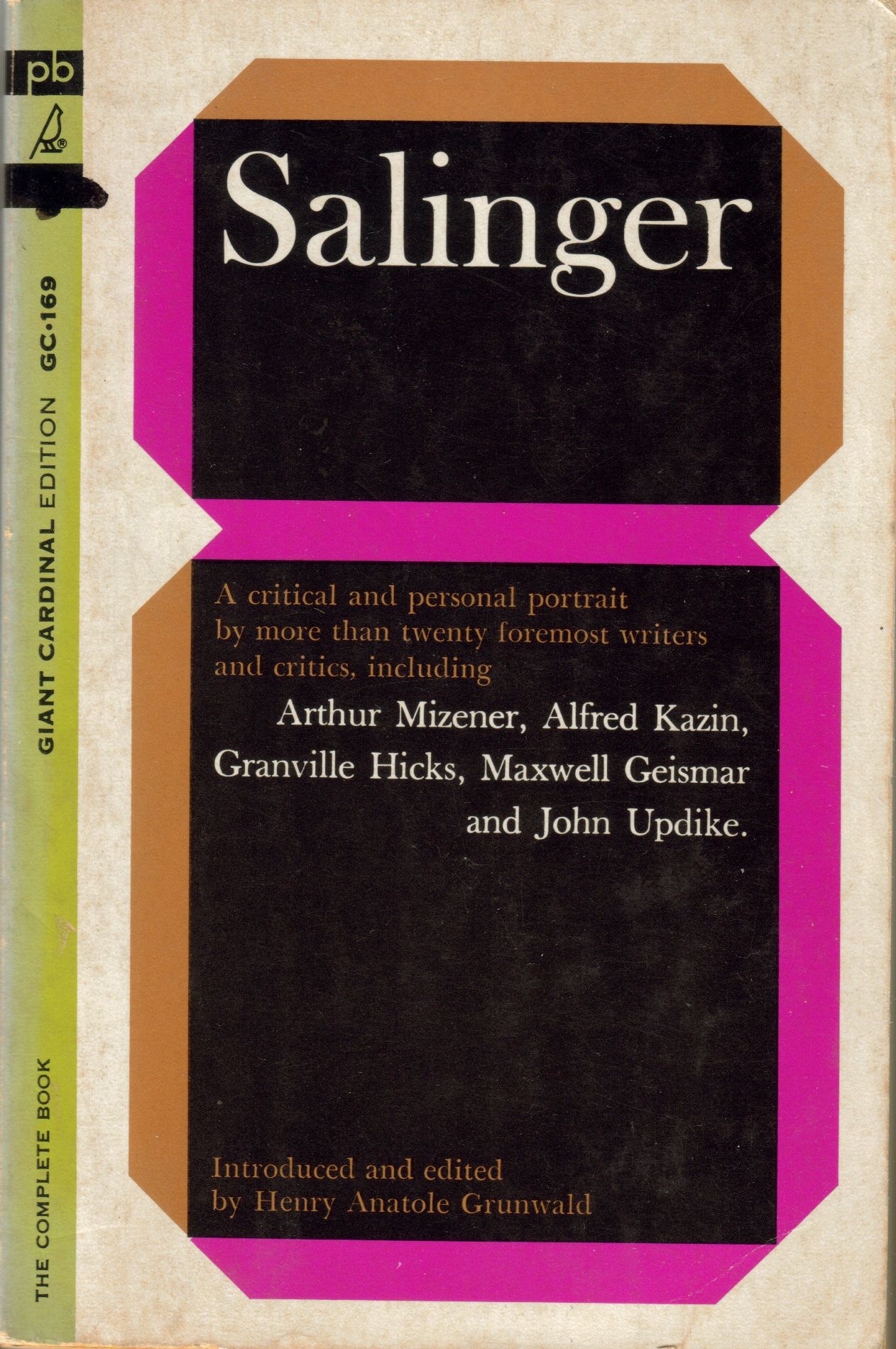
    “There is a feeling in many quarters that altogether too much fuss is being made about J. D. Salinger,” Henry Grunwald wrote in his introduction to the 1962 collection of critical pieces titled Salinger: A Critical and Personal Portrait, a major effort to explain a “good minor writer,” whose popularity with the general interest reader rankles some of the critics. Salinger wrote at a time when the general interest reader still read stories, when the New Yorker still opened its pages, after The Talk of the Town section, with a couple of short stories, and general interest readers looked forward with general interest to a Saturday afternoon with The Saturday Review. No doubt the twittering in those days went on at Saturday night cocktail parties, face to face, where faces were faces and books were books, even if the faces were books to be read and not the other way around. And Monday one met with one’s shrink to purge the weekend’s bluish-bile.

    I don’t know if Adelia Moore became a writer or not. Perhaps “Tea with Jerry” is her magnum opus, the satisfaction of a writer’s spring aspirations killed by a late frost growing back in fall. One of Grunwald’s chapters is called “The Cures for Banana Fever,” a reference to Salinger’s short story, “A Perfect Day for Bananafish,” where we get Seymour Glass’s breaking: “The disease has two symptoms: a kind of incapacity to purge one’s emotions, and a chronic hypersensitivity or sense of loss” (p. 126). These symptoms describe a childhood disease.

    Why would Salinger have told Adelia to “forget about it” if she had not published by age 21? Perhaps the answer is found in Leslie Fiedler’s piece in Salinger, “The Eye of Innocence”: “The notion that a mere falling short of adulthood is a guarantee of insight and even innocence is a sophisticated view, a latter-day Pastoralism, which finds a Golden Age not in history but at the beginning of each lifetime” (p. 242). Perhaps what Jerry was trying to tell Adelia was that she had to write as a child; it would be no good to write as an adult.

  • The Bare Bodkin of the English Major

    “To be, or not to be; that is the bare bodkin,” says Mark Twain’s duke as he prepares to take down the house with an encore of Hamlet’s soliloquy. Where’s an English major when you need one? They were no doubt in short supply in the Mississippi Valley in the early nineteenth century, and their heyday from the late twentieth appears now to be in full wane. What can restore their numbers?

    To take the meds, or not to take the meds; that is another question. Before you answer, read Louis Menand’s recent review, “Head Case: Can psychiatry be a science?,” in the March 1 New Yorker:  “These complaints [confusion over what causes and cures depression] are not coming just from sociologists, English professors, and other troublemakers” (68). To be an English major or not to be an English major; whether ‘tis nobler in the mind to go broke reading or to take arms with others in self-incarceration in a corporate complex – but alas, those late twentieth century opportunities to cause trouble too are in full wane. What’s a poor boy to do?

    Work, for one: “…people on the West Coast work,” Kenneth Rexroth said. “Ginsberg when he came out here, as he said in interviews, was working as a market researcher, which is just a shit job. It’s like being a floorwalker in a dime store. I said, ‘Why don’t you work? How much are you making? Forty-five dollars? You can’t live on forty-five dollars in San Francisco. That’s not money. Why don’t you go to work, get a job?’ Ginsberg said, ‘What do you mean?’ And I said, ‘Ship out…’ You come back with more bread than you know what to do with!’ In the East people don’t think like that” (Meltzer, 1971, p. 12*).

    Some did, but many seem now to have forgotten this. A past issue of Reed College’s Reed Magazine, for example, contained an article by one of their English professors selling the English major; unfortunately, it was clear that the professor had never worked outside of academia, and had not much idea what one would do with one’s English major aside from finding shelter in academia – but that’s all over. Yet no mention in the article of Kafka’s time as a claim investigator for the Worker’s Accident Insurance Institute for the Kingdom of Bohemia (where he invented the hard-hat); of Ted Kooser’s stint at Lincoln Life; of Wallace Stevens’s career at The Hartford; of Tom Clancy maintaining his Life license even after he became a best-seller.

    “Questions like these [being and nothingness, as Sartre put it] are the reason we have literature and philosophy. No science will ever answer them” (Menand, p. 74). Yet as most of today’s Hucks head out for the territory of science and technology, leaving the books to turn to dust, some professors seem to be hunkering down; how do you like this solution: “…it [solving the crisis in the Humanities] means finding creative ways to make life instructively hard, for a few years, for the broadest range of talented people of all sorts and conditions whom we can educate and then employ productively and decently”? This non-profound non-market solution comes to us courtesy of Anthony T. Grafton of Princeton who seems to miss the working point that Rexroth talked about and proves Menand’s point of stubborn resistance.  In his New Republic critical reaction to The Marketplace of Ideas: Reform and Resistance in The American University (Menand, 2010), Grafton makes graduate school sound like joining the Jesuits; but who provides financial support for the Jesuits? For the young Ginsberg just starting out today, a job as a market researcher might be a sweet assignment.

    “Oh, God,” Hamlet says, “I could be bounded in a nutshell and count myself a king of infinite space were it not that I have bad dreams.” No bad dreams, no harrowing questions, no need for the philosopher or the English major. But while the meds, according to Menand’s review, might help some with some of the bad dreams, the harrowing questions persist.

    *Meltzer, D. (1971). The San Francisco Poets. New York: Ballantine Books.

  • John Cage and Attitudes Toward Reading Today

    In John Cage’s A Year from Monday, a 1969 collection of his then New Lectures and Writings, we find a delightful, short piece titled “Seriously Comma,” and we are told the article was in answer to an inquiry regarding “attitudes toward Serial Music Today.” We find it difficult to pass on articles with the word “comma” in their title, seriously. In addition to our interest in commas, we are still concerned with the “reading crisis” topic The Coming of the Toads jumped on at the inception of the blog.

    “Seriously Comma” is an arrangement of 18 paragraphs separated by irregular spacing and layout and given further unity using Cage’s rhetorical mode of varying type font. Each paragraph might be read as a different voice in a contrapuntal arrangement – the piece might also be seen as the mosaic layout of a newspaper page. The second paragraph, quoted in its entirety (italics Cage’s):

    McLuhan insists on the newspaper front-page as the present existence type. Reading, we no longer read systematically (concluding each column, or even turning the page to conclude an article): we jump” (26).

    McLuhan’s work sums the effects of technology on the human sensorium – technology changes us. For McLuhan, the great example was the printing press. For Nicholas Carr, it’s the personal computer. Carr believes that internet skimming is changing our brain for the worse; the idea is getting ink, but it’s still a hypothesis. Do we read differently on-line? Yes, but as Cage on McLuhan illustrates, our jumping around somewhat skittishly while reading predates the personal computer. Perhaps the mosaic of the newspaper prepared us in some way for the mosaic of television and computer screens. What will happen next? The disappearance of newspapers and our adaptive brain evolving to a new way of  reading:

    “Invade areas where nothing’s definite (areas – micro and macro – adjacent the one we know in). It won’t sound like music – serial or electronic. It’ll sound like what we hear when we’re not hearing music, just hearing whatever wherever we happen to be. But to accomplish this our technological means must be constantly changing” (27).

    We are all musicians whenever we make noise; what are we whenever and however we read?

    “Dealing with language (while waiting for something else than syntax) as though it’s a sound-source that can be transformed into gibberish” (29).

    What is “computer literacy,” and how does it differ from traditional reading? In the late 30s and early 40s, the WPA produced posters encouraging, among other activities and ideas of benefit to local communities, reading, traditional reading, the book you’ve always meant to read. We agree with Carr that traditional reading slows things down; why not kick back and enjoy a slow Spring with a book? When we make noise we make music; when we read, we make time.

  • Grammar Hammer: Vertigo Swinging the Grammar Pickaxe

    My Dad once told me that a man could work himself to death with a pickaxe. I don’t know if he knew the John Henry ballad; probably he knew it, but I do know he had swung a pickaxe. But his claim was one of fact, not value. It wasn’t necessarily a bad way to die, on the swinging end of a hammer. But he may have been using the pickaxe as a metaphor. A man kills himself whatever he does, and if not, as Woody Guthrie sang, “Some [men] will rob you with a six gun, others with a fountain pen,” so there’s little hope of escaping either end of the pickaxe. My Dad knew his tools, but he didn’t know an existential wrench from an existential clause (there was no dummy pronoun grabbing hold of that handle), and so he never mentioned a man could work himself to death studying grammar.

    John Henry didn’t swing a pickaxe, but a sledge hammer. Same idea. But what kills him isn’t the hammer, but the race pitting the hand-tool hammer to beat the new technology of the steam hammer. It’s not the tool, but the fight that gets you, and the race is always against technology – which you created to make things easier, thinking the tool would be irrelevant. In any case, while we probably won’t be hearing the Ballad of John Computer, or the Ballad of John Grammar, anytime soon, we’re here to tell you that the study of grammar will take its toll.

    Consider the semantically singular they, for example. It’s OK, stay with him. You both can and may use a they following everyone. And don’t worry about for whom the bell tolls; whoever it tolled for, they’ve heard it by now, which brings us to that non-personal head that’s really only a problem for a comma king. Moreover, did you know that “the danger from adjunct non-finite clauses with missing subjects that are not syntactically determined is often exaggerated” (p. 209)? We will miss that dang dangling modifier.

    We’re in no race to quickly finish Pullum’s Grammar – a good thing, too, because we’re cutting through it with a pickaxe (for as the back cover tells us, this is a “groundbreaking textbook”), and we don’t want our grammar hammer to be the end of us too soon, Lawd – Lawd. “Let the hammer do the work,” my Dad advised whenever he saw me overswinging and looking dizzy. While I try today to apply that advice to grammar, if you’ve not had enough grammar fun this morning, try this.

  • Piracy off the Coast of Gramarye

    Huddleston and Pullum’s English Grammar liberates grammar studies from the prescriptivists. Pullum boards the jolly, unsuspecting ship Elements of Style, captained by the evil E. B. White, and ransacks it, taking no prisoners. Pullum is now king of Gramarye, having deposed White and his motley crew of prescriptive pirates. A Student’s Introduction to English Grammar is the dinghy version of the piratically priced mother ship, The Cambridge Grammar of the English Language.

    Why study grammar? Most native speakers will get “dog, the, away, ran” correct (correctness is not, contrary to popular notion, the language spoken in Gramarye – correct is what serves one’s purpose; now if we have that wrong, we are still deliberating; we’re not sure who the true pirates are in this story).

    “The, dog, ran, away” is the first exercise in Dinghy. There are 24 possible arrangements of the four words; only three will be grammatical, and they are not difficult for the native speaker to recognize, for, as it turns out, if we speak the language, we know the grammar. So why study grammar?

    We are given eight reasons in the preface to Dinghy, only a couple very convincing, at least one political, having to do with the declining student population of Gramarye. I wish they had talked about how they got into the study of grammar, why they became grammarians and linguists; there’s little passion in the reasons they submit. Pullum did a study early in his career analyzing popular song lyrics – he could have talked about that! There is a whiff of passion in the middle of the preface, where they talk about their lunch discussions, and the “pronouncements unchallenged for 200 years [that] are in fact flagrantly false.” We’re all for exposing the tyranny of the old kings and their minions, but Dinghy’s preface is no match for Roger Angell’s (White’s stepson and another New Yorker writer) forward to the fourth edition of Elements.

    Pullum seems bent on defending his reign, and more power to him, for it will be some time before his prescriptive grammar alerts are heard and understood throughout the land, but he sounds like a Fox News commentator when he says “We linguists should not be shy about speaking out and condemning this opinionated [Elements], influential, error-stuffed, time-wasting, unkillable zombie of a book for all the harm it has done.” *

    One of the problems with Pullum’s claim that Elements has done “real and permanent harm,” and that it has been “deleterious to grammar education in America,” * is the assumption that every high school kid in the land has been subjected to it, and having been subjected to it, has successfully incorporated it into their language skills, and that their teachers taught it as a literal reading of the bible – or that their teachers taught it at all. In any case, it might be a good thing if a style book, even a flawed one such as Pullum accuses White’s of being, had anything close to such a profound effect on the general reading public. And there’s the rub. Pullum goes after White because he’s not a text-book. Pullum proves that as a grammar Elements is way off course. Why doesn’t Pullum go after the text-books? White is only a puppet king.

    White’s an easy target. Elements is a commercial effort, something CGEL will never be (my copy of English Grammar, purchased from Amazon for just under $30, does not have a price anywhere on its cover – it’s a text-book). I do like English Grammar. I first tried paddling straight through, but got only about half way before the swell of terms started to swamp my boat; I recommend that the general interest reader begin with the “Prescriptive grammar notes” – that’s where the new constitution is being written.

    What grammar studies needs isn’t a Pullum, but an Andy Warhol, someone who can show us and popularize what we already know to be true – Gramarye is our land.

    *Pullum’s article explicating Elements, “Prescriptive grammar in America: The Land of the Free and The Elements of Style,” (Dec. 2009), is posted on his website, along with links to his other works, including CGLC and EG. Pullum blogs with other linguists at Language Log, an entertaining pirate hangout.