• Trick Photography and Trees

    There are, some argue, two forms of life on our planet: animal and plant. It’s generally conceived that only animals have consciousness, but not all of them. When Descartes said, “I think; therefore I am,” he may have ruined possibilities for a lot of potential ams.

    “The unconscious passes into the object and returns,” Robert Bly says (213), discussing Francis Ponge’s prose poem, “Trees Lose Parts of Themselves Inside a Circle of Fog” (217).

    Yet Joyce (XXXIII) says:

    A rogue in red and yellow dress
    Is knocking, knocking at the tree;
    And all around our loneliness
    The wind is whistling merrily.
    The leaves – they do not sigh at all
    When the year takes them in the fall.

    The “rogue” is nature, nature falling, falling kicking, yet the wind “merrily” whistles, anticipating the irony of winter’s undressing summer, when the leaves can no longer feel. Bly would argue that the leaves do sigh, and that we can hear them sigh, if we learn to listen. But earlier, Joyce had already (XV) said:

    From dewy dreams, my soul, arise,
    From love’s deep slumber and from death,
    For lo! the treees are full of sighs
    Whose leaves the morn admonisheth.

    The tree of the avenue, particularly at night, dressed in dappling neon or enamored moonlight, suggests another kind of consciousness for Joyce’s (II) trees:

    The twilight turns from amethyst
    To deep and deeper blue,
    The lamp fills with a pale green glow
    The trees of the avenue.

    For in the catechism of Episode 17, “Ithaca,” in Joyce’s Ulysses, Bloom and Stephen are apparently discussing the ability of trees, or leaves, to turn toward or away from light (paraheliotropism, or tropism):

    “Was there one point on which their views were equal and negative?
    The influence of gaslight or electric light on the growth of adjoining paraheliotropic trees.”

    The ideal photograph captures not necessarily the object, though the object must at least be attracted, or the light, which the photo must also catch, but the perfect photo snaps Bly’s passing and returning “into the object,” the epiphanic journey. This is the trick of photography, the lure.

    Bly says Ponge doesn’t “exploit things [objects], either as symbols or as beings of a lower class.” Yet the desert creeps closer and closer. “The union of the object with the psyche moves slowly, and the poem may take four of five years to write,” Bly says.

    Pieter Hoff, talking to Burkhard Bilger in “The Great Oasis” (New Yorker, Dec. 19 & 26, 2011), says, “A seed can afford to wait. Encased in dung from a passing bird or other animal, it can survive for months without rain. If the soil is dry, it can put all its energy into sending a single taproot in search of groundwater…It can worm itself into the tiniest crack, then expand a few cells at a time, generating pressures of up to seven hundred and twenty-five pounds per square inch – enough to split paving stones or punch holes through brick walls” (114).

    The desert of the human imagination also creeps, reasoning against its very nature that it is the only perspective that matters, that is aware of itself. Bly says: “Descartes’ ideas act so as to withdraw consciousness from the non-human area, isolating the human being in his house, until, seen from the window, rocks, sky, trees, crows seem empty of energy, but especially empty of divine energy” (4).

    Bly, Robert. News of the Universe: poems of twofold consciousness. [Chosen and introduced by Robert Bly] San Francisco: Sierra Club Books, 1980.

    Joyce, James. Collected Poems [Chamber Music]. New York: Viking Press, Compass Book Edition, 1957 [eighth printing, July 1967].

    Photos in this post were taken this week in Mt. Tabor Park, in SE Portland, with a Canon PowerShot A560, set on Auto – no tricks, but the top photo was “enhanced” using iPhoto.

  • HAPPY NEW EARS!

    “There are no aesthetic emergencies,” John Cage said, in A Year From Monday (1969, p. 28). Above that, same page, Cage typed:

    “Complaint: you open doors; what we
    want to know is which ones you
    close. (Doors I open close auto-
    matically after I go through).”

    Later, on page 30, Cage gets to a point:

    “What is the crux of the matter as far as a listener is concerned? It is this: he has ears; let him use them.”

    And then, in all caps:

    “HAPPY NEW EARS!”

    The years close behind us like automatic doors.

    And Jesus said:

    “But blessed are your eyes because they see, and your ears because they hear.
    For truly I tell you, many prophets and righteous people longed to see
    what you see but did not see it, and to hear what you hear
    but did not hear it” (Matthew, 13:16-17).

    Remember when cell phones and email converged? “Can you hear me? Can you hear me now?” … “I just sent you an email! Did you get it?”

    Who can hear the door closing?

    “There are no aesthetic emergencies.”

    Let the doors close
    automatic
    ally,
    as they will,
    and have a Hap
    py Nap
    py New Year
    at The Coming
    of the Toads.

  • The Toads Goes to The Movies: “Moneyball”

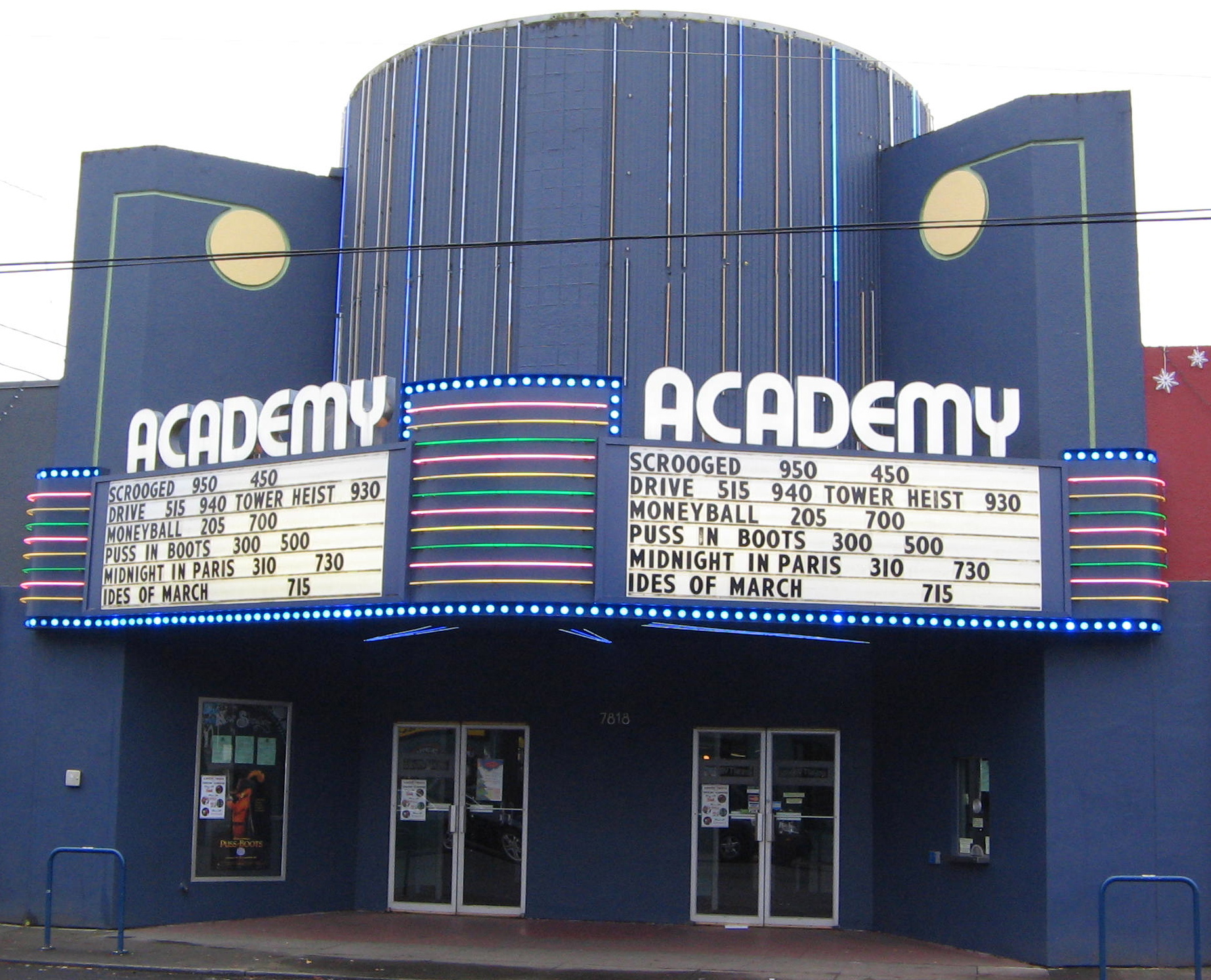
    We went down to the Academy last night to see “Moneyball,” staring Brad Pitt as Billy Beane, the paradigm breaking general manager for the Oakland A’s, from the book by Michael Lewis. I have not read the book, but I liked the movie.

    The A’s were a poor, inner-city team, and when good players left them as soon as they could, they couldn’t afford to replace them, but a new approach to fielding a team of inexpensive but utilitarian players worked, and changed the game. The story of the Academy Theatre is a little like the 2002 A’s winning season depicted in the film.

    For years the theatre was home to Nickel Ads, a free newspaper flier that was nothing but advertising, mostly from individuals, a precursor to Craigslist, which of course helped put Nickel Ads out of business. Nickel Ads had been housed in the old theatre for years, then the building was empty until Flying Pie Pizza (next door) bought it with the idea to restore it to its original East Side, working class splendor. The lobby was reconditioned, and features a rising, carpeted floor leading past the concession stand (where patrons can buy pizza and beer to take into the show) to three small theaters cut from the original, single hall. The seats are roomy, comfortable, and rock. The arms have drink holders, and side tables are scattered throughout the rows, At first, Academy tickets were $3, but now they cost $4, but Tuesdays are 2 for 1, and locals often find 2 for 1 coupons around, good any night.

    The new Academy wasn’t the first theatre of its kind, but it has helped change the game of going to the movies. Now what we need is a Billy Beane of Education.

    Related: Baseball and the Parts of Speech

  • East Side Mt Tabor Photo Essay Walk

    The sidewalks in what used to be called Tabor Heights, on the north slopes of Mt Tabor, were poured in the early 1900’s. The dates are marked on the curbs, but many of the dates are being lost to code enforcement requiring homeowners to fix broken concrete in their sidewalks. Curbs rounding corners were banded with steel to protect them from wheels of horse drawn carts. The steel bars are now peeling off.

    Steel rings were placed into the curbs for horse ties. Some folks have taken to tying play animals to them these days.

    The names of the streets were cut into the curbs.

    John Lennon once said a poet’s job is to walk around and notice things that no one else has time for. It’s late December, but bulbs are already starting to come up, and noticing them, I was reminded of John.


    There are a few poetry posts in the neighborhood. Today, this one contained Walt Whitman. I stopped to read it. Here’s what it says:

    “This is what you shall do; Love the earth and sun and the animals, despise riches, give alms to every one that asks, stand up for the stupid and crazy, devote your income and labor to others, hate tyrants, argue not concerning God, have patience and indulgence toward the people, take off your hat to nothing known or unknown or to any man or number of men, go freely with powerful uneducated persons and with the young and with the mothers of families, read these leaves in the open air every season of every year of your life, re-examine all you have been told at school or church or in any book, dismiss whatever insults your own soul, and your very flesh shall be a great poem and have the richest fluency not only in its words but in the silent lines of its lips and face and between the lashes of your eyes and in every motion and joint of your body.”

    The excerpt is from Whitman’s preface to Leaves of Grass.

    Someone left a small pile of used bricks near the sidewalk. Maybe they are going to make a little stepping block. Used brick is very useful.

    The deciduous trees in the neighborhood are asleep. One of the biggest yard trees around is located on Yamhill, across from the small pile of bricks.

    In addition to a lot of bikes, beer, and beards (as illustrated in Alex Barrett’s This is Portland), there are a lot of churches in Portland. This stained glass window is at Ascension, on the corner of SE Yamhill and 76th.

    Tri-Met Line 15 passes through the neighborhood. This one’s rounding the Ascension corner, continuing its westward route to Belmont and downtown.

    The NO sign is on the fence of the playground-parking lot at Ascension. It was the occasion of a sestina (see previous post). Today there were a couple of bright orange-red cones by the fence. So much depends upon the bright orange-red cone; not sure what depends on the sign of NO. John Lennon might have written a song about the sign of NO, instead of a sestina.

    Just below the sign of NO, on the wall, is a little plaque that reads, “Dedicated to All of the Lost Children.” It’s easy to miss. It’s just below the sign of NO.

    Inside the Ascension grounds, there’s a lovely shrine.

    This building on SE Stark shows a number of projects involving bricks.

    This is a Portland landmark, on SE Stark. Stark was originally called Baseline Road, and from the baseline meridian, measurements and directions were made. The two photos show one of the old baseline markers, located just west of Flying Pie Pizza, on the south side of Stark.

    This is another Portland landmark, the original Flying Pie. Above the sign, you can see the tops of the firs atop the northeast corner of Mt Tabor. I’ve dropped a few hundred feet since beginning the photo essay walk.


    This is my destination, Bipartisan Cafe, SE Stark and 79th. Note the Vintage cocktail lounge sign just below the Cafe sign, where I’ve played guitar a few times. Vintage used to be the Why Not Wine bar. I played some guitar there when it was the wine bar also, a few times with George, and a few times solo.


    Here I am inside Bipartisan, putting together the photo walk essay, drinking a cup of coffee. The cafe is crowded today. I’m sitting on a couch with my back to the wall. They’re playing some good songs in the cafe. People all around me are talking, reading, working on laptops, as I am, drinking coffee. There’s a guy showing his daughter how to play Scrabble. There’s another guy reading and listening to his iPod, white wires going into his ears. Outside, the rain is beginning to fall again. There goes another Line 15. Above and behind me is a large poster of a Rockwell. At the top it says: “OURS…to fight for.” And at the bottom it reads, “FREEDOM FROM WANT.” The drawing is of a family turkey dinner.

  • Peccadilloes; or, The School of No Sestina

    Peccadilloes; or, The School of No Sestina

    In the School of No, every word
    sounds a peccadillo,
    every class closes a cage,
    every cage captures a rule,
    every rule regards no
    with gusto.

    No bites yes with gusto
    behind a fence of words.
    No, no, no
    peccadilloes;
    that’s the rule
    in the land of cages.

    Explained John Cage,
    what cage you’re in, escape with gusto.
    Well, that was anyway John Cage’s rule.
    Silence was for the rule his word,
    though he broke records of silence with every chance peccadillo
    he got in the School of No.

    No No knows
    a Yes one day came selling out of a cage
    peccadilloes,
    from a food cart stuffed with gusto,
    apples falling and rotting for a code was worded:
    no Nos can know – the candy apple red rule –

    a committee of Nos ruled.
    So life is slow in the School of No,
    for a world wrapped in rules needs no words,
    and all the world’s a cage
    where the only gusto
    blows in from the occasional peccadillo

    by some picaroon poet acting alone,
    against tide and rule,
    all hopped up on some street grade gusto,
    but soon runs into a posse of nos,
    and is put back in the cage
    without a word.

    So with a bit of tempered gusto we suggest this peccadillo:
    every word should break a rule
    to escape a School of No cage.

  • Beyond Yourself: Where the Poet Hides

    Clive James argues that poets should know the rules before breaking them. “Technique’s Marginal Centrality” (Poetry, January 2012, pp. 326-335) is a very conservative argument, often repeated by those who do know the rules and have come to control the prescriptions, and we find the argument in the criticism of all the arts as well as in the professions. Few exceptions are acknowledged, and those must be geniuses. And yet what these same critics value is hiding the rules, dressing the technique in camouflage. But isn’t this what we call advertising?

    Why James sees fit at the end of para 1 to dis the lovely Yoko Ono isn’t clear, but his value goes beyond technique. To prove something simple has lasting value, a simple but beautiful line of Picasso, for example, the critic must work hard at uncovering the camouflage, thus validating the artist’s “expect[ing] to charge you a fortune for it” (326). Whenever we see something simple or even “bland,” but good, James argues, we can be sure the poet has been to school and learned the trade first, before, as E. B. White prescribed, “omitting needless words.”

    James uses as one of his proofs the musician, who must learn scales, for example, the rudiments of technique. One problem with the comparison of musicians to poets is that most musicians don’t learn technique to compose, but to play the work of others, who themselves might not be very good musicians, but very effective composers. And musicians need not know much theory to play pieces proficiently, for the theory is embedded in the piece and brought to life through the musician’s technique. Is technique an art? Itzhak Perlman practiced his violin technique while watching television.

    James is not talking about the reading of poetry as much as the writing of poetry. He’s not talking to readers of poetry (an increasingly dwindling number), but to writers of poetry (an increasingly increasing number, and James would plainly like to see fewer poems written by fewer poets). James is trying to restore poetry’s value in linguistic skills, prescriptions that he argues are learned then disguised or ignored to create something new. But the new isn’t always pretty to James’s taste.

    Consider the Coltrane example. “Ugly on Purpose,” an Open Letters Monthly review (2008), by John G. Rodwan, Jr., of Richard Palmer’s Such Deliberate Disguises: The Art of Philip Larkin, also addresses the issue of the apparent camouflage. Here, the subject is jazz, where musicians like John Coltrane blow dissonance and cacophony at their audience. They can also play otherwise, but their sound is deliberate, however unintelligible the average listener may find it. But here James doesn’t seem to approve of the disguise. Even average listeners require training, experience, or special upbringing to appreciate an art form, popular or other, lowbrow or highbrow, standard or anti-standard. Rodwan says that in his Cultural Amnesia, “Clive James complains of Coltrane ‘subjecting some helpless standard to ritual murder’ and the ‘full, face-freezing, gut-churning hideosity’ of his playing, in which ‘shapelessness and incoherence are treated as ideals.’” But where James can read through to what’s concealed in poetry, he seems to have missed it in free-jazz. James’s conservative argument will never approve of free form improvisation.

    These arguments, that the simple or incomprehensible work of art is rooted in learned, valued, talented apprenticeship, are by now classic responses to the popular criticism of “modern” art, that a monkey could have made it, or a child. Indeed, James barely disguises his acknowledgement of this argument in his opening paragraph, where he discusses the Japanese artist Hokusai, who made a painting, in part, by having chickens, their feet dipped in paint, walk across the paper. So much depends upon a critic justifying technique. I understand that James prefers Ben Webster over John Coltrane; what I don’t understand is why he thinks John Coltrane should sound like Ben Webster (another conservative argument). Should we criticize something for not being what it was not intended to be?

    James has more to say, that poets often write too many poems, thus ruining whatever reputation, “name,” they might have earned with their few really good poems. There’s also an interesting discussion of technique suitable to message: “…the argument is the action”; and “…the reasoning is in command of the imagery” (332). But there have been so many successful informal poems, so many successful Duchamps and Rauschenbergs, that “…we must contemplate the possibility that there is such a thing as an informal technique,” but James rejects this notion, for to accept it would suggest that we can write poems while watching television.

    James ends his short but full piece with an odd coda of sorts, about a copy of a book owned by Elizabeth Bishop (not one she wrote) in which she jotted notes for a poem, and the book recently was put up for sale, valued by virtue of its being owned and written in by Bishop. Says James, chances are this won’t happen to most poets (no kidding), “but that’s the chance that makes the whole deal more exciting than Grand Slam tennis. Unless you can get beyond yourself, you were never there.” From chickens with paint on their feet walking across an artist’s paper to Grand Slam tennis – I for one am certainly beyond myself at this point. But I don’t quite get James’s conclusion. He seems to be saying that fame is the exciting part, the chance that a poet might become so famous that readers would scrounge for her notes. But fame seems an odd place to want to hide.

  • This is Portland for Christmas

    I asked Eric if for Christmas he might like a couple of books. It was a busy week, with the Christmas baby on her way, and so Susan and I found ourselves in Powell’s on Hawthorne two days before Christmas looking around for things we thought Eric might find interesting, not an easy chore, since we have trouble usually identifying things that even we might find interesting. It’s not easy finding the right book at the right time for someone. Choosing a book is like picking a campsite. But Susan’s a genius at this sort of thing, and found Nick Hornby’s 31 Songs, perfect, and Nickel and Dimed: Undercover in Low-wage USA, by Barbara Ehrenreich (the perspicacious reader will pick up on the perfect pairing these two books make).

    Then, waiting in a long Powell’s last minute Christmas line with a hundred other Portlanders on Hawthorne, I spotted what appeared to be a little, homemade paperback, This is Portland: 13 Essays About the City You’ve Heard You Should Like, by Alexander Barrett. Three of the essays are only one sentence long (illustrated, to give them a bit more heft), and I liked that he still called them essays, and that you could read an entire essay standing in line at Powell’s on Hawthorne and that by the time you got to the counter, you could finish the book, and if you didn’t like it, you could just put it back. But I did like it, and I thought Eric would dig it, and the essay that cinched the deal (two pages long, still standing in line), was “Hawthorne V. Belmont,” about the supposed value clash between the two alt-commercial Portland East-side strips.

    The author of This is Portland had only moved to Portland eight months before the writing of his book, but the book’s undated, which we find a bit weird, but Portlanders are supposed to value weird, so there you go, but a bit of Toads sleuthing and we came up with an on-line version of the book ($5 at Powell’s, but we’re more than ok with that, see below), and not only that, but we discovered (ok, this was actually pretty easy, the sleuthing part, since Alex the brief essayist included his website address at the end of his book) an amazing website devoted to himself, the Portland essayist, apparently hosted by his parents.

    About being ok spending $5 for something available on-line for free: obviously, emailing somebody a link doesn’t make for much of a gift, but beyond that, we continue to support hard copy whenever we can, and Alex’s little hard copy book has already been shared and read by at least six others, folks dropping in on Christmas day to visit and share-alike. It’s a wonderful Portland.

    Related: “Portlandia“; “Portlandia Portraits

  • Two Poems for Christmas and the Feast of the Epiphany

    Epiphany

    In the straw burrow farm mice.
    Get a little closer and you’ll see
    Nits in baby Jesus’s hair, lice,
    And a house snake in the olive tree.

    There’s beer on the breath of the three
    Sage men sitting under the olive tree,
    Playing games of cribbage,
    Ushering in a new age.

    The pieces are swaddled in wool.
    Mary’s breast-feeding the baby Jesus.
    Joseph takes out his tools
    To build a bed before the night freezes.

    Mary wipes Joseph’s brow,
    The wise men questioning how,
    Talking to Joseph about what he did,
    And what in the end might be in the crib.

    From an East Side Bus

    The lurching bus crowds forward,
    dogs away from the curb broken under
    the plum tree overarching the shelter.

    The bus thrashes on, wobbling
    in a fit of leaf blowing, phlegmatic coughing.
    The young, motley couple

    (we see them every day lately),
    their rusted stroller full
    of plastic blankets,

    empty bottles, and crushed cans,
    sleeps on the bench in the bus shelter
    covered with plums and damp purple leaves.

    “Epiphany” appeared in Rocinante, Spring 2009, Vol. 8

  • David Brooks and How to Be a Better Person

    David Brooks, in “The Sydney Awards: Part I” (New York Times, Dec. 19, 2011), selects the “best magazine essays of the year.” Like the recent Rolling Stone article, “The 101 Greatest Guitarists of All Time,” Brooks’s piece is another list; it has become a journalistic genre, the creation of year-end lists. And, as we said in our post on the greatest guitarists, lists are made for argument. But Brooks doesn’t even let us get to his list before starting his argument, to wit: “Anybody interested in being a better person will click the links to these essays in the online version of this column, and read attentively.” We’re all for reading, writing, and critical thinking, and hopeful that the Toads blog illuminates our curiosity, if nothing else, but wish becoming a better person were that easy.

    If, as Norman O. Brown argued, “the fall is into language” (Love’s Body, 257), it’s hard to see how more of it is going to help matters. But we were reminded of something else we read this week, Elif Batuman’s “The Sanctuary: The world’s oldest temple and the dawn of civilization” (New Yorker, Dec. 19, 2011). Elif asks a penetrating question, which links us to a previous post on Brooks, coincidentally: have humans improved over time? Elif puts it this way: “Was the human condition ever fundamentally different from the way it is now?” (82 – but it’s behind the New Yorker paywall). Entire belief systems, Elif argues, depend on how we answer questions having to do with human progress. Is it possible that not only are we unable to improve, but we can only get worse? We see some evidence for this, but if we had to choose, we hold with those who think we’re the same as we’ve ever been.

    But maybe Brooks is right, and humans simply have not read enough. Who knows, but we doubt it. When it comes to improvement, to becoming a better person, we’re also reminded of the compliment scene in the film “As Good As It Gets” (1997). “You make me want to be a better man,” the human-overdosed Jack Nicholson character, Melvin, tells Carol (Helen Hunt). No more accurate definition of love have we ever read.

    Perhaps we reach a point where we are as good as we want to be, and we stop reading and writing, and that’s as good as it gets. But Melvin doesn’t say that Carol makes him a better person, only that she makes him want to be a better person, and we see him struggle. And Brooks doesn’t say that reading does makes us better persons; and maybe what he meant is merely that those interested in self-improvement might find reading helpful.

    Something else: Brooks’s article is a bit confusing, also, for what, exactly, are the Sydney awards? They seem to be something of his own making, but we also find the Sydney Hillman awards. There are apparently two Sydneys, then, both with the purpose of providing interested persons links to reading that is as good as it gets.

    Follow-up: Brooks wrote his article in two parts. Here’s part two: “The Sydney Awards, Part II” (New York Times, Dec. 22, 2011).

    Related: David Brooks and The Plaque of Alienation; or, the Consciousness Bubble

  • Big Dogs in Tall Grass

    On the beach at Refugio we walked under palms through sea grass
    Small waves rolling off the point from curlers coiled and we’re
    Young and unafraid holding our long boards against our hips and in
    Summer surfers with yellow and green bangs and those days only a few dogs
    Peopled the campground under the fat wide palms big
    Umbrellas shading the old watermen drinking cool beers out of tall

    Cans telling stories of how in their days the waves were really tall
    Paddling out beyond the kelp beds and diving through the ocean grass
    Holding their breaths under water scraping off the rocks big
    Abalone shells for eating on the beach around the evening fire we’re
    Stoking in a giant hole near the high tide mark with dogs
    Down the beach running after gulls swooping low and in

    The water the dogs paddle into the shallows after the gulls in
    The shore pound the old stories go out with the tide before the big tall
    Pensheet dogs with designer stories of virtual waves but these dogs
    Don’t see the sun also rising setting fire to the grass
    We don’t need your tall tales we are a big dog generation we’re
    Never going to passeth away we’re just that big

    The pensheet dogs they said were high class the dogs were really big
    Went to the finest schools in the prairie grass land in
    With the in crowds in with the big dog push the big dogs were
    All witty wealthy healthy hardly weathered at all and tall
    And ran through the tallest grass
    But didn’t notice on their tail trailing the three headed dog

    Bidding them sign a yellow dog
    Contract
    and sign it they did the big
    Dog generation in the tall grass
    Trying to avoid passing away in
    Dog dress posed in ties tall
    And dog weary of putting on the dog were

    Bone tired and dogged they were
    Now in the dog days of their runs as big dogs
    Woofing at their virtual waves barking tall
    In the overhead grass under a big
    Ocean prairie sky panting and drooling in
    The tall dry smoky grass.

    Who listens to this doggerel we’re wishing still big
    And long swells to the lucky dogs under running laughter in
    The whirling wind through the tall sea grass!

  • Didi and Gogo Feted with Lifetime Achievement Award

    A country road. A tree. Against the tree a bicycle. Quick! Gogo!
    What the hey? I was sleeping! Why can’t you let me sleep, Didi?
    The need for your heinie’s beauty sleep notwithstanding,
    Surely you’ve not forgotten we are to be feted, you hopeless hobo.
    I could use a new pair of shoes, though I shall dance no doubt solo.
    What about Godot?

    Just this once, we won’t wait for Godot.
    Both on the wind and off, eh, Gogo?
    I’m bound to remind you I can go this solo.
    Oh, please, love, don’t leave us waiting all alone, Didi.
    I want to practice my standing.
    I don’t want to fall on the stage like some common hobo.

    Where’s your bicycle, Gogo, the one you acquired from that hobo
    With the funny hat and tight shoes? Claimed he saw Godot
    In Hermosa in the 70’s at the Biltmore, notwithstanding
    That grand hotel already razed. Those were the days we were on the go.
    Yes, yes, enough said, but was it Godot’s? And did he
    Not leave us in the end after so many promises solo?

    Yes, before your onions and bunions soliloquy.
    Oh! The feet and breath of this at once great and humble hobo.
    How do we get in, do you suppose, Didi?
    I had just found a new pair of shoes in which to address Godot.
    New Year’s Eve 1969, we saw Johnny Rivers at the Whiskey a Go Go!
    Oh, you poor thing, remembrances of time past notwithstanding.

    The elements, the rain and snow, a bit of sun notwithstanding.
    Remember the night of the marauders? We prayed for our soul.
    Yes, the soul we’ve shared and with which we now go,
    Not heaven nor hell, to each his own, a worked over pair of hoboes
    Who worked hard waiting faithfully for their Godot,
    Who never ever came, our hour upon the stage, did he?

    For perhaps we missed him, looked away, did he,
    Our good intentions notwithstanding,
    Pass by this place, this road, this tree, our Godot,
    And seeing us distracted with an onion or a bunion pass, solo,
    Ignoring his ignominious hoboes?
    Let’s go, let’s go, it’s time, let’s leave this place, let’s go!

    Didi! No matter what happens, don’t leave me solo,
    A lonely hobo, a bicycle with no kickstand,
    Waiting to go, wanting to go, unable to go, nowhere to go.