• More On Trees

    Are trees intelligent? We are how we define. In this week’s New Yorker (23 Dec), Michael Pollan takes a fresh look at the compare and contrast conversation over animal versus plant kingdoms: “The Intelligent Plant: Scientists debate a new way of understanding flora.”

    At what cost do we hold the brain primary in a hierarchical view of consciousness, problem solving – in short, life? Picture two planets. On one, life forms with a torso and five appendages have evolved to invent marvelous technological tools, but the essential nature of the life form does not appear to have improved. Persuasion remains the name of the game. On the other planet, a similar life form appears to live in symmetry with the planet’s plants and animals (and, by extension, with one another), in a positive symbiotic relationship made possible by the nurturing of life sustaining partnerships and the recognition that all life contains the same kernel of consciousness, a kernel that may or may not be located in a central control system called a brain. But the artificial technology remains rudimentary. Is one planet smarter than the other?

    In perhaps the most persuasive part of Pollan’s discussion, he asks, in response to the criticism that plants can’t think because they don’t have brains, no command center, where in the brain is the brain, where in the brain is this command center? It appears that the brain may function in much the same way as a plant’s root system.

    In other news, the Toads Dec. 6 piece, titled “Trees of Christmases Past,” has been posted at the Berfrois site. Have a happy holiday diversion at Berfrois!

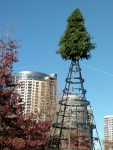
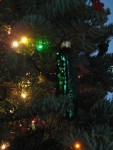
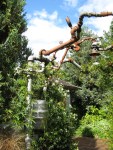
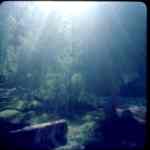
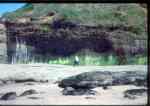
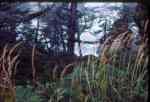
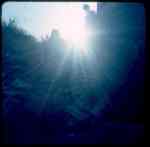
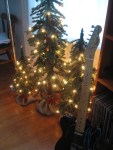
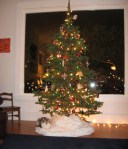
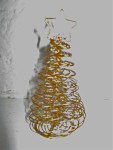
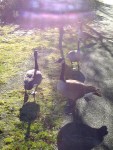
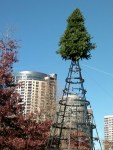
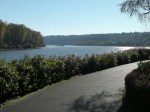
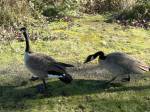
    Meantime, we celebrate Christmas with this more on trees photo gallery. Click on any pic to view the gallery.

  • Hamlet’s Status (A Play in Six Posts)

    Hamlet, at his computer. Enter Polonius:Hamlet's Status

    Polonius: What friends thou hast, add them fast, Lord Hamlet.

    Hamlet: Polonius advises us to link our souls with hoopla,
    When twice this same moon updates us,
    But still to me she hath not chatted.

    Polonius: Light lord, thy status in disconnect must be,
    Causing you this dark and dour distress.

    Hamlet: Fish not, sir; I fear she hath deleted me.
    What post supports this knotted matter?
    False light quickly fades, casting us in dark shadows.
    Let the clouds betide, let the rains come
    So thick and dark not the bark of the ark stays dry.

    Polonius: Despair not, care not, Lord, care less than not.
    Some new compeer will soon light your night
    With comely links and notes bright.
    Light be your aim, Lord, light your audience,
    And this will give light to thee.

    Hamlet: Nay, sir. In this book of faces there is but one for me,
    And I am trapped in this light box like a wench in a nunnery.

    End

  • Of the Quest of Sir Petersilie of Pestlebrawl of the Order of the Snail; or, The Slug that Slew the Knight Errant

    “There has been much scholarly debate about the significance of these depictions of snail combat,” (“Knight v Snail,” Medieval manuscripts blog, British Library).

    Sir Petersilie of Foolsbrawl in a Field of SnailsOn the sticky tricky trail of the obliviously slow sung snail
    In abstruse night hauled from mused sleep our noble knight
    Loyally hassled by Bona Fide his gallant gabbling vassal squire
    Sheathed and studded leaves amid the rustle of first light
    Abysmal metaphorical lack-a-back his lazy credo
    Squaring his mail nailing his welds into steel mental spikes
    For Bona Fide dressing Petersilie was indeed a close battle.

    Busy poets to the court replace rusting escutcheons
    This historical tourney near the end of futile modernity
    Before joust was just jest and chivalry a corporation
    Stood tall Sir Petersilie of Pestlebrawl upon staid steed
    Auguring from the Order of the Snail mortal welcome
    This his last Quest for the Wholly Exulted Wooly Grail
    To hold the sacred secret of the sweat and dour secretion.

    In satirical slime he spent his time a woed scholar of the decoy
    Stout by hearty ales microbrewed behind the berfrois
    Ate merry and many a fatty but delicate foie gras
    And escargot whilst knights jousting with snails roiled
    Scrolls of marginalia snails dressed in natural snail mail
    Pacing against mace married his demise bored sweet and torus
    The fused self-complacent snail did fain cant and tilt.

    4120159349_b798c17b54Thus domesticated rusticating finished his failure ne’er-do-well fall
    In the finals tourney he slipped tumbled and sprawled
    In a nest of snails and Bona Fide let go and abandoned all
    For a seaside rest fishing pole and white winter flounder
    And all around whelks of waves swelled and bulged
    The salt tide rising on Petersilie couched in a conch
    Dreaming of collations and juxtapositions.

  • Trees of Christmases Past

    One year, living near the ocean in South Bay, we got a fake Christmas tree. The metallic silver needles, like tiny confetti mirrors, reflected shades of yellow, blue, and red, emitted from a rotating electric color wheel placed beneath the tree. The colors turned almost as slow as a sunset. At night, with the lights in the room all off, the colors from the wheel flickered through the spaces between the thin tree branches and splashed neon paint over the walls and across the silver glittered stucco ceiling. It was our first and last psychedelic Christmas tree. The next year, we got a real tree, and the fake tree stayed boxed in the attic. Maybe it’s still up there, awaiting a psychedelic rebirth. One of these days, someone will find it and haul it off to Antiques Roadshow.

    Another year, living in an apartment on the other side of town, now less than a mile from the water, and just under ten miles along the bike path from my first teaching gig, in Venice, Susan and I bought a live tree, a small pine, rooted in a five-gallon bucket. After Christmas, we planted the pine in my parents’ front yard. Before I went on the Facebook wagon, some time ago, I posted a pic and mentioned the tree to a few ES locals. “Who knew Joe would wind up so sentimental,” one said. The tree has grown to a height of 20 feet or so. It’s not shaped like a Christmas tree. It looks more like a thick, wind tossed, but healthy, lone cypress. It leans out toward the street, between the house and a fire hydrant next to the sidewalk.

    In the Northwest, folks still drive out of the city to cut a fresh tree. In the wooded areas outside Portland, U-Cut Christmas tree farms are as common as surf spots along Santa Monica Bay. One year, up on a tree farm about twenty miles east of Portland, a full fir roped to the car roof, I suddenly discovered I’d locked the car keys inside the car.

    Another year, Susan won a Christmas tree, in a name that tune oldies radio contest. The only problem was that the tree was in a lot across the Columbia River in Vancouver. Christmas tree time in the Portland area is often cold and rainy and windy. We drove across the bridge to Vancouver, the East Wind scouring the Gorge with elbow grease, picked out a tree at the lot, petted the farm animals, visited the gift shop, where we drank some hot chocolate, and drove off for the return trip to Portland. By the time we got back to the bridge, the winds were kicking up with 40 mile per hour gusts, and with the wind cutting across our eight foot fir tree tied to the top of our little Honda, the river crossing was like windsurfing on a sailboard. I held the Honda to 40, and we blew sideways into Portland.

    Our cat likes a Christmas tree. She won’t bother it, claw at the ornaments. She’s at an age now where she just sleeps under the tree, on the white cotton blanket that’s supposed to connote snow. This year, I’m thinking it’s a good place to be, for me too, under the tree, but the cat prefers sleeping solo. Outside this morning the snow is more than a connotation. Those are denotative flakes blowing in a new east wind. If I let the Scrooge hiding in my soul emerge this year, I’m likely to wind up in the snow bed outside. Check it out – click on the photo gallery above. I’m off to find a tree. One year, I walked down to a local church and picked up a tree there, not quite a mile from our place, and carried it back home on my shoulder. You don’t see this sort of thing much anymore, I thought, self-complacently, slipping and sliding on the snow-muddy shortcut path up to our street. Maybe this year I’ll surprise Susan with a fake tree. Won’t she be surprised?

  • Notes on the Difficulty of Reading a New Poem

    Poem WalkingWhat happens when we encounter a new poem? New poems can seem impenetrable. But maybe the idea is not to penetrate. If the poem is new, the reading experience is also new, unfamiliar, foreign to our eyes and ears, to our sensibilities. What happens when we read a poem?

    In the darkroom, the developer slides the photographic paper into the chemical bath. Slowly, an image emerges. Reading a new poem is a similar process in as much as the full picture does not immediately reveal itself. But that’s as far as that analogy might go. A poem is not a photograph.

    The poem as montage, as mosaic, the narrative line pieced together stitch by stitch. Begin anywhere.

    Poems are made with words, usually, and words have two basic kinds of meaning, denotative and connotative. With regard to connotative meaning, words suggest, have associative meanings, colloquial twists, and personal meanings. We have our favorite words, and words we find distasteful. “Are you going to eat those adverbs?” “No. I got sick on an adverb once, in grammar school.” Cultural, contextual meanings. We can’t control language.

    When encountering a new poem, we ask the traditional questions: who is speaking, with what voice, and what is the intended audience, remembering not to confuse the speaker with the author, the audience for ourselves. What’s the speaker doing, talking about? What the diction, what the tone, what the setting, what the irony?

    Here’s the poem under question: “Foxxcan Suicide (Stylish Boys in the Riot),” by Russell Bennetts (the editor of Berfrois). We look for help. Suicide we know. Painless, as the song says, though we doubt that, and that song is not about suicide. A soldier’s choices are limited. Are a reader’s choices similarly limited? Does “Foxxcan” suggest Foxconn, the so-called Foxconn suicides?

    I recognize Starnbergersee, from T. S. Eliot’s The Waste Land, but is a single word enough to create an association? Why not? Eliot’s poem is fragmentary. “Foxxcan Suicide” is fragmentary, or so it seems. What if picking up on an Eliot reference is wrong? We could ask the author. No. What can the author know of the reader’s experience? Words are out of control once they hit the paper. The poem is a reading experience. And something more than Starnbergersee reminds me of Eliot: the many references, obscure to this reader, though I know who Axl Rose is, sort of, but I can’t say I know him, though he’s from my home town, big town. And the Roses had a label: UZI Suicide. So? Threads, though, links. And I know who Legacy Russell is, though not well enough to get the three asterisks at the end of that line, asterisks that point to no footnote.

    Still, I like the new poem. I like the fragmented narrative. I like it for its changes in diction and speech, its orality, its lyrical last stanza, or paragraph, the socio-economic comment it ends on. I like the almost hidden poetic characteristics, the rhyme, for example, of “Legacy,” “easy,” and “please me.” Gradually, more of the picture seems to emerge: the teen spirit (Nirvana). Maybe it’s language that has become suicidal. The poem casts this reader as a kind of outsider, beyond the pale. Maybe I just don’t get it. “Well, how does it feel?”

    Some time ago, in a workshop with David Biespiel, we used a kind of shorthand response technique as a way of quickly getting at new reading experiences. David called the technique, “What I See.” You had to tell it, what you saw, in 25 words or less, or so. Kenneth Koch taught a similar kind of technique, an attempt to get at the poem’s “idea.” What’s the idea, Koch asks, of Blake’s poem “The Tyger”? The speaker is asking questions of the wild animal, but of course the Tyger does not respond. The questions the speaker asks seem to have something to do with who made the Tyger, the maker’s character. Blake uses images of a blacksmith to try to picture the Tyger’s maker. For Blake, the blacksmith would still have been a powerful and practical individual, a maker of things useful, but his work was being subsumed at the same time by larger manufacturing forces that would come to be known as the Industrial Revolution. And that revolution would give way to more: “Stylish Boys in the Riot.”

    What happens when we read a poem? From the Paris Review Interviews, this one with August Kleinzahler:

    INTERVIEWER: Recently Poetry posed a question about the social utility of poetry. Does that interest you?
    KLEINZAHLER: No. I agree with Auden that “poetry makes nothing happen.” Nothing else needs to be said about it.

  • November Day Along the River

    How are you? You are how
    this is too easy
    a still gift of photographs
    almost like a real letter.

    You like flowers, flowers like you, like
    Peonies, purple green red yellow mopped hair
    Marigolds, red orange bites
    Red geraniums in a real clay pot
    and those little white hanging threading flowers,
    I don’t know their name, whispery white.

    I am 1,000 characters
    all so small you can’t see them
    like tiny little squiggly bugs.
    You are 1 bodacious character
    like a lobster on the ocean floor under
    blue waves under an orange sky,
    or a swell cat, an orange tabby
    with blue eyes,
    who never scratches but purrs
    and curls in your lap for a nice nap
    on a hot sunny summer day,
    a sleepy breeze cooling powdery sky.
    Evening comes and a glass of white or red wine
    and dinner and the sun goes down
    and the moon comes up
    up and up and up and up
    so the path is lit.

    But now is not summer
    now is the beginning
    of a long winter
    without you.

  • Notes on “Stoner,” a Novel by John Williams

    StonerIn his disclaimer notes at the front of “Stoner,” John Williams assures his reader that the character of William Stoner is fiction, and should not be mistaken for any coincidental likenesses, the standard “any resemblance to” lingo. And maybe there was no Stoner, but at the same time, surely there are many Stoners. Stoner is a kind of every-humanist. When asked why Ulysses, Joyce responded that the character was well rounded. Ulysses had been, of course, a son, but also a father, a husband, and a soldier, and while he was out soldiering, a cuckold. But Joyce’s Ulysses is an ironic depiction; the many resemblances to the original Ulysses amount to colossal irony. So too, Stoner is an ironic humanist, and readers are disabused of any notion that the liberal arts specialist or humanities generalist by definition reaches nirvana or achieves happiness or indeed is even able to articulate their experience for someone else to appreciate. Reading does not necessarily make us either whole or rent. Reading does not make us better people (particularly reading does not make us better people than non-readers). Stoner is a book.

    Early in the book, Stoner may come across as an existential and humanist monster; it’s hard to understand how a so-called humanist, a man educated in the liberal arts tradition, was unable to find a way to talk to his parents, however alienated he might be from their generation, their values, their experience, particularly if they have little or no education. And there were no disagreements, no political arguments, no generation gap problems, no counter cultural issues. (Indeed, as it turns out, Stoner is as conservative as Louis Menand claims is true for the majority of today’s professors.) Stoner simply seems to have felt his parents incapable on any level of understanding want he wanted. Still, how had he missed developing the skills necessary to articulate for them his need? In any case, Stoner winds up no more or less a monster than most men.

    Indeed, a suitable epigraph for Williams’s novel “Stoner” might have been this quote from Thoreau’s “Walden”:

    “The mass of men lead lives of quiet desperation. What is called resignation is confirmed desperation…A stereotyped but unconscious despair is concealed even under what are called the games and amusements of mankind. There is no play in them, for this comes after work. But it is a characteristic of wisdom not to do desperate things.”

    In other words, while there may have been no actual Professor Stoner that Williams based his character on, the character of Stoner contains the characteristics of the average college professor in the 20th Century US (Stoner teaches through two world wars, the Great Depression, and the Korean War, and though he is never a soldier, a war of a different kind engages him). “Stoner” is a hard book to talk about without creating a spoiler. Readers interested in a regular review might check out Tim Krider’s New Yorker review, posted on-line on October 21. But it’s a bit of a spoiler. So too is a spoiler the introduction to the New York Review Books Classics edition of “Stoner.” Read the introduction after finishing the book. The introduction is particularly useful for the passage of an interview with John Williams, in which he calls Stoner “a hero.”

    If Stoner is a hero, he is a kind of anti-hero. For great sections of his life, he is a loner, not alone, exactly, but alienated. He is independent, courageous, generous, disciplined. He is exploited. He is, primarily, a reader, a scholar. As a teacher, he is a kind of anti-Mr. Chips, though like Mr. Chipping, he is conservative. But Stoner is not conservative politically or socially or in any kind of religious sense. He’s conservative in that he wants to preserve the University for people like himself. This may have something to do with his being a classicist. One of the best scenes in the book (spoiler alert) is when, forced as a veteran to go back to a grueling schedule of Freshman Composition classes as a punishment backhanded down by his department chair, he decides to chuck the syllabus and teach Freshman composition through the portal of Medieval Language and Literature. Stoner is a tenured professor, so there’s nothing his chair can do about it. There are breaks in the text. Why, for example, when it’s mentioned that he writes his MA thesis on one of the tales in Chaucer’s “Canterbury Tales,” are we not told which tale? One wonders how a character so supposedly steeped in Chaucer and Shakespeare could be so naïve and awkward in his own time. But the Stoner we come to know at the end of the book is not the same Stoner we knew at the beginning of the book.

    The figurative language is sparse throughout “Stoner.” The prose is like a field of wheat. Nothing seems hurried. The sentences are long (Williams was a fan of the semicolon), and often turn into something unexpected. There is a plot. The plot is a man’s life. And this man’s life, some have argued, doesn’t amount to much. Indeed, Stoner himself, a self-disciplined specialist, feels he’s achieved little, but he’s patiently endured so much. Stoner has slowly, incrementally, experienced his life, and the reader shares, step by step, in that experience.

    Related: “How Do Professors Think? More Crisis in the Humanities”

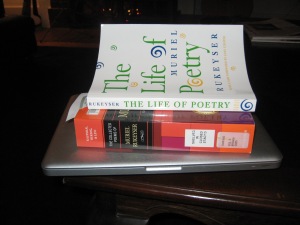
  • Poetryphobia: Muriel Rukeyser’s “The Life Of Poetry”

    The Life of PoetryMuriel Rukeyser’s “The Life Of Poetry” covers the poetic experience, its many uses and resistances, during the 1940’s. Her view of poetry comes from the experience of war, by her participation in freedom efforts prior to the war, and by disappointment the war did not bring peace, and also by science, which suggests a new age for poetry, and by the growing use of popular arts (radio, movies, songs, dance). Muriel argued that US culture feared poetry, where poetry is emotion. Emotion is feared because it calls up and recognizes harm, and asks for reparation for harms done. But who wants to do that? So poetry isn’t a popular art form. It’s not an art form at all. Once poetry becomes an art form, it freezes on the surface: No myth but movement, no still lives, no basket of fruit and the hovering fly that never dies. And the poem is not a “place” (154, 174), the mind not a hunk of meat. Both are energy. The emotion of poetry creates empathy and argues for change. She was writing about silicosis as early as 1938, advocating for victims, explaining the disease. Empathy is recognition, which is also emotion, of the audience, which she prefers to call the witness. What is witnessed? Relationships: between images, sounds, symbols, people, things. And relationships are constantly on the move. Nothing is fixed, not in time, not in space, not in mind.

    We probably do dislike poetry, at the least ignore poems, or even scorn poetry, treat poets like vaudeville clowns, but it would seem a bit overwrought today to say we fear poetry. But when Muriel says we fear poetry, she means we are separated from emotion, and the thought of reconnecting to our emotion scares us. Human nature probably does not improve over time, in spite of technological progress, and we may be further removed from emotion today than we were in 1949. The culture Muriel’s talking about does not value emotion, the emotional. The sections of “The Life of Poetry” devoted to the popular arts and the uses of poetry in the sentimental suggest lost opportunities. The popular arts fail to go deep enough. Sentiment is unlike emotion. Emotion is a weakness because, once it is unleashed, it is uncontrollable. Control is a value. One attempts self-control, and when that doesn’t work, control over others. Allowing the working class, the miners and laborers and factory workers and garment sewers and waitresses, weekend release over a couple of beers and a country western song playing on a jukebox, evoking tears, or the equivalent sentiment found in church prayer, is acceptable. But no emotion. Control yourself. Get sentimental if you must. It’s ok to vent. You can wear it on your sleeve, your troubles, but don’t freak out. And self-pity also is sentimental.

    “There is difficulty in breathing.
    Yes.
    And a painful cough?
    Yes.
    Does silicosis cause death?
    Yes, sir.” (Rukeyser, Collected Poems, “The Disease,” 86:87)

    Emotion is the weary heart wearing and tearing on the poet’s sleeve. This doesn’t play well in boardrooms, where emotion is kept submerged through charitable donations and the branding of giving, or in churches where the sacrifice is symbolic, or in marriages of competition. Emotion is not anger. Anger is the sediment of sentiment, frustrated or undefined or ill-defined desire. Poetic emotion sublimates repressed desire. Poetic emotion is the sublimation of antithetical cultural values. For example, the auto has ruined the country, the countryside, the culture suffering in detrimental reliance. Without definition, this ruin devolves into road rage, the driver’s psyche full of potholes. Sentiment is nostalgia for a 1957 Chevrolet, road trips, surf safaris. The car is a catastrophe, the planet hit by an asteroid, impossible now to see the earth beneath the asphalt. But the smell of the new car still intoxicates, Whitman’s rooms full of perfumes. What to do about it? Robert Creeley, “I Know a Man”:

    drive, he sd, for  
    christ’s sake, look  
    out where yr going.”

    The novel as middle class entertainment contains emotion; that is, the novel packages emotion, places limits on emotion, surrounds emotion with form. As for the dime store novel, mysteries, detective stories, noir: the term “hard boiled” is born of sentiment. The so-called seedy section of the city boils with sentiment. The sentimental love to visit, but they don’t want to live there. It’s good to have someone to look down on, to criticize, to arrest. Likewise, poetry as craft is sentimental where it deliberately obscures to imitate emotion. The merely personal or found fabrications or wordplay that does not touch the human condition is entertainment. Not that entertainment isn’t useful; it is, but it’s not poetry. Poetry is the marriage of play and work, where play pays dividends and work pays nothing but a release of emotion, which spells trouble. Muriel describes a workshop exercise (179) that might be called “where’s the poem”? The poem exists in the imagination of the witness, and that’s not craft. A poem is not words.

    There is a war between play and work, between worker and exploiter, between the divided selves. Poetry acknowledges the war and becomes a tool to make people whole again. Emotion is the stain of war that poetry seeks to clean. There’s another reason emotion is devalued, suggests Muriel. Emotion connects to nature, to trees, to roots, to the land and to animals. That’s seen as cutting into profits, though it need not. To reach down into the emotion that connects the human to the planet requires a reevaluation of the relationship. Today’s eMotion is backlit. That’s not the emotion Muriel is talking about. Muriel’s emotion sews together symmetrically a sensorium distorted by technology as in a funny mirror. Muriel’s emotion deals with alienations and depravations, goods and evils.

    Important poets for Muriel included Whitman and Melville. Whitman is the poet who discovered good, and good is his breathy line, the form of the discovered self, the freed self. To Melville passed the work of dealing with evil. Muriel foreshadows the current crisis in the Humanities by juxtaposing poetry with science, comparing methods, making good use of science. Imagine your kid comes home and tells you he’s decided to study to be a cave wall painter, and he’s going to work in caves, painting on walls by the light of a torch. Fear of poetry is about resistance to emotion, but more, about the resistance to the imagination, about inability to even recognize the imagination.

    “The Life of Poetry” is not an academic book (a good thing), but it’s not an easy book. For one thing, the references to popular culture are antiquated, and some of the references are obscure. For another, there’s evidence on every page the writing is the work of a poet. But by the last two chapters (the penultimate “Out of Childhood,” and the last, beginning “The Meaning of Peace”), the prose becomes familiar, the writing a little less fearful.
  • The Bad Hop Boat Poem

    You watch
    Baseball
    and recall
    the hit
    that took a bad hop,
    bebopping
    between your legs
    like a line
    impossible
    to scan,
    bouncing
    over your glove
    touching
    the dirt.
    No one is listening.
    Even the umpire
    shook his head.
    “Shake it off,”
    Coach called
    from the critical
    dugout.
    “Bad hop,”
    the gracious
    pitcher said.
    But no, even now
    you can not
    accept the excuse,
    because you
    fear the ball
    & the poem,
    as you explain:
    “I was thinking t i l l e r
    of a boat f  u
    on the high o d
    C’s.” l  d
    A e
    Infield poem b  r  u  n
    error full o w
    confuses v o
    a boat with t h e b a l l
    o
     “E6,” says C C C C C w C critic.
    C C C C C C
    C C C C C C
    C C C C C C
    C C C C C C
  • 66 Breaths of Barstow for Babs

    talk
    desert
    deepens day
    drifts
    west
    cool
    prose
    sand
    morn
    crossroads
    family
    1957
    trunk
    $300 bra-pinned
    Route
    66
    Los Angeles cures
    ocean
    butterfly
    tomato
    sunrise
    donkey birds emerge
    cowboy hat floats salt sweet
    evening hills
    angel hovers
    sky metallic blue
    orange
    sea falls ten-pound raindrops
    children embrace
    across country blows highway
    tumbleweed
    train side
    winds
    south
    distance
    silver
    water
    ardor breeze
  • At the Pumpkin Patch

    Pumpkin Man

    The frizzled farmer pushing the pulling, tired draft horse,
    his jeans ballooning like pantaloons pinched into rubber boots
    sunk and stuck like squash in the shallow fall mud,
    his arms swollen loofahs lifting pumpkins up to the children
    riding on sweet smelling, dry hay bales in the wagon,
    has a “Head like a prize pumpkin,” as Joyce’s Bloom thought
    of Tom Wall’s son, and Tom, the frazzled farmer,
    declaring this his last pumpkin patch harvest,
    prods the horse (whose name is Wally) and wagon to a stop.

    The pumpkin picking party hops to the ground and disperses,
    and the children caper around the pumpkin field,
    Papas and Mamas and Nanas snapping photos orange and blue,
    until the farmer calls the pumpkin pickers back to the wagon.

    The farmer is a frayed man, his wife explains to a group
    waiting patiently at the scales, fretting this pumpkin crop falls sparse,
    but that’s just his way, and anyhow, who can talk at a time like this,
    all these potential faces, all fat orange cheek puffed, twist handled hair,
    heads picked and packed, jugs full of orange pie mash and seeds?

    Out in the pumpkin patch, empty faces pass into ooze,
    a few pumpkin seeds carried up by blackbirds
    and dropped in the next field over, that fallow acre
    empty of people picking and parsing
    for the right ripe pumpkin, the perfect possible
    face, in bed of wet gray hair, muted mouth,
    flute feature deadpan face.
    A field of plump birds erupts in applause
    as a curtain of spitting rain starts to fall.