• Baseball Poem with Hidden Asterisk

    Baseball ParkSnug spring dusk. Players hustle greenly
    across warmed grass, balls plashing infield,
    confetti falling, false plum blossoms.

    Easy out in plain outfield, long armed
    lob. Bang of whisked bat. Runner heels bag,
    rests at two, fair, perfect diamond view.

    Call strike three. Up from his robot squat,
    knob catcher under rule huge empire
    leans away and lanky batter sulks.

    Twisting bat tulip pitcher, swollen
    cheeks sun flowered, peers down math model,
    algorithmically base template.

    Reality catcher’s secret sign,
    two and two make three in the slanted
    sunbeam most lumbered cat in ball world.

    Drops for short nap in dugout dark brew:
    shadows, spat seeds, bubblegum, oiled gloves,
    olive green browns, seasonal farm tans.

    In the stands, bums, basic blue collars,
    salt peanuts and choice beers, high above
    button down box seats where line the fouls.

    Blowy the crowd sings, “Euripides!,”
    rising in unison how still rushed
    crouched outfielder backing to close fence.

    Coiled for spiraling ball with odd red
    markings. Where do you want to begin,
    at the front of the pitch, or the end?


    Related Posts:

    Baseball and the parts of speech

    Baseball Breaks Sound Barrier

    Baseball Drought Hits Northwest

  • Fickle Moon

    Plum blossoms fall in a cool moonglow,
    and the calico cat cleans alone
    in the delicate shower,
    thinking, “How silly is this want of words,
    where so much moonglow goes to waste.
    She’s in the house, behind the curtains,
    can’t see me awash in falling petals,
    her face stuck in a moonless book.”

    Another moon passes with more moonglow.
    The ocean sky fills with gleeful moons.
    The cat bats at the sweeping beams,
    catching moon drops in her paws,
    wiping moon balm across her lips and whiskers,
    chasing yellow shadows in her tea garden,
    thinking, “The television emits no moonglow,”
    and cherry blossoms fall.

    Another moon passes, and again she misses the moonglow.
    Another moon passes, no moonglow for her.
    The ocean sky rises and falls with full moons,
    but no moonbeams come her way,
    no moon drops fill her hands,
    no moon balm wipes her lips.
    The cat’s tail brushes daylily flowers,
    and she bathes in a lavender mulch.

    A loony moon glowers along,
    heavy with a surplus of moonglow.
    “Here, Kitty…Here, Kitty, Kitty…,”
    but no moonbeams come her way,
    no moon drops wet her palms,
    no moon balm soaks her lips,
    and no cat graces her garden,
    ripe plums soon falling.

  • Chatterbox

    IMG_2356 BoxesChattering swing of ratchet wrench
    Hatted on hexed nut box bolt head
    Alloy heat threaded hatchet hoax
    Treat tears time tender torpid box
    Tightly drawn reach of technical
    Entity rat tatting chattel
    Rat a tach tech teacher hat chat
    By the stunned thwacked beach
    Or far inland brine dry valleys
    Xylophone loops accordingly roll.

    IMG_2358 All the World's a Box

  • On Discussion

    IMG_2347 "Let's dialogue"
    “Let’s dialogue!” “Oh, please.”

    What is there to discuss-ion? “Music as discourse (jazz) doesn’t work,” John Cage said.* “If you’re going to have a discussion, have it and use words.” As both a jazz and Cage fan, I’ve often reflected on the paradox, for discourse, “running to and fro,” seems an accurate description of jazz, with or without words.

    According to Google’s Ngram Viewer, the word discussion in American English is on the decline, following a peak around 1960. Interested readers may follow the link to an Ngram Viewer chart that graphs the word discussion found in “lots of books” from 1800 through 2008 using the corpus “American English.” But what is the difference between being involved in a discussion and having a conversation? Again using Ngram Viewer, we find conversation and discussion crossing just after 1900, discussion on the rise, conversation falling off, but recently apparently headed for another crossing, discussion dying, conversation on the upswing, beginning around 1980. What does all this mean, if anything? But it looks interesting, even if it does not provoke a good discussion question.

    Are discussions weightier than conversations? We may not associate the chitchat, the tete-a-tete, with discussion, but with conversation. Do we gossip during a discussion? We prattle on. Are you still with us? Maybe conversations are more intimate than discussions. Can we have a conversation question in the same sense we have discussion questions? If words have meanings, then perhaps a discussion on discussion might mean something. But is mere meaning ever enough, or must we have entertainment to boot? To mean is to mind, as we mine for meaning. And Cage added, immediately following his seemingly anti-jazz comment, in parentheses, “(Dialogue is another matter).” What did he mean by that?

    What are discussion questions, and should we have them? Can we have a discussion without a question to prompt one? What is the discussion question that can only result in silence? And is that the discussion we desire?

                                                     Give any one thought
                    a push       :     it falls down easily
              but the pusher  and the pushed    pro-duce      that enter-
    tainment          called    a dis-cussion       .
                      Shall we have one later ?
    
    Cage, "Lecture on Nothing," Silence, 1961 (1973), 109 (the text is 
    arranged in four columns, here approximate).

    Without further ado:

    7 Short Discussion Questions with Equally Short Suggested Answers:

    1. Q: Are discussion questions deconstructive? A: Pour the lecture neat.
    2. Q: Where would you like to sit? A: In separate sections.
    3. Q: Has education become entertainment? A: You’re taking me out tonight?
    4. Q: How can we improve the world? A: How long is this supposed to last?
    5. Q: What can we learn from randomness? A: Noise counts – percussion discussion.
    6. Q: Why even when diligently minding our own business are we often snared by a discussion question? A: “Do you know the way to San Jose?”
    7. Q: Does wasted time pay for itself? A: Time will never tell.
    * John Cage, "DIARY: HOW TO IMPROVE THE WORLD 
    (YOU WILL ONLY MAKE MATTERS WORSE) 1965," 
    A Year From Monday, 1967, 12.
  • Walking thru the park one day

    One
    Hundred
    Concrete years
    In a body of water
    Two women walking
    One in turquoise taupe
    The other in peach mauve
    Briskly yelling into cell phones
    Their voices trailing off like crows
    Squirrelly trees stiffen tall tail stillness

    Writing is hard work, the experts tell us
    If a day is lost to writing the reason
    Is probably you did not want
    To write, after all
    You probably
    Wanted
    A park
    Bench
    To sit
    Still.

  • On Setting and Narration

    Life on the Mississippi
    Life on the Mississippi – Reading the Waves

    In the middle of Adam Gopnik’s explanation of Lawrence Buell’s reading preferences informed by historical setting (New Yorker, “Go Giants: A new survey of the Great American Novel,” 21 Apr, 104), there’s an ambiguity, whether caused by Buell, Adam Gopnik, or both, I’m not sure, but Gopnik says Buell thinks Huck helping Jim escape is a less radical act in the eighteen-eighties, after slavery has already been abolished. The argument is made in the context of a comparison to Stowe’s “Uncle Tom’s Cabin,” published in 1852, an inferior work, according to Buell, but one, the argument continues, that Mark Twain must have read in order to write his better book. That’s probable, but while “The Adventures of Huckleberry Finn” was published in the US in 1885, Twain set Huck and Jim’s story in “The Mississippi Valley. Time: Forty to fifty years ago,” before the Civil War and before Stowe’s book. Would a common reader in 1885 have understood the costs to a kid of deciding against the values of his immediate, local culture “forty to fifty years ago”? The answer to that question seems vital to Buell’s method of reading literature.

    A common mishap reading any text occurs when readers confuse the author with the narrator. And often, indeed, writers struggle separating themselves from their narrator, trying to turn memoir into fiction, unwittingly revealing more about themselves than they intend. But crafty authors often deliberately create unreliable narrators. The lying or self-deluded narrator is most easily detected in the first person, but hidden behind the credible screen of the third person omniscient narrator, an author may still turn deceitful, sleight of hand tricks. And authors, too, often suffer from self-delusions. This isn’t so much about how literature works as how the making of literature works. But either way, readers may be easily confused. But how does that confusion matter to the reading of a text open to multiple possibilities?

    Buell thinks it’s important that readers understand something of the times of the author; or does he mean the times of the character the author created? Either way, a reader who knows something of the setting of a novel will no doubt read it differently than a reader unfamiliar with the novel’s setting. But there’s another problem: how does a reader come to know settings of the past? Through narratives, some of which may be unreliable, even if cast in the non-fiction mode. And even if reliable, history is constantly undergoing revision. How does historical revisionism impact the reading of literature?

    But the question of whether or not readers in 1885 understood Huck’s predicament given the novel’s setting is an important one. It’s a question we might ask of any number of literary works. Kerouac’s “On the Road” (1957), for example, gets a new reading with each new generation of readers, but the further we get from the so called Beat Generation, the more we might need other works surveying the period of the work’s setting – a good companion piece to “On the Road” is “Go” (1952) by John Clellon Holmes. How readers respond to a narrative is dependent on many variables. Non-Catholics, for example, are likely to read Joyce’s “A Portrait of the Artist as a Young Man” differently than Catholics, and Catholics who actually attended Catholic schools will read it differently again.

    Where is the reader who brings no experience or expectation whatsoever to a text? They just might be the author’s best target audience. And likewise, why wouldn’t readers search for that very book, the experience about which they know nothing?

  • On Description

    A Cat Egg
    Where did that egg come from? What egg? Why are you sitting on an egg? What egg? Cats are not supposed to sit on eggs. You see eggs? I see nine eggs in the carton. I see nine missing eggs in the carton. Where are the missing eggs? “The future is in eggs,” Eugene Ionesco said, his name a perfect description of an egg. That does not even begin to describe this situation. Do you want to say situation, or predicament? A cat egg is like a mare’s nest. Let’s blow this joint before someone asks what makes a cat purr.

    Embedded in most descriptions is a prescription, instructions for viewing, boundaries stipulated and promoted. What might look at first glance objective enough turns around and around on an axis of theory.

    Qualifications: from a distance; in the waning light of a neon-like moon; on a particularly hot, steamy day, out of season. Adjectives and adverbs cloud the way. References.

    How do we describe description, the process we use to describe, carry across? And why bother? Why describe something others are free to experience for themselves?In any review, isn’t there an implicit recommendation based on a prescription of what is being described, how it ought to have been done, or at least how otherwise it might have been carried out?

    A description of a painting, a Rothko: What is blue, size, warp; from what distance, in what light? Does our description of the Rothko change if others come into the room? The paintings are on the move, constantly changing, even as the museum makes every effort to still them. Description is a distillation of a sensory happening. McLuhan advised touch is the most involving of the five senses. When we paint, we use all five senses at once: paint odors; the brush splash sounds as we touch bristles to canvas. We take a break for lunch and taste oil in our bread. But are all descriptions sensory? What happens when we describe a process, an idea. Must description use words? What does a cat’s purr describe? Can we describe a cat’s purr in a painting?

    Easter Eggs 2014
    Egg Culture

    We come, then, naturally enough, to the egg. We are reminded of Duchamp, his hidden object, if it is an object, which gets us nowhere. We need to get inside the egg for a full description, but once we crack the egg open, it’s not the same egg. We decorate our description.

    It’s easy enough to say that descriptive writing is language that appeals to one or more of the five senses. But words can’t capture experience. Where is the description that activates our taste buds, such that we taste the bread and wine even as our fast continues? Is all description vicarious? We write down, distil, drop away. Description is at the distal end of experience.

  • After the Last Snow

    Psychedelic DogHe slushed through the yard with the dog, Mosey,
    looking for the salsa garden covered with snow.
    A foggy down comforter was spread
    across the cold compost pile.
    Mosey gave it the once-over and waggled on.

    Through the grey branches of the bald maple,
    the wintry sun dripped a wet, molting light.
    “I think I’ve found the salsa garden,”
    Mosey barked, wagging through a snowdrift.

    He found some green garlic starts,
    planted last fall in hope of an orange day.
    Over on the frozen patio sat the fable
    of a red tablecloth and a bottle of sweet wine,
    Mosey dozing in a patch of warm light.

    He hears voices, someone’s recipe:
    “Fresh cilantro, hot pepper, and black beans,
    eight tender Roma plum tomatoes,
    an inch of basil, a sprig of rosemary,
    a dash of black pepper and a pinch of salt,
    a dark green jalapeno,
    and a mellow, cool lime.”
    Sevenish on the heat scale, he thinks,
    two fat, purple candles melting the snow,
    Mosey barking, “Let’s go back inside now.”

    They entered the kitchen through the side door,
    dog wet noses sloshing snow and water,
    dripping all over the stale linoleum.

  • Juice and Joy

    “What is all this juice and all this joy?” Gerard Manley Hopkins asks of Spring. And no sooner does he sing the push and fuss, the ballyhoo, of a sea sky blue slurred song of fresh thrushes than he announces the sound of a melancholy note, a bell of vespers, the turning of the promise of spring, spring’s quick morning suddenly fallen, the promise of its baby blue sky now overcast, what was in the seed of his poem from the beginning, “a strain.”

    Is spring for the earth painful? It might be, born in a bed of industrial pollution, which even in Hopkins’s time was already something to brood over, and in spring he’s already grieving.

    Not for Hopkins will spring last, and every spring grieves for its unwinding even as it unwinds in juice and joy. It’s the climate change of the “Sea of Faith” again that seems to sully his spring. To his coy mistress he does not even bother calling. He doesn’t want to make the sun run; he wants to see it stand still.

    And Hopkins twists Herrick’s argument’s ear, and Herrick’s sin of staying becomes for Hopkins a sin of leaving. Where in Herrick, Corinna is told,

    And sin no more, as we have done, by staying;
    But my Corinna, come, let’s goe a Maying,

    in Hopkins, the children are told:

    Have, get, before it cloy,
    Before it cloud, Christ, lord, and sour with sinning,
    Innocent mind and Mayday in girl and boy,
    Most, O maid’s child, thy choice and worthy the winning.

    Hopkins does not seem to sing to the virgins. Somehow, he’s unable to seize his day. Hopkins disliked cages: “This in drudgery, day-labouring-out life’s age.” In Hopkins, spring is not sustainable, but this abstract thought becomes itself a cage. And age is a cage.

    So it was of Hopkins and his springs and falls I thought as I walked past this Flowering Japanese Crabapple tree the other day. And I remembered a line from Hopkins’s poem, “God’s Grandeur”: “And for all this, nature is never spent.”
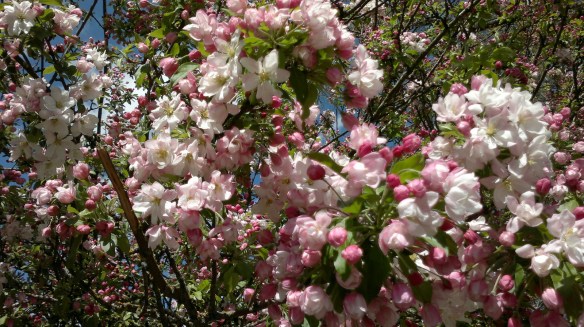
    041220141136 Flowering Japanese Crabapple 1

    At least, I think it’s a Flowering Japanese Crabapple. Hopkins would probably know. He despaired, among the many things he seems to have despaired over, of the toil and wear and tear already evident upon nature of the effects of urbanization and industrialization. Yet here I saw these lovely blooms persisting, in the middle of the city, surrounded by construction. For the tree, as you can now see in the pic below, is a caged skylark. But it’s been there awhile, wedged into a corner of a parking lot up against an old brick apartment house, but it continues to sing to me, and will sing to you, too, and to anyone who cares to take a walk in spring. Alas, as Hopkins and the carpe diem poets remind us, spring won’t last, so get it while you can, while the juice still runs freely and the joy escapes confinement.

    But, no, wait, why go under such a stricture and structure? That seed grows into a tree of melancholy. Why not simply go? Not put out, but go out. Ah, now there’s some juice and joy to go by.
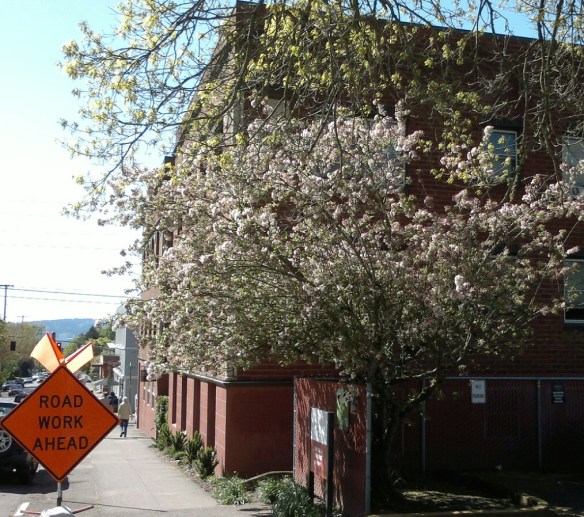
    041320141137 Crabapple road construction


  • Cat Settings (a graphic novel)

    “Cat Settings” is another text in the series of The Adventures of Scamble and Cramble, two cats who live with a poet and spend most of their time puzzling over the writer’s habits. Click on the cover to begin reading.

  • Argument in the Time of Apples

    Torqued antipathy apparels dimple Args
    dented funny car, idling gear limbed,
    oiled, greased, and garbed
    wardrobe red, beaming barbs,
    wavy hair flames bursting
    from the fat winged fenders
    of his 1950 hot rod roadster,
    and the countdown lights
    go green, and the ground springs,
    and the asphalt melts to sap;

    meanwhile, in lane next whole daddy,

    apples in juicy life dangle,
    from form below pending,
    suspended, the quick nap of a bee,
    moistly sloping sap up elegant boughs,
    up, wake up, give us blush
    pale pink blossoms,
    not the false fruit of an inapt poem.
    Leaf springs, cracks the bark
    of the dormant pome tree
    pruned for Verve & Vigor.

    Explication:

    What is called a season is the mapping of sap
    around a wound,
    and a poem is a funny car.
    After the burled cuts, twisted,
    elbow pruned shifting of gears
    and squealing of red wheelbarrows,
    the melting tongue wanders away,
    talking to the bees from a standing start,
    showing the pink slip core of reason
    dash and flash in a sap sluice.