The cover story of the September 17 issue of Rolling Stone gives us the best reasons to watch television. It’s all about content, of course – not a word about form.
Marshall McLuhan, in Understanding Media, gives us the real best reasons for watching TV.
“With TV, the viewer is the screen,” McLuhan says (p. 272), and he foreshadows the same arguments that currently occupy Nicholas Carr and others. “The introspective life of long, long thoughts and distant goals…cannot coexist with the mosaic form of the TV image that commands immediate participation in depth and admits of no delays” (McLuhan, p. 283).
Carr recently blamed the end of book culture on internet habits. McLuhan was writing before the invention of the personal computer, but Carr’s focus still repeats McLuhan’s claim: “The phenomenon of the paperback, the book in ‘cool’ version, can head this list of TV mandates, because the transformation of book culture into something else is manifested at that point” (McLuhan, p. 283). But then Carr goes off track. Carr thinks print culture is about deep thinking, but it’s about living on the railroad, and has little to do with all of Carr’s deep sea metaphors, as McLuhan explains: “The American since TV has lost his inhibitions and his innocence about depth culture” (p. 283).
McLuhan illustrates that it’s impossible to be illiterate in a non-literate culture. It’s not yet clear what this might mean placed into the socially ubiquitous phenomenon of PC literacy. E. L. Mayo gives us a clue perhaps with his political (and perhaps the best yet) reason for watching TV in his short poem “The Coming of the Toads,” where TV, while perhaps the ugliest medium a book cultured person can fathom, flattens social stratification.
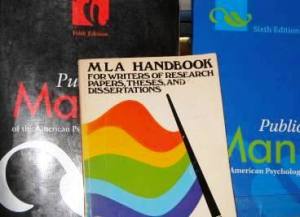 Students often wonder aloud at the minutiae of publication manuals. New editions of both the
  Again
Again 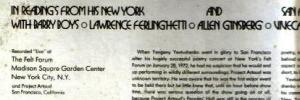 I played the Yevtushenko, and during the “Babi Yar” poem, nine minutes long on the album, I noticed that one of the Russian students was crying. Later, I apologized, concerned that the poetry had suggested some bad memories. But that wasn’t the reason for his crying at all, he told me. It was the fact that we could listen to this record in our classroom without feeling any kind of fear. “What a country I have come to,” he said. “We can play this record in our classroom and no one even cares.”
 My health care piece, “An object lesson in health and happiness,” appeared in the Saturday, August 29, 2009 print edition of
  We cross the border into
  The Coming of the Toads