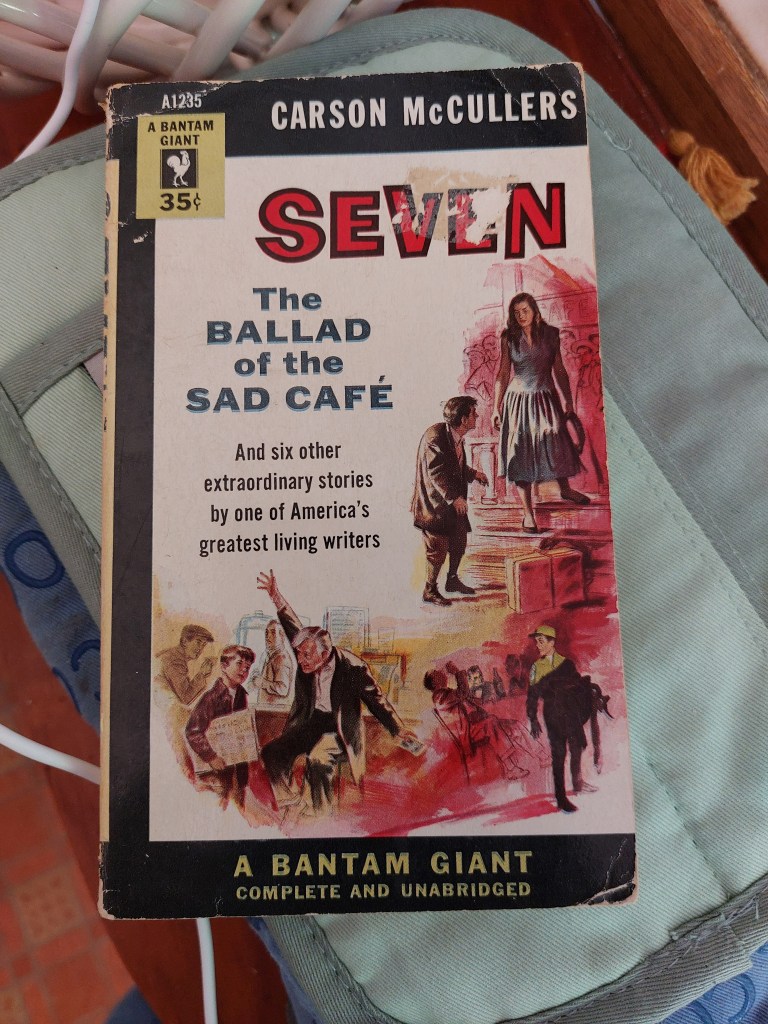
If you’re looking for Carson McCullers, you won’t find her at the Heart Clinic, where in the waiting room the chairs are a pleasant pastel-green plastic, the color of hope, and comfortable, though the wait is not long, and the streaming station is set to 60’s and 70’s rock ‘n’ roll.
Carson’s “The Heart is a Lonely Hunter” was published in 1940, when she was just twenty-three. We read it in high school in the mid 1960’s. The title comes from a poem by the Scottish poet William Sharp, published under his pseudonym, Fiona MacLeod. The word green appears in the 24 line poem 10 times. Here is the last stanza:
O never a green leaf whispers, where the green-gold branches swing: O never a song I hear now, where one was wont to sing Here in the heart of Summer, sweet is life to me still, But my heart is a lonely hunter that hunts on a lonely hill.
Only a poet would say of the heart it is “a lonely hunter.” But notice MacLeod/Sharp didn’t say “the heart”; he said “my heart.” Carson took his personal reflection and turned it into a universal appeal. Is the heart a lonely hunter? The answer will depend on whom you ask. But meantime we might also play around with Carson’s title:
The Heart is a Garrulous Scavenger The Heart is a Forlorn Blogger The Heart is a Red Red Rose The Heart is a Hollow Muscle
The word heart appears in Joyce’s “Ulysses” at least 200 times. Here is Stephen reflecting on one of his students in the “Nestor” episode:
Ugly and futile: lean neck and tangled hair and a stain of ink, a snail’s bed. Yet someone had loved him, borne him in her arms and in her heart.
But Joyce’s use of the word includes the real thing, too, as we find when we first meet Bloom:
Mr Leopold Bloom ate with relish the inner organs of beasts and fowls. He liked thick giblet soup, nutty gizzards, a stuffed roast heart, liverslices fried with crustcrumbs, fried hencods’ roes. Most of all he liked grilled mutton kidneys which gave to his palate a fine tang of faintly scented urine.
And this, meant to convey patience and forbearance in its context – Bloom thinking:
Wear the heart out of a stone, that.”
Of course many of the hearts are at the funeral for Paddy Dignam, but the young girls heart-worded “Nausicaa” episode begins with Gerty on the rocks close to sunset:
The summer evening had begun to fold the world in its mysterious embrace. Far away in the west the sun was setting and the last glow of all too fleeting day lingered lovingly on sea and strand, on the proud promontory of dear old Howth guarding as ever the waters of the bay, on the weedgrown rocks along Sandymount shore and, last but not least, on the quiet church whence there streamed forth at times upon the stillness the voice of prayer to her who is in her pure radiance a beacon ever to the stormtossed heart of man, Mary, star of the sea.
There is the sweetheart and the Sacred Heart. And times they might be the same. Or the heart is a flower. This from Molly Bloom:
I love flowers Id love to have the whole place swimming in roses God of heaven theres nothing like nature the wild mountains then the sea and the waves rushing then the beautiful country with the fields of oats and wheat and all kinds of things and all the fine cattle going about that would do your heart good to see rivers and lakes and flowers all sorts of shapes and smells and colours springing up even out of the ditches primroses and violets nature it is
And yes Molly Bloom has the last heart at the last of Joyce’s book “Ulysses” says:
yes and his heart was going like mad and yes I said yes I will Yes
Why do some derive pleasure from some other’s misfortune, a strange joy often described as schadenfreude? The English version is epicaricacy. Now there’s a good word, suggesting epic caricature. A form of sadism, maybe. It’s not one of the seven deadly sins, though it could be related to wrath or envy. Or moral desert.
Is it a weakness not to feel happy at a bad person’s misfortune? Is it impossible for a bad person to experience misfortune? Is misfortune a precursor to happiness? Can we even recognize true misfortune? What appears to be divine retribution may turn out to be a blessing in disguise. Likewise, do we know luck when we find it? Trina wins a lottery in Frank Norris’s novel “McTeague.” She ends up sleeping on the coins, literally, a bed of coins.
The blessing in disguise is of course impossible to know. We can’t know what does not happen, only imagine it. But we’re good at imagining things. And our predispositions and assumptions often make no sense. We don’t believe in God, but we think people get what they deserve. We stick to the belief that good deeds are rewarded while bad acts get punished even as the headlines are proof of an alternative reality. Pride, greed, and envy are well-dressed floats in our celebration parades.
We scan the headlines for signs of redress: the writer whose best seller is found to be plagiarized; the preacher who kept a mistress; the scholar who misspells, mispronounces, misses tenure; the sports hero hooked on drugs; the politician prosecuted. But the schadenfreude feelings these misfortunes stir up are no substitute for kindness and humility. What we seem really to be looking for is vengeance. But our code of disbelief has already struck down any possibility of such a judge.
We are given then to randoms. We don’t know why things happen the way they do. And no event seems final. The so-called extinction of the dinosaurs is belied by the hummingbird and crocodile. I’ve been thinking of the dinosaurs recently, the ones we once thought now fill the gas tanks of our cars, but that’s a myth. Life doesn’t pass so much as alter – allegro non troppo: fast, but not so fast we can’t see or feel it go; and for the most part happy, though not permeating or permanently so. In any case, and as Slavoj Zizek points out in his segment of the Astra Taylor film “Examined Life,” the catastrophe of one species may be the good fortune of another.
Is happy misfortune a universal truth, like the constant speed of light or theories of relativity? In the absence of proof of life elsewhere in the universe, is life on Earth a happy misfortune? Or is life elsewhere already over, ended, and not so happily? And would we feel a sense of schadenfreude to find out?
One day, a child sitting in his grammar school classroom, I swallowed a ferrule, the metal eraser-holder cap at the top end of the pencil. I had been chewing the end of my pencil, thinking, I like to think now, was why, or maybe I was just hungry, but, in any case, I had like a beaver at work on a log, bit through, and suddenly the ferrule shot like a pill right through my mouth and down my throat. I hardly felt a thing. It didn’t lodge or get stuck, just down it went, where things go when you swallow them.
As if chewing the pencil through and swallowing the ferrule wasn’t foolish enough, when I got home, I told my mom. That night, in the hospital bed, after visiting hours, the nurse came in to turn out the light and told me in the morning to use the bedpan so they could check to see if the ferrule had gone all the way through. The ferrule was never found, but I was discharged after the one night’s stay anyway.
Yesterday, I Googled “Why did I chew on the end of my pencil?” and found this, from a site called “Pen Heaven,” an article titled “Pen Behaviour; Chewer, Clicker, Twiddler…?”: “Those who are in the habit of chewing and/or nibbling on their writing implements are generally nervous souls. Other than not wanting to borrow their pen, this person needs to be handled with care as they are often anxious, thin-skinned and take offence easily.” Nailed it? Not sure, but it was the most interesting answer in between all the more obvious dental hygiene warning posts.
It’s a neat trick, of course, naming things based on casual observation of ticks and such. You can do it with just about anything, works like astrology. When something is given a name, a certain amount of control is exchanged, and explanations exceed their boundaries. But the trick after time is often exposed. Several recent articles serve to demonstrate.
In “Why We’re Turning Psychiatric Labels into Identities,” Manvir Singh takes a close look at the Diagnostic and Statistical Manual of Mental Disorders (The New Yorker, May 6, 2024). The DSM is the desktop guide of the American Psychological Association, used to reference diagnoses. Behavior is given a name, and the named one assumes an identity. One problem with the process, as Singh makes clear, comes when the names are changed or deleted and those assumed identities are abandoned: “Revamping the DSM requires destroying kinds of people.”
In “Who’s Afraid of Judith Butler?” (The New Yorker, April 29, 2024), Parul Sehgal profiles the Berkeley based philosopher. Butler, Sehgal says, “recently adopted they/them pronouns but doesn’t ‘police it.’” Sehgal refers to Butler as an academic celebrity – is that a non-sequitur or oxymoron, I wonder. Certainly Butler had not set out to achieve celebrity: “Butler told me that they had little notion of what was happening at first. ‘Someone from the Village Voice asked, What are you thinking about the new directions in queer theory? I said, What’s queer theory? They thought I was being Socratic.’”
In grammar school, we were required to have two pencils, one red, the other black, and one pen, blue ink. At the top of each loose folder page we wrote “JMJ,” invoking the Holy Family to bless our work, no matter how messy or failing it might become. The pencil was used for math; in fact, to use ink for math (or arithmetic, as it was then named), cost points. So I must have been involved in some arithmetic function at the time I swallowed the ferrule. I doubt the word ferrule was at the time part of my speaking or even reading vocabulary. Imagine swallowing an iron bracelet.
Pope Francis may seem by some bound by something like iron bracelets, but he always seems able to break free from them. In “The Pope Goes Prime-Time” (The New Yorker, May 21, 2024), Paul Elie comments on the Pope’s recent appearance on the news show “60 Minutes.” I missed the show, but found Elie’s comment piece noteworthy. The Pope had to respond to questions as if he were running for political office. Elie comments: “In substance, it was something like a highlight reel of topical remarks similar to those the Pope has previously made in interviews, homilies, and blessings. The wars in Ukraine and Gaza; women, children, and migrants; sexual abuse and climate change; the nature of the Church; the need for hope; and the attitude that Francis calls ‘the globalization of indifference’—were all mentioned, if briefly. When Francis was asked about antisemitism, for example, he replied, ‘All ideology is bad, and antisemitism is an ideology, and it is bad. Any ‘anti’ is always bad. You can criticize one government or another, the government of Israel, the Palestinian government. You can criticize all you want, but not ‘anti’ a people. Neither anti-Palestinian nor antisemitic.’”
Also of special interest, the Pope’s definition of conservative: “A conservative,” the Pope said, “is one who clings to something and does not want to see beyond that. It is a suicidal attitude. Because one thing is to take tradition into account, to consider situations from the past, but quite another is to be closed up inside a dogmatic box.” The Pope seems to be trying to speak without a dogmatic ferrule bound around his neck.
Dogma may be the practice of naming things. We used pencil for arithmetic because it was assumed in math we make errors, which need erasing (seemingly contrary to that was the requirement to show one’s work). I’m not sure why it was not equally assumed we’d make errors in writing sentences. The red pencil was used for both math and writing, where the lines of a diagrammed sentence would be drawn in red. We named the words diagrammed: noun, verb, adjective, adverb, pronoun, preposition, conjunction, interjection. Grammar became dogma.
Once you start thinking about ferrules, you might begin to see them everywhere, as, indeed, they are ubiquitous. Without them, things unravel, fall apart, come undone.
Books. Shelved books. Backs to the world. Musty, dusty, pages that crackle when opened. Do I want to live in a library, surrounded by a labyrinth of shelves of my own making, impossible to find my way out, the books aging and shrinking as things alive, spine colors fading, hairlines receding, skins foxing, books sleeping in their den?
On-line, books do not sleep. And why not clear the house of the fossilizing, dusty creatures? In 1996, the San Francisco Library started a grand plan to replace its paper books with the new fandangled electronic stuff:
“In an apparent attempt at secrecy, Dowlin arranged for 200,000 more books to be completely discarded: Over nine months and despite protests and even outright sabotage by the library staff, San Francisco Department of Public Works dump trucks carted away these books to landfills.”
From Baker, Nicholson. ‘The Author vs. The Librarian,’ The New Yorker 72 (Oct. 14, 1996): 50-62 and Basbanes, Nicholas, Patience and Fortitude. New York: Random House, 2001.
Organizing, shelving, cataloging books, building cradles, bookcases, shelves to hold them, often an enjoyable if obsessive evening’s occupation. Borges, from “The Library of Babel”:
“The universe (which others call the Library) is composed of an indefinite and perhaps infinite number of hexagonal galleries, with vast air shafts between, surrounded by very low railings….Twenty shelves, five long shelves per side, cover all the sides except two; their height, which is the distance from floor to ceiling, scarcely exceeds that of a normal bookcase. One of the free sides leads to a narrow hallway which opens onto another gallery, identical to the first and to all the rest.
“The Library of Babel,” from Labyrinths, Selected Stories & Other Writings, by Jorge Louis Borges, A New Directions Paperbook – NDP186, 1964, p. 51.
I recently joined Goodreads. No, that isn’t stop the press headline news. I wanted to catalog my library. I tried Libib, but always wondering what I was missing without the “Upgrade,” left for Library Thing, maybe too frantic for a library, but I’m still working with Thing. Finding books on Goodreads is both easy and difficult. Easy to find any book, or any version of the book you might be looking for, difficult, at times, to find an exact match (of the many versions often shown) to the book you have in hand. Still, not a big deal, unless you obsessively want or need to ensure every brick in the wall of your collection is designed in color coded Flemish brickwork, in which case you want your books on course.
Perusing the various versions though can be a pleasure. Discovering, for example, the bright yellow banana on the cover of an e-book version of Beckett’s “Krapp’s Last Tape.” And pulling books I’ve not looked at for some time from the home shelves, I’ve a chance to reconsider what a particular book has meant to my reading life. Not that I’m a constant reader, one who is going to post hundreds of reviews weekly to Goodreads. Egads! I’m still gobsmacked to see readers doing that. And I think I’m a slow reader, though I’ve never ran a reading marathon – would probably finish somewhere in the middle of the pack.
Not too long ago, at around 4,000 books in my library, I decided to winnow the bunch down to those books I feel a special affinity for, usually gained from my predicament when first acquired and read. I now have about 1,500 books, and I thought I might use Goodreads to catalog some of those with brief notes and comments, beginning with collections of my favorite authors. Not that any book is not important. To have read even a single book in one’s life is noteworthy. To have discovered a writer and read all their books is to become a fan of literature – without which a writer’s books fade away. And when you pull an old book away from its crusty place, you might find it crystallized like an old bottle of honey lost high on a pantry shelf. But you can warm it up and it’ll come back to flowing.
In Percival Everett’s “James,” we read Mark Twain’s “Adventures of Huckleberry Finn” overdubbed with newly invented first person narration by Twain’s character Jim, who becomes the protagonist, changing his name to James – “Just James,” he introduces himself at the end, when asked what his last name is. Or maybe, in Everett’s telling, James is his last name, and his first name is Just.
Huck becomes a secondary main character, a deuteragonist. “James” is not the first book to take a foil character from another book and reverse foils. Mark Twain did it himself when Huck, who first appears in “The Adventures of Tom Sawyer,” becomes the narrator of his own story. The full title of Huck’s work is “Adventures of Huckleberry Finn (Tom Sawyer’s Comrade).”
The antagonist remains the same as in the Mark Twain book James comes from: slavery in the US mid 19th Century – or more specifically, slave traders or sellers, owners, and others benefiting or attempting to leverage for some advantage from the arrangement. In one of many ironic ideas in “James,” James and his friend Norman come up with a plan: sell James, James escapes, sell James again, repeat again and again as they move north – the idea first suggested to James by the Duke of Duke and Dauphin infame, here presented as far more evil than in Twain. They are brought nearby, and the slapstick is not funny. The early chapters of Everett’s book more closely follow Twain’s narrative than the later chapters, where we find new adventures of James and his reflections on what’s happening to him, why, and what can he possibly do about it as the book spirals into fantastical end chase scenes.
But Everett might have left James without a surname to underscore the existential adventure James embarks upon when he decides to leave his wife and child when he hears of his owner’s intent to sell him downriver; if sold he fears he’ll be separated from his family never to see his wife or child again. But to be without a surname is to be free from predispositions, assumptions, or any kind of argument about who you are or might be, where you come from or where you might be going. Language is a primary theme of “James,” as is writing and reading, and to give names to people, places, things, is to establish their reality, particularly if named via writing:
“My name is James. I wish I could tell my story with a sense of history as much as industry. I was sold when I was born and then sold again. My mother’s mother was from someplace on the continent of Africa, I had been told or perhaps simply assumed. I cannot claim to any knowledge of that world or those people, whether my people were kings or beggars. I admire those who, at five years of age, like Venture Smith, can remember the clans of their ancestors, their names and the movements of their families through the wrinkles, trenches and chasms of the slave trade. I can tell you that I am a man who is cognizant of his world, a man who has a family, who loves a family, who has been torn from his family, a man who can read and write, a man who will not let his story be self-related, but self-written.
With my pencil, I wrote myself into being. I wrote myself to here.”
Percival Everett, “James,” Doubleday, 2024, p. 93 (italics in original).
What does James mean by “self-related,” and what does it mean to be “self-written“? And how do the two terms differ? He doesn’t mention self-published, or any kind of publishing, and how he might have to rewrite, edit, embellish his story to get it published. But he seems to feel it is published as soon as he writes it down. Self-written. “Adventures of Huckleberry Finn” begins differently. We’re six paragraphs in before we learn Huck’s name, which we get indirectly, from the Widow Douglas. Huck begins by telling us we don’t know about him unless we’ve read “Tom Sawyer,” which contains some lies, Huck says, which doesn’t matter, everyone lies, he says. James presumably will not lie, not to his reader.
To be a writer is to make choices, to string together those choices. The above quote, from page 93 of “James,” is a rewrite of an earlier draft:
Then I wrote my first words. I wanted to be certain that they were mine and not some I had read from a book in the judge’s library. I wrote:
“I am called Jim. I have yet to choose a name. In the religious preachings of my white captors I am a victim of the Curse of Ham. The white so-called masters cannot embrace their cruelty and greed, but must look to that lying Dominican friar for religious justification. But I will not let this condition define me. I will not let myself, my mind, drown in fear and outrage. I will be outraged as a matter of course. But my interest is in how these marks that I am scratching on this page can mean anything at all. If they have meaning, then life can have meaning, then I can have meaning.”
p. 55.
Huck is not much given to such reflections in his book. That’s not why he writes. Maybe he’s too young yet. Why does he write? He simply jumps in and rambles on, telling of things as they happen, his eye for detail and ear for dialog both as acute as an owl’s. He doesn’t recognize or reveal his indebtedness to his creator, but he does mention him:
“That book [Tom Sawyer] was made by Mark Twain, and he told the truth, mainly.”
Huck has no need to lie to his reader. He’s enough to relate without lying.
James’s use of the term self-related could be a reference to the autobiography of Venture Smith, mentioned above in the quote from “James” page 93. Smith’s self-account begins as follows:
“The following account of the life of VENTURE, is a relation of simple facts, in which nothing is in substance to what he relates himself. Many other interesting and curious passages of his life might have been inserted, but on account of the bulk to which they must necessarily have swelled this narrative, they were omitted. If any should suspect the truth of what is here related, they are referred to people now living who are acquainted with most of the facts mentioned in this narrative.
The reader is here presented with an account, not of a renowned politician or warrior, but of an untutored African slave, brought into this Christian country at eight years of age, wholly destitute of all education but what he received in common with other domesticated animals, enjoying no advantages that could lead him to suppose himself superior to the beasts, his fellow servants. And if he shall enjoy no other advantage from perusing this narrative, he may experience those sensations of shame and indignation, that will prove him to be not wholly destitute of every noble and generous feeling.
The subject of the following pages, had he received only a common education, might have been a man of high respectability and usefulness; and had his education been suited to his genius, he might have been an ornament and an honor to human nature. It may perhaps, not be unpleasing to see the efforts of a great mind wholly uncultivated, enfeebled and depressed by slavery, and struggling under every disadvantage. The reader may here see a Franklin and a Washington, in a state of nature, or rather, in a state of slavery. Destitute as he is of all education, he still exhibits striking traces of native ingenuity and good sense.
This narrative exhibits a pattern of honesty, prudence, and industry, to people of his own colour; and perhaps some white people would not find themselves degraded by imitating such an example.
The following account is published in compliance with the earnest desire of the subject of it, and likewise a number of respectable persons who are acquainted with him.”
The Project Gutenberg eBook, A Narrative of the Life and Adventures of Venture, a Native of Africa, But Resident above Sixty Years in the United States of America, Related by Himself, by Venture Smith.
That is not like the book Percival Everett is helping James to write. In any case, self-related might also refer to concepts or ideas of the self discussed by Kierkegaard. Percival Everett gives his reader homework assignments. James in dream reveries has discussions with Voltaire and Locke. Does the common reader simply gloss over these references? Google them? Do they provide argument for James’s own conclusions and rebuttals regarding economics, ethics, slavery? Are they meant to explain the behavior of Judge Thatcher, who presumably has read these same writers (James gets the books from the judge’s library)?
“Kierkegaard does not think of the human self predominantly as a kind of metaphysical substance, but rather more like an achievement, a goal to strive for. To be sure, humans are substances of a sort; they exist in the world, as do physical objects. However, what is distinctive about human selves is that the self must become what it is to become, human selves playing an active role in the process by which they come to define themselves.”
Language is the great theme of Percival Everett’s book. It’s about writing, what to write about and how. It’s about how people talk, often adopting or adapting a style they might think is suitable to their audience – or what they think their audience might want to hear. Language is marketing. Even when talking to ourselves, we might often feel like we’re selling something, or being sold something. The rhetorical flourishes in “James” both stir the emotions and logically persuade; and who can argue with James’s first hand ethos reliable and credible experience? James is a statement, a claim, to which there can be no rebuttal. His backing is impervious. Percival seems to want to write (as James does) something of both human affairs (history) and economic activity (industry). When James kidnaps Judge Thatcher, the judge asks James three times over the course of several pages, “Why are you talking like that?” – referencing James speaking out of the expected slave-speak language and instead using the judge’s own language. The judge can’t get over it, can’t understand, is utterly confused by James’s ability to speak out of (what the judge believes to be) character. James’s rhetorical skills mean, for one thing, the judge’s view of James has been and remains wrong. The foundation of his excuse for slavery is undermined, and he caves in on himself, though he keeps acting like a judge. In terms of the dual language scenario Everett has created, the judge might just as well be suddenly talking to an alien. He is talking to an alien.
While language is the great theme of “James,” the pencil is the great symbol. James at one point thinks he’ll adopt the last name of FABER, it being stamped on the stub he’s using:
“I studied the small stick that had cost so much. I had no way of knowing whether Young George’s beating had stopped short of his death. I knew I owed it to him to write something important. The pencil lead was soft and made a dark mark. I resolved to use it with a light touch to have it last as long as possible. Stamped on it was the name FABER. Perhaps that would be my last name. James Faber. That didn’t sound too bad.”
p. 102.
Did Percival Everett consider putting the name THOREAU on the pencil, after Henry David Thoreau’s father’s pencil making company, where Henry worked a good part of his life? The pencil appears again and again during James’s journey, almost always at a cost incommensurate with its size and weight and feel. If symbol, what does the pencil stand for? If you’re going to write, as James wants to, you need an implement, and paper, which James also acquires though not quite at the same cost as the pencil. The pencil is a tool. We would probably discard without thinking twice a pencil already whittled down to the stub size of the one James holds on to almost to the end. The feel of the pencil in his pocket gives him comfort, he says. Later, he notes the pencil has “survived.” Others have not.
But note how quickly James seems to move from the sacrifice of Young George for the pencil to thinking some more about choosing his name. James has the ego of a writer. Huck had a story to tell, but he had no aspirations of becoming a writer. Ironically, Huck has no use for books, in Twain or in Everett. Can books make you good? Is reading sublime? Is James a good man or a good character or both or neither, or does that matter? He wants out of his birth predicament. What he wants is not arcane: he wants to live in peace and independence and freedom with his family. Notably not included in Everett’s version is the scene in “Adventures of Huckleberry Finn” where Jim scolds his daughter for leaving a door open, asks her to close it, and when she ignores him, he hits her, only to discover she can’t hear. She didn’t hear him telling her to close the door. Twain’s Jim feels the remorse of pathos, and we feel it too as he recalls the event to Huck. Would a similar scene, if included in “James,” come before or after the “Papa, Papa, Papa,” that comes at the end of Everett’s chase? Writers make choices because they have choices. That’s the reason James wants to become a writer. Slavery can’t prevent James from writing.
“James” is full of sarcasm, wit, irony, satire – but it’s not humor as Twain wrote humor. For example, at the end of “James,” Graham, the evil owner of a slave breeding plantation, upon being rousted out of his house to find his cornfield ablaze and his slaves in revolt and escaping, his overseer dead on the ground, James’s gun in his face, says, “What in tarnation?” Really? Tarnation? Isn’t that a clown’s word, an alteration, euphemism, for damnation? Is tarnation what Graham would have said? But it was a word used circa 1850’s, as indicated by Google’s Ngram analysis:
Use over time for: tarnation
And, note, tarnation is making a resurgence.
Or does Percival have Graham say tarnation to mock him before James shoots and kills him? Is its use in “James” intended as humor? Graham has no idea, as Judge Thatcher did not, not clue one, of what’s happening. Tarnation, indeed.
I stepped in front of him. “Who the hell are you?” I pointed my pistol at him. “I am the angel of death, come to offer sweet justice in the night,” I said. “I am a sign. I am your future. I am James.” I pulled back the hammer on my pistol. “What in tarnation?” He cocked his weapon.
p. 302.
Maybe it’s farce? A pun? It’s a mixture. Depends on how you hear it, not necessarily on how it’s said – not necessarily the same as how it’s said. But James (the word, Biblical) means supplanter. While James professes no interest in the God of his oppressors, he clearly knows the Bible.
They might be called Smart TVs for their clever capability to befuddle the old fashioned viewer. Long ago and far away are the days you walked up to the television set, turned a knob to On, turned the other knob to Channel 2, 4, 6, or 10, TV Guide in hand, reached over the set to fidget a bit with the rabbit ears antennae, and slid back to the couch to watch a recorded picture version of what your parents when young had listened to on live radio.
Television has grown, if not matured; still, we haven’t quite reached the television walls Ray Bradbury predicted in “Fahrenheit 451,” where the entire wall is a television, and keeping up with the Joneses means adding additional TV walls until your room is entirely enclosed in TV, the effect being that you are part of the television show you are watching. But the new virtual reality headsets are probably skipping over Bradbury’s wall sets.
One advantage of old television was that at the end of the broadcast day, TV rested – it went off, off the air. A sign off screen appeared. The station transmitters shut down, the Star-Spangled Banner played (absurdly, no game following), then a test pattern with a shrill hum signal, a high E organ note. Nothing more to watch. Midnight. You either went to bed or read a book. Or went out walking, nothing on television.
Not that it matters what’s on television. Whether you’re watching “Masterpiece Theatre” or “All in the Family,” the “Red Skelton Show” or the “Andy Griffith Show,” “The Colgate Comedy Hour” or “Arthur Godfrey and His Friends,” you have to fill in the dots. Television is a DIY proposition.
“The structural qualities of the print and woodcut obtain, also, in the cartoon, all of which share a participational and do-it-yourself character that pervades a wide variety of media experiences today. The print is clue to the comic cartoon, just as the cartoon is clue to understanding the TV image.”
Marshall McLuhan, Understanding Media, 1964, p. 151, Signet Mentor
Rarely if ever does my élan vital express itself in such a way that I’m spirited to imagine a life writing away from the blog and appearing in other rags mags zines or dreams. So I’m not sure what had come over me when a short time ago I submitted alas unsolicited a piece intended as humor if not hilarity but certainly on the droll side of the street to not one but two unsuspecting webzines. It was the same pitch but each written from a different angle etched or drawn to what I felt might be the proper editorial lilt of the zines in question. After a few days my vital on the wane I withdrew one and a short time after that the other was returned declined. Not to go too deep into these waters, but I then decided to post the piece or pieces here at the Toads, such was my confidence in my own funny business. But it’s hard to be funny when you are thinking about it, and which piece would I post? One view was a bit more sarcastic, not very helpful, and not in keeping with the gentle persuasion usually practiced here at the Toads. The other was perhaps a bit too light, like leaves falling but not from a wind.
Anyway, I then posted the piece on my own blog, here at the Toads, and then withdrew it myself, a self declining procedure. And then Susan asked why did she get two emails with the same title and both unable to read. What tangled webs we weave when weaving loose and goose via the web. I figured out my mistake. The first piece I had started back on March 8, and it sat in my unpublished (and unpolished) bin where I let it stew awaiting a reply from the zines I’d submitted to. When I did pull it out from the in progress bin and let it fly to the blog yesterday, March 16, it posted with its start date of March 8, thus confounding. Interesting. In any case, here it is yet again a third time a charm, but with a few additives, the two different voices brought into one. Is it funny? Well, what’s funny?
The Expressionist Poem
You can’t even draw a cartoon sketch using stick figures – how are you going to make an oil painting? But you love color, and vivid, oily, oozing wet paints. You squeeze a tube of pea green onto a cream white canvas and using a squeegee smear the paint into the coarse warp and weft, dripping drops of black, yellow, and white paint as you go. Composing an expressionist poem is like the paint scenario above, but you use words instead of paints. No one will notice the difference, but some will complain they don’t understand, to which you might reply, what’s to understand about hue?
The Political Poem
You want peace, and you’re willing to fight for it. Your poem is a protest sign, a bumper sticker, a lawn sign, graffiti on a post, a bill on a telephone pole. You don’t count syllables and you don’t take no for an answer. You submit and resubmit relentlessly. You are not patient – you are stubborn. Then some nasty neighbor you think is the enemy lends you a gratuitous hand. Senseless. Unjustified. Nevertheless, you try to thank them, but they turn the other cheek. The pecuniary poem is often disguised as a political poem, or mistaken for one. The question is not, who will have the money, but who will have the poetry, but the answer is the same. Two examples of political poetry can be found 100 years apart, the first in Walt Whitman’s “Leaves of Grass” and his other writings, the next in Allen Ginsberg’s “Howl” and his other writings. Whitman and Ginsberg remain the best examples of political poetry and also provide the template for the line that works best for the sub-genre.
The Funny Poem
From the rear of the classroom you heckled a joke at the teacher and the other students laughed. You thought it might be fun to be a stand up comedian, but when you get in front of an audience you break out in hives. But the funny poem doesn’t just tell a joke. It is witty and wise and takes a long time to master. It is the poem of the mime. Sarcasm is not necessarily satire. The master of satire is still Jonathan Swift, whose essay “A Modest Proposal” could have been written yesterday in as much as it’s still about today.
The Anti-Poem
You abhor poetry, it’s a hateful thing, and you attempt to infiltrate its postmodern ranks with rants and fury, rhyme and sense, rhythm and music. Your hate is epic, but your talent is nought. You find a job pumping gas. You come to realize the anti-poem has become de rigueur in the house of living poets. To write an anti-poem today, you must reinvent the wheel of poetry. You will begin a new trend, the anti-anti-poem. You consider changing your name to Gilgamesh when some lady riding a Pinto pulls in and wants her windows washed. You join the Big Quit, walk away from the filling station, as you realize too that poetry is a wheel without an axle. If you find yourself feeling anti, or anti-anti, or however many antis make a day, remember these words from the Preacher: “One generation passeth away, and another generation cometh: but the earth abideth for ever.”
The Moody Poem
Apropos of absolutely nothing, three pieces of rusty apple, a chunk of Garrotxa goat cheese, and a half-full bottle of Vouvray in your knapsack, three college degrees framed and hanging on your office walls (office hours M-W-F, 1 to 2), and a long list of successful publications (albeit in paywalled journals not well read by even your peers), leaving a reading, a blue mood like gauze cheesecloth falls over your fizzog, and you escape to a local pub where you start your first modish moody poem, about a feeling of loss in the midst of plenty, which turns into a four pint memoir. The master of the moody poem might be Leonard Cohen. Surprisingly though many of his songs are not in minor keys. Nor did he as far as I know keep office hours, publish in obscure journals, or what have you.
Poem Standard
The poem standard usually is about a lovelorn topic: a waning moon, a laundromat at 3 in the morning, a simple puppy love jilt, dubiety, trains, solitude, leaving home, returning home – but everyone’s moved away. Cars, surf, homesickness are all permissible topics. Keep it short and sweet, or bittersweet, but avoid sounding angry. The poem standard is bi-partisan. To get inspired, think slow dance wearing socks on the gym floor while a live band plays “Louie Louie” at a time when there was no such thing as a crappy instrument.
The Theoretical Poem
The theoretical poem is never actually composed, only discussed.
The Mother’s Day Poem
The Mother’s Day Poem is not theoretical. You should write one every day, even if it’s never discussed.
Pretend you’re sitting atop the water tower of a town. A bird. You look around and with a questioning caw fly off and glide about. What do you see? To the north, an airport; to the south, a factory; to the east, manufacturing, and a few fields as yet undeveloped (in one grow strawberries, in another horseback riding stables, in another a few dirt bike trails); to the west, sand dunes covered with ice plant flow down to the ocean.
That’s a good start. Now you’re sitting with paper and pencil, it doesn’t matter where, and begin to sketch. In paragraph one, above, you defined the edges of your place, edge as a kind of border or margin. We see the airport north, the dunes and ocean west, the factory south, and the industrial area east. These mark the outer edges of the paper.
Now sketch within those edges streets and buildings, houses and apartments, schools and parks, churches, a downtown area with shops and a few offices. The place is hilly. A winding railroad track enters from the east and ends near the downtown business section, at a small rail station housing a post office. A road passes the railroad station and leads out of town and over the dunes, curving down to the beach. A north-south four lane highway passes on the east side of town, separating the residential area from light manufacturing buildings and offices.
So far, we could be just about anywhere. If you want, you can pencil in a particular school or park, a baseball diamond, a police station, a bowling alley or pool hall, a tavern or two on the outskirts, at the edges. Notice the more detail we add, the more we limit ourselves to a particular place and time.
Time
You are a night bird. It’s 3 or 4 in the morning as you fly over looking down on your place. A few people might still be awake, and a few others are just waking up. But most of the population is still asleep, and the place is night dark, a few lights on here and there, one or two traffic lights, a few street lights on the main streets. But the factory to the south is well-lit (twenty-four hours a day), and spews smoke from stacks, while the airport to the north is lit but quiet for now, but the first planes are gearing up for early morning take off. The beach is dark, but you see the foam from the waves brushing toward shore.
Is your place in the past, present, or future? Or a mix of times. If in the past, what year? You don’t need to be specific. You might think of the time of place as before or after a war, during the 1950s, or some time before or after the coming of the Internet. Above, we said some of the fields on the east side of town are still undeveloped. That might suggest mid-century. For now, let’s go with the 1950s. We see two little league baseball fields, one on the east side, one on the west side, so again with more detail we limit our options. That’s ok. It creates focus.
If we think 50s, we might spot a milk man delivering bottles to residential homes in the early morning hours. There are station wagons in the driveways, bicycles left out in the yards, clothes left on outdoor clotheslines. There are empty lots and a number of small wood frame structures that house factory workers. The factory whistle blasts twice a day, morning and evening, another indicator of time. A custodian opens a school. It’s morning. A priest leaves his rectory for the church sacristy to say early morning mass to a bevy of nuns. A castaway sleeping under a lifeguard tower on the beach awakes, rolls up his bag, and continues his trek south. A boy folds the morning papers in the driveway of one of the little houses on the west side of town. He pauses to glance at a headline, but doesn’t read the story. He wraps each folded paper in a rubber band and sticks the folded paper into a satchel hanging from the handlebars of his bicycle. The bicycle is painted royal blue, a one speed with coaster brakes.
Also as part of time we should consider which of the four seasons we want to start with. And here we might as well begin to think about how these kinds of details influence our purpose. Spring suggests new, birth, optimism; while winter suggests the opposite. If we begin our novel in spring, will we end it in winter, or continue it into the following spring? Again, all we need for now is a sketch. We might move through several springs, but we’ve got to end somewhere, even if our ending is going to suggest a sequel. Because a novel should have a beginning, a middle, and an end. It’s a bundle. For now, let’s keep it simple – one cycle of the four seasons, beginning and ending with spring. If it’s spring, we can now sketch in flowers, cherry trees in bloom, a nursery in the center of town busy with pots and bags of compost.
Speaker
Spring brings out the population, from which you’ll pick a talker, the speaker, the voice who tells the story. You might pick more than one, but for now, again, let’s keep things simple and pick only one. To decide on a talker, it will be helpful to first look in and see who’s there, in your place. We’ve already started to sketch in characters. At 3 am, we noticed a high school kid climbing out a first floor apartment window on the edge of town, near the airport, and we watch him walk to a house in the center of town, open the unlocked door, and go inside without turning on a light. He could be our talker. Or we could sketch out who he might have left in the apartment he climbed out of. Maybe she should be our talker. Again, we don’t need to pen it in yet. We can continue to sketch in pencil. We also see the night shift leaving the factory and the day shift come on. Lunch pails. Thermoses.
Notice though, that once we pick a single speaker, we’re limited to talking about only what that speaker can see and hear. Of course, any one individual can see and hear just about everything by talking to others, listening to the radio, inferring from clues, but we might also consider a speaker who appears to see and know everything – we’ll let the bird introduced up above be our speaker. But that speaker won’t be from the place, even though they’ll seem to know everything about the place. That kind of speaker might seem easier to develop at first, but readers will want to know why, out of everything the speakers see and know, they pick only a few people or things or events or activity to talk about.
Activity
If we see activity, we might begin to realize the development of a plot. We already saw the kid climbing out a ground floor apartment building in the early morning hours, before dawn. What was he doing? Did anyone else see him? The factory is changing shifts. We can follow one worker home or another to his workplace. The priest and nuns are at mass. What are they thinking about? A milk man makes his rounds, moving in quick spurts like a second baseman.
To those activities we might add: a cook and waitress open a cafe in the downtown block – let’s go ahead and give that street a name: Main Street. A man in a uniform of some sort opens a dutch door to the little train station building, though there is no train. Let’s put the train station on Railroad Road. Two school busses leave the city yard, located near the train station. One heads east, the other west. Also in the city yard appear three mechanics, a street sweeper operator, a squad of seven city maintenance workers, and a hungover supervisor wearing a crumpled suit and dirty tie and an out of shape fedora hat. The hat could be a detail we might follow later.
What else do we see going on? A line of cars enters the airport parking lot. A plane takes off over the dunes and out over the water begins a wide turn to the north. About 20 minutes later, another plane takes off, low over the beach, disappears in the western sky. This goes on all day long. The place is noisy. Noise becomes a character. On the side of the beach road, a surfer climbs out of a station wagon, pulls his surfboard from the rack on the car roof, and walks down to the water near a rock jetty. Two neighbors meet on a sidewalk and stop to talk.
Dialog
People talk, to one another, and, if no one else is around, to themselves. What do they say? Depends on who they’re talking to. To a neighbor, they might talk about family and friends, goings on about town, fashion and fads, magazine and newspaper articles, who’s getting married and who’s separating, sickness and health, songs, jobs, who just moved out and who’s moving in, the weather, the upcoming spring rummage sale at a local church, Easter hats and dresses, the new 1955 Chevrolet Bel Air the supervisor down at the city yard just drove by, his hat crushed, it was noticed.
People talking is a kind of action. They can talk anywhere, anytime. To write effective dialog, you have to listen to a lot of different people, and you’ll notice no two talk exactly alike or say exactly the same thing the same way twice. Unless they’re trying to sell you something. Enter the door to door salesman who parks his car at the end of a block, pulls his sample case out the trunk of his car, smokes a cigarette at the curb, and walks up to door number one and knocks, hat in hand.
Finished Sketch
You’ve been sitting up on the water tower for some time now. Post the sketch on the wall over your writing space. Focus in on one of the structures or persons. Clock in time, date, location relative to place, and start writing.
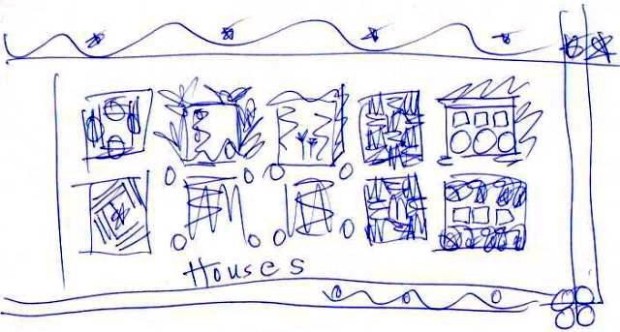
Houses
Think you know this place described above? Leave a comment!
What is sound? Tinnitus, from the Latin for ring or tinkle, we hear in our ears, but its source is not external sound. My own tinnitus is louder in my left ear, and if I try to pay attention to it, there are at least two sounds audible, as if an electronic musical duo is playing in my head. The ringing is enveloped under an umbrella of an engine or fan, or the electric rush of a motor, an incessant susurrus, which is balanced between the ears. The quieter my environment, the louder the tinnitus. Tinnitus is noise that is not sound, and it is a common ailment for those with hearing loss.
My hearing loss, in both ears, worse in the left, probably originating from operating the motor pool compressor truck with jackhammers and other pneumatic tools and from firing weapons without adequate ear protection during my Army days and probably made worse playing music too loud over the years, is now augmented through hearing aids. The current pair are state of the art and include Bluetooth capability, which means I can stream an electronic sound source (radio, TV, computer, phone) directly into the hearing aids. But the sound is not quite natural. I hear it in my head, not in the ears, and not precisely where the tinnitus sounds, but when streaming, the tinnitus seems to turn off. It’s a bit like wearing headphones. It can be somewhat disconcerting.
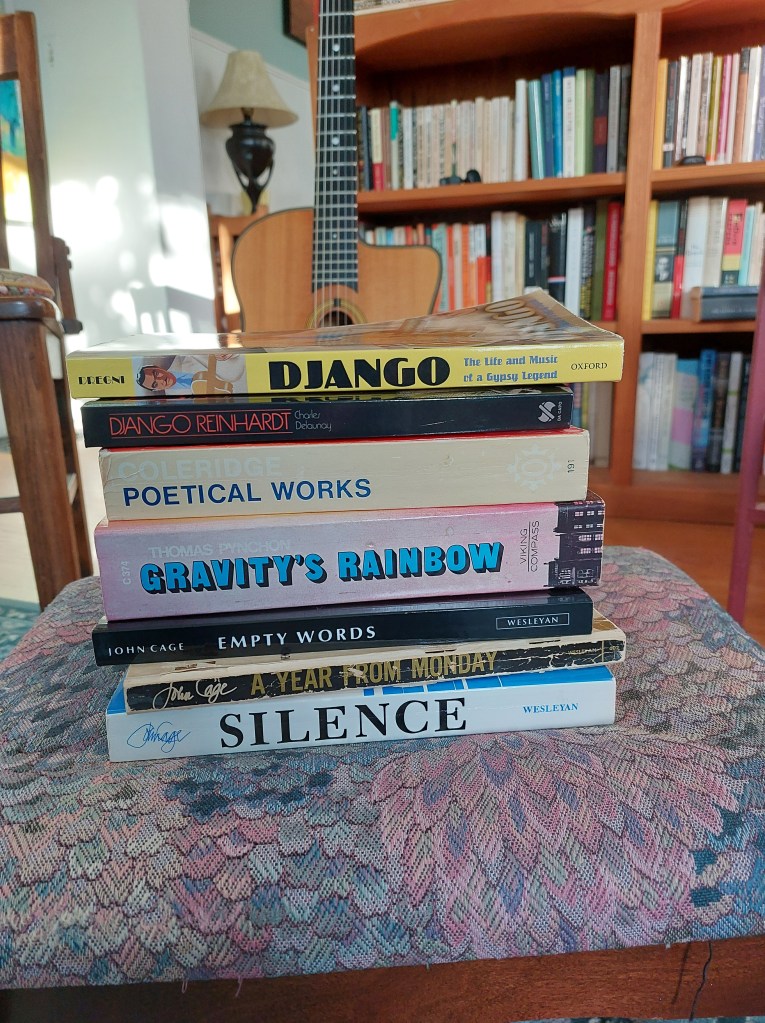
Often, when I think of sound sans sense, I think of John Cage. Cage was a musician and writer. Piano was his instrument, but he became involved in electronic sound and electronic music – experimental music. Cage’s music might sound like tinnitus to some listeners. But any instrument can grate or creak or be made to scream or moan or laugh or guffaw. Some of the early film cartoons used modern music innovations and techniques. “Modern” music is often characterized as atonal or dissonant, and as technology developed as electronically enhanced. An evocation of emotional turmoil. Turbulence and tohubohu is often the sound it conveys, or that I hear, which of course are two different things. In any case, what I’m still calling modern here is actually now quiet old.
What are the differences between noise and music? What is the relationship between sound and hearing? We might spend a few big bucks on music sound reproducing equipment (stereo, speakers, etc.) for home or car. The louder, it seems, the better. But when heard live at a concert, the sound may seem radically altered. And the listener in a front row seat hears a different concert than the listener in the back row, upper level, even if they’re in the same hall at the same time for the same music. In music and in conversation clarity is probably the most important attribute to one hard on hearing. It’s not that I can’t hear, but often that I don’t hear clearly. Increasing volume doesn’t necessarily add clarity. It just adds noise. Cage might say, what difference does it make? Listen to what you hear and disregard the rest. And music is not words.
“Music as discourse (jazz) doesn’t work,” Cage said. “If you’re going to have a discussion, have it and use words. (Dialogue is another matter.)”
John Cage, A Year From Monday, Wesleyan, 1969, page 12, from Cage’s ongoing “Diary: How to Improve the World (You will only Make Matters Worse)” 1965, which was taken from the magazine Joglars (Vol. 1, No. 3, 1966), where it was presented as: “a mosaic of ideas, statements, words, and stories. It is also a diary.”
What did Cage mean by distinguishing dialogue from discourse? Dialogue is conversation, conversational. Discourse is debate, to run away from. Dialogue is theater. Discourse is lecture. Discussion is an investigation. We are using words; no help, no matter how loud.
Some sounds are empty. What does that sound like? Jazz guitarists speak of getting a hollow sound or tone. One of the John Cage books is titled “Empty Words” (Wesleyan, 1981). “Most of the material in this volume has previously appeared elsewhere,” the listener is told. Where? Sound is ubiquitous, everywhere:
“Wherever we are, what we hear is mostly noise. When we ignore it, it disturbs us. When we listen to it, we find it fascinating. The sound of a truck at fifty miles per hour. Static between the stations. Rain. We want to capture and control these sounds, to use them not as sound effects but as musical instruments.”
“The Future of Music: Credo,” from Silence, John Cage, p. 3, Wesleyan 1961, 1973.
Capture this, from the opening section to Thomas Pynchon’s novel Gravity’s Rainbow (Viking, 1973):
“A screaming comes across the sky…He won’t hear the thing come in. It travels faster than the speed of sound. The first news you get of it is the blast. Then, if you’re still around, you hear the sound of it coming in.”
page 3, then 7
The reader is in London where the German V2 rockets, travelling faster than the speed of sound, hit the ground and explode before anyone hears them coming. Before Pynchon’s novel begins, then, an explosion has occurred. Or not, maybe one lands a dud.
In Coleridge’s poem “The Eolian Harp” (1795), the instrument sits on an open window ledge, where an incoming breeze stirs over the strings, making music. How improvised is that! One would need super sensitive ears to pick up such wispy sounds.
…the world so hush’d! The stilly murmur of the distant Sea Tells us of silence.
…Where the breeze warbles, and the mute still air Is Music slumbering on her instrument.
The wind as guitar pick.
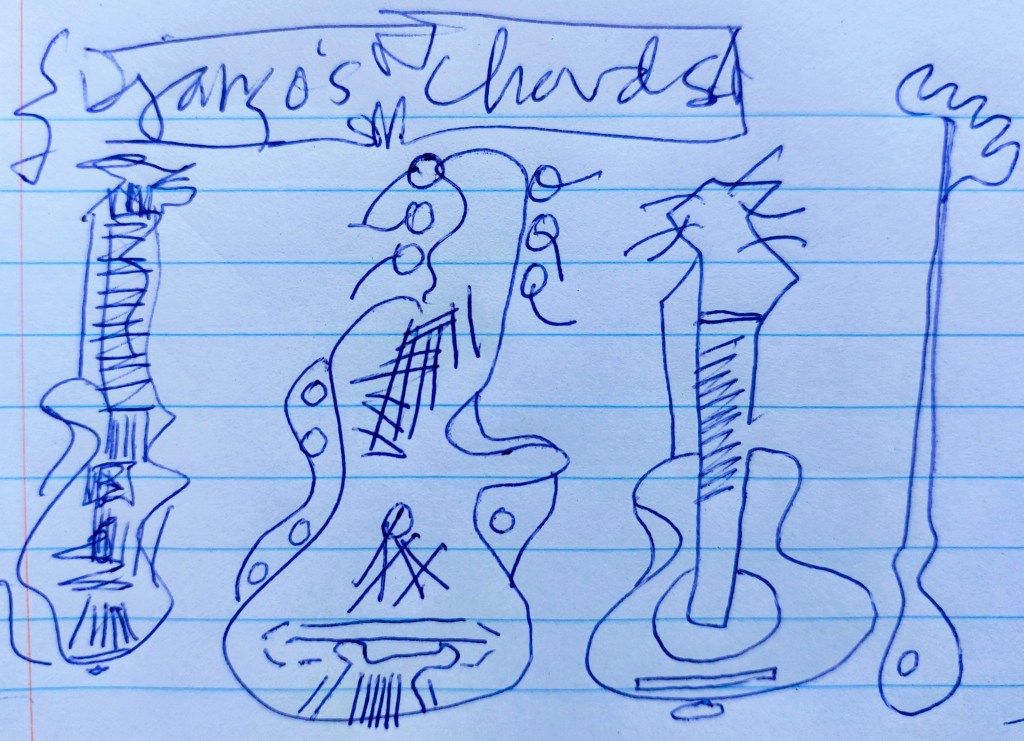
I’ve been playing Gypsy-Jazz guitar lately, by which is usually understood playing in the style created or formalized by Django Reinhardt and his peers and followers. The style is characterized by the use of a different kind of guitar from the classical guitar popularized by guitarists like Andrea Segovia and Julian Bream. They played on a 12 fret neck fitted with catgut and then nylon strings in the treble and silk then nylon wound with metal in the bass. Other differences might include a shorter but wider neck, a smaller box, different woods and internal bracing techniques. Different from what? Basically from the all metal, louder string guitars developed later – what has come to be known as the western or folk guitar, and is used in blues, bluegrass, folk, country. But the Gypsy-Jazz guitar is a different instrument still.
The Gypsy-Jazz (also “jazz manouche”) guitar is louder, played with a guitar pick rather than the fingers with fingernails, has a longer neck, so a longer scale length, and all metal strings. Most importantly, it’s not a solo instrument. It’s designed to be played in a small combo, usually consisting of at minimum two guitars, and often with stand up acoustic bass, violin, clarinet, accordion, and vocalist. Django played in noisy dance clubs before the advent of amplifiers and electric guitars. He needed an acoustic guitar that would project over the racket and clatter and sound in sync with the other instruments. Readers interested in learning more about Django and his music might read Django Reinhardt, by Charles Delaunay, 1961, Da Capo Press, and Django: The Life and Music of a Gypsy Legend, by Michael Dregni, Oxford, 2004. Briefly, it’s told that Django, born in poverty and coming of age without any kind of formal education, learned to play violin, banjo, banjo-guitar, and guitar. By the time he was 18, he was playing in bands in Paris and making money. Then he burnt his left hand badly in a fire in the caravan. Recovering, he taught himself to play the guitar anew, using mainly just two fingers from his left hand to fret the notes and chords, developing an entirely new technique. Thus began a new style of playing guitar that has influenced just about every guitarist of all genres since and still begs to be mastered even by those with all their fingers playable.
When asked if he admired Django Reinhardt, Julian Bream said:
“Oh sure. And I played plectrum guitar up to the age of 21, I played frequently in a dance band in the Army. And, yes, I loved playing jazz guitar, but not as a profession, just for fun. You can’t mix the two. I can remember playing steel-string guitar for dances, and it just ruined the sensitivity of your left hand. And I was playing rhythm guitar with big six-string chords all night long. It was a knucklebender!”
“50 Years on the Planks: Julian Bream Talks About His Life and Work,” Classical Guitar October 1996. Retrieved 4 Mar 24.
I’ve been working to play Gypsy-Jazz style without a plectrum (guitar pick), so fingerstyle, with fingers and fingernails, which some say is not only unorthodox but impossible – to play in the Gypsy-Jazz style of Django. I use a thick gauge string on a Saga Gitane DG-250M model, which I purchased used not long before the pandemic broke out and then had to quit the group workshops I’d been attending. The thicker strings compensate for the lack of pick. I’ve just always played with my fingers, hardly ever flatpicking. And I’m not playing dance halls these days, more like a lute in an open window.
Gitane DG-250MConcert ReadyAmerican GothicDjango’s ChordsGuitar LandBooks referenced in this post.
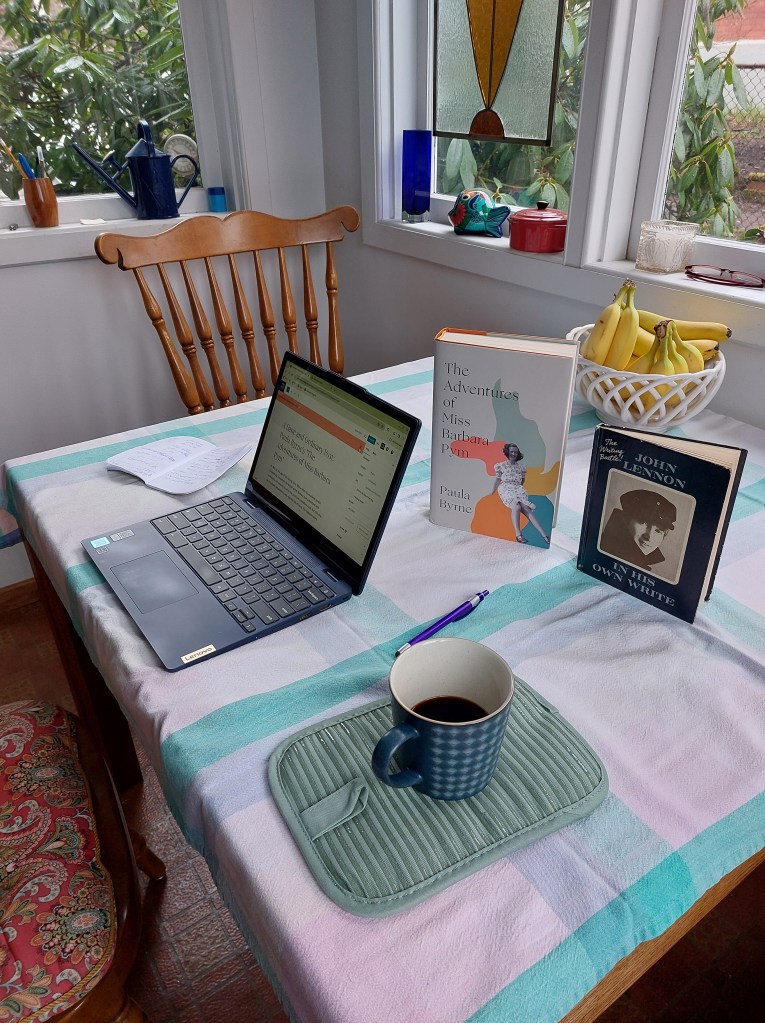
In 1963, at the age of 50, having since 1950 written six excellent novels successfully published, the British writer Barbara Pym submitted with confidence her seventh novel to her publisher, Jonathan Cape. But this one, An Unsuitable Attachment, was rejected out of hand. The rejection story comes as a plot twist in Paula Byrne’s biography, The Adventures of Miss Barbara Pym (2021, William Collins).
Then, as now, publishers were trying to respond to changes in their operating environment. After being rejected by her publisher Cape, Pym sent her new novel off, on a long successive round of submissions, to publisher after publisher, where it met with the same rejection fate, as if she were a writing newbie lost in the slush pile.
Publishers are expected to make a profit. New books have always been expensive. Books are, after all, not a necessary. Yet few novelists, and even fewer, if any, poets, can survive financially off the royalties from their book sales. The occasional blockbuster book followed by a movie is the rare exception that has often helped support a publisher’s efforts to produce less popular works with literary merit. Detailed numbers of what might have been necessary to recoup publishing costs and turn a profit in 1963 are a small but important part of Byrne’s Pym biography, and because Pym continued to write without publishing, then over a decade later did publish anew and with even greater positive critical reception (including a Booker Prize nomination in 1977 for Quartet in Autumn), an interesting theme is suggested where we might find some insight into what gets published (and unpublished) and when and why.
How many prospective sales were necessary in 1963 to get a publisher’s attention? Pym’s good friend British poet Philip Larkin suggested 4,000 as a break-even point: “I’m told that the economic figure for novels is 4,000 – and has risen a lot recently. The circulating libraries are diminishing, too – Smith’s gone, Boots going” (Byrne, 533). Larkin’s own book, The Whitsun Weddings (a collection of 32 poems published in February 1964), sold 4,000 copies in the first two months, an unusual poetry bestseller (504). Pym mentions to Larkin that “she heard Cape were about to publish a book by one of the Beatles: John Lennon? I think?” (497). The book in question was Lennon’s In His Own Write, which sold, according to Wikipedia, 300,000 copies in Britain, and was also a best seller in the US market. Wiki shows, citing Hazel Holt, that Barbara Pym’s book Excellent Women, published by Cape in 1952, had sold 6,577 copies by 1960. Writers decide what will be written, publishers decide what might be read, critics decide what’s good, and readers decide what to purchase. And then there’s the remaindered, not remembered.
How do books get into the hands of readers? Public libraries, generally assumed to be in the public interest and of great cultural benefit, arrived at a cost to publishing. In England, since the mid 1700s, prior to public libraries, books were made available to the reading public through the use of “Circulating Libraries.” These were not free public libraries. They rented books for a fee. Nor were they housed in buildings. They traveled, by rail and wagon. Still, the rental fees were affordable only down to a middle class clientele. Later, stores carried books for rent, but usually as part of a store’s variable lines of business. Renting or selling books wasn’t enough to keep a stand-alone book business afloat. But the effect of renting books on publishing was simply this: readers could rent far more books than they could afford to purchase. It was therefore in the interest of the circulating library business for publishers to keep prices of new books high. If readers could not afford to buy new books, they would have to rent them.1
All of that of course before the Internet, ebook, etc. Still, paper books persist. Past changes like the mass market, cheaply produced paperback brought book prices down, but still the book market is supply and demand driven, and it’s not easy determining what drives demand. Dime novels in the US and the Penny Dreadful in England were relatively cheap and brought literature to working class readers. I was a working class reader, started with comic books, graduated to Classics Illustrated at the suggestion of my Confirmation sponsor, who also encouraged me to read novels and to start my own library, six paperback books sitting on a window ledge of my bedroom. I still have a few of them. That books are a commodity, no more no less, may seem like a paradox to some readers:
“One could make an argument that the book’s own history mitigates against seeing it as a commodity. For centuries, after all, the book’s primary place was at the center of religious practice. It is historically associated, as a result, with the evanescent, spiritual, not-for-profit world. But printed books, as Elizabeth Eisenstein and Raymond Williams have shown, have always had as much of a secular as a spiritual existence. Their history in the modern west is synonymous with the development of industrial production and the rise of consumer culture that went with it. If the book has maintained some sort of transcendent identity, it has done so despite its position at the center of the world of goods, not because of some privileged position outside it.” 2
After the Cape rejection, Pym kept writing, kept submitting, and kept getting rejected. She reached a point where she told a friend, “All I want now is peace to write my unpublishable novels” (Byrne, 530). And, Byrne says, “Her friend Hazel Holt even suggested that she should think about publishing her novels privately for her loyal following of readers” (524). Today, of course, Pym could easily self-publish her novels. But would she? In any case, all of her books are today still in print, with many used copies of Pym books available for sale via sites like Alibris. And a quick check at Multnomah County Library shows ten Pym books available, but only one copy each, and six copies of the Byrne biography in stock.
As critic, Larkin described what he liked to read, and he did not find fault with work devoted to a narrow alley of life, provided ample detail was given to bring that life into profound focus:
“‘I like to read about people who have done nothing spectacular, who aren’t beautiful or lucky.’ He wanted to read about people who can see ‘in little autumnal moments of vision, that the so called big experiences of life are going to miss them.’ That such things are ‘presented not with self-pity or despair or romanticism, but with realistic firmness & even humour’” (521).
Larkin, with connections in publishing, and as England’s popular poet, gave Pym emotional support and advocated on her behalf. Still, it took time to convince the publishers to reconsider. In a letter to Charles Monteith, editor at Faber, Larkin wrote:
“Turn it down if you think it’s a bad book of its kind, but please don’t turn it down because it’s the kind of book it is…I feel it is a great shame if ordinary sane novels about ordinary sane people doing ordinary sane things can’t find a publisher these days. This is in the traditions of Jane Austen & Trollope and I refuse to believe that no one wants its successors today” (521).
What kind of books were being published in 1963? John le Carre’s The Spy Who Came in from the Cold (which a couple of years later would be assigned reading in one of my high school English classes); Thomas Pynchon’s V.; John Rechy’s City of Night; Kurt Vonnegut’s Cat’s Cradle. And when the publisher Little, Brown republished in book form The New Yorker stories of 1955 and 1959, Raise High the Roof Beam, Carpenters and Seymour: An Introduction, by J. D. Salinger, it was the third best-selling novel in the US in 1963 (Wiki). (I remember seeing Mr. Abney, my 9th grade Language Arts teacher, reading it at his desk at the front corner of the room, stage right, next to our ground floor windows, which looked into the Breezeway, where the girls were at lunch recess.) While there were of course many other kinds of books published in 1963, those just mentioned probably would not qualify as the kind of book favored by Philip Larkin.
There’s no critical advantage gained in trying to put down the 1963 books mentioned above, that’s not the point, they’re already classics, or of pooh-poohing John Lennon’s book as silly. The point is, what’s good is what achieves its purpose, even if that purpose might be considered bad, or if it’s not the purpose you want. Lennon’s book is successful on its own terms. It’s good because it achieves what Lennon wanted. It’s also good because it’s entertaining and clever and also gives a nod to James Joyce and his technique in Finnegans Wake. Few would have thought Lennon at the time might have been a Joycean. No amount of marketing could have achieved for a Pym book the kind of sales Lennon’s In His Own Write racked up. But Pym’s books also are good because they achieve what she wanted, are entertaining and clever, and her style, while original, gives a nod to Jane Austen, master novelist of them all.
There is much more to Paula Byrne’s biography “The Adventures of Miss Barbara Pym” than the discussion above regarding what gets published. Byrne’s biography of Pym is 20th Century history as viewed from a specific writer who lived according to detail. Pym kept copious notebooks, always writing. She rethought, reconsidered, reconnoitered her every conversation, meal or tea, dress and dance, kiss or hug, relationship, experience. No detail was too small, the smallest maybe the most important. Bryne’s Pym biography might inspire any would-be writer, for we see Pym at work and play, see the ups and downs, the approvals and dismissals, the potential loneliness of life sitting at a typewriter, the rewards of completion and the hopes for a bite of recognition. We see where ideas for fiction come from and how life experience might be formed into fiction. In the end, the ordinary life, realistically rendered, given due attention, is exceptional and impressive and universally shared.
“Circulating Libraries,” Oxford Reference, The Oxford Encyclopedia of British Literature. ↩︎
Rumor has it the pandemic is over, and folks are getting back to the way they were. Sidewalk cafes are filling with hopeful bon vivants, wine bars are recreating the gypsy jazz trio, tea rooms have put out the herbal welcome mats, and down on the corner, a lone violinist is busking the blues away. Movies? Newspapers and magazines? Some things are likely not coming back. But we can’t blame the pandemic for all our ills and woes.
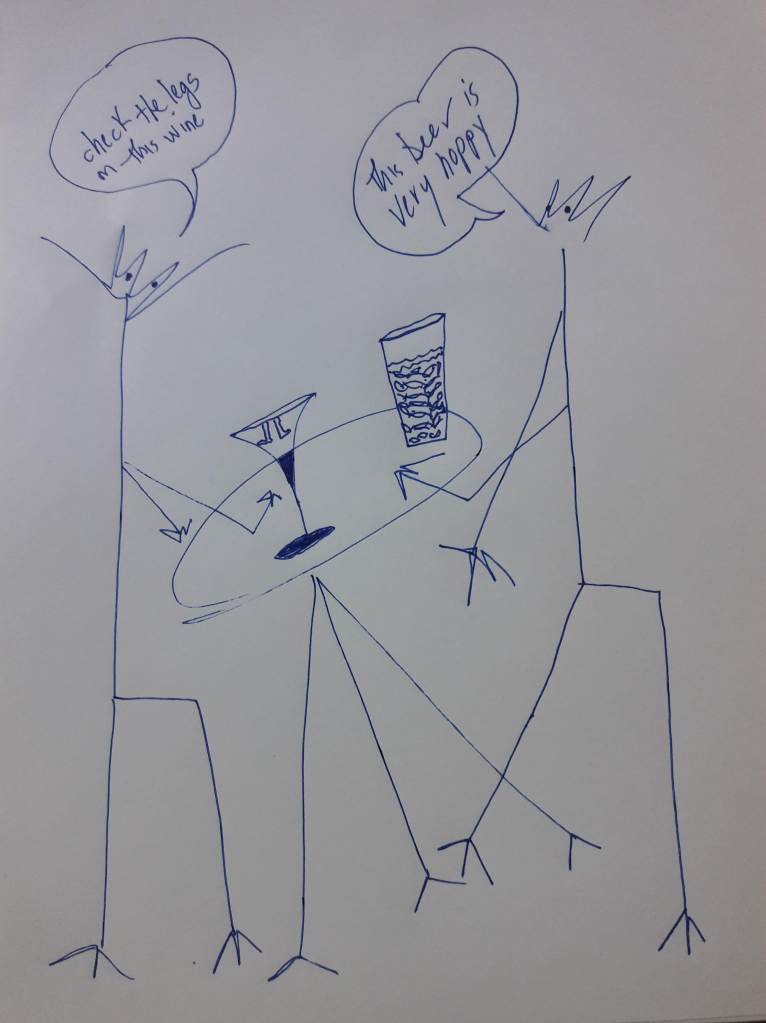
Brick sidewalk cafeBuskerUrban CafeNewspapers and MagazinesCoffee Noir
Pubs are open, and wine bars, bakeries and coffee shops. You’re lucky though if you can find a place to park in between the street seats impromptu platforms, or to find a warm tavern that serves both a hefty microbrew and a tasty pinot noir.
Wanted: A clean, well-lighted place, with polite waiters, a high ceiling and not too crowded or too noisy or too far away, with a live trio that doesn’t require ear muffs, a place that doesn’t mind singles sitting hour after hour over a book and the same cup of frequently topped off java.
Below: A friendly waiter.
And weddings are back in full motion, fashion, with updated attendance rules. Below, what to wear:
Wedding DressCocktail WearCome as you are
Soon Spring will spring, doing its thing, a spring dance fling, prom night, a concert at an old venue downtown.
Spring FlingProm NightAllegro con brio
But some folks might have the post pandemic blues, and don’t want to go out. In a way, the pandemic has set them free. No more shopping sprees. No more putting on the style. But what about a baseball game in the ballpark? There must be some way the afflicted can lose those post pandemic blues.










 The Coming of the Toads