Tag: Writing

  • One Night At Flobe’s Pizza Below Frye’s Apartment

    Flobe’s Pizza below my friend Frye’s apartment one night last April was puzzlingly rowdy, so we climbed down to see what was up. The place was steaming, crowded, people sitting on the ceiling, hot cheese slipping, falling pepperoni pieces and mushrooms, while a string band fiddled. The open mic was live, with Pepper, Herb, and Fava’s trio in line on the sign-in sheet to perform Joe’s “Surf Surge.”

    Frye and I occupied empty seats at the end of a rambunctious table in the corner, and Joe got in line to order some pizza and orange soda. The porthole sidewalk window next to our table was occluded with steam, the string band zipping, and a couple without a table was dancing, one with the pizza the other with the beer. Suddenly, Willa and Raymond took the stage with ukulele and tambourine.

    They sang of an old photo of Joan Didion sitting in a Corvette, holding a cigarette. A young man riding a piebald pony rode up to the takeout bar and ordered a veggie pizza with extra garlic and sauce. He fed his pony a breadstick. Joe came with the orange soda and said the pizza was a forty-minute wait. He poured us each a glass from the pitcher, sparkling yellow, not as orange as we had expected.

    Joe sat by the porthole orb. He saw flashing lights, paisley globes filled with silver and gold light. The bubbles flew like electrified parameciums escaping down the side of the window, along its tarnished curved brass edge. Big Dada announced Joe’s pizza would not be ready until September. By then no one would be reading poetry any longer than a tweet, and that before they realized what they were hearing.

    By the time Joe’s name was called (“Pizza ready for Joe!”), he had grown a pony tail and Frye had gone bald. Pepper, Herb, and Fava were on tour somewhere in the Midwest. I had tired of waiting and moved back down to Southern California to be near the beach. Every day I ride my bicycle along the Strand, watching the surfers come and go without a thought for pizza or poetry.

  • Learning to Deconstruct Finally

    Derrida seems satisfied if not happy with his contradictions, with having learned finally to live with them unencumbered by any implicit criticism. His primary concern in his last days appears to have been what comes after the final act of writing. After all, “there are, to be sure, many very good readers (a few dozen in the world perhaps, people who are also writer-thinkers, poets)” (34). Were he a blogger, would Derrida be thus assured of 36 followers? Jesus had only 12, but even they were not always reliable.

    Can a writer ever finally trust any reader? Part of the problem seems to be that readers do have an unconditional freedom to read from their own particular singularity, always peculiar. It’s all they can do, as general readers, apart from the 36 carefully selected followers, who must leave their families behind. It’s not that whatever you say will automatically be misunderstood, but that conditions of freedom vary among individuals. But Derrida says at the same time, “You don’t just go and do anything with language; it preexists us and it survives us” (36). For Derrida, deconstruction was a form of “self-critique” (45). Before “learning to live finally,” one must deconstruct oneself.

    In his idea of “The University Without Condition,” Derrida wants “absolute claim to an unconditional freedom to think, speak, and critique” (48). The presumption is there are conditions set by “political or religious power” (48). Kant’s solution that scholars be free to say whatever they want as long as they keep it in the University was not enough for Derrida. But the philosopher who leaves the University becomes an outsider, a blogger, as opposed to a scholar. Not that it matters, because

    “…you do not know to whom you are speaking, you invent and create silhouettes, but in the end it no longer belongs to you. Spoken or written, all these gestures leave us and begin to act independently of us.” (32)

    Jesus spoke to a general audience, asked for similar unconditional freedom wherever he happened to be located, but he was ready to give to political power what belongs to political power, while Christianity too often has turned into a University that, like the University of Kant’s that Derrida points out, is only free on its own grounds.

    Any notion of finally can only be fantasy; life goes on with and without us. What happens finally is the words stop coming, we stop thinking with words, and must figure out some other way to deconstruct.

    Learning to Live Finally: The Last Interview [with Jacques Derrida]. Melville House, 2007. 95 pages, including a 27 page selected bibliography of works by Derrida published in English.

  • On the Poem of Made and Unmade Beds

    “Without grip or gripe, what bed thou hast, sleep in it, sleep, sleep, perchance to rest, for a sound bed is worth all the wine in France, all the beer in Germany, nay, all the ale in England.” (Polonius, The Collected Deleted Scenes of Shakespeare)

    Introduction – the idea of the poem as an unmade bed:

    Joe Linker on April 10, 2015 at 6:14 pm said
    [in comment, having never heard of ‘My Bed’]:
    But on the subject of Emin’s bed, which apparently last sold for $2.5 million, imagine a bed-selfie, and unmade at that, in such demand. But of course a made bed would never have fetched as much attention or money. People want to see unmade beds. In fairness, I suppose many poems are nothing more than unmade beds. But when did a poem, made or unmade, ever suck in $2.5 million in a single breath?
    I may find myself later today attempting a bed poem.”

    1: The Sonneteers

    On the green barracks bunk,
    a thin mattress on chain link
    steel frame Army 30 foldable,
    wrapped in ephemeral wool
    as tight as a barnacle’s grip
    against the red tide of sleep,
    nothing personal save a letter
    from Susan in the South Bay,
    tossed into open foot locker,
    touches the drab rolled socks,
    no night light in the dull quiet
    dark hall full of dunned boys,
    roused by reveille’s mournful
    made bed, hook up and wait.

    2: The Makeshift Bed

    “At Ease!
    Thum that’s got ‘um, smoke ‘um.
    In this next 30 minutes of instruction,
    you will learn how to make a field bed.”

    The sun crashed, and I climbed into the cab
    of a deuce and a half, parked
    in a field with a raw view
    of the moon and the Pacific Ocean,
    curled up in my fatigues
    and fell asleep, my face to the canvas seat,
    surrounded by coastal sage scrub
    lit with a few Lord’s Candles.

    3: The Water Bed

    We drove down to Hermosa Beach and picked up one of the first
    water beds, a giant surf mat. We took it home, put it on the floor
    in the bedroom, and filled it with water from the garden hose
    stuck through an open window. We went to sleep hushed
    and soothed by one another’s jostle, canoeing over surf.
    But early in the morning we awoke cold and colder.
    The next day back at the water bed store, the guy told us,
    “Yeah, you need a foam pad and a wood frame. If you sleep
    on the bare mattress, you’ll wake up with hypothermia.”

    4: The Money Bed

    After the water bed experience,
    whenever we needed a bed,
    I made a frame out of 2×4’s,
    upon which I nailed a sheet
    of plywood, upon which we
    plopped down the futon, a
    bag of airy baffled cotton.

    In bed, we are lodged in
    one of two kinds of beds: one
    easy to move, the other hard.
    The hard ones cost much
    more than the easy ones
    and frequently must be
    put asunder to move.

    Tracey Emin’s “My Bed” now
    takes several million dollars
    to move, maybe so much
    because the installers must
    budge the bed without
    disturbing the sleeper.
    One might try making beds

    for a living. People often seem
    to prefer beds to poems.
    Joyce sat in bed and wrote,
    embedded in his spidery
    notes and his family’s issues,
    while McTeague’s Trina
    slept solo on her bed of coins.

    5: The Short-sheeted Bed

    Some readers may feel
    short-sheeted by this poem.
    They probably would prefer
    sleeping in their own bed
    and writing their own poem.
    Then again, someone may offer
    forty winks for this poem.
    Who will start the bidding?

  • The Lavish Land

    “April is the cruelest month,” Eliot told
    Pound all about it, Easter tide out,
    but why brood on our days
    unless we are made
    of dry wood and worry,
    each ring a memory of rain?
    Does any month feel pity?

    You called her a primrose,
    your spiral spring shell.
    The land tired of playing possum
    opened in lavish blossom.
    Meantime, you go from a funeral
    to a game of chess?
    No wonder you’re so depressed.

    Hurry up! Indeed, it is time,
    and there is no more time
    for revisions of decisions and such.
    Spit it out, that tooth that broke
    on the hardtack bread.

    Yes, the river, its currency
    seems to bother you,
    crossing the rough bar
    in your tipsy canoe,
    sipping sweet wine from a shoe.

    Why do you drift so? Maybe
    it’s time to seize the falling
    yellow forsythia, catch and bundle
    the candied pink camellia calling
    a day a day alack-a-day day.

    No, I won’t say we’re wasting time,
    working up a dry thirst over an old city,
    lamenting the past. We might have called
    Big Dada and asked for a blessing,
    a holy water sprinkling, and asked,
    “Dada, how’s Nana?”
    “Dada! Dada! Dada!”

    Maybe we’ll see you in May.
    Hopefully you’ll be feeling better,
    and we can all spend a day
    going a Maying,
    if Corinna comes to town, everyone
    looking forward to ordinary time,
    the grassy bed spread with garlic greens.

  • Notes on “Big Cactus,” a Novel by Sylvia Wilkinson

    In his third essay in Anatomy of Criticism, “Theory of Myths,” Northrop Frye places irony and satire in the “Mythos of Winter”:

    As structure, the central principle of ironic myth is best approached as a parody of romance: the application of romantic mythical forms to a more realistic content which fits them in unexpected ways. No one in a romance, Don Quixote protests, ever asks who pays for the hero’s accommodation. (223)

    But if someone does ask, tell them, “Aunt Lucy.”

    The aging Lucy, accused of being at risk of not being able to take care of herself and forced into “the county home,” sweet-talks (in a manner of speaking) her teenage nephew, Benny, into a road trip in his pickup truck, a 1965 GMC. Lucy wants to satisfy her Holy Grail vision of seeing the Big Cactus at sunset, a quest suggested by something she’s seen in a magazine, Arizona Highways.

    Benny is at risk of becoming a responsible adult and has dreams of someday becoming a NASCAR mechanic, but for now he’s stuck telling a story about his trip driving his Aunt Lucy and his dog, Polar, from North Carolina across the southern states to Arizona and back, a distance of some 4,000 miles of mixed terrain and worry in an old pickup, stopping in towns along the way, sleeping nights in motels and eating in restaurants, encountering a host of characters and trials of travel episodes. Benny falls for a waitress but must get back on the road, but Sue Faye is just a prelude to his own unrequited quest which develops on the run with Aunt Lucy, Polar, and the rich Tennessee, another road rescue.

    In his This Year You Write Your Novel, Walter Mosley explains why aspiring authors might want to avoid a first person narrative their first time out. If you’ve ever tried ocean wave surfing, you probably know it’s best not to try to stand up on your first wave. Ride the foam to shore in the prone position, getting the feel of the surfboard on the water. But

    I’ve tried to do a story in my mind about what happened to me (231),

    Benny says, and besides, Sylvia Wilkinson knows what she’s doing when it comes to writing a novel. Big Cactus is her seventh, and she’s a master of the first person narrative.

    Big Cactus features characters revealed through dialog and action. “What’s a body for?” Judith Butler asks in Astra Taylor’s film Examined Life. Big Cactus features comparisons and contrasts between wealth and poverty, the old and the young, their aspirations and problems, their ideas of love and the needs of the body, how they present themselves in public and to one another in private, how they communicate – “for better, for worse.”

    Big Cactus is a kind of picaresque, quixotic novel, where two main characters play off one another as separate halves of a single protagonist. They get in one another’s way as opposites but share a symbiotic relationship in a shared endeavor as outsiders against some social antagonist. Think of Huck and Jim, or Don Quixote and Sancho Panza, of Estragon and Vladimir.

    Sylvia’s new book is a marvel of vernacular. The wit and humor is layered with carefully constructed confusion between what the reader sees and what the characters see, between what one character thinks is happening and what their foil character thinks. In the end, it’s Benny’s story, another marvel – of opposites between first person narrator and author. But Benny is a close observer, and as he says of himself,

    I say a bunch of things out loud I ought to just think. (125)

    That might be a good definition of a novelist. Gifts are a theme throughout the book. Benny has the gift of storytelling, a gift presented by Sylvia to the reader.
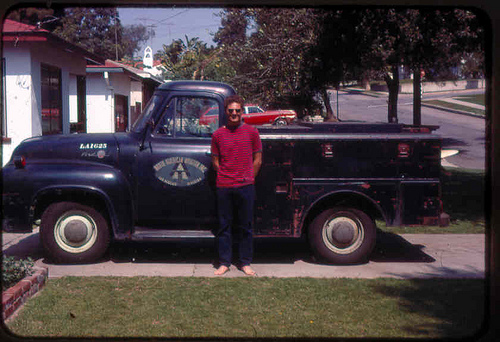
    Joe and the Peace Truck April 1970_4151572268_mNo, that’s not Benny and that’s not a 1965 GMC. That’s me and my 1949 Ford pickup truck that my Dad bought me for $200 from a nearby motor pool. In the photo, if you look close, you can see the white tip of my surfboard hanging over the tailgate. I’ve just returned from a rescue trip up to Zuma Beach, towing my friend’s old, tiny BMW back home. My memory isn’t perfect here, but I think it was a BMW 700 convertible. It broke down in Zuma and we drove up to tow it back, pulling it with a rope from Zuma down to the South Bay along the Pacific Coast Highway, a distance of about 30 miles, but towing with the rope was probably illegal, required someone to stay in the disabled BMW to brake it at stops, and a smooth clutch operator in the truck with its three-speed on the column. Certainly not a novel in that story, probably not even a short story, unless Benny had been along for the ride.

    Give me my good old American truck any day of the year (89),

    Benny says. Now there’s some irony ole Northrop Frye might have enjoyed.

    Big Cactus, a novel by Silvia Wilkinson. 2014. Owl Canyon Press: Boulder, Colorado.

    Update, Dec 20, 2015: A review of “Big Cactus” in the Fall 2015 issue of Blackbird.

  • A Brief Statement on the Comma

    San Juan Islands FerryThe comma, which gives one pause; the comma which does not give one pause; the comma, at which point one pauses; the comma, a cockroach in the corner of the closet after all the clothes are cleaned out and the conversations are forgotten, hollow and cold; the comma that defies erasure, the comma that sticks; the comma that permits addition but sometimes subtracts; the comma a foot soldier, a drone wearily drove, the first key to fade; the comma a banana peal only a curmudgeonly grammarian with scruples would slip on; the comma a red light where turning right on the red without stopping is ok; the commas lined up like cars waiting for the ferry to return to cross over to the islands:

    ,,; ,, ,,; ,, ,,; ,, ,,; ,, ,,;   .     .       .         .           .            .            

  • Breaking Bad at Berfrois with Baseball and Stromboli

    Breaking Bad
    “I’m going over to Hip’s place to watch some old ‘Breaking Bad’ episodes.” “I thought we were going to play catch with Joe out in the backyard?” “Come on, man. Get hep. Playing catch in the backyard is no longer hep, if it ever was.”

    The Toads post “Breaking Bad in Stromboli” was published today over at Berfrois. Turn off the internal infernal TV for a few minutes and click here to check out the hep stuff happening these days at Berfrois!

  • Cherry Trees in City Park in Spring

    031920152271It was such a perfect day in the park. You might have been reminded of the Lou Reed song “Perfect Day.” The cherry trees were drinking sangria:

    Oh, it’s such a perfect day
    I’m glad I spent it with you
    Oh, such a perfect day
    You just keep me hanging on

    The second person is often tricky. “Who is you?” the cherry trees sang above the fresh open water of the reservoir.

    “And let us not be weary in well doing: for in due season we shall reap, if we faint not” (Galatians 6:9 KJV). But the world will likely not end with a moral but with a song of thirst. “Do you think your cherry blossoms will sink or swim?”

    031920152268

    “The depths below the surfaces must be equal.”

    Joyce uses the word cherry only three times in “Ulysses,” and he may have thought of cherry as a word that triggers a genre, of sangria fruit and not the white wine of the cherry blossoms:

    Did you try the borax with the cherry laurel water?…
    always with a laugh in her gipsylike eyes and a frolicsome word on her cherryripe red lips…
    she of the cherry rouge and coiffeuse white…

    Cherry TreeSit down on the grass and listen. You can hear the water flowing out of the ground pipe and into the reservoir, the waterfall fountain breaking the still blue water white and frothy like surf. Like John Cage, wherever Joyce listened, he heard music:

    O, look we are so! Chamber music. Could make a kind of pun on that. It is a kind of music I often thought when she. Acoustics that is. Tinkling. Empty vessels make most noise. Because the acoustics, the resonance changes according as the weight of the water is equal to the law of falling water.

    The breeze coming up the hill and over the water was blowing the blossoms off the trees and into the air. If you look closely at the left hand side of the photo below, you will see the blossoms in the air, as dry as your virtual kiss:

    031920152264

  • Long after Sappho

    …forgot herself

    that he would be like a princess
    blessed across from you
    blossomed lips
    a breath away,

    your laugh leaves
    me cold with doubt
    still your kindnesses
    pink and blue flowers,

    long after this dormant grass
    past the fires and all the dead
    batteries burnt matches
    library books soot lathed,

    long ago the last picture
    show the last ’56 Chevy
    out of the drive-in
    absurd theatre

    audience hammering home,
    long after the rearmost look
    will we remember
    the kisses blown

    from open hands
    and flippant wrists
    dissipating smoke rings
    the papyrus of your skin

    upon which critics crawled
    to carve their handles
    to try to lift you back
    oomph circling overhead.

  • Breaking Bad in Stromboli

    Breaking Bad in StromboliI walked down to meet Susan on Hawthorne late afternoon but arrived early and when I passed Nick’s and noticed baseball on the screen I ducked in to wait at the bar for a text asking my whereabouts. I ordered a glass of milk and a coffee chaser and the bartender asked me if this was my first visit to Nick’s. The game was in the 8th inning, a 3 to 3 tie, the Dodgers against the Cubs out spring training in sunny Arizona. A group of young folk occupied the north end of the bar, but I alone watched the game. The tables were all empty. The balls were breaking late, bad, away. The Cubs scored in the bottom of the 8th on a sacrifice fly to take the lead 4 to 3, and the Dodgers in the top of the 9th could not break away. My first taste this year of spring training TV was bad for a Dodger fan. I like the Cubs, too, and hope they do better than last year’s cellar close. Edging the Dodgers 4 to 3 yesterday marked the Cubs first win in seven games this spring training season. It’s still early, but the Cubs are off to a bad start. Cub fans are a forgiving bunch. Dodger fans live in baseball paradise at Elysian Park. But baseball and paradise broke bad some time ago, came the summers of our discontent, baseball breaking away.

    One of modern baseball’s design problems, as McLuhan explained, is that it’s a poor fit for television. Baseball is not pixel friendly. McLuhan saw how vaudeville moved to radio and radio to television, where there will never be enough channels, the need for distraction being what it is, even though all channels do the same thing and distract in the same way. But he did not foresee vaudeville being rekindled by Lady Gaga and Madonna in the Super Bowl arena where the camera is now a drone following the collective unconscious eye of the audience. Meantime, the living room remains the electronic middle class mosh pit. The form of television is its art; the channel hardly matters.

    Yet some said that “Breaking Bad” was television finally or finely elevated to art. The art of the installment, the fix, waiting for the next episode, the episodic adventure induced by Walter who like Fagin in Dickens’s “Oliver Twist” lives and thrives in a world of children. Is breaking bad an occupational hazard of teaching resulting from classroom isolation from the real world? Or “Breaking Bad” might have been titled “Death of a Teacher,” Walter White the Willy Loman who lives on TV fantasy to avoid the existential question imposed by being crushed beneath the wheels of contemporary financial, job, metaphysical, and medical malaise. We interrupt this post to bring you a full disclosure: I never saw a single “Breaking Bad” episode when the series was running. I did read a few reviews. I recently watched the first three episodes, borrowed from the library. I was thinking I might try to see the whole thing through, to its conclusion, and angle a post off it. But I don’t want to watch any more “Breaking Bad” episodes. Predicament may harden the romantic heart in all of us.

    For one thing, the premise of “Breaking Bad” seems algorithmic. A high school Chemistry teacher with experience and talent gets an existential kick in the butt when he discovers he has terminal cancer. He sees an opportunity in the two years he has left to make some quick money as a meth chef and improbably takes to a life of violent drug associated street crime. Various critical reviews suggest something philosophical going on. His street name is Heisenberg, and it’s probably true that nowhere in contemporary life are things more uncertain than out on the street, certainly not in the living room, watching television. So the existential predicament is the close proximity to death, not to be confused with the close proximity of television. But everyone dies and knows they will; why wait any time at all to break bad and kill the TV? Most people break indifferent. No life is longer than the one spent in moiling drudgery.

    Then I watched Roberto Rossellini’s “Stromboli” (1950). Essentially, Ingrid Bergman’s Karin’s existential predicament is similar to Walter White’s, though even more absurd, because she’s saved but ironically condemned to live in a place and with a man she believes she’s entirely unsuited for, which comes with the surprise of the epiphany. The island of Stromboli is a Mediterranean volcano. Life is harsh. Karin was expecting something a bit more pleasant, romantic, colorful. Life on Stromboli is inescapable sun or impervious shadow. The people on Stromboli live under the constant threat of volcanic eruption. Their values are kept immutable by the impossibility of change. Unlike the Mario by the end of “Il Postino,” Karin can’t see any beauty on her island or in the fishing life. It doesn’t take her long to realize she must break bad. But Karin breaks bad differently from Walter. She frantically climbs the volcano that Walter pedantically runs from.

    Note: No commas were mistreated in the writing of this post.

  • Hep Cats in Cash Clothes

    Why are you wearing money?
    Why are you wearing money?
    Have you considered hemming the five?
    Have you considered hemming the five?