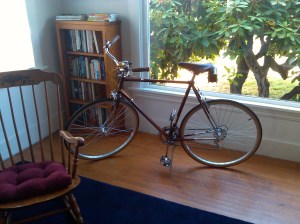
 Ryan finished his rebuild of my circa-1970 steel frame Raleigh bicycle. It is to Ryan (to wit, a wit) I’m indebted for the title of this post. He knows I think myself neither sophisticated nor gentlemanly – nor much of a bicyclist. There was a time indeed when the Raleigh did duty for an auto, but that was of necessity, hardly hobby or Edwardian privileged choice, and while there is evidence of bicycle chivalry in my bio, as evidenced by the call-in, for example, to the Bill Ballance radio show “Feminine Forum,” circa the old Raleigh days, the topic of the day “Is Chivalry Dead?,” the young lady caller apparently the same girl I had saved from a group of wine-drunk ruffians after an outdoor blues concert one evening on Venice Beach – and she never got a chance to thank me, she told Bill, as she rode south on her bike while I ran north up the boardwalk, chased by the ruffians, dashed east on Windward, cut through the vacant lot next to what is now Danny’s Deli, across the alley and through the apartment corridor to Susan’s aunt’s place, peeking around the corner of the building to see the hooligans searching for me around the parked cars on Windward, it’s purely anecdotal. The rude dude had made the girl cry, pulling at her handlebars and pestering her to come join his coterie sitting under a palm
 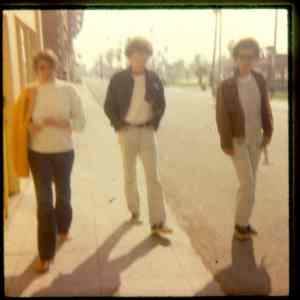 drinking wine. I had stepped up and grabbed the other side of her handlebars, surprising and startling the cad, yanking them out of his grip, and pretending to be her brother, I had said, “Come on, we gotta go, Dad’s waiting for us.” At which point we walked quickly off, and I asked her if she was ok, and I glanced back to see the bad guy stirring his buddies to action, pointing at me. The chase was on. In the picture right, taken by Susan, I am walking along the Venice Boardwalk in the early 70s. The two ladies I am with were capable of handling their own chivalric needs. And I still think of a bike ride as a paragraph lacking a unified topic. As in writing, you discover where you’re going in the process of getting there. The risk is that some readers may find this kind of bicycling writing annoying, just as some motorists would rather not share the road with parenthetical interruptions.
The characteristics of an upright, urban bicycle include casual step pedals and upright handlebars. A brass bell mounted to the bars gives the bicycle a voice to its otherwise smooth sail-boat-quiet glide. The photo above shows the Raleigh in minimalist set-up: no saddlebags, bar basket, lights, or racks. The kickstand adds a sense of responsible behavior expectation. The cork grips suggest the sophisticated gentleman knows his way around country streams and beaches as well as back roads to far away places within the city. In one of his ten blog-posts it took Ryan to complete the rebuild, or maybe it was in an email he sent me, as we went back and forth discussing parts and style, I remember him referring to the vision for the restored bike as an “upright gentleman’s urban bike,” and I remember thinking I was in trouble now. But etiquette of the road is not to be sneered at. And if I could not be grand, I at least would not have to be a spinet.
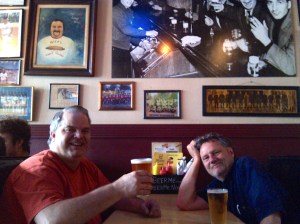
One of those far away places, though not too far to bike to, the destination, as it turned out (an urban bike ride usually revealing a flexible plan), of our maiden voyage on the rebuilt and reconfigured Raleigh, with Ryan riding co-pilot on his Handsome bike (a make, not necessarily an adjective), was Nick’s Coney Island, in the Hawthorne District. In the pic right, you can see Frank’s portrait framed, the original Nick, before he sold the place and the new owners built Nick’s into a somewhat sophisticated gentleman’s Coney Island, wearing a Nick’s shirt with a Coney Island Dog on it, above Ryan and me sitting at a refurbished booth with pints drawn to celebrate the renewed bike. Frank was a stout and diehard Yankee fan. I don’t know what Frank thought of bicycles or even if he was ever on one, but I knew him as a kind of blue-collar gentleman when he was doing duty tending bar and waiting tables at Nick’s, his royal red Cadillac parked at the curb outside the door.
Bicycle and urban are easily defined. Urbanity might get a little muffled in the noise of orbs and urbs (the city is surely a verb), but what of sophisticated and gentleman? Now we are in deep waters. And what is a bicycle as political semiotic as signified by Roland Barthes? The bicycle is a Beckett motif, his characters hardly sophisticated or gentlemen and often located well beyond orb or urb. What on a bike is a sophist, or a fallen gentleman? Benjamin Franklin walked, so did Thoreau. Franklin might have invented the bicycle but wasn’t in enough of a hurry, while Thoreau might have associated the bicycle as a product of the same forces that built the railroad, the unforgiving lineal track that prevented one from wandering.
The further one wanders often the riskier the route. Southeast Belmont Street does not for most of its distance provide for safe bicycle riding space. The Salmon and Taylor Street designated east-west shared roadway encourages a sauntering ride, which is a ride in which one takes the time to muse and wonder, even to wander, and there is no shame in dismounting and walking the bicycle. That is what it might mean in Southeast Portland to ride a bike, to write your own story, not necessarily against the commute, but on the margins of the commute. The sophisticated gentleman urban bicyclist is a marginal man, a reader around a town of text. His destination is never clear. His purpose is opposed to argument. His narrative does not follow conventional route expectations.
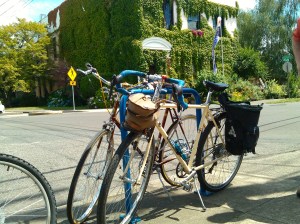
He might make a mistake. I wanted to show Ryan Tabor Space, the coffee house in the old Presbyterian church on the northwest corner of Belmont and 55th. But when we got there, the coffee space was closed. But having already secured the bikes (pic left), we went into the church and sat for a spell where it was cool and restful.
The sophisticated gentleman upright urban bicyclist may take liberties with his trip narrative. That doesn’t mean he ignores rules of the road, at least those that are not ambiguous. On the contrary, he rides clearly and concisely, if not precisely, and never speeds or travels too fast for conditions. He is, in short, in no hurry and not in search of a hassle. We caught up with Susan and had British fish and chips and bangers and beer at Horse Brass Pub while discussing 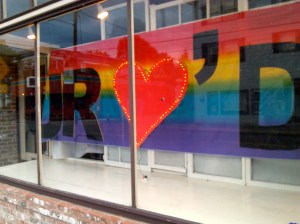 bikes and comedians and films. Susan suggested we walk down to Movie Madness and rent a comedy to watch when we got back home. These are hard times around the country. For some, the time seems permanent. Platitudinous postings, retweets of bad attitudes, prayers without reflection, pandering of politicians to atavistic fears and wants, happiness confused with satisfaction – that’s all part of the difficulty; still, this sign in a business window on Belmont is a viable posting. Here, it seems to be a response to the Orlando shooting specifically. The sign it replaced said LOVE in bold red off balance letters, letters in love
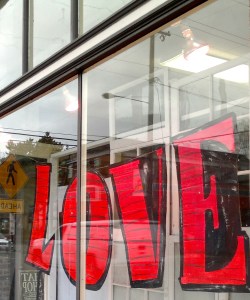 . Before the LOVE sign, there was a gold lettered GLORIA with stars in a Christmas display. The window display has become a kind of public service announcement. It exudes a good vibe. I’ve passed it in my car, on the bus, walking, and now on my bicycle. Were I in a Beckett book, I might crawl to a sign of love with that hopeless hope that motivates his characters. You can’t make love to a sign, though it sometimes seems all we have is signs for things, and not the thing itself. I have a bicycle helmet, but I can’t forget Thoreau’s dictum to avoid enterprises which require a new suit of clothes, so I’ll be eschewing the purchase of bicycle apparel.
On to Movie Madness, where we rented a Christmas comedy to watch back home, “Mixed Nuts.” So we’re watching a Christmas movie in July. “Mixed Nuts” was filmed in Venice, the Venice boardwalk a prop, along the same blocks in the Venice pic at the top of this post, with Steve Martin playing manager and owner of a suicide prevention non-profit hotline. Madeline Kahn is wonderful as Mrs. Munchnik.
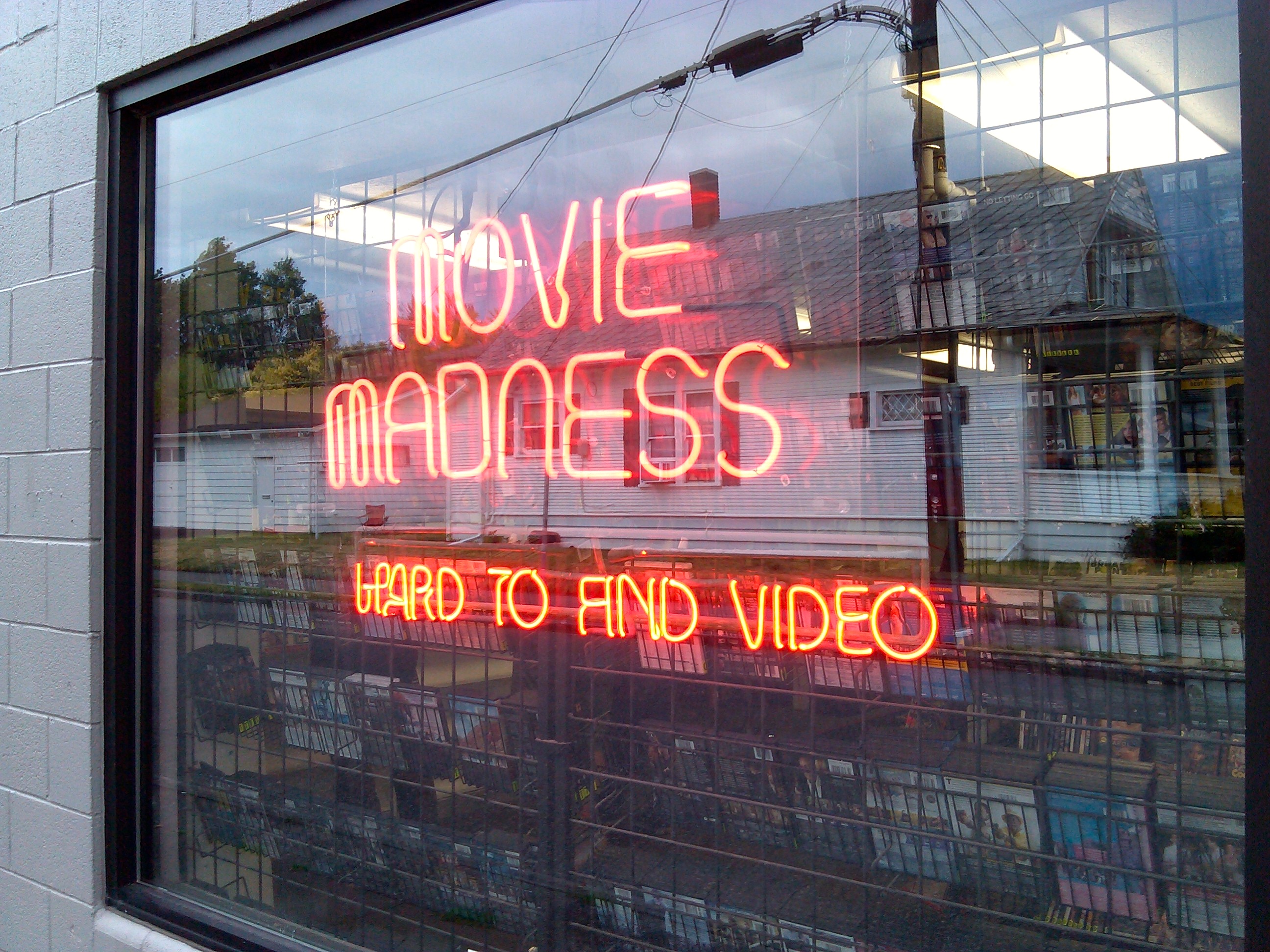
Movie Madness is more than just a video rental store. It’s a film museum, displaying a collection of movie making artifacts such as the knife used in the shower scene in Hitchcock’s “Psycho.” “Psycho” is on my reverse bucket list, which includes films I’ve seen that I never want to see again. One film I never tire of watching is the original “The Time Machine.” Movie Madness has on display the miniature table-top time machine used in the film, the one the time traveler sends into the future and so it disappears from the table. Presumably, it’s still time traveling. I also enjoyed the PSYCHOTRONICS sign to the thriller room. “More!”? What more could there be? I didn’t go in.


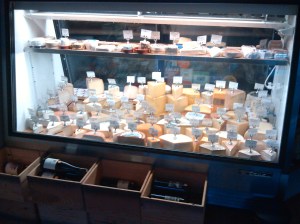
I wanted to visit with Ryan Cheese Bar at the bottom of the Belmont hill. We enjoyed a board of mixed soft and hard cheeses with a glass of wine before “Mixed Nuts.” We watched the film and the next morning we walked down to Coquine for a scone and coffee. Ryan took off and later I went for a ride up in the park.
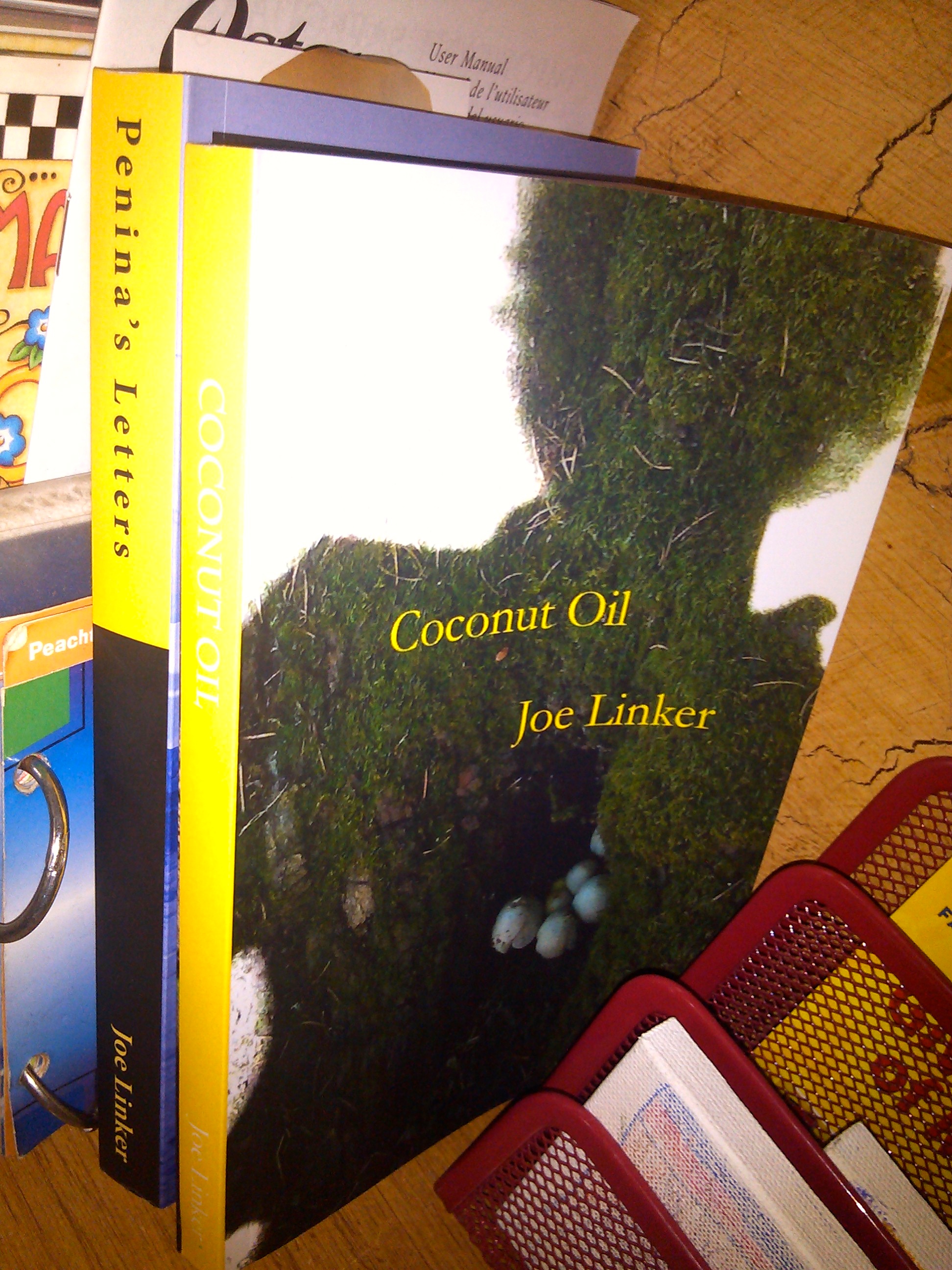
In chapter two of “Penina’s Letters,” Salty is sitting at a cafe table outside Blubber’s on the Strand when Puck Malone rides up on a bicycle:
“I drank a tall glass of water and was nursing a beer, watching the walkers and the waves, when along came Puck riding up the Strand, grinning, playfully pedaling his royal blue bicycle, holding a surfboard under one arm, wiggling to and fro. He was barefoot and shirtless, wearing some baggy trunks. He was watching the waves, closed out, booming bass lines now in the spring high tide. He saw me and parked his bike and leaned his board against the wall.
Puck Malone’s neck was as thick as a telephone pole. His face was full and fat, with marble brown eyes spinning between freckled cheeks and straight, sandy-red hair, bowl cut with bangs down to his eyes. His tornado torso funneled down to two skinny legs. He had big surfer knots on his knees and feet from paddling in the kneeling position.”
I’ll leave it to readers to decide if there are any gentlemen in “Penina’s Letters,” but it’s a question of fact that there is at least a bicycle, and it gets ridden – a surfer on a Strand cruiser.






 In the process of deconstruction we discover new ideas. We need not start with a design in hand. We don’t necessarily need a plan. Unless, of course, there is some destination we are particularly interested in, we need to get to. If that’s the case, we’ll usually find ourselves on the wrong path, wrong way on a one way street, people barking directions at us, flipping us off. But if we begin with deconstructing that destination, we often find we discover interesting things along the route we end up taking we would have otherwise missed. There will be constraints. Fences and gates. Do Not Enter signs. No Solicitors. Beware the Dangerous Critic!
 The Coming of the Toads