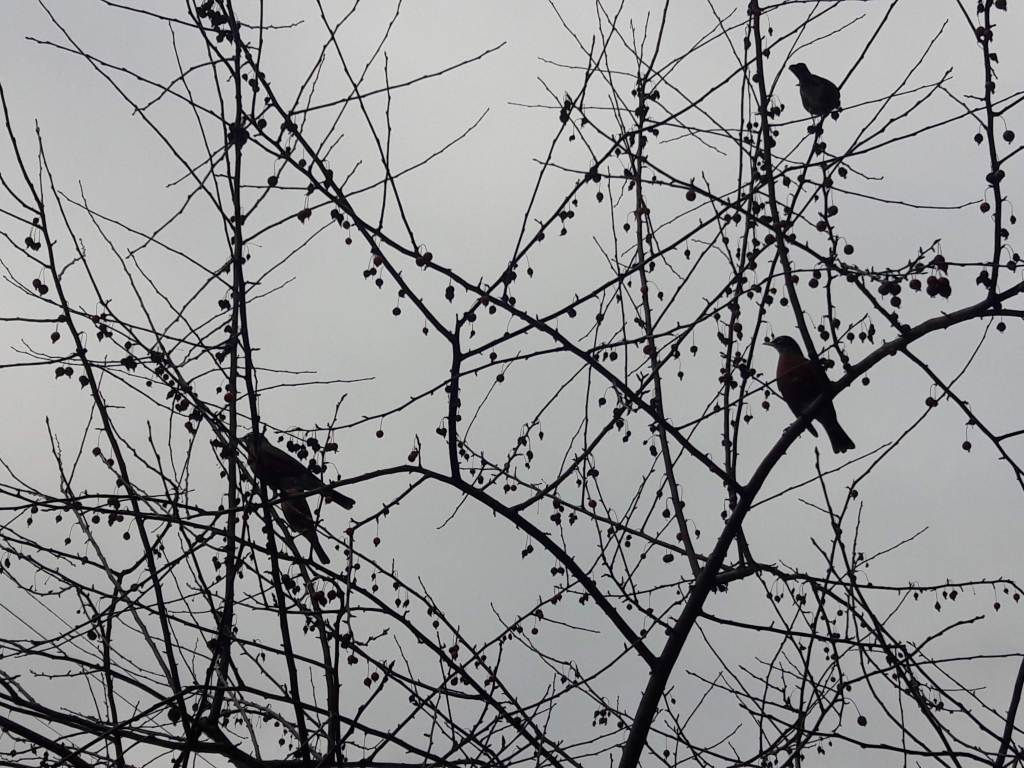
A trip of plovers paused wading
in the wet sand of an ebb
tide each one after another
across the sloping beach
stopped and pecked and ran on.
Up on 101 a swarm of workers
on a wet sidewalk in winter
huddled at the bus stop waiting
and each one hopped aboard
and nipped and gripped.
They feed with their eyes
and only pretend to be
where they are,
falsely brooding,
but amusing, all the same.
Tag: Writing
-
Drizzle Rain
-
Epiphanic Cat
A kin of kindly
epiphany, unblinding,
not whiskey aflame
in your raw throat,
a mud dog’s bouche
to your uncupped
groin, but the silent
soft brush of a cat
rub against your leg
to say hello
and please
pay attention
to her.
-
This and That
This and That had a quick chat.
You go this way and I’ll go that,
balanced on the brim of a hat.
Said That, I which wish to set
up this neither forget nor forgive
any trespass near or far.
As far as that goes, replied This,
I’ll look forward to that there
reminder, and with That,
into the hat fell This,
and next,
out came That.
Thus This fell forward nearby,
while That fell far and away
back, and this chat was that.
-
The Awful Truth
How awful to be foul
all of the time.
One should wise up
once in awhile.
But uneasy, those
strange gods above us,
all who stir
to one thing:
“Three little people
don’t amount
to a hill of beans
in this crazy world.” *
* Rick to Ilsa
at the end
of Casablanca.
-
A Cutting Edge Paradox
Mr. Groen maintained a modest but pleasant yard.
Saturdays in season he cut the grass with a push
mower, pruned roses, fertilized, spread compost.
Martha Groen watered the beds full of crimson
geraniums, purple peonies, tulips, daisies, and
such that fancied her seasonal gardening moods.
But back to back dry nasty winters followed by
suns so hot the weatherman warned of drought,
and the city curtailed yard watering with fines.
Weeds bolted like bad thoughts coming from
nowhere but filling the mind with oil and gas.
Mites appeared, worms, mildews, the antithesis
of a long forgotten paradisaical anthesis.
They still sat out, but they let the yard go.
-
Hugs Penyeach: “I Saw a Man Hugging a Fridge: Twelve Poems by Youssef Rakha in Robin Moger’s Translation”
Youssef Rakha, Egyptian writer and editor of the international online publication The Sultan’s Seal (aka Cosmopolitan Hotel Cairo), recently posted to his site twelve of his own original poems, translated from the Arabic by Robin Moger. That posting draws significance for several reasons: both writer and translator are professionals published elsewhere in traditional forms – literary, commercial or journalistic; the poems are estimable; as literary online culture continues to evolve, with some longtime bloggers dropping out following more traditional successes or frustrated by the perceived over saturation of unpaid venues, Rakha continues to appear determined to develop even further his site, creating unprecedented opportunities for diverse writers and readers.
As I consider a discussion of Rakha’s twelve poems, I’m reminded of Kirill Medvedev, the Russian poet whose concerns regarding ownership of communication and open access to literature and language led him to renounce his copyright, and in addition to his other work, he began to self-publish his poetry on Facebook. At the same time, Medvedev seemed interested in writing that would not alienate a common reader, as so much poetry often does, even if inadvertently. Reading poetry can seem like studying a foreign language, as indeed it is.
Rakha’s poems behave, it might seem redundant to say, poetically. That is, they move by metaphor and juxtaposition of images, narration sometimes ambiguous, with many unexpected turns. What is their subject? Rakha has always made expeditious use of tags. At the bottom of the “Twelve Poems” post, for example, we find 70 tags, alphabetically ordered, but we don’t find fridge or hug.
We should assume the speaker or narrator of a piece is not necessarily the author. Authors create characters, in both fiction and poetry, and narrators, including those in the first person, are characters. Even the narrator of a so called memoir, perhaps particularly so, is a character created by the author. Louis Menand recently spoke to this issue in a New Yorker article. I’m not sure he clarified or muddied the waters. That business about the “narrative pact,” for example: I prefer Trilling’s argument that everything is an argument – and that probably includes memoirs, essays, poems, novels, ads and commercials, junk mail, the evening news, anything on an op-ed page, and notes left on the fridge from your partner. The old, venerable encyclopedias? Full of arguments. The new Wiki? Likewise. But Menand’s closing point, that no occasion for writing should prevent us from reading, is right on. But what of the culpability of readers who in their creative reading find something the author had not intended? But isn’t one of the purposes of poetry to create and sustain or nurture the possibilities of unintended consequences?
The setting of the poem where we find the man hugging a fridge seems domestic. His wife is there, swinging from the chandeliers, but this doesn’t seem to be a party. The local world is drowning in rain. We might recall Bob Dylan’s “A Hard Rain’s A-Gonna Fall.” “Oh, what did you see, my darling young one?” The man’s legs are submerged. Is he hugging the fridge for its buoyancy potential, a life preserver? The poem is titled “Listen Ashraf,” and Ashraf Fayadh, a poet initially sentenced to be beheaded in Saudi Arabia, is named in the first line. His sentence was subsequently reduced to an eight year prison sentence with 800 lashes. His crime, it seems, wasn’t so much poetry, or being a poet, but of writing the wrong kind of poems. We hug our abodes, our houses, our wives and fridges, our lifestyles, as the waters continue to rise. We hug to say hello, goodbye. We hug the things we love. We hug a fridge or a clothes washer when we want to move it to another location. We hug to hold on. “Listen Ashraf” is the last of the twelve poems.
The first poem of the twelve is titled “First Song of Autumn,” and speaks of joy: “I am the clarinet’s mouth.” This poem is lyrical, cylindrical, like the flight of birds.
In “The Angel of Death Gives Counsel to a Bereaved Parent,” we find one of those poems whose narrator or speaker appears as a character invented by the author of the poem. The poem appears to be the angel’s apology, a rebuttal to the argument that he has no feelings. But he must harbor his hugs to get the job done. And he gives back, not an answer, and certainly not even a hint of a meaning to his work, but a hug of surety.
The twelve poems speak in both the first and second persons. The speaker addresses someone close but at the same time far away, questioning, observing, remembering. There are sparks of sadness and of sarcasm, of hope drowned in irony, of anger:
“Sleep and hug, like the downy pillow, the certainty
That you’re the genius, alone in a society of retards.”Readers might wonder what it is they hug, to get them through the night or day of a poem, across the invisible wall of a border.
One of the twelve poems, “Stallion,” is a prose poem. Not that a piece written in prose is any easier to grab hold of. It only appears to be one of the more accessible poems here. Written “For Ahmed Yamani,” it moves as a dream of water over oil. Another prose poem, titled “Love (Marriage),” seems an aphoristic apology, though we may not be exactly sure for what. It is not the sentiment often found on greeting cards.
On second and third reading, the poems open more easily. The reading is not difficult; that is because the writer has done most of the work. But there is work required of the reader, too. The settings and references may be unfamiliar, the problems, though universal, hardly equitably distributed. Characteristic of the poetry is the packing together of history, personal observation, everyday events (visiting a cafe, for example), a kind of diarist epistolary form. The movements feel free, without restraint, not hamstrung.
-
Banana Yellow Sunrise
About fell asleep waiting on doctor to come
under beguiling wall poster of limbic system.“I’m going to give you three words, and I’ll ask
for them back before we’re done.”I repeated each word after her:
yellow – yellow; banana – banana;sunrise – sunrise. Then she moved
for the cuff and I rolled up my sleeveand she asked how Susan was doing.
Sunsee, sunsaw, I thought aboutBuckminster Fuller’s neologisms,
and also considered the possibilitythe doctor had given me not three
but four words, sunrise compound,two words in one meaning. There
was a time I might have discussedthis with her, but no more. I felt
my arm swell as the cuff tightened.Had I fallen in the last year? No,
not that I could recall, small smile.Trying to keep her three words
top of mind, I inverted them:banana yellow sunshine, locking
them together as a descriptivephrase, cleverly reducing work
from three chores to one.How many beers did I drink
in a week’s time? Finally, she askedfor the three words back,
catching me off guard.She sat quite close to me,
her face to mine, and I sawher nonplussed, and I knew
something was wrong.As I left her office to go down
to the lab to leave some blood,I thought about the difference
between sunrise and sunshine,sunshine like adding a 7th
to a sunrise triad. -
Notes on “je me touché,” 4 essays by Jeremy Fernando
je me touché, Jeremy Fernando, 2017, Paradiso Editores, Delere Press, 77 pages.
Jeremy Fernando’s method of writing shows his acoustic, vibratory thinking, making connections, moving from one idea to another, enharmonic soundings, transported by his readings. In “je me touché” (it is i touch me – or, I me touch: I touch myself), he connects, in four essays, as cars interconnected on a train, Flann O’Brien’s short story “John Duffy’s Brother,” Melville’s “Bartleby,” the Occupy Movement, and, in an “Afterword,” sound, touch, and tune.
If Flann O’Brien’s Brother is a train, Melville’s Bartleby is a station, the last stop, the end of the line, no turnaround. Nothing to be done now but occupy that well-foreshadowed destination, where we hear night and day the whistle of a human train derailed, “the scream of the scrivener” (25). That scream is a kind of tinnitus. There is no actual sound. What we are hearing is a phantom noise in our imagination.
In the beginning was the word, and the word created community. In every beginning originating with a word, a commune is created, a habitat for the imagination. Community contains potential for sharing, for touching, without conflict, but with the possibility of divergence, which is risk, which becomes reading, a home, a place to dwell. And every household invites divergence, a library of dry goods.
Fernando begins “je me touché” with an immersion into Flann O’Brien’s short story “John Duffy’s Brother.” Following some strange inexplicable happening, Brother (unnamed, perhaps one of Beckett’s unnamable) believes himself to be a train. Children often play at being things – “Choo!Choo! Good and Plenty. Good and Plenty.” But Brother really is a train. What is a train? Following a linear path, tied to its tracks, a community of cars carrying sundry goods and people and animals, all properly ticketed or listed in a bill of lading, the train rolls, pulls, steams along, along the line, picking up speed, braking for curves, slowing on hills (“I think I can. I think I can”), forward to a destination, for every train has a purpose, clear and unmistakable. And part of its purpose it to run on time, less the socioeconomic demographics harmonizing the connecting stops becomes disrupted (45-48). We don’t care about the people on the bus any more than we care about the bus drivers. What we care about is the system, the fixed routes, the timetables, the robotic movement of time. We become the bus, the train. But the story is not about the train; it’s about our thinking we are the train, a secret few of us care to admit, less we be admitted. What happens when the drivers (today’s scriveners, writing a line along a predestined route) go on strike?
Our choices are limited. All authority lies in the tracks, and “it is only truly authority when ones does not have to use any force.” The system that runs on time requires no force but to enforce the schedule, which should require no force once set into motion. The individual who leaves the track, detours the bus route, goes on strike, does not necessarily wander far afield, but comes to rest, as does Melville’s Bartleby. Employed as a scrivener (a human copy machine), Bartleby inexplicably begins to “prefer not” to do any more copying, or have anything to do with the office or its community, yet he will not vacate the premises, for he prefers not to do that either. Bartleby’s boss, possibly the first humanist, works around him, but Bartleby eventually winds up in the Tombs, and we learn that he started out in the dead letter office. “Ah, Bartleby. Ah, Humanity,” the story ends.
We begin to see Fernando’s connections, how he unravels then weaves again the themes found in Brother, Bartleby, then the Occupy Movement, and lastly, in “Afterword,” into one wandering path. Along the way, we meet the likes of Zizek, Ronell, Kant, Otis Redding, Cervantes, Wall Street and its Bull (symbol, sculpture, art), reading as touching. “Prosopopoeia”: feeling, book, relation, touch. The word empathy is not used, but perhaps should be, as in to feel oneself is to grant oneself some altruistic version of how another might feel us. Henry Miller. In tune. Dash, the dash. Coming together. Risk. Love (“I love you,” 72-73). Laughter as music, as language.
Fernando’s layers upon layers of reading unfold, every word its history we must also remember, “keeping in mind” how others might have used it. And under the surface a stream, a river, runs undercover. Thus relation, within words: correspondence, interconnections, kin, intersections. Connecting Bartley with Occupy – occupy what? Nothing? The stairs? Bartleby occupies, to occupy already an occupation (“…why don’t they just apply themselves and get a job,” 37). Touch themselves? Now here: no where? To read is to touch oneself as another might touch, with permission.
This is not a pipe dream, but a book, hard copy.
(“Try this apple, Adam, very good”). Essay as fruit of the word.
Who reads when we read? Even reading something we ourselves have written, we wrote, yesterday or some time ago, we are not the same person reading as we were writing – we are not exactly that same person who sat at that very desk, now also changed, and wrote, for we have already a myriad of new experiences constantly adding to our connections.
I first read Melville’s “Bartleby: A Story of Wall Street” when, as a sophomore in high school, I was assigned Melville as my first term reading and research author assignment. I remember some of the other boys who got Hemingway, Steinbeck, Babbitt. I wasn’t all that happy to get Herman. But that attitude changed. Of course I loved Moby-Dick, but I tried to argue “Pierre; or, the Ambiguities,” written just after The Whale, the better work. Meanwhile, though he died before I was born, my paternal grandfather was an engineer on the Louisville Nashville Line. “So it goes.” Connections.
-
From the Edge
From the edge he walked to the center and hit
return. He might have felt lost in the clearing,
returning again and again to the dark margin.He thought
of making a home
in the clearing,
planting a meadow
of words.
But things changed
at night
in the clearing.
Balderdashes
ran to and fro.He crossed to the other side, the distant
edge, the clearing now behind him.
He walked into that far margin,
and was never seen again. -
what The
what now hap
penned
, the,
pointing,
sd:
point
Bing!only one the
me
still quiet
all watched
waited
listing
not pointing
missing onebut one the
high flyer
the the
the the
the the
mouth
engine
sputtering
what the
what the
what the -
News at the Toads
I reviewed British poet Scott Manley Hadley’s debut poetry collection, “Bad Boy Poet,” at Queen Mob’s Teahouse. The book, just out this week, is available from the publisher (Open Pen) and at Amazon (paperback and Kindle editions). Read my review here.
My novel “Alma Lolloon” is now available in Kindle electronic edition format. You can download a copy for $2.99 here (free if you have Kindle Unlimited).
 The Coming of the Toads