Tag: Writing

  • Coast Road Trip: Unpacking the Pacific Northwest

    For most of my life, I’ve lived near the Pacific Ocean. Nothing special about that. A lotta people live near the water, all around the Earth, some, arguably, too close. At least that’s the opinion of The New Yorker’s Kathryn Schulz, whose latest piece, “Oregon’s Tsunami Risk: Between the Devil and the Deep Blue Sea,” takes aim at the new Oregon law that will allow further building development in tsunami zones along the Oregon coast.

    One Oregon state senator, Brian Boquist (R 12), opposed the bill. His district runs parallel to but east of the I-5 from south of Hillsboro (which is just west of Portland) to south of Corvallis, an area covering a significant part of the Willamette Valley, and includes much of Oregon’s wine country, and, situated on the east side of the coast range, is not in a tsunami zone. Schulz mentions Boquist in her article as one of the state’s problematic republicans, but Boquist opposed HB 3309, the bill now signed into law allowing more tsunami zone development on the Oregon coast, with the following explanation:

    Secretary: Vote Explanation. Thanks, Sen Boquist

    HB 3309 is simply wrong. It allows local government to build unsafe facilities in tsunami zones to save them money. The deaths that will result by building new emergency services facilities that will be destroyed, with deaths, will and should make the city, county and state liable for the deaths. This started two sessions ago allowing OSU to build on liquified Newport Bay so future students will die in a future tsunami. It is clear, the State of Oregon really does not care about tsunami preparation nor the lives of its citizens. Bad policy.

    Vote explanation, Senator Brian Boquist, June 17, 2019

    The “catchline/summary” of HB 3309 reads as follows:

    Directs State Department of Geology and Mineral Industries to study and make recommendations on provisions of state law related to geological and mineral resources of state. Requires department to submit report on findings to Legislative Assembly by January 1, 2021.Removes State Department of Geology and Mineral Industries’ authority to prohibit certain construction within tsunami inundation zone.

    Overview, HB 3309

    The complete bill, which is only 5 pages in length (“The hand that signed the paper felled a city,” as Dylan Thomas put it, in a different context) can be read here.

    According to the Office for Coastal Management: National Oceanic and Atmospheric Administration, the coastal counties of the United States fund multiple economies: “Annually, coastal counties produce more than $8.3 trillion in goods and services, employ 55.8 million people, and pay $3.4 trillion in wages.” This helps explain why about half of the US population lives somewhere near the water. But for many, where one lives isn’t a viable choice one makes: “Approximately 40 percent of Americans living in coastal counties fall into an elevated coastal hazard risk category. These include children, the elderly, households where English isn’t the primary language, and those in poverty.” These people the OCM calls “vulnerable populations.” But Oregon’s coastal human population accounts for only about 5% of Oregon’s total population of just over 4 million. Of course that population increases somewhat in the summer tourist season. But for people living on the Oregon coast, life is rural and poor, with local economies largely dependent on tourism – which generates mostly service type jobs.

    There are other reasons that might help explain Oregon’s sparse coastal population: the coast mountain range, which makes travel to and from the coast problematic; the weather, wet and wild for most of the year; very cold ocean water temperatures; a rugged coastline marked by cliffs, river estuaries, unnavigable headlands, and north south traffic limited to a single, two lane highway (US 101) with few bypasses and parts of which are washed away or closed by flood and landslide or tree fall nearly every winter.

    In June, I spent nine days on the coast. We drove down to Sonoma County, spending a few nights in wine country Healdsburg, to attend a family reunion surrounding a 60th birthday celebration. We spent two nights in Crescent City, which this Slate article calls “Tsunami City, USA.” We walked along the big beach crescent out into the harbor area and ate fish and chips at “The Chart Room,” a local and tourist favorite. We shared our table with a couple of guys, one older even that us, a 90 year old gentleman celebrating his birthday month with a trip up the coast. We talked about the coast, places to stop and see, compared notes. No one mentioned the fact that we were drinking beer and eating fish and chips deep within a tsunami inundation zone. In fact, we were in what DOGAMI calls an XXL zone. That’s a tsunami t-shirt so big it will swallow a whale. From the Crescent City Harbor District History page:

    The Inner Boat Basin at the Crescent City Harbor District was damaged by a 2006 tsunami, but was totally destroyed by the tsunami that struck the harbor on March 11, 2011.  The damage from both events required three years to rebuild.  (The word tsunami in Japanese translates literally as “harbor wave.”)

    Crescent City Harbor District

    I’m going to stop here for today. But for now I’ll leave you with this: between the devil and the deep blue sea, for most of my life, I’ve taken the sea.

    to be continued: this is part one of a series that will cover our June 2019 coastal road trip.

  • Theatrical

    Older then, one more yesterday notched
    into this haggard wasted belt, tight about,
    turning in the widening gut, but must
    be the clothes, despondent, I seem,
    up the block quirky bobber says,
    and I think he’s talking shit on
    my writing, but no, he says, your mien,
    like a traveler lost his way,
    fearful forged face, luggage jowls,
    over needy and under taken.

    Ate too much, talking to self,
    I don’t travel well, I say, when
    he tells me, Go to Hell, but
    let’s go for a beer sometime.
    Drank to gorge, piss like a glacier
    melting, violating the graces,
    not a single work of mercy,
    no incense in my crucible,
    my feet leave a trace of beach tar
    on the pavement parchment.

    As the third and final act ends,
    the boards weathered smooth,
    the audience awakes to the smell  
    of coffee and petrichor coming
    down the aisles, the ushers throw open  
    the great doors of the hall.
    But what’s this, another act?
    The players pretend nothing really
    happens backstage dressing room sweat
    when I present sweet flowers to the star.

  • Paintings and Poems: City on a Hill

    “You are the light
    of the world.
    A city
    set upon a hill
    cannot be hidden” (Matthew 5:14).

    Not to mention something you’ve put up online. What’s posted online can’t be deleted or hidden. That is the poet’s dilemma, who craves publication but still has changes, or will have. But that is only a matter or problem of print. Oral poetry, or song, allows, invites, indeed wants variations. Covers. Over time, cities get covered up. The earth rises, and falls.

    I assumed the Queen Mob’s Teahouse poetry editor position back in April, taking over from Erik Kennedy, Queen Mob’s second poetry editor, from May, 2015, who followed Laura A. Warman. The gig is volunteer work, of course, as befits any true poetic enterprise.

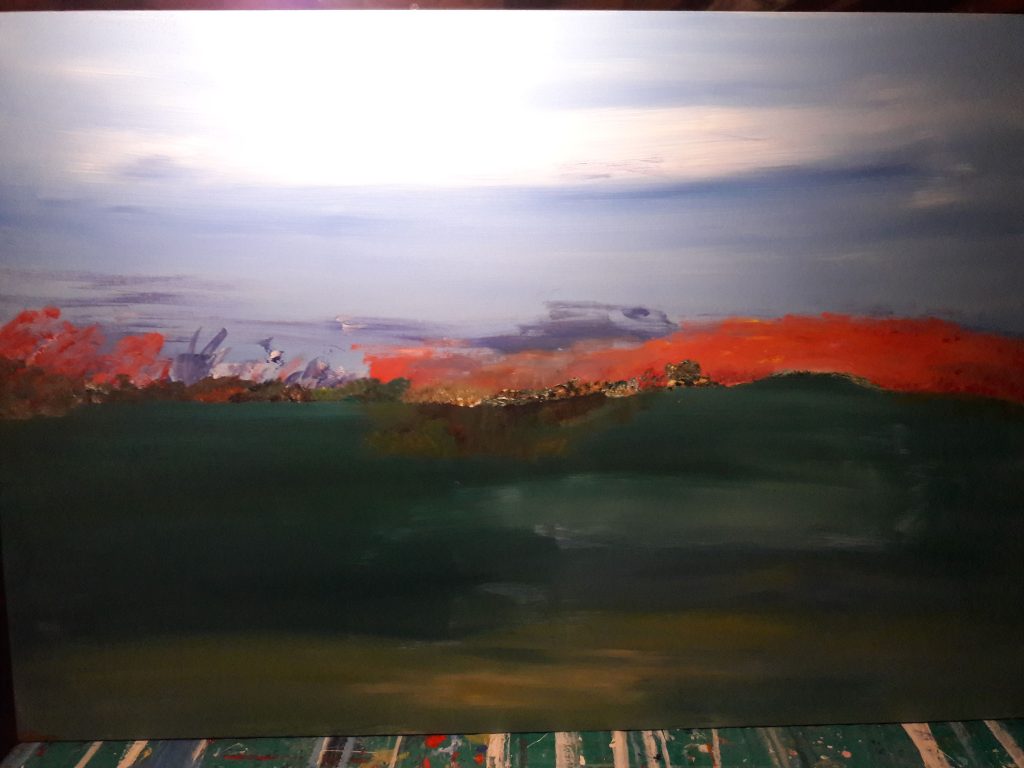
    I first put up, on April 19, three poems by Jax NTP. It was then the idea came to me to use my own paintings as the header images over the poet’s work. I was struck by Jax NTP’s atmospheric, impressionistic poetry. The poems are packed with energetic images changing with the speed of “Highway 61 Revisited”:

    “there’s a giant temple on hazard and new hope street
    blue reptile and green mazing skeletons, keepers of time
    how long can you sit there with the pain before you try to fix it?”

    from “how to pivot when you’re paralyzed,” by Jax NTP

    And I had just finished a painting, the impressions of which, the symbols within, the colors, the shapes, I thought might complement Jax NTP’s poetry. I don’t mean to suggest any of the paintings necessarily align with the poetry in any literal way. In any case, I continued to look for images within my collection of painting pic selfies for complementary impressions.

    Reading and reflecting on Jessica Sequeira’s poems, and later looking for a painting to go with the posting on QMT, I again felt the suggestion with impressions that seems the essence of poetry, particularly of poetical delight:

    “The heavens have promised rain for so many days.
    I think of waiting for torrents from the white sky.
    But it might be a long time. Or this could be a dream.
    Taking your hand, I guide it below, to my cloud.”

    from “Eastern Variations, style of Ikkyū Sōjun,” by Jessica Sequeira

    I selected for Jessica’s poems a painting from last year, “City on a Hill,” a large painting that had taken some time to complete. Again, the setting of the poems and the painting seemed harmonious:

    “lakes shine like mirrors
    reflecting tall mountains

    rainfalls are unpredictable
    innocent changes in the divine mood

    birds sing into great holy spaces
    the wind whistles its reply

    icy glaciers plunge towards sky
    green valleys dive into earth”

    from “My South,” by Jessica Sequeira

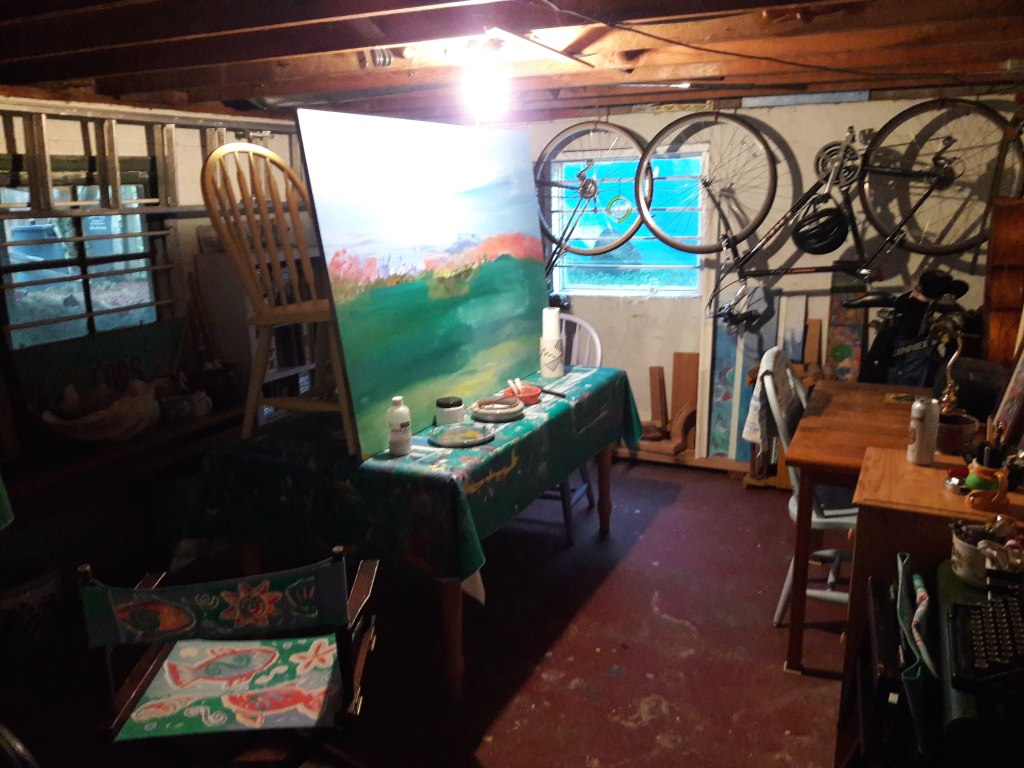
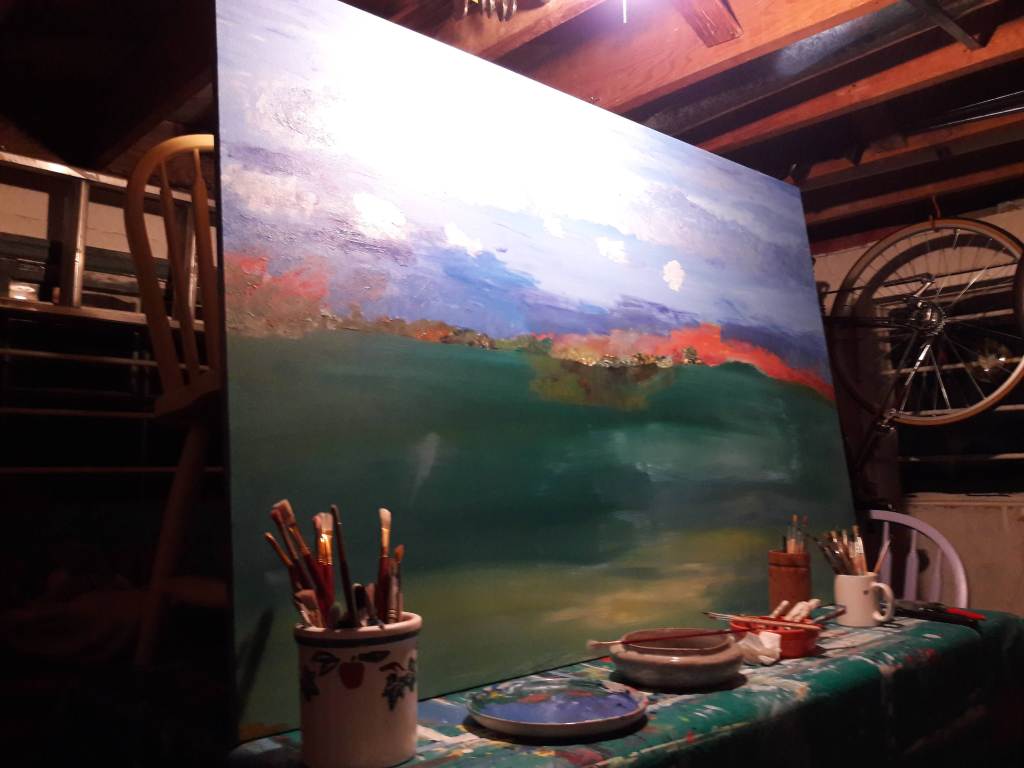
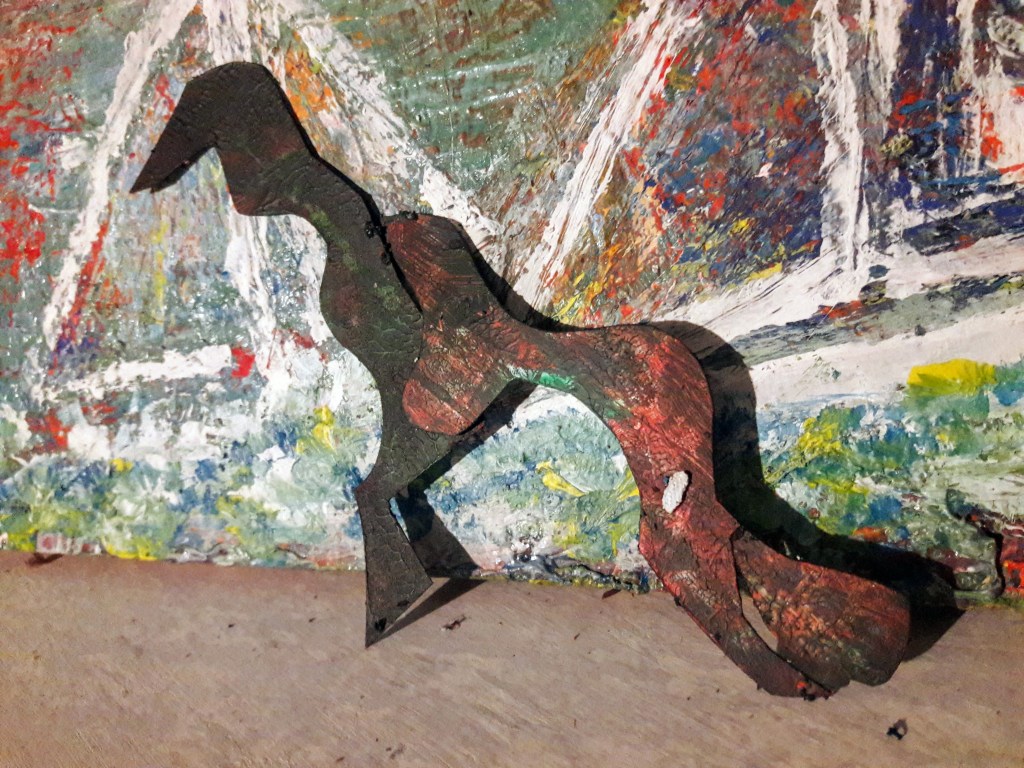
    I had taken numerous pics of “City on a Hill” when a work in progress in the basement studio:

    And I used an early draft of “City on a Hill” to go with Ashen Venema’s poetry:

    I sit still, watch him thin the oil
    and restore his long gone love
    on canvas, standing in
    as the young skin
    by the window, sunlit among
    lilies, fresh cut, and Persian rugs
    casually flung across seats.

    from “My Painter,” by Ashen Venema

    Well, the setting of Ashen’s “My Painter,” “sunlit among / lilies,” doesn’t quite align with the basement studio, though things are there too “casually flung.”

    All my paintings I eventually give away, to family, friends, colleagues, who show an interest and enthusiasm. “City on a Hill” is hanging in my daughter’s den, looking out upon the backyard. The light in the room is perfect. I just want or hope the paintings have a life outside my basement, where, as Ashen puts it in “My Painter”:

    “A blaze of light rims his white hair
    from under his thick swirl of brows
    black humour hides, and surprise”

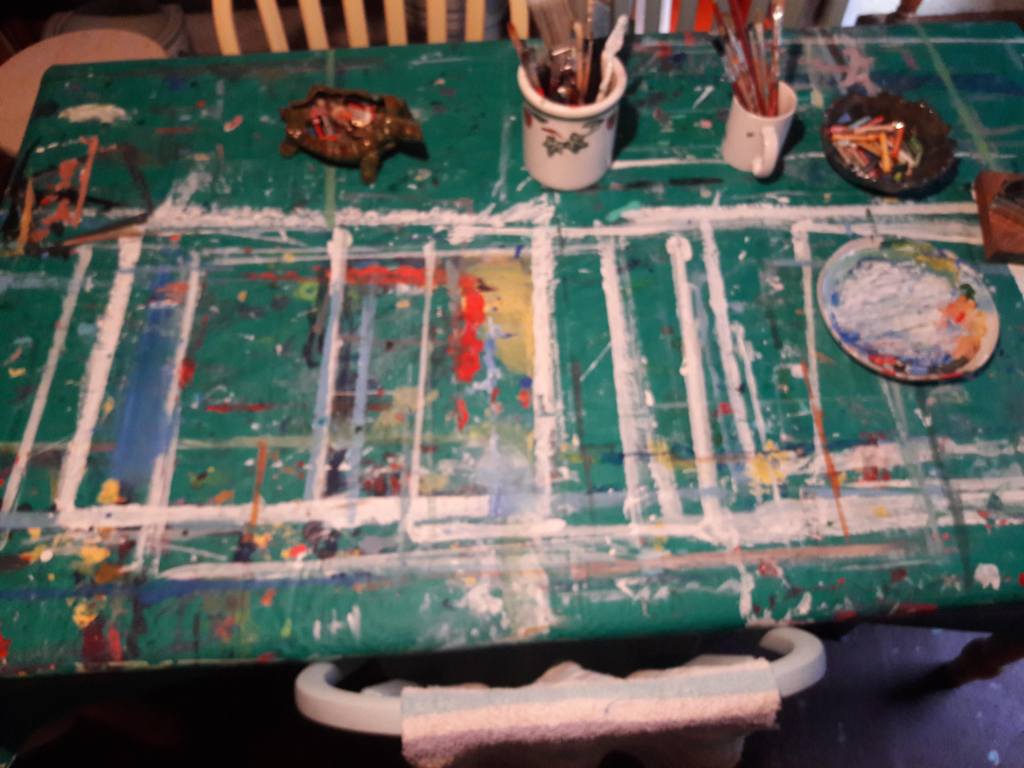
    After all the work on a painting, which isn’t really work, of course, but play, like the work of much poetry, we just might find a true work of art in what we’ve mostly ignored, in the mess we left behind. That tablecloth, for example, now that’s a work of art!

  • Trees

    Some poems speak of love
    others hate.
    If you’re like me
    you like poems about trees.

    Trees are lovely and cool
    because they make shade
    which is nice to sit in
    with a mint tea in summer.

    A tree will grow hot
    turn crisp and line
    into stone menhir
    not even booklice will like.

    This poem is not about trees.
    Would somebody please
    send me a leafy poem?
    The shade here is thin, the sun so near.

  • Horny Theology

    Horny Theology

    A rufous whistled
    and hummed
    at my open door.

    She flew at my heart
    picked and snatched
    hairs from my chest
    for her nest.

    Me flat on my back on the floor
    while she sits on my face
    hooked to my lips
    slicing my eyes
    like an ophthalmologist.

    Her every winged flush
    as sweet and powerful
    as a rush of butterflies

    falling
    filling
    my coughing joy.

    To and fro
    true and from
    until

    ‘harumph’! 

    she blurted out
    and bolted off
    as quickly as she came.

    I thought she was a unicorn
    or a rhinoceros with wings.

    She left me
    without a prayer.

  • Ode to Joy

    Ode to Joy

    Old monk drunk walk garden
    olive way moon path nude
    blue light strain powder pouring
    bare feet stains red muscatel.

    On his rock sits Jesus eyes clear
    tell him of your life sans joy
    brave Brother Anhidonus oh
    fun monk too but without joy.

    Hung over herbs your Jesus praying
    not an only child was he
    resting for the weak of passion
    who find no joy in silent being

    feel no peace no happiness
    no light of joy no sound of joy
    for the ears no touch of joy no
    raised goosebumps on the skin

    no taste of joy sweet salty bitter
    no sour bites teeth the tongue
    no smell of joy stirs memories
    no prayer saturates the temperate.

    No joy found in going silent
    sing for your soup of certitude
    what has brought you not to
    here certainly cannot help now.

    “The cut worm forgives the plow”
    Blake sang now you at least may
    forgive yourself and drink to joy
    lost to joy abstained all these years.

    Walk out of this garden leave
    transcend all plants and animals
    there above where the angels sing
    awaits the turn of your perfect being.

  • This bud was for you

    Across the street from the Estate Sale,
    there’s talk if it’s a teardown,
    while a couple of bushtits build
    a hanging nest in a paperbark maple,
    coming and going through the perfect
    hole at the top of the sack woven
    with string, spider web, tiny twigs
    and grassy strands yarned around.

    “Go easy,” she yearned. “Go around.”
    Then came the night she won’t spring back.
    Some do not come back,
    even as the buds rise in the rows
    heatly lubricated by the bees;
    not all the plants pull through
    that inscrutable winter stare.

    But to turn under? Finished now.
    Not to worry, the sun is the poshest one.
    His light goes shallow, into the soil,
    as easily as through fish water,
    a clean singing glow.
    The days are gone
    this bud was for you.

    20190402_183653

  • Notes AWP Close: The 8th Day

    Wandering post AWP19 Portland town yesterday with entrepreneurial intrepid impresario Berfrois editor at large Russell Bennetts and his Midwestern sidekick Simon Calder, I had occasion to consider Hemingway’s “The Sun Also Rises” in a contemporary context, where all the characters have cell phones, except one, who has lost theirs. But I can’t decide which Hemingway character would be cellphoneless: Jake? Lady Brett Ashley? Certainly not Count Mippipopolous, whose Twitter feed at AWP19 would be going nonstop. Maybe we would have Jake’s friend Georgette find the lost cell phone, but she would keep it hidden for a time, posting miscreant tweets and pics with her bad teeth.

    The idea behind Thornton Wilder’s “The Eighth Day” is that God, having created the world in 7 days, proceeds to take the 8th day off, during which what we now consider time takes place, such that we are all, since the beginning of time, living in the 8th day of creation.

    After their holiday in Pamplona at the festival of the bulls and all the bullfighting, “The Sun Also Rises” characters go their separate ways, Robert Cohn disabused of his romanticism, Jake cemented in his existential crisis, Brett off with the once untouchable but now touched and wrecked bullfighter Romero. It’s going to be a long 8th day.

    Now living in the 8th day of AWP19, at least one Berfrois character has decided to remain on in Portland town. Here they are, comfortably taking over the TV remote:

    20190401_091516

    This is the eighth and last in a series with notes on AWP19 and the concurrent publication of the Berfrois and QM’sT books.

  • Notes: The One They Call the Seventh Poet

    They look like anyone, these poets and writers, intellectuals and artists, editors and publishers – filling and milling about the Oregon Convention Center for AWP19, sauntering though the book fair and scurrying off to panels and readings and private receptions. The fact of a book must say something about their ability to write, to argue and persuade, to think and entertain, to talk and listen. But which one is the one, the seventh poet of a seventh poet, the one who can “make your heart feel glad,” “heal the sick and even raise the dead,” “make your flesh quiver”? You know when you meet the one who thinks they’re the one, but how do you know the one who is the one, “in the whole round world, the only one”?

    I met the poet Calliope Michail at the Berfrois table. She has a book out, “Along Mosaic Roads,” (2018, 87 Press, UK). She also appears in “Queen Mob’s Teahouse: Teh Book,” in the form of an interview conducted by the inimitable Vlad Savich. Calliope is refreshingly fresh, able to speak of poetry in clear and concise terms. She gracefully dances around Vlad’s often idiosyncratic questions:

    “I think it’s a coy dance with writing. You choose it and it chooses you, but sometimes the feelings aren’t mutual” (126).

    She describes with clarity the writing process:

    “I tend to see each poem as a pattern. This pattern consists of layers and links, connections to things in various realms – the personal, the political, the aesthetic, the literary, the linguistic and so on. For me, it’s more of a process that may begin with a line, a concept, or some other preoccupation, that then gets built on” (127).

    “Along Mosaic Roads” contains five sections, each beginning with a threaded poem, “Standing in the Sun,” Roman numerals I through V following. There are 17 poems in all. The titles of the poems sound like those of classical music tone poems. The book is a movement through time and place and person. Again we find the theme of wandering, “Going.” I’ll be spending more time in Calliope’s book in a later post, after AWP19 and Portland returns to its normal weirdness.

    I also met at the Berfrois table veteran poet Dorothy Chan, a 2014 finalist for the Ruth Lilly and Dorothy Sargent Rosenberg Poetry Fellowship. Dorothy has a book just out, “Revenge of the Asian Woman” (Diode Editions, 2019). Dorothy is obviously a capable writer and speaker and advocate for poetry as a means toward understanding one’s place in popular culture and how to take control of a picture others may have of you (probably very different from the picture you have of yourself), as was evidenced in my brief conversation with her amid the distractions at the table, but also as evidenced in her essay written for “Queen Mob’s Teahouse: Teh Book, “Asian Princesses: Fetishisation, Sexiness, Anime Girls and Poetry” (95).

    “The very thing that makes you fetishised, such as ‘Asian girl cuteness’ or kawaii fashion can be turned on its head and become a thing of power” (101).

    I’ll also be spending more time with “Revenge of the Asian Woman,” in a future post. The essay is erudite, but the theory behind it is very clearly explained.

    “I wonder a lot about the way we command ourselves through how we dress, and how these thoughts can be translated to poetry, since fashion is poetry” (98).

    This is the seventh in a series with notes on AWP19 and the concurrent publication of the Berfrois and QM’sT books. I’m reading through the Berfrois anthologies this week and commenting on the writing and the conference as the week wears on.

  • Notes ‘If 6 Was 9’: The Psychogeography of the Book Fair

    I arrived a bit early for my scheduled stint to help out at the Berfrois table at AWP19, so I wandered through a few aisles of tables set up for the book fair. At each table, a couple of usually amiable greeters happily and professionally described the occasion or purpose of their press or otherwise writing or teaching venture. The number of tables was daunting. If 6 was 9 there wouldn’t be time to peruse them all. In the lobby, the wait in the long, long line reminded me of the line for a ride at an amusement park, a long stretch of individuals lined out through the main rotunda, waiting to enter the ticket area, where the line then snaked through numerous switchback turnstile aisles. My friend Bill, who had arrived early, said he’d waited in line for two hours. He voiced his complaint to us at the Berfrois table. As T. S. Eliot might have said, had he not been so gloomy, “I had not thought spring had undone so many.” The sun was out in Portland town. The only way to proceed was at random, psychogeographically. The book fair of course is only one event at any AWP. I enjoyed my short wander, but it was a bit like shopping, which I don’t much care for. Life is subject to change.

    One of my favorite stops in the book fair was at the table for the Otis College of Art and Design. The college, its main campus in Westchester, is 100 years old, and is located about a mile from where I attended high school, in Playa del Rey, an unnotable fact I shared with Kyle Fitzpatrick, who I visited with for some time, discussing his school, the books exhibited at his table, and what’s happening in Los Angeles these days.

    20190328_134254

    I purchased several of their books: “Seeing Los Angeles: A Different Look at A Different City,” edited by Guy Bennett and Beatrice Mousli; “Swell,” by Noah Ross; and “Proof of Loss,” by Sara Marchant. What sold me on the “Seeing Los Angeles” book was a photo by John Humble, from Shooting L. A., titled “343 Hillcrest Street, El Segundo, May 13, 1995.” My father moved his family to El Segundo the same year the Brooklyn Dodgers announced its move to Los Angeles: 1957. The first house we lived in was at the time one of the oldest in El Segundo, a rental house, an old unpainted wood shingled house, and was located on Hillcrest. It’s of course now long gone, and was located farther north on Hillcrest than the one in the Humble photo. Talking with Kyle, I was reminded of Reyner Banham’s “Los Angeles: The Architecture of Four Ecologies,” now back in print. But I couldn’t recall the title accurately, so there you have it.


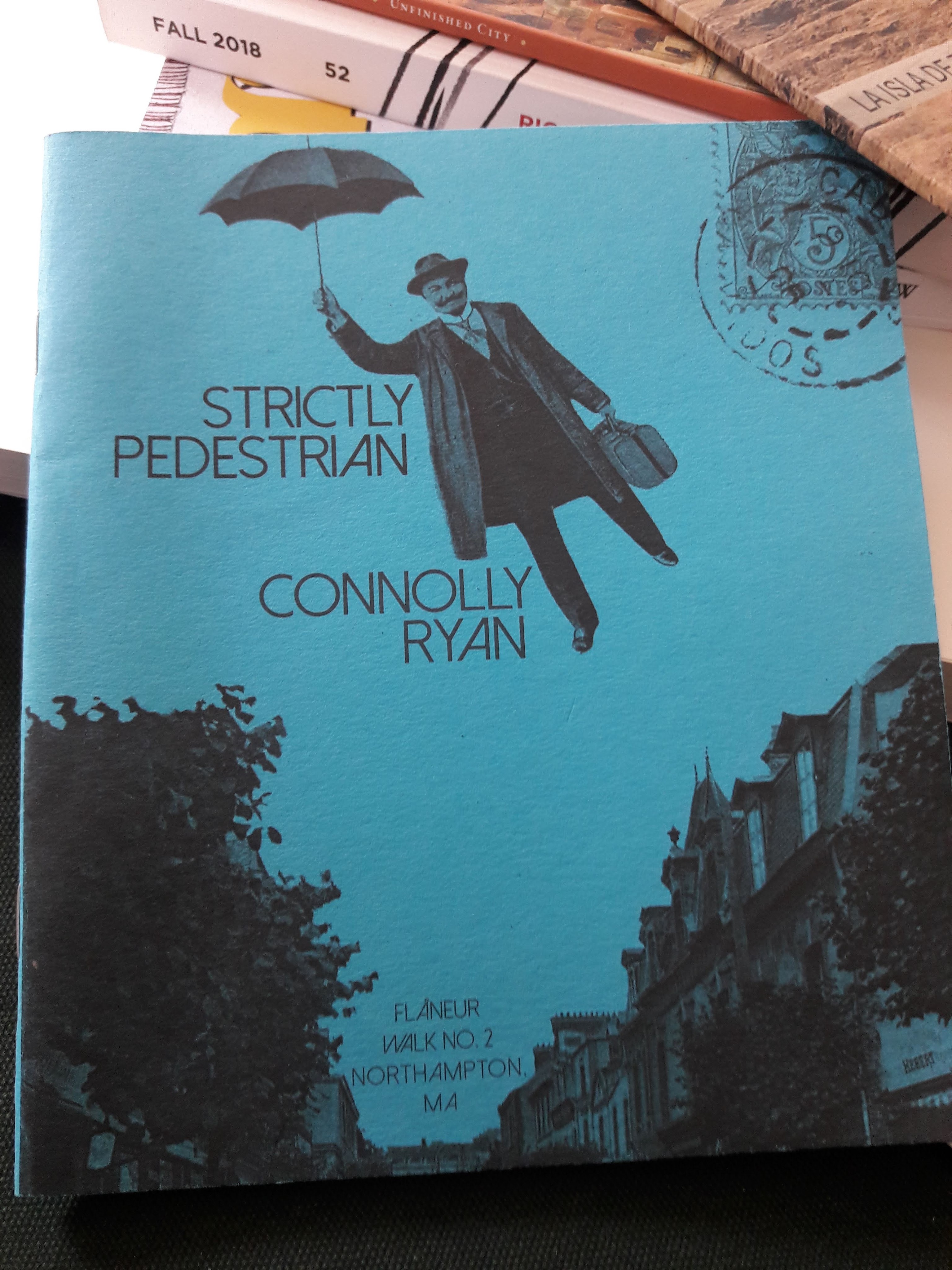
    I met Maria Williams-Russell, editor in the Flaneur Walks Pamphlet Series, put out by Shape Nature Press. By now, of course, I had my meme of the day, and could not leave Maria’s table without buying a copy of “Strictly Pedestrian,” by Connolly Ryan. The book begins:

    “Like all great walks, this one begins in a park.”

    20190329_164338

    I asked Maria to sign the page with her “Editor’s Note,” and she did, but I could tell she thought the signing a bit silly since she wasn’t the author, and I continued my saunter.


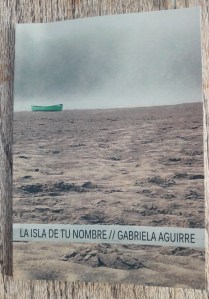
    Back in 1969, I found myself miserably in the Army at Fort Bliss, Texas, which is in El Paso. So I stopped at Veliz Books, sharing space with the Rio Grande Review, of the University of Texas at El Paso. From Veliz, I purchased a copy of “La Ilsa De Tu Nombre,” by Gabriela Aguirre. I talked with co-founding editor and publisher of Veliz, Minerva Laveaga Luna. I mentioned my time in El Paso, and talked some about my time at Portland Community College teaching ESL and ENNL in the late 70’s and early 80’s. There was a professor of the bilingual MFA program at the UTEP sharing the booth – unfortunately, I neglected to note his name, and I can’t recall it. He was a good listener, and encouraged me to continue learning Spanish, which I’ve not studied seriously since high school. And they shared with me their hopes for their work, students, and writers.


    20190329_074245

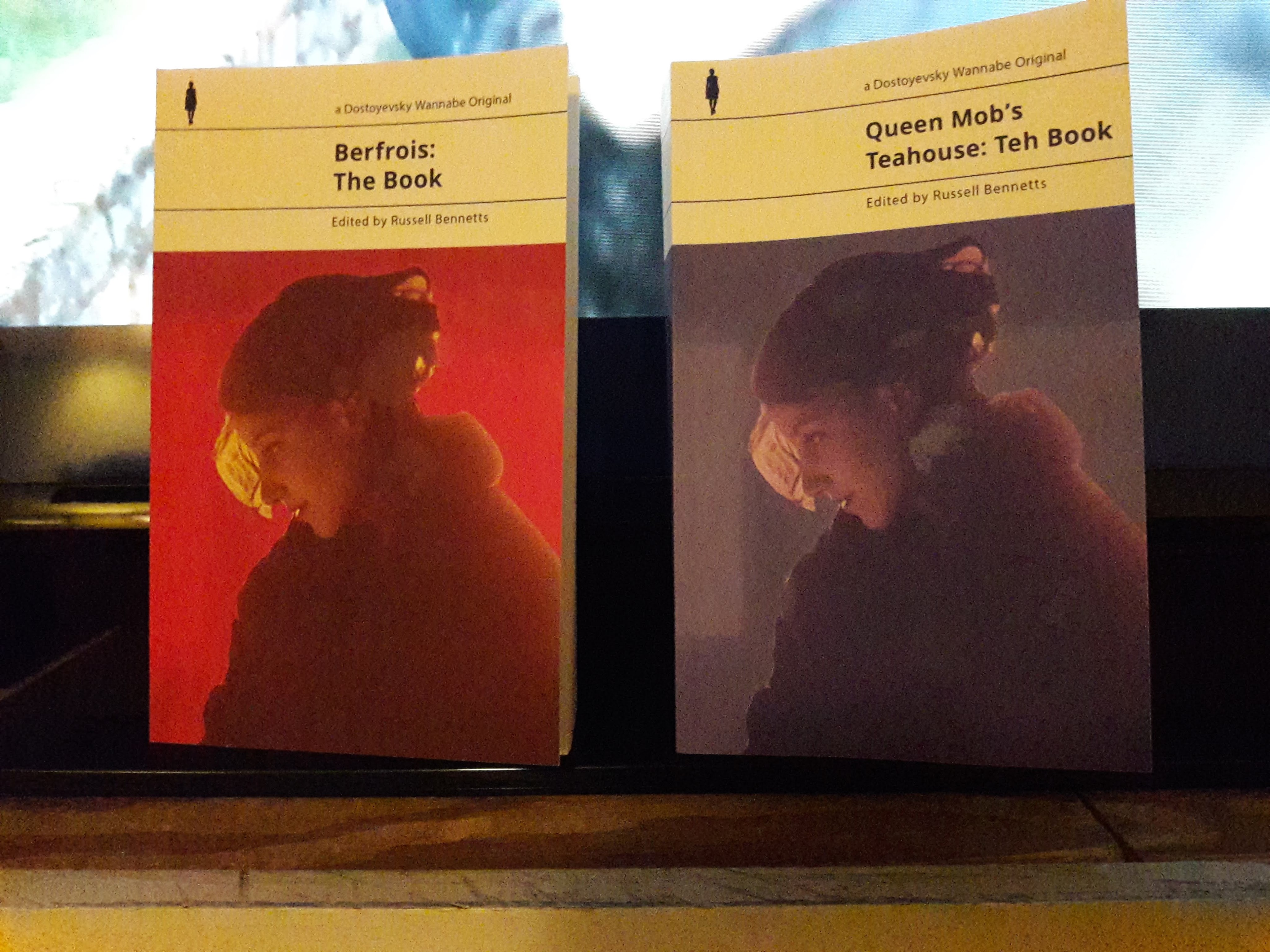
    Meanwhile, back at the Berfrois table, editor Russell Bennetts was busy explaining his hopes for his own work and writers. He was able to say hello to a few writers he’d not met in person before, including Robin Richardson, whose one page piece in “Berfrois: The Book,” titled “Stockholm Syndrome,” is a block paragraph with no punctuation marks:

    “It was the face it was the width the weight of it” (195)

    Here is Russell meeting Robin. I’m thinking of giving up trying to write altogether and becoming a photographer (amateur, specializing in cell phone pics). But, as Jimi said:

    “I got my own world to look through
    And I ain’t gonna copy you” (“If 6 Was 9”)


    …to be continued. This is the sixth in a series with notes on AWP19 and the concurrent publication of the Berfrois and QM’sT books. I’m reading through the Berfrois anthologies this week and commenting on the writing and the conference as the week wears on.

    20190326_203419

  • Notes Number 5: Smells Like Berfrois Spirit

    Nevermind, I’m already 10 minutes late for my appointed volunteer shift at the Portland Convention Center to help out at AWP19. Turns out even 11:30 am too early for this old kid to gig. I hope my unexcused absence doesn’t reflect too poorly on my literary reputaughtshun. But I will use the time though, looking ever closer and deeper into “Berfois: The Book”  and “Queen Mob’s Teahouse: Teh Book.”

    Whenever confronted with conventions, I remember the Salinger story “A Perfect Day for Bananafish,” which begins:

    “THERE WERE ninety-seven New York advertising men in the hotel, and, the way they were monopolizing the long-distance lines, the girl in 507 had to wait from noon till almost two-thirty to get her call through. She used the time, though. She read an article in a women’s pocket-size magazine, called “Sex Is Fun-or Hell.” She washed her comb and brush. She took the spot out of the skirt of her beige suit. She moved the button on her Saks blouse. She tweezed out two freshly surfaced hairs in her mole. When the operator finally rang her room, she was sitting on the window seat and had almost finished putting lacquer on the nails of her left hand.”

    Why ninety-seven? The 97th Infantry Division was active in WWII, but Salinger served in the 4th Infantry Division. In any case, today, “the girl in 507” would, in addition to all her other time using activities, be on her cell phone, wouldn’t she? As for the advertising men, they might be attending an Associated Writers and Writing Programs annual convention, such as AWP19, this week being held in Portland. Portland is a good place for bananafish. Maybe something to do with all the rain. In the today Salinger story version, AWP might be an acronym for All Earwickers Post.

    But the word “ear” appears only once in “Berfrois: The Book.” Six times in “Queen Mob’s Teahouse: Teh Book.” One can read too closely. And that’s just whole words, anyway. Backing up a bit, we see “ear” appears frequently as part of other words: years, bear, Radishes, breath, Misrepresentation (in the Berfrois book); Eavesdropping, great, Picaresque, artes, Funeral, Breakfast (in the Queen Mob’s book).

    The only use of the whole word “ear” found in “Berfrois the Book” is in the essay by Ed Simon, “Moved the Universe: Notes Toward an Orphic Criticism” (59:72):

    “…Erato whispering in Sappho’s ear…” (59).

    In his essay, Simon speaks to the mystery of literature. It’s what can’t be quizzed in class. Nor is it:

    “I’ve no interest in taste, discernment, or style…” (66).

    Simon is talking about the ear, about listening. He’s not asking what is literature, but where does it come from, and how does it get here. How do we hear it, learn it, learn to listen to it, for it. It’s a raw approach. It cuts through a lot of crap:

    “What defines the Orphic approach is never necessarily analytical acumen (certainly not that), nor adept close readings, but rather, an ecstatic, enchanted, enraptured sense of the numinous at literature’s core. Orphic criticism is neither method nor approach, but rather attitude and perspective” (71).

    For a reader, the attitude might have a bearing on Nabokov’s emphasis on relying on one’s “spine,” the “tingle” that goes up it when the magic kicks in:

    “A major writer combines these three – storyteller, teacher, enchanter – but it is the enchanter in him that predominates and makes him a major writer…a great writer is always a great enchanter, and it is here that we come to the really exciting part when we try to grasp the individual magic…In order to bask in that magic a wise reader reads the book of genius not with his heart, not so much with his brain, but with his spine. It is there that occurs the telltale tingle” (5:6). (Nabokov, “Good Readers and Good Writers,” from “Lectures on Literature,” Weidenfeld and Nicolson, London, 1980).

    Simon’s essay is in form a classic argument, and a perfect example of one. Plus, we get a history of literary criticism and enough references to keep us going for some time. The essay bemoans the very academic sustenance that gave it life, but explains why. In essence, theory grows monstrous when it becomes horror to the common reader. Simon’s statement, about which there will be some disagreement, I found very persuasive, intuitive, purposeful, clear and concise yet thorough and clarion in its call to let the sound back into the word.

    Justin Erik Halldor Smith‘s “The G.O.E” (101:108 B:TB) is, at least in one sense, also about the ear:

    “What I remember most vividly is the great cleavage, in the earliest time, when the moon was torn away from us” (101).

    The speaker seems to be an ecological griot, an evolutionary being that “remembers everything,” and attempts to dialog with those who may have forgotten or never knew:

    “There is a memory that runs through all of us unbidden, and that can be brought to the surface with a little effort. In this effort, we stop being I and thou, which seems implausible, but I have always felt that coming to see oneself as an I in the first place was the far more remarkable way of apprehending the world, while conjuring our shared memory with all the other Is is by far less remarkable” (101).

    Justin’s piece is in form a parable. Why is life so reliant on symbiotic relationships that eat one another? There is a partnership, on Earth, at least, of animal and plant life. At least one form from the animal life world has suppressed and oppressed plant life. Too, within the animal world, there are unmarked distinctions that have grown into borders creating divides that threaten all kinds of partnership. Why does life eat itself so?

    We find more “ears” embedded in “Queen Mob’s Teahouse: Teh Book.” But, before we get too far away from “the girl in 507,” we find, in QM’sT:tB, “advertising.” Only once, both books combined, do we find the word “advertising.” It’s in “Conductor,” by Nate Lippens:

    “I drive around my hometown, past the Sons of Norway advertising a Saturday lutefisk lunch, past the strip mall, past the mega-stores and past the Irish sports pub where men who look like fraternal twins line the bar with boilermakers” (187).

    How is disgust drawn, when even one’s mother expresses doubt? While pure hate simply ignores, or pretends to. What happens when dislike pierces the skin so often we begin not to like ourselves, and begin to scratch away at an itch the source of which we know comes from where? Do we begin to blame ourselves for being the lightning rod? Nate’s piece seems a personal essay (it could be a story, the narrator a character). The writing is visceral, honest, seemingly true to experience. The writing is clear, drives forward without blinking. The essay contains the kind of writing you feel in your spine.

    We interrupt this post for a PSA (Public Service Announcement): I’ve learned that I am being given the opportunity of redeeming myself from today’s (now, as I continue these notes, yesterday’s) unexcused absence. Either tomorrow or Friday, This afternoon, I should be helping out at the Berfrois table at AWP19 for a spell. I’ll be wearing my ears and my advertising cap. If your there, the table ID is T11094. We might talk about how I’ve no doubt misread Simon and Smith, Lippens, and now Pickens?.

    Meantime, in the Queen Mob’s book, we find Robyn Maree Pickens using the word “ear” in “The skeleton of a dog who is still alive” (47:57).

    “She has been trained to fix her gaze on the clients’ hairlines or ear tips” (48).

    The story moves in a form of dream language, which is to say surreal, both clear and unclear at once. Yet,

    “Her dreams are full of bounding for terriers. They are either benign guides or soporific constellations that suffocate her eyes. They must never talk about dreams at the institute. She registers the cessation of oscillating air on her head and leaves the circle” (51).

    Perhaps the secret to reading all dreams is simply this:

    “All references are lost. Their lives are so short. They glisten. They hum” (57).

    The Pickens story also is the kind that you feel in your spine.

    This is the fifth in a series with notes on AWP19 and the concurrent publication of the Berfrois and QM’sT books. I’m reading through the Berfrois anthologies this week and commenting on the writing and the conference as the week wears on.

    20190327_162032
    Spring in Portland for AWP19