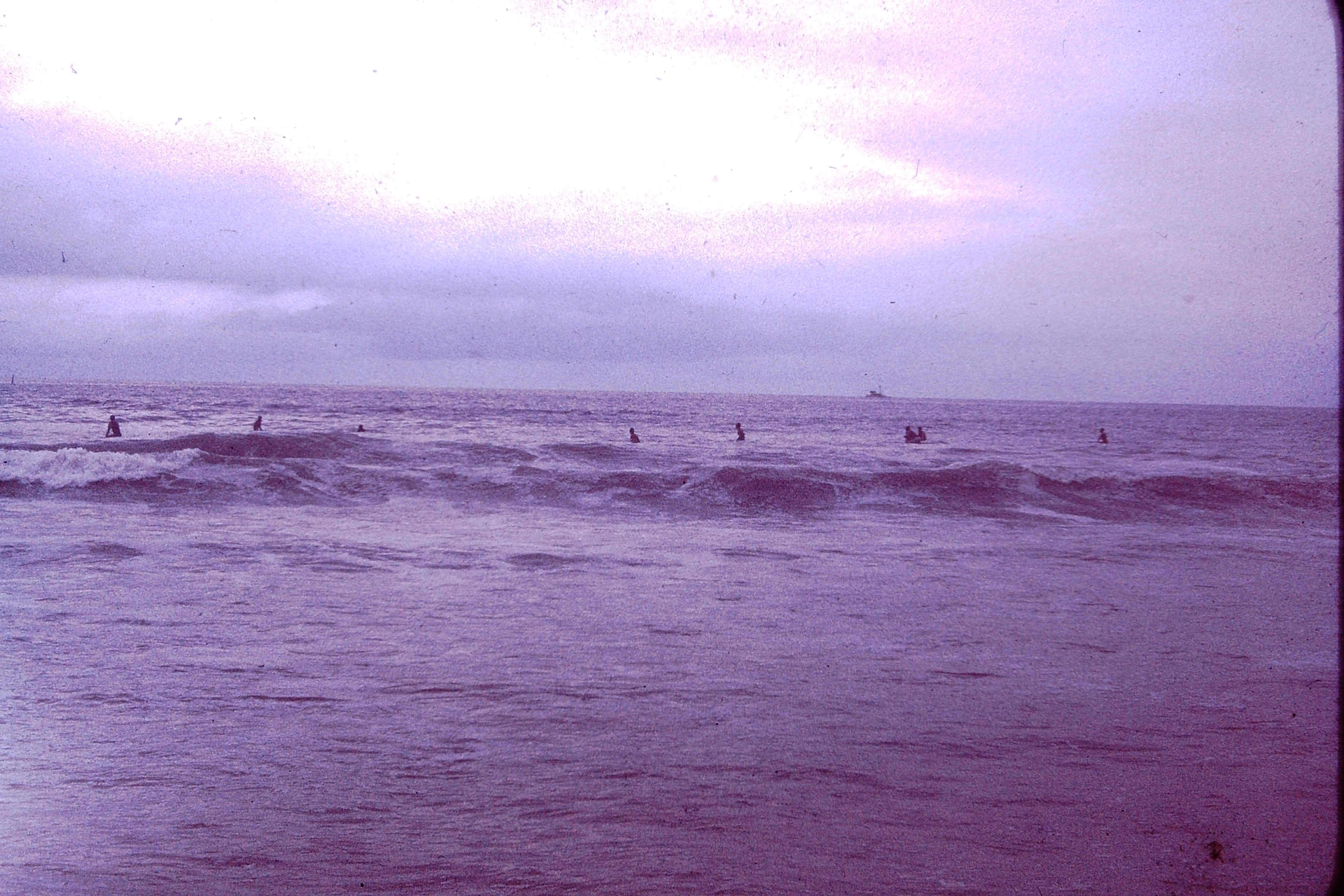
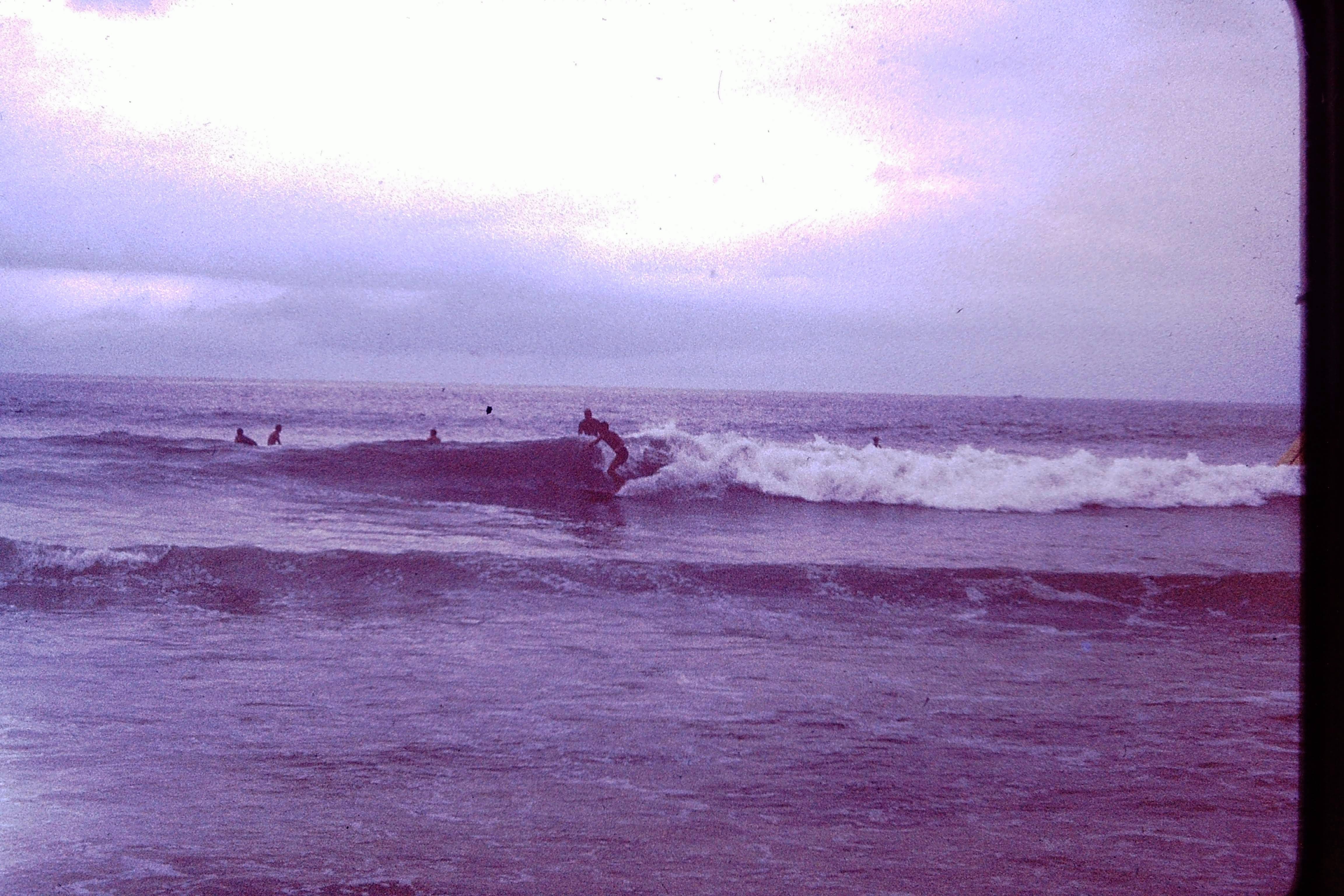
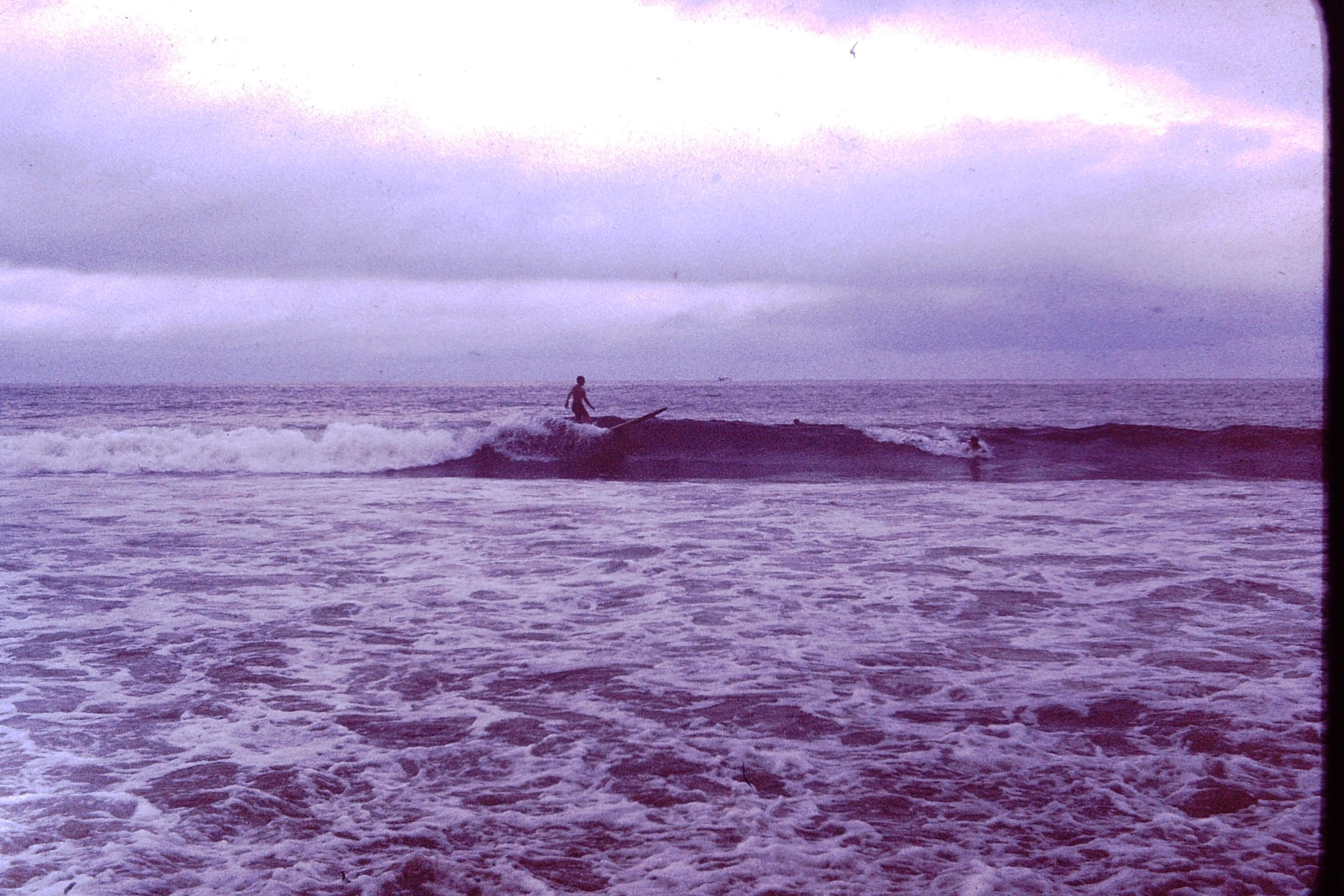
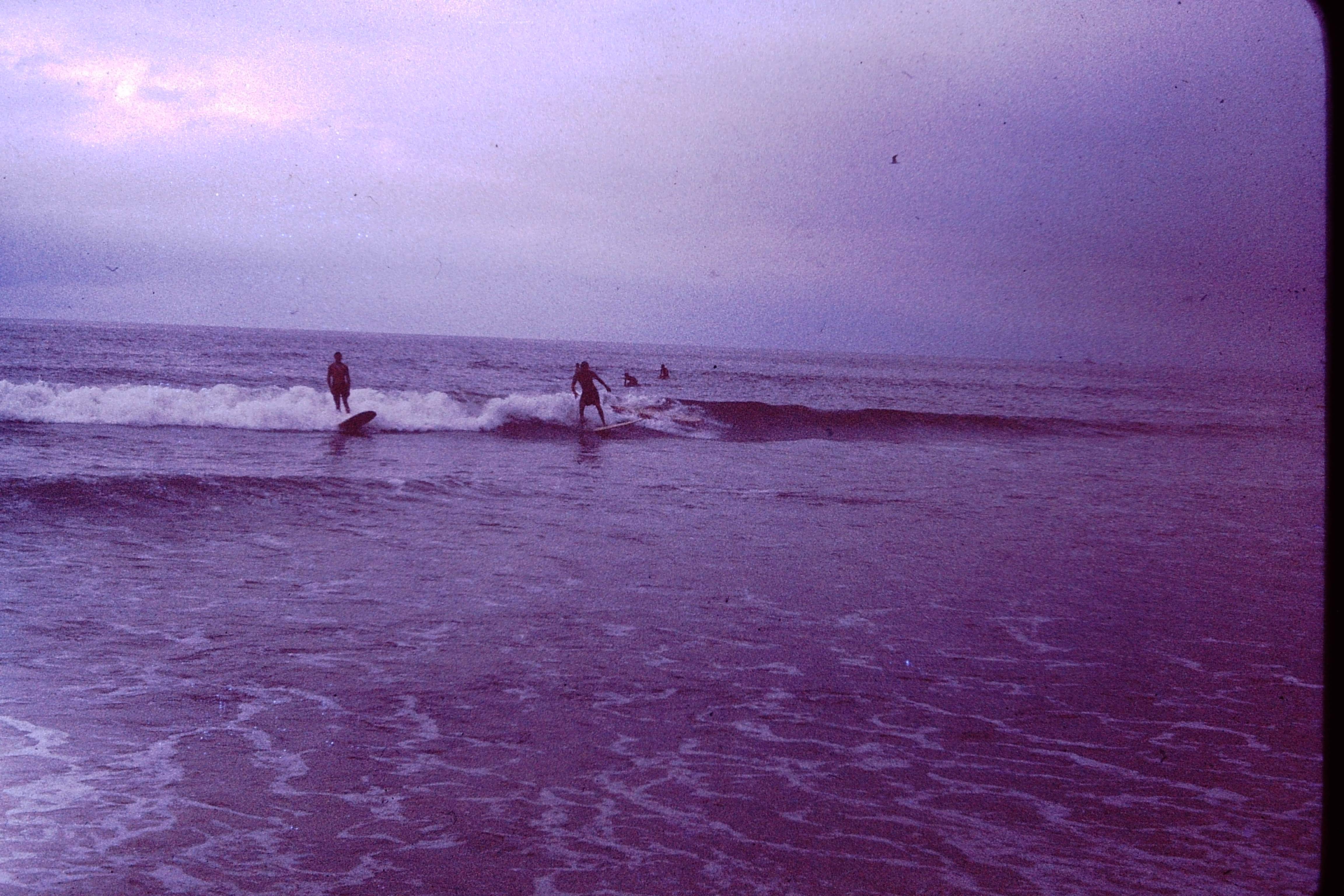
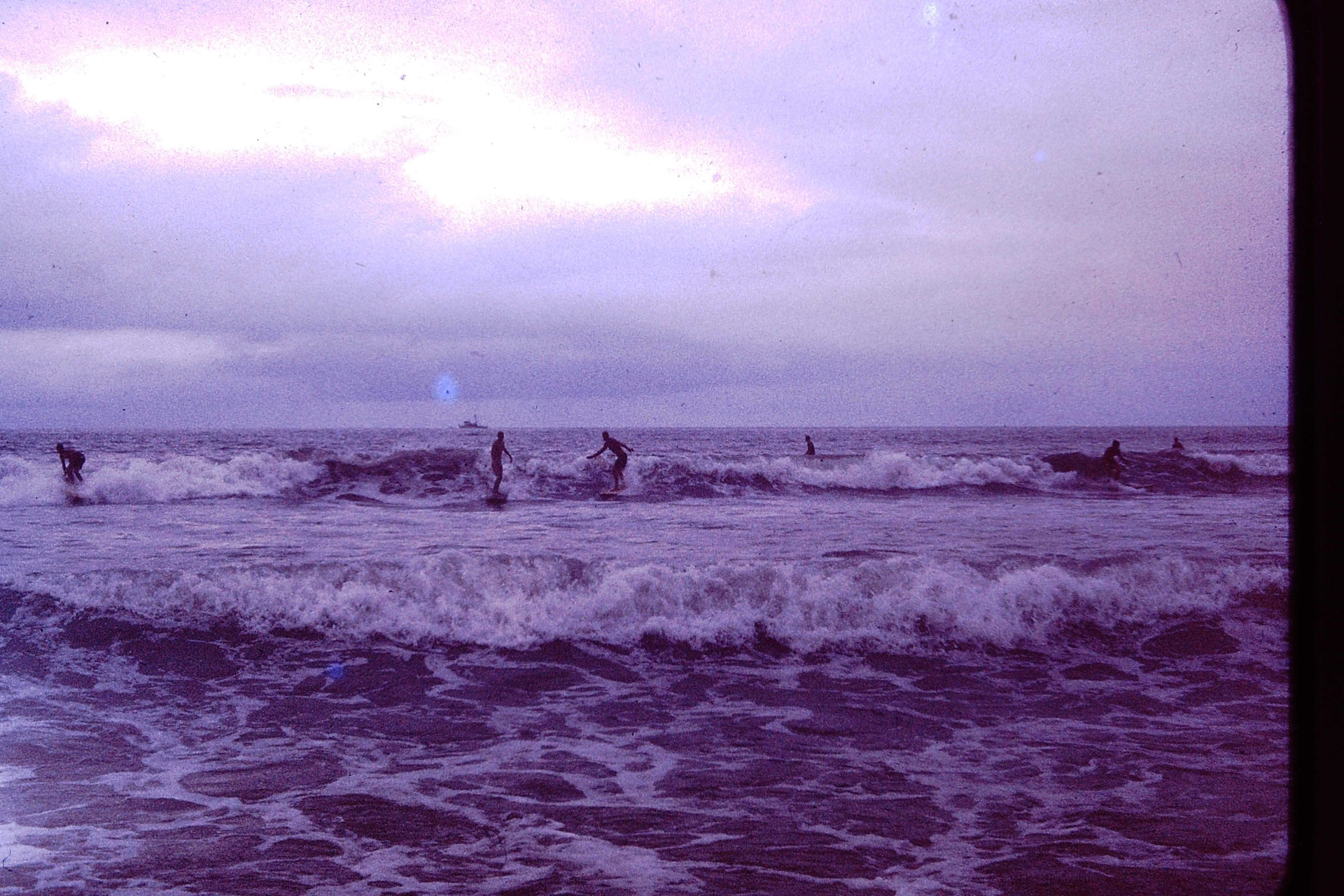
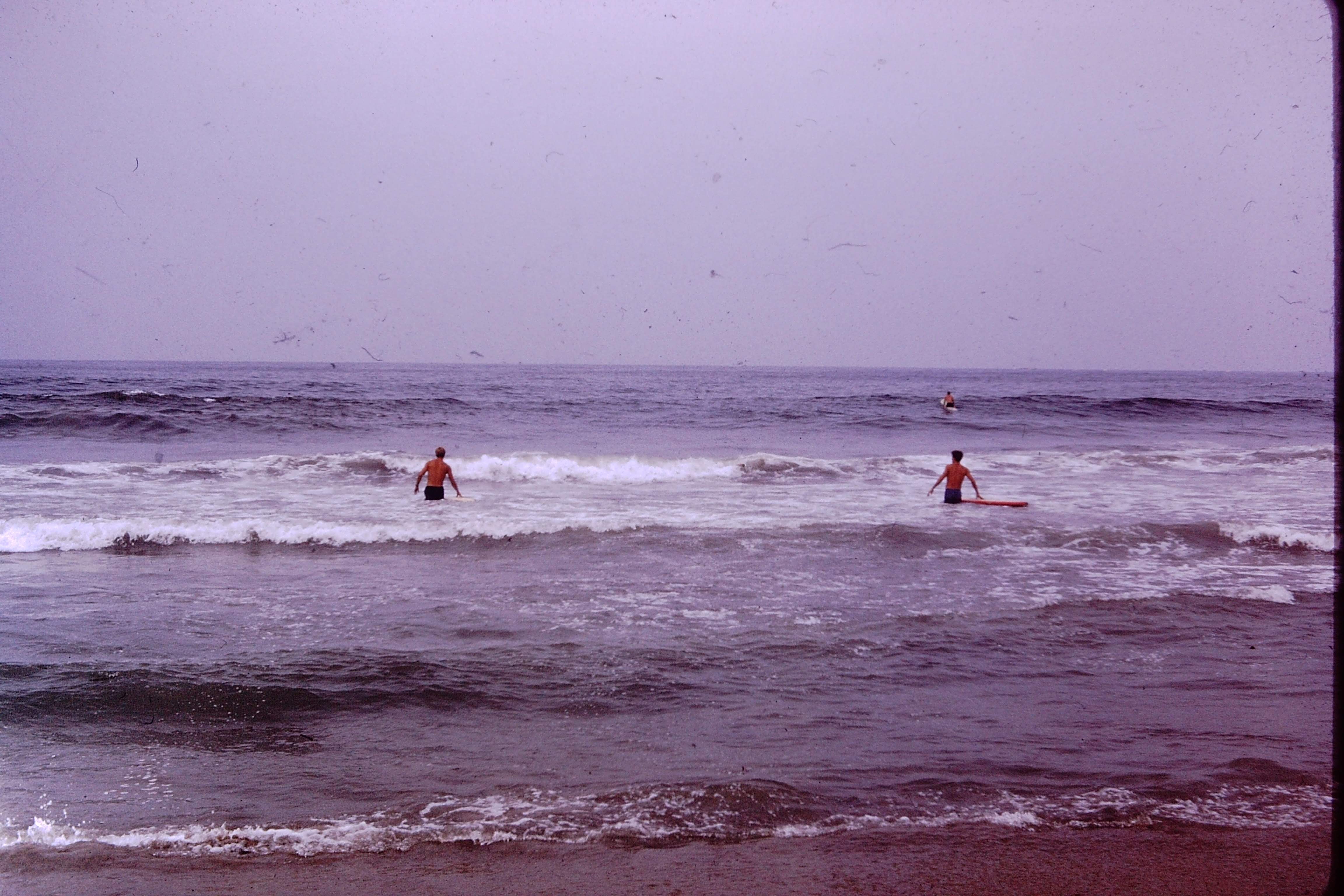
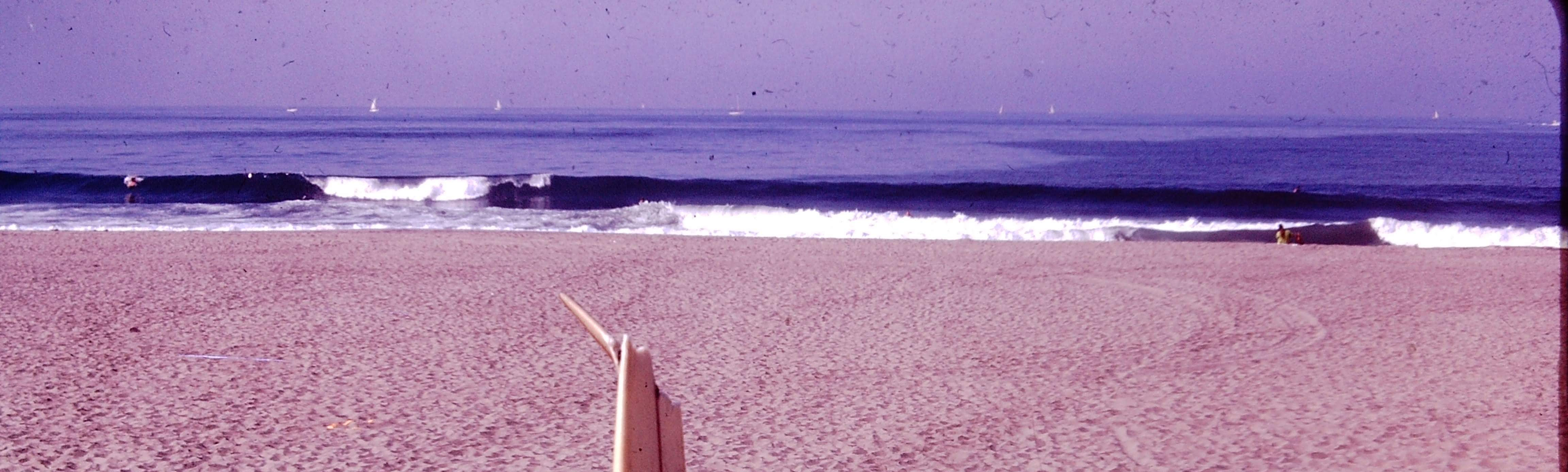
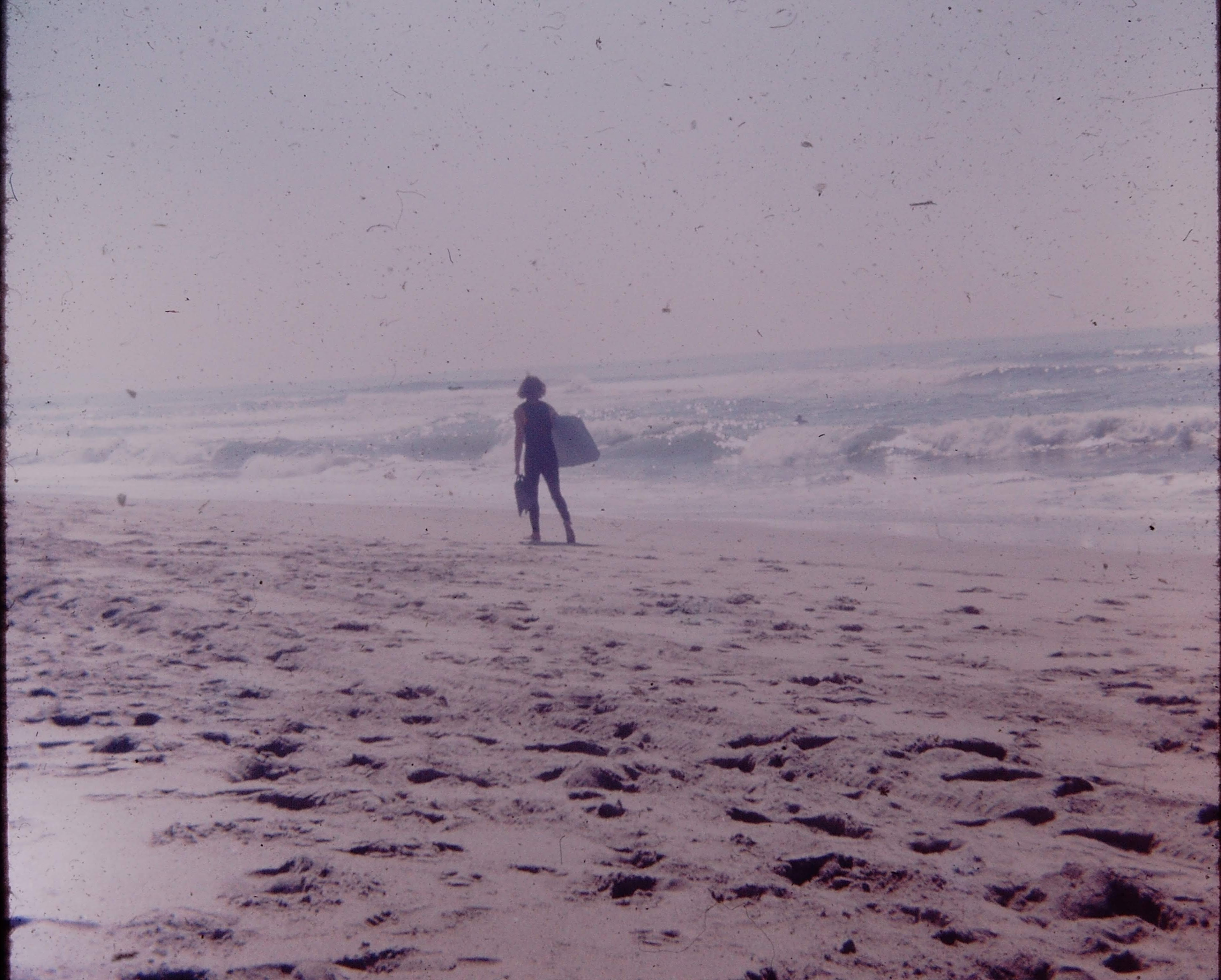
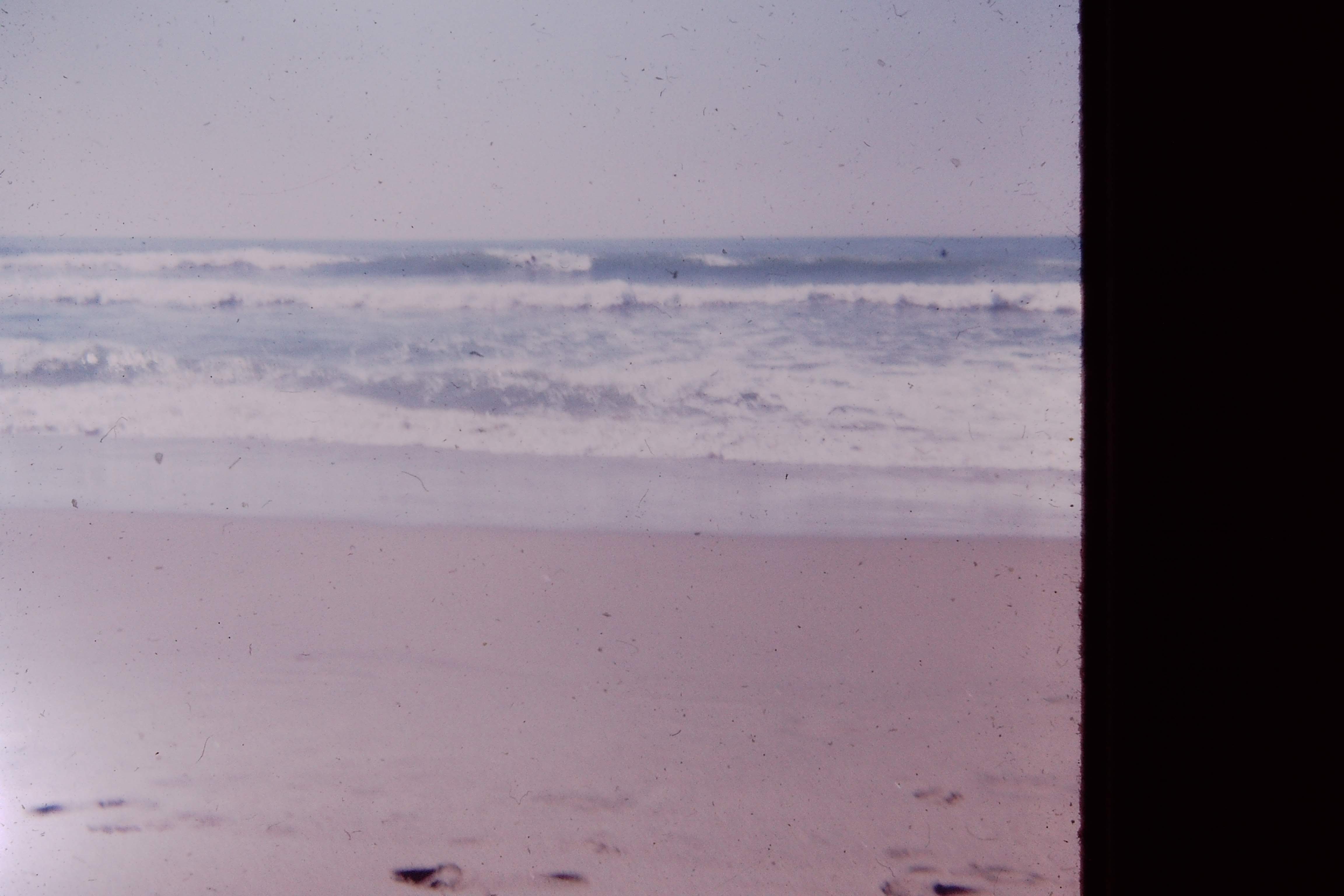
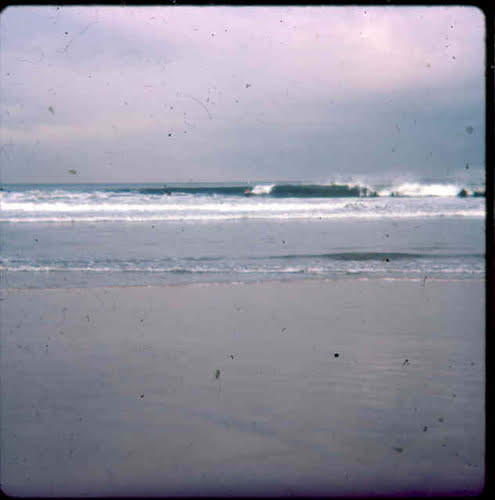
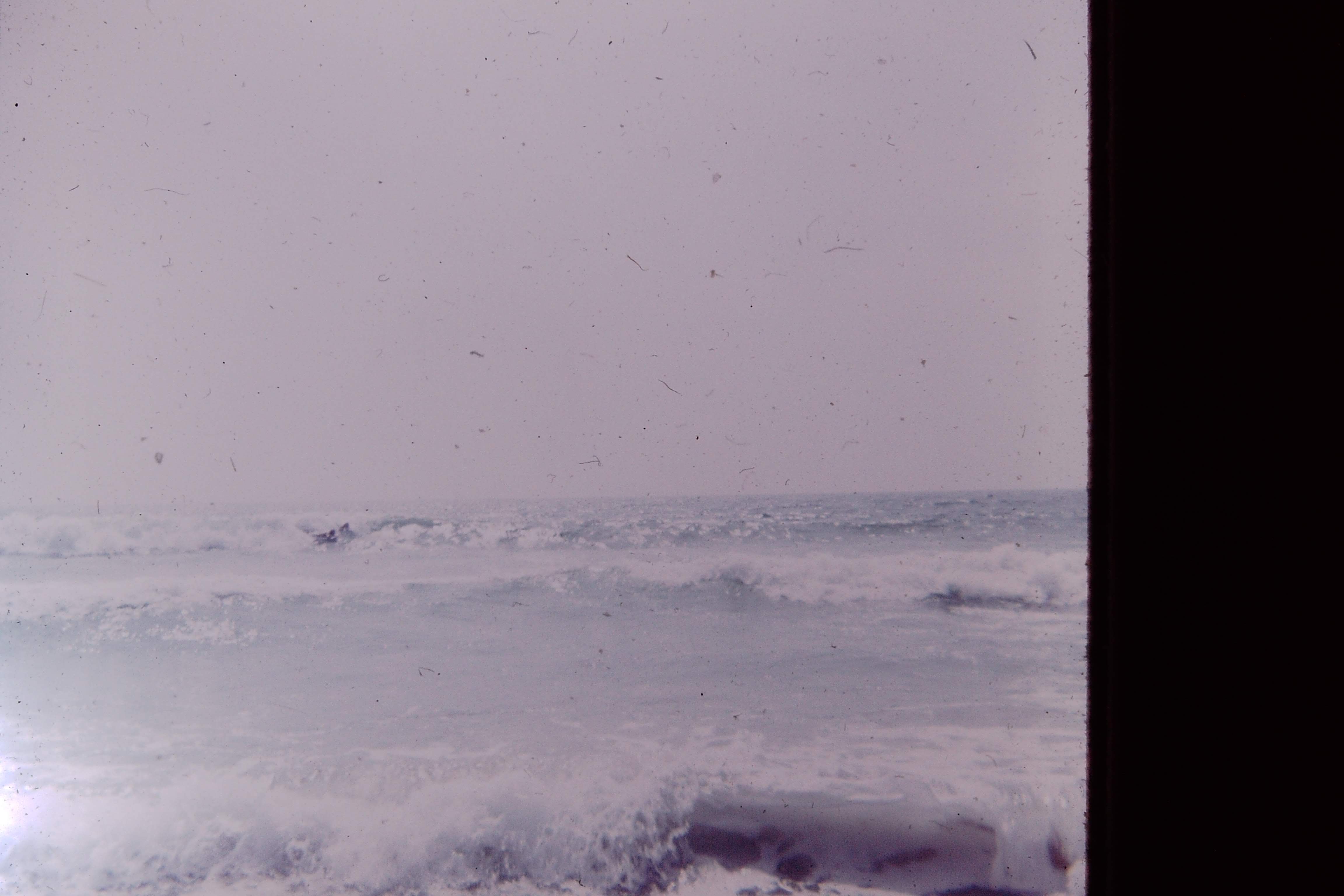
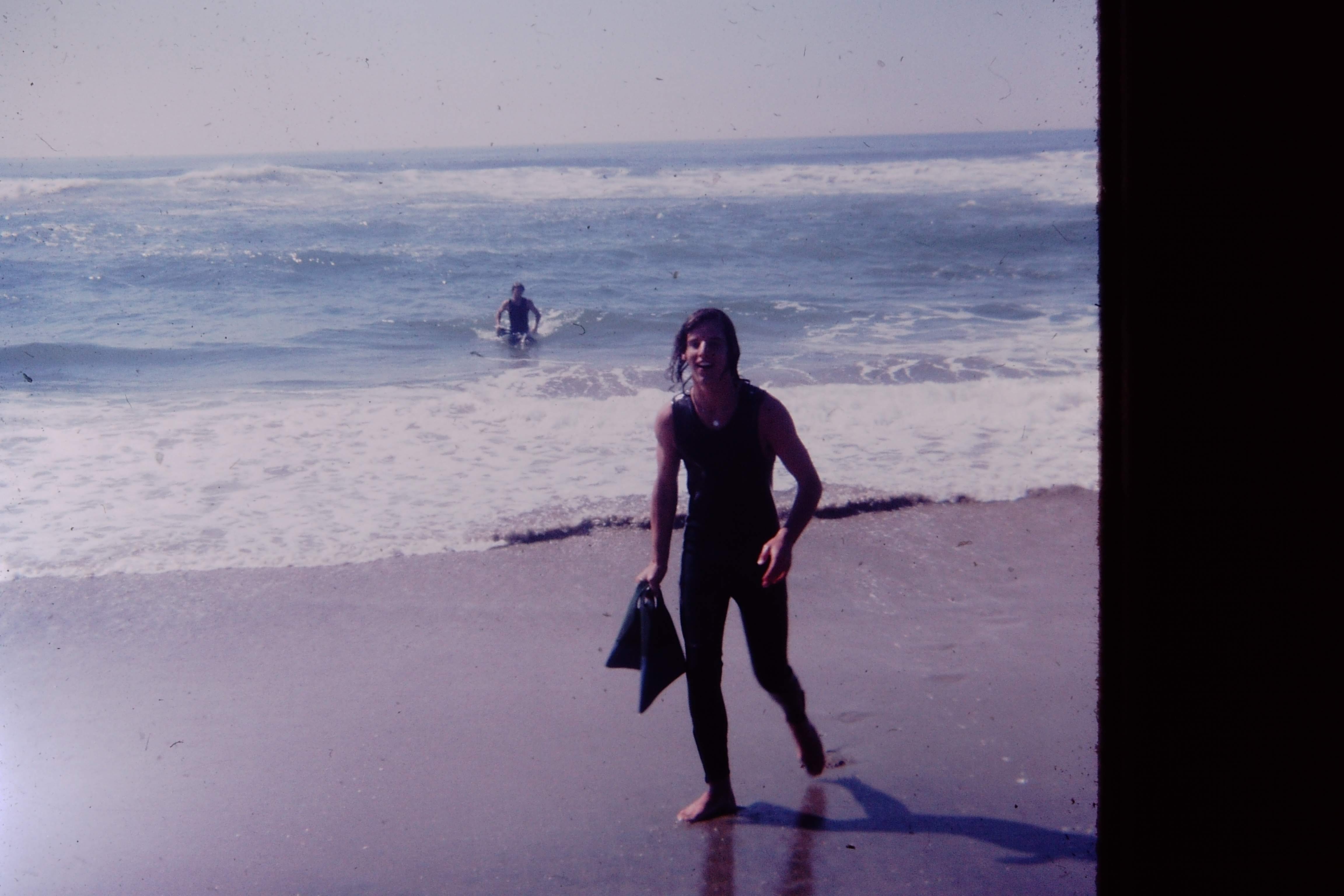
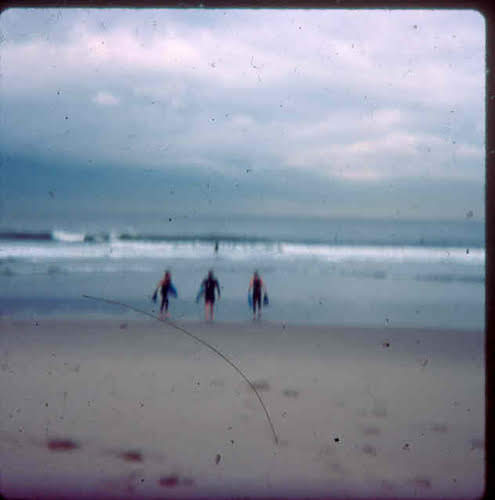
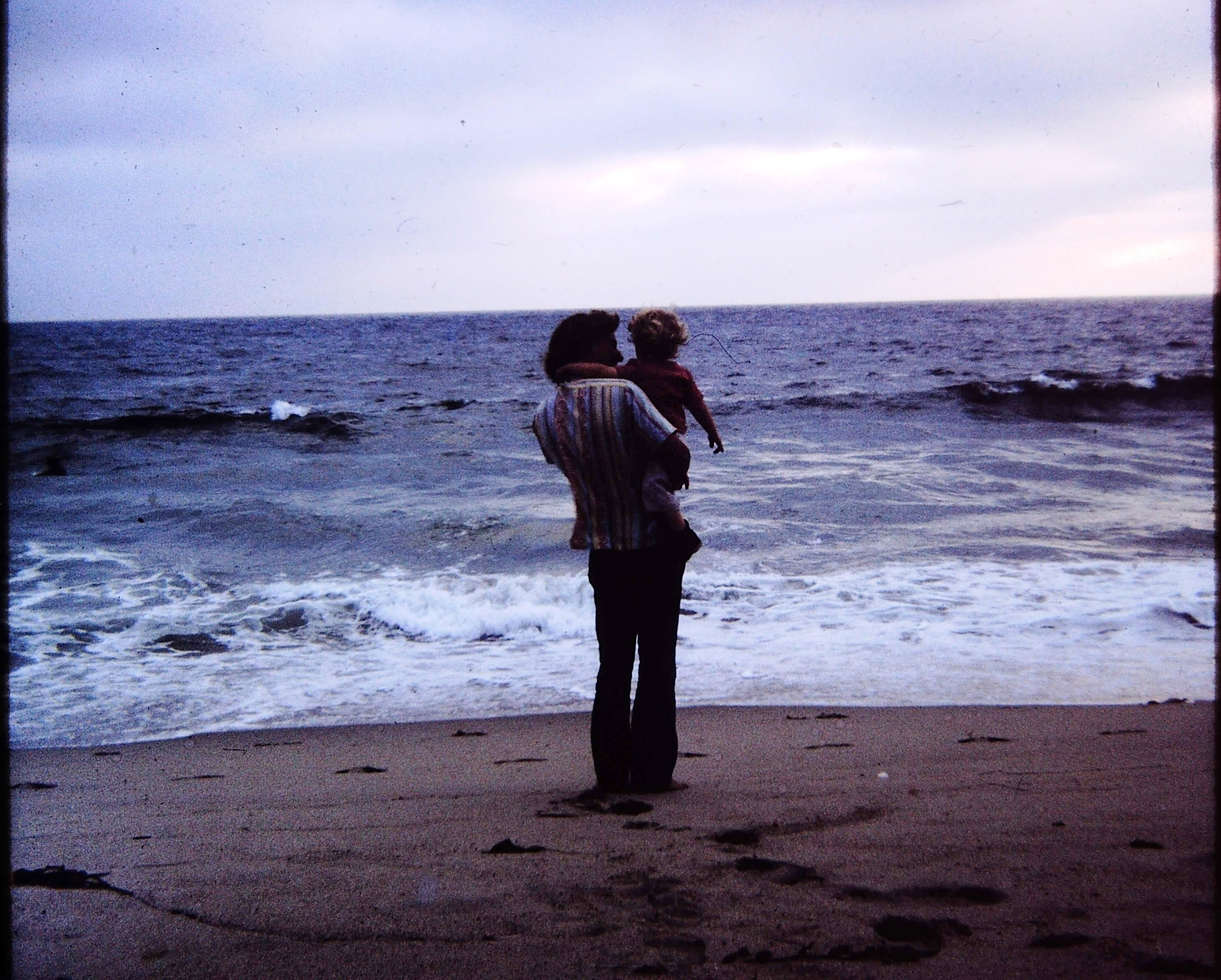
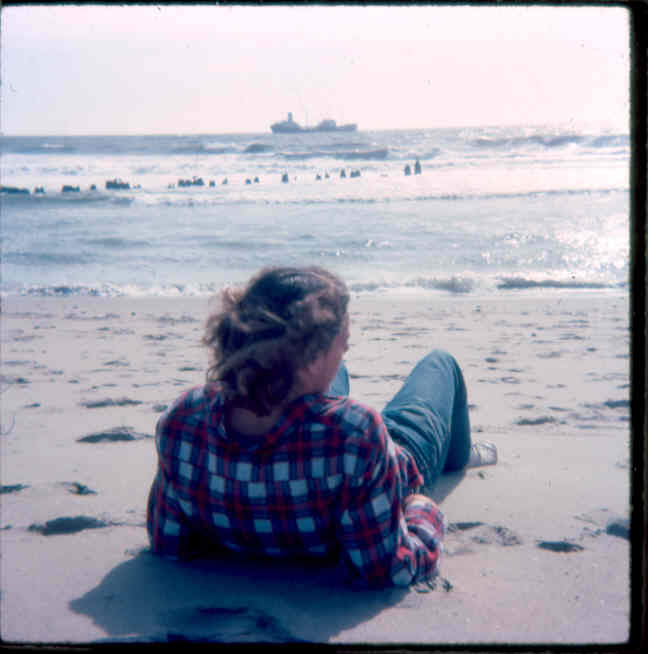
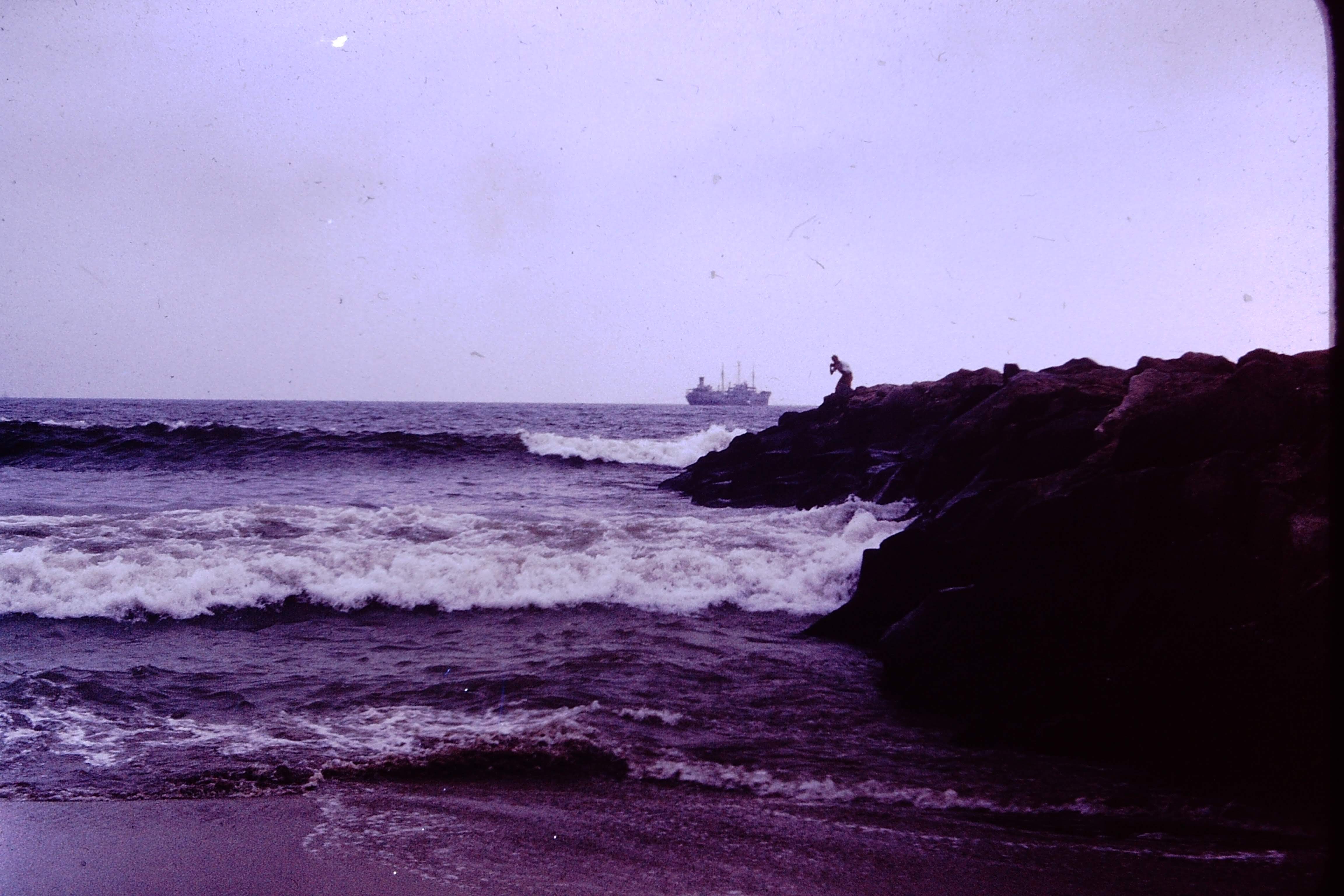
We never tired of going down to the beach, in the mornings to surf, in the afternoons to boogie, in the evenings to walk, to catch the sunset. I bought a used Exakta 500 for surfing photos. The 50mm lens was too small, so I bought a used 120mm portrait lens. After the sun went down we sat out in the backyard and watched a slide show on the side of the garage wall.
Surf films, streaming videos, and photos often depict surf spots as gardens of paradise, perfect waves, friendly sun, and green down to tan-white sand and then the waterline, clean blues and greens. Nothing industrial going on. Very good days are rare though, and we went down to the water anyway, regardless of conditions. And once in the water, it didn’t matter. Every wave was a Top 40 hit song, every photo a classic. The beach break at El Porto was our home spot, over the dunes from the El Segundo Standard Oil Refinery. The photos we took in the 60s and 70s might today look as bad as the waves we rode. AI Assistant wants to touch them up for me, but I prefer seeing the originals, even if those are now becoming as faded as the memory, dye fading and color shifting.
Never mind why, but so you have a notebook, or a blog, what do you write, and when? You begin to ignore other interests and responsibilities. You quickly become preoccupied with the possibilities of writing, and don’t see, or ignore, consequences. In “Forbidden Notebook,”1 Valeria begins to obsess over her writing and her notebook, which for Valeria are one and the same:
“Michele wanted to keep me company and I said, ‘No, thanks, you go ahead, go to bed.’ But it was because, afterward, I intended to write. Now, under everything I do and say, there’s the presence of this notebook. I never would have believed that everything that happens to me in the course of a day would be worth writing down. My life always appeared rather insignificant, without remarkable events, apart from my marriage and the birth of my children. Instead, ever since I happened to start keeping a diary, I seem to have discovered that a word or an intonation can be just as important, or even more, than the facts we’re accustomed to consider important. If we can learn to understand the smallest things that happen every day, then maybe we can learn to truly understand the secret meaning of life” (35).
Valeria writes mostly about what she can see and hear and reactions within reach. It’s 1950, and she’s aware there’s talk of the possibility of a new war. But she stays focused on her household and family, and on her job and friends and acquaintances. I keep reminding myself it’s a novel, not a real notebook. But that effect is part of Alba’s, the author’s, intent.
Reading along, I began to think the unfolding household dramas amounted to a kind of soap opera. But Italian television in the 1950s did not include serial shows like those originating in New York City, fueled and sustained by TV advertising, akin to today’s social media set-up, where the audience easily confuses the real with the make believe. Nevertheless, I looked forward to each new installment-like chapter with a soap opera addiction.
It wasn’t until I finished the book and went back to read the Introduction, followed by a Note from the Translator, that I discovered that “Forbidden Notebook” was indeed first produced as a serial, in an Italian weekly magazine, in real time, from December 1950 through June 1951.
Coming to terms with the smallest things that happen every day can be difficult. We would probably have to let go of the fortunate distractions of the news, the media, radio, and television, reels and reels and reels of distraction – fortunate because without them we are forced to stare at an empty screen:
“If we can learn to understand the smallest things that happen every day, then maybe we can learn to truly understand the secret meaning of life. But I don’t know if it’s a good thing. I’m afraid not” (35).
Having decided its worth as a bad thing, how do you get rid of it? Valeria writes for herself, but in constant fear someone in her family will find her notebook, and, since she’s writing about them, and what’s outside their purview, the intimate details of her family interactions and her work life, her criticisms and disappointments, her thoughts and wishes, resentments and humiliations, her contradictions and doubts, to be discovered would jeopardize her standing as “mamma,” a name so full of assumptions and presuppositions it’s smothering, but to be rid of it is something she both wants and doesn’t want.
“But maybe everything I’ve been thinking I see around me lately isn’t true. Maybe it’s the notebook’s fault. I should destroy it, I will certainly destroy it: I’ve decided” (39).
She continues to debate with herself the value of her notebook, why she continues with it, worrying about it being discovered, where to hide it from her family, what and how to write:
“Sometimes I think I’m wrong to write down everything that happens; fixed in writing, even what is, in essence, not bad seems bad. I was wrong to write about the conversation I had with Mirella when she came home late and, after talking for a long time, we separated not as mother and daughter but as two hostile women. If I hadn’t written it, I would have forgotten about it. We’re always inclined to forget what we’ve said or done in the past, partly in order not to have the tremendous obligation to remain faithful to it. Otherwise, it seems to me, we would all discover that we’re full of mistakes and, above all, contradictions, between what we intended to do and what we have done, between what we would desire to be and what we are content to be” (47).
The writing in “Forbidden Notebook” is epistolary, as if each short chapter is a letter Valeria is writing to you, the reader, her audience, or, more to the point, letters to herself that you, the reader, have discovered. You have found her notebook, and are reading about her fears that someone might find her notebook.
Later in the book, she reads through a collection of old letters Michele wrote to her when he was stationed across the sea, in World War II, and she confides she doesn’t recognize him or herself. But are not the letters a kind of notebook? Maybe, but letters are edited. The letter you write to your mother sounds very different indeed from the letter you write to your wife or mistress, boss or senator, different if written in times of happiness and safety versus times of stress and bombardment. Indeed, you are a different person as your circumstances undergo upheaval or fall to sleep.
“Every time I open this notebook the anxieties I felt when I began to write in it return to mind. I was assailed by regrets that poisoned my day. I was always afraid that the notebook would be discovered, even if at the time it contained nothing that could be considered shameful. But now it’s different. In it I’ve recorded the chronicle of these last days, the way in which I’ve gradually let myself be drawn into acts that I condemn and yet which, like this notebook, I seem unable to do without. Now I’ve got into the habit of lying; the gesture of hiding the notebook is familiar to me, I’ve become very good at finding the time to write; I’ve ended up by getting used to things that, at first, I judged unacceptable” (189).
She considers taking her notebook to the office, and finding time to write and a place to hide it there, but she still fears it being found and her being laughed at and losing prestige.
“It’s strange: our inner life is what counts most for each of us and yet we have to pretend to live it as if we paid no attention to it, with inhuman security. Also, if I took the notebook to the office, I’d find nothing of my own when I came home” (199).
And what if she dies, the notebook’s secrets revealed; but she thinks Mirella, if she finds it, would not read it. She thinks the notebook is the reason her life seems to be changing, her self-image evolving, and the fact she’s hiding something so important from her husband has her feeling she’s living in sin. Is to know one’s self a sin?
“I know that my reactions to the facts I write down in detail lead me to know myself more intimately every day. Maybe there are people who, knowing themselves, are able to improve; but the better I know myself, the more lost I become” (233).
She’s in the middle of her life, in the middle of her family, in the muddle of her thoughts, feeling alienated, even if being alone with her notebook is what she wants:
“It began in wartime, because of the housing crisis. Or maybe because suddenly you could die and things had no importance compared with the lives of human persons, all equal, all threatened. The past no longer served to protect us, and we had no certainty about the future. Everything in me is confused, and I can’t talk about it with my mother or my daughter because neither would understand. They belong to two different worlds: the one that ended with that time, the other that it gave birth to” (247).
She remembers a reason why she wanted the notebook to begin with:
“I hoped that in it I would be able to fulfill without guilt my secret desire to still be Valeria” (252).
In the end, Valeria’s notebook is out of place. What she imagined her family would think of her writing is probably right. She’s wasting her time and writing is causing herself grief and gaining her nothing. There are those who should not write, even if they can, even if they happen to be good at it, but what is good is also of course debatable. Her husband has written a screenplay, ironically his secret from Valeria. He reveals it when Valeria meets up with her old friend, Clara, now a filmmaker, and Clara agrees to look at Michele’s screenplay, but later she tells Valeria it’s not going to work out:
“He’d like to change his life, leave the bank to devote himself to the movies. But you have to persuade him not to, Valeria….They wouldn’t have any faith in a man like Michele, who has spent all his life in a bank. They’d always judge him a dilettante; and in fact he would be, it couldn’t be otherwise” (196).
Clara claims the script is too risque for producers to risk, but that might be hard for some readers to accept as true given the history of Italian cinema. In any case, we don’t get any of the script in Valeria’s notebook because she hasn’t read it, but we do get snatches in passing from her talks with Clara so we have some idea, but it remains vague, while Valeria’s concerns are modeled on the conservative, class, and religious values she has come of age in, even if her behavior flirts at times with betrayal of those values. When a rule is violated, is the offender blamed or the order behind the rule?
If there are writers of secret notebooks today, of course we don’t know them. We assume they are there, working away, learning about themselves, maybe with productive results, maybe not, but either way, filling notebooks then throwing them out with the trash, or, maybe worse, saving them – for what? And of those who for various reasons try to share their writing, we find many forms of occasions of writing, of simple to outlandish claims with and without backing, full of personal details or no mention or sign of the author whatsoever, an anonymous blogger. But readers seldom have the same picture of the writers the writers have of themselves. Like flowers, some writing is perennial, some annual; some take root and in a friendly environment thrive, some wilt. Or writing is not a flower at all, more like a weed, an invasive, non-native weed, growing prolifically out of a crack in a street.
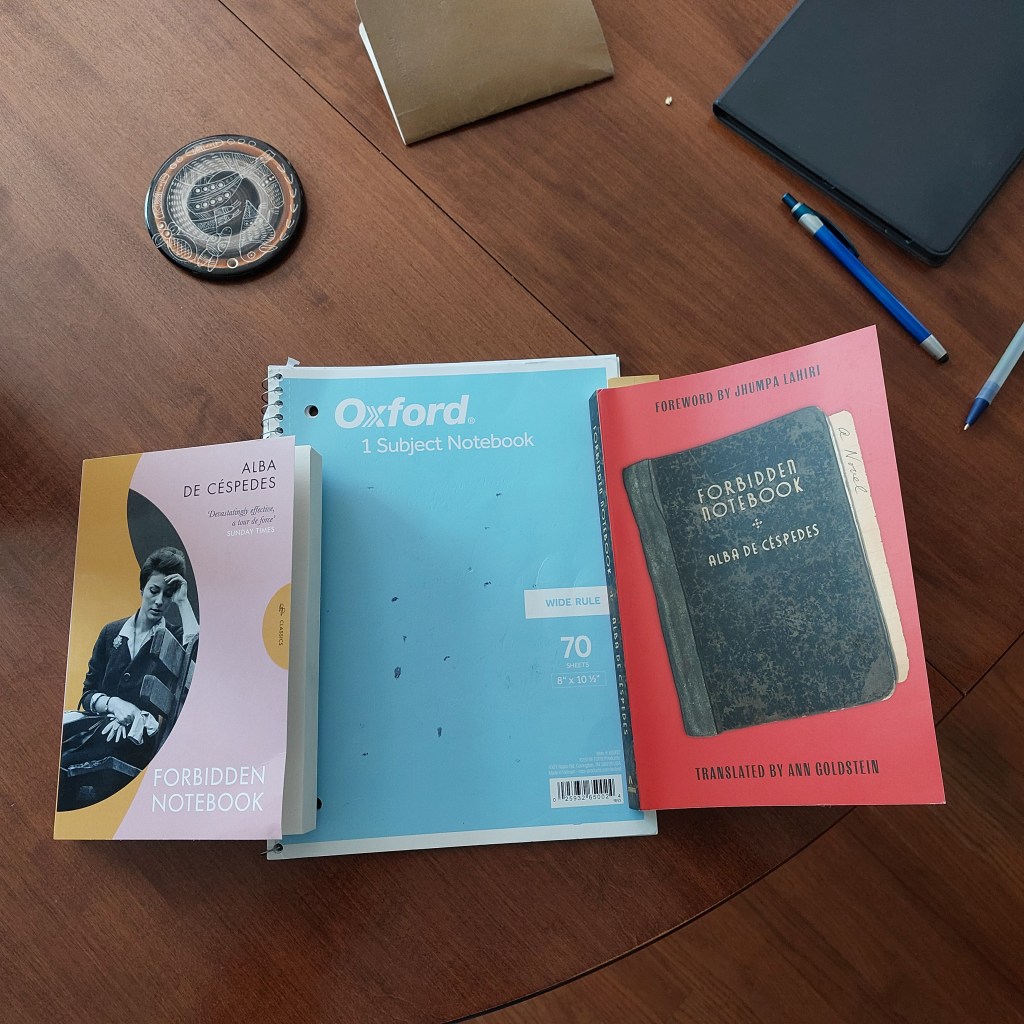
“Forbidden Notebook,” by Alba De Cespedes. Originally published in book form in Italian as Quaderno Proibito in 1952 by Mondadori. I read the first paperback edition 2024 from Astra House, Translation by Ann Goldstein and Forward by Jhumpa Lahiri. ↩︎
I wonder why some bloggers blog anonymously. Maybe the answer can be found in a novel I just started reading, titled “Forbidden Notebook,”1 that starts with a diary entry of November 26, 1950, the first person narrator, Valeria Cossati, explaining her illegal purchase of a notebook:
“I saw that the tobacconist had assumed a severe expression to tell me: ‘I can’t. It’s forbidden.’ He explained that an officer stood guard at the door, every Sunday, to make sure that he sold tobacco only, nothing else. I was alone now in the shop. ‘I need it,’ I said, ‘I absolutely need it.’ I was speaking in a whisper, agitated, ready to insist, plead. So he looked around, then quickly grabbed a notebook and handed it to me across the counter, saying: ‘Hide it under your coat’” (10).
Having obtained the notebook, Valeria must now find a place to keep it hidden in her apartment, secret from her husband, Michele, and her two children, Mirella and Ricardo. And she conspires with her would-be writing self to find time when the others won’t notice to write in her notebook:
“For more than two weeks I’ve kept the notebook hidden without being able to write in it. Since the first day, I’ve been constantly moving it around – I’ve had a hard time finding a hiding place where it wouldn’t be immediately discovered. If the children found it, Ricardo would have appropriated it for taking notes at the University or Mirella for the diary she keeps locked in her drawer. I could have defended it, but I would have had to explain it” (11).
Her anxiety builds, and she finally starts to write, but says,
“I have to confess – I haven’t had a moment’s peace since I got this notebook” (11).
Yet she looks forward to finding the opportunity to write, writing that no one will read but herself:
“I always used to be a little sad when the children went out, but now I wish they’d go so I’d be left alone to write” (11).
Then of course the metatheme makes itself obvious:
“The strangest thing is that when I can finally take the notebook out of its hiding place, sit down, and begin to write, I find I have nothing to say except to report on the daily struggle I endure to hide it” (12).
She asks for a drawer, one she can lock. “For what?” her husband asks. “I answered, “some notes. Or maybe a diary, like Mirella” (15).
“They all, including Michele, began laughing at the idea that I might keep a diary. ‘What would you write, mamma?’ said Michele.”
They more than laugh; they make fun of her, until, “Suddenly, I burst into tears” (16).
Michele suggests a cognac to settle her down, but she refuses, because,
“Embarrassed, I looked away. In the pantry, next to the cognac bottle, in an old biscuit tin, I had hidden the notebook” (17).
I first started my blog, The Coming of the Toads, back in 2007. I had been reading and following – dare I say, studying – a few blogs, and had even tried my hand at a few comments when I decided to deal myself in (solitaire though the game was). After a few posts, I deleted everything, then almost as soon randomly reinstated it. Of course I had no readers, no “followers,” to begin with, so no worries, but I tried to take the writing seriously nevertheless, which is to say with literary decorum, as oxymoronic as that might sound to some readers, but one is never alone, after all, and must address the possibility against the assumption no one will read it that someone might read it. But either way, so what? Such irony might immediately call for self-deprecation, which might be a way of keeping one’s intentions, one’s writing, hidden, self-prohibited.
“Forbidden Notebook,” by Alba De Cespedes. Originally published in Italian as Quaderno Proibito in 1952 by Mondadori. At first, it seemed hard to find. I tried Alibris and Amazon, and I now somehow have two: a first paperback edition, 2024, Astra House, and a Pushkin Press edition, also 2024, both Translation by Ann Goldstein and Forward by Jhumpa Lahiri. ↩︎
More rain. More “Traveling Sprinkler.” Paul Chowder hasn’t been playing his new guitar much, though. Instead, the former bassoonist has found an interest in electronic music, and he’s bent on creating jingles and jangles and hums and beats and calls it dance music.
“I worked for several hours today on a new song called ‘Honk for Assistance.’ I saw the sign at a convenience store, near the ice machine, and I thought, Now that is a dance song, in the tradition of Midnight Star. I sampled a few honks from my Kia’s horn and set up a beat and fingered up some harmony using an instrument I hadn’t tried before, the Gospel Organ, which has a slightly percussive sound in the attack phase of each note. I added more chords on a Mark II keyboard and some homegrown handclaps and some rhymes made with the Funk Boogie Kit” (190).
Where is music, today? Where was it in Claude Debussy’s day? I’m listening now, suggested by Paul Chowder, our narrator of “Traveling Sprinkler,” to Debussy’s “Preludes,” via YouTube Music on my Chromebook. I don’t have my hearing aids in, and the Chromebook speaker is not exactly a Marshall Super Lead 100 Watt amplifier stacked with two humongous speaker cabinets towering overhead, so maybe I can’t really say I’m listening to Debussy’s “Preludes,” anymore than I can say I’m in the kitchen nook typing while getting wet from the drizzle outside.
Around page 128, Paul spends ample time discussing the benefits of stereo versus mono. What he does not mention is asymmetrical hearing loss, a condition where you hear less volume in one ear than the other. You’re sometimes unsure which direction a sound is coming from, and it can make you a bit paranoid as you navigate your way around town. You have to be extra careful crossing the street, particularly if there are electric vehicles in the neighborhood. And bicyclists and joggers coming up behind you and passing full of assumptions and presuppositions about their position startle the shite out of you.
“I put the headphones on, and I lowered the needle on Zubin Mehta conducting The Rite of Spring, and suddenly I was there, enclosed in the oxygenated spatial spread of stereophonic sound. I was there with the panicked piccolo, and the bass clarinet was a few feet away, and the timpani surged over to the left, mallets going so fast you couldn’t see them. I couldn’t believe how big a world it was – how much bigger and better stereo was than mono….You need two ears” (129).
Or three, or four. One day, back home, I rode my bike down the Strand to Mike Mahon’s place in Hermosa, carrying with me Archie Shepp’s “Fire Music,” on the Impulse label, from 1965, still new and noisy around the early 70s. Mike was a classically trained pianist, although like Paul Chowder, had decided he wasn’t good enough to make a career of it, and went back to school for a PhD in English Literature, specializing in Yeats and Joyce and company, but still Mike was an audiophile, and had the latest equipment. He took my album and ran it through an electronic vinyl record cleaning machine he had, then we listened to some of it on his impressive and expressive and expensive sound system. Then he pulled from his album collection a copy of Stravinsky’s “The Firebird,” and we listened to the “Infernal Dance” piece. Talk about “attack phase.”
I played a bit of “The Firebird” just now, switching off the Debussy. I’m immediately reminded of Poe’s “The Bells”:
Hear the loud alarum bells— Brazen bells! What tale of terror, now, their turbulency tells! In the startled ear of night How they scream out their affright! Too much horrified to speak, They can only shriek, shriek, Out of tune, In a clamorous appealing to the mercy of the fire, In a mad expostulation with the deaf and frantic fire, Leaping higher, higher, higher, With a desperate desire, And a resolute endeavor Now—now to sit or never, By the side of the pale-faced moon.
I can only handle a minute or two of “The Firebird” this morning (or Poe) before switching over to Segovia playing Bach on his acoustic guitar, from Andrés Segovia: Bach – Gavotte from 4th Lute Suite for guitar, Allegro Films.
In butterfly mode, Paul Chowder continues, in “Traveling Sprinkler,” from acoustic guitar to electro sounds to his girlfriend Roz and his neighbor Nan, parking his car here and there to get some writing done, in other words, in and out and back in again, listening to every day sounds and how they wrap around the cans and cannots of one’s thoughts. But Chowder keeps mentioning songs and music I’ve never heard of. Where have I been? And I asked myself again when and how and why it was I got Nicholson Baker’s “U & I,” and “Traveling Sprinkler” to begin with. So I looked them up. I thought I had purchased (and said in a previous post) “Traveling Sprinkler” used from Alibris. Not so. I purchased it new from Amazon in June of 2023 (though it was not sold by Amazon – a bit confusing all of that, how Amazon works sometimes). And just now, about two years later, I’m getting around to reading it, “Traveling Sprinkler” (though I had given it a try a couple of times before), while “U & I,” I got used on Alibris in February of 2019, also giving it a couple of tries, but unable to fall into it, yet.
Anyway, it’s all old stuff, the books, the references, the music, not to mention the many political digressions, arguments with backing but often rants of a sort, Paul Chowder takes off on. He’s a pacificist, who, as I mentioned, attends meetings, though he’s not a full member, but which is why I thought the acoustic guitar was a good fit, him being a pacificist. But it depends on how you hear sounds. Last night late (after watching the Dodgers beat the Athletics in a record-breaking score of 19 to 2) before bed I played through a few of the Leo Brouwer “Etudes Simples” pieces, as I do almost every night, on my 1977 acoustic Takamine C132S. Number 1 is not all that pacific sounding, but Number 2 is lovely, particularly setting the tone for sleep.
The political arguments, by the way, though now aged, just over a decade away, are effective today, without stirring up too much dust. I’m increasingly finding I’d rather listen to decade old or older music too. Timeless music. Anyway, thinking back to that business about stereo and mono, I’m reminded of the Jimi Hendrix album “Axis: Bold as Love.” The first piece, titled, “Exp,” is an amazing example of stereo at play. It’s very short: 1:56. You can give it a listen here.
Rain. Inside still reading “Traveling Sprinkler” while outside rain falls, sprinkles, showers. Yesterday briefly it rained hard, but mostly (and the forecast is now calling for ten more days of this) a light, light to moderate rain, periods of partial clouds amid dashes of partial sun. But it’s beautiful, the multi-blue-grey cruisers and destroyers, heavy-hefty frigates idling by, littoral patrol boats, submarines up in the sky. Loose Cs strolling by. Anyway, I reached page 160 in Nicholson Baker’s “Traveling Sprinkler,” beginning the day at page 92, so close to 70 pages for the rainy day. When I left you yesterday, I might have sounded a bit worked up about his getting the Best Buy guitar. And later, I even looked it up, and sure enough, there it was, for $40, at Best Buy, a Gibson acoustic, but out of stock.
Back at the first paragraph of Chapter Four, Paul Chowder, the first person narrator of “Traveling Sprinkler,” opens with:
“I’m out in the garden, Maud, and the very fine clouds have, without my noticing, moved across the moon and collected around it like the soft gray dust in the dryer. I want to scoop the gray clouds away and see the moon naked like a white hole in the sky again, but it isn’t going to happen” (29).
Why does he call it dust, the dryer lint? Because dust sounds better than lint coming just before dryer, and the st gives off the flavor of the stuff.
I took numerous breaks from “Traveling Sprinker” yesterday, one to play The New York Times “Spelling Bee” game with Susan. We’ve been playing it together nearly every day. We sit next to one another on the love seat and prop my tablet against a pillow between us and use our stylus pens to enter words, making mistakes as we go, talking about the words. Coco, for example, which we’ve seen before, not acceptable (“not in word list”), not to be confused with cacao or cocoa, both acceptable. Sometimes the rules seem a bit illogical. Yesterday, the middle letter was O, and the other six letters were G, L, A, I, C, and Z, the other letters arranged in a circle around the O, and I saw emerging like a photograph being developed, zoological, and so we started with the day’s only pangram.
But we ended up getting stuck a few words away from a Queen Bee finish, found a couple more, but then couldn’t find our last word, a 6 letter GO word. We took a break to stretch and cut an apple into slices and came back to the couch lightheartedly determined to reach Queen Bee for the day, only one word away. In 179 Spelling Bee game-puzzles, we’ve reached Queen Bee only 19 times. I decided to ask AI (Artificial Intelligence) for some help, explaining to Susan the difference between cheating and getting some help. I asked Gemini, and this is the answer I got:
“Let’s see… using only the letters G, O, L, Z, A, I, and C, and starting with GO, a six-letter word we can make is GOLGI.”
Do you see the problem with that answer? So much for getting some help.
I was reminded of a recent post over at Ashen’s blog, “Course of Mirrors.” The post is titled …Thoughts on AI and ChatGPT …, and in it, Ashen creatively questions the implications of Artificial Intelligence. She quotes a 70s poem by Wislawa Szymborska – here are a couple of lines: “The Tree of Understanding, dazzling straight and simple,/ sprouts by the spring called Now I Get It.” And I am reminded of the Richard Brautigan poem, “All Watched Over by Machines of Loving Grace.” Machines, who, like all parents, it would seem to be developing, make mistakes.
I woke up this morning thinking of rain and W. Somerset Maugham’s short story titled “Rain.” The story is about restraint and strain and torrential tropical rain. But what I was thinking about was what we mean when we say, “It’s raining.” What’s the it? I wasn’t fully awake yet when I thought later I’d ask Gemini to explain. I just now asked, and here is Gemini’s answer:
“Ah, that’s a fun little linguistic puzzle! The “it” in the sentence “It is raining” is what we call a dummy pronoun or an expletive pronoun.
Think of it this way: the “it” doesn’t actually refer to any specific thing. It’s a grammatical placeholder that we use because English sentence structure generally requires a subject. In this case, there isn’t a real subject doing the raining. Rain is a weather phenomenon, not an action performed by a particular entity.
So, the “it” is just there to make the sentence grammatically correct. We use similar dummy pronouns in other impersonal constructions, like:
“It is cold outside.”
“It seems like a good idea.”
“It‘s important to be on time.”
In these sentences, the “it” doesn’t point to anything concrete; it simply fills the subject slot.
Isn’t language fascinating? We have these little grammatical tools that help our sentences flow even when there isn’t a literal subject performing an action.”
Not a bad answer. I wasn’t expecting that bit of editorializing at the end. And now I’m thinking back to the short story “Rain”:
“If he remonstrated or sought to put his meaning into an intelligible phrase, Walker would fly into a passion and cry: ‘What the hell do I care about grammar? That’s what I want to say and that’s how I want to say it.’”
But back to yesterday. While I was chatting it up on my phone with Gemini, Susan said, “Look at the [tablet] screen.” And there it was, the page that appears when you’ve reached Queen Bee! Susan had come up with the missing word: Googol.
Eugenio Montale, who won the Nobel Prize for Literature in 1975 (for his poetry), would have made a great blogger. In 1946, he started writing for a newspaper, a form ill-suited to his poetic writing style, and for his articles created a new form, based on the characteristics of the personal essay:
“To write about those silly and trivial things which are at the same time important” (Montale, quoted in Introduction, p. x)1.
And since the blogger doesn’t write for today’s formal critic (who eschews the amateur writer), or for the reader of tomorrow (who delights in the undiscovered), but for today’s casual scroller (who has no patience for the esoteric), Montale could knock out his pieces on demand:
“I write the articles in two hours, with no trouble,”
(Sounds about right, given this blogger’s experience; what flows easily for one writer may trouble another, but either way, one should still carefully select from one’s personal Library of Babel)
“but when I’m out of ideas (and it happens often) I feel lost” (xi).
How could you ever run out of ideas when your subject is everyday life? To write, maybe it’s best to first be lost.
“If I was not a born storyteller, so much the better, if the space at my disposal was limited, better still. This forced me to write in great haste. To cater for the taste of the general public, which is little accustomed to the allusive and succinct technique of the petit poeme en prose, created no problem” (x).
And what are those characteristics of the personal essay one might find in Montale’s “sketches”?
“…humor, irony, self-irony, and a ready supply of nostalgia, across fictional vignettes, memoir, literary and cultural opinion, travel writing, and music criticism” (xi – Galassi, Introduction).
The sketch form (which is neither news nor opinion), to get it right, must be written askance or on a slant less it become straightforward autobiography, which by definition most will find boring, for readers must be able to find themselves in the writing, even if the picture they find might not be particularly flattering.
To give some idea of the length of the sketches, Montale’s newspaper pieces, there are 195 pages of them in the NYRB book I’m quoting from, which is divided into four parts that total 50 pieces, so an average 4 pages in length. The longest are 7 pages, of which there are only 2, and the shortest are 2 pages, of which there are 7.
The titles of the “Butterfly of Dinard” pieces don’t always give much of a clue as to the topic. Take for example, “Success,” which turns out to be a music experience piece which includes a consideration of “claqueurs,” who were a kind of precursor to the canned laughter of television sitcoms, and the piece turns out to be not about success at all but about its opposite, failure; fair enough, since the early sitcoms and soap operas, one might theorize, did borrow from the classical melodramas, and in terms of art consideration, fit the bill. Of course the soaps lived without laughter of any kind, unless the audience had cried itself silly.
I’ve often thought John Cage, Marshall McLuhan, and Buckminster Fuller each would have made efficient and excellent bloggers. I was reminded of Cage when reading Montale’s “Success” piece. Montale is recruited by his barber (and vocalist who would then become Montale’s bel canto teacher) to join “his team of claquers” for a night to applaud a musician, Jose Rebillo, who could not “read notes but nonetheless he composed music for the pianola by cutting and punching holes in cardboard rolls with scissors and awls.” (There are 73 “Translator’s Notes”: #26 explains that Rebillo is based on the real composer Alfredo Berisso). Of course Cage could read notes, but still, the method described evokes Cage. And not only the method; Montale says, “Music such as that of Signor Rebillo, all dissonance and screeching, had never been heard before” (50).
Other titles include “The Bat,” about a couple in a hotel room invaded by a bat. The woman freaks out while the man must find a way to evict the bat. And “Poetry Does Not Exist,” about a visit Montale receives from a German Sergeant during the war-winter of ’44, a would-be poet himself and a fan of Montale’s poetry. During the visit, Montale is hiding two compatriots in an adjoining room. And the title piece, “Butterfly of Dinard,” which may or may not have been real.
The four sections of the book align somewhat with Montale’s chronological history, explained in the Introduction, which itself includes 8 footnotes. Each piece is a self-contained reading experience that points in two directions, one outward, the other inward, and the reader may take either path. In the title and end piece, “Butterfly of Dinard,” the narrator tells of a cafe and a waitress, who may or may not be the butterfly of the piece, which is only about 500 words long, a single page. Was the butterfly real or a figment of the imagination is the unanswerable question.
Butterfly of Dinard, by Eugenio Montale, Translated from Italian by Marla Moffa and Oonagh Stransky, Introduction by Jonathan Galassi, New York Review Books, 2024, Originally published in Italian as Farfalla di Dinard, 1960. ↩︎
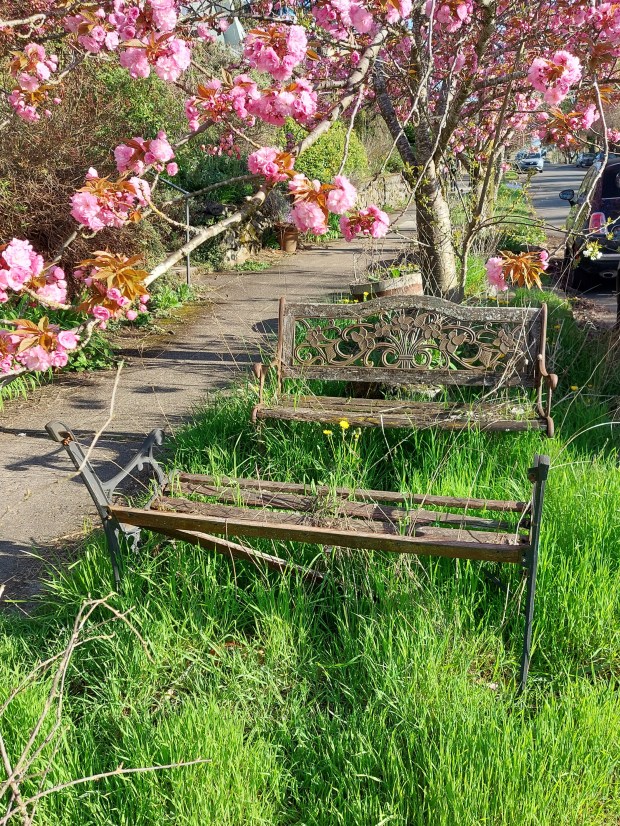
Winter passes when the cherry trees blossom. Passersby frequently pause to view the blooms from various angles and take photos with their phones. I wonder what the viewers feel or if they make a note to come back summer to pick some cherries. Of course these street trees across from our place are ornamental flowering cherry trees that don’t bear fruit. Some consider the ornamental a waste; others think it’s art. Here’s a photo of flowering cherry branches across the street, above a set of nonfunctional benches – some consider those art, too:
Just before leaving England for France, where he would die in the Battle of Arras (1917), the British writer Edward Thomas turned from prose to poetry. Here is his short poem titled “The Cherry Trees”:
“The cherry trees bend over and are shedding On the old road where all that passed are dead, Their petals, strewing the grass as for a wedding This early May morn when there is none to wed.”
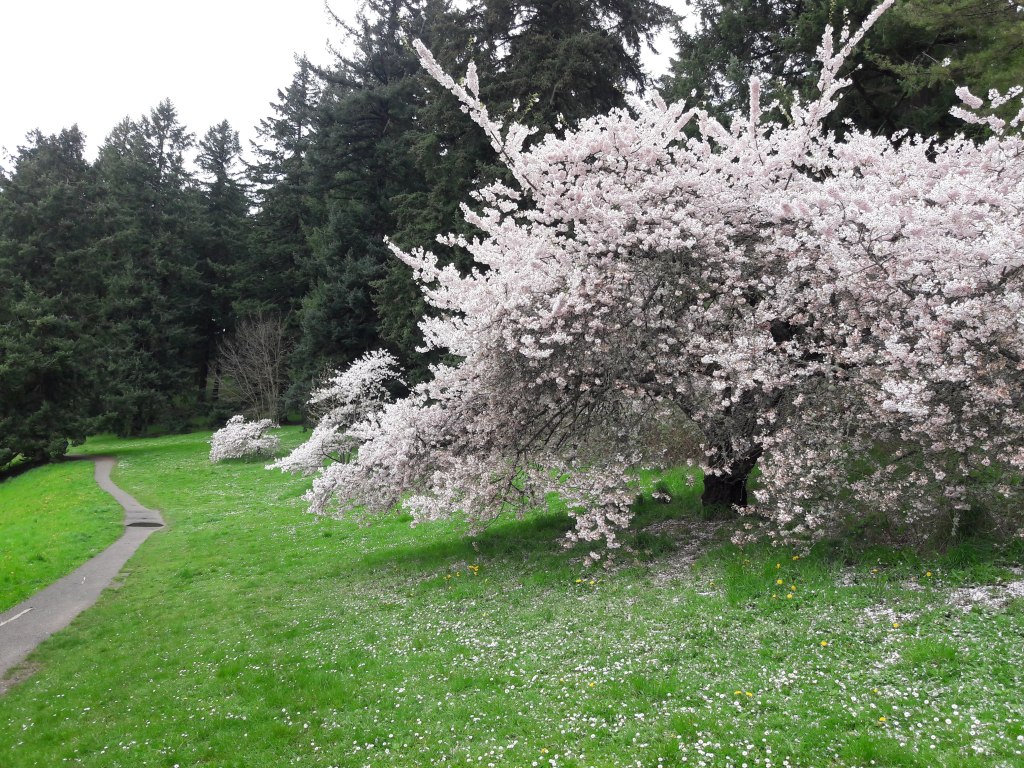
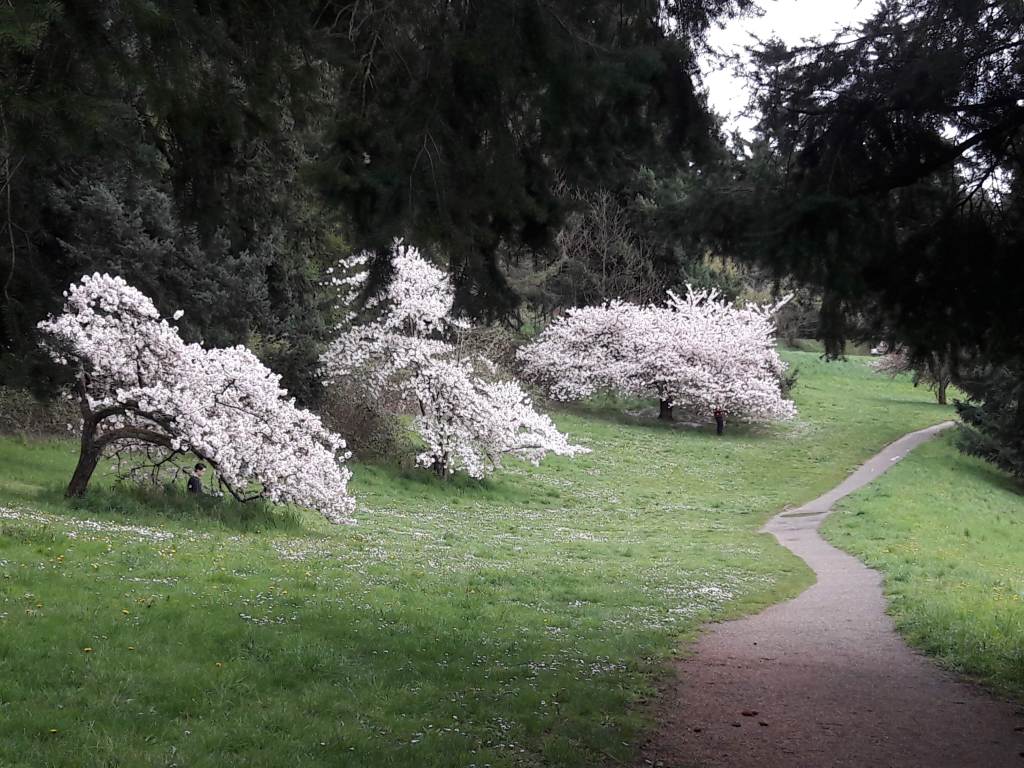
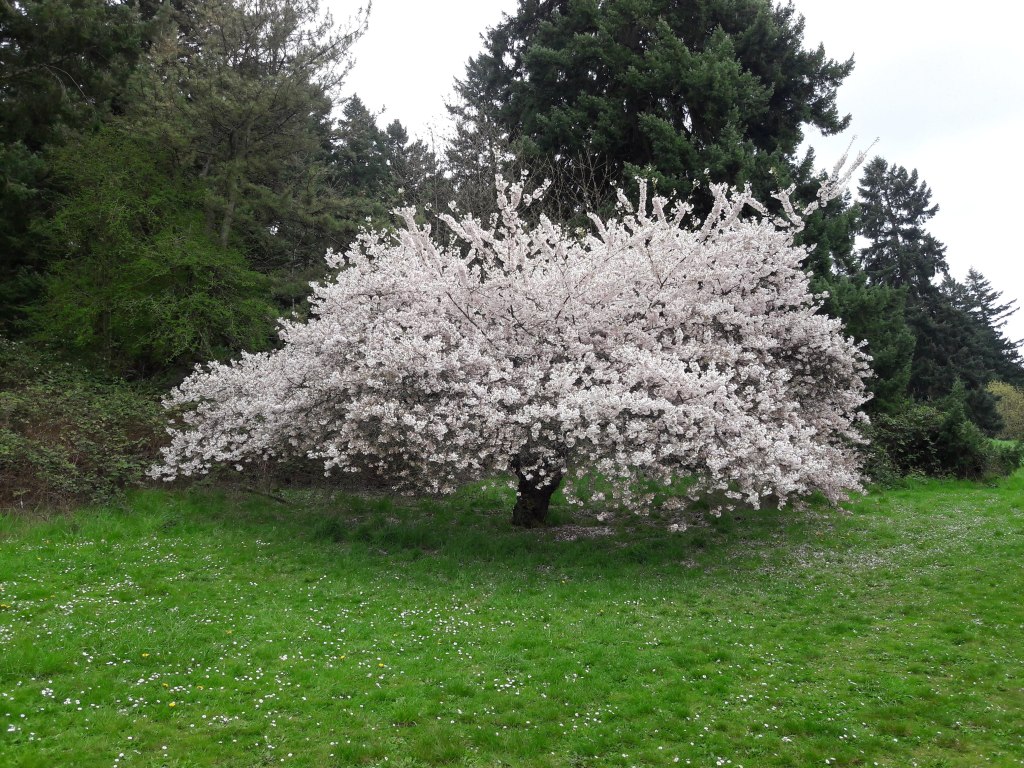
Here are two photos of cherry trees near an old path in Mt Tabor Park:
The Minnesota poet Robert Bly talked about nature’s capacity to send and receive images in transference from object to subject back and forth. The cherry tree in blossom might leave its image resonant in focus in the viewer’s consciousness. Not only the image, but what it felt like in the moment of sending and receiving, and Bly talked about how poetry might reconvey that image and feeling.
“Descartes’ ideas act so as to withdraw consciousness from the non-human area, isolating the human being in his house, until, seen from the window, rocks, sky, trees, crows seem empty of energy, but especially of divine energy….
As people begin again to invest some of their trust in objects, handmade or wild, and physicists begin to suspect that objects, even down to the tiniest molecular particles, may have awareness of each other as well as ‘intention,’ things once more become interesting.”
“News of the Universe: poems of twofold consciousness,” 1980, Sierra Club Books, San Francisco, pp 4-5.
Bly referred to the transference of consciousness idea using the poetic term deep image. Some might consider the ability to so access such images an affliction of the imagination. However it works, the cherry trees in spring seem to attract more than bees, and the pollinators are certainly responsible for more than honey. Here is another photo of one of the cherry trees in Mt Tabor Park, this one accentuated by the surrounding shades of green:
Walter de la Mare chipped in on the cherry tree theme with his poem “The Three Cherry Trees.” He reflects on the passing of both blossoms and viewers. Here is the last stanza:
“Moss and lichen the green branches deck; Weeds nod in its paths green and shady: Yet a light footstep seems there to wander in dreams, The ghost of that beautiful lady, That happy and beautiful lady.”
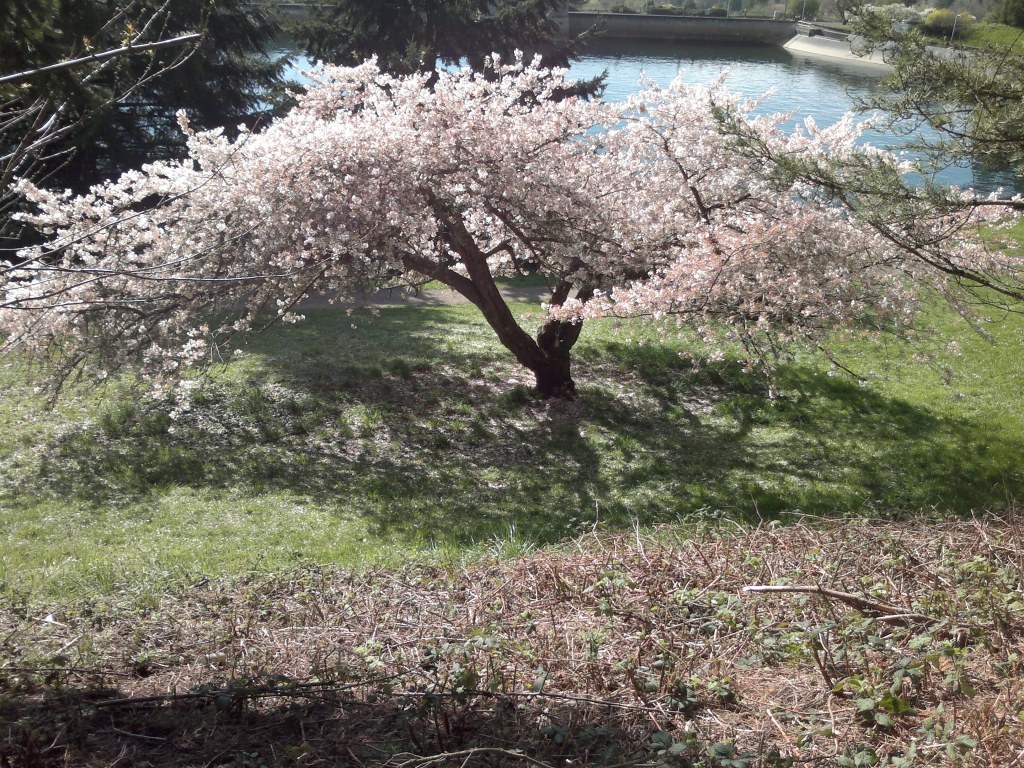
Cherry Tree above Reservoir #5 in Mt Tabor Park
A. E. Housman seemed to conclude waiting for a tree to blossom one might miss the ongoing opportunity to catch other images of that tree. From his poem about the cherry tree titled “Loveliest of Trees”:
“And since to look at things in bloom Fifty springs are little room, About the woodlands I will go To see the cherry hung with snow.”
Images don’t always come with sound. Here is a four second video of cherry blossoms in a wind:
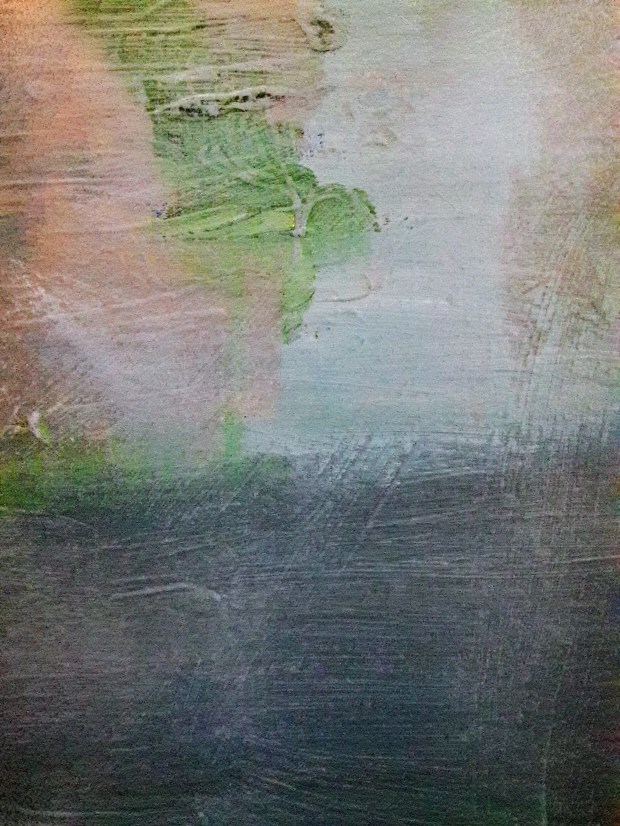
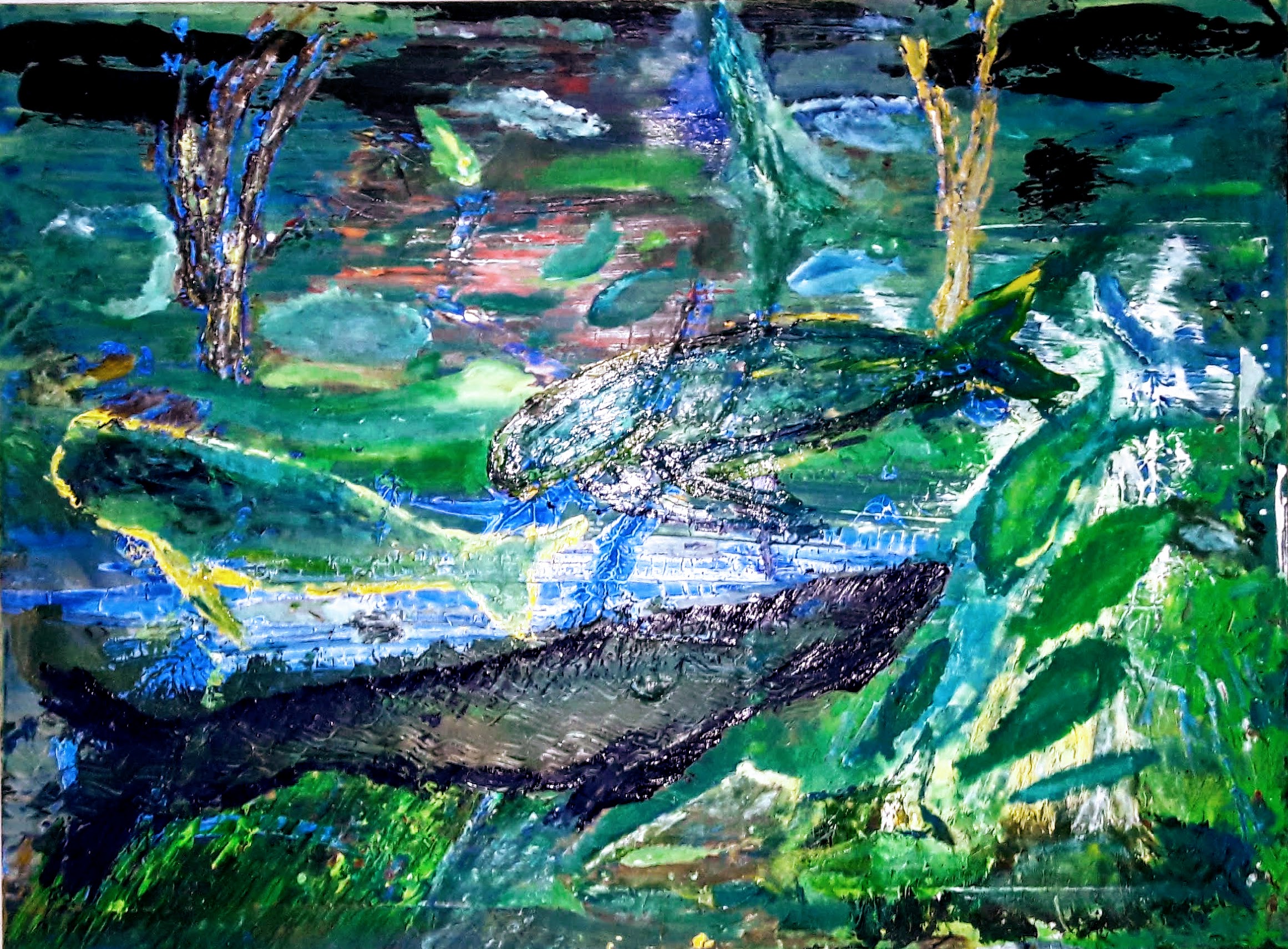
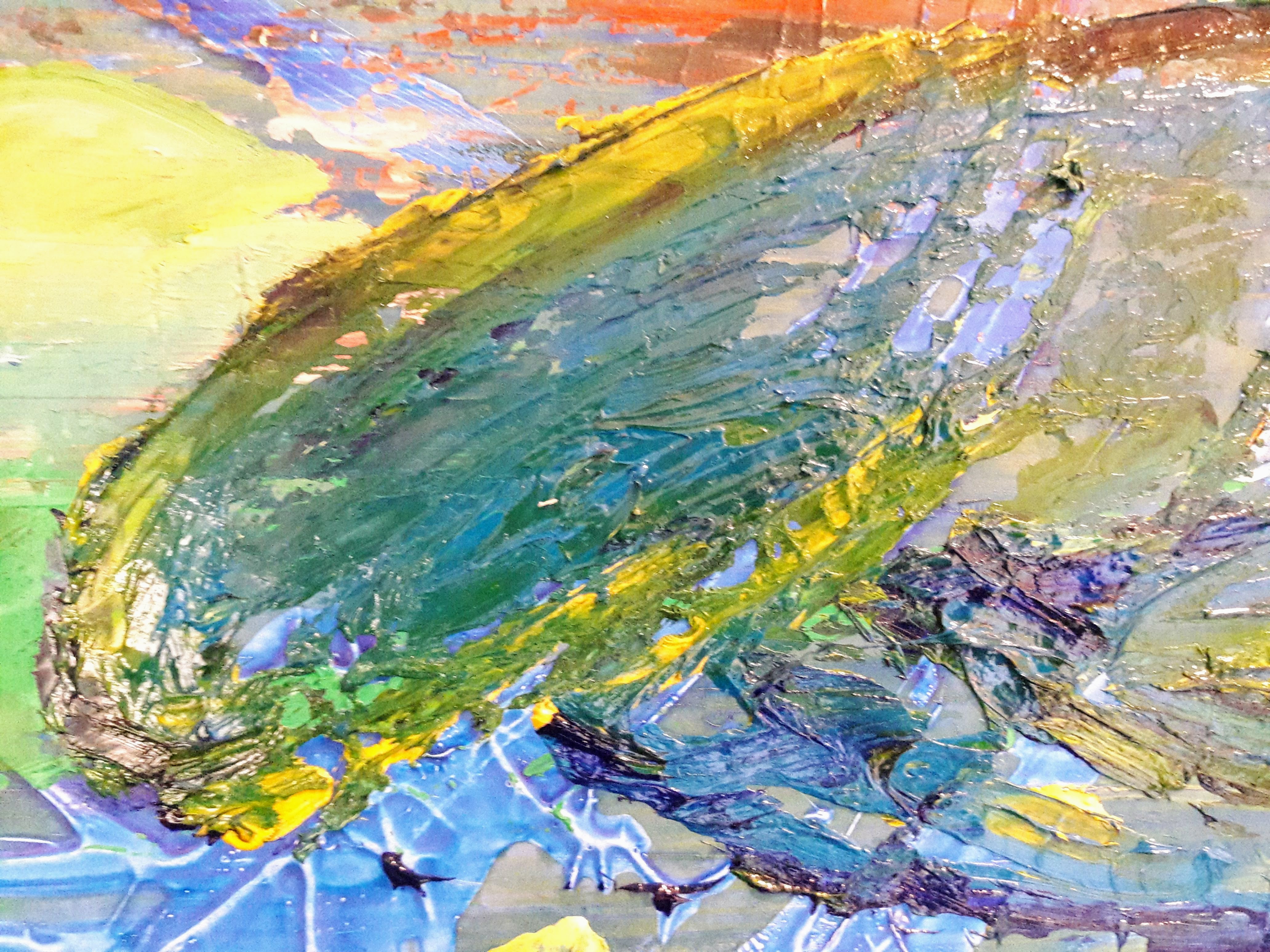
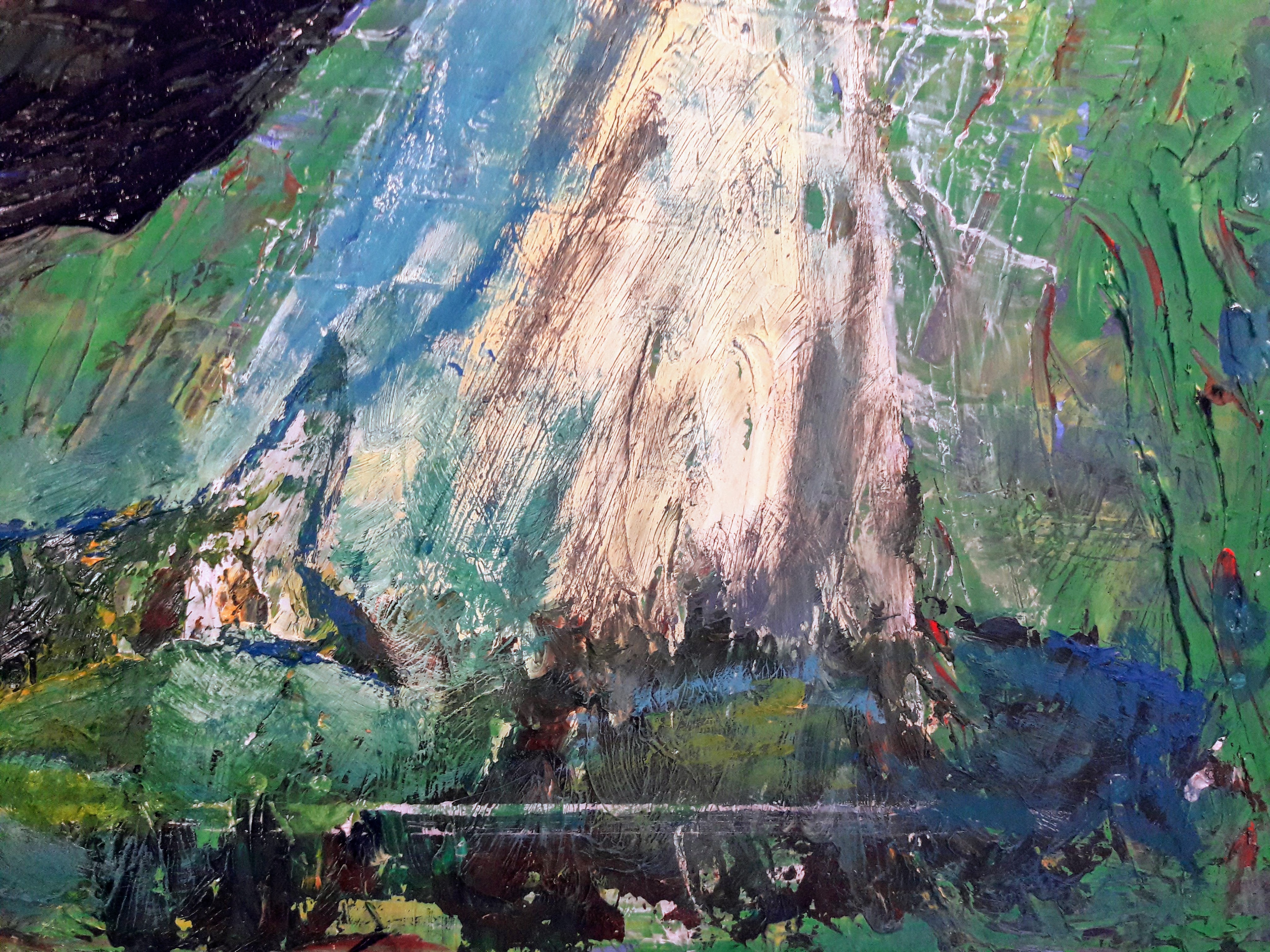
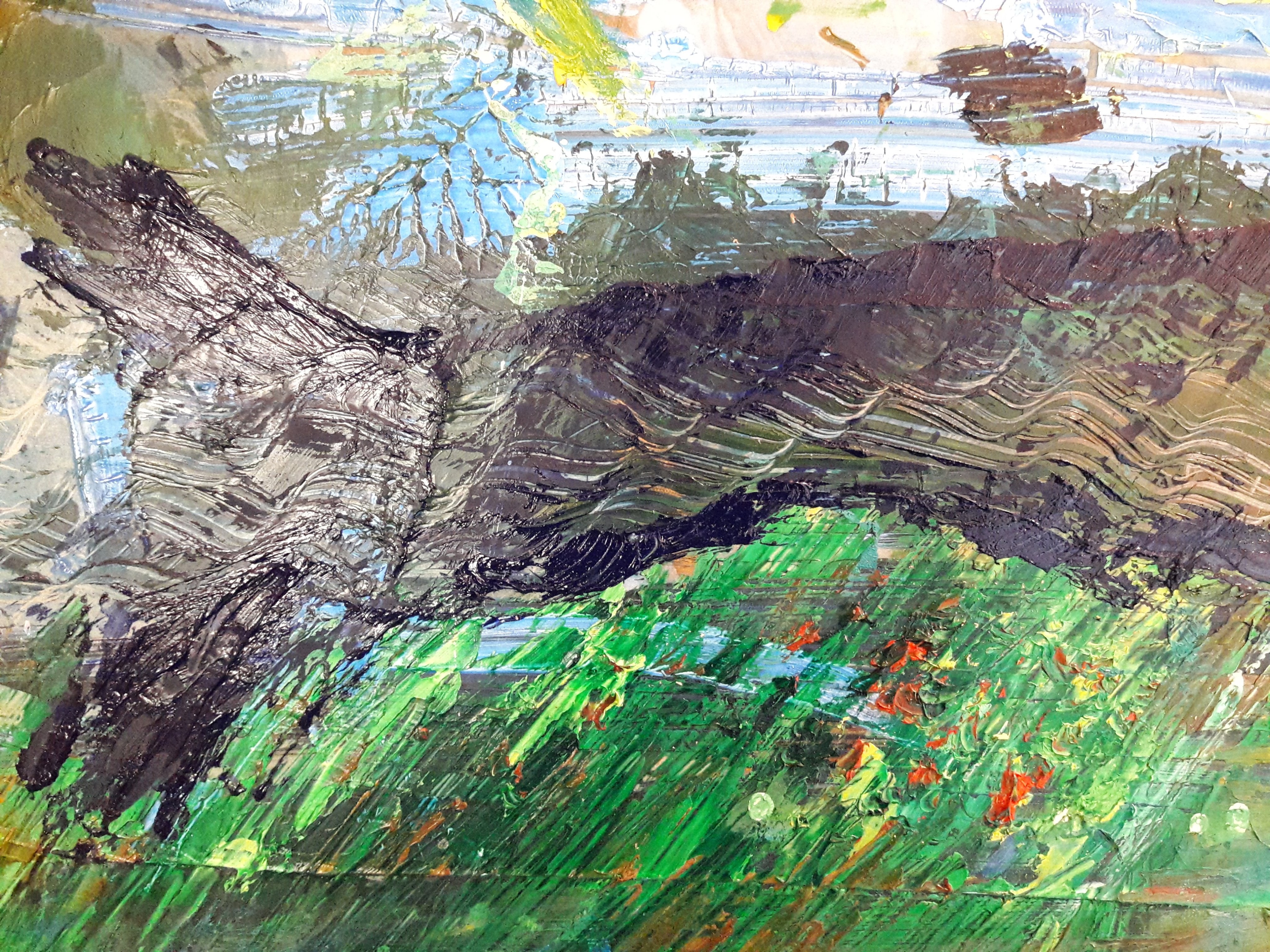
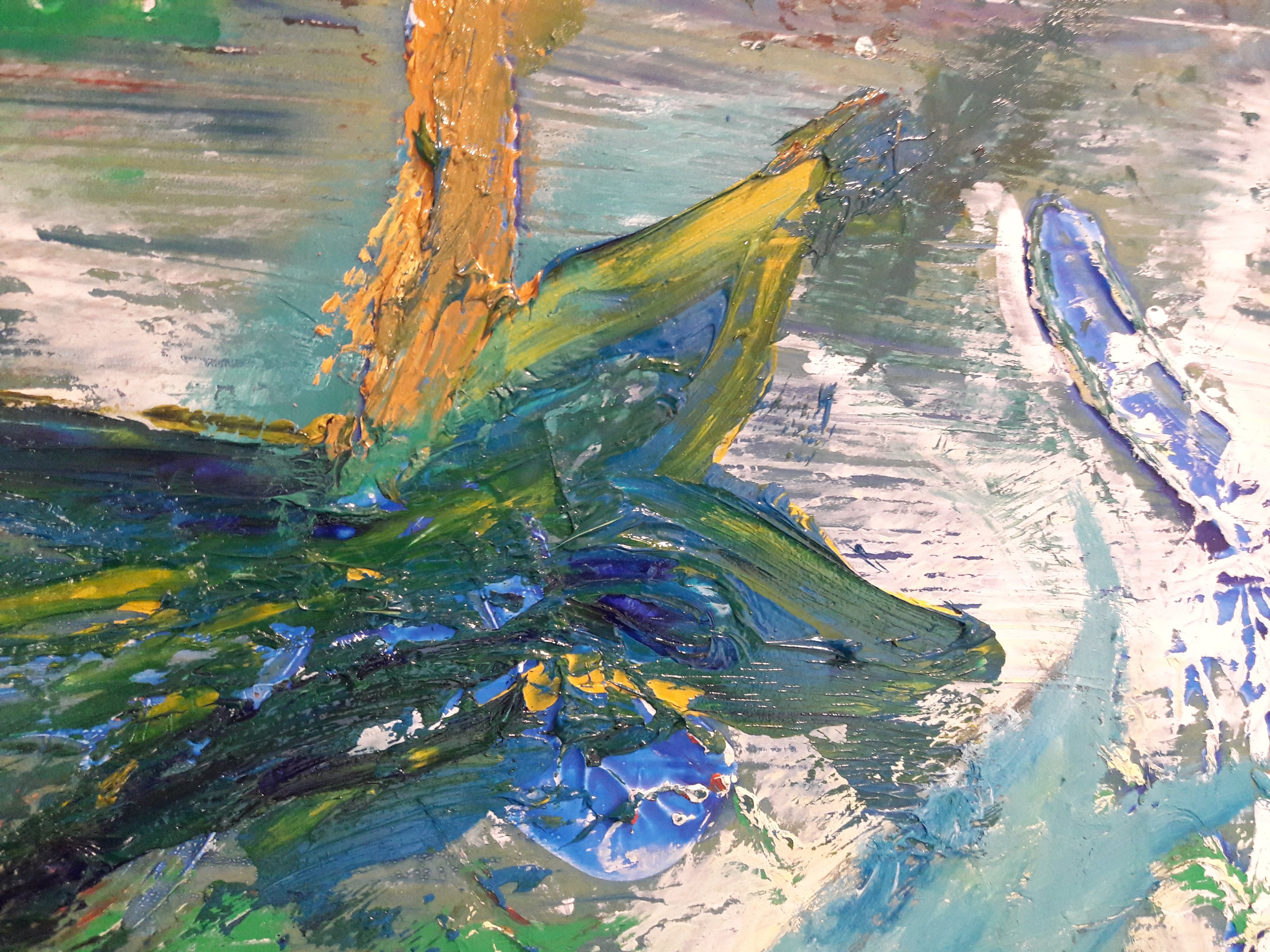
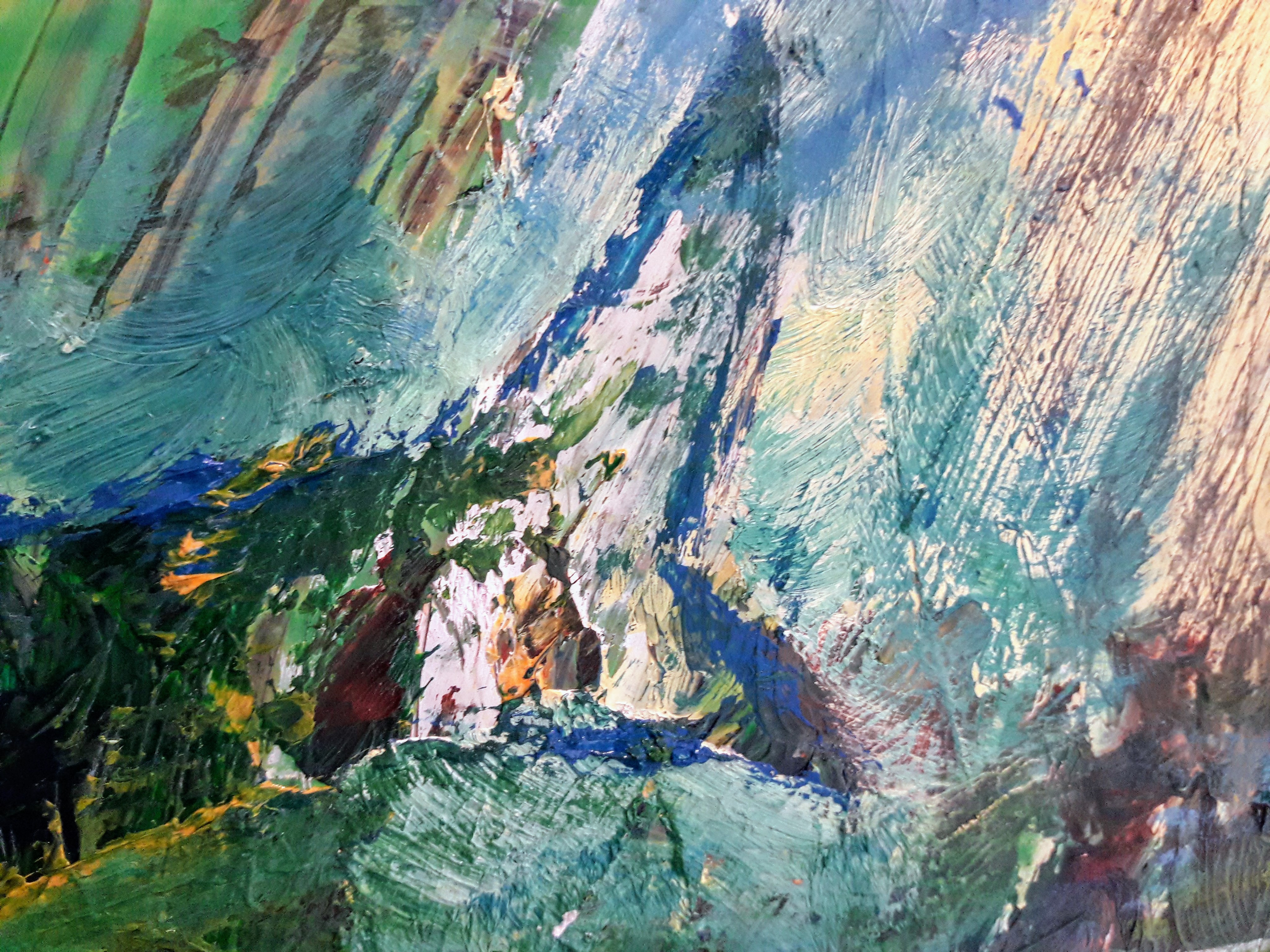
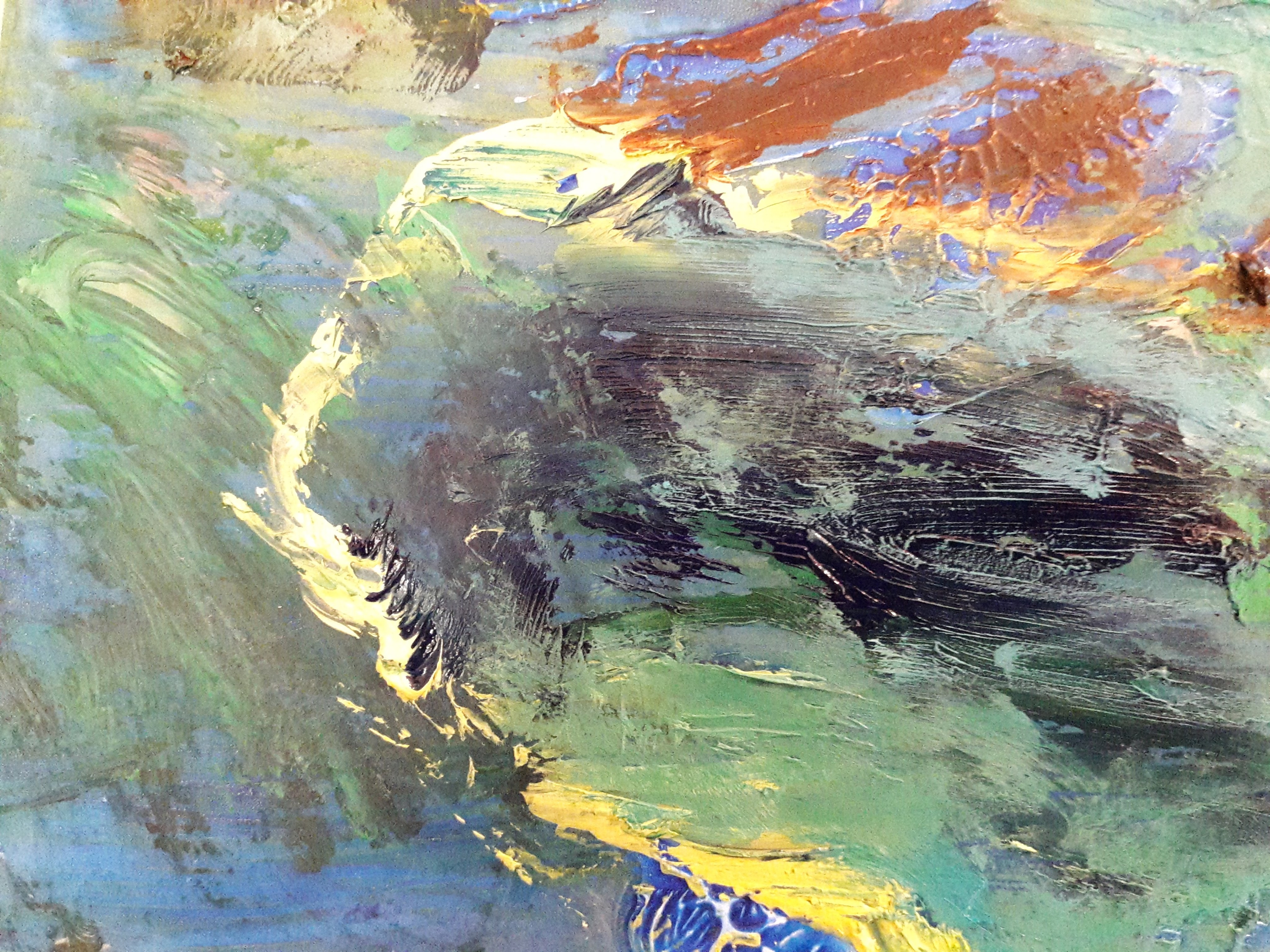
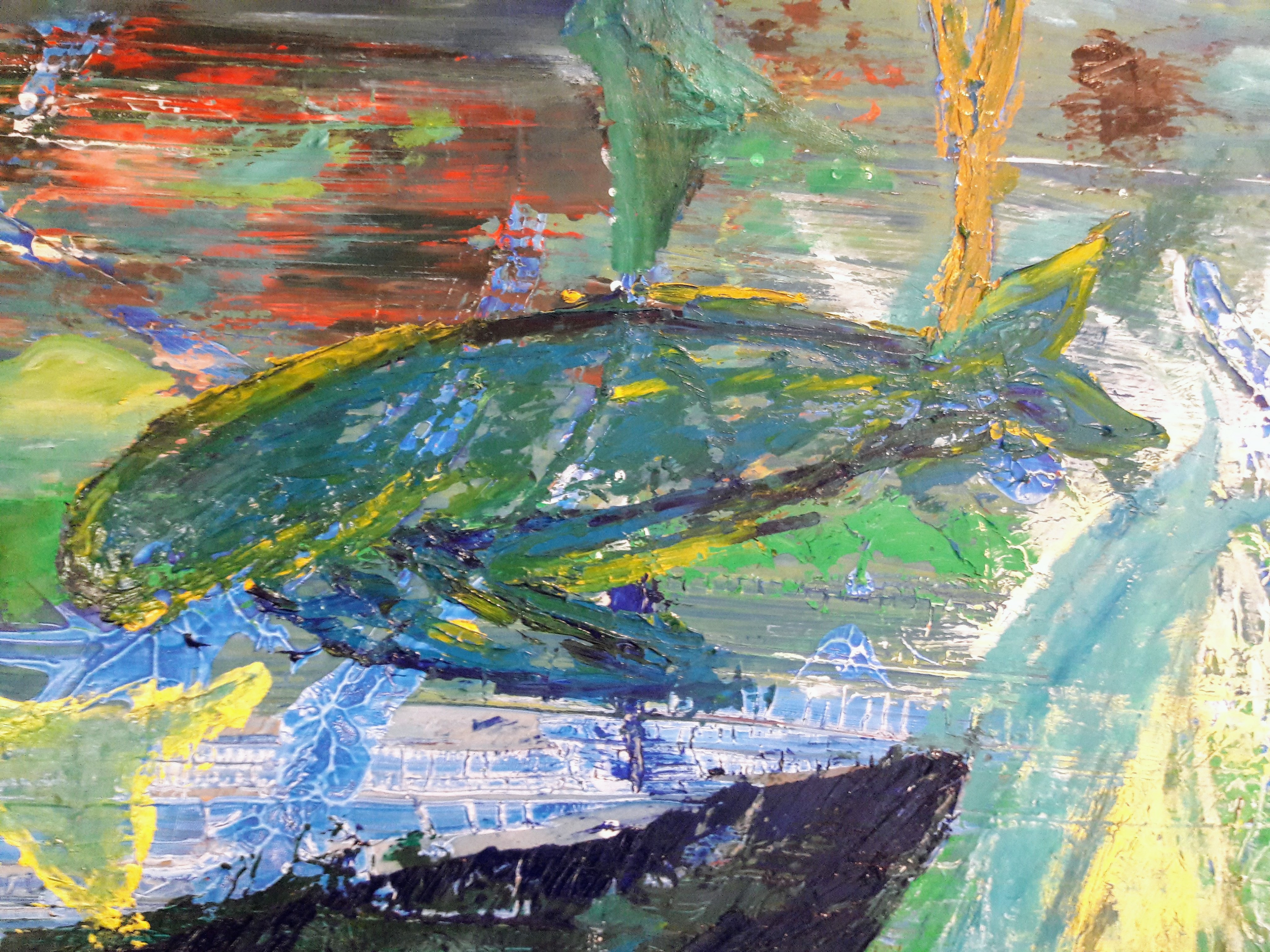
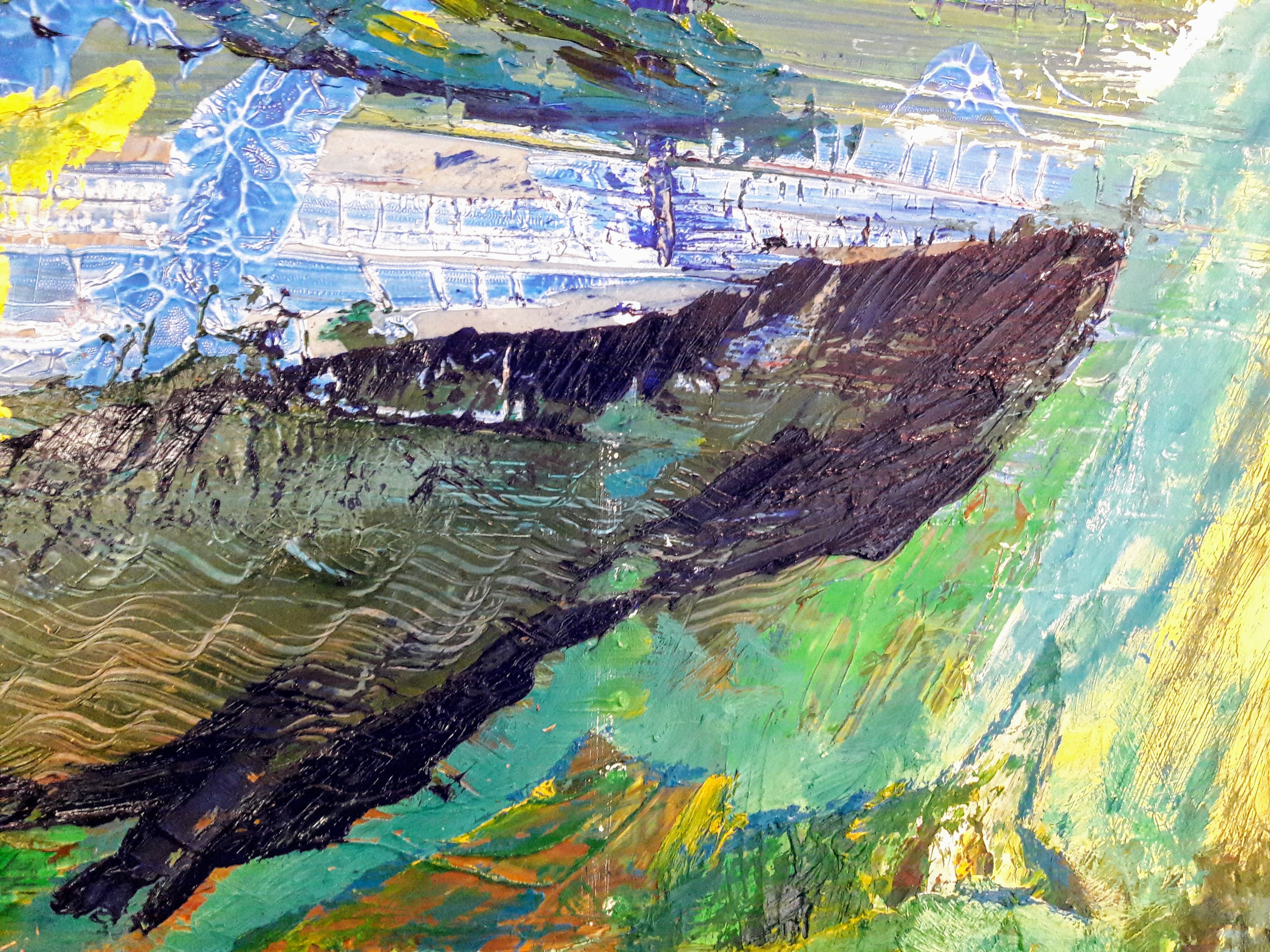
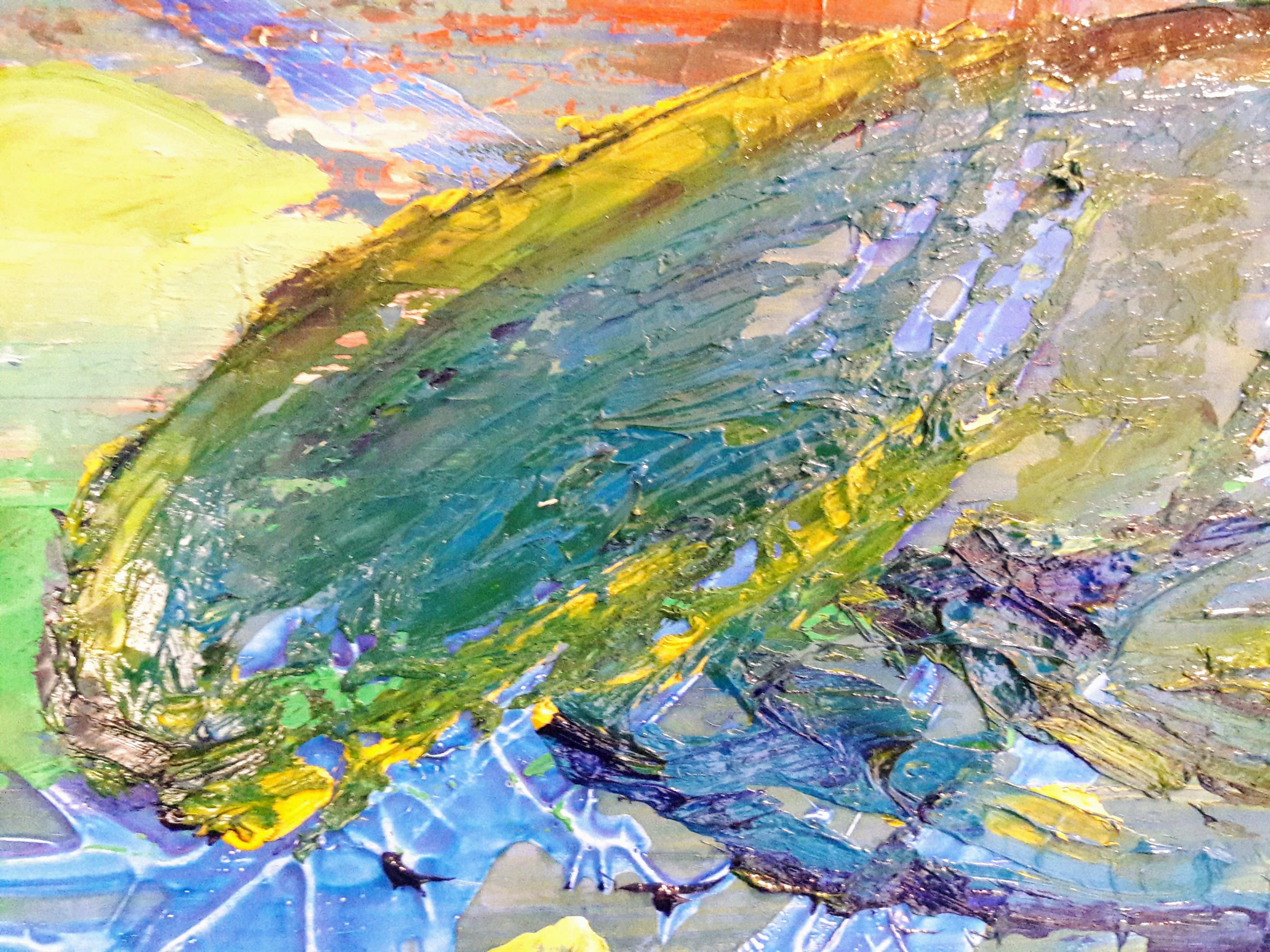
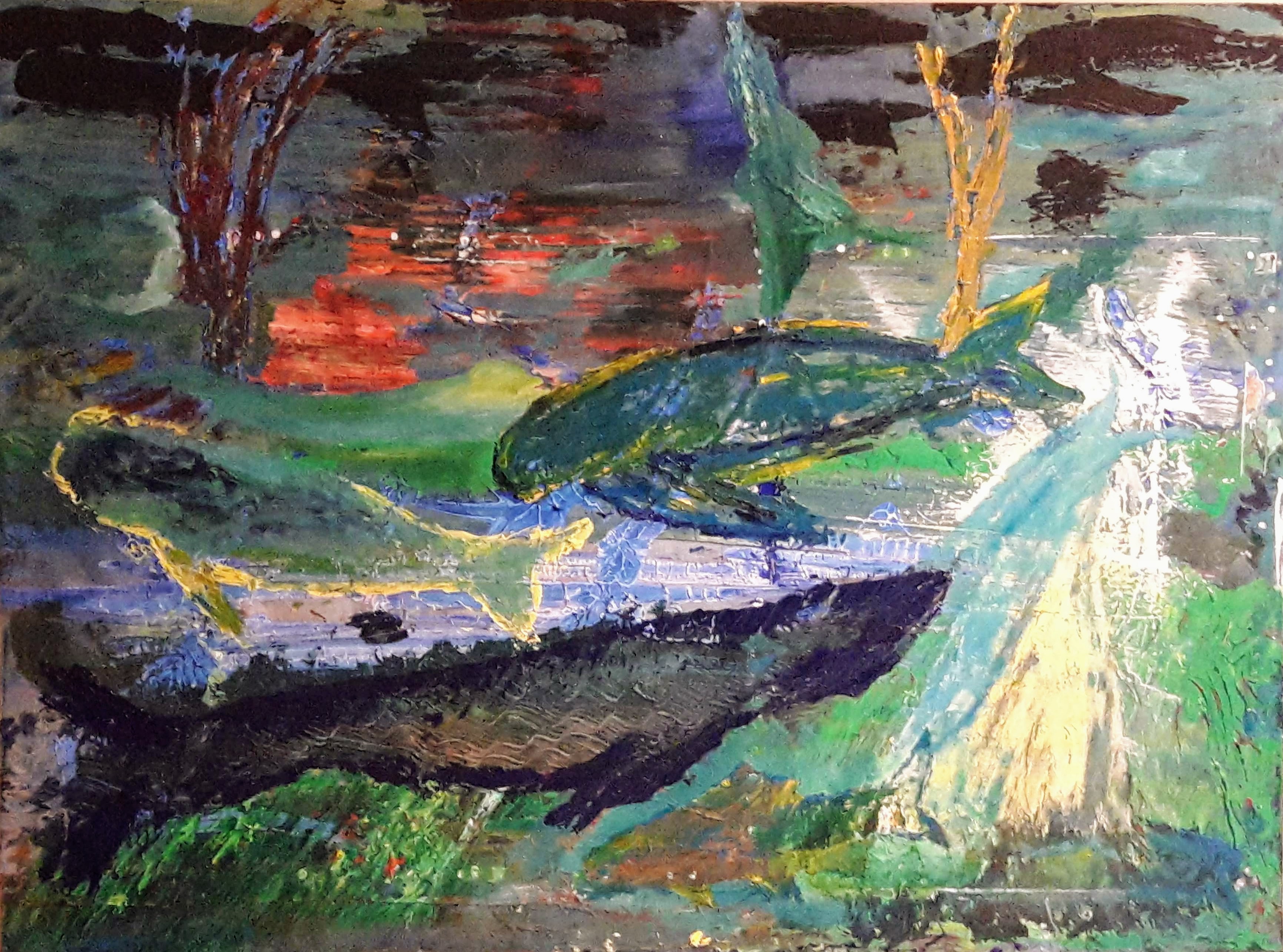
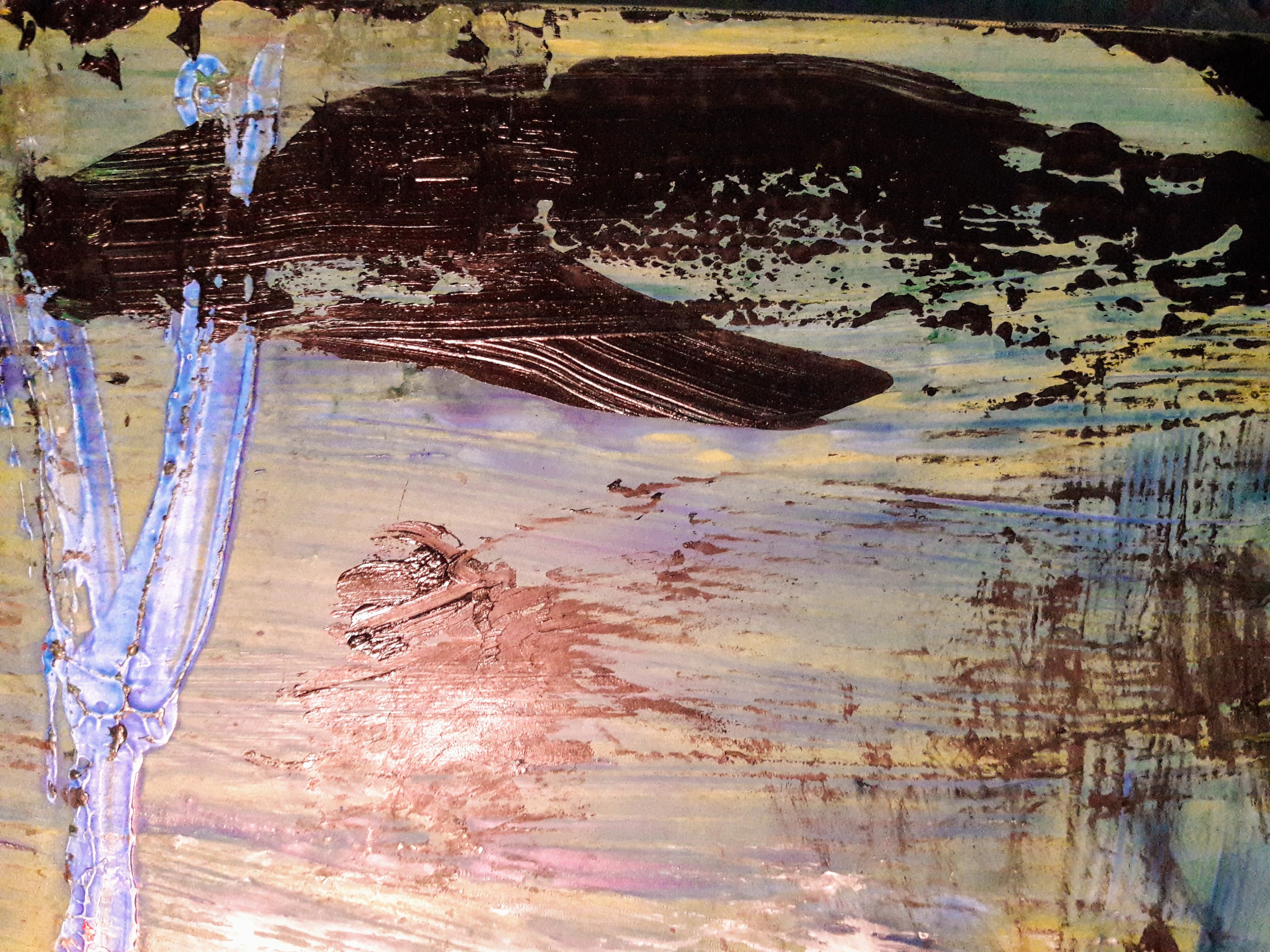
Painting, smearing pigment or dye from a palette to an object for the purpose of catching light, is a physical activity. Whereas Melville begins his great book “Moby-Dick; or, The Whale” explaining why men take to the sea (“Whenever it is a damp, drizzly November in my soul,” Ismael says, and, “If they but knew it, almost all men in their degree, some time or other, cherish very nearly the same feelings towards the ocean with me”), I drop down to the basement or spread a cover over the kitchen table and begin a painting.
“Whale Watch” (2019) Water based oils on Canvas 30″ x 40″:
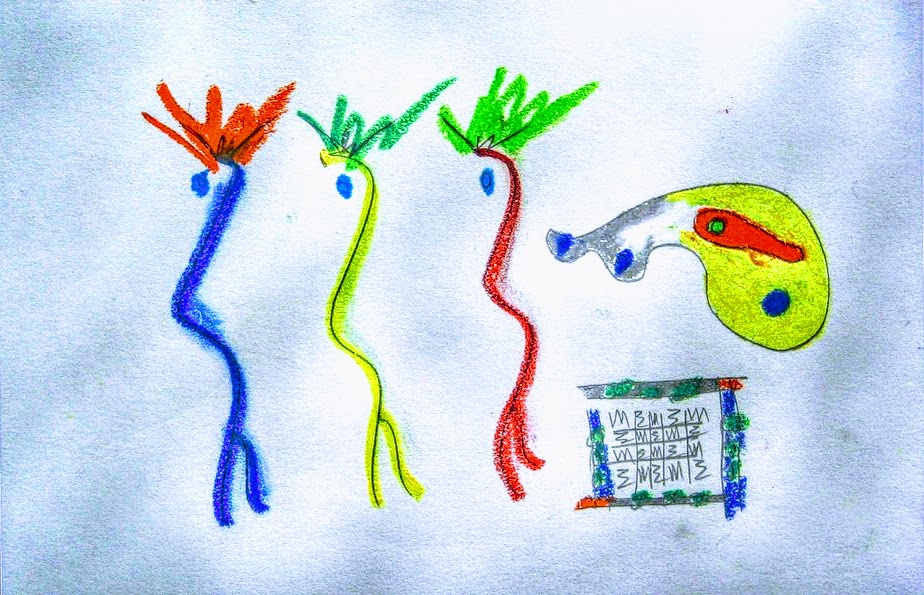
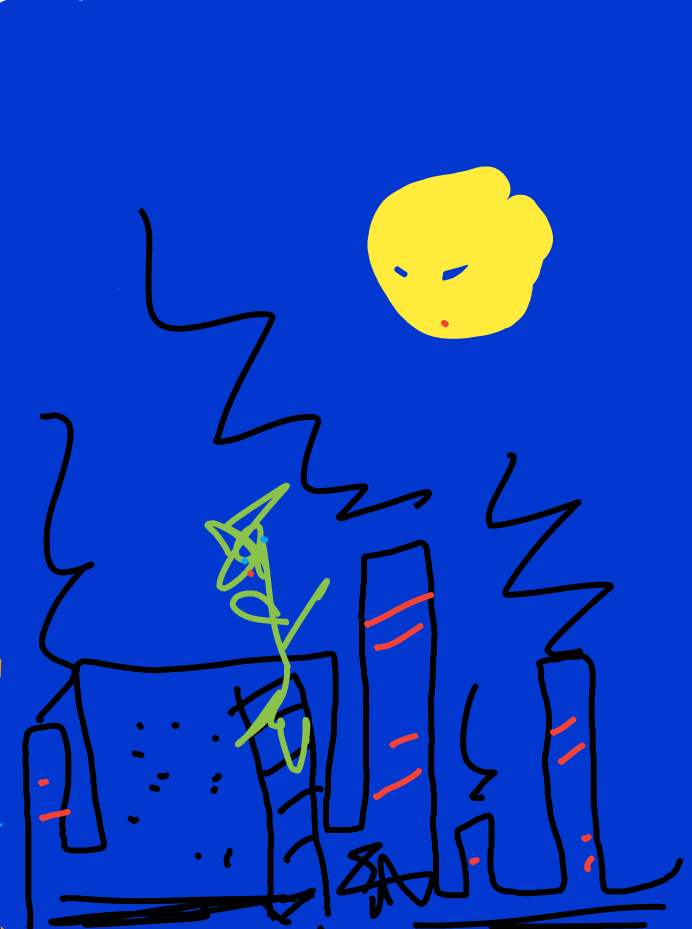
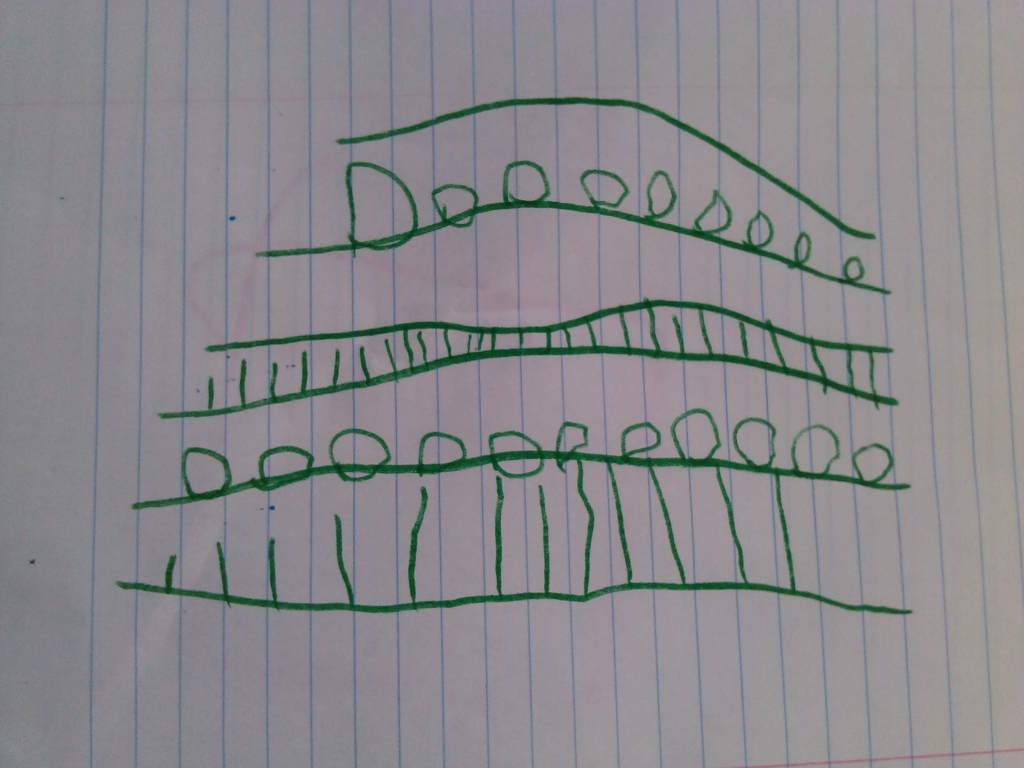
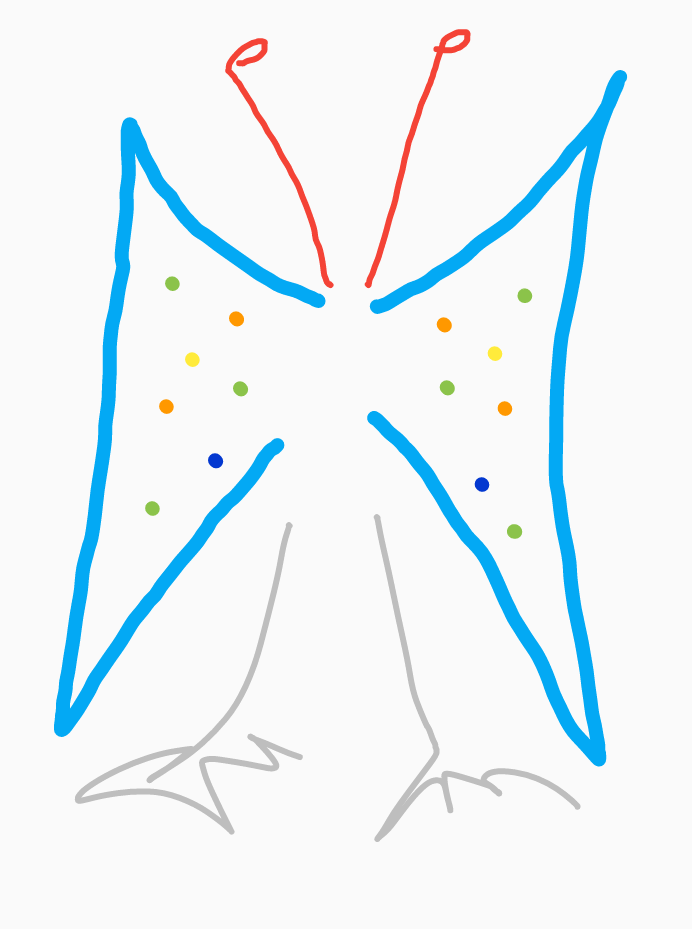
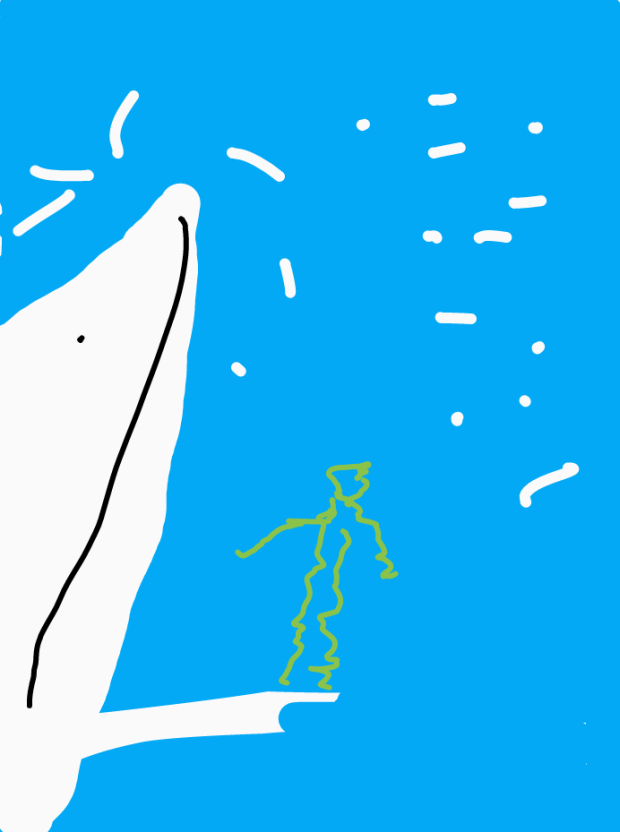
Painting is necessarily physical and messy. Anyone can paint, you don’t need to be an artist, and if you have no paints or canvas or board, you can draw or sketch, on paper or on your cell phone, for example:
A few mornings ago, I walked into the kitchen, set about making coffee, and noticed a line of tiny ants climbing up and down a corner edge, starting from a small gap behind a molding where the wall meets the floor, and when the ants reached the countertop, they went meandering to and fro, around the toaster and coffee maker and compost bucket. And two nights ago, out walking, we came across a nest of what appeared to be the same ant species emerging from a crack in the sidewalk, a line of scouts working their way into a neighboring yard. And early yesterday, the weather still clement, in spite of thunderstorms and tornadoes forecasted for the later afternoon hours, I had taken a morning break with my coffee outside in the fine Spring morning, and when I swung the door open to come back in, a fly the size of Rodan nearly knocked me over as she flew into the house and proceeded to spin around and around near the ceilings, cavorting from room to room.
Spring begins with a pile of chores, and one recalls T. S. Eliot’s seemingly anti-intuitive start to his disillusionist poem titled “The Waste Land”:
“April is the cruellest month, breeding Lilacs out of the dead land, mixing Memory and desire, stirring Dull roots with spring rain.”
Not to mention the appearance of ants awaking from their winter diapause.
“Winter kept us warm, covering Earth in forgetful snow, feeding A little life with dried tubers.”
Soon April, and signs of spring are breeding and mixing in the kitchen and in the air, inside and out. Across the grass, dandelions are sprouting and even flowering already, and the turf at the edge of the sidewalk needs edging. The list goes on, but never mind – I discovered this week Ruth Stout, whose practice of gardening is summed up in the titles to her mid-century books, notably: “Gardening Without Work: For the Aging, the Busy & the Indolent” (1963); and “The Ruth Stout No-Work Garden Book: Secrets of the year-round mulch method” (1971); and her first, “How to have a Green Thumb without an Aching Back: A New Method of Mulch Gardening” (1955).
It was in a New Yorker article of March 17 that I discovered Ruth Stout, sister, as I learned, of the famous detective fiction writer Rex Stout, best known for his protagonist Nero Wolfe. The subtitle to Jill Lepore’s article tells all: “Ruth Stout didn’t plow, dig, water, or weed.” Suddenly, Spring seemed a happier time than how T. S. Eliot described it.
Still, I had ants in the kitchen to deal with, for I learned to my dismay they had nested inside the coffee maker. I surrounded the coffee maker with a moat of vinegar, and when the ants appeared between the moat and the coffee maker, I knew they had to be coming from within the coffee maker, where they must have set up a new nest. Never one to rush for the can of spray that “kills bugs dead” (ad line attributed to Beat poet Lew Welch, by the way), after a bit of research, I decided to try Dr. Bronner’s peppermint soap, having read that ants don’t like peppermint oil. The soap certainly stops ants on contact, and it seems to slow new scouts from returning to the scene.
Meantime, our kitchen counter is cleaner than ever before. I had to retire the electronic coffee maker. I read ants like water and warmth (who doesn’t?), and they can also detect electric currents, including vibes from computers and cell phones and such – so we won’t be able to charge our devices on the kitchen counter anymore, for fear of ants. Imagine ants in your Chromebook, crawling in and out of the keyboard. And we’ve returned to a French press coffee maker, and while it takes a bit longer with more steps to brew, the coffee is robust. And immediately employing the Ruth Stout method, the yard work is quickly done, leaving more time for writing pieces, well, like this one.
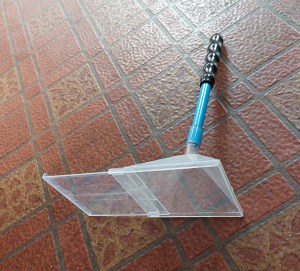
But what of the fly the size of Rodan, the deep reader will be wondering? Advocating a catch and release policy toward all living but unwelcome things, I grabbed the fly catcher and went dancing around the house with the fly. I trapped it in the bathroom, where it had landed on the window screen. To catch a fly with the fly catcher, you have to wait until it lands, approach quickly but stealthily, cover it with the catch door open, then slide the catch door closed with the fly inside the trap. Might sound easy, but it’s often a cat and mouse game as the fly inevitably flickers away at the last second. After several attempts banging around the small bathroom, I caught the fly, then released it into Spring and all wilderness where all Earth life mingles half awake and half asleep.
“The Coming of the Toads” is the title of a short poem by E. L. Mayo:
“‘The very rich are not like you and me,’ Sad Fitzgerald said, who could not guess The coming of the vast and gleaming toads With precious heads which, at a button’s press, The flick of a switch, hop only to convey To you and me and even the very rich The perfect jewel of equality.”
E. L. Mayo. Summer Unbound and Other Poems, the University of Minnesota Press, 1958 (58-7929). Also, E. L. Mayo. Collected Poems. New Letters, University of Missouri – Kansas City. Volume 47, Nos. 2 & 3, Winter-Spring, 1980-81.
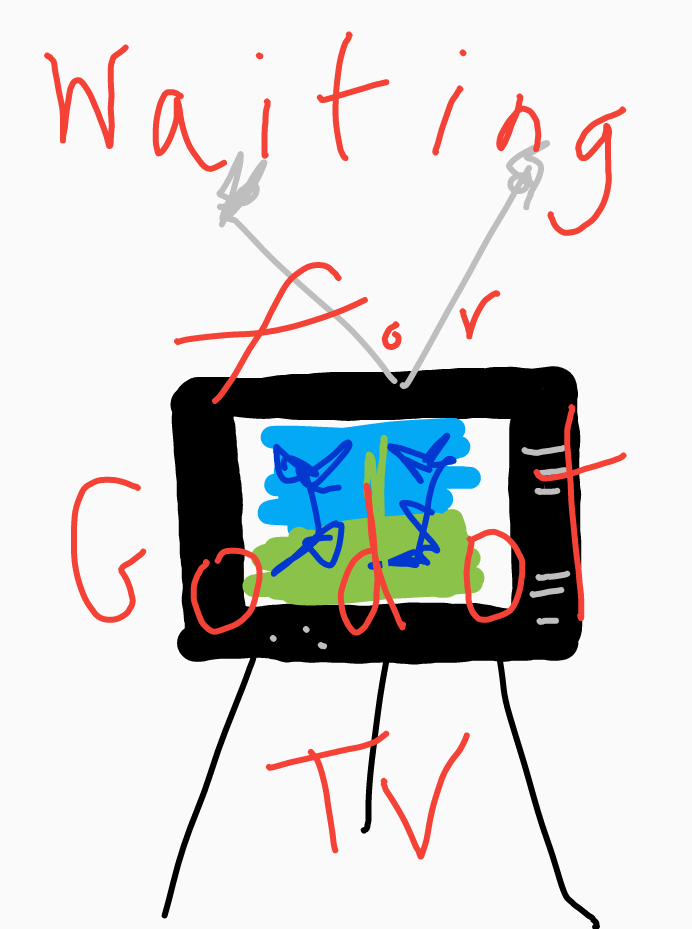
The young toads were ugly televisions, but those eerily glowing tubes contained a lovely irony. The toads invaded indiscriminately. The bluish-green light emitted from the eyes of the toads emerged from every class of home, all experiencing the same medium for their evening massage. Mayo’s poem is a figurative evaluation of the effects of media on class and culture.
In Fitzgerald’s short story “The Rich Boy” (1926), the narrator says, “Let me tell you about the very rich. They are different from you and me.” But Mayo doesn’t seem to be quoting from Fitzgerald’s story. He seems to be referencing the famous, rumored exchange by the two rich-obsessed, repartee aficionados Hemingway and Fitzgerald. Hemingway wrote, in his short story “The Snows of Kilimanjaro” (1936):
“He remembered poor Julian and his romantic awe of them and how he had started a story once that began, ‘The very rich are different from you and me.’ And how some one had said to Julian, Yes, they have more money. But that was not humorous to Julian. He thought they were a special glamourous race and when he found they weren’t it wrecked him just as much as any other thing that wrecked him.”
Did TV have a democratizing effect, or are its effects numbing? In Act 2, Scene 1, of Shakespeare’s “As You Like It,” Duke Senior, just sent to the woods without TV, mentions the toad’s jewel:
“Now, my co-mates and brothers in exile, hath not old custom made this life more sweet than that of painted pomp? Are not these woods more free from peril than the envious court? Here feel we but the penalty of Adam, the seasons’ difference, as the icy fang and churlish chiding of the winter’s wind, which, when it bites and blows upon my body, even till I shrink with cold, I smile and say ‘This is no flattery: these are counselors that feelingly persuade me what I am.’ Sweet are the uses of adversity, which, like the toad, ugly and venomous, wears yet a precious jewel in his head; and this our life exempt from public haunt finds tongues in trees, books in the running brooks, sermons in stones and good in every thing. I would not change it.”
Fitzgerald didn’t embrace television, but today he might cradle a metamorph tadpole in his lap. What would it convey? The toad’s jewel is more than a metaphor; the churlish shows of television are today the Duke’s counselors. We enter the space of the light box, and the toad’s jewel poisons us to the paradox of staying put, to electronic exile, but does it contain its own antidote, the toadstone?

 The Coming of the Toads