When the urge to write slows to a trickle
and the need to talk seems superfluous
the funnel of listen fills with earwax
summer’s vase stuck with dry flies
and all the flowers fall drooped
one awakes yet again and gets up
aroused by the unsurpassable sun
spilling coffee on the backs of its studs.
Tag: Writing
-
On Urges
-
First Snow on Fuji, 1959 (transl. 1999)
Nine stories and a “Dance-Drama” by Nobel Prize winning Japanese writer Yasunari Kawabata. Domestic settings around living quarters, gardens and paths, plants and pets, involving marital and extramarital relationships, post World War II thoughts and experiences in lovingly (at once sympathetic and detached) close, naturalistic readings of character motivations and responses – to one another, to nature, to self. In a “Translator’s Note,” Michael Emmerich summarizes the style:
“He [Kawabata] had to make the most of each unclaimed moment, each precious word. So it’s no surprise to find that the pieces in this collection are incredibly distilled, often dealing with the relationship between language and being, words and the past, and with being claimed, with losing possession of one’s historical self” (ix).
Not that the motivations and responses are necessarily absent any ambiguity, in spite of the lucid, no-nonsense prose. There might be an impulse to get away from one another, the hugging closeness of living together, from one’s own place, of wondering what taboos have to do with you, from, in the end, comparing and contrasting what you have with what you think others might have, to break one’s silence of the solitude that comes with living with someone else:
“Once more I seemed to have said too much. Wasn’t what I was doing like forcing a desperately wounded soldier to return to battle? Wasn’t it like violating a sanctuary of silence? It wasn’t as though Akifusa was unable to write – he could write letters or characters if he wanted to. Perhaps he had chosen to remain silent, chosen to be wordless because of some deep sorrow, some regret. Hadn’t my own experience taught me that no word can say as much as silence?” (167).
Kawabata’s writing is full of atmosphere created from the smells and sounds, visions and touch, of ordinary living. The effects might be described as calming, even if the events portrayed are not. And in that sense there is an acceptance of life the characters often in personal rebellion don’t want to accept, or, at least, wonder what life might be like on the other side of such acceptance. That is brought forth from description, dialog, shifting point of view, of course, but here the brush strokes, the word juxtapositions, the storytelling flow, just seem so perfect and create that sense one sometimes yearns from reading – a momentary relief, as Frost said of poetry, against the confusion of the world, even, again, if confusion is what it’s all about.
The copy I read is a Counterpoint (Washington, D. C.) paperback, 227 pages, Perseus Books Group (ISBN: 1-58243-022-5), 1999, but there appears to be a reprint, “revised,” which I’ve not seen, from Counterpoint (Berkeley, 2000, 248 pages).
-
Poetry Post
The poetry post was taken down over night spirits the rules of cultural worm tongues relevance ad hoc heresy. Kicked to the ground old fashioned paper pages bestrew the weeds of diction and grammar. Who put up the poetry post unknown nor who kicked the post down still cadence broke at the base cracked where it entered the yard near the sidewalk free for passersby to read not the news and certainly nothing about a poetry post pushed over in the night nor who picked up the pieces and raked clean any evidence Who put up the poetry post unknown nor who punched the post's still cadence broke at the base cracked where it entered the yard near the sidewalk free for passersby to read not the news and anyway nothing about a poetry post pushed away in the night broken where entered the ground empty the post head where displayed a page a day now empty abandoned unfulfilled leaning fallen pushedfall -
pure poetry, 2000
Readers who like unlikeable characters will love Binnie Kirshenbaum’s Lila Moscowitz. Lila is stubborn, spoiled, angry, bitter, promiscuously self-destructive. And, frosting on the cake, she’s a poet. That’s not to say she’s without redeemable qualities. She’s funny, hilarious, in fact, a natural wit, and as honest as a person can be without losing all of one’s family and friends and readers. Her humor is laced with sarcasm and irony. She’s quick, street smart and intelligent, independent. Experienced readers will recognize that Lila is not Binnie, that the narrator of a novel should not be confused with the author. This narrative truth is emphasized toward the end of the book when Lila takes some questions after a poetry reading:
“‘Did you really dance topless at the Baby Doll Lounge?’ Another one of the college girls is contemplating a career move, no doubt.
I smile as if I’ve got a secret, and I say, ‘I refuse to answer on the grounds that it could incriminate me.’”Lila may be a poet, but she’s not stupid:
“That I never danced topless at the Baby Doll Lounge or anyplace else either is not what they want to hear.”
Does she “write every day,” another student asks, and Lila pretends for the audience that she does write every day. She’s then asked “how much money do poets make?” Here she tells the truth (192-193).
But while the perspicacious reader knows Lila is not Binnie, we all know that poetry does not sell, so why not only does Binnie put “poetry” in her title but structures her book with poetic devices, informing each chapter with epigraphs, definitions of poetic conventions? Didn’t she want her book to sell? The answer has to do with wheels within wheels, or how to turn a stand up routine into literature:
“Many of the poems I write are about sex. I have a gift for the subject. The ins and outs of it. My poems lean toward the sordid side of the bed, the stuff of soiled sheets” (21).
We don’t get to hear those poems, but they apparently are full of the tension created by want harbored in inhibitions freed in seduction, romp enclosed in forms, procedures, praxis, which express mores without which somehow sex is not nearly as much fun. The fun is enclosed in a box of gravure etchings. The notion of form as enclosure is conservative. The poet might want out, not in. Lila’s own explanation might solve both Binnie and the reader’s questions:
“There is freedom within the confines of form the way a barrier protects you from the elements of disaster. The way there is love in the bonds of marriage. ‘Without boundaries, you can be only adrift,’ I say. ‘Lost. Without lines drawn on the map, you are nowhere. It is better to be a prisoner of war than to be without a nation, a place, a people’” (194).
Jesus may have said the opposite – Come, follow me, and leave all that nonsense behind. Of course, most of his followers wound up wanting it both ways.
“Maybe they should stay in their cages and sing their hearts out. Unbridled passion…results from being tied to the bedpost” (194).
Which is to make of Lila a dynamic character, one who’s changed over the course of the work. She finds love only by losing love. She’s human, fallen, having slipped on her own banana peel, but she gets back up, and writes a book that stirs and calms the forms.
Pure Poetry, by Binnie Kirshenbaum, a novel, Simon & Schuster, 2000, 203 pages.
-
In the Sober Reality of Celestial Shade
Day ends with a walk to sleep,
ends again in the sober reality
of celestial shade, one awakes
in the dark and quiet, too early
to get out of bed, too late
to start some new episode
on the television or telephone,
and this is when one turns
to paper and words seep
out shy and uncertain fearful
like little furry animals searching
the brambles for food and drink
day’s fire now cool ashen,
and while certainly somewhere
in the city of night madness
drones on, an asocial tinnitus,
here in the paper we find
we can hear the pencil’s breeze
and feel the bluish-gray lead lighten. -
Spelunking
What’s written by candle in yr cave
won’t be read for eons by anyone,
no views, no visitors, no likes, no
comments, until erelong perchance
some fair spelunker crawling
horizontally across the buried
rocks of yr commas, not too deep,
discovers yr degraded predicament,
etiolated undertaking to connect
images in the dark of creatures
now extinct, spellings archaic,
broken syntax of yr past, and finds
yr crushed crumpet of a skull
buried like a period at the end
of yr tunnel up against a wall,
a scurvy potation spilled betwixt. -
Dear Reader,
Won’t you please tell me your rules,
style flaws that send you over the edge,
your conjugations, constructions, con-
junctions, your clauses and marks
memorized, when to be and not to be,
double negatives and things dangling
in white space and other wedded dark
matter; for I will find immense
pleasure in breaking & trashing
the etiquette of your ways & days.Thanks,
Nomere Ana R. Chist -
Somewhere Else
It was last April, in a piece titled “What is Essential,” we again mentioned John Cage, then in the context of the pandemic quarantine discussion:
In John Cage’s “Lecture on Nothing,” we find the following comment: “It is not irritating to be where one is. It is only irritating to think one would like to be somewhere else.”
“What is Essential,” April 24, 2020Of course, some places are more irritating than others, some conditions worse, but it seems common to living in any means people like to get away, out of town, go up to the cabin, drive out to the beach, go camping, sail the seven seas, see the world, go somewhere, anywhere, but somewhere else.
Not talking here about those forced to leave home, from war or famine or wildfire or flood, abuse or political upheaval. Catastrophes are not “irritations.” A catastrophe is sudden and overturning; an irritation is slow and creeping, an itch one can’t quite reach. An earworm. One can live with any number of irritations, but one can not go on as before during or after a catastrophe. “Would like” suggests preference, unrelated to need, not desperate, but a privileged choice.
“Where should we spend the weekend, in town or in the country?”
“I don’t know. I’m bored with opera.”The COVID19 virus affects different people in different ways, depending on predicament, but literally everyone on the planet Earth has been affected, to one extent or another, slightly or severely. Wouldn’t it be nice to get away? Maybe that’s the attraction of Perseverance, of Mars, of space travel.
“Earth is irritating.”
“Let’s go to Mars.”
“Good idea.”
“I’ll book a flight today.”Can a simple irritation, almost unnoticeable until all goes quiet, grow into a catastrophe? It seems unlikely. Irritations come from within; catastrophes come with the wind. There’s talk of getting “back to normal.” That too seems unlikely. In fact, in any case, wasn’t there something particularly irritating with what was considered normal?
-
Inventories
Part human, part deity, these working gods are restless. What happens when one wants out? Episodes of a god on the run, “Inventories” is now available in paperback book format. “Inventories” first appeared here, at The Coming of the Toads, near daily installments over several months in 2020, a quarantine exercise. The text was revised for this book publication first edition.
ASIN : B08VM82YRK
Publisher : Independently published (February 2, 2021)
Language : English
Paperback : 190 pages
ISBN-13 : 979-8702891125
Item Weight : 9.4 ounces
Dimensions : 5 x 0.48 x 8 inches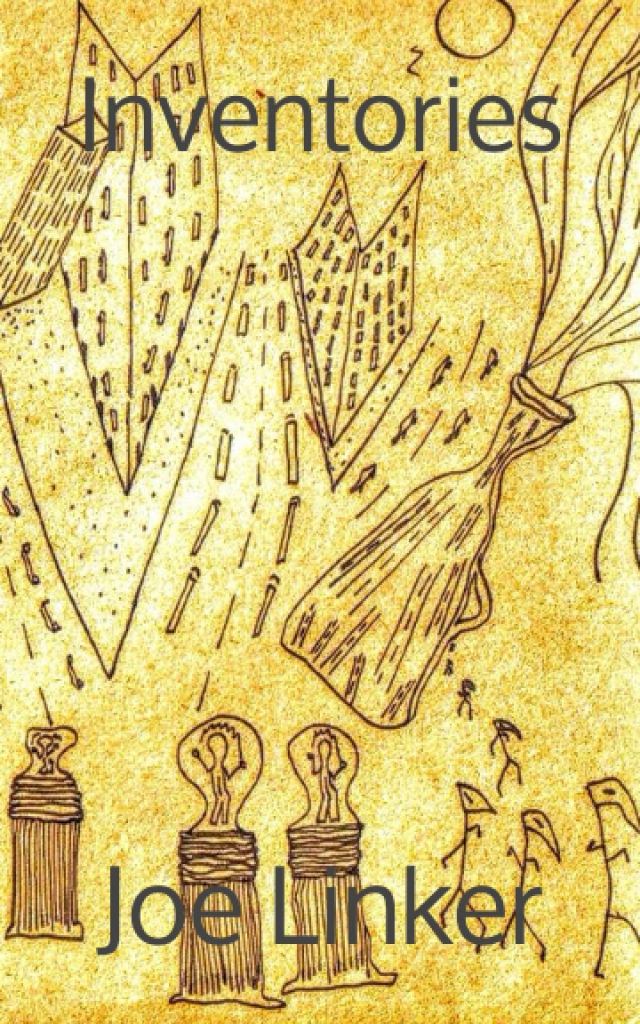
 The Coming of the Toads